Feeds:
Posts
Comments

Archive for the ‘Trades’ Category

As a big-league shortstop, Khalil Greene had special physical skills, but a mental health condition rendered him unable to continue his playing career.
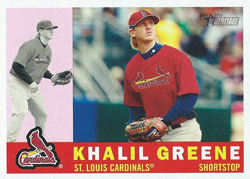
On Dec. 4, 2008, the Cardinals acquired Greene from the Padres for pitchers Mark Worrell and Luke Gregerson unaware Greene suffered from social anxiety disorder.

The Cardinals were seeking a replacement at shortstop for Cesar Izturis, who became a free agent, and Greene appealed because he hit for power and, according to the St. Louis Post-Dispatch, was “an above-average defender.”

Greene also was shy, or introverted, but those personality traits, the Cardinals found out, carried deeper meaning.

Early success

Khalil Thabit Greene was born in Butler, Pa., and went to high school in Key West, Fla. His father was a jeweler and his mother was a teacher.

Greene was brought up in the Baha’i Faith, whose followers “believe the crucial need facing humanity is to find a unifying vision of the future of society and of the nature and purpose of life,” the organization’s website explains.

According to the Post-Dispatch, Khalil translates to “friend of God” and Thabit means “steadfast.”

Greene enrolled at Clemson University and earned a degree in sociology. He also excelled at baseball, completing a four-year career as Clemson’s all-time leader in hits, doubles, RBI, extra-base hits and total bases.

The Padres chose Greene in the first round of the 2002 amateur draft and he made his big-league debut with them on Sept. 3, 2003.

From 2004 through 2007, Greene averaged 18 home runs and 72 RBI per year and had his best season in 2007 when he produced 27 home runs and 97 RBI.

Greene was limited to 105 games in 2008 because of a season-ending injury on July 30 when he fractured his left hand after punching a storage chest in frustration. “I would say that was very out of character,” Greene told Derrick Goold of the Post-Dispatch.

Though Greene batted .213 in 2008, Cardinals general manager John Mozeliak was unhesitant in dealing for him. “It’s our strong belief that last year (2008) was an aberration,” Mozeliak said.

Seventy percent of respondents to a stltoday.com poll gave the trade a thumbs up.

Under pressure

At spring training with the Cardinals in 2009, Greene, 29, impressed, hitting .408 with 17 RBI in exhibition games.

Regarding his quiet demeanor, Greene told the Post-Dispatch, “I internalize more and that leads people to assume different things about me.”

The Cardinals’ high expectations for Greene were evident in the season opener on April 6, 2009, when manager Tony La Russa batted him in the cleanup spot between Albert Pujols and Ryan Ludwick. Boxscore

Greene struggled, batting .219 in April and .171 in May. Teammates noticed Greene punishing himself during the season’s first road trip, the Post-Dispatch reported.

On May 29, 2009, the Cardinals placed Greene on the disabled list because of social anxiety disorder.

“We’re trying to take some things off him for a while,” La Russa said.

Greene’s condition “is brought on by fatigue caused by incessant stress,” Joe Strauss of the Post-Dispatch reported. “Any failure, such as a strikeout or an error, reinforces a sense of frustration that finds release only through verbal or physical outbursts, followed by embarrassment and regret.”

Said Greene: “It’s about trying to find balance, about not being too hard on myself and being able to let it go sometimes.”

Tough tests

The Cardinals reinstated Greene on June 18, 2009, and he hit home runs against the Royals in each of his first three games back. After that, he went into a slump, the anxiety resurfaced and the Cardinals returned him to the disabled list on June 29, 2009.

“When he had success in Kansas City, that wasn’t really the test,” La Russa said to the Associated Press. “The test is when you struggle and how you handle it.”

Greene went home to South Carolina to spend time with his wife and parents and receive treatment.

Brendan Ryan had taken over as Cardinals shortstop and was playing well, so when Greene returned to the club for the last two months of the season he primarily was used as a pinch-hitter and reserve infielder.

“I need to get a sense of gratification when things are going well while being able to see any shortcomings in a way that’s not such a debilitating thing,” Greene said.

On Aug. 28, 2009, Greene hit the first pinch-hit home run of his big-league career, tying the score at 2-2 in the eighth inning against the Nationals. The Busch Stadium crowd gave him a standing ovation and his teammates pushed him toward the top step of the dugout to make a curtain call and tip his cap, telling him, “Get out there. You earned it.” Boxscore

Greene finished the 2009 season with a .200 batting average, six home runs and 24 RBI in 77 games. He did hit .353 (12-for-34) with runners in scoring position.

In November 2009, Greene entered free agency and two months later signed a $750,000, one-year deal with the Rangers, who projected him for a utility role.

“This is a situation that will be good for me in a lot of ways,” Greene said. “It’s an exciting team to play for and it looks like a neat place to play.”

On Feb. 25, 2010, the Rangers voided the contract, saying a private matter would keep Greene from reporting to spring training. At age 30, he was finished as a professional ballplayer.
Read Full Post »

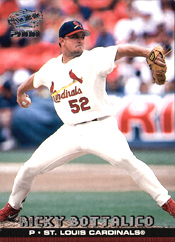
Ricky Bottalico was acquired by the Cardinals to be a setup reliever, became the closer instead and didn’t perform well enough to keep the job.

On Nov. 19, 1998, the Cardinals got Bottalico and pitcher Garrett Stephenson from the Phillies for outfielder Ron Gant and pitchers Jeff Brantley and Cliff Politte. The Cardinals also agreed to pay $6 million toward Gant’s salary over the next two years and Brantley’s salary in 1999.

With an 0-5 record, eight blown save chances and a 4.44 ERA, Brantley was a bust as Cardinals closer in 1998 and he relinquished the role to Juan Acevedo over the last two months of the season. Acevedo responded with 15 saves and the Cardinals were convinced he’d be their closer in 1999. “Our people have (Acevedo) ranked among the top five in the National League,” Cardinals general manager Walt Jocketty told the St. Louis Post-Dispatch.

What the Cardinals wanted were established setup relievers to protect leads before turning to Acevedo in the ninth. They thought they’d acquired an ideal tandem in Bottalico, a right-hander, and Scott Radinsky, a left-hander they signed as a free agent after he posted a 2.63 ERA and 13 saves for the 1998 Dodgers.

Quick study

Bottalico was a catcher in college at Florida Southern and Central Connecticut, but wasn’t selected in the major-league draft. The Phillies signed him as an amateur free agent in July 1991 and projected him to be a pitcher.

“I knew I threw the ball hard, but I really didn’t have even a windup at that point,” Bottalico said. “I was throwing more like a catcher, straight from the ear.”

Bottalico was sent to the low levels of the Phillies farm system and was used as a starter. “I learned more about pitching in the first week of minor-league baseball than in the whole rest of my life,” Bottalico said.

After making 11 starts in 1992, he was converted into a closer and began a quick ascension through the farm system. “The Phillies saw my intensity level,” Bottalico said. “Once they saw that, I was labeled for a closer’s role.”

Bottalico debuted in the big leagues with the Phillies in 1994 and he had 34 saves for them in each of two seasons, 1996 and 1997.

In April 1998, Bottalico had surgery to remove bone spurs in his right elbow. He sat out two months, returned in July and “struggled to regain his control and velocity,” the Philadelphia Inquirer reported.

Left-handed batters hit .375 against Bottalico in 1998. He had an 11.68 ERA in August and a 5.59 ERA in September.

Something is amiss

The Cardinals approached the Phillies in November 1998 and suggested trading Gant for Bottalico, Phillies manager Terry Francona said. “We were dying for a 30-homer guy like Gant,” said Phillies general manager Ed Wade.

To sweeten the deal, the Cardinals said they’d include Brantley and Politte and pay portions of the remainder of Gant’s and Brantley’s contracts, Francona said.

The Phillies included Stephenson in the package because he’d filed a grievance against them, claiming he was sent to the minors while injured, and “wore out his welcome here,” Wade said.

Though Bottalico was 1-5 with a 6.44 ERA for the 1998 Phillies, Jocketty called him “a guy we’ve liked for a long time” and said Cardinals doctors were convinced the pitcher’s arm was sound. “My arm hasn’t felt this good in years,” Bottalico said.

Early in the 1999 season, Bottalico pitched well for the Cardinals and Acevedo didn’t. Bottalico had a 1.46 ERA in 11 appearances in April. By mid-May, Acevedo had a 6.75 ERA, so the Cardinals made Bottalico the closer.

Though Bottalico had stretches of success, he faltered in the final two months of the season. His ERA in August was 9.72 and in September it was 7.84.

Meanwhile, Radinsky injured his elbow and didn’t pitch for the Cardinals in August and September.

The relievers who began the season as the Cardinals’ top three all produced poor results:

_ Acevedo, 4-5, 5.06 ERA, four saves as a reliever.

_ Bottalico, 3-7, 4.91 ERA, 20 saves and eight blown save chances.

_ Radinsky, 2-1, 4.88 ERA, three saves.

Bottalico had “too many walks, too many late-inning home runs, too little confidence” during the second half of the season, the Post-Dispatch surmised.

The pitcher who turned out to provide a boost was the throw-in from the Phillies deal. Stephenson, sent to the minors early in spring training, was called up to the Cardinals in June 1999 and won his first five decisions. He finished 6-3 with a 4.22 ERA. In 2000, he was a 16-game winner for the Cardinals.

One and done

The Cardinals were 75-86 in 1999 and they vowed to make moves to improve.

On Nov. 16, 1999, the Cardinals acquired reliever Dave Veres from the Rockies and projected him to be their closer in 2000.

Soon after, the Cardinals offered to deal Bottalico and outfielder Eric Davis to the Dodgers for starting pitcher Ismael Valdez and second baseman Eric Young, the Post-Dispatch reported. When the Dodgers balked at taking Davis, talks continued about a swap of Bottalico for Young.

On Dec. 12, 1999, the Dodgers got what they considered a better offer and dealt Valdez and Young to the Cubs for pitchers Terry Adams, Chad Ricketts and Brian Stephenson. A week later, the Cardinals got second baseman Fernando Vina for Acevedo, catcher Eliezer Alfonzo and pitcher Matt Parker.

Unable to trade Bottalico and unwilling to pay him the $2.2 million salary he got in 1999, the Cardinals decided they wouldn’t offer him a contract for 2000, making him a free agent. “I had a feeling this is what they might do,” Bottalico said.

In January 2000, Bottalico signed a one-year contract with the Royals, bringing his short, unfulfilling stint with the Cardinals to an official end.

Read Full Post »

Benny Valenzuela, a pioneering Mexican-born ballplayer, emerged from a humble start in professional baseball and reached the majors, but the Cardinals were the wrong club for a rookie third baseman.

Valenzuela played briefly for the Cardinals in two stints with them in 1958. The Cardinals, though, were set at third base with a premier player, Ken Boyer, and that meant Valenzuela had little opportunity to play.

The Cardinals traded Valenzuela after the 1958 season and he never got back to the big leagues. He did, however, continue his playing career in the minors and he went on to have success as a manager for many years in the Mexican League.

Big break

Benjamin Beltran Valenzuela was born in Los Mochis, a city founded by Americans near the Gulf of California in northwestern Mexico. His nickname was Papelero because as a boy he sold newspapers to help his widowed mother.

Benny Valenzuela, no relation to fellow Mexican and former Cardinals pitcher Fernando Valenzuela, became a bat boy for a Los Mochis team managed by former Washington Senators pitcher Syd Cohen. In 1949, when Valenzuela was 16, Cohen became exasperated by a Los Mochis outfielder who couldn’t track fly balls in the sun. Cohen lifted the outfielder during a game and replaced him with the bat boy, Valenzuela, who’d showed an ability to play.

Three years later, in 1952, Cohen was manager of the Bisbee-Douglas Copper Kings of the Arizona-Texas League and he gave his former bat boy a spot on the team. Bisbee-Douglas was in the low levels of the minors, a remote Class C league with no affiliation to any franchise in the majors, but it was professional baseball in the United States and Valenzuela was grateful to Cohen to get the opportunity.

Valenzuela spent three seasons with Bisbee-Douglas, learning the craft, and produced batting averages of .352 in 1952, .347 in 1953 and .388 in 1954.

The Cardinals took notice and on Nov. 30, 1954, they selected Valenzuela, 21, in the minor-league draft.

Rising above

Valenzuela continued his strong hitting in the Cardinals’ system. He batted .354 for Fresno in 1955, .305 with 107 RBI for Omaha and Houston in 1956 and .286 with 24 home runs and 90 RBI for Houston in 1957.

At spring training with the Cardinals in 1958, Valenzuela impressed general manager Bing Devine and moved “to the front row among candidates for pinch-hitting jobs,” the St. Louis Post-Dispatch reported.

Valenzuela also had a strong arm and the Post-Dispatch reported he “gets a ball away more quickly than any infielder we can remember. He frequently gets the ball to the first baseman before the batter has reached the halfway mark to first base.”

Valenzuela was listed as being 5 feet 10, 175 pounds, but often was described in unflattering terms. The Sporting News called him “thick-legged” and “stubby.” The Post-Dispatch resorted to “chunky.”

“He resembles Yogi Berra,” The Sporting News decided.

Stereotyping was common. The Sporting News, for instance, labeled him “the peppery Mexican” and cited his “chili con carne English.”

Trailblazer

Valenzuela, 24, made the Opening Day roster of the 1958 Cardinals and became the 10th Mexican-born player to reach the major leagues, according to Frontera.info. He was the second Mexican-born player to join the Cardinals. The first was pitcher Memo Luna, whose big-league career with the Cardinals consisted of two-thirds of an inning in 1954.

Mel Almada, an outfielder with the 1933 Red Sox, was the first Mexican-born player in the big leagues.

Valenzuela made his Cardinals debut on April 27, 1958, when he batted for pitcher Larry Jackson and singled to right against Johnny Podres of the Dodgers. Boxscore

“He’s hitting 1.000, a heck of an average in any man’s language,” the Post-Dispatch declared.

On May 6, 1958, Valenzuela doubled against Bob Buhl of the Braves, but the Cardinals demoted him to Omaha on May 14 after he appeared in five games.

Moving on

On June 29, 1958, another Mexican-born player, shortstop Ruben Amaro, who’d been Valenzuela’s teammate for two seasons at Houston, made his major-league debut with the Cardinals.

Meanwhile, Valenzuela hit. 284 with 72 RBI for Omaha and was named the third baseman on the Parade Magazine Class AAA all-star team.

On Sept. 2, 1958, the Cardinals recalled Valenzuela to the big leagues and he appeared in five more games, producing a single against Bob Rush of the Braves on Sept. 18.

For the season, Valenzuela hit .214 (3-for-14) in 10 games for the Cardinals. Boyer, 27 and entrenched at third base, hit .307 and led the Cardinals in runs (101), hits (175), home runs (23) and RBI (90).

On Oct. 7, 1958, the Cardinals traded Valenzuela, pitcher Billy Muffett and catcher Hobie Landrith to the Giants for pitchers Ernie Broglio and Marv Grissom.

Valenzuela played three seasons (1959-61) in the Giants’ farm system before continuing his career as a player and manager in the Mexican League. Among the former major leaguers he managed in Mexico were ex-Cardinals pitchers Diego Segui and Pedro Borbon.

Valenzuela, Vinny Castilla and Aurelio Rodriguez are among the most prominent Mexican-born third basemen to reach the major leagues.

In 1986, Valenzuela and Amaro were inducted together into the Mexican Baseball Hall of Fame in Monterrey.

Read Full Post »

A deal designed to make the Cardinals a surefire bet to win a third consecutive pennant backfired on them and instead helped the Reds develop into the most dominant team in the National League.

On Oct. 11, 1968, the Cardinals acquired outfielder Vada Pinson from the Reds for outfielder Bobby Tolan and relief pitcher Wayne Granger.
The trade was made the day after the Tigers beat the Cardinals in Game 7 of the 1968 World Series and it seemed to signal the two-time defending National League champions would be back in 1969 for a chance to reclaim the World Series crown they’d won in 1967.

Pinson, 30, was acquired to replace right fielder Roger Maris, who retired. Like Maris, Pinson batted left-handed and earned a reputation as a special talent.

The Cardinals were able to obtain him without giving up a frontline player. Tolan, 23, was a reserve and Granger, 24, was deemed expendable in a bullpen featuring Joe Hoerner and Ron Willis.

However, Reds general manager Bob Howsam was able to see what Cardinals general manager Bing Devine could not: Pinson’s skills were fading while Tolan and Granger were on the verge of becoming prominent players.

Prolific hitter

Pinson grew up in Oakland and went to McClymonds High School, which also produced athletes such as Frank Robinson and Curt Flood in baseball and Bill Russell in basketball.

Like Robinson and Flood, Pinson signed with the Reds. Robinson and Flood made their major-league debuts with Cincinnati in 1956 and Pinson was projected to be with the Reds in 1958.

The Reds could have had an outfield of Robinson, Flood and Pinson, but on Dec. 5, 1957, they traded Flood in the first deal Devine made for St. Louis. In the book “October 1964,” author David Halberstam said Flood “always suspected they were not enamored of having an outfield of three black players” in Cincinnati.

Pinson became one of the game’s best players. He led the National League in hits in 1961 (208) and 1963 (204). Pinson also led the league in doubles in 1959 (47) and 1960 (37) and in triples in 1963 (14) and 1967 (13).

In 1968, Pinson, hampered by a groin injury, hit .271 with 29 doubles and 17 stolen bases, but was limited to five home runs and 48 RBI.

Judging talent

When Devine was fired by Cardinals owner Gussie Busch in August 1964, Howsam replaced him. After the 1966 season, Howsam left the Cardinals for a more lucrative deal with the Reds. Stan Musial replaced Howsam, resigned after the Cardinals won the 1967 World Series championship and was succeeded by Devine.

Several Cardinals staffers, including farm director Chief Bender and minor-league managers Sparky Anderson, Charlie Metro and Vern Rapp, eventually followed Howsam to the Reds’ organization and recommended Tolan and Granger.

As a backup outfielder and first baseman, Tolan hit .253 for the Cardinals in 1967 and .230 in 1968. Granger, a rookie, was 4-2 with four saves and a 2.25 ERA for the 1968 Cardinals.

The Cardinals “were disappointed” in Tolan’s hitting, the St. Louis Post-Dispatch reported, and “felt too many pitchers were able to handle him.”

“The front office and the field command had developed serious doubts Tolan would progress sufficiently as a hitter,” Post-Dispatch columnist Bob Broeg reported.

Howsam, however, thought differently, telling the Cincinnati Enquirer, “He’s got the ability and he has the desire.”

As for Granger, he “didn’t impress manager Red Schoendienst sufficiently,” Broeg wrote, even though minor-league manager Warren Spahn advocated for him.

Outstanding outfield

On Oct. 7, 1968, the day the Cardinals and Tigers played Game 5 of the World Series, Devine and Howsam agreed to the trade, the Dayton Journal-Herald reported. Though the clubs waited until after the World Series to announce the deal on Oct. 11, word leaked and it was widely reported on Oct. 10.

“Unless Pinson has aged overnight or has a hidden physical handicap, he’s likely to help the Cardinals with more speed on the bases and with a supply of doubles and triples,” Broeg surmised.

In a column for the Post-Dispatch, Cardinals pitcher Bob Gibson told readers, “With Vada, Lou Brock and Curt Flood, I think we have the best outfield in baseball. Certainly it is the fastest.”

“Can you imagine the three of us out there?” Pinson said to the Associated Press. “We’ll have some fun. I’ve known since early this season I would be traded … but I thought I’d go to San Francisco. There was talk of Ray Sadecki or Gaylord Perry for me. I never dreamed it would be St. Louis. I’m really thrilled.”

In an interview with the Dayton Daily News, Pinson said, “I don’t believe I could have made a better deal for myself. I’m going to the top. Now I’ve got to make sure we stay at the top.

“I see no problem in bouncing back with the Cardinals. I’m only 30 and I figure I’ve got at least four or five more good years. The Cards must think so, too. I talked to Red Schoendienst and Bing Devine. They said the Cards had been scouting me for a good while.”

According to Bill Ford of the Cincinnati Enquirer, “Contemporaries congratulated Howsam” for acquiring Tolan. “They say Tolan, if handled properly, can be better than Brock.”

Said Tolan: “All I want is a chance to play every day because that’s the only way you can make any money. I can’t count on a World Series check every year.”

Reds strike gold

Pinson started splendidly for St. Louis in 1969, batting .293 in his first 21 games, before he was sidelined the first two weeks of May because of a hairline fracture in his right leg after being hit by a pitch from the Pirates’ Bob Moose.

After he returned to the lineup on May 14, Pinson struggled and batted .136 for the month. He rebounded in June (.286) and July (.302, 20 RBI), but slumped in August (.174) and September (.241).

The Cardinals finished in fourth place in the East Division and Pinson received part of the blame. Though his 70 RBI ranked second on the team, Pinson batted .255, with a poor on-base percentage of .303, and had four stolen bases.

On Nov. 21, 1969, the Cardinals sent Pinson to Cleveland for Jose Cardenal.

Tolan and Granger had breakout seasons for the 1969 Reds. Tolan batted .305 with 194 hits, 21 home runs, 93 RBI and 26 stolen bases. Granger pitched in 90 games and had nine wins, 27 saves and a 2.80 ERA.

In 1970, the Reds won the pennant and Tolan and Granger were key contributors. Tolan hit .316 with 34 doubles, 80 RBI and 57 steals. Granger had 35 saves and a 2.66 ERA.

Two years later, when the Reds won the pennant again, Tolan batted .283 with 82 RBI and 42 stolen bases.

Read Full Post »

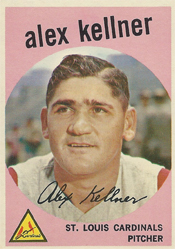
Cardinals pitcher Alex Kellner understood the importance of control and precision in his work both on and off the field.

During the baseball season, Kellner relied on pinpoint command of his curveball to keep batters off balance. After the season, he relied on complete command of a different set of skills to capture a mountain lion.
Kellner, who pitched in the major leagues for 12 seasons, including 1959 with the Cardinals, was an avid outdoorsman who hunted for jaguars and bears, went spearfishing in the ocean and, according to several accounts, pursued mountain lions to capture for sale to zoos and circuses.

Meet me in St. Louis

Kellner was born in Tucson, Ariz., in 1924. His father was a cattle rancher and newspaper stenographer, according to a biography by the Society for American Baseball Research.

In 1941, when he was 16, Kellner signed with the Reds and pitched in their minor-league system. Two years later, he enlisted in the Navy and served in the South Pacific during World War II. After his discharge, the Reds released Kellner and he signed with the Athletics.

Kellner, a left-hander, made his major-league debut with the Athletics in 1948 and earned 20 wins for them in 1949. He remained with the Athletics until he was claimed off waivers by the Reds on June 23, 1958. Kellner was 7-3 with a 2.30 ERA for the 1958 Reds, including 2-1 with an 0.65 ERA in three appearances against the Cardinals.

On Oct. 3, 1958, the Reds traded Kellner, first baseman George Crowe and shortstop Alex Grammas to the Cardinals for outfielder Del Ennis, shortstop Eddie Kasko and pitcher Bob Mabe.

Wild kingdom

While with the Reds, reports surfaced of Kellner’s wildlife adventures.

Kellner “rassles Arizona mountain lions in the off-season for pleasure and profit,” the Associated Press reported on July 16, 1958.

In its Oct. 8, 1958, edition, readers of The Sporting News learned Kellner had a “hazardous winter pursuit _ roping mountain lions in his native Arizona.” Kellner “sells the big cats to zoos and circuses,” The Sporting News reported.

Kellner, 34, made his regular-season debut with the Cardinals on April 25, 1959, earning a win with five scoreless innings of relief against the Dodgers at St. Louis. Boxscore

In his next appearance, April 30, 1959, Kellner got a start versus the Braves at Milwaukee and was matched against Warren Spahn. Hank Aaron hit a home run in the fourth, giving the Braves a 1-0 victory. Boxscore

“Kellner knows how to handle enemy batters as easily as he does jaguars and mountain lions,” the St. Louis Post-Dispatch reported.

Man vs. beast

Kellner used dogs to pursue mountain lions. When out of options during such a chase, a mountain lion’s natural inclination is to climb a tree because dogs cannot do the same. With the mountain lion in the tree and the dogs gathered below, Kellner would lasso a rope and attempt to capture the animal.

Kellner, assisted by two other men, including his brother Walt, “once took a mountain lion alive in the mountains of southern Arizona,” Post-Dispatch outdoors columnist James Kearns reported. “Dogs were used to tree the animal.”

In the book “Baseball Players of the 1950s,” Walt, who pitched briefly for the Athletics, said, “I was right there with Alex in the off-seasons hunting down mountain lions and bears for zoos and circuses.”

Kellner also “killed a 275-pound black bear in the western part of the state and wild pigs outside Tucson,” the Post-Dispatch reported. “A year ago, he made a 1,000-mile trip into Mexico and brought down a 141-pound jaguar in Nayarit. He got motion pictures of the animal as it took refuge in a tree, snarling and spitting at the pursuing dogs.”

“I tackle anything,” Kellner said.

King of the sea

Kellner, 6 feet, 215 pounds, indicated his most worrisome experience occurred while spearfishing in the Gulf of California near the Mexican town of Puerto Libertad.

“I was skin diving for fish about 200 yards from shore when this sea lion stuck his head out of the water a few feet away,” Kellner told the Post-Dispatch. “He was as big as I am. I looked him over and he looked me over. He circled me four times, making a survey from all angles. I never took my eyes off him.

“He disappeared beneath the water, but returned about five minutes later. I suppose he was just being playful, but I was glad when he left for good.”

Kellner pitched effectively for the Cardinals as a starter and reliever until June 23, 1959, when he started again against the Braves at Milwaukee. After retiring the first two batters, Andy Pafko and Eddie Mathews, in the first inning, Kellner was pitching to Aaron when he felt a searing pain in his left elbow.

Kellner, who suffered a muscle tear in the elbow, was removed from the game and never pitched again. Boxscore

His record for the 1959 Cardinals was 2-1 with a 3.16 ERA in 12 appearances, including four starts.

Kellner had a career mark of 101-112 with a 4.41 ERA for the Athletics (1948-58), Reds (1958) and Cardinals (1959).

Read Full Post »

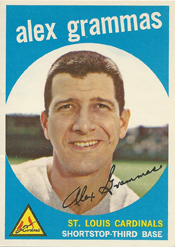
Seeking stability at shortstop, the Cardinals went back to the past in a bid to enhance their future.

On Oct. 3, 1958, the Cardinals reacquired shortstop Alex Grammas, first baseman George Crowe and pitcher Alex Kellner from the Reds for shortstop Eddie Kasko, outfielder Del Ennis and pitcher Bob Mabe.

The key to the deal for the Cardinals was Grammas, who had been their starting shortstop in 1954 and 1955 after being acquired from the Reds.

After using eight players at shortstop in 1958, the Cardinals were eager to have someone they knew who could do the job consistently, if not spectacularly.

Moving around

Grammas played baseball for Mississippi State and earned a degree in business. After graduating in 1949, he signed with the White Sox and played in their minor-league system until he was traded to the Reds in June 1951.

The Reds kept Grammas in the minor leagues and in 1953 they loaned him to the Kansas City Blues, a Yankees farm club. Grammas produced his best season for the Blues, batting .307 with 179 hits in 140 games as the everyday shortstop.

The Reds, who had smooth-fielding Roy McMillan as their shortstop, traded Grammas to the Cardinals on Dec. 2, 1953, for pitcher Jack Crimian and $100,000.

Grammas replaced Solly Hemus as the Cardinals’ starting shortstop in 1954. Grammas batted .264 and ranked second among National League shortstops in fielding percentage at .966. In 1955, Grammas continued his good glove work (.968 fielding percentage), but his batting average dipped to .240.

Frank Lane, who as White Sox general manager had traded Grammas to the Reds in 1951, became Cardinals general manager after the 1955 season and wanted more run production from a shortstop than Grammas was able to give.

Grammas opened the 1956 season as the starter, but on May 16 he was traded with outfielder Joe Frazier to the Reds for utility player Chuck Harmon. A month later, Lane dealt second baseman Red Schoendienst to the Giants for Alvin Dark, who became the Cardinals’ everyday shortstop.

Anatomy of a deal

Dark provided the hitting Lane sought, but all did not end well. Lane clashed with Cardinals owner Gussie Busch, departed after the 1957 season and was replaced by Bing Devine. Dark lacked fielding range as a shortstop, got traded by Devine to the Cubs in May 1958 and was replaced by Kasko, who’d been the Cardinals’ starting third baseman as a rookie in 1957.

Kasko made 64 starts at shortstop, didn’t hit well and was benched. Besides Dark and Kasko, others who played shortstop for the 1958 Cardinals were Ruben Amaro, Ken Boyer, Gene Freese, Johnny O’Brien, Dick Schofield and Lee Tate.

As the 1958 season neared its end, Devine, under orders from Busch, reluctantly fired manager Fred Hutchinson and replaced him with Busch’s personal choice, Hemus. While attending the 1958 World Series between the Braves and Yankees, Devine and Hemus went searching for a shortstop.

During Game 1 at Milwaukee, Devine and Hemus sat in the stands near their Reds counterparts, general manager Gabe Paul and manager Mayo Smith. According to Si Burick of the Dayton Daily News, Devine said to Paul, “I’ll take Alex Grammas.” Paul demanded Ennis in return.

“Cincinnati did not want to give up Grammas, one of the top utility infielders of the game, though a weak hitter,” Burick reported.

At Game 2, the trade interest between Devine and Paul got serious and, in an attempt at being discreet, they passed notes to one another from their box seats. One of Devine’s notes to Paul read, “It’s Grammas or nobody.”

Devine and Paul agreed to meet again when the World Series shifted to New York and they made the deal around noon on Oct. 3.

Encore performance

“Whether Grammas will be an improvement over Kasko is a question,” Bob Broeg wrote in the St. Louis Post-Dispatch. “Neither can hit for average or distance. Grammas is considered by the Cardinals’ management to be steadier afield.”

The Cincinnati Enquirer declared, “Grammas, as everybody knows, is an excellent glove man, but an all-American out at the plate.”

Grammas was glad to be rejoining the Cardinals and told the Associated Press, “I like Solly Hemus. He helped me a lot with the Cards before, as much as a fellow ever did in baseball. If I was going to be traded, I couldn’t think of a place to go that I’d like better than St. Louis.”

Of the other two players acquired by the Cardinals from the Reds, Crowe was projected to be a pinch-hitter and backup first baseman and Kellner was expected to help as a left-handed reliever.

After the 1958 World Series was completed, the Cardinals went on a goodwill tour of Japan. Grammas was part of the entourage; Crowe and Kellner weren’t. The exhibition games against Japanese teams gave the Cardinals a chance to evaluate Grammas and he impressed.

Grammas, 33, opened the 1959 season as the Cardinals’ starting shortstop and he kept the job throughout the year, making 123 starts, batting .269 overall and ranking third in fielding percentage (.964) among National Leaguers at the position.

Crowe, 38, hit .301 in 103 at-bats for the 1959 Cardinals. He also played for them in 1960 and 1961, became a mentor to players such as Curt Flood, Bob Gibson and Tim McCarver, and stayed with the Cardinals as an instructor and scout after his playing days. Kellner, 34, was 2-1 with a 3.16 ERA in 12 appearances for the 1959 Cardinals before an elbow ailment ended his major-league pitching career.

After the 1959 season, the Cardinals obtained power-hitting shortstop Daryl Spencer from the Giants. Grammas opened the 1960 season as the Cardinals’ starting second baseman and held that job until the end of May, when he was replaced by rookie Julian Javier.

Grammas was a Cardinals utility player for the remainder of 1960, all of 1961 and part of 1962 before he was traded with outfielder Don Landrum to the Cubs for infielder Daryl Roberston and outfielder Bobby Gene Smith on June 5, 1962.

Read Full Post »

« Newer Posts - Older Posts »