Feeds:
Posts
Comments

Archive for the ‘Trades’ Category

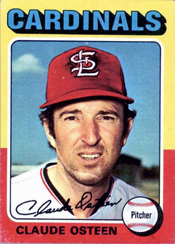
During the 18 seasons he performed in the majors, left-hander Claude Osteen pitched 40 regular-season shutouts, the same total as Sandy Koufax and more than Lefty Grove (35) and Lefty Gomez (28).

That doesn’t count the unofficial shutout Osteen crafted for the Cardinals.

On Aug. 15, 1974, the Cardinals acquired Osteen from the Astros for minor-league pitcher Ron Selak and a player to be named (another pitching prospect, Dan Larson).

Rusty from inactivity and unable to find a groove, Osteen didn’t produce a win for the contending Cardinals, but he did deliver a special performance in a remarkable game. 

Entering in the 14th inning, Osteen held the Mets scoreless until the 23rd _ 9.1 innings, or basically the equivalent of a complete game. Though he departed with the score still tied, the Cardinals eventually won in the 25th.

Prep phenom

Osteen was born in Caney Springs, Tennessee, a hamlet 45 miles south of Nashville. As The Tennessean newspaper noted, “Almost everybody who lives in Caney Springs is kin to Osteen.”

Growing up there, he played baseball in cow pastures, learned to throw a curve and advanced to a 4-H Club team when he was 12. At 14, he moved with his family to Cincinnati, where his father took a job with General Electric.

Pitching for Reading High School, Osteen was 29-3 in three varsity seasons, including 16-0 as a senior in 1957 when his team became state champions.

Though his high school coach scouted for the Dodgers, who made an offer, Osteen accepted a contract with the Reds on July 2, 1957. “I signed with Cincinnati for several reasons,” Osteen told the Nashville Banner. “My folks wanted me to, for one. Besides, (the Reds) promised me I could stay with the club for a while instead of going right out to the minors.”

(Cardinals general manager Frank Lane said to the Cincinnati Enquirer, “We were interested in Osteen, but not to the extent of … putting him on our roster.”)

Major step up

Four days after signing, Osteen, 17, made his big-league debut against the Cardinals at Cincinnati. Si Burick of the Dayton Daily News described him as a skinny southpaw, “his cap cocked on the side of his head,” who “doesn’t look strong enough to throw the ball to the plate.”

According to Earl Lawson of The Cincinnati Post, Reds pitcher Art Fowler, 35, took one look at Osteen warming up and said, “My son can throw harder than he can.”

Cardinals backup catcher Walker Cooper, 42, told Osteen, “Little Leaguers are supposed to pitch from 40 feet out,” Lawson reported.

Entering in the seventh inning with two on, one out and St. Louis ahead, 10-3, Osteen faced five batters. He retired two, walked one, gave up two singles, threw a wild pitch and yielded a run. “A lot of fun,” he told the Enquirer. “I was a little nervous and I thought I might have been worse than I was, but it was a thrill.” Boxscore

(Catching the rookie from Caney Springs, Tennessee, that day was Ed Bailey from Strawberry Plains, Tennessee.)

The next day, Osteen faced the Cardinals again and pitched a scoreless ninth. Boxscore

Having fulfilled their pledge to let Osteen experience the big leagues, the Reds sent him to their Nashville farm club managed by Dick Sisler, the former Cardinal. Called back in September, Osteen made one scoreless relief appearance against the Cubs, striking out Ernie Banks with the bases loaded. Boxscore

Good moves

Osteen spent most of the next two seasons (1958-59) in the minors. Primarily a reliever with the 1960 Reds, he had a 5.03 ERA and was demoted the next year.

Osteen never got a win for the Reds. Other pitching prospects, Jim Maloney and Jim O’Toole, advanced ahead of him. In the book “We Played the Game,” O’Toole said, “I didn’t let anybody push me around like they did Claude Osteen. He’d throw what the catcher wanted instead of his best pitches and get hit hard.”

In September 1961, with the Reds on their way to winning the pennant, Osteen, 22, was traded to the Washington Senators, an American League expansion team. The Senators finished in last place in each of Osteen’s first three seasons with them (1961-63) but he got to start regularly and figured out how to survive.

“The big difference in my pitching now and when I was in the minors and with the Reds is I no longer try to strike out a lot of guys,” Osteen told the Nashville Banner in July 1962. “I realize I can’t strike out everybody up here. So I’m just trying to make them hit a bad pitch and let my fielders do some work.”

Osteen’s breakout season came in 1964 when he won 15 for the ninth-place Senators (62-100). Afterward, the Dodgers acquired him in a deal that sent slugger Frank Howard to Washington. The move vaulted Osteen from baseball’s basement into a starting rotation with Sandy Koufax and Don Drysdale.

Hollywood material

When he joined the Dodgers, Osteen’s teammates nicknamed him Gomer because they thought he resembled actor Jim Nabors, who played the character of Gomer Pyle on “The Andy Griffith Show” (1962-64) and then on “Gomer Pyle: USMC” (1964-69). “One day, Jim Nabors comes to the clubhouse and we start talking about all that downhome stuff _ he’s from Alabama _ and doggoned if we didn’t become good friends,” Osteen told the Los Angeles Times.

Osteen (15 wins, 2.79 ERA) joined Koufax (26 wins, 2.04) and Drysdale (23 wins, 2.77) in forming a formidable top of the rotation for the 1965 Dodgers, who dethroned the Cardinals as National League champions.

After the Twins beat Drysdale and Koufax in the first two games of the World Series, Osteen turned the tide with a shutout in Game 3. The Dodgers went on to win the title in seven games. “If Claude hadn’t beaten us in that third game, we’d be the world champions,” Twins first baseman Don Mincher told The Tennessean. Boxscore

The Dodgers repeated as National League champions in 1966 (Osteen won 17 and had a 2.85 ERA) but were swept by the Orioles in the World Series. In Game 3, Osteen allowed one run in seven innings but Wally Bunker pitched a shutout and the Orioles won, 1-0. Boxscore

Osteen was a 20-game winner for the Dodgers in 1969 and again in 1972. He had double-digit wins in each of his nine seasons with them. “He is as dependable as sunset,” Jim Murray wrote in the Los Angeles Times.

Dodgers manager Walter Alston told The Tennessean, “There’s not a more reliable guy around … He gets about as much out of his stuff as anybody in the majors.”

In 1973, Osteen was 16-6 for the first-place Dodgers with one month remaining in the season, but he lost his last five decisions and the club went 12-14 in September, finishing second to the Reds. Afterward, he was traded to the Astros for outfielder Jim Wynn.

Houston, we have a problem

Osteen was the Astros’ first $100,000 salary player and was expected to make them contenders. [The highest-paid player in 1974 was White Sox slugger Dick Allen at $233,000, according to the Miami Herald. Leading the 1974 Cardinals: Bob Gibson ($160,000), Joe Torre ($140,000), Lou Brock ($110,000).]

One of the foes Osteen did best against in 1974 was the Cardinals. He beat them with a complete game in May and did it again in July. Osteen entered the all-star break at 9-7 with a 3.15 ERA. Boxscore and Boxscore

Though his fastball wasn’t sinking, and his curve and slider were hanging, “I was winning mostly on know-how and moving the ball around,” Osteen told The Sporting News.

Following the break, Osteen started twice and got shelled. He didn’t appear in a game for the next 17 days. “It was a very frustrating thing for me to find myself sitting on a bench,” Osteen told The Tennessean.

On Aug. 15, in a game against the Cubs, Osteen was told to get ready to relieve J.R. Richard. While Osteen warmed up, manager Preston Gomez waved for him to come to the dugout. “That’s when he took me aside and told me the deal had been made” with the Cardinals, Osteen told the St. Louis Post-Dispatch.

Stranger things

The first-place Cardinals projected Osteen, 35, as a replacement for ailing starter Sonny Siebert. Cardinals general manager Bing Devine “told me he had not bought my contract merely to have me help them finish out the 1974 season,” Osteen said to The Tennessean. “He said he thought I had a couple of more good years. I agree with him.”

In his Cardinals debut, a start against the Braves, Osteen couldn’t protect a 5-0 lead and was lifted in the fourth. For the 14th time in his career, Hank Aaron hit a home run against Osteen, sparking the Braves’ comeback. Boxscore

Moved to the bullpen, Osteen was used mostly in mop-up roles. As a starter, he’d developed a rhythm, knowing he’d pitch every four days. This was different.

“I had no idea how to go about being a reliever,” Osteen said to United Press International. “I didn’t know how to warm up, how long to warm up, how to get used to sitting around, waiting so much. At first, I found I was wearing myself out getting up and down (and) throwing.”

One and done

In a game against the Mets, Cardinals manager Red Schoendienst turned to Osteen in the 14th inning. Pitching like he had in his prime with the Dodgers, Osteen held the Mets scoreless until being relieved by Siebert with two outs in the 23rd. The Cardinals won in the 25th when Bake McBride scored from first base on a wild pickoff throw.

Osteen’s line: 9.1 innings, no runs, four hits, two walks. Boxscore

That was Osteen’s highlight as a Cardinal. He made eight appearances for them and was 0-2 with a 4.37 ERA. Osteen called the 1974 season “a totally lost year” and “confusing,” the Post-Dispatch reported.

At Cardinals spring training in 1975, Osteen was “a prime candidate for the job as No. 5 starter,” according to the Post-Dispatch.

The Cardinals, though, had acquired another veteran left-hander, Ray Sadecki, 35.

Osteen posted a 3.91 ERA in 23 innings during spring training. Sadecki had a 9.00 ERA in 13.2 innings, but the Cardinals opted to keep him and release Osteen. Sadecki is “used to coming out of the bullpen,” Red Schoendienst explained to the Post-Dispatch.

Cardinals coach

Athletics owner Charlie Finley said a deal to sign Osteen “is virtually completed,” the Oakland Tribune reported, but the White Sox swept in and got him instead.

Osteen, 36, made 37 starts for the 1975 White Sox but lost 16 of 23 decisions in his final season. His career record: 196-195, 3.30 ERA.

Osteen bought a chicken farm near Hershey, Pa. During the 1976 baseball season, he was pitching coach for the Phillies’ farm club in Reading, Pa.

In October 1976, the Cardinals hired Vern Rapp to replace Red Schoendienst as manager. Osteen was surprised when Bing Devine called, asking him to meet with Rapp in New York during the 1976 World Series to discuss the Cardinals’ pitching coach job.

“I had never met Rapp,” Osteen said to The Tennessean. “I spent about three hours with Vern, talking about pitching. Before we finished, he picked up the telephone and called Bing and told him I was the man he wanted.”

Osteen spent four seasons (1977-80) as Cardinals pitching coach. He had the same job with the Phillies (1982-88), Rangers (1993-94), Dodgers (1999-2000). Three Phillies pitchers won Cy Young awards with Osteen as their coach _ Steve Carlton (1982), John Denny (1983) and Steve Bedrosian (1987).

Read Full Post »

Pitcher Nelson Chittum never spent a full season in the majors, but during his time there he mingled with the sport’s aristocracy. For example:

_ In his big-league debut with the Cardinals, he got a start against the Dodgers and was opposed by Sandy Koufax.

_ In parts of three seasons in the majors, Chittum was a teammate of Stan Musial and Ted Williams. Chittum and Musial were road roommates for a while with the Cardinals. Then, with the Red Sox, Williams delivered a hit that helped set up Chittum to earn his first win.

_ In his best game as a Cardinal, Chittum struck out a pair of future Hall of Famers, Roberto Clemente and Bill Mazeroski.

In 40 big-league appearances, Chittum was 3-1 with a 3.84 ERA. Most of his professional career was spent as a starter in the minors.

Pitching prospect

Chittum moved with his family from Harrisonburg, Va., to Elizabethtown, Pa., about 20 miles from the state capital of Harrisburg, as a youth.

A right-handed pitcher, he threw two perfect games in high school. After he graduated in 1951, Chittum was approached by the Cardinals but opted instead to attend Elizabethtown College, according to the Elizabethtown Chronicle.

After two seasons of college baseball for coach Ira R. Herr, Chittum, 20, was signed by Cardinals scout Fred “Dutch” Dorman in October 1953. A week later, he was inducted into the U.S. Army and served for two years.

At 23, Chittum made his professional debut with the Cardinals’ Fresno farm club in the California League in 1956. A lanky sinkerball specialist, Chittum posted a 23-7 record in the regular season and pitched 266 innings. He earned three more wins in the playoffs, giving him a total of 26 for the year.

Promoted to the Cardinals’ Houston farm club, managed by Harry Walker, in 1957, Chittum was 16-12, developing a slider taught to him by pitching instructor Johnny Grodzicki.

“Nels is a low ball pitcher,” Houston general manager Art Routzong said to United Press. “He’s real tough and he’s got marvelous control until he lets loose with a high one. He’s hard to hit, real hard, when he keeps that ball down.”

Houston catcher Ray Dabek told the wire service, “You ought to get behind the screen and watch his ball move. He’s really got something on it. He has a good fastball that sort of sinks, and a good slider. Real good.”

Big-league debut

After compiling a 12-8 record and 2.84 ERA for manager Johnny Keane’s Omaha farm team in 1958, Chittum, 25, was called up to the Cardinals in August that year and given a start against Koufax and the Dodgers at Los Angeles.

Koufax, 22, was not yet the dominant ace he would become later with the Dodgers. He entered the start with a season record of 9-5 and a 4.19 ERA.

The first two Cardinals batters of the game, Curt Flood and Gene Freese, hit home runs against Koufax. The Cardinals totaled four runs in the inning.

Staked to the 4-0 lead, Chittum held the Dodgers scoreless in the first two innings. Koufax was taken out in the second.

The Cardinals made it 5-0 when Chittum got his first big-league hit, a single against Babe Birrer that scored catcher Gene Green from second.

Chittum, however, was unable to hold down the Dodgers, in part, because of poor fielding by his teammates. With two outs in the third, the Dodgers scored on a Gil Hodges bloop single “which Freese lost in the sun and which should, instead, have been taken in short left by Del Ennis,” the St. Louis Post-Dispatch reported. A Chittum balk brought in the Dodgers’ second run of the inning, cutting the St. Louis lead to 5-2.

In the fourth, the Cardinals scored three times, extending the lead to 8-2, but the Dodgers knocked out Chittum before he could retire a batter in the bottom half of the inning. Ken Boyer let a Charlie Neal grounder go over his shoulder for a fluke single. Two more singles followed, loading the bases. Carl Furillo, batting for reliever Fred Kipp, then doubled, driving in all three runners and making the score 8-5. After Jim Gilliam bunted for a single, Jim Brosnan relieved Chittum.

Brosnan limited the Dodgers to one run in six innings and got the win. Boxscore

St. Louis shakeup

Chittum next made two relief appearances for the Cardinals. The best of those outings was when he pitched 4.1 scoreless innings against the Pirates, including strikeouts of Clemente and Mazeroski. Boxscore

Three nights later, in the series finale versus the Pirates, Chittum started. He gave up three runs (a Dick Stuart solo home run and a two-run shot by Bob Skinner) in three innings and was the losing pitcher. Boxscore

Chittum pitched in nine more games, all in relief, for the 1958 Cardinals. According to the Spokane Spokesman-Review, the quiet rookie roomed with Musial on a couple of road trips.

With 10 games remaining, Cardinals general manager Bing Devine, on orders from club owner Gussie Busch, fired manager Fred Hutchinson.

A month later, with new manager Solly Hemus, the Cardinals traveled to Japan for a goodwill tour. Chittum opted not to go because he had committed to playing winter baseball in the Dominican Republic. “Maybe I missed my chance to impress (Hemus) in Japan,” Chittum told the Minneapolis Star Tribune, “but I know I didn’t stand much chance in the St. Louis organization.”

Moving on

At 1959 spring training, Cardinals pitcher Sal Maglie (who would become an instructor that season) said Chittum needed to develop a better curve to stay in the majors, the Elizabethtown Chronicle reported. Then, on March 15, 1959, Chittum was traded to the Red Sox for pitcher Dean Stone.

The Red Sox assigned Chittum to their farm team at Minneapolis, managed by Gene Mauch, who told the Star Tribune. “Nels … was one of the best right-handers in our league last year (with Omaha). He beat the top clubs.” One of those wins was a shutout against Minneapolis and Stone.

Red Sox farm director Johnny Murphy, a former Yankees reliever, noticed a flaw in Chittum’s delivery and worked with him to correct it. “When I let the ball go, it was traveling up instead of down, and it was taking all my stuff off,” Chittum told the Elizabethtown Chronicle. “John changed my motion so that now when I release the ball it travels in a downward arc.”

Chittum was 11-5 for Minneapolis when the Red Sox called him up for the last two months of the 1959 season.

On Aug. 28, 1959, the Orioles led the Red Sox, 4-2, in the seventh when Ted Williams, batting for catcher Sammy White, doubled, scoring Frank Malzone from second and getting Boston within a run at 4-3. Chittum entered in the eighth, pitched three scoreless innings and got the win, his first in the majors, when the Red Sox rallied. Boxscore

In September, Chittum got two more wins, beating the Indians and Senators. He finished 3-0 with a 1.19 ERA for the 1959 Red Sox. Chittum allowed earned runs in just two of 21 appearances and no one hit a home run against him.

No vacancies

Sal Maglie replaced Boo Ferriss as Red Sox pitching coach in 1960.

On April 6, on their way from spring training in St. Petersburg, Fla., to San Francisco to open the 1960 season at the new Candlestick Park, the Cardinals stopped in Scottsdale, Ariz., for an exhibition game against the Red Sox. Chittum, in relief of Bill Monbouquette, pitched 1.2 innings against his former team and gave up one run. Ted Williams had two singles in three at-bats but was upstaged by Stan Musial, whose three-run home run versus Ted Bowsfield in the eighth carried the Cardinals to a 13-10 victory.

(Asked on a 1962 questionnaire to name his biggest thrill in baseball, Chittum answered, “It has to be being teammates with two of the all-time great players _ Stan Musial and Ted Williams,” the Spokane Spokesman-Review reported.)

Chittum began the 1960 season with the Red Sox but on May 6 was traded to the Dodgers for Rip Repulski, the former Cardinal, and assigned to the minors. (In his first at-bat for the Red Sox, Repulski hit a grand slam. Boxscore)

Chittum never returned to the majors. In 1961, he was “packed and almost out the door” on his way to the Angels, an American League expansion club, but at the last moment the Dodgers reconsidered, the Elizabethtown Chronicle reported.

After pitching his last season for Rochester in 1964, Chittum managed a men’s clothing store and then became a U.S. postal inspector.

In February 1965, baseball innovator Bill Veeck told a banquet audience in Lancaster, Pa., he wanted to see interleague play, the elimination of the intentional walk, and a designated hitter for the pitcher.

Asked his opinion of a designated hitter, Chittum told the Lancaster New Era, “That’s a bunch of baloney … That would take the fun out of it. It’d be like telling some guys on a basketball team they had to play defense and couldn’t shoot.”

Read Full Post »

John Lackey was a big guy (6-foot-6) with a big presence on the mound who often came up big in the biggest games.

On July 31, 2014, the Cardinals acquired Lackey from the Red Sox for outfielder Allen Craig and pitcher Joe Kelly. The Red Sox also sent the Cardinals a minor-league pitcher, Corey Littrell, and $1.75 million cash.

Just nine months earlier with the Red Sox, Lackey beat the Cardinals in the decisive Game 6 of the 2013 World Series, making him the first pitcher to start and win the clinching game of a World Series for two franchises. As an Angels rookie, he started and won Game 7 of the 2002 World Series against the Giants.

David Eckstein, shortstop for two World Series champions (2002 Angels, 2006 Cardinals), said to the St. Louis Post-Dispatch about Lackey, “The bigger the stage, the better the performance. The bigger the game, the better he is.”

Lackey’s success in big games was an obvious quality that appealed to the Cardinals. Another was his demeanor. On the mound, Lackey was intense, edgy. Or, as Cubs catcher David Ross described it to the Chicago Tribune, full of “competitive fire.” The Cardinals would benefit from that kind of approach.

Pitching provides path

Lackey, naturally, came from a big state _ Texas. He was born and raised in Abilene. In high school, Lackey played almost exclusively at first base and hit .541 as a senior.

He went to the University of Texas-Arlington as a first baseman, but also was given the chance to pitch his freshman season. Then he enrolled at Grayson College in Denison, Texas, where he planned to play one season before transferring to Texas Tech.

At Grayson, Lackey, a right-hander, developed his pitching skills. “I like it a lot,” he told the Abilene News-Reporter in May 1999. “It gives me a chance to be in control of the game. It’s been fun so far. I still like to hit, though.”

Grayson won the national junior college baseball championship in 1999 and Lackey canceled his plans of transferring to Texas Tech when the Angels selected him in the second round of the 1999 amateur draft.

Three years later, in June 2002, he made his Angels debut, replacing Scott Schoeneweis in the starting rotation.

Rookie won’t rattle

Lackey, 23, made 18 regular-season starts for the 2002 Angels and was 9-4. He lost just once in his final seven starts of the season and won the game that clinched the Angels’ first playoff berth in 16 years.

“A lot of John’s success is due to his makeup, which started long before he pitched in the major leagues,” Angels manager Mike Scioscia told the San Gabriel Valley Tribune. “His passion for the game and his makeup and his willingness to work … You mix that with his talent, it’s an incredible combination.”

In the American League Championship Series against the Twins, Lackey started Game 4 and pitched seven scoreless innings for the win. Boxscore The Angels clinched the pennant the next day, reaching the World Series for the first time.

When Scioscia chose Lackey to start World Series Game 7 versus the Giants, Angels closer Troy Percival told the Los Angeles Times, “You couldn’t ask for a better man to be out there than Lackey. He’s not scared of anything.”

Lackey did the job, allowing one run in five innings and becoming the first rookie since the Pirates’ Babe Adams in 1909 to win a World Series Game 7. Boxscore

Noting how Lackey established the inside fastball early in the game, Angels pitching coach Bud Black told the New York Times, “You can’t discount experience, but a lot of times youthful aggressiveness pays off.”

Lackey said to the Los Angeles Times, “If you don’t want to go out there with a little pressure and pitching in big games, you shouldn’t be around.”

Lackey pitched eight seasons (2002-09) with the Angels, posting a 102-71 record, then became a free agent and took a five-year contract from the Red Sox for $82.5 million.

Getting it done

When the Red Sox missed qualifying for the playoffs in 2010 and 2011, “Lackey became one of the symbols of what had gone wrong,” the Boston Globe noted. “Fans booed him and Lackey’s angry exchanges with reporters caused team officials to wince.”

Lackey tore a ligament in his right elbow during the 2011 season, managed to make 28 starts but had a 6.41 ERA. He underwent surgery and sat out the 2012 season, when the Red Sox (69-93) finished in last place.

John Farrell, a former pitcher, replaced Bobby Valentine as Red Sox manager in 2013 and Lackey returned to the rotation. The 2013 Red Sox had the best record in the American League (97-65). In the playoffs, Lackey beat the Rays in Game 2 of the Division Series and won Game 3 of the League Championship Series against the Tigers. Then he beat the Cardinals in the decisive Game 6 of the World Series. Boxscore, Boxscore, Boxscore

“You can foresee him being successful for years to come because of the style of pitcher he is,” Farrell told the Globe. “He can put the ball on the ground. Because he throws the ball on a downhill angle, he doesn’t rely on velocity as much.”

When the Red Sox floundered in 2014 and sunk to last place in July, they shopped Lackey and fellow starter Jon Lester.

Finding a bargain

The 2014 Cardinals needed a boost. After losing, 12-1, to the Padres on July 30, the Cardinals (56-50) were in third place in a five-team division. That day, they acquired pitcher Justin Masterson (4-6, 5.51 ERA) from Cleveland for a prospect, outfielder James Ramsey.

Seeking another starter, the Cardinals had their eyes on Lackey, Lester and the Rays’ David Price, according to the Post-Dispatch.

Lackey, who would turn 36 in October, became their focus. In addition to his 11-7 record for the 2014 Red Sox, Lackey had an enticing contract structure. Though owed $5.08 million for the remainder of 2014, a clause in his contract gave his team the option to bring him back in 2015 for a salary of $500,000.

When the Cardinals agreed to include Joe Kelly (2-2, 4.37 ERA), along with Allen Craig (.237, 44 RBI), the trade was made.

Get to work

Craig and Kelly were “cherished teammates” among the Cardinals and the trade “left the clubhouse stunned,” the Post-Dispatch reported.

Cardinals general manager John Mozeliak was “a little stunned,” too, “by the immediate take of disappointment” among the players, he told the Post-Dispatch.

One of the players who applauded the deal was a newcomer, catcher A.J. Pierzynski, 37. Released by the Red Sox on July 16, he signed with St. Louis five days before Lackey was acquired.

“He brings a presence,” Pierzynski told the Post-Dispatch. “He brings competitiveness, He wants the ball. He’s won big games wherever he’s been.”

As the Post-Dispatch noted, Lackey “proved reliable, if not dominant,” for the 2014 Cardinals. In 10 starts, he was 3-3. Additionally, he “brought an edge to us,” Cardinals manager Mike Matheny told the Post-Dispatch.

From 2.5 games out of first place on the day Lackey was acquired, the Cardinals finished atop their division, two games ahead of the runner-up Pirates. The Cardinals were 34-22 after Lackey joined them and finished at 90-72.

Trading Craig and Kelly sent a message that served as a wakeup call to Cardinals players. “I think we came out of it as a stronger, tougher, more energized team,” Mozeliak said to the Post-Dispatch.

Wins matter

In the 2014 National League Division Series, Lackey pitched a gem in Game 3 (seven innings, one run) and beat the Dodgers. Boxscore

He started Game 3 of the National League Championship Series versus the Giants and was lifted for a pinch-hitter in the seventh inning with the score tied. The Giants won, 5-4, and eventually prevailed in the series. Boxscore

Back with the Cardinals in 2015, Lackey, 36, was 13-10 with a 2.77 ERA and led the team in starts (33) and innings pitched (218). No Cardinal has pitched that many innings in a season since. Video

The 2015 Cardinals (100-62) had the best record in the National League and were pitted in the playoffs against the third-place finisher from their division, the Cubs, a team they’d defeated 11 times in 19 tries.

In Game 1, matched against Jon Lester, Lackey was superb (no runs, two hits, 7.1 innings) and St. Louis won. Boxscore

It was a different story in Game 4. Lackey allowed four runs in three innings. The Cardinals came back and tied the score, but the Cubs prevailed and advanced to the next round. Boxscore

Granted free agency, Lackey joined the Cubs, whose manager, Joe Maddon, coached the Angels when Lackey was with them. Reflecting on how Lackey didn’t want to be bothered on days he pitched, Maddon said to the Chicago Tribune, “Honestly, you can’t talk to him that day in the dugout.”

Lackey was 11-8 (including 1-1 with a 2.03 ERA versus the Cardinals) in 29 starts for the 2016 Cubs. Though he didn’t win a game in the 2016 World Series against Cleveland, the Cubs prevailed for the first time since 1908.

After a final season with the Cubs in 2017, Lackey finished with a career record of 188-147 and three World Series championship rings.

Read Full Post »

A hurdler in track, Dave Williams used those skills on the football field to spring above defenders and catch passes in a crowd.

The NFL St. Louis Cardinals projected him to be the deep threat who would replace longtime standout Sonny Randle.

Williams came through for St. Louis in his first three seasons, but couldn’t sustain the success. 

Athletic ability

Though born in Cedar Rapids, Iowa, Williams grew up in Tacoma, Wash., and went to Lincoln High School, where he excelled in football and track. He won a state championship for Lincoln in the hurdles in 1963.

Williams then competed in both sports at the University of Washington. According to Bob Broeg of the St. Louis Post-Dispatch, Washington head football coach Jim Owens said, “He’s the finest natural athlete I ever coached.”

Williams was a collegiate all-America in four different events in track and field _ broad jump, 120-yard hurdles, 440-yard hurdles and 440-yard relay. He qualified to compete in the 1964 Olympic trials in the decathlon.

His football career at Washington was not as consistent. As Tacoma News Tribune sports editor Earl Luebker noted, “Much of his time was spent in frustration.”

In his first varsity season as a sophomore in 1964, Williams made a mere three catches. “He started his sophomore season as one of the most widely heralded pass receivers,” the News Tribune reported, “yet, before the year had progressed too far, he found himself working as a third-stringer in the defensive secondary.”

Williams’ breakout season came as a junior in 1965 when he made 38 catches, including 10 for touchdowns. The 6-foot-2 receiver had 10 catches, including one for a touchdown, against Stanford and another 10 catches, for 257 yards and three touchdowns, versus UCLA.

“We couldn’t cover that fellow Williams,” UCLA head coach Tommy Prothro told the Los Angeles Times. “We tried to play him loose, but it was no go … Williams, who sort of reminds me of (the Green Bay Packers’) Don Hutson, has such deceptive speed. Looks like he’s running slow with that easy gait.”

As a senior in 1966, Williams “was used largely as a decoy,” the Tacoma News Tribune reported, and had no touchdowns among his 21 catches.

Promising rookie

Williams caught the attention of the Cardinals with his play in college all-star games after his senior season. In the East-West Shrine Bowl, he snared a 48-yard touchdown toss from Stanford’s Dave Lewis. Then, in the Hula Bowl, Purdue’s Bob Griese connected with Williams on touchdown throws of 43 and 40 yards.

The Cardinals picked Williams in the first round of the 1967 NFL draft. He was the second wide receiver taken. The first was Michigan State’s Gene Washington by the Minnesota Vikings.

“Williams was the surest bet to help us,” Cardinals head coach Charley Winner said to the Post-Dispatch. “He has ideal size. In addition to speed, he’s big enough to crack back as a blocker and he definitely can catch the ball in a crowd.”

Cardinals receivers coach Fran Polsfoot told the newspaper, “He excels at catching the hard passes. He’ll go up and fight for the ball with a good spring in his legs and intense desire.”

At training camp with the 1967 Cardinals, Williams was accepted by veteran receivers Bobby Joe Conrad and Sonny Randle, and quarterback Charley Johnson.

“I’ve been really surprised by the help I’ve got from the other receivers,” Williams told the Post-Dispatch. “Bobby Joe Conrad showed me how to break on my pass patterns. Sonny Randle helped me in learning to make certain alignments. Charley Johnson has helped in telling me how to read defenses and be in the right place.”

Randle said to the newspaper, “He has all the tools. As soon as he knows the right places to be, he’ll be a good one.”

Williams did so well in exhibition games that the Cardinals traded Randle to the San Francisco 49ers for a draft choice three days before the 1967 season opener.

On Monday night, Oct. 30, 1967, the reigning NFL champion Green Bay Packers played at St. Louis. Matched against Herb Adderley, destined for election to the Pro Football Hall of Fame, Williams caught touchdown passes of 49 and 48 yards from Jim Hart. On a halfback option play, Johnny Roland also completed a pass to Williams in the end zone but it was nullified by an offsides penalty on a lineman. Described by the Green Bay Press-Gazette as “jet-like” and “explosive,” Williams made six catches for 147 yards in the game.

“The kid’s good,” Adderley told the Post-Dispatch. “I predict a great future for him. He’s not like most of these rookies who go out and see how fast they can run. Williams makes moves. I backed off and played him loose the second half. He could have those short ones, but no more bombs.” Game stats and Video

Williams completed his rookie season with 28 catches and five touchdowns.

Hard to cover

Convinced Williams was headed for stardom, the Cardinals traded Billy Gambrell to the Detroit Lions for a draft choice just before the start of the 1968 season, making Williams and Bobby Joe Conrad the starting wide receivers.

Williams had 43 catches, including a team-high six for touchdowns, in 12 starts for the 1968 Cardinals before an injury to his left knee sidelined him for the final two games.

One of his season highlights was a 71-yard touchdown catch on a pass from Hart against the Pittsburgh Steelers. “I was supposed to cut him off short and (safety) Clendon Thomas was supposed to take him long,” Steelers cornerback Marv Woodson told the Post-Dispatch, “but Williams just outran Thomas, and Jim Hart threw a perfect pass. No cornerback can stop a good receiver from catching a perfect pass, no matter how well he covers his man.” Game stats

(Of Williams’ 22 touchdown receptions in his five seasons with St. Louis, 12 were of more than 30 yards.)

In 1969, Williams led the Cardinals in receptions (56). His seven touchdown catches came in two games.

On Nov. 2, 1969, Williams scored four touchdowns on passes from Charley Johnson, but the Saints beat the Cardinals, 51-42. “Here I am with my greatest day statistically, but the luster is taken off,” Williams said to the Post-Dispatch. “You come away with an empty feeling because you lost the ballgame.” Game stats

A month later, Jim Hart connected with Williams on three touchdown passes against the Steelers. Game stats

Unhappy days

Based on his first three seasons, the Cardinals had high hopes for Williams in 1970. At training camp, Bob Broeg of the Post-Dispatch observed that Williams “gives promise of leadership because he’s sharp, articulate and the kind of performer who can inspire.”

Broeg added, “Williams’ forte is the incredible leaping ability and possessiveness that permits him to get higher than backfield defenders and to out-grapple them for the ball.”

The season, though, was a bust. Williams clashed with head coach Charley Winner and told the Post-Dispatch, “Most of the players didn’t respect him.”

Williams had 23 receptions in 1970 (33 fewer than the year before) and, according to the Post-Dispatch, Jim Hart lost confidence in him. “Dave Williams was a dejected, withdrawn football player, dressing quickly and leaving the locker room before his teammates, and intentionally ostracizing himself from the club,” the Post-Dispatch reported.

Charley Winner was fired after the season and became an assistant on the staff of Washington Redskins head coach George Allen. The Cardinals offered to trade Williams to Washington for a second-round draft pick, but Winner recommended to Allen that he decline the proposal, the Post-Dispatch reported.

Bob Hollway was the Cardinals’ head coach in 1971 but Williams regressed, losing his starting job to rookie Mel Gray and finishing with 12 catches.

On Feb. 1, 1972, after the Cardinals made Oregon wide receiver Bobby Moore (who later became Ahmad Rashad) their first pick in the draft, they traded Williams to the San Diego Chargers for wide receiver Walker Gillette. (Like Williams, Moore went to high school in Tacoma.)

“Williams had been a big disappointment to the Cardinals,” the Post-Dispatch exclaimed. “His teammates often accused him of not running correct patterns, and this alienated him from the squad.”

Never a dull moment

After a season and a half with the Chargers (21 total catches, three touchdowns), Williams was placed on waivers and acquired by the Steelers in October 1973. He played in one game for them and joined the Southern California Sun of the World Football League in 1974.

Playing for head coach Tom Fears, Williams spent two seasons with the Sun and revived his career _ 59 catches, 11 touchdowns in 1974, and 21 catches, nine touchdowns in 1975. “Williams runs like a deer, is sure-handed and runs exemplary pass patterns,” the Los Angeles Times noted.

In November 1975, Williams, 30, became the first player to sign with the Seattle Seahawks, an NFL expansion team slated to begin its inaugural season in 1976. Part of his contract required Williams to make promotional appearances to generate interest in the fledgling franchise.

Williams entered a professional indoor track meet in Seattle in the spring of 1976 after receiving approval from the Seahawks. While running an obstacle course, his spikes caught in the boards and he tore cartilage in his left knee.

Meanwhile, in June 1976, Williams filed a damage lawsuit against Dr. Arnold Mandell, a former team psychiatrist for the Chargers, who wrote a book, “The Nightmare Season,” about his experiences with the team. In his lawsuit, Williams said Mandell falsely accused him of “defects of character.”

Two months later, in August 1976, the Seahawks put Williams on waivers because he failed a physical. Williams threatened to sue the Seahawks, claiming they were responsible for the knee injury he suffered in the track meet.

In December 1976, Williams told the Tacoma News Tribune that he and the Seahawks reached an out-of-court settlement. “We sat down and resolved the matter in about 20 minutes,” Williams said to the newspaper.

With his playing career done, Williams eventually became a spokesman for the Pro Football Retired Players Association.

In May 1979, a San Diego County Superior Court jury awarded Williams $300,000 in his libel trial against the former Chargers psychiatrist.

Read Full Post »

The Cardinals took out an insurance policy on their shortstop position and it turned out the timing was fortuitous.

On July 1, 1984, the Cardinals and Expos swapped utility infielders, with Chris Speier coming to St. Louis for Mike Ramsey.

Though Ramsey, 30, had been a valuable backup for the World Series champion Cardinals in 1982, manager Whitey Herzog preferred a reserve with extra-base potential at the plate. Speier, 34, was better at that than Ramsey.

With Gold Glove Award winner Ozzie Smith at shortstop, Speier’s role figured to be mostly as a pinch-hitter who filled in at third for Andy Van Slyke against some left-handers and gave Smith an occasional breather.

The plan changed when Smith got hit on the wrist by a pitch and went on the disabled list for a month. All of the sudden, Speier was the Cardinals’ shortstop.

His stint as the emergency replacement started off with a bang.

Full steam ahead

Speier was from Alameda, just across the bay from San Francisco, but was playing for a semipro team in Stratford, Ontario (where his college pitching coach had gone), when Giants scout Herman Hannah discovered him. On Hannah’s recommendation, the Giants drafted Speier, 19, in January 1970.

After one season at the Class AA level of the minors, Speier, 20, went to the Giants’ 1971 spring training camp as a non-roster player and won the shortstop job from incumbent Hal Lanier. “Here, I took his job, and he ends up being my roommate on the road, and helping me learn pitchers,” Speier said to the San Francisco Examiner.

The 1971 Giants were 18-5 in April and Speier was a key contributor, batting .319 for the month, with 30 hits and 11 walks in 22 games. “He’s been the difference in our club,” Giants manager Charlie Fox said to the Associated Press.

Though a rookie making the leap from Class AA to the majors, Speier boldly stepped into a lineup featuring Willie Mays, Willie McCovey and Bobby Bonds.

“He didn’t so much play baseball then as attack it,” Dwight Chapin of the Examiner observed, “and he had a similar approach to life. He may have led the league in hell-raising. He’d yell at teammates, umpires, anybody in sight. He threw so many batting helmets that people lost count.”

That temperament carried over to his activities off the field. “I was single, brash and very immature,” Speier recalled to the Examiner. “I partied and caroused all the time. I guess I was trying to experience everything all at once.”

(Speier got married in October 1972 and that’s “what turned me around,” he told the Examiner. As Dwight Chapin put it, Speier’s wife became “an engineer to halt the runaway train.”)

The 1971 Giants were division champions. In the National League Championship Series, Speier hit .357, scored four runs and made just one error in 34 innings, but the Pirates prevailed and went to the World Series.

Named to the National League all-star team three years in a row (1972-74), Speier was a San Francisco treat, but in 1977 he and general manager Spec Richardson came to an impasse on contract negotiations. Eligible for free agency after the season, Speier wanted a five-year contract.

On April 27, 1977, Speier was sent to the Expos for shortstop Tim Foli. The Expos’ general manager was Speier’s first manager with the Giants, Charlie Fox. He gave the shortstop the five-year contract he wanted.

Canadian convert

While with the Expos, Speier, his wife and children became year-round residents of Canada, moving to the town of Sainte-Adele, 40 miles north of Montreal. They bought “a house built in the 1930s as a replica of a 17th-century Quebec farmhouse, with big casement windows, brick fireplaces and lots of charm,” the Montreal Gazette reported.

Speier’s wife and children learned to speak French. To show its gratitude for him becoming a year-round resident, the town presented Speier with a woodcut of him in uniform, the Gazette reported.

For six seasons (1977-82), Speier was the Expos’ everyday shortstop. He became the second Expo to hit for the cycle (in 1978 against the Braves) and the first to total eight RBI in a game (in 1982 versus the Phillies.) Boxscore and Boxscore

On June 14, 1982, Speier successfully worked the hidden ball trick on Ozzie Smith. After Willie McGee flied out, center fielder Andre Dawson threw to Speier, who returned to his shortstop position while still in possession of the ball. Pitcher Bill Gullickson instinctively knew what to do. He got set on the mound as Ken Oberkfell stepped to the plate. When Smith took a lead off second, “Speier swooped down” and tagged him for the third out, the St. Louis Post-Dispatch reported. Boxscore

“I bet I haven’t seen that play in 20 years,” Cardinals manager Whitey Herzog said to the Post-Dispatch.

Speier told the newspaper it was the first time he’d tried the play. Expos manager Jim Fanning added, “It was nothing that came from the bench. It was never plotted or rehearsed … Speier is capable of pulling that off on his own.”

In 1983, Bill Virdon became Expos manager and clashed with Speier, who called it a “personality conflict,” according to the Gazette. Speier gradually was phased out of the starting shortstop role in 1983. The next year, much to Speier’s chagrin, Virdon told him he’d be a utility player.

Speier asked to be traded and, when the Expos sent him to St. Louis, he told the Gazette, “I’m out of prison. They buried me here.”

Big blast

Speier knew at least one member of the 1984 Cardinals _ coach Hal Lanier, who lost the Giants’ shortstop job to him 13 years earlier.

Speier’s first two appearances for the Cardinals were starts at third.

Then, on July 13, 1984, in the second inning of a game against the Padres at St. Louis, an Ed Whitson pitch struck Ozzie Smith on the right wrist and fractured a bone. Smith was replaced by Speier.

In the 10th, with two on, two outs and the score tied at 4-4, Speier got a hanging slider from Luis DeLeon, a former Cardinal, and slammed it into the seats near the left field foul pole for a walkoff three-run home run. Boxscore

Speier hit just two walkoff home runs in the majors. The other was in August 1975 for the Giants against the Astros’ J.R. Richard.

Replacement player

With Smith sidelined, Speier became the starting shortstop and the Cardinals called up rookie Terry Pendleton to take over at third.

“I think I’m a capable shortstop,” Speier told the Post-Dispatch. “I think I can do an adequate job, but Ozzie … is on a plateau all by himself.”

Speier made 33 starts at shortstop for the Cardinals, committing three errors in 287.2 innings. Though he batted .178, 11 of his 21 hits were for extra bases _ seven doubles, one triple, three home runs.

(Mike Ramsey hit a total of two home runs in six years with the Cardinals.)

On Aug. 17, 1984, Speier had a RBI-double and home run against Pascual Perez in the Cardinals’ 3-1 victory over the Braves. Boxscore

Two days later, with Smith ready to return, Speier was traded to the Twins for cash and a player to be named (minor-league pitcher Jay Pettibone).

“Chris played well for us,” Herzog told The Sporting News, but he noted that with Smith back and Pendleton at third, Speier would mostly sit if he stayed with the Cardinals. Trading him to the Twins gave him a chance to play before becoming a free agent after the season.

Helping hand

Speier spent two seasons (1985-86) as a utility player with the Cubs. One of his highlights for them came on June 6, 1986, when he slugged two home runs in a 9-3 Cubs win at St. Louis Boxscore

Don Zimmer, a coach with the Cubs when Speier was there, became a Giants coach in 1987 and recommended Speier, a free agent, to general manager Al Rosen. The Giants signed him and it became a happy homecoming.

Speier, 36, was a reliable role player for the 1987 Giants, filling in when injuries sidelined their second baseman and third baseman. Speier made 35 starts at third, 33 at second and seven at shortstop. He batted .400 as a pinch-hitter. On May 5, 1987, Speier’s grand slam against reliever Ray Soff carried the Giants to a 10-6 victory at St. Louis. Boxscore

“Chris Speier is the most valuable player on this ballclub,” Giants manager Roger Craig told the Associated Press in August 1987.

The Giants in 1987 won a division title for the first time since Speier’s rookie season in 1971. In the National League Championship Series against the Cardinals, Speier was hitless in five at-bats and the Cardinals prevailed.

In 1988, Speier hit for the cycle in a 21-2 Giants rout of the Cardinals and scored four runs in a game for the only time in his career. Boxscore

His last season as a player was 1989, when the Giants won the pennant and went to the World Series, but a bad back kept him off the playoff roster.

Speier went on to coach for 13 seasons in the majors with the Brewers (2000), Diamondbacks (2001), Athletics (2004), Cubs (2005-06), Reds (2008-13) and Nationals (2016-17).

Read Full Post »

Imagine Willie Mays and Stan Musial in the same Cardinals lineup. The Cardinals could. They tried to make it happen.

In June 1957, the Cardinals offered the New York Giants a combination of cash and players for Mays, the St. Louis Globe-Democrat reported.

In the authorized biography, “Willie Mays: The Life, The Legend,” author James S. Hirsch wrote that Giants owner Horace Stoneham “seriously considered the deal but didn’t pull the trigger because of the club’s pending transfer to San Francisco.”

Opportunity knocks

The Cardinals opened the 1957 season with rookie Bobby Gene Smith as their center fielder, but he struggled to hit and, in desperation, the club shifted Ken Boyer from third base to fill the hole in center.

Meanwhile, the Giants were looking to move from New York. In 1956 and 1957, the only major-league team that drew fewer fans than the Giants was the Washington Senators.

As Mays biographer Hirsch noted, “Unlike their money-losing years from 1948 to 1953, the Giants did squeak out profits, but they could not keep pace with their Gotham rivals. Between 1947 and 1956, the Giants earned $405,926; the Dodgers earned $3.5 million, and the Yankees, $3.6 million.”

The Giants, Hirsch added, “made money only because of their increasing media revenue, receiving $600,000 a year for their television rights.”

In May 1957, National League club owners gave permission to the Giants to move from New York to San Francisco and for the Dodgers to transfer from Brooklyn to Los Angeles after the season.

A month later, the Cardinals made their pitch for Mays.

High stakes

Cardinals executive vice president Dick Meyer and general manager Frank Lane had the approval of Cardinals owner Gussie Busch to attempt a deal for Mays.

“Mr. Busch told me that I was a good general manager and that I ought to get Mays,” Lane told the Globe-Democrat. “I told him I’d try.”

Meyer said to the newspaper, “We were really anxious to get Mays … When we first told Lane to see what he could do about getting Mays, we fixed the cash price at $500,000. That apparently wasn’t enough and we authorized Lane to increase the ante.”

Lane said negotiations started with Giants vice president Chub Feeney and then club owner Horace Stoneham got involved.

“We made four offers for Mays, including one totaling $1 million,” Lane told the Globe-Democrat.

That offer was: $750,000 cash, outfielder Wally Moon, one or two other players on the Cardinals roster and several in the minors, the Globe-Democrat reported.

(According to the Federal Reserve inflation calculator, $750,000 in 1957 would be the equivalent of about $8.1 million today.)

Mays, 26, already had sparked the Giants to two National League pennants (1951 and 1954) and a World Series title (1954). In 1957, the Gold Glove center fielder would have another stellar season, leading the league in triples (20), stolen bases (38) and slugging percentage (.626). He slammed 35 home runs and scored 112 runs that season.

What a duo he and Musial would have formed. Musial, 36, won his seventh league batting title in 1957. He hit .351 and Mays was second at .333. Musial also was the 1957 league leader in on-base percentage (.422) and Mays was runner-up (.407). Musial had 29 home runs and 102 RBI for the 1957 Cardinals.

Mays and Musial had a bond. According to Mays’ biographer, the three players Mays followed as a youth in the 1940s were Joe DiMaggio, Ted Williams and Musial. When Mays traveled with the Negro League Birmingham Black Barons in 1948, he attended his first big-league game at Sportsman’s Park in St. Louis and got to see Musial hit.

On a plane to an All-Star Game in the mid-1950s, several black players were in the rear, playing cards. According to Mays’ biographer, Musial approached them and said, “Deal me in.” That was his way of telling those players they belonged. “That told me how classy he was,” Mays said, “and I never forgot that.”

Wrong time

The Giants’ gave “serious consideration” to the Cardinals’ offer for Mays, the Globe-Democrat reported, before opting to decline. Lane said to the newspaper, “Feeney told me the last time we talked about a Mays deal that it was out of the question. As I recall, Chub told me that if they traded Mays and then moved to San Francisco, the people out there would throw them into the bay.”

Stan Isaacs of Newsday wrote that moving the Giants to San Francisco “wasn’t nearly as shocking” as considering a trade of Mays to the Cardinals. 

The San Francisco Examiner noted, “Willie certainly must be a lot of baseball player to be worth that kind of money. Since the offer made by the Cardinals was turned down, it must be assumed Stoneham thinks Willie is worth even more.”

Stoneham told International News Service he “appreciated” the offer. In explaining why he rejected it, Stoneham said, “The money was not important. We’re not broke … What we want … above all else is a winning ballclub. All ballclubs have one special player … and to us it is Willie who is that ballplayer. We can build a team around Willie. Maybe that’s the answer to why we didn’t trade him to the Cardinals or anyone else.”

Then Stoneham, in that 1957 interview with International News Service, added, “Maybe we will sell him about 15 years from now, if somebody has a few ballplayers nearly as good.”

Fifteen years later, in May 1972, the Giants dealt Mays, 41, to the Mets for pitcher Charlie Williams and $50,000.

Read Full Post »

« Newer Posts - Older Posts »