Feeds:
Posts
Comments

Archive for the ‘Trades’ Category

(Updated Nov. 14, 2021)

Wayne Garrett, who had some of his best games against the Cardinals, finished his major-league playing days with them, producing a sustained stretch of solid hitting for St. Louis and positioning himself to earn an opportunity to extend his career in Japan.

On July 21, 1978, the Cardinals purchased Garrett’s contract in a waiver deal with the Expos. The Cardinals envisioned Garrett, a left-handed batter, for a pinch-hitting role, but he performed well when given the chance to substitute for slumping third baseman Ken Reitz and ended up being used in a platoon with Reitz the remainder of the season.

Playing almost exclusively against right-handed pitchers, Garrett batted .333 for the 1978 Cardinals, generating 21 hits in 63 at-bats. He hit .389 (7-for-18) with runners in scoring position.

The Cardinals were impressed and wanted Garrett, 30, to return in 1979 as a utility player, but when he and the club couldn’t agree on contract terms, Garrett departed as a free agent.

Cards connections

In 1965, Garrett was selected by the Braves in the sixth round of major-league baseball’s first amateur draft. During his stint in the Braves’ system, Garrett caught the attention of Mets scout Bob Scheffing, who recommended him to management. In December 1968, the Mets took Garrett in the Rule 5 draft and he opened the 1969 season with the major-league club.

Garrett made his big-league debut for the Mets on April 12, 1969, against the Cardinals at New York. Batting third and playing second base, Garrett had a single and walk against Dave Giusti, who pitched a shutout in a 1-0 Cardinals victory. Boxscore

The next day, April 13, Garrett again got the start at second base and had a double and walk against Bob Gibson, who pitched the Cardinals to a 3-1 triumph. Boxscore

Garrett eventually was shifted to third base and platooned there with Ed Charles.

On July 2, 1969, Garrett had his first four-hit game in the majors. He was 4-for-6 with four RBI, a walk and a run scored in the Mets’ 6-4 victory over the Cardinals in 14 innings at St. Louis. Garrett drove in two runs against Giusti with a double and a single, added a RBI-single against Chuck Taylor in the eighth and drew a bases-loaded walk from Ron Willis in the 14th. Boxscore

Garrett started 63 games at third and 34 games at second for the 1969 Mets, who supplanted the Cardinals as National League champions, and batted .218. The rookie got into two games in the 1969 World Series against the Orioles.

Big hits

In the book “After the Mircale,” Garrett told teammate Art Shamsky that at spring training in 1970, Mets manager Gil Hodges wanted to know who taught him to swing down on the ball. Garrett told him it was Charlie Lau, a manager in the Braves’ farm system who later became a respected hitting coach in the majors.

“So Gil said, ‘I don’t want you hitting down anymore. I want you swinging on a little upward plane,’ ” Garrett recalled.

Garrett made the change and began hitting more consistently.

On Sept. 1, 1970, Garrett had another four-hit game for the Mets against the Cardinals. He was 4-for-5 with a walk against Gibson and scored twice in a 4-3 Mets victory in 12 innings at St. Louis.

In the 12th, with the score tied at 3-3, Garrett led off with a single against Gibson. With Cleon Jones up next, the Mets signaled for a hit-and-run, but Jones swung and missed at a high fastball. Garrett swiped second and continued on to third when catcher Ted Simmons’ throw clanked off the glove of Milt Ramirez for an error on the shortstop. Jones followed with a sacrifice fly, driving in Garrett with the go-ahead run. Boxscore

Garrett hit .333 versus Gibson in his career, with 22 hits in 66 at-bats and 10 walks, and had a .421 on-base percentage against the Cardinals ace.

In 1973, Garrett had his best big-league season, batting .256 with 16 home runs and 58 RBI as the third baseman for the Mets, who won their second National League pennant. Facing the Athletics in the World Series, Garrett hit solo home runs against Vida Blue in Game 2 and Catfish Hunter in Game 3. Batting leadoff in all seven games of the World Series, Garrett produced five hits, five walks and was hit by a pitch, but he struck out 11 times and batted .167.

The Mets traded Garrett to the Expos in July 1976 and he platooned at second base with Pete Mackanin the remainder of the season. In 1977, Garrett was plagued by shoulder and leg injuries and was a backup to Larry Parrish at third and Dave Cash at second.

Packing a wallop

By July 1978, Garrett seldom played for the Expos. He was batting .174 for the season when the Cardinals acquired him in a transaction that attracted little attention.

Soon, Cardinals manager Ken Boyer decided to start Garrett against right-handed pitching because Reitz batted .183 overall in June and .226 in July.

On Aug. 13, 1978, Garrett was 3-for-4 with a walk, RBI and run scored in a 6-1 Cardinals triumph over the Mets at New York. Boxscore

A couple of weeks later, on Aug. 31 at St. Louis, Garrett batted for pitcher Aurelio Lopez and hit a ninth-inning grand slam against Reds reliever Doug Bair, though Cincinnati won, 11-6. The ball Garrett hit landed 20 rows deep in the bleacher seats beyond the right-field wall, the St. Louis Post-Dispatch reported. Boxscore

It was Garrett’s second major-league grand slam. The first occurred on Sept. 29, 1976, against former Mets teammate Tom Seaver in a 7-2 Expos victory at New York.

Overseas adventure

Garrett played his final big-league game on Sept. 26, 1978, going 2-for-4 in a 3-1 Cardinals win over the Mets at New York. Boxscore

“We got to make some decisions on him,” Boyer said. “He’s looking for a long-term contract, like three years, and we want to see whether we should enter into that kind of deal with him.”

The Cardinals decided to pursue free-agent Pete Rose rather than invest in a multi-year deal for a utility player. Garrett became a free agent and drew interest from the Brewers, but his best offer came from Japan.

Adrian Garrett, Wayne’s brother, went to Japan in 1977 after eight seasons as a utility player in the major leagues with the Braves, Cubs, Athletics and Angels. Adrian hit 35 home runs for the Hiroshima Toyo Carp in 1977 and 40 home runs for them in 1978.

Wayne Garrett followed his brother’s career path, signed with the Chunichi Dragons in the Japan Central League and played for them in 1979 and 1980.
Read Full Post »

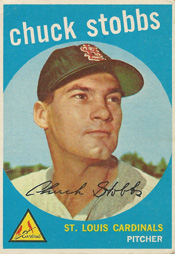
Chuck Stobbs was a left-hander who made his major-league debut at age 18, pitched for three American League franchises, yielded an epic home run to Mickey Mantle, experienced a streak of 16 consecutive losses and was given a chance to extend his career with the Cardinals.

On July 9, 1958, Stobbs, 29, was claimed by the Cardinals from the Senators for the waiver price of $20,000.
The Cardinals utilized Stobbs as a reliever the remainder of the season before they released him. He returned to the Senators, reviving his career after discovering and correcting an eye problem.

Young pro

Stobbs was a standout athlete at Granby High School in Norfolk, Va., and was recruited by several college football programs. He chose to pursue a professional baseball career and was signed in May 1947 by Red Sox scout Specs Toporcer, a former Cardinals infielder.

Stobbs was 18 when he made his major-league debut with the Red Sox in a relief role on Sept. 15, 1947, against the White Sox. He became a starter in 1949 and had one of his best seasons in 1950, posting a 12-7 record.

After the 1951 season, the Red Sox traded Stobbs to the White Sox and he spent one season with them before he was dealt to the Senators in December 1952.

“Stobbs suffers from asthma and the changeable spring weather makes him weak,” columnist Bob Addie reported in The Sporting News. “Once the weather gets hot and dry, Chuck feels human again and becomes a better pitcher.”

Stobbs made his first regular-season appearance for the Senators on April 17, 1953, in a start against the Yankees at Griffith Stadium in Washington and it was memorable. In the fifth inning, Mantle hit a pitch from Stobbs out of the ballpark, a home run estimated to have traveled more than 500 feet and the only ball to clear the left field bleachers at Griffith Stadium. Boxscore

In 1956, Stobbs was 15-15 for the Senators, but lost his last five decisions. The losing streak stretched to 16 when Stobbs lost his first 11 decisions in 1957.

Stobbs was 8-20 with a 5.36 ERA for the Senators in 1957 and 2-6 with a 6.04 ERA for them in 1958 when he was placed on waivers and claimed by the Cardinals.

Seeking relief

Cardinals manager Fred Hutchinson had pitched and managed in the American League for the Tigers, was familiar with Stobbs and thought the breaking-ball specialist could help in the bullpen.

“I suppose I’ll be called in to pitch to Duke Snider, Eddie Mathews and some of those other sluggers,” Stobbs said. “Maybe I’ll get past them by walking them.”

Stobbs disliked airplane travel and was dismayed to learn the Cardinals took flights on longer road trips. “I didn’t know the train was so obsolete,” Stobbs said. “I thought I was in baseball, but it seems somewhere along the way I joined the Air Force.”

Stobbs made his Cardinals debut on July 13 against the Pirates at St. Louis. Entering the game in the fifth inning with a 6-5 lead, he yielded a two-run home run to Bill Mazeroski and took the loss. Boxscore

On July 16, in a four-inning relief stint against the Braves at St. Louis, Stobbs gave up back-to-back home runs to Mathews and Hank Aaron and took another loss. Boxscore

A week later, on July 23 at Milwaukee, Stobbs relieved starter Larry Jackson and shut out the Braves for six innings. Boxscore

When the Cardinals fell into an eight-game losing streak from July 27 to Aug. 3, Stobbs offered to contribute the rabbits feet and other good-luck charms fans sent him when he experienced his 16-game skid with the Senators. “The charms apparently are easier to find than prospects from Redbird farms who can help right away,” wrote Neal Russo of the St. Louis Post-Dispatch.

Stobbs lost his first three decisions with the Cardinals before earning his lone win on Aug. 6 with five scoreless relief innings against the Giants at St. Louis. Stobbs also walked, scored a run and executed a sacrifice bunt. Boxscore

On Sept. 9, Stobbs earned a save against the Cubs at St. Louis, entering with two on, two outs and an 8-7 lead in the ninth and retiring Walt Moryn on a fly out. Boxscore

Stobbs finished with a 1-3 record, a save and a 3.63 ERA in 17 relief appearances for the 1958 Cardinals. Left-handed batters hit .300 (15-for-50) against him.

Eye opener

Described by The Sporting News as a “carefree bachelor,” Stobbs got married in November 1958 and was preparing to report to spring training before the Cardinals released him in January 1959.

Stobbs was home in Washington, D.C., when he went to renew his driver’s license and nearly flunked the eye test. He saw an optometrist and learned he had weak vision in his right eye. The eye problem “seriously affected his depth perception and could easily account for his increasing inability in recent years to find home plate with his pitches,” Shirley Povich reported in The Sporting News.

After being fitted for glasses, Stobbs met with Calvin Griffith and convinced the Senators owner to give him a chance to compete for a job in spring training. Able to hit his spots with his improved vision, Stobbs had a string of 16 scoreless innings in 1959 spring training games and opened the regular season as a Senators reliever.

Stobbs was 1-8 with seven saves and a 2.98 ERA for the 1959 Senators. In 1960, Stobbs had one of his best Senators seasons, finishing 12-7 with a 3.32 ERA.

When the Senators relocated to Minnesota and became the Twins in 1961, Stobbs went with them and pitched his final season there. In 15 years in the majors, Stobbs was 107-130 with a 4.29 ERA.

Read Full Post »

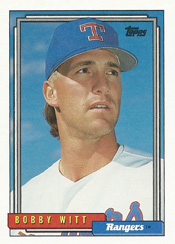
The Cardinals hoped a reunion of pitcher Bobby Witt and coach Dave Duncan would yield the kind of results they produced in their first go-around, but it didn’t work out.

On June 22, 1998, the Cardinals acquired Witt from the Rangers for future considerations. Three months later, the Rangers got outfielder Scarborough Green from the Cardinals to complete the transaction.

Witt pitched for the Athletics when Tony La Russa was manager and Duncan was pitching coach. Witt led the 1993 Athletics in wins (14), starts (33), innings pitched (220) and strikeouts (131). With a 14-13 record, Witt was the only pitcher to achieve a double-digit win total for an Athletics team that finished 68-94.

In 1998, La Russa and Duncan were with the Cardinals and seeking pitching help. Though Witt, 34, was being battered by American League hitters, the Cardinals took a chance on him.

Wild thing

Witt was a first-round choice of the Rangers in the 1985 amateur draft. He was the third overall pick, behind B.J. Surhoff of the Brewers and Will Clark of the Giants, and just ahead of Barry Larkin of the Reds and Barry Bonds of the Pirates.

Witt made his major-league debut with the Rangers in 1986. He threw hard but lacked command. Mark Simon of ESPN aptly described Witt as both entertaining and exasperating.

In his second major-league start, against the Brewers, Witt pitched five innings, struck out 10 and allowed no hits, but walked eight, threw four wild pitches and allowed two runs. “I wasn’t going to finesse you,” Witt told Simon. “My thought process was to go out there and let it go.” Boxscore

Witt had his best big-league season with the 1990 Rangers, posting a 17-10 record, 3.36 ERA and striking out 221 batters in 222 innings.

In August 1992, the Rangers traded Witt, reliever Jeff Russell and outfielder Ruben Sierra to the Athletics for outfielder Jose Canseco. Granted free agency after the 1994 season, Witt signed with the Marlins and was traded back to the Rangers in August 1995.

Low risk

In 1998, Witt was 5-4 for the Rangers. They made him available because his ERA was 7.66, foes batted .328 against him and he allowed 95 hits in 69.1 innings.

Signed for $3.25 million in 1998, Witt had $1.77 million remaining on his contract, but the Rangers were so eager to deal him they agreed to pay $1.5 million of that, leaving the Cardinals responsible for $270,000, the St. Louis Post-Dispatch reported. “I’m very confident (Witt’s) past relationship with Dave Duncan and Tony La Russa would help turn him around,” said Cardinals general manager Walt Jocketty. “He’s had problems with his control and it may be just a mechanical problem that he and Dunc can work out. Basically, it’s at very little risk to us.”

Witt arrived in St. Louis on June 23 and had a throwing session in the bullpen. “Everything looked fine,” said Duncan. “I didn’t see anything I didn’t like.”

Witt added, “Physically, there was nothing wrong … Hopefully, Duncan can take a look at me and figure it out.”

Throwing hard

On June 25, against the Indians at Cleveland, Witt made his first Cardinals appearance. Relieving starter Manny Aybar with the Indians ahead, 4-2, Witt retired the side in order in the seventh and got the first batter in the eighth, David Justice, to fly out. The next six Indians batters reached base against Witt and four scored. Jim Thome hit a home run, Manny Ramirez walked, Sandy Alomar singled, Mark Whiten reached on an error by Mark McGwire, Travis Fryman singled and David Bell doubled. Boxscore

Witt got his first Cardinals win in his first start for the club on July 22 at San Francisco. Backed by a two-run home run from Gary Gaetti and a solo home run from Brian Jordan, Witt held the Giants to two runs in five innings and the Cardinals won, 3-2. Boxscore

Witt’s other win for the Cardinals came in relief on Aug. 8 against the Cubs at St. Louis. Witt pitched a scoreless 13th, getting Mark Grace to ground out to first with two outs and two on, and the Cardinals won, 9-8, on Ray Lankford’s RBI-single in the bottom half of the inning. Boxscore

Witt finished with a 2-5 record and 4.94 ERA in 17 appearances for the 1998 Cardinals. He was 1-1 with a 3.52 ERA in 12 relief stints and 1-4 with a 6.29 ERA in five starts.

Witt said his velocity increased and credited Duncan. “Mechanically, I was out of whack,” Witt said. “Dave Duncan noticed something right away and I went up three to four miles per hour. I was actually hitting 90 to 91.”

Granted free agency, Witt signed with the Rays and was 7-15 with a 5.84 ERA in 32 starts for them in 1999.

After pitching in seven games for the Indians in 2000, Witt finished his career on an upswing, posting a 4-1 record for the 2001 Diamondbacks and pitching a scoreless inning for them in Game 6 of the World Series against the Yankees.

In 16 seasons in the major leagues, Witt was 142-157 with a 4.83 ERA.

Read Full Post »

Chuck Taylor patiently persevered in the minor leagues for most of a decade before getting a chance to pitch for the Cardinals. Joining Cardinals staffs featuring Bob Gibson and Steve Carlton, Taylor emerged as a versatile contributor.

Taylor started and relieved for the Cardinals. In three seasons (1969-71) with St. Louis, Taylor pitched in 126 games, 21 as a starter, and had a 16-13 record with 11 saves and a 2.99 ERA.
After the 1971 season, Taylor was traded by the Cardinals and pitched for the Mets (1972), Brewers (1972) and Expos (1973-76) in an eight-year major-league career.

Valuable lesson

Taylor was enrolled at Middle Tennessee State University when he was signed by Cardinals scout Buddy Lewis for $4,000 in 1961.

On Feb. 17, 1964, after three seasons in their minor-league system, Taylor was traded by the Cardinals, along with outfielder Jim Beauchamp, to the Houston Colt .45s for outfielder Carl Warwick.

A year later, on June 15, 1965, the Cardinals reacquired Taylor. In a trade of four pitchers, the Cardinals sent Ron Taylor and Mike Cuellar to Houston for Hal Woodeshick and Chuck Taylor.

Taylor’s return to the Cardinals didn’t appear to help him. The Cardinals assigned him to the minor leagues and he wasn’t prominent in their plans.

The Cardinals loaned Taylor to Indianapolis, a White Sox farm club, in 1967 and that’s when he turned around his career. Eli Grba, a former pitcher for the Yankees and Angels, was with Indianapolis and he showed Taylor how he threw a slider.

“I’d been in pro ball since 1961, but it wasn’t until Grba showed me the right way to throw a slider in 1967 that I began to make much progress,” Taylor said to the St. Louis Post-Dispatch. “I had thrown it as early as 1963, but the elbow got awfully sore and I gave up on the slider. Grba, though, taught me the right way.”

In 1968, pitching for manager Warren Spahn with the Cardinals’ Tulsa farm team, Taylor was 18-7 with a 2.35 ERA. He pitched 16 complete games, five shutouts and issued 38 walks in 230 innings. Still, the Cardinals, on their way to a second consecutive National League pennant, didn’t bring him to the big leagues.

Taylor went to spring training with the Cardinals in 1969 and pitched well, but didn’t make the Opening Day roster. Before Taylor went back to Tulsa, Cardinals general manager Bing Devine promised him he’d be called up to the big leagues “in four or five weeks” if the pitcher did well with the minor-league club.

Hitting his spots

Taylor did his part. Selected to start Tulsa’s 1969 season opener on April 18, his 27th birthday, Taylor earned a complete-game win against Denver. On May 9, Taylor, with Ted Simmons catching, pitched 11 innings and got the win against Oklahoma City.

After beating Indianapolis with a four-hitter on May 22 and improving his record to 5-1, Taylor was called up to the Cardinals to replace injured pitcher Dave Giusti.

In his first 13 appearances for the 1969 Cardinals, all in relief, Taylor posted a 1.59 ERA. He got his first big-league win on July 6 with 6.1 scoreless innings in relief of Mike Torrez in a 6-3 Cardinals victory over the Cubs at St. Louis. Boxscore

“Taylor made it easy for me to catch because he was able to get both his fastball and his slider over the plate almost any time he wanted to,” said Cardinals catcher Joe Torre.

About a month after Taylor was promoted to the Cardinals, another Chuck Taylor, a member of the Naismith Memorial Basketball Hall of Fame and a goodwill ambassador for Converse for more than 40 years, died at 68 on June 22, 1969. No relation to the Cardinals pitcher, basketball’s Chuck Taylor remains prominent as the brand name of the iconic Converse All-Star sneakers.

The Cardinals gave their Chuck Taylor his first major-league start on July 15, 1969, against the Phillies and he earned a complete-game win, striking out nine in an 8-2 St. Louis victory. Taylor also got his first big-league hit and drove in two runs. Boxscore

Taylor continued to produce strong starts for the 1969 Cardinals. On July 28, he yielded no earned runs in a complete-game win against the Padres and on Aug. 13 he pitched his first major-league shutout, a six-hitter against the Dodgers. Boxscore Taylor improved his record to 6-1 with a two-hitter against the Reds on Aug. 20. Boxscore

“Chuck upsets the hitters’ rhythm,” said Cardinals catcher Tim McCarver. “He threads the corners so well that the batters always have to reach for the ball. Chuck doesn’t even know where the middle of the plate is.”

Tailoring his role

In 27 appearances, including 13 starts, for the 1969 Cardinals, Taylor was 7-5 with a 2.56 ERA. Only Gibson (2.17) and Carlton (2.18) had better earned run averages for the club.

Taylor followed that with a 6-7 record and 3.11 ERA for the Cardinals in 1970. He led the team in saves (eight) and games pitched (56).

In 1971, the Cardinals mostly used Taylor in relief and he produced a 3-1 record with three saves and a 3.53 ERA.

On Oct. 18, 1971, seven years after the Cardinals traded Taylor and Beauchamp to Houston, they again packaged those two in a deal. In addition to Taylor and Beauchamp, the Cardinals sent pitcher Harry Parker and infielder Chip Coulter to the Mets for outfielder Art Shamsky and pitchers Jim Bibby, Rich Folkers and Charlie Hudson.

Mets manager Gil Hodges said he intended to use Taylor in long-inning relief, the New York Daily News reported.

After pitching for the Mets and Brewers in 1972, Taylor joined the Expos in 1973. He was their closer in 1974, posting a 6-2 record and 2.17 ERA and leading the Expos in saves (11) and games pitched (61).

Read Full Post »

(Updated Jan. 10, 2025)

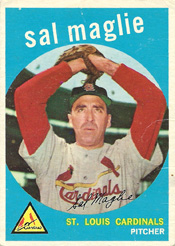
The Cardinals became a bridge for Sal Maglie, enabling him to transition from being a pitcher to a coach.

On June 14, 1958, the Cardinals acquired Maglie from the Yankees for minor-league pitcher Joe McClain and $20,000.
Maglie was nicknamed The Barber “for the close shaves he gave hitters with high and tight pitches designed to intimidate,” according to the St. Louis Post-Dispatch.

With a scowl and heavy, dark stubble, the sight of Maglie glaring at batters from the mound “resembles Jack Dempsey stepping into the ring,” Bob Broeg wrote.

“When I throw at a guy, I put it right here,” Maglie said, swiping his hand under his chin, “so he can’t hit it, but I never throw to hit a man.”

Maglie, 41, was past his prime when the Cardinals got him to be a spot starter, but he still was a prominent name and his acquisition attracted attention.

Traveling man

Maglie reached the major leagues in 1945 with the Giants and was mentored by pitching coach Dolf Luque. The next year, Maglie jumped to the Mexican League, even though it meant he would be banned from returning to the major leagues.

In Mexico, Maglie’s manager with the Puebla Parrots was Luque, who taught him a variety of curveballs. Described by Broeg as “chorus girl curves,” Maglie’s assortment ranged from slow and sweeping to sharp and darting.

After pitching in Mexico in 1946 and 1947, Maglie returned to the United States and played in 1948 for a barnstorming team of former major-leaguers against semipro clubs. In 1949, Maglie pitched in an independent pro league in Canada.

When baseball commissioner Happy Chandler lifted the ban on players who defected to the Mexican League, Maglie, 33, rejoined the Giants and thrived, compiling records of 18-4 in 1950, 23-6 in 1951 and 18-8 in 1952.

In the book “We Would Have Played For Nothing,” Dodgers pitcher Carl Erskine said, ‘I always admired Maglie … When he walked out on the mound, you knew who was in charge. No question … He had the sharpest, latest breaking curveball I ever saw. It would come right up under your arm, almost, and ‘shoom’ across the plate … He threw at hitters a lot to keep guys pushed back because he’s breaking the ball away all the time.”

Maglie pitched for the Giants (1945 and 1950-55), Indians (1955-56), Dodgers (1956-57) and Yankees (1957-58) before joining the Cardinals. He was the last player to appear with the Giants, Dodgers and Yankees while all three were based in New York.

(Don Drysdale, who was a rookie when Maglie joined the Dodgers in May 1956, told writer Roger Kahn, “I learned more from Sal than from any single individual.”)

Maglie pitched in three World Series and was the hard-luck Dodgers starter who opposed Don Larsen when he pitched a perfect game for the Yankees in 1956.

When the Cardinals acquired him, Maglie had a career record of 117-56 and his winning percentage of .678 was the best among active pitchers.

Good start

Maglie was 1-1 with a 4.63 ERA when Yankees manager Casey Stengel summoned him into his office and informed him he was being sent to St. Louis.

“I told him it was my fault because I didn’t produce for him when he gave me the chance,” Maglie told The Sporting News. “I’m the kind of fellow who has to work regularly to make the ball break the way I want it to and also to have control.”

Cardinals general manager Bing Devine said, “We expect to be able to give him more work than the Yankees could.”

Maglie was dealing with dental issues and an income tax problem when the trade was made. The Cardinals approved his request to resolve those situations and to drive his family from New York to their home in Niagara Falls before reporting to the team.

Maglie made his first appearance for the Cardinals in a June 22 start against the Braves at Milwaukee. He pitched seven innings and earned the win in a 2-1 Cardinals victory. Boxscore

In his second start, on June 28 at Philadelphia, Maglie won again, pitching a complete game against the Phillies in an 8-1 Cardinals triumph. Maglie had a shutout until Carl Sawatski hit a home run with one out in the ninth. Boxscore

Barber trimmed

Maglie left the Cardinals in July to be with his wife, who had surgery for cancer. When he returned, he wasn’t the same. After posting a 2-0 record and 1.12 ERA for the Cardinals in June, Maglie was 0-3 with a 6.48 ERA in July and 0-3 with a 6.20 ERA in August.

“First, my teeth bothered me. Then my wife became desperately ill,” Maglie said. “It wasn’t the physical or mental environment in which to win.”

Maglie finished with a 2-6 record and 4.75 ERA in 10 starts for the Cardinals.

“I feel I have another year of big-league pitching in me,” Maglie told columnist Dick Young.

Maglie reported to spring training with the Cardinals in 1959, hoping to impress manager Solly Hemus, but he yielded seven runs in the eighth inning of an exhibition game against the Phillies.

Maglie was released, but the Cardinals weren’t done with him.

Teaching role

On April 13, 1959, the Cardinals hired Maglie to be their minor-league pitching instructor. Asked which prospects impressed him, Maglie cited Bob Gibson. “All he needs is to improve his changeup to go with his speed,” Maglie said.

In June, Cal Browning, a minor-league left-hander, credited Maglie with correcting a flaw in his leg motion. In August, Bob Miller was called up to the Cardinals and said Maglie “helped me a lot with my breaking stuff.”

Reflecting on his season as Cardinals minor-league instructor, Maglie said, “I couldn’t concentrate on a player or a problem for more than three or four days at a time. No sooner would I get into a town than I’d have to leave for another. The kids did what I told them to do as long as I watched them, but slipped into their old ways as soon as I left.”

Maglie became Red Sox pitching coach in 1960 and was in that role in 1967 when Boston produced the American League Cy Young Award winner, Jim Lonborg, won the pennant and advanced to the World Series against the Cardinals. However, Maglie clashed with manager Dick Williams and was fired.

In 1969, Joe Schultz, who’d been a minor-league manager in the Cardinals system when Maglie was minor-league pitching instructor, became manager of the Seattle Pilots and hired Maglie to be pitching coach.

Read Full Post »

(Updated May 24, 2025)

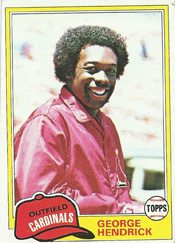
George Hendrick revived his career with the Cardinals and gave them the consistent run producer they were lacking in the outfield.

On May 26, 1978, the Cardinals acquired Hendrick from the Padres for pitcher Eric Rasmussen.

Platooned in right field by the Padres, Hendrick made it known he wanted to be traded to a team that would play him regularly. The Cardinals were happy to oblige.

Looking for lumber

The Cardinals opened the 1978 season with a starting outfield of Lou Brock in left, Tony Scott in center and Jerry Morales in right. None hit for power or average that season. Their totals: Brock (.221 batting average, no home runs), Scott (.228, one home run) and Morales (.239, four home runs).

The Cardinals needed another big bat to join catcher Ted Simmons and first baseman Keith Hernandez in the heart of the order.

Hendrick became available when he followed a strong 1977 season with a slow start in 1978 and fell out of favor with Padres manager Roger Craig.

The Padres opened the 1978 season with a starting outfield of Oscar Gamble in left, Hendrick in center and Dave Winfield in right. After batting .311 with 23 home runs and 81 RBI as the center fielder for the 1977 Padres, Hendrick hit .230 in April 1978.

Meanwhile, Craig determined catcher Gene Tenace and first baseman Gene Richards were playing out of position. In May, Craig moved Tenace to first base and Richards to left field, shifted Winfield from right to center and put Hendrick and Gamble into a platoon in right.

Hendrick and Gamble were unhappy with the arrangement and Gamble suggested he or Hendrick should be traded. When Padres general manager Bob Fontaine asked Hendrick whether he’d accept a trade, Hendrick said yes, The Sporting News reported.

Good deal

The Cardinals, Giants and Mets showed the most interest in Hendrick, Fontaine told the Associated Press. The Giants offered pitcher Jim Barr, but wanted to renegotiate the remainder of the three-year, $500,000 contract Hendrick signed in 1977, Padres owner Ray Kroc said to the Dayton Daily News.

After the Cardinals met with Hendrick’s agent, Ed Keating, an agreement was reached and the trade was made.

“He’s pleased to be coming here or he wouldn’t have approved of the deal,” Cardinals general manager Bing Devine said of Hendrick. “It was a good trade. There was no gun to our head. We wouldn’t have made it if there had been.”

Hendrick, 28, batted .243 with eight RBI in 36 games for the 1978 Padres. Rasmussen, 26, was 2-5 with a 4.18 ERA for the 1978 Cardinals after posting an 11-17 record the year before.

Cardinals manager Ken Boyer said Hendrick would be the center fielder and would bat third in the order, with Simmons fourth and Hernandez fifth.

“If Hendrick decides to give 100 percent, the deal could be Bing Devine’s best since he gave up Ernie Broglio for Lou Brock 14 years ago,” columnist Dick Young wrote in The Sporting News.

Joe Amalfitano, who was a coach with the 1977 Padres when Hendrick had his stellar season, told the St. Louis Post-Dispatch: “He’s a disciplined hitter. He’s a good base runner. He knows where he is at all times. He knows how to play this game. He never alibis. He never caused us any trouble.”

Special delivery

The Cardinals had lost 15 of their last 16 games and had a 15-31 record when Hendrick made his debut with them on May 29 in a doubleheader against the Mets in New York.

In a rare interview, Hendrick told Rick Hummel of the Post-Dispatch, “When I played against the Cardinals last year, my observation was that if they had somebody in the lineup who could protect Ted Simmons and hit 20 home runs and drive in 80 or 90 runs, I thought they could contend. I’m not saying I’m that guy, but I’m going to try to be.”

(In 2006, when Hendrick was a coach for the Rays, Hummel told the St. Petersburg Times, “He’s just a very delightful, charming, intelligent fellow and I relish every time I get to see him. People think because he doesn’t speak publicly that he’s this rude ogre, but he’s as gentle and kind a person as you’d ever want to meet.”)

Hendrick delivered for the 1978 Cardinals, batting .288 with 27 doubles, 17 home runs and 67 RBI in 102 games.

In seven seasons with St. Louis, Hendrick hit .294 and twice had more than 100 RBI in a season (109 in 1980 and 104 in 1982). He batted .321 in the 1982 World Series and drove in the go-ahead run in the sixth inning of the decisive Game 7 against the Brewers.

(Fun story about Hendrick and the 1982 World Series as told by club equipment manager Buddy Bates in an interview with Thoms R. Raber of 2004 Cardinals Yearbook: “It was real cold in Milwaukee. George was coming up to lead off the next inning. We had a heater at the end of the dugout. He laid his bat close to the heater. Well, it caught fire! Guys ran over there, stomping it out (but) his bat burned up.”)

Rasmussen, joining a rotation with Gaylord Perry and Randy Jones, was 12-10 for the 1978 Padres. He was 5-0 in July and 0-5 in September.

Rasmussen was reacquired by the Cardinals in December 1981 and pitched for them briefly in 1982 and 1983 before finishing his major-league career with the 1983 Royals.

Read Full Post »

« Newer Posts - Older Posts »