Feeds:
Posts
Comments

Archive for the ‘Trades’ Category

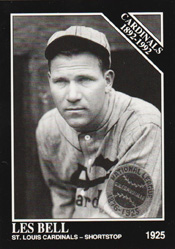
Rogers Hornsby brought out the best in the baseball talents of Les Bell, and soon after Hornsby departed the Cardinals, Bell did, too.

On March 20, 1928, the Cardinals and Braves swapped third basemen, with Bell going to the Braves for Andy High and cash.

The deal reunited Bell with Hornsby. They were Cardinals teammates from 1923 to 1926. When second baseman Hornsby became player-manager in May 1925, Bell blossomed, developing into a premier run producer. “His effect on Bell was almost instantaneous,” International News Service reported. “From a very commonplace third baseman, he became a ranking star in 1926.”

In 1926, when Hornsby led the Cardinals to their first National League pennant and a World Series title, Bell batted .325 with 33 doubles, 14 triples, 17 home runs and 100 RBI.

After Hornsby was traded by the Cardinals to the Giants in December 1926, Bell fell into a funk. Without his mentor, Bell slumped in 1927, batting .259 with nine home runs and 65 RBI for the Cardinals. He also made 24 errors at third base.

Let’s make a deal

After the 1927 season, the Cardinals demoted player-manager Bob O’Farrell, promoted a coach, Bill McKechnie, to replace him, and the Giants traded Hornsby to the Braves.

Determined to impress McKechnie, Bell reported a week early to the Cardinals’ 1928 spring training camp. Bell hit well but fielded poorly. “Ground balls were getting by him and going through his legs,” the St. Louis Post-Dispatch reported.

Meanwhile, Hornsby was urging the Braves to trade for Bell. Andy High was the Braves’ third baseman. Born in Ava, Ill., High grew up in St. Louis, where his father was an electrical engineer. High reached the major leagues with the Dodgers in 1922 and played for them until he was claimed on waivers by the Braves in 1925. He hit .302 with 46 RBI for the Braves in 1927 and committed 20 errors in 89 games at third base.

The Cardinals unsuccessfully tried to acquire third baseman Freddie Lindstrom from the Giants, the St. Louis Star-Times reported. They also asked the Phillies about Fresco Thompson, a second baseman whom the Cardinals intended to move to third, but that deal also failed to develop.

The Cardinals were talking with the Braves about a pair of infielders, Doc Farrell and Eddie Moore, and when the Braves offered High for Bell, Cardinals owner Sam Breadon approved the trade.

Effective platoon

Hornsby “was largely responsible for the deal,” United Press reported.

Hornsby told the Star-Times “the Braves consider Bell the greatest third baseman in the business.”

Said Bell: “I intend to … show the Cardinals why they made a mistake. Don’t think I won’t play great ball this summer.”

The Post-Dispatch reported the trade “came as a big surprise to the Cardinals players.” Braves manager Jack Slattery told the newspaper he didn’t think High could field well enough to be a starter.

Though he called High “a great hitter and a wonderful fielder,” McKechnie said Wattie Holm, a utility player, would be the Cardinals’ starter at third base and High would have a backup role.

“I can hardly believe McKechnie is going to give me a chance to be the regular third baseman,” Holm said. “I am going out to show Bill he has not made a mistake in giving me the job.”

Said High: “McKechnie is a wonderful man personally and a mighty shrewd manager. The Cards have a great club. I will try hard to get a regular job and it is my honest opinion that I can help the Cards win many ballgames.”

McKechnie ended up platooning Holm and High. Holm, a right-handed batter, made 82 starts at third base, hit .277 with 47 RBI and committed 22 errors. High, a left-handed batter, started 70 games at third base, hit .285 with 37 RBI and made 12 errors.

The 1928 Cardinals (95-59) won the pennant and finished 44.5 games ahead of the Braves (50-103). Bell batted .277 with 36 doubles and 91 RBI, but he and the hard-hitting Hornsby, who replaced Slattery as manager in May, couldn’t overcome a pitching staff that produced a 4.83 ERA.

Read Full Post »

Reflecting his versatility as well as the Cardinals’ need for quality pitching in all areas, Juan Acevedo opened the 1998 season as a middle-inning reliever, moved into the starting rotation in May and became the club’s closer in August.

On March 29, 1998, the Cardinals traded pitcher Rigo Beltran to the Mets and got Acevedo in return.

The deal was considered to be a relatively minor one at the time, but it turned out to be significant for the Cardinals. Acevedo became their most effective pitcher that season.

Finding his way

Acevedo, born in Mexico, played high school baseball in the Chicago suburb of Carpentersville, Ill. After he graduated, Acevedo worked at a car wash and at a tool and dye shop for three years and didn’t play baseball during that time. “I was young and trying to find myself,” Acevedo later told the St. Louis Post-Dispatch.

One day, while watching a White Sox game on television, Acevedo became inspired to take up the sport again. He attended two tryout camps and received a scholarship offer to play baseball for Parkland Community College in Illinois.

After one season at Parkland, Acevedo, 22, was chosen by the Rockies in the 14th round of the 1992 amateur draft. A year later, in 1993, Walt Jocketty became assistant general manager of the Rockies. Acevedo worked his way up the Rockies’ minor-league system and in 1994 he posted a 17-6 record and 2.37 ERA for their New Haven farm club.

Jocketty left the Rockies after the 1994 season and became general manager of the Cardinals. Acevedo reached the major leagues with the Rockies in 1995 and was traded to the Mets in July that year. The Mets sent him back to the minor leagues and he stayed there until 1997 when he posted a 3-1 record and 3.59 ERA for New York.

Jocketty kept track of Acevedo and made the deal to obtain him when the Mets made him available in March 1998. “He was one of our best-looking prospects” in Colorado, Jocketty said.

Poise under pressure

Placed on the Opening Day roster, Acevedo, a right-hander, gave up eight runs in his first five relief appearances for the 1998 Cardinals.

He turned around his season with an impressive outing on April 19 against the Phillies.

Acevedo relieved in the ninth inning with the bases loaded, no one out and the Cardinals clinging to a 3-2 lead. Cardinals manager Tony La Russa instructed him to throw only fastballs. Acevedo followed orders and retired Scott Rolen and Mike Lieberthal on pop-outs to first before striking out Rico Brogna, earning the save.

“If I threw 95 mph, I’d throw all fastballs, too,” said Cardinals third baseman Gary Gaetti.

Said Acevedo: “That was the moment I told myself I truly belonged up here. My confidence is as good as it’s ever been.” Boxscore

Ups and downs

In late May, La Russa and pitching coach Dave Duncan moved Acevedo into the starting rotation as a replacement for Manny Aybar, who was struggling.

Acevedo succeeded, posting a 4-1 record and 2.34 ERA in nine starts for the Cardinals. The added innings, however, caused him to develop a strained elbow and strained forearm, and Acevedo went on the disabled list in July.

When he returned to the active roster in August, Acevedo became the closer. Jeff Brantley, who the Cardinals had counted on to be their closer, had a 7.09 ERA in save situations.

Acevedo was 2-1 with three saves and an 0.93 ERA in eight relief appearances in August, and 1-0 with 10 saves and an 0.00 ERA in 13 relief appearances in September. He didn’t allow a run in his last 16 relief outings.

For the season, Acevedo led the Cardinals in saves (15) and was second in ERA (2.56). He had an 8-3 record. His ERA in save situations was 2.49. Right-handed batters hit .203 against him.

Acevedo entered 1999 as the Cardinals’ closer, but he flopped and was replaced by Ricky Bottalico. Used in a variety of roles, including as a starter, Acevedo finished the 1999 season with a 6-8 record and four saves. His ERA in save situations was 7.84. Right-handed batters hit .301 against him.

In December 1999, the Cardinals traded Acevedo to the Brewers in a deal that brought second baseman Fernando Vina to St. Louis.

Read Full Post »

Along with Bob Gibson and Ray Sadecki, Don Choate was a prized pitching prospect who was projected to be in the Cardinals’ plans entering the decade of the 1960s, but he never got the chance to play for them in the regular season.

Instead, Choate went to the Giants in the trade that brought Bill White to the Cardinals.

Choate, a right-hander, reached the major leagues with the Giants in 1960.

A native of Potosi, Mo., Choate grew up in East St. Louis, Ill. He signed with the Cardinals in 1956, the year he turned 18, and made his pro debut that season with their minor-league club in Peoria, Ill. In February 1957, Cardinals general manager Frank Lane cited Choate as one of the “talented kids from the St. Louis area in the Cardinals organization,” The Sporting News reported.

Assigned to the Billings, Mont., team in the Cardinals’ farm system, Choate had a breakout season in 1957, posting a 19-8 record. At 19, he pitched 20 complete games and 240 innings. On successive days, Aug. 30-31, Choate pitched shutouts against Salt Lake City. He pitched a one-hitter in a 5-0 victory cut to five innings because of rain, and came back the next night with a three-hitter in another 5-0 triumph in the seven-inning opener of a doubleheader.

Choate pitched in spring training exhibition games for the Cardinals in 1958 and was touted by The Sporting News as an “impressive” prospect. He split the 1958 season between Cardinals farm clubs in Omaha and Houston. When Choate retired 19 consecutive batters in a game against Denver, The Sporting News reported he “scintillated on the mound.”

After producing a combined record of 12-11 in 34 games for Omaha and Houston in 1958, Choate played winter ball for the Licey team in the Dominican Republic. He won his first six decisions and had a 1.54 ERA. Choate “has developed into the Dominican loop’s leading hurler,” The Sporting News reported. Cardinals assistant farm director George Silvey said Choate “is sneaky fast and his curve has been improving. He’s a pitcher, not a thrower. A definite big-league prospect.”

Cardinals manager Solly Hemus and farm director Walter Shannon went to the Dominican Republic to see the top players. Hemus filed a favorable report on Choate. As the Cardinals prepared for spring training in 1959, Choate seemed a likely candidate to earn a spot on the big-league team.

While in the Dominican Republic, Hemus and Shannon also saw Bill White, who was in the Giants’ organization, and were impressed by his power, run production and versatility at first base and in the outfield. Eddie Stanky, a Cardinals scout who managed White in the minor leagues, also recommended him.

On March 25, 1959, the Cardinals traded Choate and a starting pitcher, Sam Jones, to the Giants for White and utility player Ray Jablonski. Most analysts said the deal favored the Giants. Bob Broeg of the St. Louis Post-Dispatch predicted Choate “eventually might make the grade” as a major-league pitcher.

“There’s no doubt in my mind we’ve improved our pennant chances tremendously with Jones coming to our team,” Giants manager Bill Rigney told United Press International. Rigney added, “It was the most important pitching deal we’ve made since I’ve been manager.”

Said Bing Devine, who replaced Lane as Cardinals general manager, “We believe White will solve our outfield problem and give us the added power at the plate we have been looking for.”

White became one of the Cardinals’ best players and a premier first baseman in the National League.

Choate was assigned to the Giants’ farm club at Phoenix in 1959 and was 4-7 in 22 appearances.

In 1960, after posting a 10-15 record for Tacoma, Choate was called up to the Giants in September. He made four relief appearances, including a one-inning scoreless stint against the Cardinals at St. Louis on Sept. 17, and had a 0-0 record and 2.25 ERA.

Choate pitched one more season, 1961, with Tacoma, hurt his arm and was finished as a pro player at 23. He had a second career as a firefighter.

Read Full Post »

A candidate to replace Bill White as Cardinals first baseman, Moose Stubing had his path blocked by Orlando Cepeda for the second time in his career.

Stubing went on to have a long career as a coach and manager.

Nicknamed “Moose” because of his size, Larry Stubing was a Bronx, N.Y., native and a standout high school athlete. He rejected a football scholarship to Penn State and signed a professional baseball contract with the Pirates. Stubing stood 6 feet 3 and weighed 220 pounds.

After one season (1956) in the Pirates’ system, Stubing was sent to the Giants. He played eight seasons (1957-1964) in the Giants’ minor-league organization. The Giants had two future Hall of Famers, Cepeda and Willie McCovey, who were naturals at first base and there was no room at the big-league level for Stubing, a left-handed batter with power.

In April 1965, the Giants dealt Stubing, 27, to the Cardinals for George Williams, a minor-league third baseman. White was the Cardinals’ first baseman then and he was coming off a successful 1964 season, batting .303 with 102 RBI for the World Series champions. Cardinals general manager Bob Howsam, however, was looking for potential successors to White, making Stubing a candidate.

The Cardinals assigned Stubing to the Jacksonville Suns, their Class AAA affiliate in the International League and made him the starting first baseman. Stubing, however, flopped, batting .209 with 13 home runs in 132 games. He was surpassed by another prospect, George Kernek, as the likely successor to White.

After the 1965 season, White was traded to the Phillies and Kernek was picked to replace him. Stubing was demoted to the Arkansas Travelers, the Cardinals’ Class AA club in the Texas League.

After a slow start in 1966, Stubing began hitting with consistent power and production for Arkansas. In a 51-game stretch in June and July, he hit .381. Of his first 19 home runs, 18 came in games won by Arkansas. By then, however, Cepeda was the Cardinals’ first baseman. He was acquired in May and Kernek was sent back to Class AAA.

Stubing finished the 1966 season with a .274 batting average and 25 home runs for an Arkansas team, managed by Vern Rapp, that won the pennant in its first season in the Texas League. A team photo in the Sept. 17, 1966, edition of The Sporting News showed Stubing standing between future Cardinals pitchers Wayne Granger and Mike Torrez.

Though Stubing did well at Arkansas, he no longer fit in the Cardinals’ plans. Howsam departed for the Reds and Stan Musial replaced him as general manager. Before the start of the 1967 season, the Cardinals sent Stubing to the Angels.

Joining the Angels was a break for Stubing. He made his major-league debut with them in 1967, but went hitless, with four strikeouts, in five at-bats. Stubing stayed in the Angels’ organization and eventually became a minor-league manager for them for many years.

From 1985-1990, Stubing was back in the major leagues as an Angels hitting coach. In 1988, when the Angels fired manager Cookie Rojas near the end of the season, Stubing filled in with eight games remaining, but the Angels lost all eight.

Read Full Post »

In the first eight months of 1988, Bob Forsch rejoined the Cardinals, turned in one of his best stretches as a starting pitcher and was traded when they determined he no longer fit their plans.

Forsch’s topsy-turvy 1988 was set in motion by the actions of the Cardinals in December 1987. Though Forsch tied for the team lead in wins (11) and also earned a win apiece in the National League Championship Series and World Series in 1987, the Cardinals released him in a cost-cutting move just before Christmas.

Baseball rules said a club could cut the salary of a player on the roster by no more than 20 percent, but the Cardinals wanted to reduce Forsch’s pay by more than that. By releasing him and making him a free agent, the Cardinals could re-sign him without restrictions.

The Cardinals offered Forsch a 1988 salary of $200,000, a reduction of 73 percent from the $750,000 he made in 1987, the St. Louis Post-Dispatch reported.

“I can’t think of too many players who won 11 games and they gave them a 73 percent cut,” Forsch said. “I can’t think of too many players who won 11 games and got released.”

Said Cardinals general manager Dal Maxvill: “I felt his performance last year, even though he tied for the lead in wins, was such that we didn’t feel we should pay him $750,000.”

Preferring to stay in St. Louis, Forsch, 38, negotiated a compromise. He would pitch for the 1988 Cardinals at a base salary that was 47 percent less than what he made in 1987. In January 1988, he signed a $400,000 contract with the Cardinals. The deal also gave Forsch the chance to earn more if certain incentives were met.

“I really want to stay here, but I’m not going to play very many more years and I plan to get as much money as I can before I retire,” Forsch said. “The whole Cardinals organization has been super to me, but you just get to a point where you get tired at the whole process … You get tired of hearing how old you are.”

Good enough to trade

Though he made 30 starts for them in 1987, the Cardinals projected Forsch to be a reliever in 1988. However, because injuries depleted the rotation, Forsch made 12 starts for the 1988 Cardinals, including six in August when he had a 5-1 record and a 2.25 ERA.

“Forsch’s secret has been consistency,” the Post-Dispatch reported. “He’s endured with the strength of a marathon runner, the fortitude of a mountain climber.”

Said Cardinals manager Whitey Herzog: “Just when you count the son of a buck out, he fights back. He’s something.”

By the end of August, Forsch was 9-4 with a 3.73 ERA in 30 appearances for the 1988 Cardinals. As a starter, he was 5-2 with a 2.97 ERA. Nonetheless, the Cardinals told Forsch they couldn’t commit to him being on the team in 1989.

“I know (Forsch) has pitched well, but he’s going to be 39 years old,” Maxvill said.

When Forsch signed in January, he and Maxvill had discussed the possibility of a trade late in the season, the Post-Dispatch reported.

Still wanting to pitch, Forsch said he would agree to a trade to a contender. As a player who spent five years with one team and 10 in the league, Forsch, under baseball rules, needed to approve any proposed deal involving him.

Business deal

The second-place Astros, managed by former Cardinals coach Hal Lanier, showed the most interest in Forsch. They saw him as a starter who could help them in their pursuit of the NL West-leading Dodgers.

Forsch agreed to the trade when the Astros guaranteed him a contract for 1989.

On Aug. 31, 1988, after 15 seasons with the Cardinals, Forsch was traded to the Astros for utility player Denny Walling.

“I hate leaving, but I’m going to someplace where I’m going to enjoy it,” Forsch said.

Said Forsch’s friend, Cardinals trainer Gene Gieselmann: “I was hoping he would always be a Cardinal, but baseball is a business and all of us in baseball have to look at it that way.”

Calling Forsch “a great teacher and a great person,” Maxvill told him the Cardinals would give him a job in the organization in 1989 if he was unable to pitch for the Astros. “I feel good about that,” Forsch responded.

Forsch won his first start for the 1988 Astros, shutting out the Reds for eight innings and contributing a three-run double. Boxscore  However, in six starts for them, Forsch was 1-4 with a 6.51 ERA and the Astros finished in fifth place.

In 1989, his last season in the big leagues, Forsch was 4-5 with a 5.32 ERA for the Astros.

Previously: Why Bob Forsch didn’t end his career as a Cardinal

Read Full Post »

Unable to resolve his differences with manager Tony La Russa, third baseman Scott Rolen requested to be traded by the Cardinals.

On Jan. 14, 2008, Rolen got his wish when the Cardinals sent him to the Blue Jays for third baseman Troy Glaus.

The deal brought an unsatisfying end to the Cardinals career of a productive, popular player.

It also continued a shakeup of the Cardinals by first-year general manager John Mozeliak. After the 2007 season, when Mozeliak replaced Walt Jocketty, the Cardinals traded Rolen and center fielder Jim Edmonds, and shortstop David Eckstein was allowed to leave as a free agent. All three had been prominent contributors to the Cardinals’ 2006 World Series championship team. Like Rolen, Eckstein went to the Blue Jays.

Cardinals core

Rolen came to the major leagues with the Phillies and was named winner of the National League Rookie of the Year Award in 1997. Rolen hit with power and fielded superbly, but he eventually clashed with manager Larry Bowa and the Phillies looked to deal him.

In July 2002, the Philies traded Rolen and pitcher Doug Nickle to the Cardinals for infielder Placido Polanco and pitchers Bud Smith and Mike Timlin.

Rolen, Edmonds and Albert Pujols formed the core of a lineup that powered the Cardinals to four division titles (2002, 2004, 2005, 2006), two NL pennants (2004 and 2006) and a World Series championship (2006).

In 2004, his best Cardinals season, Rolen produced a .314 batting average, a .409 on-base percentage and a .598 slugging percentage. He had 34 home runs, 124 RBI and scored 109 runs.

Rolen also earned a Gold Glove Award four times while with the Cardinals.

Looking to leave

An injury to his left shoulder limited Rolen to 56 games in 2005. That’s when his troubles with La Russa surfaced. Rolen believed the Cardinals misled him about the severity of the injury, the St. Louis Post-Dispatch reported. La Russa objected to Rolen’s claim and an iciness developed between the two.

In 2006, the rift widened when La Russa benched Rolen during the NL Division Series. The two attempted a reconciliation in 2007, but the relationship suffered a setback when La Russa sent Rolen a four-page letter after the season, expressing his opinions of the player.

When La Russa signed a contract in October 2007 to remain Cardinals manager through 2009, Rolen contacted the club and requested a trade.

Though Rolen was an accomplished player, dealing him created a challenge for Mozeliak. Potential trade partners were limited because Rolen had $36 million and three years remaining on his contract and he had undergone three shoulder surgeries since 2005. Also, because it was no secret Rolen wanted out of St. Louis, Mozeliak’s negotiating options appeared restricted and clubs weren’t inclined to offer much in return.

Rolen has “to understand what our return must be to even consider moving someone of Scott’s talent,” Mozeliak said.

Trade talk

At the December 2007 baseball winter meetings in Nashville, the Brewers showed the most interest in trading for Rolen and met multiple times with the Cardinals, who wanted pitcher Chris Capuano. The Cardinals ended negotiations when the Brewers wouldn’t come up with an acceptable offer.

Meanwhile, La Russa told reporters Rolen should give back to the Cardinals rather than ask the club to accommodate him. The comments deepened the animosity between the two.

The public seemed fed up with the drama. In a Post-Dispatch poll asking whose side are you on, 36 percent responded in favor of La Russa, 11 percent were for Rolen and 53 percent chose no side, saying the hostilities were unbecoming and unnecessary.

Before the winter meetings ended, the Blue Jays quietly approached the Cardinals and expressed interest in Rolen. Glaus, the Blue Jays’ third baseman, underwent foot surgery in September and told the club he no longer wanted to play on the artificial surface in the Toronto stadium. The Blue Jays asked the Cardinals if they’d swap Rolen for Glaus.

The Cardinals were interested in the proposal but wanted Glaus to exercise his contract option for 2009, eliminating the possibility he could depart St. Louis after the 2008 season. Glaus agreed to the arrangement.

The Cardinals eliminated another potential obstacle to the deal when Glaus checked out clean regarding drug use. In 2007, a published report said banned performance-enhancing drugs had been delivered to Glaus at home in 2003 and 2004. Major League Baseball investigated and found insufficient evidence.

Happy slugger

Glaus five times hit 30 home runs in a season and he achieved 100 RBI four times. In 2002, he was named recipient of the World Series Most Valuable Player Award with the Angels. Glaus batted .262 with 20 home runs and 62 RBI in 115 games for the 2007 Blue Jays.

“He has off-the-chart power,” said Mozeliak.

After Blue Jays doctors checked out Rolen, 32, and Cardinals doctors did the same with Glaus, 31, and gave their approvals, the trade was completed.

“St. Louis is a city that I’ve dreamed about playing in since I was a kid (in Southern California),” Glaus said.

Said Mozeliak: “When you look at them player by player, at the end of the day what breaks the tie is a happy player versus an unhappy player.”

When Joe Strauss of the Post-Dispatch visited Rolen at Blue Jays spring training camp in Dunedin, Fla., Rolen said of the trade, “It came to a point where it had to happen.”

Regarding his dispute with La Russa, Rolen said, “A personal issue … There was nothing professional about it.”

Glaus did well for the 2008 Cardinals, batting .270 with 27 home runs and 99 RBI in 151 games. He was injured in 2009 and limited to 14 games near the end of the season.

Rolen batted .262 with 11 home runs and 50 RBI for the 2008 Blue Jays. In July 2009, the Blue Jays traded him to the Reds and he finished his playing career with them in 2012.

Previously: Scott Rolen and his strange stat line in 2004 NLDS

Read Full Post »

« Newer Posts - Older Posts »