Heading into the 1985 winter meetings, the Cardinals were willing to trade ace Joaquin Andujar for either a left-handed starting pitcher or a first-string catcher. They found a club willing to give them both.
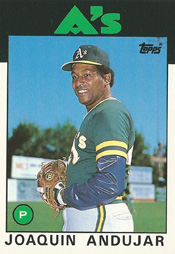 On Dec. 10, 1985, the defending National League champion Cardinals dealt Andujar to the Athletics for catcher Mike Heath and pitcher Tim Conroy.
Heath, 30, was acquired to replace Darrell Porter, who had been released. Conroy, 25, was expected to compete for a spot in the Cardinals’ 1986 rotation alongside John Tudor, Danny Cox, Bob Forsch and Kurt Kepshire.
Neither Heath nor Conroy worked out the way the Cardinals had hoped and Andujar never achieved with the Athletics the success he had with St. Louis.
Behind the numbers
Though Andujar, 32, had an impressive regular season for the 1985 Cardinals _ 21-12 record with 10 complete games and 269.2 innings pitched _ his performance in the second half and in the postseason triggered concern.
For example:
_ Andujar was 1-3 with a 5.30 ERA in six September starts in 1985 and 0-2 with a 7.88 ERA in two regular-season October starts.
_ In the NL Championship Series against the Dodgers, Andujar was 0-1 with a 6.97 ERA in two starts. In the World Series versus the Royals, he made two appearances and was 0-1 with a 9.00 ERA.
_ He had a meltdown in Game 7 of the World Series, getting into a confrontation with home plate umpire Don Denkinger and being ejected. Peter Ueberroth, commissioner of baseball, suspended Andujar for the first 10 games of the 1986 season. Video at the 1:38 mark
Look the other way
At home in the Dominican Republic, Andujar told Braves shortstop Rafael Ramirez that people from Anheuser-Busch, the brewery that owned the Cardinals, called him and said he’d never pitch for the club again, columnist Peter Gammons reported in The Sporting News.
Dal Maxvill, Cardinals general manager, denied being told to trade Andujar. “There has not been interference from above,” Maxvill said to The Sporting News.
In comments about Andujar to St. Louis reporter Rick Hummel, Maxvill added, “I know he’s kind of crazy and I know he’s unusual, but you have to look the other way when the performance is there.”
In his 1987 book “White Rat: A Life in Baseball,” Cardinals manager Whitey Herzog admitted, “It’s been reported that Maxvill and I were ordered to trade Joaquin and I won’t deny that. I will say, though, that he might well have been traded anyway. The other players were tired of his griping and his bitching. It had gotten to the point where he was dividing the clubhouse.”
No deal
The White Sox approached the Cardinals and proposed a deal of left-handed starter Britt Burns for Andujar and pitcher Ricky Horton. Burns was 18-11 for the 1985 White Sox. The Cardinals, however, “backed off because they were concerned about a hip injury of which Burns complains,” Hummel reported.
The Cardinals approached the Red Sox and offered Andujar, Horton, Kepshire and reliever Jeff Lahti for left-handed starter Bruce Hurst, who was 11-13 for Boston in 1985.
The Red Sox rejected the offer because they were given “an immediate take-it-or-leave-it deadline” by the Cardinals and they “were afraid of taking on Andujar” and his problems, Gammons reported.
Headcases OK
The Athletics were seeking a proven winner for their rotation. They offered their starting catcher, Heath, and one selection from a pool of pitchers. The Cardinals chose Conroy.
To the Athletics, Andujar’s pitching trumped his image.
“There’s nothing wrong with a headcase or two _ as long as you don’t have eight,” Sandy Alderson, Athletics general manager, told the Sacramento Bee. “This was not a multi-headcase deal.”
To the San Jose Mercury News, Alderson said, “Flamboyance is not criminal.”
Herzog had advice for Athletics pitching coach Wes Stock, who had been Herzog’s teammate with the Orioles. “Whitey told me Joaquin still needs to be coddled,” Stock said. “He told me not to forget that.”
Asked his reaction to the trade, Andujar told St. Louis radio station KMOX, “I feel surprised. Like I always said, I wanted to die in St. Louis … I leave my heart in St. Louis.”
Unhappy Heath
Heath hit .250 with 13 home runs and 55 RBI for the 1985 Athletics. He caught 38 percent of runners attempting to steal.
According to The Sporting News, Heath asked to be traded. He feuded with Oakland management after being told he’d play only versus left-handed pitching in 1986.
“I felt I was an everyday player and I felt I would not be happy,” Heath said.
In a parting shot at the Athletics, Heath added, “When Mike Heath steps on the field, his No. 1 objective is to win. No. 2 is to win and No. 3 is to win. With the A’s, No. 1 was being compatible and No. 2 was winning.”
Change for Conroy
Conroy was 0-1 with a 4.26 ERA in 16 games for the 1985 Athletics. At Class AAA Tacoma that season, Conroy was 11-3 in 22 starts.
A first-round selection of the Athletics in the 1978 draft, Conroy made his major-league debut at age 18. In five seasons with the Athletics, Conroy was 10-19 with a 4.37 ERA.
“We probably pushed him too quickly,” Alderson said.
Conroy “had to get out of our organization … The mental strain had become too great,” Stock told the San Francisco Chronicle.
Said Herzog: “We’ve liked Conroy for a long time … We feel he was rushed in Oakland and was under too much pressure to succeed.”
The results
Heath hit .205 with four home runs and 25 RBI for the 1986 Cardinals. He caught 33 percent of runners attempting to steal.
On Aug. 10, 1986, the Cardinals traded Heath to the Tigers for pitcher Ken Hill and first baseman Mike Laga.
Conroy was 5-11 with a 5.23 ERA in 25 appearances for the 1986 Cardinals. He was 3-2 with a 5.53 ERA for St. Louis in 1987, his last big-league season. In two years with the Cardinals, Conroy was 8-13 with a 5.31 ERA.
Andujar was 12-7 with a 3.82 ERA in 28 appearances for the 1986 Athletics. He was 3-5 with a 6.08 ERA for Oakland in 1987. In two seasons with the Athletics, Andujar was 15-12 with a 4.46 ERA.
Previously: How Hub Kittle got Joaquin Andujar to Cardinals
 The deal didn’t work out the way either the Cardinals or Giants envisioned.
 On Dec. 7, 2005, the Cardinals traded disgruntled reliever Ray King to the Rockies for Miles and outfielder Larry Bigbie.
 On Dec. 4, 1940, the Cardinals dealt the best young catcher in the league, Mickey Owen, to the Dodgers for $65,000, catcher Gus Mancuso and minor-league pitcher John Pintar.
 On Oct. 28, 1975, the Cardinals acquired Kessinger from the Cubs for reliever Mike Garman and a player to be named, infielder Bobby Hrapmann.

 RetroSimba