Feeds:
Posts
Comments

Archive for the ‘Trades’ Category

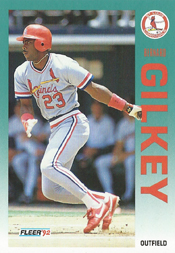
Deemed too expensive to be a reserve and not enough of a power hitter to remain the everyday left fielder, Bernard Gilkey no longer fit into the Cardinals’ plans.

bernard_gilkey3Looking to restock their farm system, the Cardinals were offered packages of prospects by the Mets, White Sox and Royals for Gilkey.
On Jan. 22, 1996, the Cardinals traded Gilkey, 29, to the Mets for three minor-league players: right-handed pitchers Eric Ludwick and Erik Hiljus and outfielder Yudith Ozorio.

In the short term, the deal had little impact on the Cardinals, even though Gilkey had a career year with the 1996 Mets. The Cardinals won the 1996 National League Central Division championship and qualified for the postseason for the first time since 1987.

In the long term, the trade hurt the Cardinals because they didn’t get the pitching help they needed. Neither Ludwick nor Hiljus could help a staff whose team ERA increased each year from 1997 through 1999, contributing to the Cardinals missing the playoffs in those seasons.

Hometown regular

Gilkey, a St. Louis native, debuted with the Cardinals in 1990, replaced Vince Coleman as the starting left fielder in 1991 and held the position through 1995.

For those six years, he batted .282 with 602 hits in 593 games. In 1993, his best Cardinals season, Gilkey batted .305 with 170 hits, including 40 doubles, 16 home runs, 15 stolen bases and a .370 on-base percentage.

However, Gilkey never hit more than 17 home runs or produced more than 70 RBI in a season with St. Louis.

In December 1995, the Cardinals signed free-agent Ron Gant, 30, to a contract for five years and $25 million. Gant had three times hit 32 or more home runs with the Braves and twice had topped 100 RBI. He had driven in at least 80 in five consecutive seasons.

Money ball

Gilkey was paid $1.6 million in 1995, when he led NL left fielders in fielding percentage (.986) and batted .298 with 17 home runs and 69 RBI.

Eligible for salary arbitration, Gilkey was seeking $3 million in 1996. The Cardinals offered $2.5 million. A settlement likely could be reached for $2.8 million, according to the St. Louis Post-Dispatch.

However, the Cardinals were looking to acquire a closer, either Dennis Eckersley of the Athletics or free-agent Gregg Olson, and trading Gilkey would help free up money to make such a deal.

“The only reason we’d have to move Gilkey is because of money,” Cardinals general manager Walt Jocketty said.

It’s business

Projecting a 1996 outfield of Gant in left, Ray Lankford in center and Brian Jordan in right, Cardinals manager Tony La Russa discussed the possibility of moving Gilkey to first base. “We were saying that, but I didn’t see that as an alternative,” Jocketty said. “That probably would have hurt us defensively.”

On the day he was traded, Gilkey said, “I’m not bitter. I understand business.”

He was, however, hurt by the rejection.

“Once they signed Ron Gant, I knew the opportunity for me playing in St. Louis was slim,” Gilkey said. “It’s kind of shocking to know that you’ve played with the St. Louis Cardinals through all the down times and you did whatever you could to help. All of a sudden, they turn into contenders and they send me on my way.”

Of the players acquired by the Cardinals, Ludwick, 24, projected to be the most promising. He had a 13-6 record and 3.31 ERA for Mets farm teams in 1995. “We have excellent reports on him,” Jocketty said.

Hiljus, 23, was 10-8 with a 3.94 ERA in the minors in 1995. Ozorio, 21, batted .217 with 40 stolen bases in Class A.

The aftermath

Joining a revamped Mets outfield that included another former Cardinal, Lance Johnson, in center, Gilkey had a sensational 1996 season. He batted .317 with 181 hits, including 44 doubles, 30 home runs, 117 RBI, 17 stolen bases and a .393 on-base percentage.

Gant hit .246 with 103 hits, including 14 doubles, 30 home runs, 82 RBI, 13 stolen bases and a .359 on-base percentage for the 1996 Cardinals.

Though Gilkey outperformed Gant in 1996, the Cardinals finished 88-74 and reached the NL Championship Series. The Mets finished 71-91.

Neither Hiljus nor Ozorio would play for St. Louis. Both were out of the Cardinals’ organization after the 1997 season.

Ludwick, older brother of outfielder Ryan Ludwick, pitched well at Class AAA Louisville _ 2.83 ERA in 1996 and 2.92 ERA in 1997 _ but flopped in two stints with the Cardinals. He was 0-1 with a 9.00 ERA in six games for the 1996 Cardinals and 0-1 with a 9.45 ERA in five appearances for the 1997 Cardinals.

On July 31, 1997, the Cardinals traded Ludwick and pitchers T.J. Mathews and Blake Stein to the Athletics for first baseman Mark McGwire.

Previously: How Bernard Gilkey foiled an opponent’s masterpiece

Previously: How Bernard Gilkey spoiled Frank Castillo’s big moment


Read Full Post »

(Updated March 20, 2022)

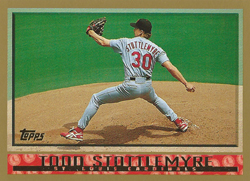
Valuing a mentor who could help him develop into a consistently productive starting pitcher, Todd Stottlemyre sought a trade from the Athletics to either the Yankees or the Cardinals.

todd_stottlemyre2His father, Mel, was pitching coach of the Yankees. Dave Duncan, who had served as somewhat of a surrogate father to Todd with the Athletics, was pitching coach of the Cardinals.

On Jan. 9, 1996, the Athletics honored his request, trading Stottlemyre to the Cardinals for outfielder Allen Battle and pitchers Carl Dale, Bret Wagner and Jay Witasick.

Stottlemyre, 30, joined free-agent acquisition Andy Benes as right-handers who bolstered a 1996 Cardinals rotation that included holdovers Donovan Osborne, Alan Benes and Mike Morgan.

Bernie Miklasz, columnist of the St. Louis Post-Dispatch, wrote, “The Cardinals have actually recruited starting pitchers who can throw fastballs by hitters.”

Stottlemyre certainly could do that. In 1995, he ranked first among American League right-handers in strikeouts. One reason he wanted to join the Cardinals was because Duncan was helping him learn to throw more than a fastball.

Bound for Blue Jays

Todd Stottlemyre, whose father started three games against the Cardinals’ Bob Gibson in the 1964 World Series, was drafted by St. Louis in 1985, but didn’t sign. He was chosen in a later draft by the Blue Jays and signed with them.

Stottlemyre debuted in the big leagues with the 1988 Blue Jays. He helped Toronto win consecutive World Series championships in 1992-93 and achieved double-digit win totals in four consecutive seasons (1990-93), but he had winning records in just two of seven years with the Blue Jays and overall was 69-70.

After the 1994 season, Stottlemyre became a free agent and signed with the Athletics, who had Tony La Russa as manager and Duncan as pitching coach. Stottlemyre posted a 14-7 record and 4.55 ERA for them. He struck out 205 in 209.2 innings. Among American League pitchers in 1995, only left-hander Randy Johnson of the Mariners struck out more batters.

Stottlemyre credited Duncan and La Russa with his development in Oakland. “I felt I took another step toward being able to pitch to my capability,” Stottlemyre said. “I felt I was more in control of myself throughout more ballgames … I’ve been able to get control of my curveball and changeup and off-speed pitches instead of just being a fastball, slideball pitcher.”

In an interview with Cardinals Magazine, Stottlemyre said, “Duncan has helped me to realize there’s more to pitching than rearing back and throwing the fastball as hard as you can. It’s been fun for me.”

Meet me in St. Louis

After the 1995 season, La Russa left the Athletics to become Cardinals manager and Duncan joined him as pitching coach. That’s when St. Louis became an attractive destination point for Stottlemyre.

“We feel his best years are ahead of him,” Duncan said. “Last year, he made tremendous progress as a pitcher. Consistency was the key with him.”

La Russa told Cardinals Magazine, “He’s a terrific competitor and that’s something you can never have enough of.”

The Athletics, looking to rebuild after finishing in last place in the American League West in 1995, were willing to trade Stottlemyre to restock their roster.

“He wanted to be elsewhere and it made sense for him to be elsewhere if we could get some value in return,” Athletics general manager Sandy Alderson told the San Francisco Chronicle.

Mike Jorgensen, Cardinals director of player development, said all three pitchers dealt to the Athletics were big-league prospects. “When you go shopping in the high-rent district, you know it’s going to be expensive,” Jorgensen said to the Post-Dispatch.

Consistent Cardinal

The trade benefitted the Cardinals more than it did the Athletics.

Stottlemyre was 14-11 with a 3.87 ERA in helping the 1996 Cardinals win the National League Central title. He led the 1996 Cardinals in strikeouts (194), complete games (five) and shutouts (two) and was second in wins.

Stottlemyre was 12-9 with a 3.88 ERA for the 1997 Cardinals and 9-9 with a 3.51 ERA for the 1998 Cardinals before he was traded with shortstop Royce Clayton to the Rangers for third baseman Fernando Tatis, pitcher Darren Oliver and outfielder Mark Little on July 31, 1998.

With St. Louis, Stottlemyre had three consecutive seasons with ERAs below 4.00 for the only time in his big-league career.

In his book, “Pride and Pinstripes,” Mel Stottlemyre said his son Todd took a while to realize his potential and believed it was because of the personal burden Todd carried after the death of his younger brother, Jason. Todd was the donor when Jason had a bone marrow transplant.

“After Jason died, it was almost like Todd wanted to lash out at the world, take out his anger on everybody else,” Mel Stottlemyre said. “He competed so hard that he was always at full throttle, and you can’t pitch that way all the time. He was fearless on the mound, which is important, but he was also pretty high-strung, always ready to fight, figuratively, if not literally.”

Of the four players traded by the Cardinals for Stottlemyre, only Witasick contributed much to the Athletics. In two stints with Oakland, Witasick was 5-5 with a 5.26 ERA. He pitched 12 years in the big leagues, appearing in the 2001 World Series with the Yankees and the 2002 World Series with the Giants.

Read Full Post »

Fed up with contract hassles and uneasy with the prospect of playing for manager Eddie Dyer, Walker Cooper, the best catcher in the National League, wanted out of St. Louis. Seeing a surplus of suitors causing Cooper’s market value to skyrocket, Cardinals owner Sam Breadon was willing to accommodate him.

walker_cooper2On Jan. 5, 1946, the Cardinals sent Cooper to the Giants for $175,000.
The cash amount was the third-largest paid by a club to acquire a player, according to media reports at that time.

(In 1934, the Red Sox sent $250,000 and shortstop Lyn Lary to the Senators for shortstop Joe Cronin. In 1938, the Cubs gave $185,000, plus pitchers Curt Davis and Clyde Shoun and outfielder Tuck Stainback, to the Cardinals for pitcher Dizzy Dean.)

“I decided Cooper wasn’t satisfied here and would do better elsewhere,” Breadon said. “But get me right: Walker was a great player here and I consider him the greatest catcher in the majors since Bill Dickey of the Yankees was a young man.”

In the short term, the trade didn’t hurt the Cardinals. Without Cooper, they won the 1946 World Series championship.

In the long run, losing Cooper was a factor in the erosion of the Cardinals, who went 18 years before winning another World Series crown.

3-time all-star

Along with his brother Mort, a starting pitcher, Walker Cooper was a key player on Cardinals clubs that won three consecutive NL pennants and two World Series titles from 1942-44.

He was named an all-star catcher in each of those three seasons. His numbers:

_ 1942: Batted .281 with 32 doubles and 65 RBI. Ranked second among NL catchers in assists (62) and runners caught attempting to steal (58 percent). Batted .286 in the World Series.

_ 1943: Batted .318 with 30 doubles and 81 RBI. Caught 48 percent of runners attempting to steal. Batted .294 in the World Series.

_ 1944: Batted .317 with 25 doubles and 72 RBI. Caught 43 percent of runners attempting to steal. Batted .318 in the World Series.

Cooper also was touted for game-calling skills. “He’s the best fellow handling young pitchers I have ever seen,” said Coaker Triplett, a Cardinals outfielder from 1941-43.

Feuding with front office

The relationship between Cooper and the Cardinals soured in 1945.

In spring training, Mort Cooper demanded a $15,000 contract. Breadon refused. In protest, Mort Cooper and Walker Cooper left camp and threatened to boycott the Cardinals’ opening series against the Cubs.

The brothers gave in and were with the club on Opening Day. Soon after, Walker Cooper was inducted into the Navy after playing four April games for the 1945 Cardinals. A month later, Mort Cooper was traded to the Braves.

While serving his Navy stint in 1945, Walker Cooper remained miffed at Cardinals management for the contract dispute and for dealing his brother.

Trade me

In October 1945, Walker Cooper called Breadon and requested a trade, the Cardinals owner told The Sporting News.

Cooper confirmed to the Associated Press he had asked to be traded.

A month later, Cardinals manager Billy Southworth resigned and joined the Braves. Breadon replaced Southworth with Dyer. Cooper again contacted the Cardinals and “said he would rather not play under Dyer,” Breadon said.

Cooper’s problem with Dyer occurred when both were with the Cardinals’ Houston farm club during spring training in 1939. Cooper apparently clashed with Dyer, who had replaced Ira Smith as manager. Cooper was shipped to the Cardinals’ Asheville, N.C., affiliate.

“(Dyer) said there had been differences with Cooper in Houston, but he believed they could be ironed out,” Breadon said. “He felt a player didn’t have to like him personally if he played good ball for his team.”

Said Dyer: “I have always been able to get along with any ballplayer and I could have gotten along with Cooper, whom I consider the best catcher in baseball.”

In his book “Stan Musial: The Man’s Own Story,” Musial said, “Breadon said Coop didn’t want to play for Dyer, but the boss gave (Dyer) no chance to talk to the catcher. The truth is, Mr. Breadon was annoyed at the Cooper boys for squabbling over salaries.”

Money talks

At the baseball winter meetings in December 1945, at least five clubs inquired about Cooper, with the Giants, Braves and Phillies making the most lucrative offers.

The Cardinals asked the Giants for $150,000 and three players. A few weeks later, the trade came together when the Giants offered to increase the cash amount to $175,000 if the Cardinals would drop their demand for players.

The transaction was announced three days before Cooper turned 31. It “kicked up more commotion among Polo Grounds customers than any deal since Frank Frisch was traded for Rogers Hornsby in 1926,” wrote The Sporting News.

Cooper was released from the Navy on April 2, 1946, and debuted with the Giants about two weeks later.

Looking back

His first season with New York was a dud. Cooper hit .268 with 46 RBI for a 1946 Giants team that finished in last place at 61-93. The 1946 Cardinals, using a platoon of Joe Garagiola and Del Rice at catcher, finished in first place at 98-58.

Cooper did better for the 1947 Giants, hitting .305 with 35 homers and 122 RBI.

After stints with the Reds, Braves, Pirates and Cubs, Cooper finished his career as a backup catcher for the 1956-57 Cardinals.

Neither Garagiola nor Rice performed at the level Cooper had for St. Louis.

In his book “Musial: From Stash to Stan the Man,” author James N. Giglio wrote, “Both Musial and (Enos) Slaughter rightly contended that the loss of Cooper cost the Redbirds several pennants.”

In choosing his all-time NL all-star team, Musial picked Dodgers catcher Roy Campanella “in a photo finish with Walker Cooper.”

Comparing the Cooper deal with the 1941 trade of St. Louis slugger Johnny Mize to the Giants, Musial said, “Big Coop’s sale by the Cardinals probably was even worse than the loss of Johnny Mize.”

Read Full Post »

(Updated March 18, 2022)

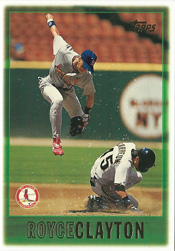
Seeking a replacement for Ozzie Smith, the Cardinals needed a shortstop who possessed exceptional fielding skills, self-confidence and diplomacy. They chose Royce Clayton.

royce_claytonOn Dec. 14, 1995, the Cardinals traded pitchers Allen Watson, Rich DeLucia and Doug Creek to the Giants for Clayton and minor-league second baseman Chris Wimmer.

The Cardinals figured they no longer could count on Smith to be their shortstop. Smith, who turned 41 in December 1995, had been limited to 41 starts during the 1995 season because of a shoulder injury.

Two free-agent shortstops _ Greg Gagne and Walt Weiss _ had been pursued by the Cardinals, but were reluctant to succeed Smith. The Cardinals also had talked with the Athletics about a trade for shortstop Mike Bordick, the St. Louis Post-Dispatch reported.

In early December 1995, the Cardinals intensified their efforts to obtain Clayton.

Heir apparent

Clayton, who turned 26 three weeks after the Cardinals acquired him, was “one of the top two or three shortstops in our league,” Cardinals general manager Walt Jocketty said.

“The Ozzie Smith Era didn’t end officially, but it might as well have,” Post-Dispatch writer Rick Hummel surmised in his report about the trade.

Jocketty said the starting shortstop would be determined during spring training. “It seemed clear, though, that the Cardinals did not acquire Clayton to be a backup,” Hummel wrote.

Post-Dispatch columnist Bernie Miklasz concluded the Cardinals “made a good trade” and urged them to declare Clayton the starter.

“The Cardinals didn’t send three pitchers to San Francisco so they could park Clayton in the dugout,” Miklasz wrote. “He’s taking over, so be straight with the fans, be straight with Ozzie. Clayton is the shortstop. That’s the obvious reality. Adults can handle it, and Ozzie will have to deal with it.”

Smith, though, had no plans to retire or accept a shift to second base. He also didn’t want to relinquish the starting shortstop spot.

Asked about manager Tony La Russa’s statement that an “open competition” would be held for the shortstop job, Smith told Hummel, “”What I’ve done over 18 years speaks for itself. But they seem to have made decisions already. Baseball is a challenge and adversity also is part of the challenge. True champions have a way of dealing with adversity. And I look at myself that way. We’ll deal with this head-on and see what happens.”

Said Clayton after the trade: “I have the utmost respect for Ozzie. I feel honored asked to be coming in after Ozzie. If he decides to stick around, it can be nothing but a positive situation.”

Ozzie fan

In 1982, when Clayton was 12, his father took him to see Smith play for the Cardinals at Dodger Stadium.

“When we left the game that night, I told my dad I wanted to play shortstop like Ozzie,” Clayton said. “God blessed me. Now, playing in the same uniform with him is like a dream.”

Clayton debuted with the Giants in 1991 and became their everyday shortstop in 1992, replacing a former Cardinal, Jose Uribe.

With the 1995 Giants, Clayton led NL shortstops in games (136), putouts (223) and assists (411). He produced 29 doubles, 58 RBI and 24 stolen bases. His batting average, though, was .244 and his on-base percentage was a measly .298. He struck out a team-high 109 times.

“Clayton is a phenomenal defensive shortstop _ maybe the best in San Francisco Giants history _ but his bat may never come around,” wrote Tim Keown of the San Francisco Chronicle.

Clayton said his 1995 batting average was low because he was under orders to focus on RBI. Keown conceded “Clayton may also benefit from a breakup with (Giants) hitting coach Bobby Bonds. The relationship hasn’t done much for either man’s career.”

Said Giants manager Dusty Baker of Clayton: “He’s going to a great manager in Tony and an outstanding batting instructor in George Hendrick. I hope the city of St. Louis gives Royce a chance to be Royce. It’s hard to follow a superstar. A lot of times, they expect to see a reincarnation of Ozzie.”

Tony tabs Clayton

As Baker predicted, Clayton clicked with Hendrick at Cardinals training camp in spring 1996. “I’ve learned more from George in spring training than I have in my whole career,” Clayton told Cardinals Magazine. “It’s really unbelievable.”

Hendrick said, “Royce is a very intelligent young man and those kinds of guys are normally very easy to work with. I don’t try to change anybody. I just try to alert them to how pitchers are getting them out and give them an approach as to what the pitchers are trying to do to them.”

At the end of spring training, Smith thought he had performed better than Clayton, but Smith was held out of the Opening Day lineup because of a hamstring injury.

La Russa started Clayton in the first six games of the 1996 season, all on the road, and gave Smith the start in the Cardinals’ home opener. Still hampered by a sore hamstring, Smith went on the 15-day disabled list after that game.

By the time Smith was activated, Clayton was established as the shortstop.

Clayton started in 111 games for the 1996 Cardinals, made 15 errors and had a fielding percentage of .972. He hit .277 with 33 stolen bases.

Smith started in 50 games for the 1996 Cardinals, made eight errors and had a fielding percentage of .969. He hit .282 with seven stolen bases.

All three pitchers acquired by the Giants in the deal for Clayton struggled in 1996. Their numbers: Watson (8-12, 4.61 ERA in 29 games), DeLucia (3-6, 5.84 ERA in 56 games) and Creek (0-2, 6.52 ERA in 63 games).

Smith retired after the 1996 season and was inducted into the National Baseball Hall of Fame in 2002.

In 1997, Clayton had a stellar season for the Cardinals. He was named an all-star, led NL shortstops in assists and hit .266 with 39 doubles, 61 RBI and 30 steals.

On July 31, 1998, Clayton and pitcher Todd Stottlemyre were traded by the Cardinals to the Rangers for third baseman Fernando Tatis, pitcher Darren Oliver and outfielder Mark Little. In three seasons with St. Louis, Clayton batted .262 with 372 hits in 373 games.


Read Full Post »

Heading into the 1985 winter meetings, the Cardinals were willing to trade ace Joaquin Andujar for either a left-handed starting pitcher or a first-string catcher. They found a club willing to give them both.

joaquin_andujar8On Dec. 10, 1985, the defending National League champion Cardinals dealt Andujar to the Athletics for catcher Mike Heath and pitcher Tim Conroy.

Heath, 30, was acquired to replace Darrell Porter, who had been released. Conroy, 25, was expected to compete for a spot in the Cardinals’ 1986 rotation alongside John Tudor, Danny Cox, Bob Forsch and Kurt Kepshire.

Neither Heath nor Conroy worked out the way the Cardinals had hoped and Andujar never achieved with the Athletics the success he had with St. Louis.

Behind the numbers

Though Andujar, 32, had an impressive regular season for the 1985 Cardinals _ 21-12 record with 10 complete games and 269.2 innings pitched _ his performance in the second half and in the postseason triggered concern.

For example:

_ Andujar was 1-3 with a 5.30 ERA in six September starts in 1985 and 0-2 with a 7.88 ERA in two regular-season October starts.

_ In the NL Championship Series against the Dodgers, Andujar was 0-1 with a 6.97 ERA in two starts. In the World Series versus the Royals, he made two appearances and was 0-1 with a 9.00 ERA.

_ He had a meltdown in Game 7 of the World Series, getting into a confrontation with home plate umpire Don Denkinger and being ejected. Peter Ueberroth, commissioner of baseball, suspended Andujar for the first 10 games of the 1986 season. Video at the 1:38 mark

Look the other way

At home in the Dominican Republic, Andujar told Braves shortstop Rafael Ramirez that people from Anheuser-Busch, the brewery that owned the Cardinals, called him and said he’d never pitch for the club again, columnist Peter Gammons reported in The Sporting News.

Dal Maxvill, Cardinals general manager, denied being told to trade Andujar. “There has not been interference from above,” Maxvill said to The Sporting News.

In comments about Andujar to St. Louis reporter Rick Hummel, Maxvill added, “I know he’s kind of crazy and I know he’s unusual, but you have to look the other way when the performance is there.”

In his 1987 book “White Rat: A Life in Baseball,” Cardinals manager Whitey Herzog admitted, “It’s been reported that Maxvill and I were ordered to trade Joaquin and I won’t deny that. I will say, though, that he might well have been traded anyway. The other players were tired of his griping and his bitching. It had gotten to the point where he was dividing the clubhouse.”

No deal

The White Sox approached the Cardinals and proposed a deal of left-handed starter Britt Burns for Andujar and pitcher Ricky Horton. Burns was 18-11 for the 1985 White Sox. The Cardinals, however, “backed off because they were concerned about a hip injury of which Burns complains,” Hummel reported.

The Cardinals approached the Red Sox and offered Andujar, Horton, Kepshire and reliever Jeff Lahti for left-handed starter Bruce Hurst, who was 11-13 for Boston in 1985.

The Red Sox rejected the offer because they were given “an immediate take-it-or-leave-it deadline” by the Cardinals and they “were afraid of taking on Andujar” and his problems, Gammons reported.

Headcases OK

The Athletics were seeking a proven winner for their rotation. They offered their starting catcher, Heath, and one selection from a pool of pitchers. The Cardinals chose Conroy.

To the Athletics, Andujar’s pitching trumped his image.

“There’s nothing wrong with a headcase or two _ as long as you don’t have eight,” Sandy Alderson, Athletics general manager, told the Sacramento Bee. “This was not a multi-headcase deal.”

To the San Jose Mercury News, Alderson said, “Flamboyance is not criminal.”

Herzog had advice for Athletics pitching coach Wes Stock, who had been Herzog’s teammate with the Orioles. “Whitey told me Joaquin still needs to be coddled,” Stock said. “He told me not to forget that.”

Asked his reaction to the trade, Andujar told St. Louis radio station KMOX, “I feel surprised. Like I always said, I wanted to die in St. Louis … I leave my heart in St. Louis.”

Unhappy Heath

Heath hit .250 with 13 home runs and 55 RBI for the 1985 Athletics. He caught 38 percent of runners attempting to steal.

According to The Sporting News, Heath asked to be traded. He feuded with Oakland management after being told he’d play only versus left-handed pitching in 1986.

“I felt I was an everyday player and I felt I would not be happy,” Heath said.

In a parting shot at the Athletics, Heath added, “When Mike Heath steps on the field, his No. 1 objective is to win. No. 2 is to win and No. 3 is to win. With the A’s, No. 1 was being compatible and No. 2 was winning.”

Change for Conroy

Conroy was 0-1 with a 4.26 ERA in 16 games for the 1985 Athletics. At Class AAA Tacoma that season, Conroy was 11-3 in 22 starts.

A first-round selection of the Athletics in the 1978 draft, Conroy made his major-league debut at age 18. In five seasons with the Athletics, Conroy was 10-19 with a 4.37 ERA.

“We probably pushed him too quickly,” Alderson said.

Conroy “had to get out of our organization … The mental strain had become too great,” Stock told the San Francisco Chronicle.

Said Herzog: “We’ve liked Conroy for a long time … We feel he was rushed in Oakland and was under too much pressure to succeed.”

The results

Heath hit .205 with four home runs and 25 RBI for the 1986 Cardinals. He caught 33 percent of runners attempting to steal.

On Aug. 10, 1986, the Cardinals traded Heath to the Tigers for pitcher Ken Hill and first baseman Mike Laga.

Conroy was 5-11 with a 5.23 ERA in 25 appearances for the 1986 Cardinals. He was 3-2 with a 5.53 ERA for St. Louis in 1987, his last big-league season. In two years with the Cardinals, Conroy was 8-13 with a 5.31 ERA.

Andujar was 12-7 with a 3.82 ERA in 28 appearances for the 1986 Athletics. He was 3-5 with a 6.08 ERA for Oakland in 1987. In two seasons with the Athletics, Andujar was 15-12 with a 4.46 ERA.

Previously: How Hub Kittle got Joaquin Andujar to Cardinals

Read Full Post »

Enticed by the chance to add a left-hander to the starting rotation and a potential power hitter to the batting order, the Cardinals gave up a Gold Glove Award winner at third base.

ken_reitzThe deal didn’t work out the way either the Cardinals or Giants envisioned.

On Dec. 8, 1975, the Cardinals traded third baseman Ken Reitz to the Giants for pitcher Pete Falcone.

Though Reitz had been awarded the National League Gold Glove for his defensive work at third base in 1975, the Cardinals thought he was expendable because of the availability of Hector Cruz, who had excelled as a slugging third baseman for manager Ken Boyer at Class AAA Tulsa.

When Boyer, a five-time Gold Glove winner and seven-time all-star as a Cardinals third baseman, endorsed Cruz, the Cardinals were confident in dealing Reitz.

“Boyer is very high on Cruz,” Cardinals general manager Bing Devine said to the Associated Press.

Carpet cleaner

Reitz debuted with the Cardinals in 1972 and was their everyday third baseman from 1973-75. He led NL third basemen in fielding percentage in 1973 and 1974.

Mike Shannon, a Cardinals broadcaster and former third baseman, dubbed Reitz “Zamboni” because, like the machine, he cleaned up everything in his path on the artificial turf carpet at Busch Stadium in St. Louis.

The Sporting News praised Reitz for having “quick hands, an extremely accurate arm, superb lateral movement.”

Reitz, 24, committed 23 errors in 1975. Noting that only eight of those errors allowed scoring or led to scoring, The Sporting News wrote that Reitz’s “great stops and throws helped save many a game” and he “has displayed the same knack shown by such former Cardinals as Ken Boyer, Julian Javier and Dal Maxvill. They rarely killed you with an error in a tight situation.”

Reitz hit .269 for the 1975 Cardinals, with five home runs and 63 RBI.

Top prospect

In contrast, Cruz, 22, batted .306 with 29 home runs and 116 RBI in 115 games for Tulsa in 1975. He made 17 errors in 289 chances at third base.

Cruz, whose brothers Jose and Tommy had been Cardinals outfielders, was named winner of the 1975 Most Valuable Player Award in the American Association and Minor League Player of the Year by The Sporting News.

“He has been the best ballplayer in the minor leagues the past two years,” said Cardinals manager Red Schoendienst.

Devine told United Press International: “We feel he’s ready.”

Falcone fits

The Cardinals saw the Giants as an ideal trade partner. The Giants needed a third baseman and they had starting pitching depth.

Falcone, 22, debuted with the Giants in 1975, posting a 12-11 record and 4.17 ERA in 32 starts. He struck out 131 and issued a team-high 111 walks.

The Cardinals’ only other potential left-handed starter was John Curtis. The Cardinals envisioned Falcone joining a 1976 rotation with Bob Forsch, John Denny, Lynn McGlothen and either Eric Rasmussen or Curtis.

“We didn’t have any good left-hand pitching prospects in the minor leagues,” said Schoendienst. “We hope to start Falcone. That’s what we acquired him for.”

The Giants were seeking a defensive upgrade at third base. Their primary starter in 1975, Steve Ontiveros, hit .289 but committed 21 errors in 89 games at third base.

Jerry Donovan, assistant to Giants owner Horace Stoneham, said, “We haven’t had a third baseman since Jimmy Davenport retired (in 1970).”

Donovan, who engineered the trade with Devine, added, “We hated to give up Pete, but we needed a third baseman badly. The Cards insisted on Falcone if we were to make the deal.”

Giants fan

Reitz was born in San Francisco and grew up in nearby Daly City. As a youth, he would scale a fence to get into Giants games at Candlestick Park. He watched as many as 60 games a season there, according to the Oakland Tribune.

His favorite player was first baseman Willie McCovey. Like McCovey with the Giants, Reitz wore No. 44 with the Cardinals.

Still, Reitz was stunned and initially disappointed to be traded. He and his wife had bought a house in St. Louis.

“I thought they’d stick with me for a couple of more years at least,” said Reitz. “I thought there was maybe one chance in 100 that I’d be traded.”

Falcone was working an off-season job as a salesman in the New York garment center while staying with his parents in Brooklyn.

“When I first learned about (the trade), I was a little mad,” said Falcone. “It was a shock. Now that I’ve thought it all over, I kind of like the idea of going to St. Louis and getting out of the cold and fog.”

How they fared

In 1976, Falcone was 12-16 with a 3.23 ERA in 32 starts for St. Louis. He led the 1976 Cardinals in strikeouts (138) and innings pitched (212) and was second in wins.

After beating the Reds on a five-hitter on Aug. 24, he was 11-11 with a 3.29 ERA, but he lost five of his last six decisions while lowering his ERA to 3.23.

Cruz hit .228 with 13 home runs and 71 RBI with a team-high 119 strikeouts for the 1976 Cardinals. He made a NL-leading 26 errors at third base.

Reitz made 19 errors in 155 games at third base for the 1976 Giants. He hit .267 with five home runs and grounded into 24 double plays.

Return to sender

After the 1976 season, the Giants traded Reitz to the Cardinals for McGlothen.

The Cardinals moved Cruz to right field. He hit .236 with six home runs in 1977 and was traded after the season with catcher Dave Rader to the Cubs for outfielder Jerry Morales and catcher Steve Swisher.

Falcone had terrible second and third seasons with the Cardinals _ 4-8 with a 5.44 ERA in 1977 and 2-7 with a 5.76 ERA in 1978 _ and was traded to the Mets in December 1978 for outfielder Tom Grieve and pitcher Kim Seaman.

Reitz remained the Cardinals’ third baseman through 1980. He was traded with first baseman Leon Durham and third baseman Ty Waller to the Cubs for reliever Bruce Sutter in December 1980. Ken Oberkfell replaced Reitz at third base.

Read Full Post »

« Newer Posts - Older Posts »