Feeds:
Posts
Comments

Archive for the ‘Trades’ Category

(Updated March 12, 2023)

The Cardinals acquired Jose Oquendo with the idea he would become the eventual replacement for Ozzie Smith at shortstop. Instead, Oquendo became their second baseman and paired with Smith to form a top keystone combination.
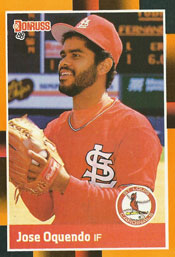
jose_oquendo5On April 2, 1985, the Cardinals got Oquendo from the Mets in the first trade engineered by general manager Dal Maxvill.

Maxvill knew what it took to play shortstop, having been the Cardinals’ starter at that position on pennant-winning clubs in 1967 and 1968. Like Maxvill, Smith was a Gold Glove Award winner. Like Maxvill in 1967, Smith helped the 1982 Cardinals to a pennant and World Series title.

The Cardinals wanted Smith to remain their shortstop, but he was eligible to become a free agent after the 1985 season. If Smith and the Cardinals were unable to negotiate a contract extension, Maxvill was prepared to trade him.

Shoring up shortstop

A headline in an April 1985 edition of The Sporting News declared, “Cardinals Admit Ozzie May Be Dealt.”

“If we can’t sign him, there’s got to be some thought about trading him,” said Fred Kuhlmann, Cardinals chief operating officer.

Said Smith: “A trade is a possibility.”

Also, Smith had a serious shoulder injury (a torn rotator cuff) in 1985. Smith wanted to let the injury heal naturally rather than undergo surgery, so the Cardinals were concerned whether he could make it through the season.

The Cardinals, though, had no suitable replacement for Smith.

That’s when Maxvill went to work.

The Cardinals dealt shortstop Angel Salazar, whom they had acquired from the Expos three months earlier, and minor-league pitcher John Young to the Mets for Oquendo and minor-league pitcher Mark Davis. Four days later, April 6, 1985, the Cardinals got veteran shortstop Ivan DeJesus and reliever Bill Campbell from the Phillies for reliever Dave Rucker.

Maxvill saw DeJesus, 32, as the stopgap and Oquendo, 21, as the long-term answer at shortstop if Smith was traded or couldn’t overcome the bum shoulder.

“You have to prepare yourself for any eventuality,” Maxvill said. “I looked in our system and there was nothing there at shortstop. You have to backstop yourself whether (Smith) is here or not.”

Mets prospect

Oquendo was 15 when he signed with the Mets as an amateur free agent in 1979 and made his professional debut that year with their Class A affiliate, the Grays Harbor Loggers of Aberdeen, Wash., in the Northwest League. He made 40 errors in 63 games at shortstop that season.

Four years later, Oquendo, 19, became the starting shortstop for the 1983 Mets under manager George Bamberger.

In 1984, the Mets were managed by Davey Johnson. He saw Rafael Santana, a former Cardinal, and Ron Gardenhire as shortstop options.

“Johnson felt Oquendo had to be a better hitter,” The Sporting News wrote. “He also was less enamored of Oquendo’s fielding than that of other shortstops in the organization.”

Smith stays

Maxvill was more impressed with Oquendo than Johnson was. (After the deal was made, Johnson learned Gardenhire had back problems. “If I had known about this,” said Johnson, “Jose Oquendo might still be here.”)

The Cardinals assigned Oquendo to Class AAA Louisville.

“You can look for the Wizard to pack his bags any day now,” Bill Conlin, a columnist for The Sporting News, wrote of Smith after the Cardinals got Oquendo and DeJesus.

Instead, on April 15, hours before the Cardinals played their 1985 home opener that night against the Expos, Smith agreed to a four-year contract extension to remain with St. Louis.

The deal was worth $8.7 million. Smith received a $700,000 signing bonus and salaries of $1.8 million a year in 1986 and 1987 and $2.2 million a year in 1988 and 1989, The Sporting News reported. Also, the Cardinals provided Smith a $500,000 loan at 10 percent interest and Anheuser-Busch promised him consideration for a wholesale beer distributorship.

Smith played the entire 1985 season despite the bad shoulder. He would play for the Cardinals through the 1996 season before retiring.

Shift to second

Oquendo spent the 1985 season with Louisville. His manager was Jim Fregosi, who had been an all-star shortstop with the Angels. Oquendo hit .211 in 133 games for Louisville and made 23 errors at shortstop.

In 1986, Oquendo stuck with the Cardinals as a backup to Smith at shortstop and to Tommy Herr at second base. He hit .297 in 76 games, establishing himself as a valuable utility player.

After Herr was traded to the Twins in 1988, Oquendo became the Cardinals’ starter in 1989. He led National League second basemen in fielding percentage in 1989 (.994) and 1990 (.996).

In 10 seasons with the Cardinals (1986-1995), Oquendo hit .264 with an on-base percentage of .359. In 1989, he was eighth in the NL in batting at .291.
Read Full Post »

The Cardinals traded two all-star infielders, first baseman Bill White and shortstop Dick Groat, to acquire Alex Johnson and told Lou Brock to shift outfield positions to accommodate the heralded newcomer.

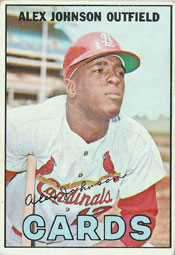
alex_johnsonJohnson never fulfilled his potential with St. Louis. Instead of joining Brock and Curt Flood as an outfield regular, Johnson got demoted to the minors in his first Cardinals season and backed up Roger Maris in his second and last year with St. Louis.

Phillies phenom

At 21, Johnson debuted in the big leagues with the 1964 Phillies. He hit .296 in two seasons with Philadelphia.

Cardinals general manager Bob Howsam envisioned Johnson as an ideal fit to join Brock and Flood in forming a fleet, productive St. Louis outfield.

On Oct. 27, 1965, the Cardinals dealt White, Groat and catcher Bob Uecker to the Phillies for Johnson, catcher Pat Corrales and pitcher Art Mahaffey.

White was a five-time all-star who hit .298 and won the Gold Glove Award six times. In three years with St. Louis, Groat was a two-time all-star who batted .289. Both were key contributors to the Cardinals’ World Series championship season in 1964.

Power potential

“We expect Johnson to hit the long ball for us,” Howsam told The Sporting News. “Playing everyday instead of just against left-handed pitchers, he may even surpass White in long-ball hitting over the full season.”

Said Cardinals vice president Stan Musial, who was consulted by Howsam before the deal was made: “Over the long haul is what we’re thinking about. We’re trying to analyze our team better and it’s a switch to the youth system.”

The Cardinals believed Johnson would hit for a higher average and had more speed than Mike Shannon, their right fielder in 1964 and 1965.

Johnson hit .307 against left-handed pitching for the 1965 Phillies. He also hit .424 in 11 games versus the Cardinals that season.

Move over, Lou

Johnson reported to the Cardinals’ Florida Instructional League camp at St. Petersburg and worked with manager Red Schoendienst and coach Dick Sisler. “He has a better arm than I thought he did,” Schoendienst said.

The Cardinals decided to shift Brock from left to right and start Johnson in left, with Flood in center. Shannon was relegated to a reserve role. “I know the Cardinals made a big deal to get Johnson, but all I want is a chance,” Shannon said. “… I think I can hit .300. I’m strong. I can run and I’ve got good power.”

Johnson hit .286 in spring training and opened the 1966 regular season as the left fielder. He started each of the Cardinals’ first 20 games and hit .195. The Cardinals’ record was 8-12 and Johnson received part of the blame. “It’s not the pitchers getting me out,” Johnson said. “I’ve been getting myself out. I’ve been going for the long taters.”

On May 8, 1966, the Cardinals played their final game at Busch Stadium, formerly Sportsman’s Park. Johnson had the last at-bat and hit into a game-ending double play. Boxscore

Four days later, the Cardinals played their first game at the new Busch Memorial Stadium. Johnson started in left field and was 1-for-4 with a run scored. Boxscore

On May 18, 1966, the Cardinals sent Johnson to Class AAA Tulsa and called up outfielder Bobby Tolan. Brock returned to left field and Shannon took over in right.

In 25 games with the Cardinals, Johnson batted .186 with two home runs.

“Johnson appeared overmatched in his first opportunity at a regular job.” The Sporting News declared. “He has plenty of raw talent and good speed. There is considerable hope for him, especially if he can develop the ability to learn from coaches both in the minors and in the majors. He has not adapted well to instruction and he has been easy to pitch to.”

At Tulsa, Johnson prospered under manager Charlie Metro, batting .355 with 104 hits in 80 games.

Carlton to Cubs?

After the 1966 season, Howsam agreed to a proposed deal to send Johnson, Tolan and pitchers Steve Carlton and Nelson Briles to the Cubs for outfielder Billy Williams, The Sporting News reported. The trade was vetoed by Cardinals “super brass,” who presumably included Musial. “We needed a lefthanded-hitting outfielder and we went after (Billy) Williams,” Musial confirmed.

After the proposed trade was nixed, Howsam dealt third baseman Charlie Smith to the Yankees for outfielder Roger Maris. Soon after, Howsam resigned to become general manager of the Reds and was replaced by Musial.

In spring training, the Cardinals assigned hitting instructor Joe Medwick to work with Johnson. “I told him, ‘The only guy who is keeping you down is yourself. You’ve got all the equipment,’ ” Medwick said. “Alex was pulling too many pitches.”

Some thought Johnson and Maris would platoon in right field for the 1967 Cardinals. Maris, though, won the job outright, with Shannon replacing Smith at third base and Johnson taking a reserve outfield role.

In May 1967, The Sporting News reported Johnson was “swinging at too many bad balls and fouling off too many good ones.” Musial “had tried hard to deal Johnson to an American League club, but there were no takers.”

Johnson hit .223 with one home run in 81 games for the 1967 Cardinals, who won the National League pennant. He didn’t appear in the World Series against the Red Sox.

After the Cardinals won the championship, Musial resigned in triumph and was replaced by Bing Devine, in his second stint as St. Louis general manager. Devine’s first trade was to send Johnson to the Reds for outfielder Dick Simpson on Jan.11, 1968.

In two seasons with the Cardinals, Johnson hit .211 in 106 games with three home runs and 18 RBI. “Alex just might put everything together one of these days and become quite a ballplayer,” Schoendienst said.

Red was right

Reunited with Howsam and Metro (who had become a Reds scout), Johnson hit .313 with 146 RBI in two seasons with Cincinnati.

Traded to the Angels, Johnson was the 1970 American League batting champion, hitting .329, but his career continued to be marred by controversy and accusations of an indifferent attitude.

Said Cardinals coach Dick Sisler: “The tag on Johnson is that he will not accept advice from a manager or a competent coach. He easily could have become a great Cardinal player, but he showed no interest.”

In 13 years with the Phillies, Cardinals, Reds, Angels, Indians, Rangers, Yankees and Tigers, Johnson batted .288 with 1,331 hits.

Previously: Here’s how Mike Shannon became a Cardinals catcher

Previously: Bill White: We thought Lou Brock deal was nuts

Previously: How Charlie Metro miffed Stan Musial

Read Full Post »

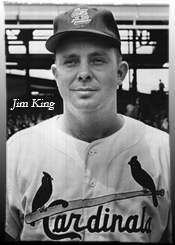
Jim King spent five years in the Cardinals organization, learning from the likes of George Kissell and Johnny Keane, but he twice departed and never got much of a chance to make an impact with St. Louis at the big-league level.

jim_kingKing, an outfielder who started in the first big-league game played in California, spent 11 seasons in the majors, primarily with the Senators.

After making his professional debut at 17 in 1950 with the independent Vernon Dusters of the Class D Longhorn League, King was signed by the Cardinals. He played in the St. Louis minor-league system from 1951-54, including two stints with Omaha clubs managed by Kissell, the franchise’s iconic instructor.

In 1954, King had his best season in the Cardinals organization, hitting .314 with 31 doubles and 25 home runs for Omaha. King, who had a strong arm, also contributed 19 outfield assists.

Courted by Cubs

King caught the attention of Wid Matthews, director of personnel for the Cubs, and on Nov. 22, 1954, the Cubs claimed King from the Cardinals in the minor-league draft.

King made his major-league debut with the Cubs in 1955 and played for them for two seasons.

In 1957, Cubs general manager John Holland was seeking to overhaul the roster. Cardinals general manager Frank Lane was seeking a left-handed pull hitter who could benefit from the Busch Stadium dimensions. The distance along the right field line from home plate to the outfield at the former Sportsman’s Park was an enticing 310 feet.

Holland made a special trip to Memphis to talk with Lane as the Cardinals headed north from spring training. Their talks continued in the Busch Stadium press box lounge when the Cubs and Cardinals played in St. Louis during the first week of the 1957 regular season, The Sporting News reported.

Second chance

On April 20, 1957, the Cardinals reacquired King from the Cubs for outfielder Bobby Del Greco and pitcher Ed Mayer.

“The deal for King was completed within 48 hours, culminating a lengthy series of conversations between Lane and Holland,” St. Louis writer Bob Broeg reported.

Broeg described King as “a pull hitter for whom the Busch Stadium dimensions are tailored” and declared the Cardinals were “stronger and deeper” with King on the roster.

Said Lane: “He’s got the knack of pulling, an asset especially with our short right field, and he won’t be handicapped in St. Louis by the wind blowing in as it does so often off the lake in Chicago, making hitting tough for left-handers.”

The Cardinals issued uniform No. 9 to King. It was the number worn by Cardinals standout Enos Slaughter before it was retired by the club.

King was used primarily as a pinch-hitter. On May 15, 1957, less than a month after he was acquired, the Cardinals sent King to Class AAA Omaha in order to get their roster to the mandated 25-player limit.

Wrote Broeg: “Entirely unexpected was the decision to send down King rather than Tom Alston, the good-field, no-hit first baseman … Although mum was the word around the club, it was apparent that owner Gussie Busch … had requested that Alston be given another chance or, at least, a longer look.”

At Omaha, King played for manager Johnny Keane (who, seven years later, would lead the Cardinals to a World Series title) and hit 20 home runs in 116 games before being called back to the Cardinals in September.

In 22 games overall for the 1957 Cardinals, King hit .314. All 11 of his hits were singles.

California connection

King appeared poised to earn a spot on the 1958 Cardinals. However, the Cardinals were seeking catching help and the Giants needed a lefthanded-hitting outfielder to replace Don Mueller. On April 2, 1958, the Cardinals traded King to the Giants for catcher Ray Katt.

When the Dodgers faced the Giants on April 15, 1958, at San Francisco’s Seals Stadium in the first regular-season major-league game played in California, King was in the starting lineup, playing left field and batting second, just ahead of Willie Mays. King was 2-for-3 with two walks, a run scored and a RBI-single off Don Drysdale. Boxscore

King had his best seasons with the 1963 Senators (24 home runs) and 1964 Senators (18 home runs). He broke Mickey Vernon’s Senators single-season record of 20 home runs by a left-handed batter. On June 8, 1964, King hit three solo home runs in a game at Washington against the Athletics. Boxscore

In a big-league career spanning 1955 to 1967 with the Cubs, Cardinals, Giants, Senators, White Sox and Indians, King hit .240 with 117 home runs.

Previously: How Cardinals nearly traded Bob Gibson to Senators

Read Full Post »

(Updated June 12, 2024)

In a deal that triggered their transformation into champions, the 1985 Cardinals got a sleeping giant to wake up their offense.

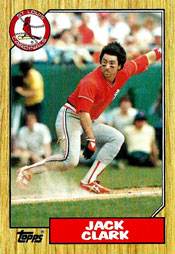
jack_clark4On Feb. 1, 1985, the Cardinals acquired Jack Clark from the Giants for Dave LaPoint, David Green, Jose Uribe and Gary Rajsich.

Cardinals manager Whitey Herzog saw Clark as the answer for an offense that lacked consistent power. “I’m getting a sleeping giant who immediately fits right into our picture a lot better,” Herzog said to The Sporting News.

Clark, 29, was a proven run producer, but he missed three months of the 1984 season because of right knee surgery. He also developed a reputation as a malcontent.

Asked about his image, Clark told the St. Louis Post-Dispatch, “I give my best effort on and off the field. I don’t act crazy. I’m a real straight shooter. Some people like that and some people don’t.”

Green, 24, was a prized prospect, but personal problems led to him being admitted to a treatment center in 1984.

“You’re really gambling on his potential,” Herzog said. “Of all the players I’ve had the opportunity to manage, David Green has more ability than anyone as far as hitting, hitting with power, speed and throwing arm. (Garry) Templeton and George Brett are in that category, but Green has more power than either, he runs better than either and he throws better than George (Brett).”

Prime target

After the Cardinals traded their top run producer, George Hendrick, to the Pirates in a December 1984 deal that brought them pitcher John Tudor, Herzog sought a replacement for the heart of the batting order. Clark was a prime target.

“It all happened rather quickly,” Giants general manager Tom Haller said. “The Cardinals instigated talks about Clark and we threw some names at him.”

In his book “The White Rat: A Life in Baseball,” Herzog said, “I’d always wondered what it would be like to write his name down on my lineup card. We went after Jack Clark hammer and tong in the winter of 1984-85.

“With Hendrick gone, we stepped up the campaign for Clark, the same kind of hitter George had been, only better. We knew he was unhappy in San Francisco, playing in that disgraceful ballpark of theirs (Candlestick Park). The Giants were down on him because he was unhappy there.”

Let’s make a deal

The trade initially called for the Cardinals to receive Clark and minor-league pitcher Colin Ward. Talks hit a snag when it was discovered Clark had several financial incentives in his contract, including a clause stating Clark would be given a $250,000 payment if he joined another team in 1987.

When Giants owner Bob Lurie agreed to compensate the Cardinals with $125,000, Ward was dropped from the deal and the transaction was completed.

“I’ll be playing somewhere I can be more productive and it will be more fun coming to the park every day,” Clark said to columnist Stan Isle. “You don’t develop good work habits at Candlestick Park. You can’t always do what you want to do out there, like trying to hit Nolan Ryan with dust blowing in your eyes.”

Said Herzog to the Associated Press: “Jack Clark puts us in the situation of definite contenders again. Here’s a guy who can win a ballgame with one swing of the bat. He’s the only player in the league besides (Mike) Schmidt who could hit 20 homers a year playing in our park.”

Said Lurie to columnist Art Spander, “Nobody in the organization was anxious to trade Jack Clark … but we need players; we need starting pitchers. We’re supposed to be getting some top prospects.”

Upper hand

The deal was lopsided in favor of the Cardinals.

The Giants, who had finished in last place in the National League West at 66-96 in 1984, did even worse after the trade, finishing last again at 62-100 in 1985.

Green, primarily playing first base, hit .248 with 20 RBI in 106 games in 1985.

Uribe, who had played for the 1984 Cardinals under the name Jose Gonzalez, was the everyday shortstop for the 1985 Giants. He hit .237 and committed 26 errors.

Rajsich hit .165 as a utility player. LaPoint was 7-17 with a 3.57 ERA in 31 starts.

Clark connects

The Cardinals, who had finished in third place in the NL East at 84-78 in 1984, won the division title at 101-61 in 1985. Sparked by the additions of Clark and rookie left fielder Vince Coleman, the Cardinals, who scored 652 runs in 1984, scored a league-leading 747 runs in 1985.

Clark, primarily playing first base, had a .393 on-base percentage and .502 slugging percentage for the 1985 Cardinals. He had 26 doubles, 22 home runs, 83 walks and 87 RBI. Clark hit the game-winning home run that clinched the pennant for St. Louis in Game 6 of the NL Championship Series versus the Dodgers.

In the book “You’re Missin’ a Great Game,” Herzog said, “Jack Clark could pull a bullet … I could be blindfolded and tell when Jack was taking (batting practice). He was the only guy I had who didn’t sound like he was hitting underwater … The man’s power scared people, kept the defenses honest and kept our jackrabbits circling the bases.”

In three seasons with the Cardinals, Clark had a .413 on-base percentage and a .522 slugging percentage, powering St. Louis to two pennants.

Herzog “was the best manager I ever played for, and he was the best manager I ever played against,” Clark told Cardinals Magazine. “Whitey was the X factor that gave his team an opportunity, or the right matchup, and put his players in position to succeed.”

Read Full Post »

(Updated Dec. 18, 2018)

Seeking a starter to replace Woody Williams in the rotation, the Cardinals used a prospect, Dan Haren, to help land an ace, Mark Mulder.

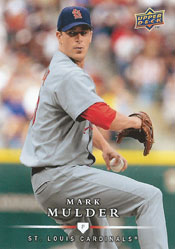
mark_mulderOn Dec. 18, 2004, the Cardinals acquired Mulder from the Athletics for Haren, reliever Kiko Calero and first baseman Daric Barton.

The Cardinals were praised for adding Mulder to a rotation of Chris Carpenter, Jason Marquis, Jeff Suppan and Matt Morris.

Haren, though, turned out to be more durable than Mulder.

Mulder had one strong season for the Cardinals, suffered shoulder ailments and pitched his final game for them in 2008 at age 31.

Haren was 6-10 in two seasons (2003-2004) for St. Louis, but developed into one of the most consistent pitchers in the majors. Haren had 11 seasons in a row of double-digit wins and made 30 starts or more in each of those years.

Haren, whose last season was 2015, posted a career record of 153-131. He was 147-121 after leaving St. Louis. The right-hander pitched for eight teams: Cardinals, Athletics, Diamondbacks, Angels, Nationals, Dodgers, Marlins and Cubs.

After compiling an 81-42 record in five years with the Athletics, Mulder was 16-8 in 32 starts for the 2005 Cardinals. The left-hander went a combined 6-10 for the Cardinals from 2006 to 2008.

Making a splash

After they were swept by the Red Sox in the 2004 World Series, the Cardinals had four prominent players depart as free agents _ Woody Williams (11-8 in 2004), shortstop Edgar Renteria, catcher Mike Matheny and second baseman Tony Womack.

Eager to make a splashy move to show the Cardinals would fight to repeat as National League champions, general manager Walt Jocketty spoke with his Athletics counterpart, Billy Beane, about Mulder and starting pitcher Tim Hudson.

On Dec. 16, 2004, the Athletics dealt Hudson to the Braves for pitchers Juan Cruz and Dan Meyer and outfielder Charles Thomas. Two days later, the Cardinals got Mulder.

Elite starter

“This is something we’ve been working on for two or three weeks,” Jocketty said to the St. Louis Post-Dispatch. “We’ve been going back and forth between Hudson and Mulder and we felt like, in our case, we had control of Mulder for an extra year (on his contract) … Both are quality, top of the rotation starters.”

Post-Dispatch columnist Bernie Miklasz described Mulder as “an elite starting pitcher” and “a legitimate front-of-rotation starter.”

From 2001-2004, only Curt Schilling had more wins (74) than Mulder (72).

“He’s an intelligent guy, a great athlete, a great fit,” Jocketty said of Mulder.

Red flag

Miklasz and his colleague, reporter Derrick Goold, did note, however, Mulder had faltered in the second half of the 2004 season after starting the All-Star Game for the American League. Mulder was winless in his last seven 2004 starts, posting an 0-4 record and 7.27 ERA. Overall, Mulder was 17-8 in 2004 but with a 4.43 ERA.

Wrote Miklasz: “Is he wearing down after averaging 212 innings over the past four seasons?”

Mulder denied he was weakened or injured.

“We took our time and thoroughly researched this … As far as we’re concerned, he’s fine,” Jocketty said. “There are no physical problems at all. We made sure.”

Said Mulder: “I wasn’t hurt at all … There was nothing wrong with me.”

Asked to explain why Mulder was ineffective in the second half of 2004, Jocketty replied, “He put a lot of pressure on himself … He tried to do too much.”

Swift start

Any concerns about Mulder were erased early in the 2005 season. He won seven of his first nine decisions for the Cardinals. After stumbling in June (2-3, 7.18 ERA), Mulder recovered and was a combined 7-3 over the last three months of the season. He was especially effective against left-handed batters, limiting them to a .191 average in 2005.

Haren, meanwhile, had 14 wins for the 2005 Athletics, posting a 3.73 ERA in 34 starts. Calero contributed four wins and a save in 58 relief appearances.

In 2006, Mulder won five of his first six decisions for St. Louis before the shoulder woes began. Mulder made two starts after June 20 and finished the 2006 season at 6-7 with a 7.14 ERA. He was 0-3 with a 12.27 ERA for the 2007 Cardinals; 0-0 with a 10.80 for the 2008 Cardinals.

Read Full Post »

Before Johnny Mize played a game for the Cardinals, they gave up on him and gave him away to the Reds.

Fortunately for the Cardinals, the Reds gave him back.

johnny_mize5During six seasons as the Cardinals’ first baseman, Mize won a National League batting title (.349 in 1939), a RBI crown (137 in 1940) and twice led the league in home runs (28 in 1939 and 43 in 1940).

In three consecutive years (1938-40) with the Cardinals, Mize led the NL in slugging percentage and total bases. Nicknamed “The Big Cat,” Mize was a four-time all-star with St. Louis. He was elected to the National Baseball Hall of Fame.

The story of how Mize transformed into one of the Cardinals’ all-time sluggers is filled with a dizzying array of twists and turns.

Rich Reds

In 1934, Mize, 21, was with the Cardinals’ minor-league Rochester (N.Y.) affiliate. His season was cut short because of a groin injury. In 90 games, Mize hit .339 with 17 home runs.

Larry MacPhail, the Reds’ brash general manager, needed sluggers for a team that ranked last in the major leagues in runs scored (590) in 1934. MacPhail saw Mize as a cornerstone for that rebuilding project.

Jim Bottomley was the Reds’ first baseman. Bottomley, who would be elected to the Hall of Fame, had been a standout for the Cardinals, helping them win two World Series titles (1926 and 1931) and four pennants. The Cardinals traded him to the Reds in December 1932.

Though he hit .284 with 31 doubles for the 1934 Reds, Bottomley, 34, had peaked as a run producer.

Powel Crosley, the Cincinnati radio manufacturer and broadcasting titan, had purchased the Reds in 1934 and was willing to spend money to revive a franchise that had finished in last place in the NL that year. In December 1934, MacPhail approached the Cardinals and offered $55,000 for Mize.

It was an astonishing sum at a time when the nation still was staggered by the economic hardships of the Great Depression. MacPhail’s offer topped the $50,000 the Yankees had paid the San Francisco Seals a month earlier for their highly touted prospect, outfielder Joe DiMaggio.

The Cardinals, who had won the 1934 World Series championship, were quite willing to accept such a large sum for a hobbled player who never had appeared in the big leagues.

On Dec. 13, 1934, the Cardinals sent Mize to the Reds.

String attached

“Whatever happens to the Reds (in 1935), it cannot be said (they) have not put plenty of cash and industry into their efforts,” The Sporting News reported. “The substantial sum of $55,000 was turned over to the Cards for (Mize) … There is ample reason for believing that Mize will prove well worth the expenditure. He is a strapping youngster … who puts a great deal of power into his swing.”

The deal came with one important condition. Wrote The Sporting News: “As for the injury, so confident are the Cardinals that it will not prove a hardship that they have guaranteed the first sacker will be sound for 1935, which means that if the injury still handicaps the player, the Reds need not keep him but instead may return him and get back the money paid for his services.”

As spring training started in February 1935, Mize told reporters he was “entirely recovered” from the groin injury. The Sporting News speculated Bottomley would be traded to the Cubs or Giants.

After watching Mize perform, though, it became evident something was wrong with him. It later was determined spurs had developed on his pelvic bone, restricting his movement and causing pain.

Return to sender

On April 15, 1935, the Reds voided the deal, returning Mize to the Cardinals the day before the start of the season.

Assigned to Rochester, Mize played in 65 games and hit .317 with 12 home runs until the pain became too intense to continue. With his career in jeopardy, Mize agreed to surgery after the season.

In December 1935, The Sporting News reported, “Mize recently underwent an operation to correct a condition that interfered with the free action of his legs … The surgery (Mize) submitted to was for the removal of a growth on the pelvic arch and it has been pronounced a success.”

The report was accurate. Mize opened the 1936 season with the Cardinals and soon after took over from Rip Collins as the first baseman. The rookie hit .329 with a team-leading 19 home runs and 93 RBI for the 1936 Cardinals.

In six seasons with St. Louis (1936-41), Mize batted .336 with 1,048 hits in 854 games. His .600 slugging percentage with the Cardinals ranks third all-time in franchise history and first among left-handed batters. The only players with higher career slugging percentages as Cardinals are Mark McGwire (.683) and Albert Pujols (.617).

On Dec. 11, 1941, seven years after they sent him to the Reds, the Cardinals traded Mize to the Giants for catcher Ken O’Dea, first baseman Johnny McCarthy, pitcher Bill Lohrman and $50,000.


Read Full Post »

« Newer Posts - Older Posts »