(Updated Dec. 12, 2020)
At baseball’s winter meetings in December 1980, Whitey Herzog stole the show with a breathtaking series of daring deals that remade the Cardinals into the manager’s kind of team.
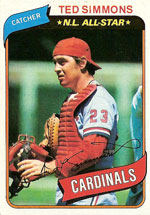 Herzog, who doubled as the Cardinals’ general manager, traded 13 players and received nine in return in deals with the Padres, Cubs and Brewers. The biggest stunner was the last one on Dec. 12, 1980: popular catcher Ted Simmons, the soul of the team, was traded with pitchers Rollie Fingers and Pete Vuckovich to the Brewers for pitchers Lary Sorensen and Dave LaPoint and outfielders Sixto Lezcano and David Green.
Herzog also landed free-agent catcher Darrell Porter during the meetings.
“I’ve done my job as general manager,” Herzog told the St. Louis Post-Dispatch. “Now if the manager doesn’t screw it up…”
The acquisitions turned out well for the Cardinals. Porter, LaPoint, Green, closer Bruce Sutter and catcher Gene Tenace helped the Cardinals win the World Series championship in 1982, but the trade of Simmons was unpopular.
In his book, “White Rat: A Life in Baseball,” Herzog said, “I liked Teddy. He is bright and intelligent and he played hard for me in 1980. If the National League had the designated hitter rule, he would have died a Cardinal.”
The deal was put in motion after Herzog signed Porter, whom he managed in Kansas City, to a five-year, $3.25 million Cardinals contract. Herzog planned to move Simmons to first base and Keith Hernandez from first base to left field for the 1981 season.
Herzog said, “Teddy couldn’t catch, at least not on my club … He gave up a lot of passed balls and he couldn’t throw worth a damn.”
As a Cardinal, Simmons hit .298, drove in more than 90 runs six times and had an on-base percentage of .366. He produced 1,704 hits in 1,564 games.
In his book, “You’re Missin’ a Great Game,” Herzog said, “Ted hit the ball like a son of a gun, was a fine person who played hard and cared about winning, but he had one major weakness as a ballplayer: poor arm strength.”
Vuckovich, among others, was miffed about the Cardinals’ plan to have Simmons shift positions. “They say he (Simmons) can’t catch,” Vuckovich said. “That makes me laugh.”
Simmons initially said playing first base was “just fine” with him, but he reconsidered and asked to be traded. “You’re taking a Gold Glove (Hernandez) and putting him at a position other than where he might win it,” Simmons said.
Herzog said Simmons “really pissed me off” by changing his mind about playing first base, but he regrouped and looked for a trade partner.
Herzog said he approached Brewers general manager Harry Dalton and asked, “How’d you like to win the pennant next year?”
The Brewers were eager to make a deal for Simmons, but he had a no-trade clause in his contract and wanted to be compensated for relinquishing it. Herzog said Simmons asked for $750,000. The Brewers wanted the Cardinals to split the cost. When the Cardinals refused, the Brewers threatened to walk away from the deal, but after Herzog indicated he would trade Simmons to another American League team, the Brewers made the swap.
In a November 2019 interview with broadcaster Dan McLaughlin, Simmons said he and Herzog had several discussions about the trade before it was made and Herzog explained to him the objectives. When Simmons learned Fingers and Vuckovich would go to the Brewers with him, he said he knew it would make them a championship contender.
“I was then in a position to say OK,” Simmons said.
Regarding his opinion of Herzog, Simmons said, “Whitey was a great, great manager. People ask me, ‘Who was the best manager you ever had?’ I was only with him the one year (1980), but clearly he was the best strategist. No one could out-design him. He literally took a ballclub and said, ‘OK, we are going to speed and defense you to death’ and he did.”
Herzog told the Post-Dispatch the trade “might be the best thing for Simmons.”
“Teddy had gotten down on the whole situation here, never winning, and he took responsibility on himself for the whole organization,” Herzog said. “He’s an analyzer, and he let a lot of things worry him that he had no control over.”
Year later, in an interview with “Memories and Dreams” magazine, Hall of Famer Paul Molitor, a Brewers teammate of Simmons, said, “You realized when you talked with Teddy just how smart he was. He had a unique way of thinking. A lot of it was above most of us, to be honest. He influenced the game in a lot of ways.”
 When outfielder
 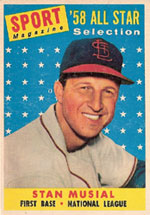 In August 1959, The Sporting News pubished a trademarked Page 1 story by publisher J.G. Taylor Spink reporting the Cardinals would trade Stan Musial to the Yankees for catcher and St. Louis native Yogi Berra.
 A Cardinals spokesman confirmed Eddie Stanky, player development director and special assistant to general manager Bing Devine, was in New York, scouting the Yankees, in August 1959.
 RetroSimba