Feeds:
Posts
Comments

Archive for the ‘Trades’ Category

Tom Underwood’s time with the Cardinals was brief _ 19 games pitched in 1977 _ but he was an integral part of two trades that significantly shaped the St. Louis team.

A left-handed pitcher, Underwood was the centerpiece of a controversial trade by the Cardinals that sent outfielder Bake McBride and pitcher Steve Waterbury to the Phillies on June 15, 1977. In addition to Underwood, the Cardinals got outfielders Dane Iorg and Rick Bosetti.

McBride was popular with Cardinals fans and players, but he feuded with first-year St. Louis manager Vern Rapp. McBride was the first Cardinal to defy Rapp’s hair-length code and he bristled at Rapp’s demand that McBride trim his mutton chop sideburns.

Because McBride had undergone knee surgery in 1976, Rapp wanted to move him from center field to right field and place Tony Scott in center. When McBride balked at the move, it triggered the trade to Philadelphia.

The Cubs thought they had a deal to acquire Underwood from the Phillies for outfielders Jose Cardenal and Greg Gross. When the Cardinals made McBride available, the Phillies dealt with St. Louis instead.

McBride, who batted .307 in five years with St. Louis, helped the Phillies to three division titles and the 1980 World Series championship.

Underwood was 6-9 with a 4.95 ERA (17 starts, two relief appearances) with St. Louis. He walked (57) almost as many as he struck out (66).

The Cardinals wanted Underwood because their only left-handed starter, Pete Falcone, was struggling and two other rotation members (Larry Dierker and John Denny) were slowed by injuries. At the time of the trade, Underwood was 23 and coming off consecutive winning seasons for the Phillies. The Cardinals envisioned him as a pitcher who could pay dividends for years.

As a Cardinal, Underwood was effective against left-handed batters (he held them to a .186 batting average with no home runs). Right-handed batters pounded him for a .299 batting average and seven homers.

In his nine losses with St. Louis, Underwood had a 7.82 ERA and opponents batted .363 against him.

Underwood’s best-pitched game for the Cardinals came against the Cubs in Wrigley Field on Sept. 6, 1977. He pitched a complete game, yielding six hits and a run while striking out eight in a 3-1 Cardinals victory. Catcher Ted Simmons homered, singled, walked, scored a run and drove in two.  Boxscore

On Dec. 6, 1977, Underwood and picher Victor Cruz were traded by the Cardinals to the Blue Jays for pitcher Pete Vuckovich and outfielder John Scott.

Vuckovich, a tough right-hander, pitched well (39-31, 3.21 ERA) in three years with St. Louis. He, along with Simmons and reliever Rollie Fingers, were dealt by the Cardinals to the Brewers in December 1980 for pitchers Dave LaPoint and Lary Sorensen and outfielders David Green and Sixto Lezcano. That trade was critical to the construction of the Cardinals and Brewers into pennant winners in 1982.

Underwood went on to pitch for the Blue Jays, Yankees, Athletics and Orioles. In an 11-year big-league career, he was 86-87 with a 3.89 ERA.

Read Full Post »

In October 1965, the Cardinals shocked their fans with the trade of third baseman Ken Boyer to the Mets.

Boyer had been a fixture for the Cardinals since 1955. He was an all-star in seven of his Cardinals seasons, five times won a Gold Glove Award and was the National League winner of the Most Valuable Player Award in 1964.

General manager Bob Howsam, anticipating the Cardinals’ move to spacious, new Busch Stadium in 1966, wanted younger, faster players. On Oct. 20, 1965, he dealt Boyer to the Mets for third baseman Charlie Smith and pitcher Al Jackson. Boyer was 34 and Smith, 28.

The deal Howsam initially wanted to make for Boyer was with the Astros, while the Mets first offered Smith and Jackson to the Angels.

According to a report in the Nov. 6, 1965, edition of The Sporting News, Howsam offered Boyer to the Astros for third baseman Bob Aspromonte. The deal would have included other players, but the keys were Boyer and Aspromonte.

Dick Peeples, sports editor of the Houston Chronicle, broke the story. (He also revealed that Astros general manager Paul Richards rejected a trade offer of outfielder Jim Wynn to the Reds for outfielder Frank Robinson; a month later, Robinson was dealt to the Orioles.)

Aspromonte was 27 at the time of the proposed deal. A competent fielder (he twice led NL third basemen in fielding), he wasn’t a strong run producer. In a 13-year big-league career, he never had more than 12 home runs and 69 RBI in a season.

While the Cardinals were negotiating with the Astros, Mets executive Bing Devine was offering Smith and Jackson to the Angels, according to a story by Ross Newhan in the Nov. 20, 1965, edition of The Sporting News. The Mets wanted outfielder Jose Cardenal in return.

When Angels general manager Fred Haney “dallied,” as Newhan reported, Devine turned to the Cardinals. Devine had been the Cardinals’ general manager before being fired in 1964 and knew Boyer well.

The Cardinals and Mets made the deal, setting off a firestorm of protest from Cardinals fans.

A year later, just before leaving the Cardinals to become general manager of the Reds, Howsam traded Smith to the Yankees for right fielder Roger Maris. That deal, which prompted Mike Shannon’s conversion from a right fielder to a third baseman, was integral in shaping the Cardinals into pennant winners in 1967 and 1968.

If the Cardinals had acquired Aspromonte instead of Smith, would the deal for Maris have occurred? Possibly (Aspromonte was a Brooklyn native), but we’ll never know.

Read Full Post »

The passing of former Phillies pitcher Wayne Twitchell on Sept. 16, 2010, brought to mind one of the most electrifying performances in the career of Cardinals speedster Bake McBride.

In the Phillies’ home opener on April 11, 1975, McBride sparked the Cardinals to a 6-3 victory with a three-run inside-the-park home run to center field against Twitchell. Boxscore

McBride, a left-handed batter, went 4-for-5 with four RBI and two runs scored that night. Against Twitchell, who started and lasted five innings, McBride was 3-for-3.  He singled in the first, homered in the third and singled again in the fifth.

His home run came after Lou Brock singled and Ted Sizemore walked. McBride then drove a Twitchell pitch into center field and circled the bases.

McBride tormented Twitchell throughout his career, hitting .480 (12-for-25) against him.

In a twist of fate, the Phillies made trades involving McBride and Twitchell within minutes of one another on June 15, 1977.

After falling short in an aggressive bid to acquire pitcher Tom Seaver from the Mets (Seaver was dealt to the Reds instead), the Phillies traded Twitchell and catcher Tim Blackwell to the Expos for catcher Barry Foote and pitcher Dan Warthen.

With the trade deadline rapidly approaching, the Phillies then acquired McBride and pitcher Steve Waterbury from the Cardinals for pitcher Tom Underwood and outfielders Dane Iorg and Rick Bosetti.

The deal upset the Cubs, who thought they had a commitment from the Phillies to send them Underwood for outfielders Jose Cardenal and Greg Gross.

McBride became expendable because first-year Cardinals manager Vern Rapp preferred Tony Scott in center field and because the Cardinals were concerned about McBride being slowed by shoulder and knee problems. McBride also had clashed with Rapp over the club’s ban on facial hair and long sideburns.

McBride gave the Phillies an effective leadoff batter. He helped them to division titles in 1977 and 1978, and to a World Series championship in 1980.

Twitchell, a 6-foot-6 right-hander, had been named to the 1973 National League all-star team. Writing about the trades in the July 2, 1977, edition of The Sporting News, Ray Kelly suggested the Phillies “were reluctant to let him (Twitchell) go because he’s one of the hardest throwers around.”

Twitchell went from the Expos to the Mets and then the Mariners.

His last big-league season was 1979 and he finished his career with a 48-65 record.

Read Full Post »

The trade of Ryan Ludwick from the Cardinals to the Padres is understandable if it gives St. Louis the financial flexibility to eventually sign Albert Pujols to an extension. Still, it’s a downer.

Ludwick represented himself and the team with class. He was supposed to be just a fill-in outfielder and pinch hitter when he joined the Cardinals in 2007. Instead, he developed into a blue-collar all-star who played aggressively and enthusiastically. He will be missed.

What often went unappreciated with Ludwick was his potent slugging. He ranks 12th in Cardinals history for highest career slugging percentage (a player’s total number of bases reached on hits divided by official times at bat).

Here are the top dozen career slugging percentage leaders as a Cardinal (minimum 1,500 plate appearances):

Mark McGwire, .683

Albert Pujols, .622

Johnny Mize, .600

Rogers Hornsby, .568

Chick Hafey, .568

Stan Musial, .559

Jim Edmonds, .555

Joe Medwick, .545

Jim Bottomley, .537

Rip Collins, .517

Scott Rolen, .510

Ryan Ludwick, .507

To put that in perspective, here are just some of the players with lower slugging percentage’s than Ludwick’s as a Cardinal: Ken Boyer (.475), Bill White (.472), George Hendrick (.470), Enos Slaughter (.463), Ted Simmons (.459), Joe Torre (.458), Orlando Cepeda (.454) and Keith Hernandez (.448).

Read Full Post »

(Updated Dec. 12, 2020)

At baseball’s winter meetings in December 1980, Whitey Herzog stole the show with a breathtaking series of daring deals that remade the Cardinals into the manager’s kind of team.
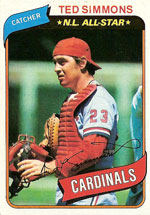
Herzog, who doubled as the Cardinals’ general manager, traded 13 players and received nine in return in deals with the Padres, Cubs and Brewers. The biggest stunner was the last one on Dec. 12, 1980: popular catcher Ted Simmons, the soul of the team, was traded with pitchers Rollie Fingers and Pete Vuckovich to the Brewers for pitchers Lary Sorensen and Dave LaPoint and outfielders Sixto Lezcano and David Green.

Herzog also landed free-agent catcher Darrell Porter during the meetings.

“I’ve done my job as general manager,” Herzog told the St. Louis Post-Dispatch. “Now if the manager doesn’t screw it up…”

The acquisitions turned out well for the Cardinals. Porter, LaPoint, Green, closer Bruce Sutter and catcher Gene Tenace helped the Cardinals win the World Series championship in 1982, but the trade of Simmons was unpopular.

In his book, “White Rat: A Life in Baseball,” Herzog said, “I liked Teddy. He is bright and intelligent and he played hard for me in 1980. If the National League had the designated hitter rule, he would have died a Cardinal.”

The deal was put in motion after Herzog signed Porter, whom he managed in Kansas City, to a five-year, $3.25 million Cardinals contract. Herzog planned to move Simmons to first base and Keith Hernandez from first base to left field for the 1981 season.

Herzog said, “Teddy couldn’t catch, at least not on my club … He gave up a lot of passed balls and he couldn’t throw worth a damn.”

As a Cardinal, Simmons hit .298, drove in more than 90 runs six times and had an on-base percentage of .366. He produced 1,704 hits in 1,564 games.

In his book, “You’re Missin’ a Great Game,” Herzog said, “Ted hit the ball like a son of a gun, was a fine person who played hard and cared about winning, but he had one major weakness as a ballplayer: poor arm strength.”

Vuckovich, among others, was miffed about the Cardinals’ plan to have Simmons shift positions. “They say he (Simmons) can’t catch,” Vuckovich said. “That makes me laugh.”

Simmons initially said playing first base was “just fine” with him, but he reconsidered and asked to be traded. “You’re taking a Gold Glove (Hernandez) and putting him at a position other than where he might win it,” Simmons said.

Herzog said Simmons “really pissed me off” by changing his mind about playing first base, but he regrouped and looked for a trade partner.

Herzog said he approached Brewers general manager Harry Dalton and asked, “How’d you like to win the pennant next year?”

The Brewers were eager to make a deal for Simmons, but he had a no-trade clause in his contract and wanted to be compensated for relinquishing it. Herzog said Simmons asked for $750,000. The Brewers wanted the Cardinals to split the cost. When the Cardinals refused, the Brewers threatened to walk away from the deal, but after Herzog indicated he would trade Simmons to another American League team, the Brewers made the swap.

In a November 2019 interview with broadcaster Dan McLaughlin, Simmons said he and Herzog had several discussions about the trade before it was made and Herzog explained to him the objectives. When Simmons learned Fingers and Vuckovich would go to the Brewers with him, he said he knew it would make them a championship contender.

“I was then in a position to say OK,” Simmons said.

Regarding his opinion of Herzog, Simmons said, “Whitey was a great, great manager. People ask me, ‘Who was the best manager you ever had?’ I was only with him the one year (1980), but clearly he was the best strategist. No one could out-design him. He literally took a ballclub and said, ‘OK, we are going to speed and defense you to death’ and he did.”

Herzog told the Post-Dispatch the trade “might be the best thing for Simmons.”

“Teddy had gotten down on the whole situation here, never winning, and he took responsibility on himself for the whole organization,” Herzog said. “He’s an analyzer, and he let a lot of things worry him that he had no control over.”

Year later, in an interview with “Memories and Dreams” magazine, Hall of Famer Paul Molitor, a Brewers teammate of Simmons, said, “You realized when you talked with Teddy just how smart he was. He had a unique way of thinking. A lot of it was above most of us, to be honest. He influenced the game in a lot of ways.”

Read Full Post »
(Updated Nov. 1, 2023)

The Cardinals shopped third baseman Mike Shannon in trade talks with the Phillies, Angels and Mets after the 1969 season.

When outfielder Curt Flood balked at joining the Phillies after being dealt with catcher Tim McCarver, reliever Joe Hoerner and outfielder Byron Browne in October 1969, the Cardinals almost sent Shannon as a replacement.

According to columnist Dick Young in the March 14, 1970, edition of The Sporting News, “The Phils and Cards had a settlement deal all cooked up when Curt Flood first expressed his disaffection for playing in Philly. Bob Carpenter (Phillies owner) was prepared to settle for somebody like Mike Shannon, just to end the succession of headaches. Then Curt Flood filed his (antitrust) lawsuit, and the whole thing blew up.”

In December 1969, published reports surfaced that the Mets were talking about a deal for Shannon to replace third baseman Ed Charles, who was released. The Mets instead acquired third baseman Joe Foy from the Royals for outfielder Amos Otis and pitcher Bob Johnson.

In October 1969, Dick Young revealed in his syndicated column for the New York Daily News that Cardinals general manager Bing Devine “tried to send Mike Shannon and (shortstop) Dal Maxvill to the Angels for (shortstop) Jim Fregosi.”

According to Young, Angels general manager Dick Walsh told the Cardinals, “Not enough. We want a genuine homer hitter for Fregosi. I don’t consider Shannon a home run hitter.”

In the Dec. 27, 1969, edition of The Sporting News, it was reported that Angels third baseman Aurelio Rodriguez, “the young man with the flashy glove but the sporadic bat, would be exchanged for an older strongman, someone like Ken McMullen (of the Senators) or Mike Shannon.”

In March 1970 a medical exam revealed Shannon was suffering from a kidney disease and would miss at least the first part of the season.

With that, McMullen became the Angels’ target. On April 27, 1970, the Angels traded Rodriguez and outfielder Rick Reichardt to the Senators for McMullen.

Shannon returned to the lineup on May 14 and played in 55 games for the 1970 Cardinals. After the season, he retired and the Cardinals gave him the job in the front office.

Read Full Post »

« Newer Posts - Older Posts »