Feeds:
Posts
Comments

Archive for the ‘Trades’ Category

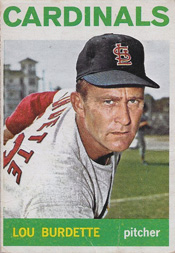
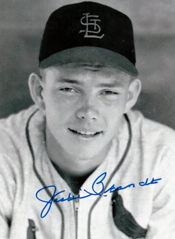
Jackie Brandt was an outfielder who earned a National League Gold Glove Award and was named to the American League all-star team, but people wanted more from him.

He was supposed to be the next Mickey Mantle, but he wasn’t.

He was supposed to be a sure bet to receive the National League Rookie of the Year Award with the Cardinals, but he didn’t.

He was supposed to be a flake, but maybe was just good at pretending to be one.

Quick rise

Brandt was an accomplished amateur pitcher and outfielder in his hometown of Omaha, but he didn’t get any offers to turn pro. Three months after he graduated from high school in 1952, he was wielding a sledgehammer as a boilermaker’s helper for the Union Pacific Railroad when Bob Hall, president of the minor-league club in Omaha, contacted the Cardinals and recommended Brandt to them, The Sporting News reported.

Cardinals scout Runt Marr went to Omaha, saw him throw and offered a contract, Brandt recalled to The Sporting News. A right-handed batter, Brandt preferred playing the outfield instead of pitching, and the Cardinals went along with his request, he told the Associated Press.

In his first regular-season game as a pro for Ardmore (Okla.) in the Class D Sooner State League, Brandt tore ligaments in his right leg and was sidelined for a month. When he came back, he tore up the league, hitting .357 with 131 RBI in 120 games.

Brandt made an impressive climb through the Cardinals’ system, hitting .313 for manager George Kissell’s Class A Columbus (Ga.) team in 1954 and .305 for Class AAA Rochester in 1955.

His performance for Rochester marked Brandt, 21, as a prime prospect for the majors. He excelled as a hitter (38 doubles, 12 triples), fielder (20 assists, 420 putouts) and base runner (24 steals). “Brandt is one of the best-looking kids I’ve ever seen,” Rochester manager Dixie Walker told the Rochester Democrat and Chronicle. “He’ll be a major league star.”

Cardinals general manager Frank Lane said his Reds counterpart, Gabe Paul, offered $100,000 for Brandt. In rejecting the proposal, Lane told The Sporting News, “If Gabe offers $100,000 for him, the kid is worth every bit of $400,000.”

After Cardinals manager Fred Hutchinson saw Brandt play winter ball in Havana following the 1955 minor-league season, he said to The Sporting News, “He has a physical makeup similar to Mickey Mantle. He’s got the same kind of sloping shoulders, strength and speed. He showed exceptional aptitude defensively, a great knack of getting a jump on the ball and a strong arm.”

When New York Times columnist Arthur Daley got his first look at Brandt during spring training in 1956, he observed that the rookie had the “cat-like gait of Mickey Mantle. In fact, he looks as if he might be Mickey’s little brother.”

Another New York columnist, Red Smith, described Brandt as “a smaller, slighter version of Mickey Mantle.”

Great expectations

Brandt’s spring training performance earned him a spot on the Cardinals’ 1956 Opening Day roster and heightened expectations. Cardinals outfielders had won the National League Rookie of the Year Award in 1954 (Wally Moon) and 1955 (Bill Virdon), so Brandt was being touted as a favorite to get the honor in 1956.

“He is faster than either Moon or Virdon, both on the bases and in the outfield,” The Sporting News reported. “He loves to run, loves to hit and he doesn’t know the meaning of pressure.”

Brandt “could be another Terry Moore,” Cardinals chief scout Joe Mathes said to the St. Louis Globe-Democrat, referring to the center fielder on the club’s 1940s championship teams.

Unfazed, Brandt told The Sporting News he could hit as well as any Cardinals player “except Stan” Musial. “Confidence is my major asset,” Brandt said.

Hutchinson, though, preferred a lineup with experienced big-leaguers. The Cardinals opened the 1956 season with Hank Sauer in left field, Virdon in center, Musial in right, Moon at first base and Brandt on the bench. In May, they dealt Virdon to the Pirates for Bobby Del Greco and made him the center fielder.

When Del Greco got injured, Brandt filled in and came through with consecutive three-hit games. Boxscore and Boxscore

Future shock

After a few starts in late May, Brandt was back on the bench. Dissatisfied with sitting and watching, he asked the Cardinals to send him to the minors so he could play every day, he told author Steve Bitker in the book “The Original San Francisco Giants.”

Instead, the Cardinals traded him. He was part of the June 1956 deal that sent second baseman Red Schoendienst to the Giants for shortstop Al Dark and others. The Giants insisted on Brandt being included. “We wouldn’t have made the deal without him,” Giants general manager Chub Feeney told United Press. “Frankly, we were surprised that the Cards would let him go.”

Brandt batted .286 with one home run in 42 at-bats for the Cardinals and fielded flawlessly. (According to researcher Tom Orf, Brandt is one of two players who began his career with the Cardinals, hit one home run for them and went on to slug 50 or more in the majors. The other is Randy Arozarena.)

On the day the trade was made, the Cardinals were 29-23 and one game out of first place in the National League. Frank Lane thought having Dark as their shortstop could spark them to a pennant. “Brandt could come back to haunt us, but we’re concerned about 1956 and not the future,” Lane explained to The Sporting News.

J. Roy Stockton of the St. Louis Post-Dispatch countered: “We don’t consider the Cardinals a sufficient threat in 1956 to justify trading away Brandt.”

(The Cardinals hit the skids in July and finished 76-78, 17 games behind the champion Dodgers.)

Schoendienst told the Post-Dispatch, “Lane didn’t hurt the Cardinals trading me. It was his dealing off young players like Bill Virdon and Jackie Brandt … Brandt alone, counting what he can do now and what he’ll do in the future, is worth all four players the Cardinals got in the Giants deal.”

Golden gate

The Giants made Brandt their left fielder and he hit .299 with 11 home runs for them in 1956.

After spending most of the next two seasons in military service, Brandt was the Giants’ left fielder when they opened the 1959 season at St. Louis against the Cardinals. In the ninth inning, with a runner on first, one out and the score tied at 5-5, Brandt made two unsuccessful sacrifice bunt attempts, then ripped a Jim Brosnan pitch 400 feet to left-center for a double, driving in the winning run. Boxscore

Brandt went on to hit .270 for the 1959 Giants and ranked first among National League left fielders in fielding percentage (.989), earning him a Gold Glove Award. The other NL Gold Glove outfielders that season were teammate Willie Mays (center) and the Braves’ Hank Aaron (right).

(According to the authorized biography “Willie Mays: The Life, The Legend,” there were tensions between Brandt and Mays. “Brandt was outspoken and he was always criticizing Mays,” Giants broadcaster Lon Simmons said.)

Brandt was traded to the Orioles after his Gold Glove season.

Offbeat Oriole

Brandt played six seasons (1960-65) for the Orioles and was their center fielder for most of that time. In 1961, when he hit .297 and scored 93 runs, Brandt was named to the American League all-star team, but it was during his Orioles days that he got labeled a flake.

Teammate Boog Powell told the Baltimore Sun, “He had a pair of alligator shoes and, at a team party, decided to take them for a swim. He just walked into the pool, then out, and continued the evening like nothing had happened.”

(Decades later, when Powell operated a barbecue stand at Camden Yards in Baltimore, Brandt tapped him on the shoulder, said, “Pardon me, sir, but can you spare a poor man a sandwich?” and then kissed his old teammate square on the lips, the Sun reported.)

In a spring training game, Brandt got caught in a rundown and did a backflip to avoid the tag, the Sun reported. Another time, Brandt scored ahead of Jim Gentile, who missed the plate with his slide. Brandt bent down, picked up Gentile’s foot and placed it neatly on the plate, according to the Philadelphia Daily News.

Brandt’s words could be as amusing as his actions.

According to Milton Gross of the North American Newspaper Alliance, after the 1964 season, when Brandt hit less than .250 for the second straight year, Orioles general manager Lee MacPhail wished him a good winter. Brandt replied, “I always have a good winter. The bad summers are what troubles me.”

Regarding his inability to measure up to Mickey Mantle, Brandt told Gross, “I do everything pretty fair, but I’m not up to my potential. Maybe I’m living in the future.”

Orioles manager Hank Bauer said to the Sun, “I asked him how he managed to misplay a fly. He said, ‘I lost in the jet stream.’ “

According to the Baltimore newspaper, other gems uttered by Brandt included:

_ “This year, I’m going to play with harder nonchalance.”

_ “It’s hard to tell how you’re playing when you can’t see yourself.”

Brandt told author Steve Bitker, “My mind works crazy. I don’t do anything canned. Whatever comes to mind, I say or do.”

At least one popular story told about Brandt turned out to be untrue. As reported by the Associated Press and the Newspaper Enterprise Association, Brandt, wanting to experience some of the 40 flavors offered at an ice cream place, drove 30 miles out of his way to get there _ and then ordered vanilla. In 1983, the Baltimore Sun reported it was Ed Brandt, a reporter who covered the Orioles for the newspaper, who drove the extra miles for the ice cream and settled for vanilla. Over time, Jackie, not Ed, got associated with the tale.

“I’m shrewder than most of the guys think,” Brandt, the player, said to North American Newspaper Alliance.

Being a pro

When the Phillies swapped Jack Baldschun to the Orioles for Brandt in December 1965, Larry Merchant of the Philadelphia Daily News called it a trade of “a screwballing relief pitcher for a screwball of an outfielder.”

Regarding his reputation for being a flake, Brandt told Merchant, “We’re paid to entertain. It’s like being on stage. People want a show. They pay three bucks, so they ought to get one.”

The 1966 Phillies were a haven for free spirits, with Bo BelinskyPhil Linz and Bob Uecker joining Brandt on the roster. Brandt didn’t play regularly, but was serious about finding ways to contribute.

“For weeks at a stretch, he would pitch batting practice 25 minutes a day,” Bill Conlin reported in the Philadelphia Daily News. “He would catch batting practice and became Jim Bunning’s preferred warmup catcher because of his knack of setting a low target with his glove.”

The Phillies sent Brandt to the Astros in June 1967 and he completed his final season in the majors with them. In his last big-league appearance, on Sept. 2, 1967, at St. Louis, Brandt singled versus Steve Carlton. Boxscore

In 11 seasons in the majors, Brandt produced 1,020 hits, including 112 home runs.

Read Full Post »

As Tom Murphy felt his pitching career sliding downhill, the Cardinals pulled him back into the big leagues.

On May 8, 1973, the Cardinals rescued Murphy from the Royals’ farm system, acquiring him for pitcher Al Santorini.
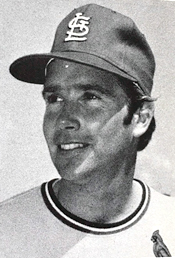
A right-hander who had been in the Angels’ starting rotation for four years, Murphy used his season in St. Louis to show he could be effective again in the majors, After that, he transformed into a closer _ but not with the Cardinals.

Baseball cards come to life

Born in Cleveland and raised in nearby Euclid, Ohio, Tom Murphy and his identical twin brother, Roger, became college athletes. Tom was a pitcher for Ohio University and Roger became a wide receiver for Northwestern’s football team.

Tom Murphy had a combined 16-1 record his sophomore and junior seasons at Ohio U. Roger Murphy had 51 catches for Northwestern in 1966 and went on to play in the Canadian Football League.

The Astros (1965) and Giants (1966) drafted Tom Murphy but he preferred to stay in college. When the Angels drafted him in January 1967, one of the reasons he signed was they agreed to let him complete his bachelor of arts degree in English that spring, The Sporting News reported.

Murphy’s first stop in the Angels’ system was with Quad Cities, a Class A club in Iowa managed by Fred Koenig. Murphy was 5-1 with a 2.34 ERA in six starts.

The Angels called up Murphy, 22, the next year, in June 1968, and put him in the starting rotation. The Angels’ pitching coach, Bob Lemon, had been Murphy’s favorite boyhood player with the Indians, according to The Sporting News.

In beating the Yankees for his first big-league win, Murphy faced another baseball icon from his childhood, Mickey Mantle. Though Mantle, 36, was playing in his last season on wobbly knees, “I was scared,” Murphy told the Los Angeles Times. “You better believe I did a little trembling. Here was a guy I idolized.”

Murphy managed to twice retire Mantle in key situations. His strategy, he told the Times, was, “I figured I’d challenge him with my best, and let him hit it as far as he could,”

In the third inning, with runners on second and third, one out, Mantle hit “a whistling drive directly at first baseman Chuck Hinton, who threw to shortstop Jim Fregosi at second for a double play,” the Times noted.

Two innings later, Mantle batted with two on and two outs. “Murphy threw two sweeping curveballs and Mantle could do no better than hit foul balls,” the Times reported. “The third pitch was a high fastball. Mantle swung ferociously, but the ball nestled in catcher Tom Satriano’s glove” for strike three. Boxscore

Murphy made 15 starts for the 1968 Angels and had a 2.17 ERA.

California dreaming

Being a rookie in the big leagues in Southern California in 1968 made for heady times for Murphy. Tall (6 feet 3) and angular, Murphy was a bachelor who enjoyed the California beach life. Murph the Surf, they called him.

He wore the mod clothes of the time, including silk brocade Nehru jackets. As the Los Angeles Times observed when he arrived for an interview, “Murphy wears a brown shirt of Edwardian cut. It is complemented by a brown and gold ascot. The pants are hip huggers. They are white with a black stripe and bell-bottomed.”

His road roommate, pitcher Andy Messersmith, told the Times, “I get my kicks walking around with Tom and hearing what people say about his clothes. Like the day in Boston after he had just bought this gold Nehru. We walked around downtown and people thought he was Ken Harrelson (of the Red Sox). They thought he was The Hawk.”

Murphy replied, “Aw, it was because of my nose.”

In 1969, Murphy and Messersmith joined Rudy May and Jim McGlothlin _ the four M’s _ in a mod Angels starting rotation, all 25 or younger.

During spring training, players sneaked Murphy’s twin brother Roger into an Angels uniform and sent him onto the field for calisthenics. Roger lied down in the grass and used first base for a pillow, then got up and told astonished Angels manager Bill Rigney he was retiring. Rigney thought Roger was Tom until he was brought in on the gag, the Times reported.

There wasn’t much funny, though, about Tom Murphy’s season for the 1969 Angels. He had 16 losses, threw 16 wild pitches and hit 21 batters with pitches. “The statistics seem to suggest that Murphy’s pitching was as wild as his wardrobe,” John Wiebusch of the Times reported.

Murphy told the newspaper, “There are smart pitchers and stupid pitchers, and it doesn’t take a genius to classify me.

“I tend to lose my cool too quickly. Things upset me and when that happens I lose my poise.”

Murphy did much better in 1970 (16 wins) but not so well in 1971 (17 losses, but in eight of those the Angels failed to score. He also lost three games by 2-1 scores and another by 3-2.)

K.C. and the Sunshine Band

After the 1971 season, the Angels obtained a pitcher who was 29-38 with the Mets (Nolan Ryan), put him into their starting rotation and traded Murphy to the Royals in May 1972. “I can’t quite picture myself sunbathing in Kansas City,” Murphy quipped to The Sporting News.

Bob Lemon was the Royals’ manager. Murphy’s first start for him was against the Angels. He pitched well (two runs allowed in seven innings) but lost. Boxscore

In July, Murphy (3-2, 4.79 ERA) was demoted to minor-league Omaha. He pitched a no-hitter against Indianapolis and was back with the Royals in September. His highlight was a shutout against a Twins lineup with Rod Carew and Harmon Killebrew, beating Bert Blyleven. Boxscore

Murphy had an 0.34 ERA in 26.1 innings pitched for the Royals in September 1972, but when the season opened in 1973 he was back in the minors.

Join the club

The 1973 Cardinals lost 20 of their first 25 games and were looking for any help.  Cardinals director of player development Fred Koenig, Murphy’s first minor-league manager, recommended him and the deal was made with the Royals.

Murphy joined a pitching staff populated with other American League castoffs such as Alan Foster, Orlando Pena and Diego Segui. His first two Cardinals appearances, both in relief, resulted in 4.1 scoreless innings, and he was moved into the starting rotation on June 10.

Though Murphy lost his first three decisions as a Cardinals starter, he pitched well. He allowed one run in a 3-1 loss to the Expos Boxscore and two runs in a 2-0 loss to the Cubs. Boxscore

His breakthrough came on July 4, 1973, with a complete-game win against the Pirates. Murphy also contributed a single and a double, scored a run and drove in another. Boxscore

He won his next start as well, beating the Dodgers in Los Angeles. Boxscore

The next day, Murphy’s twin brother pulled another prank. He got into the clubhouse, dressed in Tom’s uniform and asked trainer Gene Gieselmann for a rubdown, saying he’d hurt his arm in a surfing accident. Gieselmann went to work, thinking it was Tom.

Murphy also became a source of amusement for Bob Gibson, who delighted in imitating his teammate’s herky-jerky pitching motion. “Murphy has the habit of prefacing his windup by flipping his gloved hand forward, as if shooing flies,” the St. Louis Post-Dispatch noted.

On July 29, 1973, Murphy had two hits in the Cardinals’ win against the Cubs but didn’t qualify for a decision. Boxscore In his next start, he limited the Expos to two runs. but was the losing pitcher. Balor Moore shut out the Cardinals on four hits. Boxscore

Soon after that, Murphy was moved to the bullpen and was effective. He finished the season 3-7 with a 3.76 ERA. In his six relief appearances totaling 13.1 innings, he was 1-0 with an 0.68 ERA.

Finding a niche

Murphy’s strong relief work for the Cardinals was a sign of good things to come for him. It was the Brewers, though, who benefitted.

On Dec. 8, 1973, the Cardinals sent Murphy to the Brewers for utilityman Bob Heise. Brewers manager Del Crandall made Murphy, 28, the closer. “He’s got heart,” Crandall told The Sporting News. “While other guys get nervous in certain situations, he can go out there and do the job.”

Using a combination of sinkers and sliders, Murphy made 70 relief appearances for the 1974 Brewers and was 10-10 with 20 saves and a 1.90 ERA.

He had 20 saves again for the Brewers the next year but overall wasn’t as dominant, posting a 1-9 record and 4.60 ERA.

Murphy went on to finish his playing career with the Blue Jays. In 12 seasons in the majors, he was 68-101 with 59 saves and a 3.78 ERA.

Read Full Post »

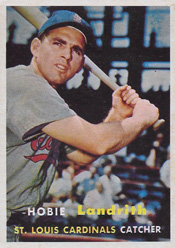
Hobie Landrith was an undersized catcher with big desire.

At 5-foot-8, according to the Associated Press and his Topps baseball card, Landrith stood “about as tall as the bat boy,” the Baltimore Sun noted, but he played in the majors for 14 seasons, including two with the Cardinals.
A left-handed batter, he had many good games at St. Louis, both for and against the Cardinals. Landrith had more career hits (78) in St. Louis than he did in any other big-league city.

Though best known for being the first player the Mets took in the National League expansion draft, Landrith didn’t last a full season with them.

Catching up

Hobart Landrith was born in Decatur, Ill., and moved with his family to metropolitan Detroit when he was 7. At 15, he served as a bating practice catcher for the Tigers.

In 1948, according to the Detroit Free Press, Landrith was one of two top high school catchers in Detroit. The other was Harry Chiti. Both became big-leaguers. (Landrith and Chiti were teammates on the 1956 Cubs and 1962 Mets).

After attending Michigan State for a year, Landrith signed with the Reds in 1949. Sent to their Tulsa farm club in 1950, Landrith broke a leg sliding into home plate in the season opener at the Cotton Bowl in Dallas, the Tulsa World reported.

When he recovered, the Reds, needing a bullpen catcher, brought Landrith, 20, to Cincinnati. He impressed manager Luke Sewell, who put him on the roster. Landrith started four games for the Reds that summer.

After spending most of 1951 and 1952 in the minors, Landrith stuck with the Reds through 1955 as backup to Andy Seminick and then Smoky Burgess.

Flair for dramatic

For a player who hit .198 in 1954, Landrith had his share of standout performances. In May, his three-run home run against the Cardinals’ Gerry Staley sparked the Reds to victory. Boxscore Two months later, Landrith hit a walkoff home run in a 1-0 triumph over the Giants. Boxscore

Reds broadcaster and former pitcher Waite Hoyt referred to Landrith “with unabashed affection as Little Hobie because he’s been the sort of guy it’s always easy to root for,” the Dayton Journal Herald reported.

On Sept. 1, 1954, Landrith impressed with his glove _ and his courage _ when he took part in a promotional stunt and caught a baseball dropped 575 feet from a helicopter at Crosley Field. “It knocked me to the ground, ” Landrith told the Cincinnati Enquirer, “but I held on.”

Landrith received $500 for catching the ball.

(The record was set in 1938 when Indians catchers Hank Helf and Frank Pytlak each caught a ball dropped from atop the 708-foot Terminal Tower in Cleveland, the Associated Press reported.)

Second string in St. Louis

In November 1955, Landrith was traded to the Cubs and he made 90 starts for them in 1956. After the season, the Cubs dealt Landrith, pitchers Sam Jones and Jim Davis, and utilityman Eddie Miksis to the Cardinals for pitchers Tom Poholsky and Jackie Collum, catcher Ray Katt, and an infield prospect, Wally Lammers.

Cardinals general manager Frank Lane then tried to flip Landrith to the Reds for Smoky Burgess, but was turned down, the Associated Press reported.

Used primarily as a backup to Hal Smith, Landrith made 56 starts for the 1957 Cardinals. He hit .243 and nailed 14 of 30 runners attempting to steal.

Seeking a catcher with more pop, Bing Devine, Lane’s successor as Cardinals general manager, tried to swap Landrith to the Reds for Burgess after the 1957 season, but he was turned down, too, according to the Associated Press.

Landrith was the Cardinals’ Opening Day catcher in 1958, but most of the playing time that season went to Hal Smith (61 starts) and Gene Green (48). Landrith, who started 34 games, batted .215.

A highlight came on July 13, 1958, when Landrith had four hits and two RBI against the Pirates at St. Louis. (A lifetime .233 hitter in the majors, Landrith batted .313 versus the Pirates in his career.) Boxscore

A month later, Landrith walloped a game-winning home run in the eighth inning against the Phillies’ Turk Farrell at St. Louis. Boxscore

On Oct. 7, 1958, Landrith, pitcher Billy Muffett and third baseman Benny Valenzuela were traded to the Giants for pitchers Ernie Broglio and Marv Grissom.

Tall among Giants

Landrith twice had four-hit games for the Giants at St. Louis. The first was July 4, 1959. Boxscore The other came on Aug. 16, 1960, when Landrith had three doubles and a single against Bob Gibson and caught the four-hitter of rookie Juan Marichal, who was facing the Cardinals for the first time. Boxscore (Landrith also was the catcher when Marichal pitched a one-hit shutout versus the Phillies in his Giants debut. Boxscore)

“Hobie has helped me a lot, especially on gripping the ball so the batters can’t see if it’s going to be a fastball or a curve,” Marchial told the St. Louis Post-Dispatch.

On Aug. 17, 1961, a spectacular catch by Cardinals center fielder Curt Flood robbed Landrith of an extra-base hit at Candlestick Park in San Francisco.

With the Cardinals ahead, 2-0, in the eighth, the Giants had a runner on second when Landrith batted against Larry Jackson. “At least three Cardinals (in the dugout) grabbed towels and signaled Flood to shade farther to the right,” the San Francisco Examiner reported. “He took five steps and needed every one.”

Landrith drove a pitch to right-center. “I hit that ball as hard as I’ve ever hit any,” he said to the Post-Dispatch.

Flood told the newspaper, “I thought for sure the ball was going out.”

“Flood took off with his back to the infield all the way,” the Post-Dispatch reported. “About one step from the fence he timed his high leap perfectly and speared the ball.” Boxscore

An original

After being drafted by the expansion Mets, Landrith went to spring training with them in 1962. Crouched behind the plate in a game, he was struck on top of the head by the backlash of a batter’s big swing. After a few days on the sideline, Landrith returned and was knocked on the noggin by another batter’s backlash. “I’m three inches shorter than when I reported to camp,” he told Dick Young of the New York Daily News.

In the Mets’ first regular-season game, against the Cardinals, Landrith started, went hitless and made an errant throw to second on Julian Javier’s stolen base. Boxscore

Landrith’s Mets highlight came on May 12, 1962, when he hit a two-run walkoff home run at the Polo Grounds against the Braves’ Warren Spahn. The high fly down the line in right “just did make the railing of the upper deck as it fell almost straight down,” the New York Daily News reported. Boxscore

A month later, Landrith was traded to the Orioles as the player to be named in a deal for first baseman Marv Throneberry

In his second week with the Orioles, Landrith slugged a two-run walkoff home run against Dick Radatz of the Red Sox at Baltimore, earning a win for starter Robin Roberts. Landrith, Radatz and Roberts all attended Michigan State.

“Roberts leaped out of the Orioles dugout, jumped up and down, and gave Landrith a big bear hug as Hobie battled his way through congratulating teammates.” the Baltimore Sun reported. Boxscore

Read Full Post »

As a teen, Alan Foster was a pitching prospect being compared with Sandy Koufax. At 26, he was a pitching project hoping to get another chance to stick in the majors.

In 1973, the Cardinals threw a lifeline to Foster, inviting him to spring training as a non-roster pitcher. He made the most of the opportunity, earning a spot on the Opening Day pitching staff and working his way into the starting rotation.

A right-hander who made his big-league debut in 1967, Foster had his first winning season in the majors with the 1973 Cardinals. He achieved career highs that year in wins (13), innings pitched (203.2) and strikeouts (106).

By design

When Foster was a senior at Los Altos High School in Hacienda Heights, Calif., near Los Angeles, he struck out 188 batters in 99 innings and posted an ERA of 0.39, according to The Sporting News.

“What attracted the scouts was that, besides being able to throw very hard, I was accomplished in other aspects of pitching,” Foster told the St. Louis Post-Dispatch. “I had good control. I could hit the corners. I knew how to pitch, in and out. I was able to make a lot of hitters look ridiculous.”

Foster’s father, a physician, told the scouts his son wanted to study architecture at UCLA and would opt for college unless offered a substantial contract, the Los Angeles Times reported.

On the recommendation of scout Ben Wade, the Dodgers selected Foster, 18, in the second round of the 1965 June amateur draft (ahead of catcher Johnny Bench). Foster signed after his father negotiated a $97,000 contract for him, the Los Angeles Times reported.

Orient express

In 1966, playing for manager Bob Kennedy at Albuquerque, Foster was 11-5 with a 2.86 ERA. The Dodgers, 1966 National League champions, brought Foster on their tour of Japan after the World Series. Pitching against Japanese all-star teams, Foster, 19, impressed, earning three wins and posting a 2.53 ERA in 32 innings pitched.

In a story headlined “Rookie Pitcher Steals Show on Dodgers Tour,” the Los Angeles Times described Foster’s pitching as “dazzling.”

“He has an easy motion like Sandy Koufax,” umpire Doug Harvey told the newspaper.

The Sporting News rated Foster’s pitches “as impressive as (a young) Koufax.”

(While in Japan, Foster met Cristina Rodriguez. Born and raised there, she was the daughter of a film distributor, according to the Post-Dispatch. Alan and Cristina married three years later.)

High expectations

Foster, 20, opened the 1967 season with the Dodgers. making his debut in relief against the Braves, The first batter he faced: Hank Aaron.

“I was going to try to show him I was not just another wild kid,” Foster said to Sports Illustrated. “Well, the first pitch went right over his head and the second one wasn’t much better. Now I’m two balls behind to Henry Aaron.”

Foster made another bad pitch, but Aaron swung and bounced out to shortstop Gene Michael. Foster pitched two scoreless innings. “I wasn’t nervous,” he told the Los Angeles Times, “but I sure was excited.” Boxscore

(For his career, Aaron batted .366 with 15 hits, including two home runs, against Foster.)

After another relief appearance, Foster was sent to Spokane to get starts. He pitched two no-hitters against the Angels’ Seattle farm team, winning both by 1-0 scores, and a two-hitter, striking out 15, versus the Cardinals’ Tulsa affiliate.

At Dodgers spring training in 1968, Foster was a center of attention. Under the headline, “Best Rookies of 1968,” Foster appeared on the cover of the March 11 Sports Illustrated, along with the Reds’ Johnny Bench, the Cardinals’ Mike Torrez, the Tigers’ Don Pepper (father of golf pro Dottie Pepper) and Cisco Carlos of the White Sox.

“Alan Foster is the man (Dodgers owner) Walter O’Malley hopes can help his team back into contention,” Sports Illustrated exclaimed. “When the Dodgers get high on a pitcher, the National League had best look out.”

At the annual Dodgers spring training party hosted by O’Malley and his wife Kay, pitcher Mudcat Grant sang to the accompaniment of teammates Foster and Tommy Hutton on guitars, The Sporting News noted.

It was a surprise when the Dodgers sent Foster back to Spokane.

Coming up short

Foster stuck with the Dodgers in 1969 but finished 3-9 with a 4.38 ERA.

One of his best performances that season came in a losing effort against the Cardinals. Foster held them to a run and three hits in eight innings, but Steve Carlton pitched a five-hit shutout in a 1-0 victory. Boxscore

“I guess I’m not very lucky,” Foster said to the Los Angeles Times. “That’s the best I’ve ever pitched in the major leagues … I can’t pitch any better than that.”

Three months later, the Pirates’ Willie Stargell launched a Foster curve more than 500 feet over the roof of the right field pavilion and into the parking lot, becoming the first batter to hit a home run out of Dodger Stadium. Describing the blast in the Los Angeles Times, Ross Newhan wrote, “It appeared to be Apollo 12.” Boxscore

After a 10-13 record and 4.26 ERA for the 1970 Dodgers, Foster was traded to the Cleveland Indians.

Humbling tumble

Before joining the Indians, Foster said he hurt his arm playing winter baseball in Mexico, the Post-Dispatch reported. Then, on the first road trip of the 1971 season, he damaged his right elbow lugging his luggage. “I had to nurse that along without telling anybody,” he said to the newspaper.

Traded to the Angels after finishing 8-12 for the 1971 Indians, Foster spent most of 1972 in the minors. “It humbled me,” Foster told The Sporting News. “It taught me not to take anything for granted. I matured then.”

Called up to the Angels in September 1972, Foster made three relief appearances. Cardinals player personnel director Bob Kennedy, who’d managed Foster at Albuquerque six years earlier, scouted him and liked what he saw. “He has a lot of desire now,” Kennedy told the Post-Dispatch.

Kennedy and Cardinals player development director Fred Koenig recommended Foster to general manager Bing Devine. The Cardinals purchased Foster’s contract in February 1973 and put him on a minor-league roster.

On the rise

At Cardinals spring training, Foster, 26, emerged as a force, posting a 1.61 ERA in 28 innings. “I couldn’t have done any better,” Foster told The Sporting News, “and if I had done a little worse, I probably wouldn’t have stayed with this club.”

After six relief appearances to start the 1973 season, Foster joined a starting rotation with Bob Gibson, Rick Wise and Reggie Cleveland.

In Foster’s first Cardinals start, at Dodger Stadium, Al Downing beat him, pitching a two-hit shutout. Foster got one of the hits. Boxscore

In his next start, Foster shut out the Expos on a four-hitter. He also singled twice, scored twice and had a sacrifice bunt. Boxscore

Foster finished 13-9 overall (13-7 as a starter) for the 1973 Cardinals. He had six complete games and two shutouts.

“This year, I finally began to have full command of my pitches,” Foster told The Sporting News. “I’ve cut down on the number of pitches and I’ve been ahead of most of the hitters. That’s the only way to pitch. When you get behind, a .300 hitter becomes a .600 hitter.”

Winding down

Foster had an inconsistent 1974 season for the Cardinals. He shut out the Giants and pitched a three-hitter against the Mets. Boxscore and Boxscore

He also twice produced three hits in a game. Boxscore and Boxscore

However, Foster lost five of his first six decisions. In June 1974, the Cardinals offered Foster, Mike Garman and Mike Tyson to the Cubs for shortstop Don Kessinger, but were turned down, The Sporting News reported. (The Cardinals acquired Kessinger for Garman in October 1975.)

Foster got his record to 7-7, then lost three in a row and was removed from the rotation in September 1974. Two months later, he was traded to the Padres.

In 10 seasons in the majors, Foster was 48-63 overall, 20-19 with the Cardinals.

Read Full Post »

Getting dealt by a World Series champion put Dave Duncan and George Hendrick on a course toward helping the Cardinals win three World Series titles.

On March 24, 1973, the Athletics traded Duncan and Hendrick to the Indians for Ray Fosse and Jack Heidemann.

Duncan, a catcher, and Hendrick, an outfielder, played in the 1972 World Series for the Athletics, who prevailed in seven games against the Reds. Each wanted to be traded, but for a different reason. Duncan felt unappreciated and feuded with Athletics owner Charlie Finley. Hendrick wanted a chance to play every day.

The trade to Cleveland gave Duncan and Hendrick the opportunities they sought and positioned them for success with World Series champions in St. Louis _ Duncan as a coach for the 2006 and 2011 Cardinals and Hendrick as a player for the 1982 club.

Fed up

Duncan was the Athletics’ Opening Day catcher in 1972, slugging a home run against Bert Blyleven, but Gene Tenace replaced him in the last five weeks of the season. Though Duncan hit for power (19 home runs) and ranked second among American League catchers in fielding percentage (.993) in 1972, he batted .218.

Tenace was the starting catcher in the first six games of the 1972 World Series and hit four home runs, but manager Dick Williams shifted him to first base for Game 7 and put his best catcher, Duncan, behind the plate. Duncan threw out Joe Morgan attempting to steal second, Tenace drove in two runs, and the Athletics won, 3-2. Boxscore

Duncan, who was paid $30,000 in 1972, wanted $50,000 in 1973, $10,000 more than what Finley offered, The Sporting News reported. When Duncan remained unsigned during 1973 spring training, the Athletics looked to trade him, an action Duncan welcomed.

“I didn’t have a very good relationship with Finley,” Duncan said to The Sporting News. “We didn’t share the same philosophy. One of the things I’ve learned from Finley is how I don’t want to live my life. I consider myself a human being with an identity of my own, and I think he tries to strip this away from everyone surrounding him.

“Part of our bad relationship is that he never took the time to listen to me like a human being, and that’s all I ever wanted him to do _ listen to me.”

Unlimited potential

Hendrick made his big-league debut with the Athletics in June 1971 and primarily was a backup to Reggie Jackson. When Jackson was injured during the decisive Game 5 of the 1972 American League Championship Series, Hendrick replaced him and scored the winning run in the pennant-clinching victory versus the Tigers. Boxscore

With Jackson sidelined, Hendrick started in center in each of the first five games of the 1972 World Series. The Athletics won three of those.

“He’s on the threshold of being a star in this game,” Athletics manager Dick Williams told the Associated Press. “He can run, throw and hit with power to all fields. I’m not afraid to put him anywhere in my outfield. Whenever anyone talks trade with us, they mention Hendrick. We won’t even talk about him.”

Let’s make a deal

The Athletics changed their minds about not trading Hendrick when the Indians expressed a willingness to deal catcher Ray Fosse, a two-time Gold Glove Award winner. Though there were some who thought Fosse’s left shoulder never fully recovered from a 1970 All-Star Game collision with Pete Rose, the Athletics liked the idea of having him behind the plate and moving Tenace to first base.

“I’ve long had an eye on Fosse,” Finley told the San Francisco Examiner. “I consider him second only to Johnny Bench as an all-around outstanding catcher.”

To obtain Fosse, the Indians insisted on Hendrick being part of the deal. “They wouldn’t have gone for the trade, not one bit, if we offered Duncan even up,” Finley said to the Examiner. “Putting Hendrick in the pot was what did it.”

Comparing Hendrick to a young Hank Aaron, Indians manager Ken Aspromonte told The Sporting News, “There is nothing, absolutely nothing, George can’t do if he puts his mind to it.”

Hendrick said he wanted to be traded after Finley told him he’d open the 1973 season in the minors, The Sporting News reported. Duncan told the Examiner, “The A’s soured on Hendrick because they believed him to be lazy, but I don’t feel he is. What’s more, he has marvelous all-around talent.”

Five days after the trade, in a spring training game at Mesa, Ariz., in which orange baseballs were used as an experiment, Hendrick hit three home runs versus the Athletics. Two of the homers came against Catfish Hunter. Fosse also hit a home run in the game against his friend, Gaylord Perry.

Opportunity knocks

With Fosse as their catcher, the Athletics won two more World Series championships in 1973 and 1974. The trade helped Duncan and Hendrick, too. Duncan got to be a leader on the field, and Hendrick got to prove he could be a productive player.

“Being traded was the only answer to my problems,” Duncan told The Sporting News. “I had lost my taste for the game, but now I expect it to be fun again.”

Displaying leadership qualities that would make him a successful coach, Duncan earned the respect of his Indians teammates and manager Ken Aspromonte.

“He knows what he’s doing,” Aspromonte told the Sacramento Bee. “So I let him run things for me on the field. He moves the players around on defense and he always lets me know how the pitchers are doing _ whether to lift them or keep them in. I listen to him because I trust his judgment very much. I admire the fact that he tells the truth. He knows this game, and he doesn’t hesitate to tell me what he sees.”

Hendrick told The Sporting News, “We’re especially better because of Duncan.”

Hendrick was a big contributor, too. On April 17, 1973, he lined a pitch from the Brewers’ Billy Champion that carried 455 feet into the center field bleachers at Cleveland Stadium. Indians pitching coach Warren Spahn told The Sporting News, “We retrieved the ball and, so help me, it was flat where George hit it.” Boxscore

Two months later, Hendrick hit home runs in three consecutive at-bats against the Tigers’ Woodie Fryman, then drove in the winning run in the ninth with a single. Boxscore

Unfortunately, both Duncan and Hendrick fractured their right wrists when hit by pitches. Duncan, struck by Don Newhauser of the Red Sox, was sidelined from June 29 through Aug. 17. Hendrick missed the rest of the 1973 season after being struck by the Royals’ Steve Busby on Aug. 14.

Winning touch

Duncan played two seasons with the Indians, then was traded to the Orioles for Boog Powell in February 1975. (Eleven months later, the Indians reacquired Fosse from the Athletics.)

Hendrick spent four seasons with the Indians, topping 20 home runs in three of those, before being dealt to the Padres.

The Cardinals acquired Hendrick in 1978 and four years later he helped them win a World Series title. Hendrick hit .321 in the 1982 World Series against the Brewers and drove in the winning run in Game 7. Boxscore (Gene Tenace also was a member of that Cardinals championship team.)

Duncan became a prominent pitching coach on teams managed by Tony La Russa. With Duncan as their pitching coach, the Athletics won three American League pennants (1988-90) and a World Series title (1989).

In 1996, La Russa’s first season as Cardinals manager, Duncan was pitching coach and Hendrick was hitting coach. The Cardinals won a division title that year for the first time since 1987.

Hendrick joined the Angels’ coaching staff in 1998. He went on to coach for 14 seasons in the majors, primarily with the Rays.

With Duncan as their pitching coach, the Cardinals won three National League pennants (2004, 2006, 2011) and two World Series championships (2006 and 2011). He spent 34 years in the majors as a coach.

Read Full Post »

Dan McGinn didn’t sign with the Cardinals when they drafted him, but they got to know one another quite well.

A left-handed pitcher, McGinn did some of his best work against the Cardinals during his first full season in the majors with the 1969 Expos, a National League expansion team.

McGinn was 2-1 with a save and a 1.29 ERA in six relief appearances versus the 1969 Cardinals. In both wins, he delivered hits that were pivotal to the outcomes.

In five seasons in the majors, McGinn pitched with the Reds, Expos and Cubs. He was the first Expos player to hit a home run in the regular season, and he was the winning pitcher in their first home game. He finished his playing career in the Cardinals’ system.

A touch of blarney

McGinn earned varsity letters in baseball, basketball and football at Cathedral High School in Omaha. A quarterback, he signed a letter-of-intent to accept a football scholarship to the University of Nebraska, the Omaha World-Herald reported.

When McGinn changed his mind and took a scholarship offer from Notre Dame head coach Joe Kuharich instead, Nebraska head coach Bob Devaney said the quarterback was making a mistake. “We play his type of football and Notre Dame does not,” Devaney told United Press International.

In 1963, McGinn’s sophomore year and his first varsity season, junior John Huarte was Notre Dame’s quarterback. Hugh Devore, who replaced Kuharich as head coach, made McGinn the punter. The left-handed passer was a right-footed kicker. After the football season, McGinn pitched for Notre Dame’s baseball team and was 5-2 as a sophomore.

Ara Parseghian, Notre Dame’s third head coach in three years, took over in 1964 and immediately revived the football program. Parseghian built an offense around two seniors, Huarte and receiver Jack Snow. He also gave Snow the punting duties. Huarte won the Heisman Trophy and Snow was an all-America. McGinn was a backup to Snow.

McGinn’s chance to shine came on the baseball field. He was 8-3 his junior season. The Cardinals chose him in the 21st round of the June 1965 amateur draft. “The Cards wanted me to sign right away, but I felt I had to get my degree,” McGinn told the Dayton Daily News.

He said no to the Cardinals, and returned to Notre Dame for his senior year. With Jack Snow gone to the NFL’s Los Angeles Rams, Parseghian made McGinn the punter for the 1965 team. “It was a great privilege to play for Ara Parseghian,” McGinn told the Tampa Times. “He’ll do anything to help any of his players.”

In January 1966, a month after the football season ended, the Reds selected McGinn in the first round of the secondary phase of the amateur draft. When the Reds agreed to let McGinn remain at Notre Dame to complete the work for his degree before reporting to the minors, he signed with them.

Signing the contract meant he had to give up his senior baseball season at Notre Dame, but he did graduate in June with a degree in communication arts.

Rude welcome

Assigned to Class AA Knoxville, McGinn was put in the starting rotation and had a 5.23 ERA in 1966 and a 6-13 record in 1967. “Frankly, we’d given up on McGinn as a major-league prospect,” Reds general manager Bob Howsam told the Dayton Daily News.

The Reds sent McGinn to the Class AA Asheville (N.C.) Tourists in 1968 and it changed the course of his career. Asheville manager Sparky Anderson and pitching coach Bunky Warren converted McGinn into a reliever and he flourished.

McGinn posted a 2.29 ERA in 74 appearances for Asheville, winner of the Southern League championship. Bunky Warren “helped Dan McGinn more than anyone knows,” Sparky Anderson told The Sporting News.

On Sept, 3, 1968, McGinn was called up to the Reds. He arrived at Crosley Field in Cincinnati just as that night’s game against the Cardinals was starting, and slipped into a uniform with no time for introductions to his new teammates.

In the 10th inning, manager Dave Bristol sent McGinn to run the bases for first baseman Don Pavletich. In the 11th, McGinn, who never had played in a pro game outside the Southern League, was on the mound, facing the Cardinals.

He walked the first batter, Ed Spiezio, on five pitches, “and then, as the nervous lefty worked the count to 2-and-0 on Lou Brock, Bristol replaced him with Billy McCool,” the Cincinnati Enquirer reported. McCool completed a walk to Brock (charged to McGinn), and the Cardinals went on to score twice in the inning.

McGinn was the losing pitcher in his initiation to the majors. Asked why he chose to use McGinn with the game on the line, Bristol told the St. Louis Post-Dispatch, “He has to be baptized in the big league sometime.” Boxscore

Tres bien

A month later, the Expos selected McGinn in the National League expansion draft.

In their first regular-season game, on April 8, 1969, against the Mets at Shea Stadium in New York, McGinn relieved starter Mudcat Grant in the second inning. In the fourth, facing Tom Seaver, McGinn broke a 3-3 tie with his first big-league hit, a home run at the 371-foot mark in right. Video

“It was a one-in-a-million shot,” McGinn told the Montreal Star. “I just guessed fastball on the first pitch and let ‘er rip.” Boxscore

A week later, the Cardinals were the opponent for the Expos’ first home game. McGinn relieved the starter, ex-Cardinal Larry Jaster, in the fourth and pitched 5.1 scoreless innings for the win, his first in the majors. The feat was extra sweet, coming against the team that beat him in his debut. “I’ve waited for this chance to get even and it sure feels good,” McGinn told the Montreal Star.

McGinn’s single in the seventh against Gary Waslewski scored ex-Cardinals prospect Coco Laboy and broke a 7-7 tie. Boxscore

The King and I

When the Expos came to St. Louis for the first time a week later, McGinn was involved in a game-deciding controversy.

With the score tied 4-4 in the bottom of the ninth, the Cardinals had the bases loaded, two outs, when McGinn was brought in to face Tim McCarver. After McGinn made five warmup tosses, McCarver asked plate umpire Shag Crawford to examine the ball. Crawford tossed the ball away and gave McGinn another “that was slicker than Yul Brynner’s scalp,” McGinn told the Montreal Star.

McGinn asked for a different ball but the request was denied. McGinn then purposely heaved his final warmup pitch over the head of catcher John Bateman and into the screen, hoping to have it removed from the game, the Star reported.

Crawford kept the ball in play. “Next, Bateman rubbed it against his shoe to get black polish on it and force Crawford to change the ball,” the Star reported.

Crawford tossed out the ball but gave McGinn another shiny one.

McGinn worked the count to 3-and-2 on McCarver, then walked him on a pitch high and inside, forcing in the winning run. McGinn blamed himself, not the ball. “I just couldn’t get the ball over (the plate),” McGinn said to the Star. Boxscore

That sinking feeling

McGinn’s second win against the Cardinals in 1969 was a lot like his first. On June 26 at Montreal, McGinn pitched 6.2 innings in relief, allowing one unearned run, and sparked a two-run rally in the sixth with a single against Ray Washburn.

Of the 20 outs McGinn recorded, only one was on a fly ball to an outfielder. The rest were strikeouts or “dime store ground balls,” the Montreal Gazette noted.

“When McGinn’s sinker is right, you’ll see 9,000 ground balls and some strikeouts,” Expos catcher Ron Brand told the Post-Dispatch. “There was no way anyone could have hit some of McGinn’s sinkers in the air.” Boxscore

After pitching in 88 games in 1968 (74 for Asheville and 14 for the Reds), McGinn pitched in 74 for the 1969 Expos _ a total of 162 appearances over two seasons.

Lamb to lion

McGinn had a dreadful beginning to the 1970 season. His ERA after 11 relief appearances was 11.77.

On May 11, Expos rookie Carl Morton (3-0, 2.64 ERA) was scheduled to start against Tom Seaver (6-0, 2.10) and the Mets. Seaver had won 16 consecutive regular-season decisions dating to August 1969.

Expos manager Gene Mauch preferred saving Morton for an easier matchup, so he picked McGinn to start against Seaver.

“He was the lamb being led to slaughter,” Red Foley wrote in the New York Daily News, “but apparently neither the Mets nor Tom Seaver were informed of the scheduled sacrifice. As far as they’re concerned, the lamb turned out to be a wolf in sheep’s clothing.”

McGinn pitched a three-hit shutout for the win. Mauch told The Sporting News, “He’s the most enigmatic young man I’ve ever met.” Boxscore

Two months later, McGinn was matched against Bob Gibson in a start at St. Louis. Like McGinn, Gibson was born and raised in Omaha. McGinn played against Gibson in an Omaha industrial basketball league, the Post-Dispatch reported.

In the third inning, with the score tied at 1-1, the Cardinals had the bases loaded, two outs and Mike Shannon at the plate. McGinn threw a wild pitch, resulting in a run. It turned out to be the decisive run in the Cardinals’ 2-1 triumph. Boxscore

In April 1972, McGinn was traded to the Cubs, and a year later he was sent to the minors. The Cardinals acquired him on May 26, 1973, and McGinn, 29, spent the rest of that season, his last, with their farm club in Tulsa.

Read Full Post »

« Newer Posts - Older Posts »