Feeds:
Posts
Comments

Archive for the ‘Trades’ Category

(Updated Sept. 12, 2024)

Frank Thomas, a slugging outfielder for the 1950s Pirates, came close to being acquired by the Cardinals, but it would have come at a hefty price.

In 1957, Cardinals general manager Frank Lane was ready to deal Ken Boyer to the Pirates for Thomas and third baseman Gene Freese. When the deal got put on hold by Cardinals hierarchy, Lane quit and became general manager of the Cleveland Indians.
A right-handed batter, Thomas played for seven teams during 16 seasons in the majors, belting 286 home runs. He hit 30 or more home runs in a season three times, twice topped 100 RBI and never struck out as many as 100 times.

Different uniform

Born and raised in Pittsburgh, Thomas developed a passion for baseball at an early age. In the book “We Played the Game,” Thomas recalled, “My mother said I never went to bed without a bat or ball in my hand. I first used my dad’s pick hammer for a bat.”

Thomas said he attended the games of the Pirates and the Negro League Homestead Grays at Pittsburgh’s Forbes Field. “I got my first baseball from (Negro League catcher) Josh Gibson. He gave me two,” Thomas told author Danny Peary.

When Thomas was 12, he was sent by his parents to a Catholic seminary in Niagara Falls, Ontario, to study for the priesthood. He quit the seminary when he was 17, returned to Pittsburgh and played sandlot baseball. Six months later, after he turned 18, the Pirates signed him in July 1947. “It was like a miracle,” Thomas said in “We Played the Game.”

In his first professional season, playing for a 1948 minor-league Tallahassee team managed by former Cardinals outfielder Jack Rothrock, Thomas produced 132 RBI. Three years later, he made his debut in the majors with the 1951 Pirates.

Possessing power and a strong throwing arm, Thomas was a good player on mostly bad Pirates teams. In 1954, when he earned the first of three all-star honors, Thomas batted .298 with 32 doubles, 23 homers and 94 RBI.

Shopping list

During the 1957 season, the Cardinals shifted Ken Boyer from third base to center field. Boyer led National League center fielders in fielding percentage but his hitting declined. He batted .265 with 19 home runs and 62 RBI in 1957 after putting up better numbers (.290, 23 homers and 89 RBI) the year before.

At the 1957 World Series between the Braves and Yankees, Cardinals general manager Frank Lane met in New York with his Pirates counterpart, Joe Brown, and discussed a trade of Ken Boyer for Frank Thomas, The Pittsburgh Press reported. A pull hitter who stood close to the plate, Thomas hit .290 with 23 home runs and 89 RBI for the Pirates in 1957.

Lane said he and Cardinals manager Fred Hutchinson had two four-hour talks with Brown and Pirates manager Danny Murtaugh about the proposed trade, according to The Sporting News. The talks continued into the fall.

In the book “Ken Boyer: All-Star, MVP, Captain,” biographer Kevin D. McCann noted, “Lane had been Boyer’s biggest supporter and harshest critic. He expected much from him and felt he should be as good as _ or even better than _ Yankees slugger Mickey Mantle. He wasn’t timid about publicly chastising what he perceived to be Ken’s lack of competitive hustle and aggressiveness.”

On Oct. 23, 1957, the Pittsburgh Post-Gazette reported that Lane was willing to trade Ken Boyer and pitcher Willard Schmidt to the Pirates for Frank Thomas and Gene Freese.

“Boyer is reported to have told friends in St. Louis that he had been alerted by the Cardinals not to be surprised if he were traded,” The Sporting News reported. “He was expecting to come to Pittsburgh.”

Boyer told the St. Louis Globe-Democrat, “After the season I had, I had made up my mind that I was going to be traded by Lane.”

Too many chiefs

Lane said he and Joe Brown talked trade until the first week of November 1957 “and, for his part, was ready to make the deal,” The Sporting News reported, but there was a hang-up.

In 1956, after swapping Red Schoendienst to the Giants and trying to deal Stan Musial to the Phillies for pitcher Robin Roberts, Lane was told any trades he wanted to make must be approved by club owner Gussie Busch and team executive vice president Dick Meyer. “Lane was unhappy with the handcuffs on him,” The Sporting News reported.

Lane told The Pittsburgh Press that Busch “has too many advisers to suit me. If I’m the general manager, I want to stand or fall on my own decisions. Before I’d make a deal, I’d always tell Busch. Then his vice-presidents would call a meeting and in three or four days I’d get an answer.”

According to the Sporting News, when Lane sought permission to make the trade of Boyer and another player (possibly Schmidt) for Thomas and Freese, “the okay wasn’t forthcoming.”

“The Cardinals’ brass shuddered every time I’d mention Boyer in a trade,” Lane told The Pittsburgh Press, “but they should have known if I traded him I’d get somebody good in return.”

Though he had a year remaining on his Cardinals contract, a frustrated Lane quit in November 1957 and accepted an offer to be general manager of the Cleveland Indians, who agreed not to restrict his ability to make trades. Lane’s assistant, Bing Devine, replaced him as Cardinals general manager.

Just say no

Devine had no interest in pursuing the trade Lane had put together with the Pirates. “Stan Musial is the only player not tradeable, but Boyer comes close to it,” Devine said to The Sporting News.

Cardinals manager Fred Hutchinson had other ideas. Asked by the Post-Dispatch whether he would have made the deal with the Pirates that Lane had proposed, Hutchinson said, “I’d still be inclined to give it a considerable amount of attention. Boyer has potential, all right, but I don’t know whether he’s determined enough to achieve that potential.”

In December 1957, the Phillies offered outfielder Richie Ashburn and pitcher Harvey Haddix (a former Cardinal traded by Lane) for Boyer, but Devine declined, the Globe-Democrat reported.

Boyer said to the Post-Dispatch, “I told my wife that if I’d have been the Cardinals, I’d have made that trade.”

(In his autobiography, “The Memoirs of Bing Devine,” Devine said Lane had initiated talks with the Phillies about Ashburn for Boyer before departing St. Louis.)

Bob Broeg of the Post-Dispatch also revealed that the Pirates approached Devine with an offer of outfielder Bill Virdon (another former Cardinal traded by Lane) and Freese for Boyer, but that was rejected, too.

Returned to third base in 1958, Boyer hit .307 with 23 home runs and 90 RBI, and won the first of five Gold Glove awards. He remained a force for the Cardinals, powering them to a World Series title in 1964 and winning the National League Most Valuable Player Award.

Thomas had a big year in 1958 for the Pirates, batting .281 with 35 home runs and 109 RBI, but was traded to the Reds after the season.

Breaks of the game

After stints with the Cubs and Braves, Thomas was a Met when he hit a walkoff home run to beat the Cardinals’ Curt Simmons on July 9, 1964. Pinch-hitting with one on, two outs and the Cardinals ahead, 3-2, in the bottom of the ninth, Thomas pulled a changeup over the wall at Shea Stadium in his first at-bat since developing a glandular infection May 31. Boxscore

Nicknamed “Big Donkey,” Thomas “bet guys $100 he could catch their hardest throw barehanded at 100 feet,” Mets first baseman Ed Kranepool recalled to the New York Times. “He did it with a two-handed swinging motion to take the sting out of it. He even bet Willie Mays when Willie was at his best. Willie let one go, but the Big Donkey caught it.”

In August 1964, Thomas was traded to the first-place Phillies, who wanted him as their first baseman for the pennant stretch. Thomas provided a spark, hitting .294 with seven home runs and 26 RBI in 143 at-bats before fracturing his right thumb on Sept. 8.

The Phillies, who held a six-game lead at the time Thomas was injured, went into a slide soon after, allowing the Cardinals to overtake them and win the pennant.

Read Full Post »

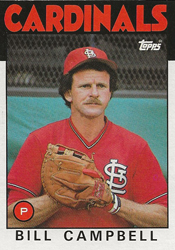
In their first venture into free agency, the Cardinals pursued a closer, Bill Campbell, but were unprepared for what it would cost to get him.

Campbell signed with the Red Sox instead of the Cardinals in November 1976.

Nine years later, when the Cardinals acquired Campbell in a trade with the Phillies, he became part of a bullpen by committee constructed to replace closer Bruce Sutter.

Campbell helped the Cardinals win a National League pennant in his only season with the club.

From battlefield to diamond

After serving with the Army in the Vietnam War, Campbell was playing semipro baseball in California when the Twins signed him in September 1970.

Two years later, when he was a starting pitcher in the Twins’ system, Campbell told Bob Padecky of the Charlotte News, “Vietnam is still something that lives with me. The Charlies had this rocket over there you could hear coming for miles. Even now, I still flinch occasionally from a loud noise.”

A right-hander who featured a screwball, Campbell, 24, reached the majors in July 1973 with the Twins, who converted him into a reliever. After the 1975 season, when he played for $22,000, Campbell sought an $8,000 raise, but Twins owner Calvin Griffith said no, the Minneapolis Star Tribune reported.

Until then, Campbell would have had to accept Griffith’s terms or quit, but in December 1975 arbitrator Peter Seitz had overturned baseball’s reserve system, opening the way for eligible players to become free agents in November 1976.

Campbell could become a free agent if he didn’t sign and played out his contract at the $22,000 salary offered by the Twins in 1976. That’s what he decided to do. 

With Campbell piling up wins and saves for the 1976 Twins, Griffith approached him during the season and offered him what he had asked, the Star Tribune reported, but now it was Campbell’s turn to say no.

Campbell posted a 17-5 record with 20 saves in a league-leading 78 relief appearances for the 1976 Twins.

“It’s all in his delivery,” Twins manager Gene Mauch said to the Star Tribune. “Take all the pitchers in the league and time their fastball on a speed machine and there won’t be much difference. It’s where the ball comes from that counts. Good delivery equals consistency and endurance and deception.”

Top dollar

Campbell was the free agent who interested the Cardinals the most in November 1976. They envisioned him joining Al Hrabosky in giving them a dominant pair of late-inning stoppers _ Campbell from the right side and Hrabosky from the left.

“Campbell is an impressive individual, physically and personally,” Cardinals general manager Bing Devine said to the St. Louis Post-Dispatch.

Cardinals officials, including owner Gussie Busch, met with Campbell and his agent, LaRue Harcourt. “They asked me if I would give them the first shot,” Campbell told Peter Gammons of Sports Illustrated.

Campbell said to the Post-Dispatch, “Money will be the most important factor in my decision. You consider location and you want to play with a contender, but money comes first.”

Because the Cardinals “seemed more interested” than any other club, Campbell told Gammons he was “resigned to playing with the Cardinals.”

Then the Red Sox entered the bidding. Assistant general manager John Claiborne led the negotiations for Boston. (Claiborne had been mentored by Devine in St. Louis and would replace him there in 1978.) Once Campbell and his agent heard the Red Sox’s proposal, they quickly accepted it.

The reliever who played for $22,000 in 1976 got from the Red Sox a five-year contract worth $1.075 million. Campbell received a $250,000 signing bonus and yearly salaries of $165,000, Gammons reported.

Asked why Campbell didn’t sign with the Cardinals, agent LaRue Harcourt said to the Boston Globe, “Not enough money. That was St. Louis. Not enough money.”

As Bob Broeg noted in the Post-Dispatch, the Cardinals “weren’t in the ballpark financially in the bidding.”

Big in Boston

Campbell’s bonanza was stunning in a day when the average salary for a big-league ballplayer was $51,500. “No player is really worth what they’re paying me,” Campbell told Sports Illustrated, “but if they want to, then fine.”

Red Sox followers had high hopes for a $1 million reliever. Or, as columnist Leigh Montville put it, “He was expected to deliver instant pitching salvation.”

His first appearance for the 1977 Red Sox, on Opening Day at Fenway Park, drew boos. Tasked with protecting a 4-2 lead, Campbell gave up a two-run home run to Buddy Bell in the ninth. The Indians went on to win, 5-4, in 11 and Campbell was the losing pitcher. Boxscore

He was the losing pitcher again in the second game of the season. Boxscore

Campbell was 0-3 with a 6.94 ERA in eight appearances in April 1977. “His public image fell somewhere between that of an auto repairman and a politician under indictment,” Montville wrote.

A month later, he was a darling of the Red Sox faithful, posting a 4-0 record and five saves in May. “He comes in, and it’s like Christmas morn,” Red Sox pitching coach and former Cardinal Al Jackson told the Globe.

Campbell finished the 1977 season with 13 wins and a league-leading 31 saves.

Wiley veteran

After fulfilling his contract with the Red Sox (1977-81), Campbell pitched for the Cubs (1982-83) and Phillies (1984).

That’s when the Cardinals came back into the picture. Bruce Sutter, who had 45 saves for the 1984 Cardinals, became a free agent and went to the Braves. The Cardinals wanted a veteran reliever to join holdovers Jeff Lahti and Ken Dayley in forming a bullpen corps that manager Whitey Herzog could use to fill the closer vacancy created by Sutter’s departure.

On April 6, 1985, the Cardinals traded pitcher Dave Rucker to the Phillies for Campbell and shortstop Ivan DeJesus.

Campbell, 36, used a herky-jerky motion to deliver an assortment of pitches, primarily the screwball. “It’s tough for hitters to decipher because they’re seeing a lot of arms and legs,” Campbell told the Post-Dispatch. “My leg hits the ground and then my arm comes through … It looks like I’m jumping out there.”

In his first two saves for the Cardinals, Campbell pitched three scoreless innings against the Giants Boxscore and four scoreless innings versus the Braves. Boxscore

“He throws all the pitches _ screwball, slider, curveball, fastball,” Cardinals pitching coach Mike Roarke said to the Post-Dispatch. “He uses his pitch selection well. When he’s going good, it can be very confusing for a hitter.”

Campbell was at his best during the Cardinals’ drive for a division title. On Sept. 14, 1985, he was the winning pitcher with three scoreless innings against the Cubs, a victory that vaulted the Cardinals ahead of the Mets and into first place in the National League East. The Cardinals remained on top the rest of the season. Boxscore

For the month of September, Campbell pitched in nine games for the Cardinals and had an 0.93 ERA.

During the season, he allowed just six of 39 inherited runners to score. From Aug. 18 to Sept. 28, he pitched 13.1 innings without yielding a run.

Campbell finished the season with a 5-3 record and four saves in 50 appearances. Seven Cardinals relievers _ Jeff Lahti (19), Ken Dayley (11), Todd Worrell (five), Campbell (four), Bob Forsch (two), Neil Allen (two) and Ricky Horton (one) _ combined for 44 saves, basically matching the total of 45 Sutter had for them the year before.

Campbell pitched in the 1985 National League Championship Series (no runs allowed in three games) and in the 1985 World Series (one run in three games). Those were his only postseason appearances in 15 years in the majors.

Released by the Cardinals in November 1985, Campbell pitched for the Tigers (1986) and Expos (1987). He ended up with 83 wins and 126 saves in 700 games in the majors.


Read Full Post »

Looking to cut costs during the Great Depression and open a spot at first base for the aptly named Rip Collins, the Cardinals decided the time was right to peddle a player who was popular and productive.

On Dec. 17, 1932, the Cardinals traded their future Hall of Fame first baseman, Jim Bottomley, to the Reds for pitcher Ownie Carroll and outfielder Estel Crabtree.
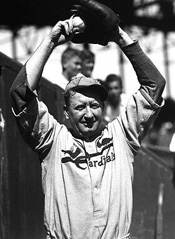
Nicknamed Sunny Jim for “his friendly disposition,” as the Associated Press described it, Bottomley had been a consistent run producer in 11 seasons with the Cardinals, and though there had been indications he was being shopped, it was thought he’d bring more than what St. Louis got for him.

Style and substance

Bottomley was born in Oglesby, Ill., and settled with his family in Nokomis, Ill., a farming and mining town. Bottomley’s father and brother worked in the mines. Bottomley’s brother was killed in a cave-in, the St. Louis Post-Dispatch reported.

When Bottomley was 16, he quit high school and clerked in a grocery store, the Associated Press reported. According to the Post-Dispatch, he also worked on a farm and as a blacksmith’s helper.

In his spare time, Bottomley played semipro baseball for $5 a game, walking eight miles each way to the home ballpark, the Associated Press reported. A St. Louis policeman saw him hit two home runs and three triples in a game and told Cardinals executive Branch Rickey he should give Bottomley a look. Invited to a Cardinals tryout camp in 1919, Bottomley was awarded a contract.

During 1922, his third season in their farm system, Bottomley got called up to the Cardinals and became their first baseman. He made an immediate impression with the fans because of his strut and the way he wore his cap.

“He was the only man I ever knew who could strut while he was crouched in the batter’s box,” Rickey told the St. Louis Globe-Democrat.

As for the cap, it “was never pulled down to shade the eyes like most ballplayers wore it,” the Globe-Democrat observed. “Sunny Jim’s was always cocked at a rakish angle.”

Before long, nearly everyone who followed the Cardinals knew Bottomley simply as Sunny Jim. He “smiled and swaggered his way into the hearts of baseball fans,” J. Roy Stockton noted in the Post-Dispatch.

According to the Associated Press, “Sunny Jim was one of those rare ballplayers who combined genuine color with honest-to-goodness ability.”

Playing to win

A left-handed batter, Bottomley hit for power, using a choked grip on a heavy bat.

On Sept. 16, 1924, Bottomley drove in 12 runs in a game against the Dodgers. Boxscore Since then, the only player to match that feat has been another Cardinal, Mark Whiten, versus the Reds on Sept. 7, 1993. Boxscore

Bottomley helped the Cardinals to four National League pennants (1926, 1928, 1930 and 1931) and two World Series titles (1926 and 1931). He won the National League Most Valuable Player Award in 1928 when he led the league in triples (20), home runs (31), RBI (136) and total bases (362).

Bottomley hit better than .300 in nine of his 11 seasons with the Cardinals. (In the other two years, he hit .299 and .296.) He ranks fourth in career RBI as a Cardinal (1,105). Only Stan Musial (1,951), Albert Pujols (1,397) and Enos Slaughter (1,148) produced more RBI for the franchise.

As for his fielding, “It doesn’t make any difference how wide or how high they are thrown to Sunny Jim. He always manages to get them,” the Dayton Daily News reported.

Time to go

Bottomley’s best friend on the Cardinals, another future Hall of Famer, left fielder Chick Hafey, was traded to the Reds on the eve of the 1932 season opener. Rip Collins, a natural first baseman, replaced Hafey in left field on Opening Day.

After Bottomley started slowly, hitting .158 with no home runs in April, manager Gabby Street benched him and moved Collins to first base.

Collins, 28, went on to lead the 1932 Cardinals in hits (153), home runs (21), RBI (91), runs scored (82) and total bases (260). Bottomley, 32, hit .296 with 11 homers.

With Collins making a convincing claim for the first base job, the Cardinals began making plans to move Bottomley. In September 1932, the last-place Reds revealed that manager Dan Howley would depart after the season. Reds owner Sidney Weil was an admirer of Bottomley and sought permission from the Cardinals to interview him for the job.

At the urging of Branch Rickey and Cardinals owner Sam Breadon, Bottomley went to Cincinnati on Sept. 23, 1932, while the season still was being played, and interviewed with Weil for the role of player-manager, the Cincinnati Enquirer reported. Donie Bush, a veteran manager, eventually got the job, but Weil was determined to acquire Bottomley to play for the Reds.

After Cardinals shortstop Charlie Gelbert was shot in a hunting accident in November 1932, the Cardinals offered Bottomley to the Reds for shortstop Leo Durocher and starting pitcher Si Johnson, a 13-game winner, the Enquirer reported.

When the Reds deemed the price too high, the Cardinals settled for Ownie Carroll (10-19 in 1932) and Estel Crabtree (.274, two home runs, in 1932). It was suspected the Reds sent the Cardinals a stack of cash as well.

Asked whether the Cardinals got cash in the deal, Breadon told Red Smith of the St. Louis Star-Times, “I wouldn’t want to say anything on that.”

According to The Sporting News, the trade garnered the Cardinals “a sizeable sum of money.” The Post-Dispatch informed its readers, “Close followers of baseball did not have to be told that it was a cash transaction.”

In addition to reaping the cash, the Cardinals also rid themselves of Bottomley’s $13,000 salary, about double what most players were making in 1932.

Worth the price

The Reds proposed to Bottomley a salary of $8,000, a $5,000 cut, for 1933, The Sporting News reported. After a negotiation, Bottomley, who wed St. Louis beauty shop owner Betty Brawner in February 1933, eventually signed for $10,000.

In May 1933, the Cardinals got the Reds to trade them Leo Durocher. (Three years later, the Cardinals also got Si Johnson from the Reds.)

Bottomley delivered what the Reds hoped from him. He led the 1933 Reds in triples (nine), home runs (13) and RBI (83). He had 16 RBI in 22 games versus the Cardinals. The following year, with the 1934 Reds, Bottomley was their leader in doubles (31), triples (11) and RBI (78). He hit .313 versus the Cardinals.

After a third season with Cincinnati, Bottomley was traded to the St. Louis Browns, finishing his career with them, including a stint as manager in 1937.

Read Full Post »

Brett Tomko was a sketch artist who made his living painting corners as a pitcher.

On Dec. 15, 2002, the Cardinals got Tomko from the Padres for reliever Luther Hackman and a player to be named (pitcher Mike Wodnicki).
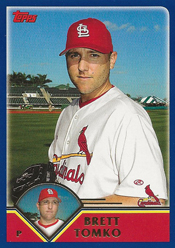
A right-hander, Tomko was a durable, but hittable, member of the Cardinals’ 2003 starting rotation, earning 13 wins despite some rough outings.

Arts and crafts

In 1970, three years before Brett was born, his father Jerry entered a contest to name the new Cleveland NBA franchise. His suggestion, Cavaliers, was selected from more than 11,000 entries submitted, The Cleveland Plain Dealer reported. His prize for naming the team was a pair of season tickets for the club’s first year.

When Brett was 3, he moved with the family from Euclid, Ohio, to Placentia, Calif., near Anaheim, and developed skills in baseball and in art. 

An art communications major at Florida Southern College, Tomko had a 15-2 record for the baseball team in 1995 and was named NCAA Division II player of the year, pitching a shutout in the national championship game.

When not playing baseball, he’d sometimes spend his nights at the campus art studio. “I’d stay until 4 in the morning, drawing and painting,” he recalled to the Dayton Daily News. “It relaxes me totally.”

He said to the Tampa Tribune, “I’ve always taken art courses. It’s come easy to me, like majoring in baseball.”

The Reds chose Tomko in the second round of the 1995 June amateur draft. After he reached the majors with them in May 1997, art remained a part of his life. “Tomko always carries with him a sketch pad and charcoals,” The Cincinnati Post reported. On road trips, he visited art museums. “I am the biggest nerd in major league baseball,” Tomko told Peter Gammons of the Boston Globe.

Before long, Tomko “dazzled teammates with his charcoal drawings,” Jeff Horrigan of The Cincinnati Post reported. Hal McCoy of the Dayton Daily News wrote, “Tomko drew beautifully in charcoal.”

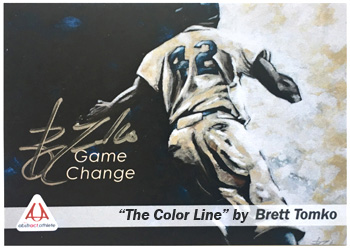
(On April 15, 2007, the 60th anniversary of Jackie Robinson integrating the big leagues, each fan attending the Dodgers game that day received a copy of Tomko’s drawing of Robinson, the Los Angeles Times reported.)

Traveling man

Tomko had 11 wins for the Reds his rookie season and 13 the next year. In April 1999, the Dayton Daily News reported, the Reds could have acquired Jim Edmonds from the Angels for Tomko but refused to part with him. (The next year, Edmonds was traded to the Cardinals.)

In February 2000, the Mariners made the Reds an offer they couldn’t refuse, sending them Ken Griffey Jr. for a package of players, including Tomko. The Mariners used him primarily as a reliever before shipping him to the Padres in December 2001.

Tomko was 10-10 with a 4.49 ERA in 32 starts for the 2002 Padres, but Cardinals manager Tony La Russa and pitching coach Dave Duncan noticed he was developing an effective sinkerball. “When he was in Cincinnati, he would just rear back and fire,” La Russa told the St. Louis Post-Dispatch. “We saw that he has really started to move the ball around and pitch.”

Shopping for pitching at the baseball winter meetings in December 2002, the Cardinals talked to the Giants about a trade of second baseman Fernando Vina for either starting pitchers Russ Ortiz or Livan Hernandez, the Post-Dispatch reported, but the Giants instead opted to sign free-agent second baseman Ray Durham.

Turning to the Padres, the Cardinals discussed swapping Vina for Tomko and another pitcher, Kevin Jarvis, before scaling back the framework of the deal, according to the Post-Dispatch.

The Cardinals projected Tomko, 29, to join a starting rotation with Matt Morris, Woody Williams, Garrett Stephenson and Jason Simontacchi.

“He’s a guy who we’re getting in the prime of his career,” La Russa said to the Post-Dispatch.

Skeptics noted that Tomko was joining his fourth team in five years and only once posted an ERA below 4.44, but Dave Duncan told the newspaper, “He’s a low-ball pitcher, gets a lot of ground balls, and we have a good defense. I think he has pitched in some other places where the defense wasn’t so good and he had to suffer through that and paid a penalty for it.”

After seeing Tomko pitch in spring training with the Cardinals, Duncan said to the Post-Dispatch, “I feel good about everything about him. I like the way he’s throwing. I like the way he goes about his business, his willingness to work, his drive to win. All the ingredients are there.”

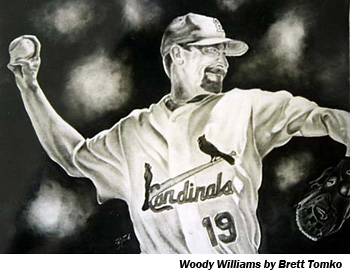
Like he had elsewhere, Tomko continued his art work while with the Cardinals. Among his projects was a portrait of teammate Woody Williams.

“The moments when Tomko has a charcoal pencil in his hand are among the most relaxing he can imagine,” Stu Durando wrote in the Post-Dispatch.

Good, bad, ugly

Tomko’s 2003 season with the Cardinals was a mix of gems and duds. He pitched complete games in wins against the Marlins (Boxscore) and Rockies (Boxscore). He also gave up nine runs in a game three times _ versus the Rockies (Boxscore), Red Sox (Boxscore) and Yankees (Boxscore).

Tomko finished the season with a 13-9 record and ranked second on the club in wins, but he gave up more hits (252) and more earned runs (119) than any pitcher in the National League. He allowed 35 home runs and batters hit .305 against him, helping account for a 5.28 ERA. Video

At times, Tomko impressed as much with his bat as he did with his arm. He hit .286 with nine RBI for the Cardinals. 

Granted free agency after the season, Tomko signed with the Giants _ the fifth of 10 clubs he pitched for in 14 seasons. The others: Dodgers, Royals, Yankees, Athletics and Rangers.

Tomko finished with a career mark of 100-103. His 13 wins for the Cardinals tied his single-season career high.

Read Full Post »

Ken Griffey Jr. should have been in the lineup for the Padres when the Cardinals faced them in the 2005 and 2006 National League playoffs. Instead, Griffey remained with the Reds, a team that never reached the playoffs during his nine seasons with them.

In November 2002, the Reds and Padres agreed to a trade of Griffey for Phil Nevin. Griffey would have been a Padre if Nevin hadn’t blocked the deal by invoking a no-trade clause in his contract.

The idea of trading Griffey for a journeyman such as Nevin would have been deemed preposterous a few years earlier, but the Reds were ready to cut their ties with a player once considered to be the best in baseball.

Special treatment

With the Mariners from 1989 to 1999, Griffey four times led the American League in home runs, and won 10 Gold Glove awards and a Most Valuable Player honor, but he wanted out of Seattle.

Born in the the same town (Donora, Pa.) and on the same date (Nov. 21) as Stan Musial, Griffey grew up in Cincinnati, where his father played for the Reds, and eventually relocated to Orlando. After the 1999 season, he rejected an eight-year, $140 million offer from the Mariners, saying he wanted to play for a team closer to his Florida home.

Though the Cardinals tried to acquire him, Griffey was traded to the Reds. According to Bill Madden of the New York Daily News, Reds general manager Jim Bowden “made no secret of the fact that Griffey was going to get special treatment, a grievous mistake … Numerous Reds, past and present, have blasted Griffey as being self-absorbed and an island unto himself in the clubhouse.”

Limited to 70 games because of leg injuries in 2002, Griffey produced eight home runs and 23 RBI.

Content in California

A few days after Griffey turned 33, the Reds agreed during the Thanksgiving weekend to swap him to the Padres for Nevin, the Associated Press reported.

Primarily a third baseman and first baseman, Nevin had come to the Padres after stints with the Astros, Tigers and Angels. After producing 41 home runs and 126 RBI for the 2001 Padres, Nevin, 31, totaled 12 homers and 57 RBI in 2002.

The Reds viewed Nevin (due $31 million for the next four years) as a less expensive alternative to Griffey (due $86 million for the next six years). Also, Nevin was friends with Reds manager Bob Boone.

“Boone and Nevin have a longstanding friendship dating to Nevin’s childhood, when he grew up in the same Southern California neighborhood where Boone lived,” The Cincinnati Post reported.

Nevin’s agent, Barry Axelrod, said his client rejected a trade to the Reds because he wanted to remain on the West Coast, The Cincinnati Post reported.

Acting on orders from the Reds’ front office, Boone met with Nevin for lunch and tried to convince him to change his mind, but was unsuccessful, according to the Dayton Daily News.

Bargain basement

The Reds initially denied trying to trade Griffey, but came clean after Nevin confirmed to reporters he had blocked the deal.

Reds chief operating officer John Allen said the trade, orchestrated by Bowden, had the support of team owner Carl Lindner, The Cincinnati Post reported.

According to USA Sports Weekly, after the proposed deal with the Padres collapsed, the Reds offered Griffey to the White Sox for outfielder Magglio Ordonez, but were quickly turned down.

Among the reactions to the Reds’ attempts to peddle Griffey:

_ Mike Anthony, Hartford Courant: “How quickly Griffey has fallen off the map of baseball stars in three years with the Reds. The minute he left Seattle, he got old. He’s been injured and, at times, unhappy.”

_ Dan O’Neill, St. Louis Post-Dispatch: “Seems hard to believe Ken Griffey Jr., considered hands-down the best player in the game a few years back, is now being shopped like a used lawn mower.”

_ Bill Simmons, ESPN.com: “He’s 33, plagued by injuries, miserable and bitter, on the downside of his career, and his team can’t even give him away.”

_ Paul Daugherty, Cincinnati Enquirer: “Griffey can be paranoid when he has no reason. Now, he has plenty of reason.”

Still got game

Three years later, in July 2005, the Padres traded Nevin to the Rangers. He went on to play for the Cubs and Twins, too. In 12 years in the majors, Nevin hit 208 home runs. During the 2022 season, he replaced Joe Maddon as Angels manager.

Griffey had more injury-marred seasons in 2003 and 2004 (when he hit his 500th career home run versus the Cardinals), but returned to form in 2005, when he was named the National League Comeback Player of the Year with the Reds.

Griffey produced 35 home runs and 92 RBI for the 2005 Reds. If he had been with the Padres that season, he would have been their team leader in home runs and RBI. The 2005 Padres, with top producers Ryan Klesko (18 home runs) and Brian Giles (83 RBI), qualified for the playoffs but were eliminated by the Cardinals in the first round.

In 2006, Griffey slugged 27 home runs for the Reds, three more than the Padres’ team leader, Adrian Gonzalez. The Padres again were eliminated by the Cardinals in the first round of the playoffs.

The Reds traded Griffey to the White Sox in July 2008. Granted free agency after the season, he returned to the Mariners for two more years. In 22 seasons in the majors, Griffey batted .284 with 2,781 hits, 630 home runs and 1,836 RBI, but never played in a World Series.

Read Full Post »

(Updated Nov. 10, 2024)

A power struggle within the front office nearly cost the Cardinals a chance to get the shortstop they needed to win a championship.

On Nov. 19, 1962, the Cardinals acquired shortstop Dick Groat and reliever Diomedes Olivo from the Pirates for pitcher Don Cardwell and shortstop Julio Gotay.

With his exceptional hitting and base running, Groat helped the Cardinals become World Series champions in 1964.

At the urging of manager Johnny Keane, Cardinals general manager Bing Devine made the trade over the objections of consultant Branch Rickey.

From a baseball perspective, Devine and Keane made the right move _ Groat was a key contributor to the Cardinals becoming contenders _ but it cost them. The trade widened a rift between Devine and Rickey, and Keane and Groat eventually had a falling out.

Terrific talent

Born and raised in the Pittsburgh area, Groat went to Duke University and became an all-America in baseball and basketball. A 5-foot-10 guard, he averaged 26 points and 7.6 assists per game as a senior for the basketball team.

Branch Rickey was the Pirates’ general manager when Groat signed with them in June 1952 and went directly from the Duke campus to the major leagues. Picked by the Fort Wayne Pistons in the first round of the NBA draft, Groat played in 26 games for them in the 1952-53 season, averaging 11.9 points.

After two years of military service, Groat chose to focus on baseball and resumed his big-league career with the Pirates in 1955.

The Pirates nearly traded Groat to the Athletics for Roger Maris in December 1959, but called off the deal at the last minute. The Athletics then swapped Maris to the Yankees. Groat won the National League Most Valuable Player Award in 1960, Maris was named the American League MVP, and the Pirates prevailed in the World Series against the Yankees.

Your move

On Oct. 7, 1962, Bob Broeg of the St. Louis Post-Dispatch broke the story that the Cardinals offered starting pitcher Larry Jackson to the Pirates for Groat.

Jackson led the 1962 Cardinals in wins (16) and innings pitched (252.1). Groat produced 199 hits, including 34 doubles, and batted .294 for the 1962 Pirates.

According to The Pittsburgh Press, the Pirates countered, offering backup shortstop Dick Schofield, a former Cardinal, but Devine and Keane were interested only in Groat.

When the Pirates dawdled, the Cardinals on Oct. 17 dealt Larry Jackson, Lindy McDaniel and Jimmie Schaffer to the Cubs for George Altman, Don Cardwell and Moe Thacker.

Pirates general manager Joe Brown admitted the swap of Jackson to the Cubs “surprised him” and he “didn’t know the trade was in the making,” The Sporting News reported, but he liked Cardwell as much as he did Jackson.

According to the Pittsburgh Post-Gazette, “Brown called Devine and said he thought there was still basis on which the clubs could make a trade.”

Power plays

While Devine was trying to acquire Groat, Cardinals owner Gussie Busch was on a business trip to Los Angeles and met with a friend, Bob Cobb, owner of the Brown Derby restaurant. Cobb suggested to Busch that he should hire Branch Rickey, 80, as a consultant, the Post-Dispatch reported. “He’ll help you win a pennant more than any other person could,” Cobb said to Busch.

The Cardinals hadn’t won a pennant since Busch bought the franchise in 1953 and he was tired of waiting. Acting on the advice of the restaurateur, Busch hired Rickey, who had built the Cardinals into a powerhouse before departing for the Dodgers in October 1942. In the consultant role, Rickey would advise Devine on player personnel matters and report to Busch.

In his autobiography, “The Memoirs of Bing Devine,” Devine said, “To be honest, I rather resented that Rickey was back … I was still in charge, but Rickey still had Busch’s ear.”

The relationship was rocky from the start. Rickey acted like he was Devine’s boss, and they disagreed on personnel matters.

Devine had gotten the Pirates to agree to trade Groat, 32, but Rickey thought the Cardinals would be better keeping Julio Gotay, 23, as their shortstop.

“Rickey hated giving up young players for veteran players,” Devine said in his book. “I had to set it up so that Rickey would approve the Groat deal and take it to Mr. Busch.”

At the Florida Instructional League in St. Petersburg, director of player development Eddie Stanky, coach Harry Walker and others joined Devine in approaching Rickey and making a case for Groat.

In his book, Devine recalled that Rickey said to him, “You’ve kind of loaded this meeting for me, haven’t you?”

Devine replied, “I know it looks like that way, but we need Groat to make this team go.”

After a long discussion, Rickey said, “I’ll talk to the boss … I’ll tell him you feel strongly about it and that he should do what he wants to do.”

Busch approved the trade for Groat, but Rickey wasn’t happy. “The Groat trade started cooling the relationship between Rickey and me,” Devine said in his book.

Getting it done

Though, as The Sporting News noted, “Groat still has the reputation of being the best hit-and-run man in the league,” he led National League shortstops in errors five times with the Pirates. Devine and Keane were hoping Groat’s knowledge of playing the hitters would compensate for the errors and a lack of range.

Pittsburgh Press sports editor Chester L. Smith wrote of Groat after the trade, “Maybe he has slowed up a half stride or so, perhaps his hands aren’t quite as sure as they once were, but he plays the hitters so well that he minimizes any loss of speed. He reminds you a great deal of Lou Boudreau when the artful codger was on the downside of the hill and was using his head to get the results his legs had produced in his youth.”

Groat said to Sports Illustrated, “I’m aware of my shortcomings. I’m not fast. I have limited range and my arm isn’t strong.”

As it turned out, Groat was everything Devine and Keane hoped he’d be for the 1963 Cardinals, who placed second with 93 wins, their most since 1949.

In the book “We Played the Game,” Groat said, “I went to St. Louis with the intention of showing Joe Brown that he made a very bad mistake trading me. In 1963, I had the best year of my career, a better year than in 1960. I hit the ball with more authority.”

Groat produced career highs in hits (201), doubles (43), triples (11), RBI (73) and on-base percentage (.377) for the 1963 Cardinals. He and teammates Bill White, Julian Javier and Ken Boyer were the starting infielders for the National League in the All-Star Game. “We were really proud of that because we were chosen by our peers, not the fans,” Groat told author Danny Peary.

In his autobiography “Stan Musial: The Man’s Own Story,” Musial said, “I’d learned to respect Dick playing against him, but not until I played with him my last year did I realize fully how smart and thorough he is … Groat and Bill White are the best players the Cardinals obtained by trade in my many years with the club.”

In his book “Few and Chosen,” Tim McCarver said of Groat, “I learned more about base running from him than from anybody else … I never saw anybody as good as Groat going from first to third. He did everything instinctively on the bases.”

Ken Boyer said to Sports Illustrated, “It adds to your confidence to have a player of Dick’s stature standing next to you.”

Plots and schemes

The underachieving Cardinals had a losing record at the all-star break in 1964 and a rift developed between Groat and Keane. Because of how well Groat could handle a pitch, Keane allowed him to call a hit-and-run play when he wanted to while batting. Eventually, Keane decided Groat abused the privilege and took it away. That angered Groat and he sulked. In his book “October 1964,” author David Halberstam wrote that Keane “saw Groat as a challenge to his control.”

At a team meeting in the clubhouse, Keane confronted Groat, accusing him of undermining the manager. Groat apologized, and the the matter appeared settled.

A month later, Gussie Busch learned of the incident from his daughter, who heard about it from the player she was dating, Braves third baseman Eddie Mathews. Petty and paranoid, Busch accused Devine of hiding the matter from him. Meanwhile, Rickey, on the outs with Devine, was advising Busch to get another general manager.

On Aug. 17, 1964, Busch fired Devine and replaced him with Rickey’s choice, Bob Howsam. Busch schemed to replace Keane with Leo Durocher after the season.

“That Groat situation was an issue,” Devine said in his autobiography, “but I don’t think that’s why Busch fired me. I really think it had more to do with us being so far back in August.”

Helped by Groat, who hit .282 in September and .417 in October, the Cardinals surged and won the National League pennant on the last day of the season. After prevailing in the World Series against the Yankees, Keane quit and became Yankees manager.

Groat hit .292 with 35 doubles and 70 RBI for the 1964 Cardinals but he also made a career-high 40 errors.

After the 1965 season, he was traded by Howsam to the Phillies.

Groat had 2,138 hits in 14 seasons in the majors and batted .302 against the Cardinals.

Read Full Post »

« Newer Posts - Older Posts »