Feeds:
Posts
Comments

Archive for the ‘Uncategorized’ Category

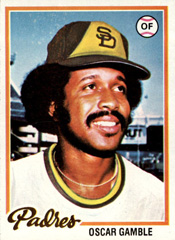
Oscar Gamble twice teamed with a future member of the 1982 World Series champions to help the Padres beat the Cardinals.

Gamble was an outfielder in the major leagues for 17 seasons (1969-1985), including five years in the National League with the Cubs (1969), Phillies (1970-1972) and Padres (1978).

He was the Opening Day left fielder on a Padres team that included future Cardinals Ozzie Smith at shortstop, George Hendrick in center field and Gene Tenace at catcher. Smith, Hendrick and Tenace went on to play for the 1982 World Series champion Cardinals. In 1978, Smith and Tenace paired with Gamble in providing prominent production in wins over the Cardinals.

The first of those games was May 5, 1978, at St. Louis. The Padres won, 2-1, and Gamble and Smith played key roles versus starter John Urrea. Smith had two triples, a single and a stolen base. Gamble drove in the winning run with a triple. The game was the sixth for Ken Boyer as Cardinals manager.

Cardinals second baseman Mike Tyson deprived Gamble of a second RBI in the eighth inning when he dived for Gamble’s hard smash, snared the ball, leaped to his feet and threw out Smith, who was attempting to advance from third base to home.

Two months later, on July 28, 1978, at San Diego, Gamble and Tenace were culprits in defeating the Cardinals. Gamble had a RBI-double against starter John Denny and a two-run single off Buddy Schultz. Tenace drove in five runs and scored twice. He produced a RBI-single and solo home run against Denny and a three-run homer off Aurelio Lopez.

It was the 10th time in a row the Cardinals lost to the Padres at San Diego.

For his career, Gamble batted .254 (30-for-118) against the Cardinals.

Read Full Post »

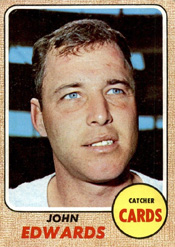
Johnny Bench made Johnny Edwards available to the Cardinals and Ted Simmons made him expendable.

On Feb. 8, 1968, the Cardinals acquired Edwards from the Reds for catcher Pat Corrales and infielder Jimy Williams. The trade was made by general managers Bing Devine of the Cardinals and Bob Howsam of the Reds. When Devine was fired in August 1964, ending his first stint with the Cardinals, Howsam replaced him as Cardinals general manager before departing for the Reds in January 1967.

The deal brought together Edwards and Tim McCarver, giving the Cardinals an all-star catching tandem. Corrales and Williams went on to become big-league managers after their playing careers.

McCarver, the Cardinals’ first-string catcher, was outstanding in 1967. He batted .295, finished second in balloting for the National League Most Valuable Player Award and handled a pitching staff that carried the Cardinals to a World Series championship.

The Cardinals, however, wanted a strong backup who could fill in when McCarver was fulfilling his Army reserve duties one weekend a month and when McCarver needed a rest.

“It’s up to me to prove I can be of some value to them and I’m going to spring training in an optimistic frame of mind, even knowing McCarver is there,” Edwards said to the Dayton Journal-Herald.

Edwards, 29, became available because Bench, a rookie phenom, was ready to take over the starting catcher role for the Reds in 1968. Edwards, who debuted with the Reds in 1961, twice won a Gold Glove Award for fielding excellence (1963-64) and three times was named a National League all-star (1963-65) with the Reds.

He fell out of favor with the Reds when his batting averages dipped substantially in 1966 (.191) and 1967 (.206). Unhappy with being platooned and aware Bench was ready to take over, Edwards publicly requested a trade. “It was a real good deal to get out of Cincinnati,” Edwards said to The Sporting News. “The (management) people in Cincinnati were down on me.”

In joining the Cardinals, Edwards was reunited with Dick Sisler, who was Reds manager in 1965 before becoming Cardinals hitting coach in 1966. “Maybe Sisler can help me with my swing,” Edwards said. “I used to hit to all fields. Then they wanted me to try to pull the ball more.”

Recalling Wally Pipp, the Yankees first baseman who missed a game, was replaced by Lou Gehrig and never got his job back, McCarver said, “Maybe I would be better off with a little more rest, but I don’t want to get Wally Pipped out there.”

On March 10, 1968, in his spring training debut for the Cardinals, Edwards caught 14 innings in a game against the Mets and impressed his teammates.

Edwards quickly contributed to the Cardinals during the regular season. After Edwards produced three hits in a Cardinals victory over the Astros on May 1, outfielder Roger Maris needled McCarver. “I’m sure glad we had a good-hitting catcher in there tonight,” Maris said. Boxscore

A left-handed batter, like McCarver, Edwards hit a two-run home run off Juan Marichal in Bob Gibson’s 3-0 shutout of the Giants on July 6. Boxscore Edwards caught 10 of Gibson’s starts in 1968 and Gibson had a 0.89 ERA in those games, according to baseball-reference.com.

On Sept. 18, Edwards caught Ray Washburn’s no-hitter, the first by a Cardinals pitcher since Lon Warneke in 1941. Boxscore

Edwards appeared in 85 games for the 1968 National League champions, made 52 starts and batted .239.

In the World Series against the Tigers, McCarver started all seven games. Gibson won his first two starts but was the loser in the decisive Game 7. “I feel if I had caught Bob in the World Series, the result would have been different,” Edwards said to the Society for American Baseball Research.

On Oct. 11, 1968, Edwards was traded to the Astros in a deal for pitcher Dave Giusti. Simmons, a first-round draft choice of the Cardinals in 1967, was being groomed to replace McCarver and Edwards no longer was needed.

Read Full Post »

Paired with an innovative coach who provided a seal-tight offensive line, reliable running backs and sure-handed receivers, Jim Hart was among the NFL’s top quarterbacks in the mid-1970s and secured his place as the best who played for the St. Louis football Cardinals.

The Cardinals played 28 seasons (1960-1987) in St. Louis and Hart was a quarterback for them for 18 of those years (1966-1983).

Like the franchise, Hart had many ups and downs. When he came to the Cardinals as an undrafted prospect from Southern Illinois University, Hart competed with another underrated quarterback, Charley Johnson, for the starting job.

Hart prevailed when Johnson was traded to the Oilers after the 1969 season, but when Bob Hollway became Cardinals head coach in 1971 he soured on Hart. By 1972, Hart was a reserve behind Gary Cuozzo and Tim Van Galder.

The arrival of Don Coryell as Cardinals head coach in 1973 revived Hart’s career. Coryell recognized Hart as a special talent and named him the starter.

Coryell also supported Hart with a cast that included offensive linemen Dan Dierdorf, Conrad Dobler, Bob Young, Tom Banks and Roger Finnie; running backs Terry Metcalf and Jim Otis; and receivers Mel Gray, Jackie Smith, Earl Thomas and Ike Harris. As Dobler told Sports Illustrated in July 1977, “I’ll do anything I can get away with to protect my quarterback.”

Hart led the Cardinals to their best St. Louis seasons. The Cardinals finished in first place in the NFC East Division in 1974 (10-4) and 1975 (11-3) and in second place in 1976 (10-4). They got to the playoffs in 1974 and 1975, years when only four teams from the NFC qualified for the postseason.

Here are 10 facts to know about Hart based on research, most especially from Pro Football Reference:

1. Leader of the pack

Hart is the Cardinals franchise leader in passing yards (34,639), completions (2,590) and touchdown passes (209). That’s no small feat. The franchise has been in the NFL since 1920. The Cardinals started in Chicago (1920-1959) and relocated to St. Louis (1960-1987) and Phoenix (1988-present). Hart highlight video

2. Best in class

In 1974, Hart led the NFL in pass attempts (388) and ranked first in the NFC in both completions (200) and touchdown passes (20). Hart was named 1974 NFC Player of the Year by United Press International.

3. Tough to beat

Hart threw more career touchdown passes (35) against the Cowboys than he did against any other foe. The Cardinals, however, had a 7-17 record versus the Cowboys in games in which Hart played.

In 1975, Hart threw seven touchdown passes in two games against the Cowboys. On Sept. 28, Hart connected on two touchdown passes to Gray and one each to Thomas and Smith, but the Cowboys beat the Cardinals, 37-31. On Dec. 7, the Cardinals defeated the Cowboys, 31-17, with Hart completing two scoring strikes to Gray and one to Metcalf. The victory gave the Cardinals control of the NFC East.

4. Playing long ball

Hart had an exceptionally strong arm and was effective at completing long passes, or bombs. Forty-one percent of his career touchdown throws (87 of 209) were of 30 yards or more.

In his 1977 book, “The Jim Hart Story,” Hart said, “The bomb is partly feel and partly luck. The feel is knowing where to throw it. You want to get it over the receiver’s outside shoulder, so the defender can’t get to it. The luck is having the right speed, the right velocity. You can’t always control that.”

5. Longest yard

Hart’s longest completion didn’t produce a touchdown.

On Dec. 10, 1972, against the Los Angeles Rams, Hart completed a 98-yard pass to Bobby Moore (later named Ahmad Rashad). The play went from the Cardinals’ 1-yard line to the Rams’ 1-yard line. It’s the NFL’s longest non-scoring play.

“If I scored, it wouldn’t have been a record,” Moore told the St. Louis Post-Dispatch.

Hollway sent in the play _ a fly pattern _ figuring the Rams expected the run.

Moore snared Hart’s pass at the Cardinals’ 40-yard line and cut downfield. He was caught from behind by Al Clark. Video

On the next play, Donny Anderson ran for the touchdown.

6. Productive target

Gray was the receiver who caught the most touchdown passes from Hart. Gray and Hart connected for 38 touchdowns.

The most famous came on Nov. 16, 1975, against the Redskins. On fourth down, Hart completed a seven-yard scoring pass to Gray. Officials initially disagreed on whether Gray maintained possession, but the call went in the Cardinals’ favor. Some refer to it as the “Phantom Catch.” Video

St. Louis won in overtime, 20-17, and earned the label “Cardiac Cardinals.”

7. Welcome to the NFL

Hart played in his first regular-season Cardinals game on Dec. 17, 1966, against the Browns.

Appearing in relief of starter Terry Nofsinger, Hart completed four of 11 passes for 29 yards. The Browns won, 38-10.

Asked about Hart’s debut, Cardinals head coach Charley Winner said, “Most of those passes he completed were short and to the sidelines. You’re supposed to complete those passes.”

8. On-the-job training

The first regular-season touchdown pass thrown by Hart was 12 yards to Prentice Gautt on Sept. 17, 1967, against the Giants.

Hart, making his first start, was intercepted four times. The Giants won, 37-20.

“After that loss, I felt so poor that I didn’t want to look anybody in the eye,” Hart said.

9. On the run

Hart had 16 career rushing touchdowns. The longest was his first, a 23-yard run on Sept. 24, 1967, versus the Steelers.

“I had to run with it,” Hart said. “The play was a fake up the middle and a pitch to the fullback. (Linebacker) Andy Russell made a good move to get in the way of the pitch. I was going to throw it, but with our linemen already down the field I couldn’t. I had to run.”

Jim Bakken kicked seven field goals and St. Louis won, 28-14.

10. Picked off

In 1967, Hart was intercepted 30 times in 14 starts.

George Blanda of the 1962 Oilers holds the single-season record. He was intercepted 42 times.

Previously: Football Cardinals finally got it right with Don Coryell

Read Full Post »
After getting a ringside view of Muhammad Ali bludgeoning an opponent, Bill White had seen enough boxing.

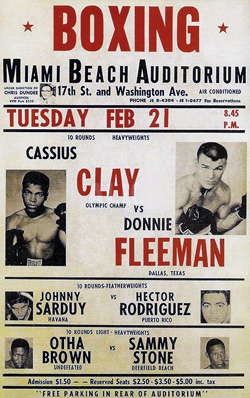
clay_fleemanWhite and Cardinals teammate Curt Flood met Ali, then known by his birth name of Cassius Clay, in Florida in February 1961. Ali, 19, was early in his professional boxing career after having won a gold medal at the 1960 Summer Olympics. White, 27, was the first baseman and Flood, 23, the center fielder for the Cardinals.
The Cardinals had opened an advance training camp in Homestead, Fla., near Miami, on Feb. 12, 1961, before they would move across state to their St. Petersburg base at the beginning of March. White and Flood were among the veterans who attended the early workouts at Homestead to get in extra hitting.

Ali was preparing for his fifth professional bout, a match with Donnie Fleeman, 29, an experienced heavyweight from Midlothian, Texas.

Meet in Miami

Seeking a break from small-town Homestead, which primarily was an agricultural community, White and Flood drove the 35 miles to Miami.

In his book “Uppity: My Life in Baseball,” White said he and Flood “went to the Sir John Hotel in the Overtown section, an area earlier known as Colored Town, where a lot of black celebrities stayed and performed.”

White said he and Flood were standing outside the hotel when an acquaintance approached and offered to introduce them to a friend of his.

“The friend was a tall, good-looking black kid named Cassius Clay _ later, of course, Muhammad Ali,” White said.

Bloody event

On Feb. 21, 1961, Ali fought Fleeman before 2,076 spectators at the Miami Beach Auditorium. White accepted Ali’s invitation to attend the fight and was given a ringside seat.

Ali, using what the Associated Press described as “a speedy jab and a rock-hard right cross,” earned a seventh-round technical knockout of Fleeman.

Ali twice opened a cut over Fleeman’s right eye and bloodied his nose, according to the Associated Press.

“At the end of the sixth,” wrote the Associated Press, “the bleeding Fleeman pointed to his midsection … and asked that doctors examine it. Dr. Alex Robbins said Fleeman had a rib injury and recommended that the scheduled eight-rounder be stopped.”

Said White: “In typical Ali fashion, he had boasted to me that Fleeman would never lay a glove on him _ and in typical Ali fashion, he was right … By the time he knocked Fleeman out in the seventh round, I had flecks of Fleeman’s blood all over my clothes. I never went to another professional fight.”

No thanks

Nine years later, in 1970, when White had retired as a player and gone into broadcasting, he was asked by Howard Cosell of ABC television to join him in working a fight in Italy.

“Howard persisted,” White said, “and while I was flattered by the offer, in the end I turned him down. Although I often watched boxing on TV, I hadn’t been to a fight since Ali spattered me with Donnie Fleeman’s blood in Miami in 1961. I just didn’t think that I was ready for such a high-profile assignment in a sport I had never covered.”

Message of hate

During their February 1961 introduction to Ali, White and Flood were invited to join the boxer at a Nation of Islam meeting at a Florida mosque.

In his book “The Way It Is,” Flood said Cardinals pitcher Bob Gibson attended the meeting, too.

Said White: “After being searched for weapons at the door, we went in and sat down and listened as a speaker talked about separating black people from the ‘white devils’ and how Black Muslims wanted to inflict mayhem on their enemies … After about 10 minutes, Curt looked at me and I looked at Curt and then we got up and left. Ali left with us.”

Said Flood: “Our wallets and watches were impounded at the door … The speeches _ or sermons _ were rampantly, savagely racist. The only discernible program seemed to be destruction of the hated ‘white devil’ and substitution of black rule.”

Rejecting racism

Said White: “I wanted to support anyone who was fighting against the oppression of black people, but the Nation’s philosophy really wasn’t my kind of thing.”

Said Flood: “I simply happen to doubt that black pride need be accomplished by racism … We ought to have learned enough about racism to avoid it in ourselves.”

Of Ali, Flood concluded, “Anyone who expects me to attack Muhammad Ali or the Black Muslims can forget it. I respect Ali. I would be surprised if he were a racist fanatic.”

Previously: Bill White interviewed about autobiography

Previously: Book details how Cardinals were segregated in Florida

Read Full Post »

(Updated May 26, 2020)

Ted Simmons slugged a Cubs player before he delivered a knockout punch to the entire Chicago team.

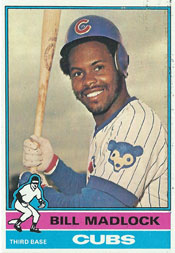
bill_madlockOn Sept. 22, 1974, at St. Louis, Simmons hit Cubs batter Bill Madlock, setting off a melee.

Soon after, Simmons got the game-winning hit.

In the ninth inning, with the score tied at 5-5, Madlock led off against Al Hrabosky. When Hrabosky stepped off the mound, turned his back on the batter and went into his routine of psyching himself for the confrontation, Madlock backed away and went toward the on-deck circle.

After Madlock returned to the batter’s box, Hrabosky exited the mound again. Madlock responded by walking back to the on-deck circle.

“I know what they were doing,” Hrabosky said to the Associated Press. “They were trying to out-psyche me.”

Play ball

Irritated, plate umpire Shag Crawford walked toward Madlock and ordered him to return to the batter’s box. “I said, ‘Bill, get back here,’ ” Crawford told the St. Louis Post-Dispatch. “I thought maybe he didn’t hear me because of the crowd noise. So I went after him and said it again.”

Cubs manager Jim Marshall and Jose Cardenal, the Cubs’ on-deck batter, rushed toward the umpire, protesting what they considered delay tactics by Hrabosky.

“The pitcher walked off the mound and just stood there,” Marshall said. “The pitcher is the one who should have been told to come in with the ball.”

Whirling away from Marshall and Cardenal, Crawford strode back toward the plate. With Marshall and Cardenal in pursuit, the umpire positioned himself behind the catcher, Simmons, and motioned to Hrabosky to make a pitch.

Hrabosky obliged and, with no one in the batter’s box, fired a high fastball that was called a strike.

Simmons rifled the ball back to Hrabosky and the pitcher quickly prepared to make another delivery.

Alarmed, Cardenal waved frantically to Madlock to get into the batter’s box.

Double trouble

Cardenal, fearing Madlock wouldn’t arrive in time, took a batting stance at the far end of the box. As he did, Madlock rushed into the box and took his stance in front of Cardenal, giving the Cubs two batters in the box, both with bats cocked, prepared to swing.

In his haste, Madlock brushed Simmons with the bat as Hrabosky’s fastball crossed the plate.

“I looked up and he (Madlock) was standing there with his bat, looking at me,” Simmons told reporters. “I said, ‘What are you looking at?’ And he said, ‘Get lost.’

“Then I hit him.”

Simba strikes

Simmons landed a punch to Madlock’s chin. “I must have hit him pretty good,” Simmons said to the Post-Dispatch. “I cut my knuckles.”

The benches emptied and fighting ensued. You can see a video of the incident by playing the first 1:05 of this You Tube clip.

After punching Madlock, Simmons pursued him up the third-base line and was struck from behind with a full body blow by Cubs first baseman Andre Thornton.

In a 2020 interview with Stan McNeal of Cardinals Gameday Magazine, Simmons recalled, “I got hit harder than I ever had been in my life when Andre Thornton ran up and laid into me … I went down and just laid there. I couldn’t breathe. I’m not mad that he hit me from behind because I’d have done the same thing if I had been him.”

Pat Dean, widow of Hall of Famer Dizzy Dean, whose uniform No. 17 was retired by the Cardinals before the game, witnessed the fight and told the Post-Dispatch, “They must have done this for Diz. It looked like the old Gashouse Gang.”

When order was restored, only Marshall was ejected because he complained to Crawford about Simmons remaining in the game. “I don’t think players should be thrown out for fighting,” Crawford told the Chicago Tribune.

Hrabosky said the fight “really psyched me up. It was just what the doctor ordered.” Hrabosky struck out Madlock and got Cardenal to pop out to Simmons before striking out pitcher Dave LaRoche.

In the bottom of the ninth, Lou Brock singled and advanced to second when Reggie Smith walked. With two outs, Simmons, batting right-handed, laced a single to center, scoring Brock and giving the Cardinals a 6-5 victory. Boxscore

Years later, in an interview with the Baseball Hall of Fame magazine, “Memories and Dreams,” Hrabosky said of Simmons, “His best attributes were his strong will to win and his dedication to being out there every day. He could motivate me better than anybody I’ve ever been around.”

The emotional triumph gave the division-leading Cardinals a 1.5-game advantage over the second-place Pirates with nine games remaining.

Basking in the afterglow of victory, Hrabosky said, “I really don’t intend to make people or players mad at me with what I’m doing. I’m just doing it for myself. But, if it makes them mad, it’s just serving my purpose all the more.”


Read Full Post »

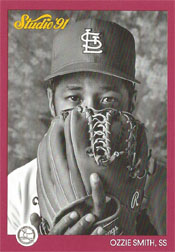
Three prominent Cardinals from the Whitey Herzog era _ Willie McGee, Tom Pagnozzi and, yes, Ozzie Smith _ thrived under Tony La Russa in his first season as St. Louis manager.

ozzie_smith7Though Smith got upset with La Russa because the manager reduced his playing time in 1996, relegating him to a reserve role behind shortstop Royce Clayton, what gets overlooked is Smith produced a quality final season under La Russa’s management.

After Joe Torre was fired in 1995, La Russa was hired to manage the Cardinals in 1996.

Pagnozzi and Smith were holdovers from the 1995 Cardinals. McGee returned to the Cardinals as a free agent after spending the 1995 season with the Red Sox.

After spring training in 1996, Smith was slowed by a hamstring problem and Clayton established himself as the starting shortstop. The decision to put Smith in a secondary role created a rift between La Russa and Smith.

Unlike Smith, McGee and Pagnozzi built respectful relationships with La Russa in 1996.

Like Smith, McGee and Pagnozzi performed well under La Russa’s management that year.

McGee: Team player

_ McGee batted .307 for the 1996 Cardinals. It was his highest batting average in five years. McGee also led the 1996 Cardinals in pinch-hitting batting average (.350, 14-for-40).

In October 1996, just before the Cardinals opened the National League postseason, Jeff Gordon of the St. Louis Post-Dispatch wrote, “McGee brought a lot more than heritage or aesthetics to the table. He filled in admirably for (Brian) Jordan and (Ron) Gant and proved dangerous as a part-timer coming off the bench.”

McGee said of La Russa, “Whatever he asks me to do, I do. Pinch-hit, play, whatever … I’m sure he’ll try to put the best team he can out there.”

Pagnozzi: Rises to challenge

_ Pagnozzi produced single-season career highs in home runs (13), slugging percentage (.423) and runs scored (48) for the 1996 Cardinals while elevating his skill as a pitch caller. Pagnozzi batted .270 in 1996 and especially was effective (.311, 56-for-180) with runners on base.

Describing the celebration after the Cardinals clinched the division title on Sept. 24, 1996, at Pittsburgh, Rick Hummel wrote, “One of the more poignant clubhouse scenes was a tearful Tom Pagnozzi, the Cardinals catcher, hugging manager Tony La Russa, who didn’t seem all that impressed with Pagnozzi early in the season.”

Said Pagnozzi: “We went through a lot. I just thanked him for staying with me and keeping me here. We respect each other and I think I’ve risen to his challenge. To me, this was a great feeling because I was able to go up and look him in the eye and he knows I’m a player.”

Smith: Blinded by pride

_ Smith, who was 41 during the 1996 season, hit .282 that year. He started 50 games at shortstop and otherwise was used primarily as a pinch hitter. He hit .351 (40-for-114) at home under La Russa’s management.

Wrote Gordon: “La Russa’s unsentimental handling of Smith set the tone for this season. He was here to win, not to massage egos. Those who played had to bust their tails and those who sat were supposed to stay ready.”

“The key is, this is a team sport,” La Russa said. “They’ve got to handle their emotions so that they’re contributing something positive to the club. If the guy on the bench is in the corner and not getting ready to put a piece in later on, I have a problem with that. I’m checking that all the time. My job is not making guys happy. It’s to do what’s best for the team.”

Previously: How Ron Gant, Jeff Brantley burned bridges with Cardinals

Read Full Post »

« Newer Posts - Older Posts »