Feeds:
Posts
Comments

Archive for the ‘Uncategorized’ Category

(Updated Nov. 10, 2019)

The Cardinals’ all-time leader in regular-season plate appearances for a year isn’t a noted leadoff batter such as Lou Brock or Vince Coleman. It’s Taylor Douthit.
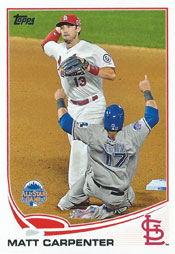
matt_carpenter3The Cardinals’ top 10 in regular-season plate appearances in a year, according to Baseball-reference.com:

1. Taylor Douthit, 752 in 1928.

2. Taylor Douthit, 748 in 1930.

3. Curt Flood, 739 in 1964.

4. Lou Brock, 729 in 1970.

5. Don Blasingame, 728 in 1957.

6. Lou Brock, 727 in 1973.

7. Bill White, 726 in 1963.

8. Lou Brock, 724 in 1967.

9. Stan Musial, 722 in 1949.

10. Lou Brock, 721 in 1971.

The most recent Cardinals player who came closest to cracking the top 10 was Matt Carpenter, who had 717 regular-season plate appearances in 2013.

A player is credited with a plate appearance each time he completes a turn batting. Unlike an at-bat, a plate appearance may result in a walk, a hit by pitch, a sacrifice bunt or a sacrifice fly.

The all-time major-league leader in regular-season plate appearances in a year is Jimmy Rollins of the 2007 Phillies at 778.

Musial is the Cardinals’ career leader in regular-season plate appearances at 12,717.

Cardinals catalyst

Among Cardinals, no one was better at getting to the plate in a season than Douthit.

A right-handed batter, Douthit, 27, was the center fielder and leadoff batter for the 1928 National League champion Cardinals. He hit .295 with 191 hits and 84 walks in 752 plate appearances in 1928. In the only game he wasn’t in the leadoff spot that season, he batted fifth in four plate appearances.

He also was a high-quality center fielder.

Despite his success, Douthit was the subject of trade speculation after the 1928 season.

In its Oct. 25, 1928, edition, The Sporting News reported Douthit “is one of the mysteries of baseball. He has been a great fielder for years, perhaps the best fly chaser in the game today … This year, he started out like a champion batter. He was the first hitter to collect 100 safeties. His fielding, as always, was brilliant. Then, in midseason, he slumped as a batter and stayed in the slump right through the World Series.”

At the end of July, Douthit had a season batting average of .347, but he hit .218 in August and .179 in September. In the 1928 World Series against the Yankees, Douthit was 1-for-11 (.091).

“If Douthit is traded,” The Sporting News reported, “he’ll make the Cards weep frequently … It will be difficult to remember his early-season hitting after the long late summer and fall when he was looked upon as the man who officially opened every game by making the first out.”

The Cardinals kept Douthit and it was a good decision. He helped them win another National League pennant in 1930. Douthit hit .303 that season with 201 hits and 60 walks in 748 plate appearances. In the 11 games he wasn’t in the leadoff spot, he batted third in 54 plate appearances.

Again, though, he had a miserable World Series, hitting .083 (2-for-24) against the Athletics.

In 1931, Douthit was challenged for the center field job by rookie Pepper Martin. On March 26, 1931, The Sporting News reported, “There was much winter conversation about (Pepper) Martin … But that doesn’t make Douthit anybody’s snail. Taylor always has been a good hitter and a brilliant fielder and, unless he breaks a leg or an arm, he’ll play 154 games for the Redbirds in center field.”

That prediction didn’t pan out. The Cardinals wanted Martin in center field. Though Douthit was hitting .331, he was traded to the Reds on June 15, 1931, for outfielder Wally Roettger.

In nine seasons (1923-31) with the Cardinals, Douthit hit .300 and produced 1,006 hits. His on-base percentage with St. Louis was a sparkling .373.
Read Full Post »

(Updated June 11, 2024)

Desperate for a power-hitting right fielder and feeling the sting of the defection of free-agent Jack Clark, the Cardinals stunned nearly everyone when they traded second baseman Tommy Herr, a stalwart of their three pennant-winning teams of the 1980s, to the defending World Series champion Twins in 1988.

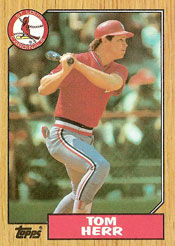
tom_herrAs he departed, Herr said he hoped to return to the Cardinals as their manager.

When he arrived in Minnesota, Herr told the Minneapolis Star-Tribune, “I tried to take the trade like a man, but when the plane left St. Louis I cried like a baby for a half hour.”

Surprise move

On April 22, 1988, Herr was dealt to Minnesota for outfielder Tom Brunansky. The trade was announced after the Mets beat St. Louis, 4-0, dropping the Cardinals’ record to 4-11.

Joe Durso of the New York Times wrote, “It stunned Herr and his teammates as they came into the locker room. Herr was asked to step into manager Whitey Herzog’s office, where he received the news from Herzog and Dal Maxvill, the Cardinals’ general manager.”

Said Herr: “Sure, I’m shocked. I’ve loved my years as a Cardinal and it’s hard to say goodbye.”

Acknowledging it was difficult to inform Herr of the trade, Herzog told the St. Louis Post-Dispatch, “Tommy always knew he was my type of player from day one. It was tough.”

Herr played 10 seasons (1979-88) with the Cardinals, batting .274 with 1,021 hits in 1,029 games. He was the starting second baseman on the pennant-winning clubs of 1982, 1985 and 1987. He was an all-star in 1985 when he placed third in the National League in both RBI (110) and doubles (38). Herr ranked among the top three second basemen in the league in fielding percentage six times.

“It’s not an easy thing trading a great ballplayer and a fine gentleman,” Maxvill said to the Associated Press.

Mets third baseman Howard Johnson told the Post-Dispatch, “I think the Cardinals have dealt themselves a blow. A guy like Tommy Herr is a pretty valuable part of your ballclub.”

Three factors prompted the trade:

Factor No. 1

The Cardinals’ top run producer, Clark, signed with the Yankees after the 1987 season. Jim Lindeman, the 1988 Opening Day right fielder, was headed to the disabled list because of back spasms. The Cardinals were averaging 2.8 runs per game. Brunansky, who hit 20 or more home runs in six consecutive seasons (1982-87) for the Twins, provided a much-needed power source.

“The deciding factor was our (poor) run production,” Maxvill said to the Associated Press. “Brunansky can help.”

Cardinals pitcher John Tudor told the Post-Dispatch, “It was kind of pleasant to see that they’re trading to win instead of sitting on their attendance.”

Factor No. 2

The Cardinals feared Herr would depart for free agency. Herr was in the final season of a four-year contract. After losing reliever Bruce Sutter and Clark to free agency, the Cardinals were determined to get value in return for Herr before he could depart.

Herzog told the Minneapolis Star-Tribune, “We just can’t keep losing players like that. It was something we felt had to be done right now.”

“I could see the writing on the wall,” Herr said to the Post-Dispatch, “but I didn’t think it would happen this soon.”

Said Mets first baseman Keith Hernandez, who played with Herr on the 1982 World Series champion Cardinals: “If they had Clark, Tommy Herr’s on the team.”

Herzog told the Post-Dispatch, “If they’d tell me they were going to re-sign him, then who knows what we’d do?”

Regarding whether the Cardinals ever did have interest in re-signing him before he became eligible for free agency, Herr said, “I knew I’d find out sooner or later what the thinking was here. It was sooner rather than later.”

Factor No. 3

The Cardinals had a replacement for Herr. Luis Alicea, a first-round selection of the Cardinals in the 1986 draft, was promoted from Class AAA Louisville to replace Herr at second base.

“We think we have a fine young man who is ready to be an everyday player here in Alicea,” Maxvill said to United Press International.

Timely chat

Twins general manager Andy MacPhail told the Minneapolis Star-Tribune he made a social phone call to Maxvill on April 21. “At the time, I didn’t think there was any chance of a trade,” MacPhail said.

As the conversation evolved, MacPhail mentioned the Twins needed a left-handed batter for the top of their order.

“He made it clear he couldn’t trade Willie McGee or Vince Coleman,” MacPhail said.

Herr, a switch-hitter, fit the need.

MacPhail said Maxvill asked about third baseman Gary Gaetti and outfielder Kirby Puckett.

“I told him I wouldn’t trade Gaetti and that my house would be burned to the ground if I traded Puckett,” MacPhail said.

Familiar foe

The Twins had defeated the Cardinals in a seven-game World Series in October 1987. Six months later, they were swapping position starters.

“I will miss Tom Brunansky,” Gaetti said. “It’s like a cold shower and a slap in the face at the same time.”

Minneapolis Star-Tribune columnist Sid Hartman reported, “Twins officials maintain Brunansky’s speed is down from last year, that he hasn’t covered the ground in right field as well and that his arm is not as strong.”

Herzog told the Post-Dispatch, “To tell you the truth, the only time I’ve ever seen Brunansky play in person was in the World Series, but over the last 10 years he’s always had pretty good bat potential and he’s had good power statistics. He’s always been a good outfielder with a good throwing arm.”

Minneapolis Star-Tribune columnist Dan Barreiro wrote, “Brunansky had his limitations, we all know how streaky he could be, but he still was a hitter with power numbers.”

For Brunansky, the trade was the chance for a new adventure. “It’s going to be exciting,” he said.

For Herr, the trade took him away from his professional roots and a place he had hoped to grow his career. “I’m proud of the accomplishments I’ve had here,” Herr said before leaving. “I wanted to play my whole career here. That dream has gone. It’s been a good time. Maybe I’ll be back and manage this ballclub.”

Years later, when asked about Herzog, Herr told Cardinals Magazine, “Whitey had a profound effect on me. He was the guy who gave me my shot as a regular … The confidence he showed in me really put me over the top.”


Read Full Post »

(Updated March 24, 2019)

The second baseman who participated in one of the happiest periods in Cardinals history parted with the franchise in an unhappy manner.

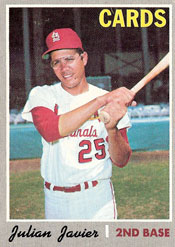
Only three players _ Frankie Frisch, Julian Javier and Tommy Herr _ have been the everyday second basemen on three Cardinals pennant winners. Javier started for the National League championship clubs of 1964, 1967 and 1968.

By 1972, Javier, 35, no longer was prominent in the Cardinals’ plans. Ted Sizemore had taken over as St. Louis’ second baseman and Ed Crosby was seen as a capable backup.

On March 24, 1972, the Cardinals traded Javier to the Reds for pitcher Tony Cloninger. Bob Howsam, who’d been Cardinals general manager before taking the same role with the Reds, acquired Javier to back up Joe Morgan at second base and Denis Menke at third.

After the deal was made, Javier indicated he was unhappy with general manager Bing Devine and manager Red Schoendienst for not getting the chance to play more in spring training and compete for a starting job.

“I feel too good, like 20, to be sitting around,” Javier said to the Associated Press.

During the off-season, Devine and Schoendienst had talked with Javier about his future and were of the impression Javier had agreed to a reserve role in 1972, the St. Louis Post-Dispatch reported. “I thought Bing and I had a perfect understanding with Hoolie,” Schoendienst said to The Sporting News.

At spring training, however, Javier asked the Cardinals for his release because he was upset Schoendienst was taking a look at other candidates for a reserve infield role, according to Post-Dispatch sports editor Bob Broeg.

Javier told Schoendienst, “I think I can play everyday for two more years,” the Dayton Journal Herald reported.

Javier’s complaints prompted an uncharacteristic blast from Schoendienst, a former all-star second baseman. “Hoolie wasn’t in shape, didn’t want to play and scarcely could get the ball from second base to first, yet he wants to say we didn’t use him,” Schoendienst told Broeg. “I’m tired of people who don’t want to play but say they do.”

In 12 seasons (1960-71) with the Cardinals, Javier twice was named an all-star (1963 and 1968), twice led National League second basemen in putouts (1963 and 1964) and collected 1,450 hits.

A right-handed batter, Javier hit .299 against left-handed pitching during his major-league career.

Javier’s role with the Cardinals changed after the 1970 season when the club acquired Sizemore from the Dodgers for first baseman Dick Allen.

Javier was found to owe back taxes to the U.S. government, leading to speculation the native of the Dominican Republic could become entangled in a legal case that might jeopardize his career. However, Javier worked out a settlement on his tax problems. When he reported to spring training in 1971, he was 10 pounds lighter (at 180) and performed more like the player he’d been on those championship teams.

Because of an injury to Dal Maxvill, Sizemore opened the 1971 season at shortstop and Javier remained the starter at second base. Javier batted .309 in the first two months of the season, slumped and entered July at .234. Maxvill returned to shortstop and Sizemore moved to second, replacing Javier.

At spring training in 1972, the Cardinals determined they were ready to move on without Javier. The trade to the Reds turned out to be a blessing for him. Javier had several key hits for the Reds and helped them win the 1972 NL pennant. Among the highlights:

_ Reds 11, Cardinals, 2, May 13, at Cincinnati: Facing Cloninger, the pitcher for whom he was traded, Javier delivered a RBI-single, scoring Johnny Bench. Boxscore

_ Reds 4, Giants 3, May 16, at San Francisco: Starting at third base, Javier hit a three-run home run against left-hander Ron Bryant. Boxscore

_ Reds 6, Phillies 5, June 3, at Philadelphia: Javier hit a two-run home run against left-hander Steve Carlton, a former Cardinals teammate. It was the 78th and last homer of Javier’s big-league career. Boxscore

_ Reds 8, Mets 2, June 17, at Cincinnati: Facing another former Cardinals teammate, left-hander Ray Sadecki, Javier hit a two-run single. Boxscore

Javier capped his career by appearing in four games for the Reds against the Athletics in the 1972 World Series.


Read Full Post »

In 1987, the Cardinals made a trade with the Pirates that stunned fans of both teams. Whether one believes the deal helped or hurt the Cardinals is a matter of perspective.

On April 1, 1987, the Pirates traded catcher Tony Pena, a four-time all-star, to the Cardinals for outfielder Andy Van Slyke, catcher Mike LaValliere and pitcher Mike Dunne.

The deal brought immediate results for the Cardinals. Though he had a subpar regular season, Pena helped the Cardinals win the 1987 National League East Division championship. Inspired by his first exposure to postseason baseball, Pena was a key part of St. Louis’ march to the pennant and a berth in the World Series.

After two more seasons with St. Louis, Pena became a free agent and signed with the Red Sox.

Van Slyke, LaValliere and Dunne all blossomed into top producers for the 1987 Pirates. Van Slyke and LaValliere played integral roles in helping Pittsburgh emerge from a last-place team in 1986 to win three consecutive NL East titles (1990-92).

Informed of the trade made by general managers Dal Maxvill of the Cardinals and Syd Thrift of the Pirates, Pena and Pirates manager Jim Leyland cried.

“My heart’s bleeding,” Pena said to the Associated Press. “I made my life with this ballclub.”

Said Leyland, who approved of the deal: “We’ve traded the best and most durable catcher in baseball.”

Pena, 29, was a three-time winner of the Gold Glove Award and popular with Pirates fans. In an editorial, the Pittsburgh Press wrote,

If Pirates fans could cast a mold of their prototype baseball player, it would come out looking a lot like Tony Pena. He plays baseball the way they like to see it played _ with zest, verve and abandon.

Reaction to the trade largely was negative in Pittsburgh. Wrote columnist Bruce Keidan of the Pittsburgh Post-Gazette,

Sorely in need of a starting pitcher, a first-rate shortstop and a right-handed power hitter, the Pirates conspired to give away an all-star catcher without obtaining any of the three.

Said Thrift: “How am I going to explain to my 82-year-old mother when the fans boo me?”

Adding to the despair of many Pirates fans was the reaction to the trade by the Cardinals.

“In Tony Pena, we are getting one of the premier players in the game,” Maxvill said to the Associated Press.

Added manager Whitey Herzog: “When you get a ballplayer of that caliber, you’ve done something. We are really happy. We paid a good price to get him, but it was worth it.”

The Cardinals had entered the 1986 season with Mike Heath as their starting catcher. He couldn’t hit (.205 in 65 games) and the Cardinals dealt him to the Tigers in August that season.

Herzog figured to utilize a platoon of LaValliere and Steve Lake at catcher in 1987, but the thought of having two slow-footed, light-hitting catchers concerned him. Thrift, looking to lift a team that had finished 64-98 in 1986, dangled Pena as trade bait.

“This is a move we believe will benefit the Pirates … Van Slyke has the capability and physical tools to become an outstanding, complete player,” Thrift told the Post-Gazette.

It soon became evident the trade may not have been as lopsided as initially thought.

Post-Gazette columnist John Steigerwald wrote,

Who got the better of the deal depends on which Tony Pena the Cardinals got … Chances are the Cardinals got the same two Tony Penas that have played here, the hot one and the cold one.

If you think the Pirates were robbed, it might make you feel better to know that longtime Cardinals announcer Jack Buck told me yesterday that he thinks Andy Van Slyke is the best defensive outfielder in the National League and that he is as exciting in right field as Pena is behind the plate.

In interviews immediately after the trade was made, Van Slyke and LaValliere provided insights into how they expected to contribute to the Pirates.

“I felt that this (1987) was my year to blossom,” Van Slyke told the Post-Gazette. “This was my year to do the things everybody anticipated me doing in St. Louis. But I can do it here. Sure I can.”

Said LaValliere: “I pride myself an awful lot on my defense … That’s probably my strongest point _ working with my pitchers … With the Cardinals, I knew who I had to kick in the butt and who I had to burp. I’ll have a crash course here.”

Pirates players bought into the trade. Said outfielder Mike Diaz: “The team isn’t made up of one player … We got two starters (Van Slyke and LaValliere) for the price of one.”

In retrospect, the Pirates got three starters for the price of one.

Dunne, 24, earned a spot in the rotation of the 1987 Pirates, posting a 13-6 record and 3.03 ERA in 23 games.

LaValliere, 27, earned a Gold Glove Award in 1987, finishing second in the NL in fielding among catchers, with a .992 percentage. He went on to a seven-year career with Pittsburgh.

Van Slyke, 27, opened the 1987 season in right field for Pittsburgh, with Barry Bonds in center and Bobby Bonilla in left. (During the season, Van Slyke was shifted to center, with Bonds moved to left and Bonilla to right). Van Slyke had the stellar season he expected in ’87, batting .293 with a .359 on-base percentage, 36 doubles, 11 triples, 21 home runs and 82 RBI.

In eight years with Pittsburgh, Van Slyke hit .283 with an on-base percentage of .353. He won a Gold Glove Award in five consecutive seasons (1988-92).

The Cardinals had made the deal, in part, because they believed rookie Jim Lindeman was ready to become an everyday right fielder, but he wasn’t as talented as Van Slyke. (A year later, to plug the gap in right field, the Cardinals traded their productive second baseman, Tom Herr, to the Twins for outfielder Tom Brunansky).

Pena batted .214 with 5 home runs and 44 RBI for St. Louis in 1987. He hit much better in the postseason (.381 in the NL Championship Series against the Giants, and .409 in the World Series against the Twins).

Pena was better in 1988 (.263, 10 homers, 51 RBI) and in 1989 (.259, 4 homers, 37 RBI, with an all-star berth) for St. Louis. He also ranked first in fielding among NL catchers in both seasons (.994 in ’88 and .997 in ’89).

Read Full Post »

(Updated May 7, 2025)

So you think showing a squirrel on a Skip Schumaker Topps baseball card is controversial? How about printing baseball cards for seven years from 1951-57 and never offering a Stan Musial baseball card?

In the first series of its 2012 baseball card set, Topps printed two cards of St. Louis utilityman Skip Schumaker. The common card shows an image of Schumaker sliding. The other card, which has been released in limited supply (driving up demand and price), shows only Schumaker’s shoe as the so-called “rally squirrel” dashes across home plate.

Critics call the squirrel card dumb. Supporters find it fun. For Topps, the card has created publicity.

It may be the most controversy associated with Topps and the Cardinals since its seven-year absence without Musial.

Topps began printing baseball cards in 1951 when Musial was 30 and near the peak of his Hall of Fame career. Musial had a contract to appear on baseball cards produced by a rival company, Bowman.

Bowman produced Stan Musial cards in 1952 and 1953.

For the next four years (1954-57), Musial didn’t appear on any baseball card, even though he may have been the most popular player in the game.

In a 2001 interview with USA Today on the 50th anniversary of Topps baseball cards, Topps executive Sy Berger said Musial “just didn’t want to sign (a contract) for cards.”

The breakthrough came in time for Topps’ 1958 set. Berger said Cardinals owner Gussie Busch was raising money for charity. Berger said Topps offered to donate $1,500 to the non-profit of Busch’s choice if Musial would agree to sign a Topps contract to appear on a 1958 baseball card. Musial did.

(In the book “Musial: From Stash to Stan the Man,” author James N. Giglio claims “insufficient compensation” was the reason Musial didn’t sign with Topps until 1958.)

“Every year after that, Musial told us that he didn’t want the license fee, but would sign a contract in exchange for us making a similar donation to a charity of his choice,” Berger told Cardinals Yearbook in 2001. “That was how Musial ended up on Topps cards.”

Musial continues to be featured on Topps baseball cards today.

When Topps issued its first baseball cards in 1951, the look and feel were more like a deck of playing cards, or game cards for a baseball board game.

The 1951 cards came in two styles: with red backs and with blue backs. The front of the cards featured a player’s face bordered by a baseball diamond. The backs of the cards were colored either red or blue and offered no statistical information.

The red backs and blue backs were issued at the same time.

Two Cardinals _ pitcher Howie Pollet and outfielder Tommy Glaviano _ were part of the red backs. Six Cardinals _ pitchers Gerry Staley, Red Munger and Harry Breechen; second baseman Red Schoendienst; outfielder Enos Slaughter; and third baseman Billy Johnson _ were part of the blue backs.

The series had 52 red back and 52 blue back cards. There also were special-feature team cards and all-star cards. These included a Cardinals team card and an all-star card of retired Cardinals pitcher Grover Cleveland Alexander.

In 1952, Topps issued a 407-card set that is the prototype for the traditional baseball card, with statistics on the back and designed images of players on the front.

The first Cardinal to appear in the 1952 set was catcher Johnny Bucha (card No. 19). Bucha played in a total of 24 games for the Cardinals over two seasons (1948 and 1950) but didn’t play in any games for St. Louis in 1952.

Previously: The story behind Stan Musial’s $100,000 contract

Read Full Post »

« Newer Posts