(Updated March 5, 2023)
Mike Roarke brought out the best in Bruce Sutter, earned the trust and respect of Joaquin Andujar and John Tudor, guided the comeback of Dan Quisenberry, and enhanced the careers of several other Cardinals pitchers, including Danny Cox, Ken Dayley, Jose DeLeon and Jeff Lahti.
 Roarke was pitching coach on the staff of Cardinals manager Whitey Herzog from 1984-90 and helped the club win National League pennants in 1985 and 1987.
Sutter, the Hall of Fame reliever, viewed Roarke as a guru and went to him for advice throughout his career.
Teaching skills
Roarke was a standout athlete at Boston College. He was a catcher on the baseball team and a receiver on the football team. His football teammates included defensive tackles Art Donovan and Ernie Stautner, whose NFL careers earned them induction into the Pro Football Hall of Fame.
Roarke chose to pursue a baseball career. He played four seasons (1961-64) in the major leagues as a backup catcher for the Tigers. He and Herzog were teammates on the 1963 Tigers.
After his playing career, Roarke was a coach for the Tigers and Angels, managed in the minors, and from 1976-77 was a pitching instructor in the Cubs system.
Sutter signed with the Cubs as an 18-year-old amateur free agent in September 1971. He struggled until Cubs minor-league instructor Fred Martin, a former Cardinals pitcher, taught him the split-fingered pitch. Martin showed Sutter how “to spread his index and middle fingers and throw the ball like he would a fastball,” the Chicago Tribune noted. “Immediately, he got the ball to dive.”
Sutter told writer Roger Kahn, “I threw it, and the first time I did it, the ball broke down. Right away it broke down … but it was some time before I could control the splitter the way I had to.”
Roarke never had seen the split-fingered pitch. When he joined the Cubs in 1976, he studied Sutter and learned the mechanics of what made the pitch work for him. Roarke mastered an understanding of what it took for Sutter to excel.
Sutter made his major-league debut with the Cubs in May 1976. Two years later, in 1978, Roarke became the Cubs’ pitching coach and Sutter’s career soared. He led the National League in saves with 37 in 1979 and 28 in 1980.
In September 1980, another future Hall of Fame reliever, Lee Smith, made his major-league debut with the Cubs and was mentored by Roarke.
Career paths
After the 1980 season, Roarke left the Cubs because he wanted to spend more time with his wife and five children at home in Rhode Island. Shortly after, on Dec. 9, 1980, the Cubs traded Sutter to the Cardinals.
Roarke took a job in Rhode Island as an insurance salesman. The Red Sox contacted him and asked whether he would be the pitching coach for their Pawtucket farm club. An arrangement was made for Roarke to work only home games. He’d sell insurance during the day before heading to the ballpark.
Roarke was the Pawtucket pitching coach from 1981-83. Among the Red Sox prospects he mentored were Oil Can Boyd, Bruce Hurst, Al Nipper and Bob Ojeda.
“He just turned me around,” Hurst told Sports Illustrated. “If it weren’t for him, I wouldn’t have returned to the big leagues in 1981.”
With the Cardinals, Sutter led the league in saves with 25 in strike-shortened 1981 and 36 in their 1982 World Series championship season. In 1983, he stumbled, posting a 4.23 ERA.
Hub Kittle was pitching coach in Sutter’s first three Cardinals seasons. With Kittle’s permission, Sutter arranged for Roarke to visit St. Louis each year and work with him “because he felt Roarke was the only other person who understood the vagaries and processes involved in his split-fingered pitch,” the St. Louis Post-Dispatch reported.
Right time
After the 1983 season, Kittle asked to be reassigned because his wife was ill and he wanted the flexibility to spend more time with her.
Kittle became a minor-league instructor and Herzog approached Roarke about becoming pitching coach. By then, four of Roarke’s five children had graduated high school.
“The offer came at the right time,” Roarke said. “A couple of years ago, I wouldn’t have taken it.”
The Cardinals hired him on Oct. 11, 1983.
Herzog said, “I can’t deny that having Bruce here was one of the main reasons I hired Mike.” But Roarke revealed, “If they had wanted me just to work with Sutter, I wouldn’t have taken the job.”
“I knew he was knowledgeable and had good rapport with players,” Herzog said. “When Mike talked, people listened.”
Herzog became dissatisfied with the Cardinals’ pitching in 1983 and, although he didn’t blame Kittle, he made it clear he wanted changes.
“Our pitchers wouldn’t pitch inside last year,” Herzog said. “They were pitching behind too often and we don’t strike anybody out. We can’t pitch that way. We’ve got to pitch inside and change speeds.”
Making a difference
At spring training in 1984, Roarke discovered a flaw in Sutter’s delivery. “After he had come to a stretch position, Sutter was not squaring himself with the plate,” Roarke said.
Roarke also went to work on Andujar, who had slumped to a 6-16 record in 1983. Andujar was a Kittle disciple but liked what he heard from Roarke. “He’s a really smart guy,” Andujar said. “He knows how to talk to people.”
Under Roarke’s guidance in 1984, Sutter earned 45 saves and posted a 1.54 ERA. Andujar was a 20-game winner.
“What it all boils down to is the confidence factor,” Sutter said. “When someone you believe in asks you to make an adjustment, you’re more likely to do what he says than if someone you don’t know asks you.”
After the 1984 season, the Cardinals acquired Tudor from the Pirates. Tudor began his career with the Red Sox, knew of Roarke from his work there and was comfortable with him.
In 1985, Tudor and Andujar each earned 21 wins and Cox got 18. Sutter departed to the Braves as a free agent, but Lahti and Dayley stepped up. Lahti had 19 saves and a 1.84 ERA. Dayley had 11 saves and a 2.76 ERA.
Cox credited Roarke with developing a new delivery that put less strain on his arm, The Sporting News reported. Dayley said Roarke taught him how to make his breaking ball sharper and keep his pitches down in the strike zone.
After the 1987 season, the Cubs needed a manager and were interested in Roarke, The Sporting News reported, but he decided not to pursue the chance. “I think he could have had it if he wanted,” Herzog said. The job went to Don Zimmer instead.
Roarke remained with the Cardinals and among those he helped were Quisenberry and DeLeon.
Quisenberry, released by the Royals, was 3-1 with a 2.64 ERA for the 1989 Cardinals and credited Roarke with enabling him to regain his sinker. “I can’t bend over like I used to,” Quisenberry said. “Mike taught me to throw like a 36-year-old.”
DeLeon, who was 2-19 for the 1985 Pirates, was 13-10 with the Cardinals in 1988 and 16-12 in 1989. DeLeon credited Roarke with making two changes: He altered DeLeon’s step before his delivery and got him to keep his back straight instead of leaning over.
In July 1990, Herzog resigned and Joe Torre replaced him. Roarke, who was not retained, became pitching coach for the Padres.
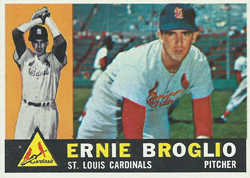 Broglio was a premium starting pitcher when the Cubs acquired him, reliever
 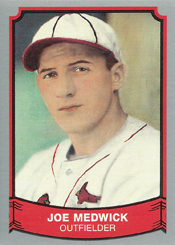 On Aug. 1, 1939, the Cardinals were one strike away from completing a win at home against the Braves when manager Ray Blades removed Medwick from left field for a defensive replacement.
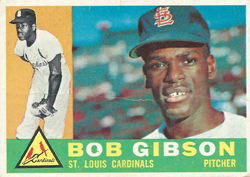 On July 30, 1959, Gibson made his first major-league start for the Cardinals and pitched a shutout in a 1-0 triumph over the Reds at Crosley Field in Cincinnati.
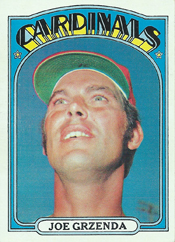 Grzenda pitched eight seasons in the major leagues for the Tigers (1961), Athletics (1964 and 1966), Mets (1967), Twins (1969), Senators (1970-71) and Cardinals (1972).
 Kolb played seven major-league seasons with the Cardinals (1960, 1962-63), Braves (1964-65), Mets (1965) and Pirates (1968-69).
 RetroSimba