Feeds:
Posts
Comments

(Updated Sept. 18, 2019)

Cardinals shortstop Garry Templeton, who played baseball like poetry in motion when he was at his best, was associated with some creative rhyme to express his displeasure with the all-star team selection process.
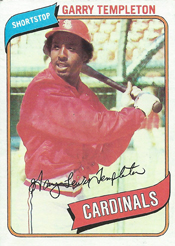
On July 10, 1979, Templeton was chosen as a reserve on the National League all-star team, but turned down the opportunity because he said he should have been the starting shortstop.

“If I ain’t starting, I ain’t departing,” Templeton reportedly said.

Though the words accurately described Templeton’s viewpoint, the catchy phrasing may not have been his.

“People bring that up all the time, but I never said it,” Templeton told the St. Louis Post-Dispatch in its Sept. 26, 1979, edition. “Someone called me on my radio show and said it. I just said, ‘OK, that’s right,’ and it seems it went out everywhere.”

I’m No. 1

Templeton made his major-league debut with the Cardinals in August 1976 and was named an all-star in 1977 at age 21 as a reserve behind starter Dave Concepcion of the Reds. Templeton made one plate appearance in the 1977 game at Yankee Stadium, hit a double against Sparky Lyle and scored. He also made an error, allowing Graig Nettles to reach base and opening the door to an unearned run. Boxscore

Templeton wasn’t an all-star in 1978, when he made 40 errors. At spring training in 1979, he asked to be traded because of a pay dispute, but was ready to play when the season began, batting .302 in April, .281 in May and .377 in June. Templeton, who had 43 hits in 25 June games, topped all National League shortstops in batting average.

Fan voting determined the All-Star Game starters and when the final results were released on July 9, 1979, the top vote-getter at shortstop in the National League was Larry Bowa of the Phillies. Concepcion placed second, Ozzie Smith of the Padres was third and Templeton came in fourth.

“Templeton should be starting,” Concepcion said to the Post-Dispatch. “He’s having a better year than anybody.”

National League all-star manager Tommy Lasorda of the Dodgers selected Templeton and Concepcion to be reserve shortstops, but Templeton was miffed with the fans for voting Bowa as the starter.

“I ain’t playing second fiddle to nobody,” Templeton said to the Associated Press.

When asked whether he considered himself to be the best shortstop, Templeton replied, “I don’t think I am; I know I am. Others know it, too.”

Right and wrong

Cardinals general manager John Claiborne spoke to Templeton about his decision and told the Post-Dispatch, “I didn’t argue, quarrel or make a pitch,” but admitted he was disappointed.

“To me, it’s an honor and he should make every effort to go,” Claiborne said.

Templeton’s refusal to attend the July 17 game in Seattle prompted varied reaction, including:

_ Rick Hummel, Post-Dispatch: “The All-Star Game is merely a showcase, an exhibition game, and somebody who doesn’t want to be there shouldn’t have to go.”

_ Dick Young, The Sporting News: “Does anybody tell the young shortstop how to vote when he steps into the polling booth?”

_ Johnny Bench, Reds catcher: “He has his reasons … He obviously knows what he’s doing.”

_ Bing Devine, former Cardinals general manager: “I think he talks too quickly and puts himself out on a limb. Then it becomes a matter of pride.”

Concepcion said, “I don’t blame him. He’s hitting .320.”

Templeton told Hummel, “A human has rights. You’ve got to show your rights. The way I see it, it’s up to the individual. I don’t want to go.”

Templeton said he wouldn’t watch the game on television and would spend the three-day break with his wife and son.

“I’d rather spend the three days getting my mind off baseball and be a little more ready mentally for the second half,” Templeton said. “I want to go hard in the second half. I need a couple of days to get my mind straight.”

Best of the rest

A few days later, the New York Times released results of a player poll, taken before the final fan balloting, and Concepcion was the top vote-getter among National League shortstops, with Templeton placing second. Concepcion got 52 percent of the player votes.

On July 11, Concepcion said he also would sit out the All-Star Game because of a groin injury. With Templeton and Concepcion unavailable, Lasorda chose Craig Reynolds of the Astros to back up Bowa.

Besides Templeton, three other 1979 Cardinals were named all-stars: outfielder Lou Brock, first baseman Keith Hernandez and catcher Ted Simmons.

Brock, who said he’d retire after the season, was selected to his sixth all-star team, all as a Cardinal, and Hernandez was an all-star for the first time. Hernandez would be selected an all-star five times in his career, twice with the Cardinals and three times with the Mets.

Asked about Templeton’s refusal to participate in the 1979 game, Brock said, “There is a lot of pride in this game and I’m sure he was hurt by not being voted in. He is the best shortstop in the league.”

Hernandez said, “I don’t pry into Tempy’s affairs. He knows what he’s doing.”

Simmons was voted the 1979 National League starting catcher by the fans, but was unable to play because of a broken left wrist. Since fan voting for the all-star teams was reinstated in 1970, Simmons was the first National League catcher other than Bench to be voted as the starter. Simmons started the 1978 game when Bench, voted the starter, couldn’t play because of a bad back.

Simmons would be named an all-star eight times, six with the Cardinals and twice with the Brewers.

Show must go on

The National League won the 1979 All-Star-Game, 7-6. The highlight was a defensive gem by Pirates right fielder Dave Parker, whose throw on the fly to catcher Gary Carter nailed Brian Downing attempting to score from second on a Graig Nettles single. Video

The National League shortstops, Bowa and Reynolds, batted a combined 0-for-4 with a walk.

Brock, batting for former teammate Steve Carlton, rapped a single against Nolan Ryan.

Hernandez also got one at-bat and struck out against Jim Kern. Boxscore

Templeton, a switch-hitter, finished the year with 211 hits, becoming the first player to get 100 hits from each side of the plate in the same season. He hit .314 and led the league in hits and triples (19).

Templeton was selected an all-star for the third and final time in 1985 with the Padres. Chosen as a backup to the Cardinals’ Ozzie Smith, for whom he was traded after the 1981 season, Templeton got one at-bat and singled against Bert Blyleven. Boxscore
(Updated March 7, 2021)

After going two weeks without a win, the Cardinals broke their skid by scoring a week’s worth of runs in one game.

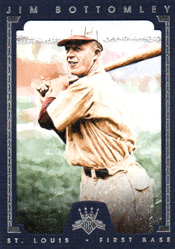
On July 6, 1929, the Cardinals set a franchise record for most runs in a game when they beat the Phillies, 28-6, in the second game of a doubleheader at Baker Bowl in Philadelphia.
The win was the Cardinals’ first since June 22, 1929, and snapped an 11-game losing streak.

10 in the 1st

The Cardinals-Phillies doubleheader was played on a steamy Saturday afternoon. “Swarms of Japanese beetles added to the discomfort of players and spectators,” the St. Louis Post-Dispatch reported.

In the first game, Cardinals cleanup batter Jim Bottomley hit a pair of two-run home runs, but the Phillies won, 10-6. It was the 11th consecutive loss for the defending National League champions and it gave them a 36-36 record. Boxscore

The second game matched starting pitchers Fred Frankhouse of the Cardinals against Phillies ace Claude Willoughby.

A right-hander from the farm town of Buffalo, Kansas, Willoughby would finish with 15 wins for the 1929 Phillies, but he struggled against the Cardinals.

Willoughby faced six batters, yielding three singles and walking three, and was lifted without recording an out.

Elmer Miller, a rookie left-hander who later in the season was converted into a right fielder, relieved, faced two batters and walked both.

Phillies manager Burt Shotton, a former Cardinals outfielder and coach, pulled Miller and replaced him with Luther Roy, who started two days earlier against the Dodgers. Roy gave up singles to the first two Cardinals batters he faced.

Rookie second baseman Carey Selph made the first out of the inning, on a sacrifice bunt, after the first 10 Cardinals batters reached base.

The Cardinals scored 10 runs in the first inning on six singles and five walks.

Given a 10-0 lead, Frankhouse, pitching with a sore thumb, “didn’t have to bear down” and “merely lobbed the ball over the plate,” according to the Post-Dispatch.

The Cardinals scored a run in the second and two in the fourth, and led, 13-4.

Pour it on

In the fifth, the Cardinals produced their second 10-run inning of the game. Bottomley got the big hit, a grand slam against the Phillies’ fourth pitcher, June Greene. Bottomley’s home run cleared the right-field wall and carried into Broad Street, the Philadelphia Inquirer reported.

The Cardinals led, 23-4, after five innings. They scored again in one more inning, getting five runs in the eighth. The big blow was Chick Hafey’s grand slam into the left-field seats against Greene.

The grand slams by Bottomley and Hafey were the only Cardinals home runs in the game.

The Cardinals generated 28 hits and also received nine walks and had one batter hit by a pitch.

According to the Philadelphia Inquirer, the Cardinals also hit two line drives off the shins of Greene, but the balls caromed to infielders, who made the outs.

Every Cardinals player who made a plate appearance got a hit.

Leadoff batter Taylor Douthit was 5-for-6 with two walks. He scored four runs and drove in two. Hafey was 5-for-7 with five RBI and four runs scored.

Bottomley was 4-for-5 with two walks. He scored four runs and drove in seven. For the doubleheader, Bottomley was 7-for-10 with 11 RBI and six runs scored. Bottomley hit a home run in every game of the five-game series. He had seven home runs and 21 RBI for the series. For the season, Bottomley had 39 RBI versus the Phillies. According to researcher Tom Orf, that’s the most RBI a Cardinals player has ever had against one team in a season.

Frankhouse was as effective a hitter as he was a pitcher. He was 4-for-7 with four RBI and, though he pitched a complete game and got a win, he yielded 17 hits and walked three.

Most of the damage was done against Roy (13 hits, nine runs in 4.1 innings) and Greene (12 hits, 11 runs in 4.2 innings). Boxscore

Willoughby, the losing pitcher, played seven seasons in the big leagues and continued to have trouble versus the Cardinals. His career record against the Cardinals: 2-12 with a 8.62 ERA.

After their record-setting performance, the Cardinals lost five of their next seven, falling to 39-41. Billy Southworth, in his first stint as Cardinals manager, was fired in late July and replaced by Bill McKechnie, who’d managed the Cardinals to the National League pennant in 1928.

Credible journalists adhere to a self-imposed policy of no cheering in the press box. John Denny wanted his Cardinals teammates to do the same in the dugout.

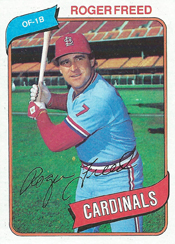
On July 1, 1979, Denny got into an animated argument with teammate Roger Freed, whose rah-rah spirit annoyed the Cardinals’ pitcher.
Manager Ken Boyer intervened before Freed and Denny exchanged punches.

After the game, Freed was demoted to the minor leagues, though the Cardinals said the decision wasn’t related to the flareup with Denny.

Pipe down

Denny and Dick Ruthven of the Phillies were the starting pitchers in the first game of the Sunday doubleheader at St. Louis.

In the first inning, Denny walked three batters, loading the bases, before yielding a three-run triple to Garry Maddox and a RBI-single to Manny Trillo.

After getting the third out of the inning, Denny, who hadn’t won since May 15, was in a foul mood as he headed off the field.

In the dugout, Freed, who wasn’t in the lineup, was “trying to rally the troops,” the St. Louis Post-Dispatch reported, and loudly urged his teammates to fight back from the 4-0 deficit. When Denny got to the dugout, the clatter caused by the fiery Freed got on his nerves.

“John told everybody on the bench to shut up,” Freed said.

Freed told Denny, “I’ll say what I want to say.”

Denny and Freed got into a heated discussion. “Boyer and a couple of players stepped in to prevent push from becoming shove,” the Post-Dispatch reported.

Said Boyer: “Roger is a pretty strong man. I didn’t want him breaking Denny’s jaw.” Though Boyer didn’t take sides in the dispute, he noted Denny had a reputation for being moody and “guys who have been around long enough should know to lay off him.”

Denny declined comment to the Post-Dispatch.

Moving on

While Denny held the Phillies scoreless over the next five innings, the Cardinals came back against Ruthven, getting three runs in the third and one in the sixth to tie the score at 4-4.

In the seventh, the Phillies scored twice against Denny, taking a 6-4 lead, but the Cardinals responded with three runs off Warren Brusstar in the bottom half of the inning to go ahead, 7-6.

The Cardinals prevailed, 13-7, with the win going to reliever Mark Littell. Boxscore

After the game, the Cardinals demoted Freed to Springfield to open a roster spot for Game 2 starting pitcher Roy Thomas, who had been in the minors. Thomas was throwing in the bullpen when Boyer informed Freed he was being optioned.

“Roger sat on the bench, staring into space in deep shock,” according to the Philadelphia Daily News.

Freed told the Post-Dispatch, “I don’t deserve it … It hurts.”

A right-handed batter who primarily was used as a pinch-hitter, Freed returned to the Cardinals on July 11, got sent back to Springfield two weeks later and was recalled again when big-league rosters expanded in September.

In 1977, his first season with the Cardinals after stints with the Orioles, Phillies, Reds and Expos, Freed hit .398 (33-for-83), including .421 versus left-handers. He dropped to .239 in 1978, but hit .379 (11-for-29) as a pinch-hitter.

Freed got 31 at-bats with the 1979 Cardinals, hit .258, including a walkoff grand slam, and was released on April 2, 1980.

After finishing the 1979 season with an 8-11 record and 4.85 ERA, Denny was traded by the Cardinals to the Indians for outfielder Bobby Bonds.

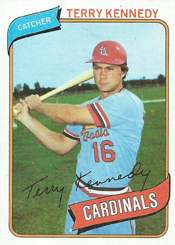
Called up from the minors to substitute for an injured Ted Simmons at catcher, Cardinals rookie Terry Kennedy contributed a bloop and a blast in a doubleheader sweep of the Phillies.

On July 1, 1979, Kennedy hit his first big-league home run, a grand slam, in Game 1 of the Sunday doubleheader at St. Louis and delivered a walkoff RBI-single on a broken-bat pop fly in Game 2.

Though Kennedy impressed the Cardinals, they eventually decided to trade both he and Simmons, opting instead for Darrell Porter as their catcher.

Stepping up

Kennedy’s father, Bob Kennedy, was a big-league player and manager who worked for the Cardinals from 1969-76 as a scout and front-office man.

In 1977, when Bob Kennedy became general manager of the Cubs, the Cardinals chose Terry Kennedy, a Florida State standout, in the first round of the draft.

A left-handed batter, Kennedy made his major-league debut with the Cardinals in 1978, appearing in 10 games, after hitting .309 with 100 RBI in the minors.

The 1979 Cardinals began the season with Simmons and Steve Swisher as their catchers and returned Kennedy to the minors. Kennedy, hitting .287 with 50 RBI for Class AAA Springfield, was called back by the Cardinals after Simmons broke his left wrist on June 24, 1979. Simmons was injured when struck by a foul ball off the bat of Mets pitcher Andy Hassler, who was attempting to bunt.

Simmons said he would work with Kennedy “every day, helping him any way I can,” the St. Louis Post-Dispatch reported.

Kennedy, who referred to Simmons as “the best hitter in the National League,” said he was “a little bit nervous” about substituting for the Cardinals’ catcher, but added, “I can do it.”

Mistake pitch

Kennedy’s breakout game occurred in the opener of the doubleheader versus the Phillies. In the eighth inning, with the bases loaded and the Cardinals ahead, 9-7, Kennedy batted against left-hander Tug McGraw. With the count 0-and-2, McGraw hung a screwball and Kennedy hit it over the right-field wall.

“My thinking was ass-backwards out there for some reason,” McGraw said to Bill Conlin of the Philadelphia Daily News. “I’ve never, ever thrown an 0-2 waste pitch screwball to a left-handed hitter, but I did today and don’t ask me why. The pitch was against all logic and I hung it. Maybe it was in the back of my mind that he’s a rookie and would be vulnerable to a screwball.”

Kennedy’s home run propelled the Cardinals to a 13-7 victory. He was 2-for-4 with a walk and threw out Bake McBride attempting to steal third. Boxscore

“He has to work on his defensive skills, but he’s going to create some thunder,” Cardinals manager Ken Boyer told the Philadelphia Inquirer.

Dumb luck

Swisher was the Cardinals’ catcher in Game 2, but Kennedy batted for him in the ninth inning with runners on first and second, two outs and the score tied at 1-1.

The first delivery from former Cardinal Ron Reed was “a killer pitch, a fastball that could have started a Midwest heat wave,” according to Jayson Stark of the Philadelphia Inquirer.

Kennedy swung and “his bat shattered with a splintering sound so loud they probably heard it in Kansas City,” the Inquirer reported.

“I got jammed,” Kennedy said to the Post-Dispatch.

The ball floated softly into shallow center.

“I was so embarrassed,” Kennedy said. “I started running to first base with my head down.”

Shortstop Larry Bowa and second baseman Manny Trillo converged on the ball.

“We both started to call it and we both looked at each other,” Bowa said, “and we both took a step away.”

With Bowa and Trillo standing like statues, the ball plopped onto the ground for a single and Keith Hernandez dashed home from second with the winning run. Boxscore

“I couldn’t believe it,” said Kennedy. “It was just dumb luck. The ball should have been caught.”

Reliever Mark Littell was the winning pitcher in each game of the doubleheader and got his first major-league RBI with a bases-loaded walk in the opener.

“When I was a kid, I read that book, ‘Baseball is A Funny Game,’ by Joe Garagiola,” Littell said. “Now I know what he meant.”

Multiple all-star

Kennedy hit .284 in 33 games for the Cardinals in 1979 and .254 in 84 games for them in 1980. Simmons, who returned to the lineup on July 24, hit 26 home runs for the 1979 Cardinals. He had 21 homers and 98 RBI for the Cardinals in 1980.

After the 1980 season, the Cardinals, who turned over their baseball operations to Whitey Herzog, traded Simmons to the Brewers and Kennedy to the Padres. Porter, a free agent, was signed to be their catcher and was backed by Gene Tenace, one of the players acquired for Kennedy.

In 14 seasons with the Cardinals (1978-80), Padres (1981-86), Orioles (1987-88) and Giants (1989-91), Kennedy was a four-time all-star who produced 1,313 career hits and played in two World Series.

In addition to his first big-league home run, Kennedy hit one other grand slam. It occurred on May 15, 1990, for the Giants against the Mets’ Ron Darling.

In a game against the Cardinals at Wrigley Field, Ernie Banks and the Cubs gave new meaning to the term, “Let’s play two.”

Banks, the Cubs’ sunny slugger, always wanted to play as much baseball as possible and his desire for doubleheaders led to his catchphrase.
On June 30, 1959, only one game was played between the Cardinals and Cubs, but “let’s play two” aptly described the madcap antics when two baseballs simultaneously were put into play.

Follow the bouncing ball

The Tuesday afternoon game matched starting pitchers Larry Jackson of the Cardinals against Bob Anderson of the Cubs.

In the fourth inning, the Cardinals led, 2-1, when Stan Musial faced Anderson with one out and none on.

With the count at 3-and-1, Anderson threw a pitch high and inside to Musial. The ball grazed Cubs catcher Sammy Taylor and plate umpire Vic Delmore, according to the St. Louis Post-Dispatch, and rolled to the backstop.

Musial headed to first base on what was called ball four.

Taylor, thinking the ball glanced off Musial’s bat and was foul, argued with Delmore and didn’t pursue the ball. Anderson left the mound and went to the plate to join in the discussion.

Cubs third baseman Alvin Dark, realizing the ball was in play, ran to get it, but a batboy, high school freshman Bobby Schoenfeldt, thought the play was dead. He picked up the ball and tossed it to the field announcer, Pat Pieper.

“I saw Dark flying toward me, but I already had thrown the ball away,” Schoenfeldt said to the Chicago Tribune.

Cardinals manager Solly Hemus said Pieper had the ball in his hand, but “dropped it like a hot potato” as Dark approached.

Pieper said, “Dark yelled at me, ‘Give me the ball.’ I told him to pick it up.”

First-base umpire Al Barlick said, “When Dark charged in from third base, I thought he was joining in the argument.”

Double trouble

As Dark reached for the ball, Delmore, unaware of what was happening behind him, absent-mindedly handed a new baseball to Anderson.

After arriving at first base, Musial said, “I heard our bench yelling for me to run,” and he took off toward second.

Dark and Anderson saw Musial attempting to advance.

Anderson hurriedly threw his ball and it sailed into center field.

At the same time, Dark threw his ball, which Banks, the shortstop, fielded on one bounce on the third-base side of second.

As Musial slid safely into second base, he looked up and saw second baseman Tony Taylor jump for a ball over his head.

“I didn’t even know there was a second ball,” Musial said.

Musial got up, started toward third, got tagged by Banks with the original ball and was called out by second-base umpire Bill Jackowski. Boxscore

Nonsense factor

The Cardinals argued Musial was entitled to second base because the batboy interfered with a ball in play. Barlick, the crew chief, disagreed, saying it was unintentional interference and Musial tried to advance at his own risk.

Hemus contended Musial “should have been safe because he was confused and deceived by the second ball, which went into center field,” but the umpires refused to reverse their decision.

The Cardinals played the game under protest, but it didn’t matter because they added a run in the seventh and another in the eighth and won, 4-1. Jackson pitched a four-hitter and retired 18 of the last 19 Cubs batters.

The Chicago Tribune concluded the game set a new standard for “baseball daffiness” and “not even Bill Veeck of the White Sox could have conjured up such a zany episode.”

After failing to qualify for the postseason in 2007 and 2008, the Cardinals were determined to show they’d do whatever it took to give themselves a chance to return to the playoffs in 2009.

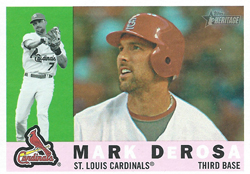
On June 27, 2009, the Cardinals acquired third baseman Mark DeRosa from the Indians for reliever Chris Perez and a player to be named, pitcher Jess Todd.

The deal helped extinguish skepticism about management’s willingness to make moves to contend and inspired an array of other acquisitions. After getting DeRosa, the 2009 Cardinals traded for left fielder Matt Holliday from the Athletics and infielder Julio Lugo from the Red Sox, and signed pitcher John Smoltz.

Those moves sparked the 2009 Cardinals to a National League Central Division championship.

Wanted: Bat man

The Cardinals opened the 2009 season with a pair of utility players, Brian Barden and Joe Thurston, platooning at third base in place of Troy Glaus, who was projected to be sidelined for several months after having right shoulder surgery.

Without Glaus, who had 27 home runs and 99 RBI for the 2008 Cardinals, manager Tony La Russa wanted a proven run producer to join Albert Pujols and Ryan Ludwick in the heart of the batting order.

The Indians, who lost 16 of their first 25 games in 2009 and didn’t figure to contend, were shopping DeRosa, who was eligible to become a free agent after the season. In late May 2009, the Cardinals and Indians discussed a deal for DeRosa, the St. Louis Post-Dispatch reported, but couldn’t agree on terms.

DeRosa, who could play multiple infield and outfield positions, began his major-league career with the Braves in 1998. He reached his peak in a three-year stretch when he hit .296 with 74 RBI for the 2006 Rangers, .293 with 72 RBI for the 2007 Cubs and .285 with 87 RBI and 103 runs scored for the 2008 Cubs.

The Cardinals and Indians resumed trade talks on June 19 and set a deadline of June 28 to get a deal done.

Future is now

DeRosa, 34, cost the Cardinals two top pitching prospects.

Perez was chosen by the Cardinals in the first round of the 2006 amateur draft from the University of Miami and was projected as a closer. Perez was 3-3 with seven saves and 3.46 ERA in his rookie season with the Cardinals in 2008 and 1-1 with one save and a 4.18 ERA in 2009.

“His fastball is 93 to 95 mph and he has touched 98,” Indians general manager Mark Shapiro said to the Akron Beacon Journal. “He also has a swing-and-miss slider.”

Todd was the Cardinals’ second-round selection in the 2007 amateur draft from the University of Arkansas and was the franchise’s minor-league pitcher of the year in 2008. He made his major-league debut with the Cardinals on June 5, 2009, pitching 1.2 innings of relief versus the Rockies.

The Cardinals determined they could part with Perez and Todd because they were confident in their closer, Ryan Franklin, and were grooming Jason Motte to be his eventual successor. According to the Post-Dispatch, Cardinals coaches told general manager John Mozeliak they preferred to have Motte over Perez.

“Sometimes you do have to make short-term decisions,” Mozeliak said. “Sometimes you have to take off the visionary hat. I think that’s how you have to look at the deal.”

Post-Dispatch columnist Bernie Miklasz wrote, “Acquiring DeRosa was the correct thing to do.”

Puzzle part

The Cardinals got a bad break when DeRosa injured his left wrist in his third game with them on June 30. He didn’t return to the lineup until July 18.

Hitless in his first nine at-bats before the injury, DeRosa was hitless in his first six at-bats after returning from the disabled list, making him 0-for-15 as a Cardinal, before he snapped the skid with a single against the Astros on July 20.

“I just want to be a piece of the puzzle,” DeRosa said to the Associated Press.

Mozeliak did the rest, swapping outfielder Chris Duncan for Lugo on July 22, trading three prospects for Holliday on July 24 and signing Smoltz on Aug. 19 after the Red Sox released him.

The Cardinals won 20 of 26 games in August on their way to clinching the division title.

DeRosa hit .228 with 10 home runs and 28 RBI in 68 games with the Cardinals. He made 58 starts at third base, two starts in the outfield and one at first base. He also played two games at second base as a substitute.

In the 2009 National League Division Series versus the Dodgers, DeRosa hit .385, but the Cardinals didn’t advance.

Short stay

DeRosa, saying he wanted to test the open market, was granted free agency after the 2009 season. The Cardinals were interested in re-signing him, although Mozeliak said rookie David Freese should get first shot at earning the 2010 Opening Day third base job.

DeRosa “still intrigues the Cardinals, but may fit more neatly as an alternative in left field than at third base,” the Post-Dispatch reported.

Holliday also became a free agent after the 2009 season and the Cardinals saw DeRosa as a Plan B in left field if Holliday didn’t return.

Unwilling to wait for the Cardinals to make up their minds, DeRosa signed a two-year, $12 million contract with the Giants in December 2009. After that, the Cardinals reached a deal with Holliday.

DeRosa played four more seasons with three teams _ Giants, Nationals and Blue Jays. In 16 years in the big leagues, he batted .268. He was at his best in the postseason, batting .358 with 19 hits in 22 playoff games for the Braves, Cubs and Cardinals.

Perez had the most success of the two pitchers acquired by the Indians in the DeRosa deal.

In five seasons with the Indians, Perez had 124 saves and a 3.33 ERA. He was an American League all-star in 2011 and 2012. He spent his last season with the 2014 Dodgers.

Todd pitched in 24 games over two seasons for the Indians and was 0-1 with a 7.43 ERA. The Cardinals reacquired him in 2011 and he pitched for their Memphis farm club for two seasons.