Tom Phoebus won a start versus Bob Gibson and got traded for Tony La Russa.
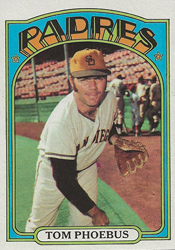 A 5-foot-8 right-hander, Phoebus pitched for seven seasons in the major leagues, primarily with the Orioles.
Phoebus hurled a no-hitter against the Red Sox, won a World Series game and had double-digit win totals for the Orioles in three consecutive years _ 14 in 1967, 15 in 1968 and 14 in 1969.
His career record in the majors was 56-52 with a 3.33 ERA.
Phoebus spent his last two big-league seasons in the National League, with the Padres and Cubs. In six appearances versus the Cardinals, he was 2-2 with two saves and a 3.44 ERA.
Hometown heroics
Born and raised in Baltimore, Phoebus was 18 when he signed with the Orioles as an amateur free agent in June 1960.
In 1961, his second season as a pro, Phoebus struggled to a 1-12 record and 5.53 ERA for Leesburg of the Florida State League. The Orioles stuck with him, though, and he worked his way through their system.
Pitching in 1966 for a Rochester club managed by Earl Weaver, Phoebus was 13-9 with five shutouts and a 3.02 ERA.
The 1966 Orioles, on their way to an American League pennant, rewarded him with a promotion to the big leagues. The Orioles’ pitching coach was the former Cardinal, Harry Brecheen.
Phoebus, 24, made his major-league debut on Sept. 15, 1966, with a start against the Angels and pitched a four-hit shutout. Boxscore. In his next appearance, Sept. 20, 1966, Phoebus shut out the Athletics on a five-hitter, beating Catfish Hunter. Boxscore
Phoebus became the seventh major-league pitcher to craft a shutout in each of his first two starts, and the first to do so since Karl Spooner of the 1954 Dodgers.
“He’s a good boy with good stuff,” Brecheen told the Baltimore Sun. “All he has to do is get it over the plate.”
A year later, after he led the 1967 Orioles in wins (14), innings pitched (208) and strikeouts (179), Phoebus was named the top rookie pitcher in the American League in player balloting by The Sporting News.
“Ask hitters around the American League and they’re quick to admit Phoebus is one of the toughest pitchers to hit,” The Sporting News reported. “He’s got a good fastball, his slider breaks nearly as much as anyone else’s curve and his curve is ridiculous.”
On April 27, 1968, Phoebus pitched a no-hitter against the defending American League champion Red Sox. He walked two batters in the first inning and another in the sixth before retiring the last 12 in a row. Boxscore
In his final Orioles appearance, Phoebus was the winning pitcher in Game 2 of the 1970 World Series versus the Reds, pitching in relief of Mike Cuellar. Boxscore
Two months later, on Dec. 1, 1970, the Orioles traded Phoebus, pitchers Al Severinsen and Fred Beene, and shortstop Enzo Hernandez to the Padres for pitchers Pat Dobson and Tom Dukes.
Facing the best
The Padres projected Phoebus to join a starting rotation led by former Cardinals farmhand Clay Kirby. “Never in my 30 years of scouting have I seen a pitcher who can get two strikes on a hitter as quick as Tom Phoebus can,” Padres scout Leon Hamilton said.
Phoebus made two starts versus the Cardinals. The first was at San Diego on April 17, 1971, and it began badly for him. Matty Alou hit the first pitch of the game for a single and Joe Hague hit the next for a home run. Phoebus regrouped and pitched seven innings, allowing three total runs, but Steve Carlton tossed a four-hit shutout and the Cardinals won, 4-0. Boxscore
A month later, on May 24, 1971, at St. Louis, Phoebus was matched against Gibson. The Padres scored seven runs against the Cardinals’ ace and won, 12-3. The Sporting News noted Phoebus “celebrated the birth of his second son” by getting the win. Boxscore
It was the last win Phoebus would get for the Padres.
After beating Gibson, Phoebus lost his next seven decisions and was moved to the bullpen. He finished 3-11 for the 1971 Padres; Dobson was 20-8 for the 1971 Orioles.
Cubs helper
At spring training in 1972, Padres pitching coach Roger Craig said, “Phoebus is throwing better than he did all last year and he’s keeping the ball down.”
After making one regular-season start for the Padres, Phoebus was dealt to the Cubs for cash on April 20, 1972.
The Cubs made Phoebus a reliever and he earned his first two saves for them against the Cardinals at St. Louis on May 18, 1972, Boxscore and on May 21, 1972. Boxscore
In the latter game, Phoebus entered in the ninth with one out, Cardinals runners on second and third, and the Cubs ahead, 3-1. He got Ted Sizemore out on a deep sacrifice fly, making the score 3-2.
The next batter, Jerry McNertney, worked the count to 3-and-1. Phoebus saw Joe Torre in the on-deck circle and, according to the Chicago Tribune, “admitted he came in with a fastball over the middle of the plate, preferring a swing of any kind from McNertney than a confrontation with Torre.”
McNertney grounded out to short, ending the game.
New career
Phoebus was 3-3 with six saves and a 3.78 ERA for the 1972 Cubs. He told The Sporting News he had become a better craftsman.
“When you first get up here, you think the most important thing is to try to impress everybody with great velocity and a good curveball,” Phoebus said. “After you’ve been around, you realize what’s really important is throwing strikes and working on the hitter, keeping him off balance. I’m not strikeout happy like I used to be. Today I’d rather throw one pitch and hope for a double play than strike out two batters.”
The Braves were impressed by him and talked to the Cubs about a deal. On Oct. 20, 1972, Phoebus was traded to the Braves for La Russa.
“When I saw Phoebus last season, he looked like a workhorse,” said Braves manager Eddie Mathews. “He showed me a good arm and he wanted to pitch.”
The Cubs liked La Russa, 28, and projected him as a utility infielder. La Russa had spent the 1972 season with the Braves’ Richmond farm club and was named the International League all-star second baseman, batting .308 with 15 stolen bases. “Our scouting reports on him indicate he can make it,” said Cubs vice president John Holland. “We’re going to give him a chance.”
The deal, however, didn’t work out the way anyone envisioned.
La Russa appeared in one game for the 1973 Cubs as a pinch-runner for Ron Santo. It was La Russa’s last game as a big-league player. He spent the rest of the 1973 season with the Cubs’ Wichita farm club and batted .314 with a team-leading 75 RBI, six more than runner-up Pete LaCock. La Russa played four more seasons in the minors before embarking on a Hall of Fame career as a manager.
The Braves assigned Phoebus to Richmond, where he pitched on a staff with former Cardinal Larry Jaster. Phoebus was 7-11 with a 3.38 ERA for Richmond, but no big-league club showed interest.
Phoebus, 31, decided to quit baseball. He worked as a liquor salesman before enrolling at the University of South Florida, where he earned a degree in education when he was 43.
According to the Baltimore Sun, Phoebus “spent nearly two decades as a physical education instructor at a Port St. Lucie (Fla.) grade school before retiring” in Palm City, Fla.
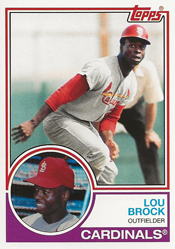 On Sept. 23, 1979, Brock, 40, made his last steal in his final appearance in New York as a player. The swipe of second base came during a Cardinals game against the Mets at Shea Stadium.
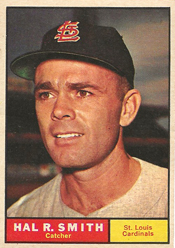 On Sept. 22, 1959, the Cardinals knocked the Dodgers out of first place in the National League with an 11-10 win at Busch Stadium in St. Louis.
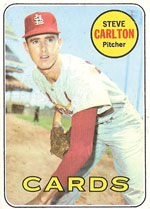 On Sept. 15, 1969, Carlton became the first pitcher in the majors to strike out 19 batters in nine innings, but it wasn’t enough to overcome the Amazin’ Mets.
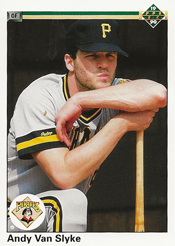 On Sept. 14, 1989, the paid attendance to see the Pirates play the Cardinals in a Thursday afternoon game at Busch Memorial Stadium in St. Louis was 1,519.
 On Sept. 7, 2009, Carpenter won his 11th consecutive decision, pitching a one-hitter in a 3-0 Cardinals triumph over the Brewers at Miller Park in Milwaukee.

