Mudcat Grant began the 1969 season as the top starting pitcher for the Expos and ended it as the top right-handed relief pitcher for the Cardinals.
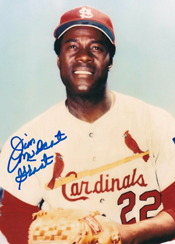 On June 3, 1969, the Expos traded Grant to the Cardinals for pitcher Gary Waslewski.
Grant, 33, preferred to start but the Cardinals needed bullpen help.
As a reliever, Grant appeared in 27 games for the 1969 Cardinals and was 6-3 with seven saves and a 3.22 ERA. In three starts, he was 1-2 with a 7.62 ERA. Overall, in 30 appearances for the 1969 Cardinals, Grant was 7-5 with a 4.12 ERA.
“Our bullpen did OK once we got Mudcat Grant,” Cardinals pitching coach Billy Muffett said to The Sporting News.
Pointing to his forehead, Muffett added, “He has it up here.”
Name game
James Timothy Grant was at a Cleveland Indians minor-league camp in Daytona Beach when a colleague, mistakenly assuming the Florida native was from Mississippi, began calling him Mudcat, according to the Society for American Baseball Research.
The nickname stuck like Mississippi mud on a catfish’s whiskers.
Grant made his major-league debut with the Indians in 1958 and got traded to the Twins in 1964. He had his best season in 1965, posting a 21-7 record, and made three starts in the World Series against the Dodgers. Grant won Game 1 and Game 6 and lost Game 4.
In November 1967, the Twins traded Grant to the Dodgers and they converted him from a starter to a reliever. Grant did well in the role. As a reliever, Grant appeared in 33 games for the 1968 Dodgers and was 5-2 with three saves and a 1.80 ERA. He also made four starts. Overall, in 37 appearances for the 1968 Dodgers, Grant was 6-4 with a 2.08 ERA.
Playing our song
The Expos selected Grant in the National League expansion draft and wanted him to be a starter. “Mudcat will win more games than any pitcher ever on a first-year expansion team,” Expos manager Gene Mauch predicted to the Montreal Gazette.
Grant impressed by yielding one earned run in spring training and was chosen to start the Expos’ first regular-season game on April 8, 1969, against the Mets at New York. Matched against Tom Seaver, Grant lasted 1.1 innings, surrendering three runs, but the Expos won, 11-10. Boxscore
Grant, a professional singer who toured with the group, “Mudcat and the Kittens,” said he planned to open a discotheque in downtown Montreal. “I’ve been in a lot of countries and a lot of states, but I’ve never felt as free as I feel right here in Montreal,” he said.
Though his record for the Expos was 1-6 with a 4.80 ERA, Grant “made a big impression” with Cardinals scout Bob Kennedy, who recommended the club acquire him to bolster the bullpen, The Sporting News reported.
Initially, Grant was displeased with the trade. “I’ll have to go back to the bullpen and I don’t dig that,” he said to the Montreal Gazette.
Grant told the St. Louis Post-Dispatch, “All pitchers prefer to start. Man, that’s where the action is.”
Action man
Grant got decisions in his first three relief appearances for the Cardinals.
In his Cardinals debut, on June 7, 1969, at Houston, Grant relieved Ray Washburn in the seventh inning with the score tied at 2-2, yielded a two-run single to former Cardinal Johnny Edwards and was the losing pitcher in a 4-2 Astros victory. Boxscore
On June 11, 1969, Grant pitched seven innings in relief of starter Mike Torrez and was the winning pitcher in the Cardinals’ 10-5 triumph over the Reds at Cincinnati. Boxscore
Grant’s third Cardinals appearance was June 19, 1969, versus the Expos at St. Louis and he got the win with 5.1 scoreless innings in relief of Washburn in a 5-3 Cardinals victory. Boxscore
Six days later, Grant started the second game of a doubleheader against the Expos at Montreal, pitched a complete game and got the win in an 8-3 Cardinals triumph.
Grant was “loudly booed” by the crowd of 28,819 at Jarry Park, the Post-Dispatch reported. After the game, as Grant walked near the stands, a spectator threw a cup of beer in his face and Grant retaliated
“I let him have a Joe Frazier right-cross right on the back of the ear,” Grant said. “I buckled him.” Boxscore
After losing each of his next two starts, to the Cubs and Mets, Grant returned to a relief role.
That’s entertainment
Grant made as big a splash in St. Louis with his singing as he did his pitching. On July 12, 1969, Grant performed at an event sponsored by the St. Louis Pinch-Hitters, wives and friends of Cardinals players, before more than 1,200 people at the Stouffer’s Riverfront Inn.
Under the headline, “Mudcat Grant Steals Show At Ball-B-Que,” the Post-Dispatch reported Grant performed solo and did numbers such as “I’m Going To Sit Right Down and Write Myself A Letter,” and “If I Had A Hammer.”
Four nights later, on Teen Night at Busch Stadium, Grant sang with the Bob Kuban band before a July 16 game. Video of Mudcat Grant singing “Wonderful World” at 2011 memorial for Harmon Killebrew
Grant’s best month with the 1969 Cardinals was August when he was 2-1 with a save and a 2.19 ERA. In September, he had five saves.
“Mudcat is sneaky out there,” said Cardinals catcher Tim McCarver. “He showed me he knows the hitters and he showed me he likes to pitch.”
On Dec. 5, 1969, the Cardinals sold Grant’s contract to the Athletics for what The Sporting News described as “considerably in excess of” the $25,000 waiver price. The move backfired on the Cardinals. In 1970, pitching for the Athletics and Pirates, Grant made 80 appearances and was 8-3 with 24 saves and a 1.86 ERA.
Grant played 14 seasons in the big leagues for the Indians, Twins, Dodgers, Expos, Cardinals, Athletics and Pirates, producing a 145-119 record and 3.63 ERA.
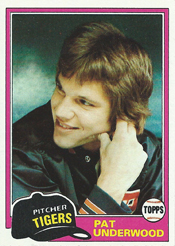 On May 31, 1979, Tom and his younger brother, Pat Underwood, opposed one another as starting pitchers in Pat’s major-league debut.
 Starr led the Packers to five NFL championships and twice won the Super Bowl Most Valuable Player award. A member of the Pro Football Hall of Fame, Starr played in 10 postseason games and the Packers won nine of those.
 Hill was ejected by the officiating crew and Starr, unable to continue, was replaced by a former Cardinal, John Roach.
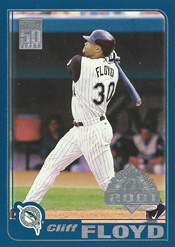 On May 31, 1999, National League umpire Frank Pulli used a television replay to determine whether a ball hit by Cliff Floyd of the Marlins was a home run.
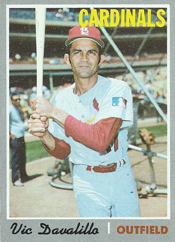 On May 30, 1969, Davalillo was traded by the Angels to the Cardinals for outfielder Jim Hicks.
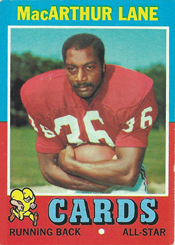 Lane played 11 NFL seasons with the Cardinals (1968-71), Green Bay Packers (1972-74) and Kansas City Chiefs (1975-78).
 RetroSimba