Feeds:
Posts
Comments

The Pirates came close to convincing the Cardinals to send them Stan Musial, but settled instead for Murry Dickson.

On Jan. 29, 1949, the Cardinals sold the contract of Dickson, a starting pitcher, to the Pirates for $125,000.

The Pirates were willing to pay almost three times as much if the Cardinals included Musial in the deal. The purchase price would have been $310,000 _ $250,000 for Musial, the reigning National League batting champion, and $60,000 for Dickson, the Pittsburgh Post-Gazette reported.

One of the Cardinals’ owners was willing but the other wasn’t, so Musial remained with St. Louis.

Right stuff

Dickson was born in Tracy, Mo., a town along the Platte River in the western part of the state. He was 20 when he signed with the Cardinals in 1936.

A right-hander with a slight build, Dickson began his professional career with Grand Island of the Nebraska State League in 1937 and worked his way through the Cardinals’ system.

After posting a 22-15 record for Houston of the Texas League in 1939, Dickson was rewarded with a promotion to the Cardinals and made his major-league debut on Sept. 30, 1939, with 3.2 scoreless innings of relief against the Cubs at Chicago. Boxscore

Dickson made another September appearance with the Cardinals in 1940 after posting a 17-8 record for Columbus, Ohio. He spent all of 1941 in the minors and stuck with the Cardinals in 1942.

The Cardinals won National League pennants in 1942 and 1943. Dickson was 6-3 in 1942, 8-2 in 1943 and made a relief appearance in the World Series versus the Yankees before entering the Army.

Dickson was assigned to a reconnaissance unit in Europe during World War II, achieved the rank of sergeant and earned four battle stars. General George S. Patton wanted Dickson to be his driver, but Dickson asked to be assigned elsewhere, according to the Society for American Baseball Research.

After two years of military service, Dickson returned to the Cardinals in 1946, achieved a record of 15-6 with a 2.88 ERA and helped them win another pennant. In the 1946 World Series against the Red Sox, Dickson started Game 3 and Game 7. He was the losing pitcher in Game 3 and got no decision in Game 7, though the Cardinals won.

Pursuing a deal

In his book, “Stan Musial: The Man’s Own Story,” Musial said Dickson “liked to experiment with pitches. He had the widest assortment I ever saw _ fastball, curve, slider, knuckler, sinker, screwball _ and a remarkable arm.”

Dickson was 13-16 in 1947 and 12-16 in 1948, when he gave up 39 home runs, but Cardinals manager Eddie Dyer liked him and wanted him in the starting rotation.

The Pirates liked Dickson, too. He was 0-5 against them in 1948, but with a 2.17 ERA, and the Pirates were convinced he’d improve their starting staff.

After the 1948 season, the Pirates began a “relentless pursuit” of Dickson, according to The Pittsburgh Press.

Pirates majority owner and president Frank McKinney was a friend of Cardinals president Robert Hannegan, who co-owned the St. Louis club with Fred Saigh. McKinney and Hannegan were powerful figures in the national Democratic Party and confidantes of President Harry Truman.

While attending the 1948 World Series, McKinney met with Hannegan to discuss a deal for a pitcher. Hannegan offered a choice of four _ Dickson, Red Munger, Howie Pollet and Ted Wilks, The Pittsburgh Press reported.

“Dickson was the pitcher we wanted,” McKinney said.

McKinney said he and Hannegan continued to negotiate, including when they were in Washington, D.C., for Truman’s inauguration on Jan. 20, 1949.

“I worked on this deal for a long time,” McKinney said.

Wait a minute

At some point, the trade talks between McKinney and Hannegan focused on Musial.

In a column headlined “Bucs Almost Had Musial,” Post-Gazette sports editor Al Abrams reported McKinney “had just about convinced Robert Hannegan to sell him Musial and Murry Dickson in one package.”

While at Truman’s inauguration, Hannegan, who suffered from hypertension, said he was advised by his doctor to sell his share of the Cardinals because of the stress the job was causing him. Hannegan planned to sell his share to Saigh.

McKinney’s $310,000 bid for Musial and Dickson was appealing to Hannegan, who “wanted to get back the money he invested in Cardinals stock and get out of baseball because of ill health,” the Post-Gazette reported.

When Saigh was told of the proposed Pirates deal, he objected to Musial being included. “Saigh would have blown his top had such a deal gone through,” the Post-Gazette reported, “and no one could blame him. The move would have wrecked the St. Louis club.”

On Jan. 26, 1949, Hannegan called McKinney, told him Musial wasn’t available and the price for Dickson had gone up to $125,000. “(He) told me to make up my mind within an hour,” McKinney said to The Pittsburgh Press.

McKinney called Pirates manager Billy Meyer, who said, “Get Dickson.”

Hannegan and McKinney made the deal but agreed to keep it quiet because the next day, Jan. 27, 1949, Hannegan announced he sold his shares to Saigh, who gained control of the franchise.

Two days later, it was Saigh who announced Dickson’s contract was sold to the Pirates.

Pinpoint control

Dickson was 12-14 for the 1949 Pirates, but 5-3 versus the Cardinals, who finished a game behind the pennant-winning Dodgers.

Musial said Dickson liked to pitch from behind in the count and get overeager batters to chase pitches. “He had such great control that instead of coming in there with a fat one, he could catch a corner with a pitch that looked good, but wasn’t,” Musial said.

In five seasons with the Pirates, Dickson was 66-85. He went to the Phillies in 1954 and they traded him back to the Cardinals on May 11, 1956, with Herm Wehmeier for Harvey Haddix, Stu Miller and Ben Flowers.

Dickson was 13-8 for the Cardinals in 1956 and 5-3 in 1957 before he hurt his right shoulder and was released.

He pitched for the Athletics and Yankees in 1958, making two relief appearances for New York in the World Series against the Braves, and for the Athletics again in 1959 when he was 43.

Dickson’s career record in the big leagues was 172-181, including 72-54 for the Cardinals.
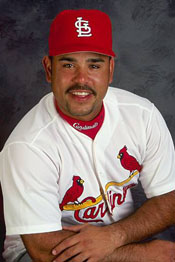
The Cardinals took a chance on Carlos Baerga, hoping the second baseman could revive his career, but the experiment didn’t last long because they couldn’t wait for him to lose weight.

On Jan. 27, 1999, Baerga, a free agent, signed a one-year contract for $1.25 million with the Cardinals, who needed a second baseman to replace departed free agent Delino DeShields.

Before choosing Baerga, the Cardinals also considered Pat Meares, a Twins shortstop who played second base early in his professional career, but the free agent wanted more than the club was willing to provide, according to the St. Louis Post-Dispatch.

With the Mets in 1998, Baerga, 30, got out of shape, limiting his fielding range, but he assured Cardinals manager Tony La Russa he’d come to spring training camp at Jupiter, Fla., ready to play.

The Cardinals, who were grooming prospect Adam Kennedy in the minors, hoped Baerga would be a short-term solution at second base in 1999 until Kennedy was prepared to take over, most likely in 2000.

Ready or not

Baerga, a switch-hitter, made his major league debut with the Indians in 1990 and developed into an elite player.

He batted .312 with 205 hits and 105 RBI for the Indians in 1992 and followed up by batting .321 with 200 hits and 114 RBI in 1993. Baerga also did well in 1994 and 1995, batting .314 each season, but in July 1996 the Indians dealt him and Alvaro Espinoza to the Mets for Jeff Kent and Jose Vizcaino.

Baerga didn’t have the kind of success with the Mets he had with the Indians. After the 1998 season, he became a free agent. The Reds and Angels wanted Baerga but he chose the Cardinals after La Russa called him multiple times and encouraged him to sign.

“He’s a premier guy who went in the opposite direction and he’s determined to get back the respect he had,” La Russa said to the Post-Dispatch.

La Russa conceded Baerga “gave the appearance of being a little listless mentally and physically” with the Mets, but “we’ve had it confirmed that he’s really working hard. I think he’s anxious to reassert himself.”

Said Cardinals general manager Walt Jocketty: “We understand he still makes the double play very well. He always has. It’s just a question of whether he has enough range to make the plays.”

Post-Dispatch columnist Jeff Gordon was skeptical, asking, “Has there been any thought given to sending Baerga out to play second base on skates?” and colleague Bernie Miklasz concluded, “This is the end of the line for Baerga. If he doesn’t turn his career around in St. Louis, it’s over. So he should be motivated.”

Weight watchers

When Baerga reported to Cardinals training camp, he was listed as carrying 215 pounds on a 5-foot-11 frame.

In exhibition games, Baerga produced two hits in 15 at-bats, twisted an ankle and, according to the Post-Dispatch, “impressed no one.”

On March 17, 1999, Baerga was released by the Cardinals because “he was too heavy and too slow,” the Post-Dispatch reported.

“He just wasn’t in shape,” said Jocketty. “He was overweight. I was disappointed with that weight. He just wasn’t able to move as well as you need to (as) a middle infielder.”

Said Baerga: “This has been my body all of my life, but when spring training is over I’m always down to where I want to be. I don’t think I hurt my defense. I didn’t miss any balls. I still make all the plays.”

La Russa met with Baerga and told him “if he could just pick up that step or two, he could have plenty of career ahead of him, but at this point, it’s not there.”

Six days later, Baerga signed a minor-league contract with the Reds.

Baseball journeyman

Placido Polanco was the 1999 Opening Day second baseman for the Cardinals. Joe McEwing eventually got most of the starts before Kennedy was called up in late August and given a look.

Baerga played in 52 games for the Reds’ farm club at Indianapolis before he requested his release. He signed with the Padres, played 21 games for their Las Vegas farm club and was called up to the big leagues in late June 1999.

On Aug. 2, 1999, Baerga started at second base for the Padres against the Cardinals at St. Louis, produced a single in four at-bats and fielded cleanly. It was his only start in the four-game series. Boxscore.

Baerga batted .250 in 33 games for the Padres before his contract was sold to the Indians on Aug. 16, 1999.

Baerga sat out the 2000 season, played in Korea and with the Long Island Ducks in 2001, and returned to the big leagues with the Red Sox in 2002. He went on to play for the Diamondbacks in 2003 and 2004 and with the Nationals in 2005.

In 14 major-league seasons, Baerga batted .291 with 1,583 hits.

After the 1999 season, the Cardinals acquired Fernando Vina from the Brewers to play second base in 2000.

(Updated Nov. 8, 2024)

As a 22-year-old rookie, Mel Stottlemyre pitched with poise and precision for the Yankees against the Cardinals in the 1964 World Series.

Stottlemyre started three World Series games versus the Cardinals and was matched against Bob Gibson in each. Stottlemyre got a win in Game 2, a no-decision in Game 5 and a loss in Game 7. He had a 3.15 ERA in 20 innings and yielded no home runs to the Cardinals.
Relying primarily on sinkers and sliders, Stottlemyre didn’t possess an overpowering fastball like Gibson did, so he tried to get groundouts rather than strikeouts.

In his victory over the Cardinals, Stottlemyre got 18 of the 27 outs on ground balls, according to The Sporting News. Of the 35 Cardinals batters he faced, nine hit the ball into the air, the St. Louis Post-Dispatch reported.

Stottlemyre “pitched impressively with a sinker that was so good he needed only three outfield putouts,” Post-Dispatch sports editor Bob Broeg noted.

Yankee from Yakima

Stottlemyre was born in Hazleton, Mo., a village along the Big Piney River near Mark Twain National Forest in the southern part of the state. His father was a pipefitter and moved the family to Oregon and South Carolina before settling in Mabton, a town in Yakima Valley in Washington state, in the early 1950s.

Stottlemyre attended Yakima Valley Community College, joined the baseball team and was taught to throw a sinker by coach Chuck Brayton.

“He was a hard worker and a dedicated pitcher from the start,” Brayton told The Sporting News.

The Yankees’ Eddie Taylor, the only scout to make Stottlemyre an offer, said, “What impressed me most was he always pitched winning baseball and had a free-throwing arm. His fastball was really not much, but he had that effortless way of throwing the ball. What kept me interested was his sinker.”

Stottlemyre, who didn’t get a signing bonus, was assigned to the Class D level of the minor leagues in 1961.

In 1964, he was at Class AAA Richmond, Va., and had a record of 13-3 with a 1.42 ERA. Seeking a replacement for Whitey Ford, who had a hip problem, the Yankees called up Stottlemyre in August.

The right-hander made his major-league debut on Aug. 12, 1964, pitched a complete game and got the win in a 7-3 Yankees triumph over the White Sox. Stottlemyre went on to post a 9-3 record and 2.06 ERA for the Yankees, who won the American League pennant by finishing a game ahead of the White Sox.

“He filled a big pitching gap when we needed it,” Yogi Berra, manager of the 1964 Yankees, told Super Sports magazine. “He kept coming through for us in the clutch. Few rookies had as much poise as he had.”

Go low

After Ray Sadecki beat Ford in Game 1 of the World Series, Stottlemyre was matched against Gibson in Game 2 at St. Louis on Oct. 8, 1964.

“I was very nervous,” Stottlemyre recalled to Super Sports magazine in 1969. “People said I didn’t look it, but I was. The whole idea of me pitching in the World Series was too much to believe.”

Stottlemyre dodged trouble in the sixth when struck on the right wrist by a Lou Brock shot. Stottlemyre retrieved the ball, threw out Brock and assured Berra the wrist was all right.

“It was numb for a little bit, but that feeling went away,” Stottlemyre told the New York Daily News.

In the eighth, with the Yankees ahead, 4-1, the Cardinals put runners on second and third with none out. “I thought about taking Stottlemyre out,” Berra said. “One more hit and I would have.”

Relying on the sinker, Stottlemyre got Curt Flood to ground out to third and Brock to ground out to short. Carl Warwick scored from third on Brock’s groundout, cutting the Yankees’ lead to 4-2, but the Cardinals had two outs and a runner, Jerry Buchek, on second. Buchek moved to third on catcher Elston Howard’s passed ball and Bill White walked, bringing cleanup hitter Ken Boyer to the plate.

Stottlemyre’s first pitch to Boyer was a mistake, high and inside, but Boyer swung and missed. Howard went to the mound and reminded Stottlemyre to keep the ball down and away. Boyer grounded out softly to short, ending the inning.

“When Stottlemyre got in the jam, I expected to get a good shot at him, but he didn’t give in,” Boyer said.

Said Howard: “He has more poise than any other young pitcher I’ve ever caught. Base hits don’t rattle him. He keeps coming back.”

The Yankees went on to an 8-3 victory. The first four batters in the Cardinals’ order, Flood, Brock, White and Boyer, were held hitless.

In his book, “Pride and Pinstripes,” Stottlemyre said, “In addition to my sinker, I was able to use my backdoor slider effectively against their left-handed hitters. I dropped it on the outside corner to their lefties to get some key strikes. I’d have to say it was the best game I ever pitched, considering the circumstances.”

Stottlemyre’s line: 9 innings, 7 hits, 3 runs, 2 walks 4 strikeouts.

Gibson’s line: 8 innings, 8 hits, 4 runs, 3 walks, 9 strikeouts.

“We have a pretty good-hitting ballclub, but we couldn’t get much off that kid,” Gibson said. “He’s nothing but good. I’d have had to be awfully good to beat him today.” Boxscore

Dueling aces

Stottlemyre and Gibson both were good in Game 5 at Yankee Stadium. The Cardinals prevailed, 5-2, on Tim McCarver’s three-run home run off Pete Mikkelsen in the 10th.

Stottlemyre’s line: 7 innings, 6 hits, 2 runs, 2 walks, 6 strikeouts.

Gibson’s line: 10 innings, 6 hits, 2 runs, 2 walks, 13 strikeouts. Boxscore

Stottlemyre and Gibson started Game 7 on two days’ rest at St. Louis. They were tired but Gibson was better, going the distance in a 7-5 Cardinals triumph.

Stottlemyre’s line: 4 innings, 5 hits, 3 runs, 2 walks, 2 strikeouts.

Gibson’s line: 9 innings, 9 hits, 5 runs, 3 walks, 9 strikeouts. Boxscore

In his book, Stottlemyre said, “What nobody ever really knew about that last game was my shoulder stiffened up after I fell on it reaching for an errant throw as I covered first base.”

In 11 big-league seasons, all with the Yankees, Stottlemyre was 164-139 with a 2.97 ERA.

He served as pitching coach for the Mets (1984-93), Astros (1994-95), Yankees (1996-2005) and Mariners (2008). The 1986 Mets and the Yankees of 1996, 1998, 1999 and 2000 won World Series championships.

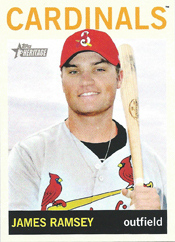
At Florida State, James Ramsey was compared with Tim Tebow, but, like his University of Florida counterpart, the Cardinals prospect learned success in professional baseball requires more than faith.

On Jan. 7, 2019, Ramsey was hired to be the hitting coach for the Georgia Tech baseball team.

Seven years earlier, on June 4, 2012, Ramsey was selected by the Cardinals in the first round of the amateur draft.

The Cardinals in 2012 had two first-round picks followed by three supplemental selections before the start of the second round. Pitcher Michael Wacha, outfielder Stephen Piscotty and third baseman Patrick Wisdom made it to the major leagues. Ramsey and catcher Steve Bean did not.

Moving up

Ramsey, an outfielder who batted left-handed, was a standout high school athlete in suburban Atlanta. His father Craig and mother Mary were Florida State alumni and both played sports in college. Craig was a baseball player and Mary played tennis.

James followed his parents to Florida State and excelled at baseball. After his junior season, Ramsey was selected in the 22nd round of the 2011 amateur draft by the Twins, who wanted to convert him into a second baseman, but he rejected their offer of $500,000.

Ramsey spent the summer of 2011 playing in the Cape Cod League on the same team with Piscotty and batted .314.

In 2012, his senior season at Florida State, Ramsey hit .378 with an on-base percentage of .513 and was named Atlantic Coast Conference player of the year. He also earned a degree in finance.

Based on his Cape Cod League performance in 2011 and his Florida State success in 2012, Ramsey raised his ranking as a pro prospect in the 2012 draft.

“He was considered the top senior hitter in the draft,” according to the Tallahassee Democrat.

Skills test

The Cardinals had the 19th pick in the first round as compensation for the Angels’ signing of free-agent first baseman Albert Pujols and also had the 23rd selection. Wacha was their first choice and Ramsey their second.

After 30 total picks were made in the first round, a supplemental round of 30 more picks was held to provide further compensation to clubs losing free agents.

The Cardinals chose Piscotty 36th overall for the loss of Pujols, Wisdom 52nd overall for the loss of Octavio Dotel to the Tigers and Bean 59th overall for the loss of Edwin Jackson to the Nationals.

Scouts were split on whether Ramsey, 6 feet, 190 pounds, should remain an outfielder or move to second base.

Ramsey “doesn’t appear to possess any off-the-chart skills,” the St. Louis Post-Dispatch reported. “He is considered to have above-average speed, but with an average arm and average power.”

After the Cardinals chose him, Ramsey told the Orlando Sentinel, “I am not going to be the sexiest prospect that comes along. I am not going to be the 6-foot-5, 220-pound guy, but I am a winner and that’s the kind of guy they want in their organization.”

Ramsey was captain of his college team and, according to the Post-Dispatch, “Scouts have called Ramsey the Tim Tebow of Florida State baseball for his leadership and strong Christian faith.”

Tebow, the former Florida quarterback, tried professional baseball after his NFL career and batted .244 in the minor leagues. Tebow, 31, entered 2019 still seeking a call to the majors.

Stiff competition

The Cardinals gave Ramsey a $1.6 million signing bonus in June 2012 and assigned him to Class A Palm Beach, where he hit .229 in 56 games as a center fielder.

In 2013, Ramsey played for three teams in the Cardinals’ system, but he primarily was with Class AA Springfield, Mo., whose manager was Mike Schildt. Ramsey’s overall statistics for 2013 included a .256 batting mark, 16 home runs and a .373 on-base percentage.

Ramsey was back with Springfield in 2014 and played again for Schildt, who, four years later, would become manager of the Cardinals.

“I can improve in a lot of facets in my game, but one thing I’ve been trying to focus on is the mental side,” Ramsey said to MiLB.com in May 2014. “If I can be the most relentless competitor everyday when I show up to the field, I’m going to give myself a good chance to succeed.”

Ramsey hit .300 with 13 home runs and a .389 on-base percentage in 67 games for Springfield in 2014, but he was unable to break through to Class AAA because the Cardinals had higher-rated outfield prospects such as Piscotty, Oscar Taveras, Randal Grichuk and Charlie Tilson.

Of those, Tilson was the most like Ramsey. “There’s no question Tilson’s emergence made Ramsey more expendable,” Post-Dispatch columnist Bernie Miklasz observed. “Ramsey’s path to Busch Stadium was clogged.”

Down on the farm

On July 30, 2014, the Cardinals traded Ramsey to the Indians for pitcher Justin Masterson.

Cardinals general manager John Mozeliak called it “dealing from an area of depth,” the Post-Dispatch reported.

Indians general manager Chris Antonetti said Ramsey “has a good approach at the plate with a little bit of power and he’s a guy we think will contribute at the major-league level,” according to the Akron Beacon-Journal.

The Indians gave Ramsey a chance at Class AAA and he hit .243 with 12 home runs for their Columbus club in 2015.

In April 2016, the Indians sold Ramsey’s contract to the Dodgers, who assigned him to a farm team. Four months later, the Dodgers dealt Ramsey to the Mariners, who also kept him in the minors.

On April 9, 2017, Ramsey was released by the Mariners and sat out the season. The Twins signed him in December 2017 and he played for two of their farm teams in 2018 before getting released on June 27, 2018.

At 28, Ramsey’s professional playing career was done without getting a chance to play a big-league game.

Florida State hired Ramsey as an assistant baseball coach in August 2018 and he worked there until getting the Georgia Tech offer.

(Updated Oct. 18, 2022)

Born and raised near Pittsburgh, John Stuper wanted to pitch for the Pirates, went to the Cardinals instead and became a World Series winner as a rookie.

On Jan. 25, 1979, the Pirates traded Stuper to the Cardinals for infielder Tommy Sandt.
The minor-league move turned into a big deal for the Cardinals, but not before Stuper had to revive a career headed in reverse.

Hometown hopeful

A native of Butler, Pa., near Pittsburgh, Stuper had a 34-3 record in three seasons as a college pitcher. He was 25-3 in two years at Butler County Community College and 9-0 for Point Park College in downtown Pittsburgh.

The Pirates chose Stuper in the 18th round of the June 1978 amateur draft, offered a $2,500 bonus and signed him that night.

“It’s been my lifelong dream to be a professional baseball player,” Stuper said to the Pittsburgh Post-Gazette. “I know the odds are against making it to the majors, but I’m not thinking about that now.”

Years later, asked by the St. Louis Post-Dispatch why he wasn’t drafted in a higher round, Stuper replied, “The rap on me in high school and later in college was I labored too much and didn’t have a smooth enough delivery.”

A right-hander, Stuper was assigned to the Pirates’ Class A club at Charleston, S.C., and posted a 4-8 record and 5.33 ERA.

“He still has a few mechanical problems he has to correct,” said Pirates farm director Murray Cook.

Said Stuper: “I learned a lot. It was an adjustment getting used to being away from home and playing against better talent.”

Climbing the ladder

Four months after his first professional season ended, Stuper was called at home by Cook, who told him of the trade to the Cardinals.

“I was a little disappointed when I was traded, but my friends encouraged me to think positively that the Cardinals wanted me, not that the Pirates didn’t,” Stuper said to The Pittsburgh Press.

In the Cardinals’ minor-league system, Stuper had ERAs of 2.71 in 1979 and 2.41 in 1980. He credited Cardinals pitching instructor Hub Kittle for the turnaround.

“I don’t make it to the big leagues without Mr. Hub Kittle,” Stuper told Cardinals Magazine. “I loved the man. He believed in me. He was probably the best pitching coach for mechanics I’ve ever encountered.”

Kittle told The Southern Illinoisan, “When we got him, he was a strong and well-conditioned kid, but he was throwing down from the side. Gradually we changed his mechanics, and when he came over the top, the ball began to jump.”

After the 1979 season, Stuper earned a degree in English at LaRoche College in McCandless, Pa. He pitched winter ball in Mexico after the 1980 season.

When Stuper got to Cardinals spring training camp in 1981, he was “in midseason form,” he later told the Post-Dispatch, because of his work in Mexico.

Stuper impressed the Cardinals, who conceded he pitched well enough to deserve a role on the Opening Day roster, but they sent him to Class AAA Springfield, Ill., so he could pitch regularly as a starter.

“He’s going to be a good pitcher,” said Cardinals manager Whitey Herzog. “He’s been awfully impressive.”

A step back

Stuper struggled at Springfield and couldn’t get untracked. When major leaguers went on strike in June 1981, Herzog said he intended to go to Springfield “to see what’s wrong with Stuper,” who had lost seven of nine decisions.

Turns out the toll of pitching in Mexico, followed by a spring training workload, left Stuper out of sorts. He finished the 1981 season with a 6-14 record and 4.92 ERA.

“In the long run, pitching in the winter hurt me,” Stuper said. “My arm was very fatigued all season.”

Stuper went home and worked to get his arm in shape, but he had a poor spring training in 1982 and the Cardinals sent him to Class AAA Louisville in mid-March.

A year after being the surprise of spring training camp, Stuper went to Louisville knowing he needed a good showing to get back in the Cardinals’ plans.

Mission accomplished

“One of my goals this year is to show that last season was a fluke,” Stuper said to the Associated Press.

After taking the loss on Opening Night, Stuper won seven consecutive decisions for Louisville and was 7-1 with a 1.46 ERA when he was called up to the Cardinals on May 28, 1982.

“I was shooting for September,” Stuper said to the Louisville Courier-Journal. “I would have been happy with that, so obviously I’m elated with this.”

Stuper made his major-league debut on June 1, 1982, in a start against the Giants at St. Louis. He pitched eight innings, allowing three runs, tripled against Atlee Hammaker and scored the tying run, but the Giants prevailed, 4-3, in 11. Boxscore

Giants first baseman Reggie Smith, a former Cardinal, said, “I liked the young guy’s guts. He challenges you.”

Said Stuper: “I thought my stuff was OK, but I wasn’t real sharp. I was getting behind on too many hitters. My location wasn’t as good as I like it to be.”

Homeward bound

Stuper won four of his first five decisions with the Cardinals.

On Aug. 14, 1982, Stuper pitched in Pittsburgh for the first time as a big-leaguer, getting the start against the Pirates. He yielded one run in 7.1 innings, earning the win in a 4-1 Cardinals triumph. Boxscore

“I’d be lying if I said it wasn’t kind of special. Very special,” Stuper said. “I always dreamed about coming here to pitch for the Pirates. The day I got traded, I started dreaming about coming here to pitch against them.”

Stuper finished his rookie season with a 9-7 record and 3.36 ERA, helping the Cardinals win the National League East Division title.

In the postseason, he made three starts and the Cardinals won all three, though he didn’t get a decision in Game 2 of the National League Championship Series against the Braves or in Game 2 of the World Series versus the Brewers.

Stuper did win Game 6 of the 1982 World Series, pitching a four-hitter in a 13-1 Cardinals victory and setting up a decisive Game 7 won by St. Louis.

Stuper was 12-11 for the Cardinals in 1983 and 3-5 in 1984 before he was traded to the Reds for outfielder Paul Householder.

In 1989, Stuper earned a master’s degree in English from Slippery Rock University. He was a Cardinals minor-league pitching instructor in 1991 and 1992 before becoming head baseball coach at Yale in 1993.

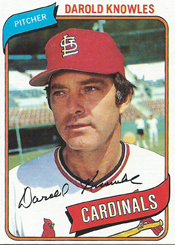
Darold Knowles was the first free-agent player signed by the Cardinals, the club he dreamed of playing for as a youth in Missouri.

On Jan. 16, 1979, the Cardinals signed Knowles to a two-year contract for $100,000 per season.

Three years after baseball put in a system enabling players to become free agents, the Cardinals finally acquired one.

Free agency for players occurred in 1976 after Cardinals outfielder Curt Flood challenged baseball’s reserve clause in court and arbitrator Peter Seitz ruled pitchers Andy Messersmith and Dave McNally should be free to sign with any teams they wanted after playing a season without contracts.

On July 12, 1976, a new collective bargaining agreement between players and owners created the framework for determining who could become free agents.

Though the Cardinals did pursue Pete Rose and other free agents, they consistently were outbid.

The signing of Knowles, a left-handed reliever, wasn’t a blockbuster, but he was respected, experienced and wanted to play for the Cardinals.

Redbirds rooter

Knowles was born in Brunswick, Mo., a rural community known for producing pecans, and he became a standout amateur player.

The first major-league game he saw as a youth was at St. Louis in the 1950s. “I’ve been a Cardinals fan for as long as I can remember,” Knowles said to the St. Louis Post-Dispatch.

The Cardinals, though, weren’t too interested in Knowles and he signed with the Orioles in February 1961.

Knowles, 23, made his major-league debut for the Orioles in 1965, pitched in five games for them and was traded after the season to the Phillies.

Storybook success

With his mother and father in attendance, Knowles got his first major-league win in his first appearance for the Phillies on April 14, 1966, at St. Louis against the Cardinals.

“I can pitch up here,” Knowles said to the Philadelphia Inquirer. “I’ve got to throw strikes. I don’t consider myself a strikeout pitcher. If I can throw 27 ground balls, I’m happy.”

The Phillies led, 5-3, when Knowles relieved starter Ray Herbert with a runner on first and none out in the fourth. Knowles pitched “six pressure-packed innings” and “constantly worked his way out of trouble,” the Inquirer reported.

After the Cardinals scored in the fifth, pulling within a run at 5-4, Lou Brock led off the seventh with a walk, but was picked off by Knowles.

“We were going to bunt Lou over,” Cardinals manager Red Schoendienst said. “I don’t know what he was doing trying to steal.”

Said Knowles: “I figured that with them one run down, Brock would try to steal sometime. So I decided to throw to first right away. We got Brock and that was the ballgame. It was a big lift for me.” Boxscore

Championship caliber

In addition to the Orioles and Phillies, Knowles pitched for the Senators (1967-71), Athletics (1971-74), Cubs (1975-76), Rangers (1977) and Expos (1978) before joining the Cardinals.

With the 1970 Senators, Knowles was 2-14 with 27 saves and a 2.04 ERA.

Knowles was with the Athletics when they won three consecutive World Series championships (1972-74). He pitched in all seven games of the 1973 World Series versus the Mets, earning saves in Game 1 and Game 7, and totaled 6.1 scoreless innings.

In 1978, when he joined the Expos, Knowles was reunited with manager Dick Williams, who managed the championship Athletics clubs in 1972 and 1973. Knowles was 3-3 with six saves and a 2.38 ERA for the Expos and they wanted to re-sign him in 1979, “but my family and I didn’t like Montreal,” Knowles said.

Knowles, 37, became a free agent and interested the Cardinals, who were seeking a left-hander to join Mark Littell as short-inning relievers.

Old pro

“I feel good and I think I can have four or five more good years,” Knowles said when he signed with the Cardinals. “I’ve never been overpowering, but I’ve been blessed with good control and the ability to keep my pitches low.”

Said Cardinals catcher Ted Simmons: “Knowles knows what he’s doing. He’s been through every kind of situation. Whatever he’s lost with his arm, he can compensate for with his head. He knows how to approach his job, and the approach is 70 percent of the game.”

At first, Knowles did well for the Cardinals, posting a 2-1 record with four saves and a 2.00 ERA in May, but he finished the 1979 season at 2-5 with six saves and a 4.07 ERA.

Knowles, 38, returned to the Cardinals in 1980 for the second year of his contract.

In his second appearance, on April 18, 1980, Knowles was brought in to protect an 8-7 lead against the Pirates with one on and one out in the sixth. He threw a “scroogie changeup” to the first batter he faced, Dave Parker, who hit a home run and put the Pirates ahead, 9-8.

“The ball was low enough, but I didn’t want it over the plate,” Knowles said.

Knowles allowed another run before completing the inning and was the losing pitcher in a 12-10 Pirates triumph. Boxscore

“We were in a position to win this game and I screwed it up,” Knowles said.

Coaching career

On May 9, 1980, Knowles was released soon after the Cardinals acquired left-hander Jim Kaat from the Yankees.

“I didn’t have that much left,” Knowles said to the Society for American Baseball Research. “I didn’t have the good stuff that I had earlier, but it was OK. I wound up playing for my boyhood dream team and loved every minute in St. Louis.”

Knowles finished with a career record of 66-74, 143 saves and a 3.12 ERA.

The next year, the Cardinals hired Knowles as minor-league pitching coach and he served in the role from 1981-88. In 1983, when Cardinals pitching coach Hub Kittle left the club in June to be with his ailing wife, Knowles filled in for him the remainder of the season.

In 1989, Phillies general manager Lee Thomas, the former Cardinals director of player development, hired Knowles to be pitching coach. Serving on the staff of manager Nick Leyva, a former Cardinals coach, Knowles was Phillies pitching coach in 1989 and 1990.