Feeds:
Posts
Comments

Immediately after the Cardinals beat the Dodgers in the playoff game that decided the 1946 National League pennant, Dodgers general manager Branch Rickey and his assistant, Arthur Mann, hustled into the home team clubhouse at Ebbets Field.

Rickey wanted to talk with Dodgers manager Leo Durocher, but the door to Durocher’s office was closed and locked. Rickey and Mann plopped down on a trunk filled with uniforms and waited.

Finally, when the door swung open, Rickey rose and started in, but was brushed aside by a small, brusque man.

“Just a minute, Pop,” the man said to Rickey. “Stand back.”

Startled, Rickey obeyed.

As the man pressed ahead, another followed close behind. As the second man passed, he said, “Hello, Branch.”

According to Mann in a piece published in the Newark Star-Ledger, the following exchange took place:

Rickey: “Who was that?”

Mann: “The little fellow in the front was Killer Gray, the bodyguard.”

Rickey: “And what body was he guarding?”

Mann: “George Raft, the movie actor.”

As Mann noted, “Rickey was nettled, but not because Raft got there first. He was distressed that Raft had got there at all.”

Described by the New York Times as “the cool tough guy who specialized in gangster roles,” Raft earned millions in his film career, but as he told Lloyd Shearer of Parade magazine, “Part of the loot went for gambling, part for horses and part for women. The rest I spent foolishly.”

A passionate baseball fan, Raft became a friend of Durocher, going back to Leo’s playing days, including his time as shortstop for the Gashouse Gang Cardinals. They spent lots of time together until baseball’s commissioner put a stop to it.

Street hustler

Raft (the original name was Ranft) grew up in the tough Hell’s Kitchen section of New York City at 41st Street and 10th Avenue. “You had to fight for your life everyday,” Raft said to the Saturday Evening Post. In recalling how he survived, Raft told the Los Angeles Times, “I could run good, and I carried a rock in the toe of an old sock.”

After quitting school in the seventh grade, he sold newspapers on street corners, was a bat boy for the New York Highlanders (who became the Yankees), delivered groceries and had a stint as an electrician’s apprentice.

Eventually, Raft tried boxing. In 14 pro fights as Dutch Rauft, he had nine wins, three defeats and two draws, according to Ring magazine. In 1911, Raft turned to baseball. He had a two-day tryout with the minor-league Springfield (Mass.) Ponies but didn’t make the team, according to the Springfield Republican.

Raft found success in his next undertaking as a dancer. Fast on his feet, he was adept at dancing the Charleston and tango. Working in New York City dance halls and nightclubs as a paid partner, or gigolo, Raft “charmed well-to-do women for money and favors,” according to the New York Times.

It was during this time that Raft began associating with gangsters. As Florabel Muir of the New York Daily News noted, “He was fascinated by them _ the lavish way they lived, the mysterious and underhanded way they did business, by their power and the perilous hold they had on life.”

One of Raft’s pals, mobster Benjamin “Bugsy” Siegel, got his nickname because he was “crazy as a bedbug,” according to PBS. “He hated to be called Bugsy,” Raft told Dean Jennings of the Saturday Evening Post, “and nobody in the mob dared use that word.”

Asked if he ever picked pockets or rolled a drunk, Raft replied to Dean Jennings, “Yes, I’m sorry to say. During Prohibition, we thought all the customers in the speakeasies were fair game.”

Raft also said he delivered bootleg booze for mobster Dutch Schultz and drove a bulletproof sedan for Owney Madden, a gang leader and bootlegger who operated the Cotton Club in Harlem. “I had a gun in my pocket and I was cocky because I was working for the gang boss of New York,” Raft recalled to the Saturday Evening Post. “I was as good as any driver in the mob, and I could have steered Owney’s car on the subway tracks without getting a scratch on the enameled armor plate.”

Leo Durocher was early in his playing career with the Yankees at this time. According to the book “Leo Durocher: Baseball’s Prodigal Son” by Paul Dickson, “Raft and Durocher first met in a poolroom on 48th Street and liked each other instantly … Raft was naturally drawn to the young ballplayer, who seemed every bit as brash as he was.”

Raft’s dancing got him parts in Broadway shows and his association with Owney Madden helped get him his start in Hollywood films. “The underworld put up money so I could try my luck in Hollywood,” Raft told the Saturday Evening Post.

Going Hollywood

The role that brought Raft stardom was his portrayal of playboy gangster Guino “Little Boy” Rinaldo, performed with coin-flipping menace, in the 1932 film “Scarface.” Other strong performances came in “Bolero” (1934), “Each Dawn I Die” (1939), “Invisible Stripes” (1939) and “They Drive by Night” (1940).

In a 2018 retrospective of Raft, Josh Sims of The Rake magazine wrote, “Other men of his era _ James Cagney, Spencer Tracy, Humphrey Bogart, Cary Grant, Gary Cooper _ entered the annals of cool, but the much-less-famous Raft embodied it. They played tough; he was tough.”

Unwittingly, Raft played a part in helping Bogart become a Hollywood legend. Raft turned down the lead roles in “High Sierra” and “The Maltese Falcon.” According to the Los Angeles Times, studio boss Jack Warner considered Raft for the lead in “Casablanca.” All of those parts went to Bogart.

Raft’s acting style might best be described as deadpan. Or, as Josh Sims wrote, “Raft made self-effacement an art form.” At a Friar’s Club event, comedian George Burns cracked, “Raft once played a scene in front of a cigar store, and it looked like the wooden Indian was overacting.”

“I don’t try to act,” Raft told the Detroit Free Press. “I try to get what the fellow in the story means, but I certainly can’t act.”

On set, he took punches at fellow actors Edward G. Robinson, Wallace Beery and Peter Lorre “because I thought they were needling me about my background,” Raft told the Saturday Evening Post.

He appeared in more than 100 movies. According to Josh Sims, Raft said, “I was killed 85 times. How unlucky can you go, right? I did pretty well with the girls, but, in the pictures, always got killed.”

Though married for 47 years, Raft and his wife separated early on. Among the actresses he romanced were Marlene Dietrich, Betty Grable, Carole Lombard, Norma Shearer and Mae West.

In West’s first film, “Night After Night,” starring Raft, she wrote some, or most, of her dialogue. When West enters a joint run by Raft, the checkroom clerk, dazzled by the jewelry, says, “Goodness, what beautiful diamonds.” West replies, “Goodness had nothing to do with it, dearie.”

Buddy system

Raft and Durocher stayed in contact as both grew their careers. When Durocher played for the Cardinals in the 1934 World Series, Raft attended games in St. Louis and Detroit, signing autographs for fans in the stands.

According to the New York Daily News, Raft “will gamble on anything, but he especially likes the horses … He likes to bet on baseball and football games, too. He will bet at the drop of a hat on either side of any known chance.”

In 1939, when Durocher became Dodgers manager, he and Raft hung out often. As author Paul Dickson noted, “The friendship was such that Durocher began parting his hair, dressing and talking like Raft. Durocher visited with Raft when he was in California, and Raft stayed with Leo in New York. Durocher had a duplicate Dodgers uniform _ complete with his number 2 _ made for Raft.”

When the Dodgers reached the World Series in 1941, Durocher gave his four tickets behind the dugout to Raft. Baseball commissioner Kenesaw Mountain Landis objected because of Raft’s gambling. Raft was put in different seats. After the World Series, Durocher, without his wife, moved into Raft’s 14-room house in the Coldwater Canyon section of Beverly Hills.

“Durocher’s infatuation with Hollywood in general and George Raft in particular seemed to intensify,” wrote author Paul Dickson. “Durocher was now dressing exactly like Raft, copying all of his details … Raft’s own tailor now made Leo’s clothes as well.”

Bad for business

Raft made headlines in 1944 for two gambling incidents.

In March, while Durocher was with the Dodgers at spring training, Raft was staying at Leo’s place on East 64th Street in Manhattan. Paul Dickson described it as “a plushy terrace apartment with a built-in bar whose stools were made of catchers mitts mounted on baseball bat tripods.” After the New York premiere of his movie “Follow the Boys,” Raft gave a party at the apartment.

One of the guests, Martin Shurin Jr., an aircraft parts manufacturing executive, filed a complaint with the New York district attorney, claiming he lost $18,500 that night to Raft in a crooked dice game. Raft said the amount was $10,000 and that the dice weren’t loaded. No formal action was taken against Raft, but Durocher now was linked publicly to high-stakes gambling.

Two months later, in June 1944, police raided a Hollywood apartment and arrested Bugsy Siegel for bookmaking. Raft was in the apartment, too. At the trial, Raft testified for the defense. “I’m ready to swear on all the St. Christopher medals I wear and everything else holy that there was no bookmaking being done,” Raft said on the witness stand.

Siegel pleaded guilty to a lesser charge, a misdemeanor, and received a small fine, the New York Daily News reported.

Durocher continued to reside in Raft’s house during baseball off-seasons. They also attended the 1946 World Series between the Red Sox and Cardinals. Newspapers published photos of Durocher, Raft, saloonkeeper Toots Shor and Joe DiMaggio seated together at a game in Boston.

The Cardinals’ 20-year-old catcher, Joe Garagiola, told syndicated columnist Jimmy Cannon, “I read in the newspapers that movie stars are here watching me play. I want to get a look at them. I want to see how they look in person. I saw Chico Marx the other night and I was looking for George Raft all day.”

Breaking up

In a series of columns he wrote for Hearst newspapers, Westbrook Pegler said the relationship between Durocher and Raft was bad for baseball and would lead to a gambling scandal similar to the one that tainted the 1919 World Series.

Happy Chandler, who succeeded Kenesaw Mountain Landis as baseball commissioner, met with Durocher in November 1946 and told him to move out of Raft’s house and end all contact with him. Durocher had stayed with Raft for nine winters in a row.

Following Chandler’s orders, Durocher returned to Raft’s house to remove his belongings. According to Paul Dickson’s book, when Durocher began to explain to his friend what Chandler commanded, Raft interrupted and said, “I know what he says. You’ll hurt your career chances hanging around with me. I don’t want that to happen. You better move out.”

Durocher replied, “Yeah, I better.”

According to Paul Dickson, Durocher “packed his bags that night and moved out the next morning. The two men never were seen alone together again.”

“Twenty years of friendship out the window,” Raft lamented to Parade magazine.

In January 1947, Raft met with Chandler, hoping to get the commissioner to change his mind about his directive to Durocher, but was unsuccessful. In his autobiography, Chandler recalled Raft said to him, “I got a bum rap.” Chandler replied, “I didn’t give it to you.”

Rough stuff

Under pressure to take action for Durocher’s perceived continued involvement with underworld figures, Chandler in April 1947 suspended Durocher for one year for conduct “detrimental to baseball.”

Two months later, in June 1947, Bugsy Siegel was killed in a hail of bullets while he sat on a couch reading a newspaper near a window inside the Beverly Hills home of an acquaintance, Virginia Hill. Shortly before midnight, the killer (never identified) rested a .30-caliber carbine rifle “on a white rose trellis in the driveway of the house next door and pumped nine bullets through a window,” the New York Daily News reported.

“Half of the mobster’s face was torn away and his right eye was found 15 feet across the room on the tiled floor. He … never knew what hit him,” Florabel Muir of the New York Daily News reported from the scene.

Dr. Fredrick Newbarr, who performed the autopsy on Siegel, called it a “typical gangland slaying,” the Los Angeles Daily News reported.

Beverly Hills police chief C.H. Anderson told the Los Angeles newspaper he wanted to question Raft for information about Siegel. Bodyguard Killer Gray, speaking for the actor, said Raft didn’t know what the shooting was all about.

(During a 1940 murder trial, a $3,200 check written by Siegel and endorsed by Raft was uncovered. At the time of Siegel’s murder, speculation was Siegel may have owed Raft $100,000, the Los Angeles Times reported. Raft denied it.)

In her gossip column, noting that Hollywood producers were considering a movie about Siegel, Hedda Hopper suggested Raft “would be a natural” for the lead role.
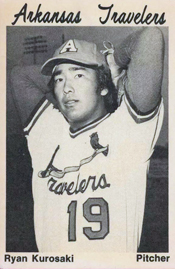
As an amateur pitcher, Ryan Kurosaki experienced a dramatic change in climate, landscape and culture, leaving the tropical paradise of Hawaii after high school and going to the prairies of Nebraska to attend college.

After making that transition, a leap from the minors at Arkansas to big-league St. Louis might seem feasible, but it turned out to be too much too soon.

Fifty years ago, in 1975, as a right-handed reliever with barely more than a year of professional experience, Kurosaki was called up to the Cardinals from Class AA Little Rock. After only a month with St. Louis, Kurosaki was sent back to Arkansas and never returned to the big leagues.

A pitcher whose job it was to put out fires, Kurosaki built a second career as a professional firefighter.

Aloha

A grandson of Japanese immigrants, Kurosaki developed an interest in baseball as a youth in Honolulu. In June 1962, when he was 9, Kurosaki was among a group of pee-wee players shown receiving instruction from Irv Noren, manager of the minor-league Hawaii Islanders, in a photo published in the Honolulu Star-Bulletin.

Kurosaki eventually became a standout pitcher for Kalani High School. As a senior in 1970, he helped Kalani win a state championship. Lenn Sakata, the club’s junior shortstop, recalled to the Honolulu Star-Advertiser that Kurosaki “was captain of our team. We looked up to him. He was the leader.”

(Sakata went on to play 11 seasons in the majors with the Brewers, Orioles, Athletics and Yankees.)

Dave Murakami, a Hawaiian who played baseball for the University of Nebraska in the 1950s, recommended Kurosaki to Cornhuskers head coach Tony Sharpe, who offered a scholarship. At Murakami’s urging, Kurosaki accepted.

Asked in May of his freshman year about making the adjustment from Hawaii to Nebraska, Kurosaki told the Omaha World-Herald, “It is a lot different … I still miss Hawaii. When you’re stuck in the snow, you get that way.”

Any feelings of homesickness didn’t prevent Kurosaki from developing into a reliable starter for Nebraska. Highlights during his three seasons there included shutouts of Kansas State, Oklahoma and Oklahoma State.

In the summers after his sophomore and junior seasons, Kurosaki pitched for a semipro team in Kansas managed by former big-league outfielder Bob Cerv. “That’s where I developed my slider,” Kurosaki told the Honolulu Star-Bulletin.

Pitching well in the National Baseball Congress Tournament, Kurosaki impressed Cardinals scouting supervisor Byron Humphrey. Opting to forgo his senior season at Nebraska, Kurosaki, 21, signed with the Cardinals in August 1973.

Fast rise

Assigned to Class A Modesto of the California League, Kurosaki had a splendid first season in the Cardinals’ system in 1974. Playing for manager Lee Thomas, Kurosaki was 7-3 with six saves. He struck out 74 in 71 innings and had a 2.28 ERA. “Ryan has a great slider and keeps the ball low,” Thomas told the Modesto Bee. “He’s everything you want in a relief pitcher.”

Promoted to Class AA Arkansas for his second pro season in 1975, Kurosaki baffled Texas League batters. In his first 11 relief appearances covering 21 innings, he didn’t allow an earned run and was 4-0 with four saves.

In May, the Cardinals demoted starter John Denny to Tulsa, moved reliever Elias Sosa into the rotation and brought up Kurosaki to take Sosa’s bullpen spot.

When Arkansas manager Roy Majtyka informed Kurosaki he was headed to the big leagues, the pitcher called his parents in Hawaii. “The family went crazy when I gave them the news,” Kurosaki told the St. Louis Post-Dispatch. “I still can’t believe I’m up here.”

As he recalled to the Honolulu Star-Advertiser, “I was in awe when I reported. My teammates included Lou Brock and Bob Gibson.”

The Cardinals assigned first baseman Ron Fairly, 36, to be the road roommate of Kurosaki, 22, and help him get acclimated. Kurosaki was 6 when Fairly debuted in the majors with the 1958 Dodgers.

Good start

When Kurosaki entered his first game for the Cardinals on May 20, 1975, at San Diego, he became the first American of full Japanese ancestry to play in the majors, the Honolulu Star-Advertiser reported.

(The first Japanese native to play in the big leagues was pitcher Masanori Murakami with the 1964 Giants. The first Asian-born player with the Cardinals was Japanese outfielder So Taguchi in 2002.)

Kurosaki’s debut was a good one. He worked 1.2 innings against the Padres, allowing no runs or hits. Boxscore

His next three outings _ one against the Dodgers (two innings, one run allowed) and two versus the Reds _ had many pluses, too.

On May 31 against the Reds, Kurosaki retired Johnny Bench, Dan Driessen, Cesar Geronimo and Dave Concepcion before giving up a solo home run to George Foster. Boxscore

The next day, Kurosaki held the Reds scoreless in two innings of work. He gave up two singles but retired Joe Morgan, Bench, Driessen, Concepcion, Foster and Jack Billingham. Morgan and Foster struck out. Boxscore

In four appearances for the Cardinals, Kurosaki had a 2.45 ERA.

Rough patch

After that, Kurosaki faltered. He allowed four runs in less than an inning against the Reds, gave up a three-run homer to Cliff Johnson of the Astros, and allowed three runs in 1.2 innings versus the Pirates. Relieving Bob Gibson (making his first relief appearance since 1965) at Pittsburgh, Kurosaki gave up singles to pitcher Bruce Kison and Rennie Stennett. Kison stole third and scored on Kurosaki’s balk. (Cardinals manager Red Schoendienst got ejected for contesting the balk call.) Boxscore

Kurosaki was sent back to Arkansas. Little did he know his big-league days were over. His totals in seven appearances for the Cardinals: 7.62 ERA, with 15 hits allowed, including three home runs, in 13 innings.

“I think they might have brought me up a little too quick,” Kurosaki said to the Omaha World-Herald. “It’s tough on you mentally when you’re somewhere you know you don’t belong. I knew that I didn’t belong in St. Louis. I knew that I wasn’t pitching for them the way I knew I could pitch.”

Reflecting on Kurosaki’s stint with St. Louis, former American League umpire Bill Valentine, who became Arkansas general manager in 1976, told 501 Life Magazine of Conway, Ark., “It was one of the silliest things the Cardinals ever did … No way he could be ready.”

Getting sent back to Little Rock did have one significant benefit for Kurosaki: He met Sandra McGee there in 1975 and they married in 1978.

Sounding the alarm

Based on his work at Arkansas, it was reasonable to think Kurosaki would be heading back to St. Louis at some point. He was 7-2 with seven saves and a 2.03 ERA for Arkansas in 1975; 5-2 with six saves and a 3.25 ERA in 1976.

After two good seasons at Class AA, Kurosaki expected a promotion to Class AAA in 1977 but instead the Cardinals sent him back to Arkansas. Once again, he delivered, with 14 saves and five wins.

So it was tough for Kurosaki to take when the Cardinals told him to report to Arkansas for a fourth consecutive season in 1978.

“Same old story year after year,” Kurosaki told the Omaha World-Herald. “They told me I could go to the Mexican League, but I said I wouldn’t go. I asked them to trade me, but they wouldn’t. They told me it was either the Mexican League or Little Rock. It is getting to the point where I’m thinking that if the Cardinals don’t have any plans for me, perhaps it would be better if I went somewhere else.”

The Cardinals wanted Kurosaki to develop a screwball or forkball to go with his slider and sinker, The Sporting News and Honolulu Star-Bulletin reported.

Kurosaki, 26, earned 11 saves for 1978 Arkansas and finally got a mid-season promotion _ to Springfield, Ill., where he was 5-2 with three saves and a 2.40 ERA for the Class AAA club.

A second chance at the majors, though, wasn’t offered. As Bill Valentine suggested to 501 Life Magazine, the Cardinals “forgot about him.”

Kurosaki spent two more years in the minors, then was finished playing pro baseball at 28.

In 1982, after a year with the Benton (Ark.) Fire Department, Kurosaki began a 32-year career with the Little Rock Fire Department, retiring as a captain in 2014.

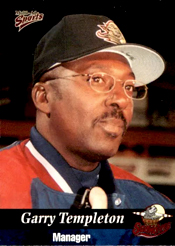
As a Cardinals player who struggled to manage his emotions, Garry Templeton didn’t seem a likely candidate to manage others. Yet that’s precisely what he did.

A shortstop for 16, sometimes stormy, seasons in the big leagues, Templeton went on to spend 13 years as a manager in the minors, often at the lowest levels.
He managed in the Angels’ system for four seasons, including two at Class AAA, one rung below the big leagues, and then for nine years with teams in independent leagues.

Beginning with Cedar Rapids, Iowa, in 1998 and concluding with Newark, N.J., in 2013, Templeton had an overall record of 636-692 as a manager. He was 294-272 with the Angels’ farm teams; 342-420 with the independent league clubs.

Asked why managing appealed to him, Templeton told the Cedar Rapids Gazette, “I like having a hand in everything … I like that challenge.”

Of the many players the former Cardinal managed, some who went on to become Cardinals were David Eckstein and John Lackey.

Growing pains

Templeton was 20 years old when he reached the majors with the Cardinals in 1976. He was exciting as well as excitable, and his six seasons with St. Louis were a mix of thrills and turmoil.

A switch-hitter with speed, Templeton was the first major-league player to get 100 hits from each side of the plate in a season. He produced a league-high 211 hits _ 111 from the left side; 100 from the right _ for the 1979 Cardinals. He also led the National League in triples for three consecutive seasons while with St. Louis (1977-79).

Before he turned 25, his prime years still ahead, Templeton was one of the sport’s top talents, but there was unhappiness. At 1979 spring training, Templeton asked the Cardinals to trade him and threatened to play at less than his best if his request wasn’t granted. During the season, he was chosen as a reserve on the National League all-star team, but turned down the opportunity because he said he should have been the starting shortstop.

Two years later, Templeton created his biggest tempest when he made obscene gestures to St. Louis spectators after he got booed for not hustling. Enraged by Templeton’s behavior, manager Whitey Herzog pulled him down the dugout steps and backed him against a wall before teammates separated them. The Cardinals suspended and fined Templeton, then moved him to the disabled list when he entered a St. Louis hospital for treatment of emotional problems.

During the winter, the Cardinals traded him to the Padres for a future Hall of Famer, Ozzie Smith.

“Of the thousands of players I’ve seen come and go, two who stand out are Garry Templeton and Dave Parker,” Cardinals broadcaster Jack Buck told the St. Louis Post-Dispatch in 1997. “I thought both could have been among the greatest players of all time … Templeton had more tools than Ozzie Smith, but Smith made himself a great player by working hard at it, and Templeton let his skills diminish because he didn’t work hard enough.”

Former Cardinals first baseman Keith Hernandez said to the New York Times in 2000, “The two greatest young players I ever saw were Darryl Strawberry and Garry Templeton, and both squandered it.”

In reflecting on those Cardinals days, Templeton told the Albuquerque Tribune in 2000, “I came into this game at a very young age. I think as a player everyone matures. It’s something gradual that happens. When you’re that young, you don’t even think about what things mean. You don’t think about what you’re saying.”

He also said to the Hammond (Ind.) Times in 2003, “I was just young and did young, foolish things … I wasn’t a hothead. I was more immature.”

Proud Padre

With the Padres, Templeton helped them to their first National League pennant (he hit .316 in the 1984 World Series) and was a steady contributor despite issues with his knees. (Templeton ranks second to Tony Gwynn for most career hits, doubles and games played as a Padre.)

He also had a good relationship with manager Dick Williams and their discussions got Templeton thinking about becoming a manager. “I’d ask (Williams) why he did certain things, and he’d tell me,” Templeton recalled to the Cedar Rapids Gazette. “We talked a lot of strategy. I learned a lot about the game. I learned how to play to win.”

Eventually, Templeton was asked by general manager Jack McKeon to help teach young teammates such as infielders Roberto Alomar, Joey Cora and Bip Roberts. Templeton found he liked doing it and was effective. “I love to teach,” Templeton told the Cedar Rapids Gazette.

After his playing days, Templeton was a roving infield instructor and baserunning coach in the Padres’ farm system in 1994 and 1995, then went home to be with his wife and their two sons and a daughter. He also developed a passion for golf. According to Mark Whicker of the Orange County Register, “Templeton had gotten so good (at golf) that he was playing in Golden State Tour events as an amateur and said he was seriously considering the PGA Tour Qualifying School.”

Then he got a call from a former Padres teammate, Angels minor-league hitting coach Gene Richards, who told him the Angels needed a manager for their Cedar Rapids farm club.

Manager material

Templeton applied for the job and was hired for the 1998 season by Angels director of player development Ken Forsch, brother of Templeton’s former Cardinals teammate, Bob Forsch. “His strength is teaching,” Ken Forsch said to the Cedar Rapids Gazette in explaining why he hired Templeton.

A skeptical Post-Dispatch declared, “Picture this: Garry Templeton sitting in the dugout of the Cedar Rapids Kernels, wearing a red, blue and silver uniform with a corncob logo and managing Class A ballplayers. Hard to imagine, if your memories of (Templeton) include him making obscene gestures to the Busch Stadium crowd at Ladies Day.”

Templeton, though, said he was committed to the task and that his goal was to return to the majors as a manager or coach. “This is the route I have to go,” he said to the Gazette. “I guess you could say I have to crawl before I can walk.”

Climbing the ladder

After a season at Cedar Rapids, Templeton was promoted to Class AA Erie, Pa., in 1999 and did well there, too. Baseball America magazine named Templeton the best managerial prospect in his league after each of his first two seasons.

Among the future big-leaguers he managed were pitchers Ramon Ortiz, Scot Shields and Matt Wise, and third baseman Shawn Wooten.

Templeton moved a step closer to his goal of the majors when he was named manager of Class AAA Edmonton for the 2000 season. Edmonton’s hitting coach was Templeton’s former Cardinals teammate, Leon Durham, who also was working to rebuild his baseball career. Durham got suspended for failing a drug test with the Cardinals in 1989, his final year as a big-league player.

Among the players on Edmonton’s roster was Edgard Clemente, nephew of Hall of Famer Roberto Clemente.

Edmonton was where David Eckstein revived his career. Placed on waivers in August 2000 after hitting .246 for the Red Sox’s Pawtucket farm club, Eckstein was claimed by the Angels, who assigned him to Edmonton. Playing for former Cardinals shortstop Templeton, future Cardinals shortstop (and World Series MVP) Eckstein hit .346. The Angels made him their shortstop the following year and Eckstein helped them become World Series champions in 2002.

Another future big-leaguer on that 2000 Edmonton team was pitcher Jarrod Washburn. “These guys are close to the next level,” Templeton told the Albuquerque Tribune. “I’m here trying to help them build on a few things and learn a few new things to get there.”

The Angels moved their Class AAA club to Salt Lake City for 2001. At the introductory news conference, Templeton and Angels front office staff wore Mickey Mouse ears, “welcoming Utah’s only triple-A team to the Disney Corp. family,” the Salt Lake City Tribune reported.

Among those who played for Templeton at Salt Lake City were catchers Bengie and Jose Molina (brothers of Yadier Molina) and John Lackey, who would pitch in the World Series for the Angels (2002), Red Sox (2013) and Cubs (2016), and in the playoffs for the Cardinals (2014-15).

The Angels, though, were overhauling their front office and Templeton wasn’t in the plans. General manager Bill Stoneman fired him after the 2001 season.

“He didn’t give me any reason other than (Angels manager) Mike Scioscia wanted someone easier to work with,” Templeton told the Salt Lake City Tribune. “It’s too bad … The Angels were good to me, but I felt I had at least one more year there.”

Wheel of Fortune

The next stop for Garry was Gary _ as in Gary, Ind., where he was named manager of a team in the Northern League. A son, Garry II, played for him there, but it didn’t work out. Templeton was fired after two seasons.

He then managed three teams in the Golden League (Fullerton, Long Beach, Chico) and one each in the North American League (Maui) and Canadian-American Association (Newark). One of the investors in the Golden League was TV game show host Pat Sajack. “I’m not in this to make money,” Sajack told the Los Angeles Times. “I’m in it to be closer to a game that I like very much.”

At Long Beach, Templeton managed a couple of former big-league pitchers trying to make comebacks _ Hideki Irabu and Jose Lima.

A year later, when Templeton managed the 2010 Chico Outlaws, one of his pitchers was Eri Yoshida, an 18-year-old Japanese woman knuckleball specialist. She said she learned to throw a knuckleball by watching video of Red Sox pitcher Tim Wakefield.

Yoshida was 0-4 for Chico but she played again for Templeton with Maui in 2011 and got her first win as a professional in the United States. “She’s not taken seriously (by others),” Templeton told the Honolulu Star-Advertiser. “Most people think of her as a novelty act, but you’ve got to look at her as if you’re looking at one of these guys who are out here trying to make it … I don’t see anything different between her and the (men) players.”

Another on the Chico roster was first baseman John Urick, a former Yankees prospect. Urick and Templeton had a serendipitous connection _ Whitey Herzog. Nearly 30 years after being yanked down the dugout steps by Herzog, Templeton was managing Whitey’s grandson.

Game 4 of the 2004 World Series was remarkable for more than the obvious reason. It was the game the Red Sox won to become World Series champions for the first time in 86 years. The magnitude of that achievement overshadowed another facet of that game: a drama that underscored the fortitude of the Cardinals’ rookie catcher, Yadier Molina.

Ever since his unplanned ascension from the minors to the Cardinals in June 2004, Molina faced a myriad of challenges, ranging from runners crashing into him at the plate to pitchers trying to embarrass him when he batted.

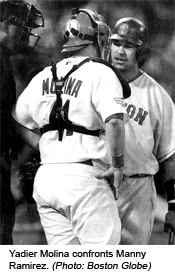
In his first World Series start, Molina encountered a different kind of test. Two of baseball’s prominent players, David Ortiz and Manny Ramirez, conspired to steal signs he was flashing to the pitcher.

Molina didn’t back down. Instead, the rookie intimidated the intimidators.

Climbing the ladder

After entering the Cardinals’ farm system in 2001, Molina made a steady rise. The 2004 season was his fourth year in the minors and his first at Class AAA Memphis.

Asked during 2004 spring training about Molina making the move to Class AAA, Cardinals director of player development Bruce Manno said to the Memphis Commercial Appeal, “Defensively, there’s no doubt in my mind (Molina) can play there. Offensively … we’ll see how he responds.”

Manno told the St. Louis Post-Dispatch, “We would like to see him play the full season (with Memphis).”

Memphis manager Danny Sheaffer, a former big-league catcher who played three seasons (1995-97) with St. Louis, managed Molina at Class A Peoria in 2002. That year, Molina threw out 52 percent of runners attempting to steal and hit .280.

Sheaffer assured the Memphis newspaper that Molina was a good  hitter _ “He uses the whole field” _  and had superb catching skills. “There’s not a whole lot he needs to improve on to catch in the big leagues right now … He’s real special,” Sheaffer told the Commercial Appeal in May 2004. “He’s head and shoulders above where I was at his age … He’s got a chance to be a good one.”

Call for help

The adjustment to Class AAA was no problem for Molina. In 37 games with Memphis, he hit .302 and nailed 17 of 28 runners trying to steal.

“He’s our top catching prospect,” Bruce Manno told the Memphis newspaper. “We feel that at some point he’s going to make a major contribution to our club at the major league level.”

That time came sooner than the Cardinals and Molina expected. On June 2, 2004, Sheaffer woke Molina during the night to inform him he was going to the Cardinals. Starting catcher Mike Matheny strained a muscle under his right rib cage, necessitating a stint on the disabled list. Molina was called up to join backup Cody McKay (son of Cardinals coach Dave McKay) as the St. Louis catchers.

Molina phoned his brothers, Angels catchers Bengie and Jose, to inform them of his promotion. Never before had three brothers been in the big leagues at the same time as catchers, according to research done by the Post-Dispatch and Joe Hoppel of The Sporting News.

Join the club

Manager Tony La Russa put Molina in the starting lineup for his big-league debut on June 3, 2004, at Pittsburgh. Before the game, Molina told the Post-Dispatch, “I’m ready. This is the best day of my life.”

Molina, 21, was in synch with starting pitcher Woody Williams, 37, who worked six scoreless innings. In the second inning, when Abraham Nunez tried to score from second base on a two-out single to right, Molina made a diving tag to prevent the run. In the eighth, he threw out Jack Wilson attempting to steal second, a key play in helping to short-circuit a Pirates comeback bid.

At the plate, Molina stroked two hits _ a single in the fifth and a double in the seventh _ against starter Oliver Perez. After the double, Molina advanced to third on So Taguchi’s sacrifice bunt and scored the winning run on a sacrifice fly by Woody Williams. Video

(The focus of the game changed in the ninth when La Russa and Pirates manager Lloyd McClendon were ejected after getting into a shouting match.)

After the Cardinals won, 4-2, Molina was praised for his successful debut. “He’s got so much composure,” La Russa told the Post-Dispatch. “He plays like he’s got 10 years of experience.” Pitching coach Dave Duncan said to the reporter Rick Hummel, “He’s not intimidated by the major leaguers. He should do all right.” Boxscore

Good job

On June 23, 2004, a few days after Matheny came off the disabled list, the Cardinals sent Cody McKay to Memphis and kept Molina. Two days later, against the Royals, Molina collected three hits, including two against 20-year-old rookie starter Zack Greinke. Boxscore

Matheny remained the No. 1 catcher but La Russa mixed in starts for Molina, making sure he didn’t rust on the bench. As the summer unfolded, it became evident Molina belonged in the majors. In addition to his brothers, Molina was the latest in a long line of big-league catchers from Puerto Rico. Others in the game then included Sandy Alomar Jr., Javy Lopez, Jorge Posada, Ivan Rodriguez and Benito Santiago.

In explaining why so many accomplished catchers were Puerto Ricans, Molina told the Post-Dispatch, “To me the difference between the Americans and us is we want the hard job.”

On Aug. 7, with the score tied at 1-1 in the ninth inning at St. Louis, the Mets issued an intentional walk to Larry Walker, loading the bases with two outs and bringing Molina to the plate. “If we were going to lose the game, we were going to make the rookie do it,” Mets manager Art Howe told the Post-Dispatch.

Mike Stanton threw a tough pitch, a fastball down and away, but Molina poked a single over the shortstop, giving St. Louis a 2-1 walkoff win. “You don’t have to be afraid in this game,” Molina said to Dirk Chatelain of the Post-Dispatch. “You just have to play the game hard. Respect the game … I’m a rookie but I know what it’s about.” Boxscore

Three weeks later, Molina earned more admiration from his teammates with a play he made at Pittsburgh. In the second inning, Ty Wigginton, trying to score from second on Jose Castillo’s single to right, steamed toward the plate. As Molina gloved Larry Walker’s one-hop throw, the 200-pound baserunner arrived. Wigginton crashed into Molina, bowling him over, but the rookie held onto the ball for the out.

“To take a hit like that and shake it off is just impressive,” Cardinals pitcher Matt Morris said to the Associated Press. “That shows you how much heart he has.”

Wigginton told the news service, “I thought I was going to score, and the next thing I know Molina is right in front of me … If he drops the ball, it might be a different ballgame.”

Two innings later, Molina tagged out Jose Castillo on Jim Edmonds’ throw from center. The Cardinals won, 6-4. Boxscore

In September, Molina hit his first big-league home run. The solo shot against the Brewers’ Matt Wise snapped a 2-2 tie in the eighth and carried the Cardinals to their 100th win of the season. Boxscore

In 59 games for the 2004 Cardinals, including 39 as a starter, Molina hit .267, made just two errors in 344 innings, and caught eight of 17 runners (47 percent) attempting to steal.

Taking a stand

After Matheny started the first three games (all won by the Red Sox) of the 2004 World Series, La Russa wanted him rested in case the Cardinals extended it beyond Game 4. So he gave Molina the Game 4 start. The Cardinals’ starting pitcher, Jason Marquis, worked well with Molina during the season. In 90.2 innings with Molina as his catcher, Marquis had a 3.38 ERA, which was better than his overall season total of 3.71.

In his first two plate appearances of the game, Manny Ramirez of the Red Sox walked and singled. While Ramirez was on base, Molina suspected Ramirez was relaying to cleanup batter David Ortiz the signs Molina was sending to Marquis.

(Years later, Reds first baseman Joey Votto, in discussing Molina with Derrick Goold of the Post-Dispatch, said, “It’s like he can sniff out, he can sense, where any hitter is looking, or what they’re attempting. It’s something that I don’t think you can measure. That seems like an intangible, but he has it.”)

In the dugout, Molina asked Matheny for advice on what to do about Ramirez’s sign stealing. According to the Post-Dispatch, Matheny replied, “When he comes up, make sure he knows you’re on to it.”

As Ramirez came to bat in the fourth, Molina stood up, stepped forward, got nose to nose with Ramirez and scolded him in Spanish.

“I was sitting over there saying, ‘That’s probably not what I would have done … but that will work,’ ” Matheny recalled to Stan McNeal of Cardinals Yearbook.

As Molina and Ramirez argued, Red Sox manager Terry Francona rushed over to umpire Chuck Meriwether. In pleading Ramirez’s case, Francona said he told Meriwether, “Chuck, Manny doesn’t even know our signs.”

The Cardinals lost the game, but the sight of their rookie catcher confronting Ramirez and refusing to back down made a powerful impression on them.

As La Russa told Cardinals Yearbook, “Yadi got in his face and started jawing at him. He told them to stop that stuff now, or somebody was going to get hurt because he would cross them up … I told him I was glad he did that, that he could not allow that stuff to happen. For a young catcher to do that in the World Series says all you need to know about his competitiveness.” Boxscore and Video at 1:15:46.

After the World Series, Matheny became a free agent and signed with the Giants. The Cardinals’ catching job belonged to Molina.

Early in his big-league playing career, Curt Flood had a tendency to try hitting home runs, which wasn’t a good idea for someone his size.

In 1958, his first season with the Cardinals, Flood, 20, clouted 10 homers. Those are the most home runs of any Cardinals player 20 or younger, according to researcher Tom Orf.
The long balls caused Flood to overswing. It wasn’t until a teammate helped him kick the habit that Flood became one of the National League’s top hitters.

Big talent

As a youth in Oakland, Flood was a standout art student and high school baseball player. A mentor, George Powles, also coached him with an American Legion team and in the semipro Alameda Winter League.

“This kid can do everything,” Powles told the Oakland Tribune. “He can run, throw, field and hit a long ball. He is smart and has great desire to get ahead.”

Big-league scouts took a look, but most determined Flood was too small to reach the majors.

In his autobiography “The Way It Is,” Flood recalled, “One day George Powles sat me down for a talk. He told me I had the ability to become a professional, but that I should prepare for difficulties and disappointments. He pointed out I weighed barely 140 pounds (and) was not more than five feet, seven inches tall … Small men seldom got very far in baseball.”

Reds scout Bobby Mattick, a former big-league shortstop, took a chance on Flood. In January 1956, after Flood turned 18 and graduated from high school, he signed with the Reds for $4,000.

Down in Dixie

Assigned to a farm club in High Point, N.C., a furniture factory town, Flood experienced racist teammates and fans.

“Most of the players on my team were offended by my presence and would not even talk to me when we were off the field,” Flood said in his autobiography. “The few who were more enlightened were afraid to antagonize the others.

“During the early weeks of the season, I’d break into tears as soon as I reached the safety of my room … I wanted to be free of these animals whose 50-cent bleacher ticket was a license to curse my color and deny my humanity. I wanted to be free of the imbeciles on the ball team.”

Flood’s pride kept him from quitting and he answered the bigots by performing better than any other player in the Carolina League. “I ran myself down to less than 135 pounds in the blistering heat,” he said in his book. “I completely wiped out that peckerwood league.”

The 18-year-old produced an on-base percentage of .448 (190 hits, 102 walks). He scored 133 runs, drove in 128 and slugged 29 home runs.

Called up to the Reds in September 1956, Flood made his big-league debut at St. Louis as a pinch-runner for catcher Smoky Burgess. Boxscore

The next season became another ordeal when the Reds returned Flood, 19, to the segregated South at Savannah, Ga. Adding to the pressure was the Reds’ decision to shift Flood from outfield to third base. One of his infield teammates was shortstop Leo Cardenas, a dark-skinned Cuban.

“Georgia law forbade Cardenas and me to dress with the white players,” Flood said in his book. “A separate cubicle was constructed for us. Some of the players were decent enough to detest the arrangement. I particularly remember (outfielder) Buddy Gilbert (of Knoxville, Tenn.), who used to bring food to me and Leo in the bus so that we would not have to stand at the back doors of restaurants.”

A future seven-time Gold Glove Award winner as a National League outfielder, Flood made 41 errors at third base with Savannah, but produced a .388 on-base percentage (170 hits, 81 walks), 98 runs scored and 82 RBI.

Earning another promotion to the Reds in September 1957, Flood’s first hit in the majors was a home run at Cincinnati against Moe Drabowsky of the Cubs. It turned out to be Flood’s last game with the Reds. Boxscore

Good deal

At the 1957 baseball winter meetings in Colorado Springs, Cardinals general manager Bing Devine and manager Fred Hutchinson met until 3 a.m. with Reds general manager Gabe Paul and manager Birdie Tebbetts, trying to make a trade, the St. Louis Globe-Democrat reported.

After much give and take, the Reds proposed sending Flood and outfielder Joe Taylor to the Cardinals for pitchers Marty Kutyna, Willard Schmidt and Ted Wieand. Devine, in his first trade negotiations since replacing Frank Lane as general manager, “had some fear and trepidation” about doing the deal, he said in his autobiography “The Memoirs of Bing Devine.”

As Devine recalled in his book, Hutchinson said to him, “Awww, come on. I’ve heard about Curt Flood and his ability. Flood can run and throw. He could probably play the outfield. Let’s don’t worry about it.”

Bolstered by his manager, Devine made the trade, his first for the Cardinals.

(Concern of having an all-black outfield of Frank Robinson, Vada Pinson and Flood prompted the Reds to trade him, Flood said in his autobiography.)

Devine told the St. Louis newspapers that Flood had potential to become the Cardinals’ center fielder. “We’re counting on him for 1959, not next year,” Devine told the Globe-Democrat.

Cardinals calling

The Cardinals opened the 1958 season with Bobby Gene Smith in center and sent Flood to Omaha, but Smith didn’t hit (.200 in April) and Flood did (.340 in 15 games). On May 1, they switched roles, Flood joining the Cardinals and Smith going to Omaha.

(When the Cardinals sent Flood a ticket for a flight from Omaha, he was concerned how he would get his new Thunderbird automobile to St. Louis. Omaha general manager Bill Bergesch kindly offered to drive the car there for him and Flood accepted, according to Bergesch’s son, Robert. Not knowing anyone in St. Louis, Flood rented a room in a house called the Heritage Arms on the recommendation of pitcher Sam Jones. In the book “The Curt Flood Story,” author Stuart L. Weiss noted that when Bill Bergesch arrived in St. Louis with Flood’s car, he found Flood was residing in one of the city’s most notorious bordellos.)

Flood, 20, played his first game for the Cardinals on May 2, 1958, at St. Louis against the Reds. The center fielder had a double and was hit by a Brooks Lawrence pitch. Boxscore

His first home run for the Cardinals came on May 15 at St. Louis against the Giants’ 19-year-old left-hander, Mike McCormick. Flood belted a changeup into the bleachers just inside the left field foul line. He also singled to center and doubled to right, prompting the Globe-Democrat to declare, “Flood resembled a junior grade Rogers Hornsby with a surprising ability to hit to all fields.” Boxscore

Among Flood’s 10 homers in 1958 were solo shots against Warren Spahn and Sandy Koufax. Boxscore and Boxscore

The power impressed, especially on a club with one 20-homer hitter (Ken Boyer), but Flood’s .261 batting average didn’t (the Cardinals had hoped for .280) and he struck out 56 times, the most of any Cardinal.

“I had fallen into the disastrous habit of overswinging,” Flood said in his autobiography. “Worse, I had developed a hitch in my swing. When the pitcher released the ball, my bat was not ready because I was busy pulling it back in a kind of windup.”

Fixing flaws

In February 1959, Flood got married in Tijuana, Mexico, to Beverly Collins, “a petite, sophisticated teenager with two children,” according to “The Curt Flood Story.” They’d met during the summer at her parents’ St. Louis nightclub, The Talk of the Town.

Solly Hemus, who’d replaced Fred Hutchinson as Cardinals manager, wanted a center fielder who hit with power. Trying to deliver, Flood went into a deep slump in 1959 and entered July with a batting mark of .192 for the season. “I now became more worried about my swing and more receptive to help,” Flood recalled in his book.

According to Flood’s book, when he asked Stan Musial for advice, Musial said, “Well, you wait for a strike. Then you knock the shit out of it.”

Help came from another teammate, pinch-hitter George Crowe, 38. “George straightened me out,” Flood said in his autobiography. “He taught me to shorten my stride and my swing, to eliminate the hitch, to keep my head still and my stroke level. He not only told me what to do, but why to do it and how to do it. He worked with me by the hour.”

It took a while, but Flood finally found his groove. In 1961, he hit .322, the first of six .300 seasons for the 1960s Cardinals. Flood twice achieved 200 hits in a season and finished with 1,854 in the majors.

In 1968, he told the Associated Press, “It took me five years to learn I’m not a home run hitter, and that’s the hardest thing in the world for a baseball player to tell himself. It’s a blow to your ego. You have to tell yourself you’re not as big and strong as the next guy. It hits at your masculinity, your manhood.”

Of Flood’s 85 big-league home runs, the most (15) came against the Reds. Flood hit four homers versus Juan Marichal and two each against Don Drysdale, Ferguson Jenkins and Sandy Koufax.

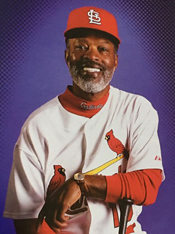
As a pinch-hitter in 1985, Hal McRae helped the Royals emerge from the brink of elimination against the Cardinals and advance to their first World Series championship. As a hitting coach two decades later, McRae helped the Cardinals become World Series champions for the first time in 24 years.

McRae spent more than 40 years in the big leagues _ 19 as a player, 15 as a coach, six as a manager and two in the front office. His last five seasons in the majors were as hitting coach of the Cardinals from 2005 to 2009.

During McRae’s St. Louis stint, the Cardinals won a World Series title in 2006, their first since 1982.

Segregated South

Harold McRae was from Avon Park, Fla., 85 miles south of Orlando. From 1927 to 1929, Avon Park was spring training home of the Cardinals.

As a youth in the 1950s, McRae developed into a right-handed hitter playing stickball on a makeshift diamond at the corner of Delaney and Castle streets in Avon Park. “A lot of skills I exhibited in the big leagues began right (there),” McRae recalled to the Tampa Tribune. “I remember a certain Mrs. Austin who lived on that corner. We knew that if we hit a ball into her yard, which was left field, she wouldn’t give it back. So that’s how I first learned to hit to right field.”

(In 1991, Castle Street was renamed Hal McRae Boulevard.)

McRae attended segregated E.O. Douglas High School in Sebring, Fla. Named for banker Eugene Oren Douglas, it was the only high school in the county available to blacks. (The school remained open until 1970, when integration finally occurred in Highlands County.)

After graduating in 1963, McRae attended Florida A&M in Tallahassee. Two years later, the Reds signed him. “I really enjoyed sliding headfirst, taking out the middle infielders, running into the catcher,” McRae told the Tampa Tribune. “I credit that outlook to my baseball coach (Costa Kittles) at Florida A&M. He was really a football coach. I was never afraid of contact.”

A few months after turning pro, McRae married his wife, Johncyna, in April 1966. Forty years later, in 2006, she was presented with an unsung hero award from the Florida Department of Health for “working tirelessly to end disparities in health care for racial and ethnic minorities.”

The award was presented with accolades from Florida Gov. Jeb Bush. According to the Bradenton Herald, Dr. Gladys Branic, director of the Manatee County Health Department, praised Johncyna “for her mentoring of migrant workers, her volunteer work for troubled teens, and the many scholarships and nurturing programs she helped develop for black girls.”

Slotted for second

In his first three seasons in the Reds’ system (1966-68), McRae was a second baseman. His minor-league manager in 1967 was former second baseman Don Zimmer. At the Florida Instructional League that fall, McRae’s instructor was former second baseman Sparky Anderson. Reds manager Dave Bristol told The Cincinnati Post, “Everyone, including scouts on the other clubs, tells me McRae is going to be Cincinnati’s next second baseman.”

McRae was called up to the Reds during the 1968 season and started 16 games at second base. Then in the winter, playing in Puerto Rico, he fractured his right leg in four places trying to knock the ball loose from a catcher on a play at the plate. That put an end to his ability to move nimbly as a second baseman.

After sitting out most of the 1969 season, McRae was shifted to the outfield and was with the Reds from 1970-72. In two World Series, he hit .455 against the Orioles in 1970 and .444 versus the Athletics in 1972. Video

(McRae also played in two World Series with the Royals. In 17 World Series games, he hit .400.)

Rough stuff

Traded to the Royals in November 1972, McRae benefitted from the American League’s adoption of the designated hitter in 1973. He told the Tampa Tribune, “Some people considered it being half a ballplayer … It just so happened that my best role was as the DH.”

Working well with hitting coaches such as Charley Lau and Rocky Colavito, McRae hit better than .300 seven times in 15 years with the Royals.

In 1976, when McRae hit .332, his teammate, George Brett, won the American League batting title at .333. In his final at-bat, Brett got an inside-the-park home run when Twins outfielder Steve Brye misjudged the ball. McRae suggested Brye intentionally let the ball drop.

Because of his aggressiveness, McRae was not a popular opponent. According to the Baseball Hall of Fame, while managing the White Sox, Tony La Russa said of McRae, “When you play against him, you detest him, but you would love to have him on your side.”

Mariners pitcher Glenn Abbott told Sports Illustrated, “I feel McRae has played dirty, but he plays to win, and that’s what it’s all about.”

Attempting to thwart a double play during a 1977 playoff game, McRae barreled into Yankees second baseman Willie Randolph with a rolling body block. The Yankees cried foul, but McRae said to United Press International, “I wasn’t trying to hurt Randolph … There was nothing dirty about it … We’re not supposed to be buddy-buddy out there.” Video

Teammates respected McRae. George Brett said to Sports Illustrated, “I look up to him. He learned the game from Pete Rose, and I learned it from him.” Whitey Herzog, McRae’s manager from 1975-79, told the Kansas City Star, “He’s the best designated hitter in baseball. He gives you everything he has on every play.”

Patience pays

The 1985 World Series between the Royals and Cardinals was played without designated hitters, but McRae still was involved in the drama.

With the Cardinals ahead, 1-0, in the ninth inning of Game 6 and on the verge of clinching the championship, the Royals got a break when umpire Don Denkinger ruled Jorge Orta safe at first, though TV replays clearly showed he was out.

As the inning unfolded, the Royals had runners on first and second, one out, when McRae batted for Buddy Biancalana. The Cardinals’ right-handed rookie closer, Todd Worrell, hoped to get McRae to ground into a game-ending double play.

According to the Kansas City Star, McRae said he reminded himself as he approached the plate to be patient and swing only if the pitch was a strike.

With the count 1-and-0, Worrell threw a slider that eluded catcher Darrell Porter for a passed ball, enabling the runners to move up to second and third. That changed the strategy. Behind in the count 2-and-0, Cardinals manager Whitey Herzog ordered Worrell to walk McRae intentionally, loading the bases and setting up a potential force-out at any base.

A left-handed batter, ex-Cardinal Dane Iorg, thwarted the plan with a two-run single. The Royals clinched the title the next night in Game 7. Boxscore

Good teacher

McRae batted .290 and totaled 2,091 hits in a big-league playing career that ended in 1987.

He managed the Royals (1991-94) and Rays (2001-02). A son, Brian, became a big-league outfielder and played for him on the Royals.

McRae coached for the Royals (1987), Expos (1990-91), Reds (1995-96), Phillies (1997-2000) and Rays (2001). As hitting coach, he was credited with helping develop Reggie Sanders with the Reds and Scott Rolen with the Phillies.

“Hitting instruction is probably my first love,” McRae told Todd Jones of The Cincinnati Post. “I enjoy the interaction with the players. As a manager, you look for results. As a hitting instructor, you look for improvement.”

After McRae helped Deion Sanders snap a slump, Reds veteran Lenny Harris told The Post, “Deion said to us, ‘It’s time to start listening to Hal McRae. He understands us.’ “

In a report on McRae’s hitting philosophy, Jim Salisbury of the Philadelphia Inquirer noted, “The plate is 17 inches wide. McRae teaches his hitters to concede the inner and outer two inches to the pitcher. That leaves 13 inches for the hitter.”

After being replaced as Rays manager by Lou Piniella, McRae moved into the role of assistant to Rays general manager Chuck LaMar, but there were “few requests for his input,” according to the St. Petersburg Times.

“I felt miserable half the time,” McRae told the newspaper.

Back in uniform

With Mitchell Page as hitting coach, the 2004 Cardinals won the National League pennant and led the league in hits and runs scored, but he was fired for reasons related to alcoholism. Page said to Joe Strauss of the St. Louis Post-Dispatch, “I have an alcohol problem and I’m going to get treatment for it.”

The Cardinals offered the job to McRae, 59, and he welcomed the chance to coach again. Recalling his start as a big-league manager with the White Sox in 1979, Cardinals manager Tony La Russa told the Bradenton Herald, “Winning was defined by George Brett and Hal McRae. In the West Division, Kansas City was the team to beat, and those were the two guys who showed how it was done. I always said I’d like to be a teammate of Hal McRae.”

After his hiring, McRae watched video and learned the habits of Cardinals batters. At 2005 spring training, he spent each day talking with the players and tailored his philosophies to their needs. As Roger Mooney of the Bradenton Herald noted, “McRae coaches like he played. He’s prepared, works hard and gets results.”

The 2005 Cardinals were loaded with big hitters such as Jim Edmonds, Albert Pujols, Scott Rolen, Reggie Sanders and Larry Walker. “With a veteran club, you’re talking about the (opposing) pitcher,” McRae said to the Herald. “We’re more concerned with the pitcher than ourselves.”

Helping hand

The 2006 Cardinals were a deeply flawed team that became World Series champions. Part of their success stemmed from the performance of rookie Chris Duncan, who slugged 22 home runs in 280 at-bats during the season.

“Hal McRae has been the biggest help because he’s working with me day in, day out,” Duncan told the Post-Dispatch. “He’s helped me the most to get through different phases and whatever is going on with me.”

In assessing McRae’s contributions to the 2006 Cardinals, Tony La Russa said to the St. Petersburg Times, “He’s a very smart man. He understands what hitting is about … and he understands winning.”

When Albert Pujols slumped early in the 2007 season, McRae gave him a tutorial _ “He needs to use his hands more,” the coach told the Post-Dispatch _ and used a video to convince Pujols that by being impatient, or jumpy, at the plate he was opening his hips too early in his swing. “He showed me, and I saw the difference,” Pujols said to reporter Joe Strauss.

In 2008, the Cardinals led the league in hits and batting average (.281, well above the league norm of .260), and got big production from a journeyman (Ryan Ludwick, 37 home runs, 113 RBI) and a former pitcher (Rick Ankiel, 25 homers).

Though division champions in 2009, the Cardinals were swept by the Dodgers in the playoffs, totaling six runs in three games. McRae, 64, was fired.

“You’re always disappointed when you get laid off,” McRae told the Post-Dispatch, “but I’m not disappointed in my work.”