Feeds:
Posts
Comments

The career paths of pitcher Curt Davis and outfielder Ernie Koy intersected in two prominent ways for the Cardinals.

The first occurred on Aug. 24, 1938, when Davis pitched a one-hitter for the Cardinals against the Dodgers. Koy produced the only hit, a bunt single.

Two years later, on June 12, 1940, Davis and Koy were part of a blockbuster trade between the Cardinals and Dodgers. The Cardinals sent Davis and slugger Joe Medwick to the Dodgers for Koy, third baseman Bert Haas, pitchers Carl Doyle and Sam Nahem, and $125,000.

It was the second time Davis was part of a major Cardinals trade. On April 16, 1938, the Cardinals dealt pitcher Dizzy Dean to the Cubs for Davis, pitcher Clyde Shoun, outfielder Tuck Stainback and $185,000.

Though Davis wasn’t the caliber of future Hall of Famers Medwick and Dean, he was a successful starting pitcher who achieved 11 double-digit win seasons after getting a late start to his major-league career.

Late bloomer

Davis was born in Greenfield, Mo., and moved with his family to a farm near Salem, Ore., when he was 3. As a young adult, Davis held a variety of jobs, including picking apples, lumberjacking and driving a truck at a logger camp, according to a biography by the Society for American Baseball Research.

A right-handed pitcher, Davis played semipro baseball and signed his first minor-league contract when he was 24. He made his major-league debut with the 1934 Phillies at age 30 and had an impressive rookie season, with 19 wins and a 2.95 ERA for a seventh-place club.

Davis had 16 wins for the 1935 Phillies, was traded to Cubs for slugger Chuck Klein in May 1936, and won 11 for the Cubs in 1936 and 10 in 1937. When the Cubs had a chance to get the sore-armed Dean on the eve of the 1938 season, they jumped at the chance. Cardinals fans were disappointed to see Dean depart and took out their frustrations on Davis, whom they viewed as an inadequate replacement for the colorful ace.

Tough to handle

Davis, 34, took a 9-6 record and 4.48 ERA into his start against the Dodgers at Sportsman’s Park in St. Louis. He’d started two days earlier, Aug. 22, 1938, against the Reds and yielded five runs and eight hits in 3.2 innings.

The Cardinals and Dodgers both had losing records and the Wednesday game on a sweltering afternoon drew a paid crowd of 1,403. Another 1,183 boys and girls were admitted for free, putting the total attendance at 2,586.

With one out in the second inning, Koy, a rookie, pushed a drag bunt between the first-base line and the pitcher’s mound. As Koy, a former running back for the University of Texas football team, barreled toward the bag, first baseman Johnny Mize fielded the slow roller and tossed the ball to Davis, who was covering first.

“I hesitated an instant on my way over to first to let Mize get the ball out of his glove,” Davis said to the St. Louis Star-Times. “For a split second, I was afraid the throw would go behind me.”

The throw was on target, but Davis fumbled the ball as Koy streaked across the base and was called safe by umpire George Magerkurth.

Davis disagreed with the call, telling the Star-Times, “I thought I had Koy beat … Just as I caught the ball, I felt a thud behind me and naturally I thought it was an out.”

According to the Brooklyn Daily Eagle, “Davis never did get his hands on the throw,” and both the New York Daily News and The Sporting News reported Davis mishandled the ball.

Magerkurth said Koy beat Mize’s throw to the bag and would have been safe even if Davis caught the ball cleanly, so the official scorer ruled the play a hit and not an error.

High quality

Medwick led off the bottom half of the second with a home run against Luke Hamlin, giving the Cardinals a 1-0 lead. It was all the support Davis needed.

The Dodgers’ only other baserunner, Cookie Lavagetto, drew a walk with one out in the fifth and was picked off first by Davis.

The Cardinals got a two-run double from Stu Martin in the fifth, a RBI-single by Davis in the seventh and a final run driven in by Lynn Myers in the eighth, winning, 5-0, in a game played in 1:40.

Davis’ line: nine innings, one hit, one walk, four strikeouts and 28 batters faced. Boxscore

Two months earlier, on June 15, 1938, the Reds’ Johnny Vander Meer pitched a no-hitter against the Dodgers and walked eight. Davis’ gem on one day’s rest “was a far better pitching performance than the no-hit game,” the Daily Eagle declared.

That’s a winner

Davis finished with a 12-8 record and 3.63 ERA for the 1938 Cardinals. In 1939, he was 22-16 for the Cardinals.

The Cardinals got off to a dismal start in 1940 and by June the club was looking to deal veteran players for cash. Davis was 0-4 with a 5.17 ERA and Medwick was sulking and losing fan support when the Dodgers offered to take them.

Davis pitched the last seven seasons (1940-46) of his career with the Dodgers and was 66-54 for them. In 1941, when the Dodgers won the National League pennant, Davis was 13-7 with a 2.97 ERA.

In 13 seasons in the major leagues, Davis had a 158-131 record.

(Updated June 12, 2024)

Vince Coleman was so fast he made it to the major leagues much sooner than the Cardinals expected.

When the 1985 season began, Coleman was with Louisville and both he and the Cardinals agreed he needed to spend more months in the minors before he was ready for the big leagues.

The plan changed in April when the Cardinals called up Coleman to fill in for a pair of injured outfielders, Willie McGee and Tito Landrum. Coleman was supposed to stay a couple of days, but his speed created headaches for opponents and opportunities for the Cardinals. When McGee and Landrum got healthy, Coleman remained as the Cardinals’ leadoff batter and left fielder.

Multiple talents

Coleman was raised in Jacksonville by his mother, Willie Pearl Coleman, a single parent who worked as a dietitian at a hospital. After graduating high school, he enrolled at Florida A&M, earned spots on the football and baseball teams, and was granted an athletic scholarship.

Coleman was a punter and placekicker for the football team, following the lead of his cousin, Greg Coleman, who was a punter for 10 seasons in the NFL, primarily with the Minnesota Vikings.

One of Vince Coleman’s baseball teammates at Florida A&M was Lary Aaron, son of home run king Hank Aaron. In his sophomore year, Coleman broke his wrist and sat out the baseball season. As a junior in 1981, Coleman batted .383 with 65 stolen bases in 66 games. He hit .407 as a senior and had 42 steals in 28 games.

The NFL’s Washington Redskins invited Coleman to a minicamp in May 1982 and urged him to become a wide receiver, but Coleman was hesitant to try. The next week, Coleman was selected by the Cardinals in the 10th round of baseball’s amateur draft and he signed with them.

Coleman was a fan of the Angels because they had his favorite player, Rod Carew, “but I was glad the Cardinals drafted me because I knew (manager) Whitey Herzog likes to have a running team,” Coleman told the St. Louis Post-Dispatch.

Fast track

The Cardinals assigned Coleman to their rookie league club at Johnson City in 1982 and he had 43 stolen bases in 58 games.

Coleman went to Macon in 1983 and established a professional single-season record with 145 stolen bases. Coleman accomplished the feat in 113 games after sitting out most of June because of a broken right hand. “I think I’m the fastest man in baseball,” Coleman said.

The 1983 season also was when Coleman, a natural right-hander, became a switch-hitter. He hit .350 right-handed and .357 left-handed for Macon.

The Cardinals brought Coleman to St. Louis on Sept. 3, 1983, to be honored in a pre-game ceremony for his stolen base record. After that, he reported to the Springfield, Ill., farm club to help in the Midwest League playoffs.

From there, Coleman reported to the Cardinals’ Florida Instructional League to focus on hitting curves and sliders.

Coleman skipped the Class AA level and opened the 1984 season with Class AAA Louisville. “I’d be delighted if Vince could hit .250 or .260 after jumping all the way to Triple A,” Louisville manager Jim Fregosi told the Louisville Courier-Journal. “It’s a natural thing for him to struggle.”

Coleman batted .257 with 101 stolen bases in 152 games for Louisville, but the Cardinals didn’t bring him to the big leagues when rosters expanded in September. “I’m a little down about not going up,” Coleman said.

Learning curve

Coleman reported to the Cardinals’ major-league spring training camp at St. Petersburg, Fla., for the first time in 1985. Cardinals shortstop Ozzie Smith tried to arrange a $5,000 match race between Coleman and McGee to find out who was fastest. When third baseman Terry Pendleton learned of the plan, he asked to be included in the race, even though he lacked speed. “If they both slip, I could win,” Pendleton told the Post-Dispatch.

McGee wanted no part of the race and Herzog told Coleman, “You should never race. Somebody would have to lose. This way, nobody will ever know. It will be a mystery.”

Herzog called Coleman “the best prospect in baseball,” but Coleman flailed at breaking balls out of the strike zone, batted .138 (4-for-29) in spring training games and was re-assigned to Louisville.

“When I started out, I figured it would take four or five years to get to the major leagues,” Coleman said. “If I don’t make it (this year), I won’t be disappointed.”

Said Herzog: “He’s as good a worker as I’ve ever had in one of my camps. You might see him up here before the year is over.”

The Cardinals opened the 1985 season with an outfield of Lonnie Smith in left, McGee in center and Andy Van Slyke in right, with Landrum the backup.

Coleman batted .143 (3-for-21) in five games with Louisville, but, when Landrum went on the disabled list because of a pulled abdominal muscle and McGee was shelved for a few days because of a strained thigh muscle, the Cardinals called up Coleman on April 17.

Best of class

In his debut game, on April 18, 1985, against the Expos at St. Louis, Coleman had a single, walk and two stolen bases. Boxscore

The next night, April 19, Coleman had four hits, including a RBI-triple in the eighth against John Candelaria, in a 5-4 Cardinals victory over the Pirates. Boxscore

“He’s a cocky little son of a gun, isn’t he?” Herzog said. “It’s amazing what a spark like that can do for a ballclub.”

Coleman credited Cardinals coaches Johnny Lewis and Dave Ricketts for his success. “They were the ones who were with me when I became a switch-hitter three years ago,” Coleman said. “They basically know me as a hitter. They know what I should do and what not to do.”

When McGee returned to the lineup, Coleman remained and Lonnie Smith was traded to the Royals in May. “I would venture to say there’s never been a better defensive outfield than Van Slyke, McGee and Vince,” Herzog said. “For speed, arms and defense, you can’t get much better than that.”

Coleman went on to shatter the major-league rookie stolen base record of 72 established by Juan Samuel of the 1984 Phillies. Coleman’s 110 steals in 1985 are surpassed only by Rickey Henderson of the Athletics (130 in 1982) and Lou Brock of the Cardinals (118 in 1974). Video

Coleman, who scored 107 runs, was the first unanimous choice for the National League Rookie of the Year Award since Orlando Cepeda of the 1958 Giants and the fourth Cardinals player to win the award, joining outfielders Wally Moon (1954), Bill Virdon (1955) and Bake McBride (1974).

Coleman led the National League in stolen bases in each of his six seasons with St. Louis (1985-90) and three times swiped more than 100 bases _ 110 in 1985, 107 in 1986 and 109 in 1987.

Herzog “gave me the green light to run whenever I got on base,” Coleman told Cardinals Magazine. “My first few years I usually ran on the first pitch, but then someone … came up with the slide step for pitchers. That threw my timing off, and I didn’t go.

“Whitey said, ‘I want you to run. I don’t care if you get thrown out. They can’t intimidate you. You intimidate them.’

“I had been shortening my lead so I wouldn’t get picked off. Everyone could see that I wasn’t going to go. Whitey said, ‘If they know you’re not running, they start throwing Willie (McGee) the curveball. They won’t throw him fastballs anymore.’ So I started running again.”

(Updated Jan. 13, 2025)

Two months after Joe Magrane won five consecutive decisions as a starting pitcher, the Cardinals gave up on him.

Magrane, 29, was released by the Cardinals on Aug. 15, 1993.
Trying to rebuild his career after being sidelined all of 1991 and most of 1992 because of reconstructive surgery on his left elbow, Magrane returned to the Cardinals’ starting rotation in 1993. He was 1-2 in April and 1-3 in May before posting a 5-1 record and 2.47 ERA in June.

Magrane, however, slumped in July (1-3, 11.50 ERA) and was moved to the bullpen. In two August relief stints, he was 0-1 with a 21.60 ERA.

“Once he went to the bullpen, he didn’t really fit into what we’re doing,” Cardinals manager Joe Torre told the St. Louis Post-Dispatch.

Right stuff

Magrane was a first-round choice of the Cardinals in the 1985 amateur draft. Looking back on how that happened, Cardinals scouting director Fred McAlister told Cardinals Yearbook in 1988, “(Scout) Marty Keough liked him more than I did, and we really were all set to take a catcher named Trey McCall, but the Phillies picked him … The next name on our list was Magrane … If Keough hadn’t sold me on him, I would not have taken him, but I’m glad we’ve got him.”

Magrane made his major-league debut with St. Louis in 1987, earned nine regular-season wins and was the starting pitcher in Game 1 and Game 7 of the World Series against the Twins.

Bright and personable, Magrane, a communications major at University of Arizona, was popular with the media. “Few players combined his love of word play, his wit and his sharp bluntness _ an oxymoron he might appreciate,” Post-Dispatch columnist Tom Wheatley wrote. “His word choice was precise, as was his diction.”

Magrane wasn’t all talk either. He was the National League leader in ERA (2.18) in 1988 and he was 18-9 with a 2.91 ERA in 1989.

A damaged elbow altered his status. After sitting out the 1991 season, Magrane didn’t pitch again for the Cardinals until September 1992 when he was 1-2 with a 4.02 ERA in five starts.

Hot and cold

Magrane opened the 1993 season as part of a Cardinals starting rotation with Bob Tewksbury, Rheal Cormier, Donovan Osborne and Rene Arocha.

In his first start of the season, on April 10, 1993, at St. Louis against the Reds, Magrane pitched eight scoreless innings before he was relieved by Lee Smith in a game won by the Cardinals, 2-1, in 10 innings. Boxscore

“He was sensational,” said Torre. “… You could tell his ball was moving because the opposition was not hitting it on the good part of the bat when he got behind in the count.”

Magrane showed more signs of returning to form when he won five consecutive decisions from June 6 to June 27 in starts against the Reds, Expos, Pirates, Marlins and Mets.

His June 11 performance versus the Expos was the best. Magrane pitched 7.2 scoreless innings, limiting the Expos to two singles, before he was relieved by Paul Kilgus in a game the Cardinals won, 1-0, at St. Louis. Boxscore

The win was Magrane’s first at St. Louis since 1990. “I’m not the same pitcher I was before,” Magrane said. “I know I’m not throwing as hard and my breaking ball isn’t as good, but I have a better changeup and my location is better.”

July was a different story. Magrane pitched well in one start, against the Braves, and was knocked around in the rest. Magrane gave up 22 hits and 17 runs in seven total innings over his last three starts. “He just got into a dead-arm period,” said Cardinals pitching coach Joe Coleman. “There just wasn’t enough in there to get people out.”

Letting go

Taken out of the starting rotation, Magrane mostly sat in the bullpen and pitched poorly the two times he was used. “I don’t think they have any confidence in me to bring me into a close game,” Magrane said.

The Cardinals offered Magrane the option to go on the disabled list “because of an assortment of minor ailments,” the Post-Dispatch reported. Magrane, however, declined and said, “I thought that was a bad idea … I’ve been on the disabled list enough. My arm feels great and my elbow is a non-issue.”

Torre was torn about what to do _ “I’ve been wrestling with this thing for a while,” he said _ but recommended the Cardinals release Magrane.

“No disrespect intended, but I thought (Torre) panicked a bit,” Magrane said.

Magrane was 8-10 with a 4.97 ERA in 22 appearances for the 1993 Cardinals. He had almost as many walks (37) as strikeouts (38) in 116 innings pitched. “Magrane has Bob Tewksbury’s speed and stuff, but not the control,” Wheatley wrote. “Walks killed him. So did slipshod defense. Strapped to get three outs, he could not muster four.”

In six seasons with St. Louis, Magrane was 51-54 with a 3.34 ERA. “It was not the most successful era in Cardinals history, but it was certainly the most erudite,” Wheatley noted.

Said Magrane: “I was proud to be a St. Louis Cardinal and part of a tradition-rich ballclub. The organization has been good as far as treating you like a man and allowing you to get ready, not meddling with your affairs.”

Empty tank

On Aug. 19, 1993, four days after the Cardinals released him, Magrane signed with the Angels. Whitey Herzog, Magrane’s first manager with the Cardinals, was in the Angels’ front office as senior vice president and director of player personnel and he advocated for Magrane.

Magrane made eight starts for the 1993 Angels and was 3-2 with a 3.94 ERA. They brought him back in 1994 and he flopped (2-6, 7.30 ERA).

After spending 1995 in the minor leagues with the Ottawa Lynx, an Expos affiliate, Magrane pitched his final big-league season in 1996 with the White Sox and was 1-5 with a 6.88 ERA.

An umpire’s ruling and an official scorer’s decision prevented the Cardinals from achieving a no-hitter against the Mets.

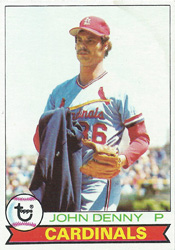
On Aug. 12, 1978, John Denny and Roy Thomas combined to pitch a one-hitter in a 5-1 Cardinals victory over the Mets at New York.

John Stearns had the lone hit, an infield single leading off the seventh inning.

Stearns would have been out on the play, but umpire Paul Pryor said first baseman Roger Freed took his foot off the bag too soon while catching a throw from second baseman Mike Tyson.

Pryor called Stearns safe and official scorer Red Foley of the New York Daily News credited Stearns with a single. If Stearns was safe because of Freed’s misstep, the play should have been scored an error, not a hit, the Cardinals argued.

Pitching and fielding

The game matched starting pitchers John Denny of the Cardinals against Kevin Kobel of the Mets. Denny was making his first appearance in two weeks after recovering from “a bad back, a bad left leg and a bad cold,” the St. Louis Post-Dispatch reported.

Kobel was a left-hander and Cardinals manager Ken Boyer decided to give his first baseman, left-handed batter Keith Hernandez, a break in the Saturday afternoon game. Backup first baseman Roger Freed started in place of Hernandez.

The Cardinals scored a run in the first and three in the second against Kobel. Denny limited the Mets to a walk in the first three innings.

In the bottom of the fourth, with one out, Denny walked Lee Mazzilli, who moved to second on a groundout by Willie Montanez. Stearns followed with a grounder to shortstop Garry Templeton, “who lobbed a throw to first,” according to the Post-Dispatch. The ball eluded Freed, Mazzilli scored from second and Templeton was charged with a two-base error.

Playing footsie

The Mets remained hitless entering the seventh against a tiring Denny. Boyer told the Post-Dispatch he planned to lift Denny after the inning, even if the no-hitter was intact. “After the fifth inning, I was losing it rapidly,” Denny said.

Stearns led off the Mets’ half of the seventh with a slow bouncer toward second. Tyson charged, grabbed the ball barehanded and, though off-balance. fired an accurate throw to Freed at first base.

As Stearns reached first, Pryor pointed toward the bag and the fielder, indicating Freed had pulled away too quickly after snaring Tyson’s toss.

“He pulled his foot off the base,” Pryor said to the Post-Dispatch. “Tyson made a hell of a play and, if he (Freed) had caught the ball with his foot on the bag, Stearns would have been out.”

Freed disagreed with the umpire and said, “He blew the play … We had him by a step and a half.”

Stearns and Mets first-base coach Denny Sommers said Pryor made the correct call.

Judgment call

As soon as Pryor declared Stearns safe, Foley scored the play a single.

Tyson disagreed, saying, “If he’s safe, then it’s got to be an error.”

Home plate umpire Ed Vargo told the Post-Dispatch, “It’s got to be an error.”

In Foley’s judgment, though, no error was made because the play was difficult and the fielders executed as best they could.

“It was a tough play for (Tyson) and he had to make a hell of a play just to make it close,” Foley said to the Post-Dispatch. “I’d like to give this guy a no-hitter, but I can’t.”

Denny got the next batter, Steve Henderson, to hit into a double play and Joel Youngblood grounded out to Templeton, ending the inning. Denny was done after yielding one unearned run, one disputed hit and three walks in seven innings.

The Cardinals scored another run in the eighth and Boyer put in Hernandez, who would win the first of 11 consecutive Gold Glove awards that year, as a defensive replacement for Freed. Thomas relieved Denny, allowed no hits and a walk in two innings, and closed out a 5-1 Cardinals victory.

Denny shrugged off any concern about missing a chance to be part of a no-hitter. “The idea is to win the game,” he said. Boxscore

Johnny Lewis, a prospect considered to have more potential than Lou Brock, overcame personal tragedy, rebounded from setbacks in his playing career and became a pioneering coach for the Cardinals.

Lewis was an outfielder with a strong throwing arm, speed and a powerful hitting stroke. He got to the major leagues with the Cardinals in 1964 and was given prominent playing time in right field the first two months of the season, but by June he was back in the minor leagues.
Traded to the Mets two months after the Cardinals won the 1964 World Series title, Lewis played three more seasons in the major leagues before returning to the Cardinals and building a second career with them as an administrator, coach, manager and instructor.

Heavy heart

Lewis was born in Greenville, Ala., and moved to Pensacola, Fla., as a toddler. At 19, he entered the Cardinals’ organization in 1959.

Advancing through the St. Louis system, Lewis played his best for manager Whitey Kurowski, a former Cardinals third baseman. Lewis played for Kurowski at Winnipeg in 1960 and at Tulsa in 1961 and 1962. In 1960, Lewis hit .299 with 23 home runs and 104 RBI for Winnipeg and he followed that with a .293 batting mark, 22 home runs and 85 RBI for Tulsa in 1961.

While in the minor leagues, Lewis got married and he and his wife, Ola Mae, began raising a family. In the winters, Lewis played baseball in the Dominican Republic and Venezuela.

Lewis, 22, was in Venezuela when his wife was killed in an automobile crash in the United States.

“My wife went to a church convention and on the way back the car she was in got into an accident and all five people in it were killed,” Lewis said to Milton Gross of the North American Newspaper Alliance. “I came back from Venezuela and there I was with two little babies, one wasn’t a year old, and I said to myself, ‘What do I do now?’

“I wasn’t going to quit baseball, get a job, stay home and take care of the babies, but my mother said she’d take care of them. She’s a good woman, my mother, and I got to keep remembering my babies are with somebody who loves them.”

Spring sensation

In 1964, Lewis, 24, reported to spring training with the Cardinals and competed with several other prospects, including Mike Shannon, for an outfield spot. Lewis played splendidly in the exhibition games, hitting .333, and was named the Cardinals’ top prospect in a poll of writers and broadcasters.

Stan Musial, who became a club executive after retiring as a player, called Lewis the Cardinals’ “best outfield prospect since Bill Virdon,” who won the National League Rookie of the Year Award in 1955.

The Sporting News described Lewis’ success as “the Cinderella epic of the spring.”

“I haven’t seen anybody like him in the last 10 years,” Cardinals manager Johnny Keane said.

Lewis “rates high in all five categories. He can run, throw, field, hit and also hit for power,” Keane said to the St. Louis Post-Dispatch.

According to Keane, the five-tool players in the National League in 1964 were Willie Mays, Hank Aaron, Frank Robinson, Vada Pinson and Roberto Clemente.

Learning curve

Lewis was shy and quiet and his teammates nicknamed him “Gabby” because he said so little, the Post-Dispatch reported.

Cardinals first baseman Bill White, who became Lewis’ mentor, said, “What we got to do is make Lewis think more aggressively, but it will take time. He knows nothing but Florida, where he’s lived, and Alabama, where he was born. Where could he have learned anything else?”

As the season neared, Keane decided to platoon Lewis and Carl Warwick in right field. Lewis, a left-handed batter, would play against right-handed pitchers and Warwick, who batted right-handed, would play against left-handers.

Though Lewis had the talent, some offered caution.

“Lewis has all the potential, but the boy has an inferiority complex,” Cardinals consultant Branch Rickey told The Sporting News. “I wish he’d believe in himself as much as all of us believe in him.”

Said third baseman Ken Boyer: “The kid should be a good player. I just hope they don’t expect him to break down the fences the first few years.”

Short stay

On April 15, 1964, Lewis got his first big-league hit, a RBI-single against Don Drysdale of the Dodgers. Boxscore Three days later, on April 18, Lewis slugged his first big-league home run, a solo shot against Bobby Bolin of the Giants. Boxscore

Lewis hit .207 in April and .278 in May. On June 10, he injured an ankle and had to leave the game. Three days later, on June 13, the Cardinals acquired outfielder Bob Skinner from the Pirates and sent Lewis to their Jacksonville farm team. Lewis hit .234 in 40 games for St. Louis, making 28 starts in right field.

On June 15, the Cardinals made another trade, getting outfielder Lou Brock from the Cubs.

“We hope Brock will fill the category of one of our regular outfielders until someone in the future, perhaps Johnny Lewis, comes along,” Cardinals general manager Bing Devine said to The Sporting News.

In an interview with the Post-Dispatch, Devine said, “I feel Lewis probably has more potential than Brock. He fields better and he throws better.”

Brock, however, took hold of the left field job and Shannon, recalled from the minors, became the right fielder. Meanwhile, Lewis floundered at Jacksonville until an X-ray on Aug. 6 revealed he had a hairline fracture of his ankle. Lewis “had been bothered by the ankle for some time,” The Sporting News reported.

In September, after Lewis returned to the lineup and helped Jacksonville win the International League title, he was called up to the Cardinals but didn’t get into a game. The Cardinals clinched the National League pennant on the last day of the season and won four of seven games against the Yankees in the World Series.

Meet the Mets

The Cardinals tried converting Lewis into a switch-hitter at the Florida Instructional League in October 1964, but the experiment failed. On Dec. 7, 1964, the Cardinals traded Lewis and pitcher Gordon Richardson to the Mets for pitcher Tracy Stallard and infielder Elio Chacon. Devine, fired by the Cardinals in August 1964, had joined the Mets as assistant to president George Weiss and advocated for Lewis.

“Playing with the Cardinals, it was a case of making good instantly or you were gone,” Lewis said. “I don’t blame them for that. They were pennant contenders and they couldn’t afford to wait, but for me it meant I always was more conscious of making mistakes. I couldn’t take chances. I was constantly tight.”

Lewis hit .245 with 15 home runs in 148 games for the 1965 Mets. On June 14, 1965, he broke up a no-hit bid by the Reds’ Jim Maloney with a home run in the 11th inning at Cincinnati. Boxscore

After the 1965 season, Lewis remarried. However, while his personal life improved, his playing career declined. He played parts of two more seasons with the Mets, batting .193 in 1966 and .118 in 1967, and finished with a year in the minors in 1968.

Second career

By 1970, Devine was back with the Cardinals as general manager and he gave Lewis a chance to return to St. Louis. Lewis was hired to be Cardinals assistant promotions and sales director and he spent two years (1970-71) in the role.

In 1972, Lewis became administrative coordinator of player development and scouting for the Cardinals.

After a year in that job, Lewis became the first African-American to serve on the Cardinals’ coaching staff. Lewis was the Cardinals’ first-base coach on manager Red Schoendienst’s staff for four seasons (1973-76).

For the next five years (1977-81), Lewis was a Cardinals’ minor-league manager at Calgary (1977-78), Gastonia (1979) and Johnson City (1980-81). Among the future major-leaguers managed by Lewis were pitchers Danny Cox and outfielders Curt Ford and Stan Javier.

From 1982-84, Lewis was a Cardinals’ minor-league hitting instructor.

In 1985, Lewis became the hitting coach for the Cardinals and was a special mentor to rookie speedster Vince Coleman. Lewis was the hitting coach on manager Whitey Herzog’s staff for five seasons (1985-89) and the Cardinals won two National League pennants in that time. Another Lewis pupil, Willie McGee, won the NL Most Valuable Player Award and the league batting title in 1985.

From 1990-98, Lewis was a Cardinals minor-league hitting instructor. He finished his career as the minor-league hitting coordinator for the Astros from 1999-2001.

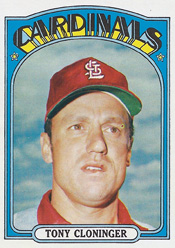
Tony Cloninger, a prominent National League starting pitcher in the 1960s, was given an opportunity by the Cardinals to extend his major-league career as a reliever in the 1970s, but it didn’t work out.

Cloninger was acquired by the Cardinals from the Reds for second baseman Julian Javier on March 24, 1972.

A right-hander, Cloninger pitched well for the Reds in 1971, posting a 3.33 ERA in 20 relief appearances and a 3.88 ERA overall, but he didn’t fit into their plans in 1972.

The Reds showcased Cloninger, 31, in a spring training start against the Cardinals on March 23, 1972, and he delivered, yielding one hit in six innings. The next day, the Cardinals, seeking relief help, made the deal for him.

Reliable starter

The trade reunited Cloninger with his friend, Cardinals third baseman Joe Torre. They were teammates with the Braves from 1961-68 and Torre was Cloninger’s catcher during the pitcher’s heyday. Torre caught more of Cloninger’s games, 141, than any other catcher.

Cloninger signed with the Braves as an amateur free agent in May 1958 and, when he made his major-league debut with them at age 20 on June 15, 1961, in a start against the Giants at Candlestick Park, Torre was his catcher. Boxscore

A month later, on July 13, 1961, at St. Louis, Cloninger faced the Cardinals for the first time and catcher Tim McCarver, 19, hit his first big-league home run against him. Boxscore

The next year, on Sept. 5, 1962, Cloninger pitched his first major-league shutout in a 1-0 Braves victory over the Cardinals at St. Louis. Bill White, with a single and double, had two of the Cardinals’ five hits against Cloninger. Boxscore

On Aug. 11, 1963, at Milwaukee, Cloninger pitched another gem against the Cardinals, striking out 11 in a four-hitter won by the Braves, 9-1. Boxscore

From 1964-66, Cloninger was a productive, durable ace for the Braves. He was 19-14 with 242.2 innings pitched in 1964, 24-11 in 279 innings in 1965 and 14-11 in 257.2 innings in 1966. Cloninger was 3-0 against the Cardinals in 1965.

Cloninger also could hit. On July 3, 1966, he produced nine RBI, with two grand slams and a run-scoring single, in a game against the Giants at Candlestick Park. He hit the first grand slam against Bob Priddy and the second against Ray Sadecki, the former Cardinal, and pitched a complete game in a 17-3 Braves victory. Boxscore

In June 1968, the Braves traded Cloninger to the Reds and, though he no longer was an ace, he contributed, earning nine wins for the pennant-winning 1970 Reds. Cloninger also started and lost Game 3 of the 1970 World Series against the Orioles. Boxscore

Taking a chance

The 1972 Cardinals looked at another former Reds starter, Jim Maloney, in spring training, but didn’t like what they saw, released him and acquired Cloninger.

“Even though I like Cloninger personally and admire his perseverance, I can’t get excited over the addition of a struggling pitching veteran who has been beset by arm, eye and back troubles,” Bob Broeg wrote in the St. Louis Post-Dispatch.

Reds manager Sparky Anderson said if the Cardinals “pitch him enough so that he can keep his control, he’ll deliver for them.”

“He still throws hard and his attitude is the best,” Anderson added.

Cardinals manager Red Schoendienst said Cloninger told him he was “ready to start, to relieve or hit fungoes” to help.

“I’ve never talked to a ballplayer yet who played for the Cardinals organization who didn’t think it was fantastic,” Cloninger said to the Dayton Journal Herald.

In his first spring training appearance for the Cardinals, Cloninger yielded two hits in five innings against the Mets and ensured himself a spot on the Opening Day pitching staff.

The Cardinals opened the 1972 season with seven relievers: right-handers Moe Drabowsky, Dennis Higgins, Al Santorini and Cloninger, and left-handers Joe Grzenda, Don Shaw and Lance Clemons.

Gopher balls

Cloninger had a good outing on May 24, 1972, against the Pirates, pitching 3.2 scoreless relief innings, but five days later he took a big step backwards.

On May 29, 1972, the Cardinals carried a 6-3 lead into the ninth inning against the Mets at St. Louis and Schoendienst called on Cloninger to be the closer. After Jerry Grote singled and Bud Harrelson walked, Ken Bowell, batting with one out, hit a three-run home run, tying the score at 6-6. Tommie Agee followed with a single before Schoendienst lifted Cloninger. Agee eventually scored from third on a passed ball by Ted Simmons, the Mets won, 7-6, and Cloninger took the loss.

The home run was the first of the season for Boswell, who entered the game batting .177. Boxscore

Cloninger unveiled a knuckleball and experienced some good outings, including a three-inning scoreless stint against the Braves on July 11, 1972, at St. Louis.

His Cardinals career, however, came to a sudden close with one bad pitch.

On July 22, 1972, against the Braves at Atlanta, Cloninger entered in the 10th inning with the score tied at 7-7. His first pitch to the first batter, Dusty Baker, was belted for a walkoff home run and an 8-7 Braves victory.

Before going to the plate, Baker told teammate Oscar Brown, “I think I’ll take a pitch and see what he’s got.” Brown replied, “No, man, go up there swinging,” and Baker did.

Denny McLain, who pitched a scoreless top of the 10th, got his first National League win and the loss went to Cloninger. Boxscore

Four days later, on July 26, the Cardinals released Cloninger, who was 0-2 with a 5.19 ERA in 17 relief appearances. On Aug. 1, Cloninger signed with the Braves, who sent him to their minor-league club at Richmond, Va., where he became a teammate of second baseman Tony La Russa.

Cloninger was 1-1 in seven appearances for Richmond, ending his playing days. He had a 113-97 record in 12 big-league seasons.

Twenty years later, in 1992, Cloninger was hired to be a coach on the staff of Yankees manager Buck Showalter. In 1996, Showalter departed and Cloninger’s old friend, Torre, became Yankees manager. Cloninger was a coach for five pennant-winning teams and four World Series championship clubs with the Yankees under Torre.

In 2002 and 2003, Cloninger was a Red Sox coach for manager Grady Little.