Initially, most thought Lou Gehrig, not Earl Averill, delivered the most damaging shot against Dizzy Dean in the 1937 All-Star Game. It wasn’t until later in the summer that the impact of Averill’s low liner off the big toe of the Cardinals ace began to be understood.
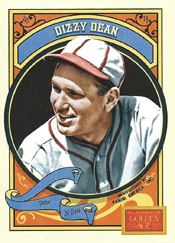 On July 7, 1937, Dean was one out away from completing his starting stint for the National League all-stars at Washington when he yielded a single to Joe DiMaggio and a home run to Gehrig.
Averill followed with a smash up the middle. The ball hit Dean’s left toe and caromed to second baseman Billy Herman, who threw to first in time for the final out of the third inning.
Dean went to the clubhouse and listened to the remainder of the game on the radio. His toe was throbbing but he didn’t bring attention to the injury when meeting with reporters.
Instead, the media focus was on the hits Dean allowed to DiMaggio and Gehrig. Dean admitted to the Associated Press he ignored catcher Gabby Hartnett’s calls for curveballs to the Yankees sluggers. Dean, looking for strikeouts, threw fastballs to them.
DiMaggio singled hard to center on a 1-and-2 count and Gehrig hit his towering home run to right on a 3-and-2 count. “Those guys were lucky stiffs,” Dean said.
Averill, looking for a fastball, got it on the first pitch and drove it right back toward Dean. Boxscore
Just a bruise
Dean returned to St. Louis and had the aching toe examined by Dr. Robert F. Hyland, the club physician. Hyland said the toe was bruised, not broken, and prescribed rest for Dean, according to the St. Louis Post-Dispatch.
Dean, who had a 12-7 record and 2.41 ERA, was scratched from his scheduled start July 11 versus the Reds.
During his recuperation, Dean clipped a newspaper photo showing his bandaged foot, autographed it, inscribed “Thanks, Earl” and mailed it to Averill.
Though Dean still was limping, Cardinals management instructed him to join the team in Boston. When he arrived, manager Frankie Frisch asked Dean whether he could pitch. Dean said he could.
On July 21, two weeks after he was injured, Dean started against the Braves in Boston. He pitched eight innings and yielded two runs, but he altered his delivery to compensate for the pain in his toe. By throwing with an unnatural motion, Dean damaged his arm.
“I was unable to pivot my left foot because my toe hurt too much,” Dean said according to the biography “Diz” by Robert Gregory. “I was pitching entirely with my arm and putting all the pressure on it. I felt a soreness … I shouldn’t have been out there.”
Said catcher Mickey Owen: “His fastball had nothing on it, nothing at all.” Boxscore
Keep going
Four days later, on July 25, Dean started against the Dodgers in Brooklyn and pitched into the 11th inning of a game halted because of darkness with the score tied at 7-7. Boxscore
“It was evident early that there was something wrong with Dizzy’s arm,” the Post-Dispatch reported. Dean “was merely lobbing the ball over the plate.”
Asked about his toe, Dean said, “I’d forgotten about the toe. My arm hurts me so bad I didn’t know I had a toe.”
The next day, Dean, grimacing in pain, went to Cardinals trainer Harrison Weaver and told him, “This toe of mine is broke.”
Still, the Cardinals started Dean on Aug. 1 at home against the Dodgers. “I couldn’t follow through with my pitches and my shoulder hurt every time I threw,” Dean said after pitching 6.1 innings.
Dean started and pitched six innings on Aug. 8 at home against the Phillies.
“Frisch never pitched him against his will,” Cardinals outfielder Terry Moore said. “He relied on Diz to tell him how he felt.”
Nothing serious
After sitting out for two weeks, Dean earned a complete-game win in a start on Aug. 22 against the Pirates at Pittsburgh.
“It took much talking by his comrades to get Dizzy through the nine innings,” the Post-Dispatch reported. “He wanted to quit after seven and complained bitterly about misery in his right arm.”
Dean contributed three hits _ two singles and a home run _ and three RBI. Boxscore
Four days later, on Aug. 26, Dean started against the Phillies at Philadelphia, gave up a double to the leadoff batter and was lifted. Frisch told him to return to St. Louis and get examined by Hyland.
Hyland diagnosed Dean with bursitis of the right shoulder and prescribed rest. “In the opinion of Dr. Hyland, the pitcher’s arm ailment is not serious,” the Post-Dispatch reported.
About two weeks later, on Sept. 8, Dean started against the Cubs at Chicago and pitched a complete game, “though he threw without his usual graceful follow through and with little of his usual burning speed,” according to the Post-Dispatch. Boxscore
“I don’t think I did bad for a fellow whose arm hurt him on every pitch,” Dean said.
Cardinals executive Branch Rickey suggested Dean sit out a full year but said the decision was up to him. Dean rejected that idea, but he was done pitching for the season. His record after the all-star break was 1-3. Without an effective ace, the 1937 Cardinals finished in fourth place, 15 games behind the champion Giants.
Just before the start of the 1938 season, on April 16, the Cardinals traded Dean to the Cubs. After posting a 134-75 record in his Cardinals career, Dean was 16-8 in four seasons with the Cubs.
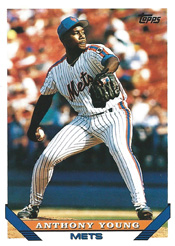 On June 27, 1993, Young was the losing pitcher for the 24th time in a row in a 5-3 Cardinals victory over the Mets at New York.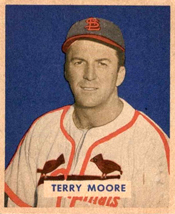
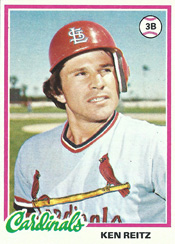 On June 28, 1977, Reitz had a career-high eight RBI against the Pirates in the second game of a Tuesday night doubleheader at St. Louis.
 Flood had a hand in turning 28 double plays in 12 seasons (1958-69) as a Cardinals center fielder. None was more impressive than the one he turned on June 19, 1967.
 From 1941-49, seven of nine National League pennants were won by either the Cardinals or Dodgers. Medwick, a power hitter and left fielder, had been a force for the Gashouse Gang Cardinals of the 1930s. After he
 RetroSimba