Feeds:
Posts
Comments

To avoid setting a major-league record for futility, Anthony Young needed to beat the Cardinals, but he couldn’t do it.
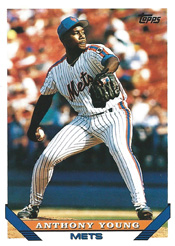
On June 27, 1993, Young was the losing pitcher for the 24th time in a row in a 5-3 Cardinals victory over the Mets at New York.

Young’s 24 consecutive losses over two seasons surpassed the big-league mark of 23 straight defeats by Cliff Curtis of the 1910-11 Braves.

Young would lose 27 decisions in a row before earning a win.

On the skids

Young was a defensive back and University of Houston football teammate of Heisman Trophy winner Andre Ware, but baseball was Young’s preferred sport and he believed it offered him his best chance for a professional career.

A right-hander, Young made his big-league debut with the 1991 Mets and finished the season at 2-5 with a 3.10 ERA.

In 1992, Young won his first two decisions, including an April 9 start against the Cardinals, before losing 14 in a row, including two to the Cardinals, and finishing with a 2-14 record and 4.17 ERA.

Young was 0-9 in 1993 _ giving him a record-tying 23 consecutive losses over two seasons _ when he entered the June 27 game against the Cardinals at Shea Stadium

Playing with fire

The Mets scored twice in the first, but the Cardinals rallied against Young with three runs in the fourth and two in the sixth. Rod Brewer contributed a two-run double for St. Louis and Brian Jordan, Tom Pagnozzi and starting pitcher Joe Magrane each had a RBI-single.

Each starter pitched seven innings: Magrane allowed 10 hits, no walks and three runs. Young yielded eight hits, two walks and five runs.

Magrane, who earned his fifth consecutive win, was relieved Young didn’t break the losing streak against him.

“I would have rather faced Doc Gooden or Bret Saberhagen,” Magrane said to the St. Louis Post-Dispatch. “I certainly didn’t want to be the answer to a trivia question. I was really scared of the game. It was like dancing on the rim of Vesuvius, waiting for it to explode. I was hoping that I wasn’t going to be the one to be torched.” Boxscore

Said Young: “It was the same old thing. I thought I pitched a pretty good game except for a couple of hits.”

Dallas Green, who was evaluating all the Mets after replacing Jeff Torborg as manager a month earlier, said Young “has a great arm … but the important things to scout are the head and the heart.”

Cardinals closer Lee Smith, expressing empathy for Young, said to the Associated Press, “I’d tell him to hang in there. I know what he’s going through. I was with the Cubs.”

Season to forget

After his loss to the Cardinals, Young lost three more in a row, stretching the streak to 27, before he earned a win on July 28 against the Marlins.

Young finished the 1993 season with a 1-16 record and a 3.77 ERA.

He spent the 1994 and 1995 seasons with the Cubs, posting an overall mark of 7-10, before completing his major-league career with a 3-3 record for the 1996 Astros.

His overall record in the majors: 15-48 with a 3.89 ERA.

Young’s career record against the Cardinals is 1-6 with a 2.86 ERA in 16 appearances, including six starts. Three of his losses during his streak of 27 were to the Cardinals.

Previously: Why 22-game loser Roger Craig appealed to Cardinals
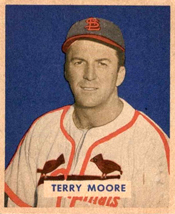
Taking advantage of a pitching staff with the worst earned run average in the National League, the 1937 Cardinals capped a doubleheader sweep of the Phillies by scoring their most runs in an extra inning.

On July 16, 1937, Terry Moore hit a three-run home run to highlight an eight-run 10th inning in an 18-10 Cardinals victory. Boxscore

No Cardinals club has scored more in an extra inning, though the 2017 team came close to matching the feat.

On June 20, 2017, Yadier Molina and Tommy Pham each hit a two-run home run to highlight a seven-run 11th in an 8-1 Cardinals victory over the Phillies. Boxscore

Hitter’s haven

The 1937 Phillies had one of the worst pitching staffs all-time. The Phillies finished the season with a 5.05 team ERA, yielding 868 total runs. Only three of their pitchers posted an ERA better than 5.00: Claude Passeau (4.34), Orville Jorgens (4.41) and Bucky Walters (4.75).

Just before the 1937 Cardinals arrived in Philadelphia, the Phillies blew a 10-4 lead at home, giving up six runs in the ninth, and losing 11-10 to the Giants in 10 innings.

The Friday afternoon doubleheader between the Cardinals and Phillies drew a Ladies Day crowd of about 9,000 in sweltering conditions.

“It was a hot, muggy day,” wrote J. Roy Stockton of the St. Louis Post-Dispatch. “It is funny to hear people in Philadelphia talk about the St. Louis heat. You can breathe in St. Louis. In Philadelphia, when it is hot, the humidity creeps up and stifles you. It was that kind of a day.”

Walters started Game 1 for the Phillies and allowed a solo home run to Moore, a two-run home run to Joe Medwick and a double to Johnny Mize before he was relieved by Jorgens after retiring one batter.

The Cardinals scored five in the first _ four of the runs charged to Walters _ and five in the fifth off Jorgens, cruising to a 10-3 victory. Si Johnson pitched a complete game and earned the win for the Cardinals. Boxscore

It’s raining runs

Moore led off Game 2 by lofting a pop fly to George Scharein, a rookie shortstop. As Scharein made the catch, his cap fell off. When he reached for it, the ball slipped out of his glove. Moore, who hustled into second base, was ruled safe by umpire Bill Stewart.

Phillies fans, who thought Scharein had held onto the ball long enough for the play to be ruled an out, “threw pop bottles from the stands in the direction of Stewart,” the Post-Dispatch reported.

Trailing 6-5, the Cardinals scored five in the eighth _ two off Wayne LaMaster and three against Walters _ for a 10-6 lead, but the Phillies responded with four off Lon Warneke in the bottom half of the inning, tying the score at 10-10.

After Walters held the Cardinals scoreless in the ninth, St. Louis manager Frankie Frisch brought in the Game 1 winner, Si Johnson, to pitch the bottom half of the inning. The Phillies didn’t score and the game went to an extra inning.

In the 10th, the Cardinals scored three off Walters and five against Jorgens for an 18-10 lead.

“Singles, doubles and home runs blossomed quicker than worms on a concrete walk after a rainstorm,” wrote Stan Baumgartner of the Philadelphia Inquirer.

When Johnson sealed the victory with a scoreless 10th, he earned his second win of the day. Walters was the losing pitcher in both games, even though he had “more stuff than he ever showed before,” Stewart, the umpire, told The Sporting News.

Previously: How Cardinals, Reds kept their heads above water

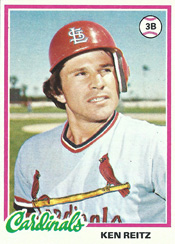
In his most productive game for the Cardinals, Ken Reitz redefined the meaning of the Mendoza Line.

On June 28, 1977, Reitz had a career-high eight RBI against the Pirates in the second game of a Tuesday night doubleheader at St. Louis.

Reitz, the Cardinals’ third baseman, generated those RBI on three hits: a single and two home runs.

The first home run was a grand slam off starter Grant Jackson.

The second was a three-run shot off Mario Mendoza.

Pace setter

An infielder, Mendoza was making his first and only big-league pitching appearance.

As a hitter, Mendoza often had a season batting average of about .200. He eventually became the symbol of the minimum expected of a big-league batter. Today, a .200 batting average commonly is referred to as the Mendoza Line.

As a pitcher, the Mendoza Line is a 13.50 earned run average. That’s what he posted after facing Reitz and the Cardinals.

Let’s play two

In the first game of the June 28 doubleheader, Reitz had a single in four at-bats and the Cardinals won, 6-1.

Cardinals manager Vern Rapp offered to let Reitz sit out the second game _ “He’d been going so hard all season and it was hot,” Rapp explained to the St. Louis Post-Dispatch _ but Reitz wanted to play because the Pirates were starting Jackson, a left-hander. Reitz hit .282 against left-handers in his big-league career and .247 versus right-handers.

Rapp put Reitz in the No. 5 spot in the batting order.

After grounding out in the first inning, Reitz got a RBI-single off Jackson in the third, extending the Cardinals’ lead to 4-2. “The first RBI was the most exciting because it helped us get rolling,” Reitz said.

In the fourth, Reitz, batting with two outs, hit a high, inside pitch off Jackson _ “It was not in the strike zone,” Reitz said _ for the grand slam, putting the Cardinals ahead, 10-2.

“I didn’t even know how many guys were on base when I hit the grand slam because I was concentrating so much at-bat,” Reitz said.

Tough job

With the score 10-3, Pirates manager Chuck Tanner lifted Jackson after six innings. Wanting to rest an overworked bullpen staff, Tanner turned to Mendoza.

“We’ve had him throw batting practice,” Tanner said to United Press International. “We had five games in three days and figured this was a good time to use him.”

Mendoza told the Pittsburgh Press, “My dad used to be a pitcher in the semipros … He said pitching is a tougher life than to be a shortstop.”

Mendoza, a right-hander, pitched a scoreless seventh, getting Keith Hernandez to line out into an inning-ending double play.

In the eighth, Reitz faced Mendoza with runners on first and second, two outs. Mendoza threw a wild pitch, advancing the runners, Roger Freed and Tony Scott, to second and third.

Reitz pulled the next pitch, a breaking ball, down the line. The ball struck the corner of the foul pole for a home run, giving the Cardinals a 13-3 lead. Boxscore

“He’s got a surprisingly good curveball,” Reitz said. “He just threw one too many to me and I happened to hit it down the line. I usually just get doubles off those pitches.”

Reitz was the first Cardinals batter with eight RBI in a game since Augie Bergamo did it in Game 2 of a doubleheader against the Giants on July 4, 1945, at New York.

Reitz would finish the 1977 season with single-season career highs in home runs (17) and RBI (79).


Returned to the lineup after recovering from a hamstring injury, Curt Flood sealed a win for the Cardinals and displayed his brilliance as a center fielder by making a rare unassisted double play.

Flood had a hand in turning 28 double plays in 12 seasons (1958-69) as a Cardinals center fielder. None was more impressive than the one he turned on June 19, 1967.

Flood achieved the first unassisted double play by a National League center fielder in 34 years. Before him, the last to do it was Danny Taylor of the Dodgers against the Cardinals on June 20, 1933.

Solid in center

From September 1965 to June 1967, Flood flawlessly handled 555 chances and had 226 successive errorless games. His streak was broken on June 4, 1967.

Two days later, Flood was out of the lineup because of the hamstring injury. He didn’t make a start from June 6 through June 12. The Cardinals started Bobby Tolan in center during Flood’s absence.

When Flood returned to the starting lineup June 13, the Cardinals were in second place, three games behind the Reds. With his glove and bat, Flood helped the Cardinals win four of five and move into first place entering the June 19 series opener against the Astros at Houston.

St. Louis took a 4-3 lead into the ninth, but Julio Gotay delivered a RBI-single off Cardinals reliever Nelson Briles with two outs, tying the score.

Back on top

The Cardinals regained the lead in the 11th. Tim McCarver singled off Barry Latman. Roger Maris followed with a double to right. When McCarver got to third, he hesitated, then dashed to the plate.

The relay from shortstop Bob Lillis to catcher Ron Brand was on the first-base side of the dish, enabling McCarver to slide across safely.

“If the throw is right in there, we get McCarver at the plate,” Astros manager Grady Hatton said to the St. Louis Post-Dispatch.

Instead, the Cardinals led, 5-4.

Game of inches

Briles, working his third inning of relief, yielded a leadoff single to Jim Landis in the Astros’ half of the 11th. Landis moved to second on Bob Aspromonte’s sacrifice bunt.

Lillis, the Astros’ eighth-place batter, stepped to the plate and hit a ball to shallow center.

Landis, like many in the Astrodome, was so sure the ball would fall for a single that he raced without hesitation toward the plate.

Unwilling to concede a hit, Flood advanced swiftly toward the ball.

“I thought Flood was doing us a favor the way he played the ball,” Hatton said. “He easily could have played the ball into a double or a triple and given us the game.”

At the last moment, Flood reached forward, caught the ball at his shoestrings and, with his momentum carrying him forward, sprinted to second and stepped on the bag for the game-ending double play. Boxscore

Good as gold

“That had to be the greatest catch I’ve ever seen in such a clutch situation,” said Cardinals shortstop Dal Maxvill.

Hatton acknowledged, “You have to give him credit for a great and daring catch.”

Said Flood: “I caught the ball right off the AstroTurf. There was only one thing between the ball and the turf _ my leather glove. I had a good jump on the drive, but I was a little afraid that it might get by me for an inside-the-park homer. It was a one-on-one play: Either I make it or I don’t.”

Eddie Bressoud, the Cardinals reserve infielder who had started his career with the Giants, said, “I’d have to put Flood right with Mays as the best I’ve seen at getting to a ball. Curt is just as sure-handed as Willie. Willie’s only edge is his throwing arm.”

The victory was the second of seven in a row for the Cardinals and helped them solidify their hold on first place. They would go on to win the 1967 NL pennant and World Series championship.

Previously: Curt Flood errorless streak ended in controversy

During the 1940s, no baseball rivalry was more intense than the one between the Dodgers and Cardinals. The player who perhaps best exemplified that fervor was Joe Medwick.

From 1941-49, seven of nine National League pennants were won by either the Cardinals or Dodgers. Medwick, a power hitter and left fielder, had been a force for the Gashouse Gang Cardinals of the 1930s. After he was traded to the Dodgers in 1940, he helped them win the pennant in 1941.
In 1942, the Dodgers appeared headed to a successful defense of their title. They were 4.5 games ahead of the second-place Cardinals entering a five-game series against St. Louis at Brooklyn’s Ebbets Field.

In the series opener, on June 18, 1942, Medwick set the tone by targeting one of the Cardinals’ most popular players, shortstop Marty Marion, for a skewering.

Medwick’s roughhouse antics sparked a melee between the teams.

Vicious slide

A pair of effective left-handers, Max Lanier of the Cardinals and Larry French of the Dodgers, were the starting pitchers in Game 1.

With the Cardinals ahead, 2-1, Medwick led off the Dodgers’ half of the sixth inning and drew a walk.

Lanier’s pitch to the next batter, Dolph Camilli, eluded catcher Walker Cooper. The ball rolled about five feet from the plate, but Cooper got to it quickly. Medwick broke for second and Cooper threw a laser to Marion, who was covering the bag.

The ball got to Marion well before Medwick reached the base. As Marion prepared to apply a tag, Medwick slid with spikes high and crashed hard into the shortstop.

Medwick “tried to carve his initials on Marion’s Adam’s apple,” said John Kieran of the New York Times.

Medwick’s spikes gashed Marion’s arm.

As Medwick attempted to rise, Marion pushed down Medwick’s spikes with his glove and said something to him.

Medwick came up swinging and motioned for Marion to fight.

Wild fury

As Medwick squared off with Marion, Cardinals second baseman Frank “Creepy” Crespi tackled Medwick from behind and knocked him to the ground.

With Medwick on his back, Cardinals players piled on top of him.

Camilli and Dixie Walker were the first Dodgers to come to Medwick’s rescue.

Camilli grabbed Crespi and put a strangehold on him.

Walker threw a flying block at Cardinals third baseman Whitey Kurowski “that would have delighted the heart of the late Knute Rockne,” The Sporting News reported.

Ump’s delight

The fighting lasted for about two minutes. Though brief, the brawl was “as exciting as has been seen in the National League this season,” the St. Louis Post-Dispatch reported.

Walker injured his ankle in the melee, limped off the field and was removed from the game.

Medwick and Crespi were ejected by umpire Babe Pinelli.

Though Pinelli later blamed Medwick for instigating the incident by sliding with spikes high, the old-school arbiter added, “I like to umpire games like that … There is too little of that in baseball today.”

When play resumed, Camilli walked and the next batter, Johnny Rizzo, was sent sprawling by a brushback pitch from Lanier.

No other incidents occurred, but the free-for-all appeared to benefit the inspired Dodgers. They rallied and beat the Cardinals, 5-2. Boxscore

Afterward, Medwick said Dodgers manager Leo Durocher had told him not to discuss the incident, according to The Brooklyn Daily Eagle.

“I can’t talk,” Medwick said. “That’s my orders … Some time, I’ll tell you my side of that rumpus at second base, but meanwhile Leo is the skipper.”

The Dodgers won four of the five games in the series, extending their lead over the Cardinals to 7.5 games. The Cardinals, however, finished strong and won the pennant with a 106-48 record. The Dodgers ended two back at 104-50.

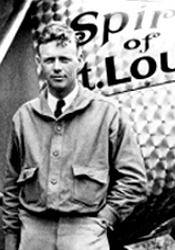
The spirit of St. Louis was on full display when Charles Lindbergh, a month after his historic flight, came to Sportsman’s Park and helped the Cardinals celebrate their first World Series title.

On June 18, 1927, Lindbergh raised the championship banner at the Cardinals’ ballpark and presented the team with World Series rings.

Lindbergh received thunderous ovations from the overflow crowd of nearly 40,000 before a Saturday afternoon game between the Giants and Cardinals. Lindbergh was making his first visit to St. Louis since piloting his single-engine airplane, The Spirit of St. Louis, from New York to Paris on the first solo non-stop transatlantic flight May 20-21, 1927.

A Detroit native, Lindbergh had been working in St. Louis as a pilot and flight instructor when he began his historic adventure. The plane, custom-built in San Diego, was named in honor of St. Louis residents who provided financial backing for Lindbergh.

Honoring Hornsby

Lindbergh’s appearance was a highlight to an emotion-packed Giants-Cardinals series.

Rogers Hornsby, who as player-manager had led the Cardinals to the 1926 National League pennant and World Series championship, was making his first appearance in St. Louis since being traded to the Giants during the winter. Hornsby, who was dealt after clashing with Cardinals owner Sam Breadon, remained highly popular in St. Louis.

The opener of the four-game series was on Wednesday afternoon, June 15, before about 15,000 spectators, the Cardinals’ largest weekday crowd of the season.

During batting practice, Hornsby was given a “great greeting” by the crowd, the St. Louis Star-Times reported. In a ceremony at home plate before the game, players from both teams gathered around Hornsby as St. Louis mayor Victor Miller presented him a watch engraved, “From the fans of St. Louis.”

The next day, Thursday, June 16, Hornsby was guest of honor of the St. Louis Exchange Club at a noon luncheon at the Chase Hotel. At the game that afternoon, Hornsby was given a floral horseshoe arrangement by civic leaders.

“Everything is going great with me,” Hornsby said to the St. Louis Post-Dispatch.

A look at Lindy

The Cardinals and Giants split the first two games of the series. No game was scheduled for Friday, June 17. The series was scheduled to resume with games on Saturday, June 18, and Sunday, Father’s Day, June 19.

With Hornsby in town, the Cardinals had arranged to raise the World Series championship banner before the Saturday, June 18, game. When it was learned Lindbergh would be in St. Louis then, he was invited to take part in the ceremony.

Lindbergh arrived at the ballpark shortly before 3 p.m. Escorted by a cordon of police, Lindbergh was greeted by Breadon and baseball commissioner Kenesaw Mountain Landis and taken to a seat near the Cardinals’ dugout.

Wearing a dark suit and gray hat, Lindbergh, who had been in constant demand since his aviation achievement, “looked haggard and worn,” according to the Star-Times. “He appeared as though all he wanted to do was to get away some place and rest.”

John Heydler, National League president, gave Lindbergh a gold pass that provided him free entrance to any NL game for life.

Lindbergh was taken onto the field. As he led a group of dignitaries to a flagpole located in center field, “uncurbed cheering threatened to shake the concrete stadium to its very foundation,” the Star-Times reported.

Winning combination

At the flagpole, Lindbergh pulled the ropes, hand over hand, that raised three flags: the American flag, the World Series championship flag and the National League pennant.

Lindbergh and the group paraded around the field and toward the plate. There, the teams gathered and Lindbergh was introduced to Hornsby.

“You’re a great fellow and you did a great thing,” Hornsby said to Lindbergh. “I congratulate you.”

Lindbergh shook the hands of each World Series champion team member as he handed out rings.

Lindbergh returned to his seat and the game began. His mother sat in the seat to his right and the mayor of St. Louis sat to his left.

When Hornsby stepped to the plate in the second inning, he received a tremendous ovation.

After the third inning, Lindbergh departed.

The Cardinals, behind the pitching of Grover Cleveland Alxander, won, 6-4. Boxscore

The next day, the Giants prevailed, splitting the series.

Previously: Bob O’Farrell went from NL MVP to Cards manager