Feeds:
Posts
Comments

As might be expected of two Hall of Fame pitchers, Jim Bunning and Bob Gibson engaged in a couple of classics when facing one another.

Bunning and Gibson were matched against each other as starters six times.

In those encounters, Bunning got 1 win, 2 losses and 3 no-decisions. Gibson got 2 wins, 2 losses and 2 no-decisions.

In the two most memorable Bunning vs. Gibson duels, Roberto Clemente and Dick Allen played key roles.

Seeking support

Bunning pitched in the major leagues for the Tigers (1955-63), Phillies (1964-67 and 1970-71), Pirates (1968-69) and Dodgers (1969). He had a 224-184 record, with 118 wins in the American League and 106 in the National League.

The right-hander’s record against the Cardinals was 5-11, but his teams were shut out in five of those losses and were held to one run in each of two others.

Bunning and Gibson faced one another on June 26, 1964, and Sept. 10, 1965, without either getting a decision.

On May 18, 1966, the Phillies beat the Cardinals, 4-3, at Philadelphia. Gibson, who allowed four runs in 6.1 innings, was the losing pitcher. Ray Culp, who pitched four scoreless innings in relief of Bunning, got the win. Bunning gave up three runs in five innings. Boxscore

Three weeks later, on June 11, 1966, Gibson pitched a shutout against the Phillies in a 2-0 Cardinals victory at Philadelphia. Bunning yielded two runs in seven innings and took the loss. Boxscore

Heated rivalry

The final two career matchups of Bunning vs. Gibson were the best.

The Pirates were in St. Louis to play the Cardinals in a doubleheader on a sweltering Sunday afternoon, July 13, 1969. Bunning, in his second season with the Pirates after being traded by the Phillies, was pitted against Gibson in Game 1.

Larry Shepard, the Pirates’ manager, pitched 10 minutes of batting practice in the 95-degree heat. In the second inning, Shepard, 50, experienced chest pains and was rushed to a hospital. Coach Bill Virdon took over as acting manager. Several fans were overcome by heat and given treatment, The Pittsburgh Press reported.

Bunning, 37, and Gibson, 33, dueled impressively in the oppressive conditions.

In the sixth inning, Gibson got his 2,000th career strikeout. It came against Roberto Clemente, the fellow future Hall of Famer, who two years earlier had hit a smash that struck Gibson and broke his leg.

Neither Bunning nor Gibson yielded a run through seven innings.

In the eighth, Matty Alou, who had reached on a bunt single, was on first with two outs. Next up was slugger Willie Stargell, who had struck out three times on outside pitches from Gibson.

“So I decided that I couldn’t do any worse looking for a fastball away,” Stargell said to the St. Louis Post-Dispatch.

Stargell slapped a single to left, advancing Alou to second.

The next batter, Clemente, slashed a Gibson delivery over the right-field wall for a three-run home run.

“Gibby gave Roberto a high pitch to hit after getting him out with low-and-away pitches,” said Pirates pitching coach Vern Law. “Gibby was bound to get tired in that heat. When a pitcher gets tired, he gets his pitches high.”

A wilting Bunning pitched a scoreless bottom half of the eighth. In the ninth, Virdon replaced him with Bob Moose, who preserved the 3-0 victory for Bunning and the Pirates. Boxscore

“I had good off-speed stuff, especially my change of pace,” Bunning said. “Everybody knows that control is the name of the game.”

Power game

The final career matchup of Bunning vs. Gibson occurred on May 23, 1970, a rainy Saturday night in Philadelphia.

Bunning had been reacquired by the Phillies in October 1969, but Dick Allen had the attention of fans and media. Allen, the slugger acquired by the Cardinals from the Phillies after the 1969 season, was playing his first games in Philadelphia since the trade. A controversial player with the Phillies, Allen had drawn a mix of boos and cheers in the first two games of the series.

Two weeks earlier, on May 11, 1970, Allen had hit a three-run home run off Bunning in the ninth inning at St. Louis, breaking a scoreless tie and giving pitcher Steve Carlton and the Cardinals a 3-0 victory. Boxscore

During a rain delay before Bunning and Gibson squared off in Philadelphia, Cardinals player Leron Lee put on Allen’s jersey and glasses, wrapped a towel over his head and ran across the field to the Phillies’ dugout to shake hands with infielder Tony Taylor.

“Don’t blame me if you get shot,” Allen told Lee.

The fans, thinking Allen was making a friendly gesture to a former teammate, cheered. Frank Lucchesi, Phillies manager, playfully pushed Lee out of the dugout, the Philadelphia Inquirer reported.

In the third inning, with Lee on second base, Allen crushed a Bunning fastball well beyond the 410-foot sign in center for a home run and a 2-0 Cardinals lead.

Two innings later, Allen hit a Bunning curve onto the roof in left for a solo home run, extending the Cardinals’ lead to 3-0.

“He hit that second one one-handed,” Bunning said admiringly.

Said Cardinals third baseman Mike Shannon: “Watching Richie hit is like watching a stick of dynamite go off.”

Gibson, meanwhile, dominated the Phillies. He struck out 16 and got the win in a 3-1 Cardinals triumph. Boxscore

“That’s the hardest I’ve thrown since 1968,” Gibson said.

Allen Lewis of the Inquirer wrote, “It was difficult to tell which balls were traveling faster _ the ones Rich Allen hit or the ones Bob Gibson threw.”

Gibson struck out 17 in Game 1 of the 1968 World Series against the Tigers. His 16 strikeouts against the Phillies were the most he achieved in a regular-season game. “I get keyed up with Richie playing here,” Gibson said. “Tonight, I had something extra and I got just about every pitch where I wanted.”
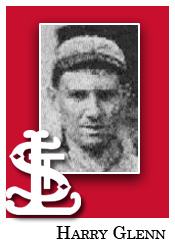
 

Harry Glenn was 28 and deep into a professional baseball career that included a stint with the Cardinals when he enlisted in the United States Army Air Forces during World War I. Soon after being assigned to the Aviation Mechanic Training School in St. Paul, Minn., Glenn contracted pneumonia and died, a month before the war ended.

Glenn is one of eight players who appeared in the major leagues and died while serving in the United States armed forces in World War I. He is the only one of the eight who played for the Cardinals.
According to the National Baseball Hall of Fame, the others, in alphabetical order, are Tom Burr, Harry Chapman, Larry Chappell, Eddie Grant, Newt Halliday, Ralph Sharman and Bun Troy.

Three Negro League players died while serving in the United States armed forces in World War I. In alphabetical order, they are Ted Kimbro, Norman Triplett and Pearl Franklyn Webster.

Career path

A native of Shelburn, Ind., near Terre Haute, Harry Glenn was 19 when he began his professional baseball career with the Vincennes (Ind.) Alices in 1910.

A left-handed batter and catcher, Glenn was 6-foot-1, 200 pounds. In 1913, the minor-league Akron Giants sold Glenn’s contract to the Cardinals, but he broke a leg soon after and sat out the season, according to the Louisville Courier-Journal.

The Cardinals sent Glenn to the St. Paul (Minn.) Apostles of the American Association in 1914 and he batted .267 in 104 games.

In 1915, Glenn made the Opening Day roster of the Cardinals as a backup to starting catcher Frank Snyder.

The 1915 Cardinals had intended to start the season with Snyder and Mike Gonzalez as their catchers after agreeing to a deal to acquire Gonzalez from the Reds, but the trade hit a snag and Gonzalez was in roster limbo while details were sorted out. That gave Glenn the opportunity to be the Cardinals’ reserve catcher.

In the lineup

On Opening Day, April 14, 1915, against the Cubs at Chicago, Snyder was hit on the right hand by a foul tip off the bat of Heinie Zimmerman and had to leave the game. Replacing Snyder, Glenn made his big-league debut and got his first hit, a single off starter Hippo Vaughn. The Cubs won, 7-2. Boxscore

With Snyder sidelined and Gonzalez still not cleared to join the Cardinals, Glenn started each of the next four games at catcher.

In his first start, April 15 against the Cubs, Glenn had a single, two walks and scored a run, helping the Cardinals to a 4-2 victory. The Cubs stole a base in their only attempt. Boxscore

The next day, April 16, the Cubs were successful in three stolen base attempts against Glenn and Cardinals pitcher Dan Griner. “The fault was evidently not wholly Glenn’s for (manager Miller) Huggins gave Griner … a calling for allowing the men too big a lead,” the St. Louis Star-Times reported. Glenn got his first RBI, but the Cubs won, 4-2. Boxscore

On April 17, the Cardinals won the finale of the four-game series, 7-4, and Glenn contributed two singles. Boxscore

Reds run wild

The Cardinals’ next game was against the Reds at Cincinnati on April 18 and Glenn again started at catcher.

The Reds won, 6-2, and had seven stolen bases against Glenn and Cardinals ace Bill Doak. Boxscore

“After watching the woeful exhibition of Harry Glenn … the Cardinals are more anxious than ever to obtain (Gonzalez),” the St. Louis Post-Dispatch declared.

The Star-Times asked: “Was it the great base running of (the Reds) or was it the poor catching of Glenn?”

While acknowledging the Reds’ rampage “looks especially bad for Glenn,” the Star-Times added, “The big fellow seems to possess all the qualifications for a good receiver and perhaps the finishing touches will come with a little more experience. His arm is as good as any, but he has not mastered the trick of getting rid of the ball with any great rapidity.”

Brief stay

Snyder returned to the Cardinals’ lineup the next day, April 19, and Glenn was relegated to the bench. The deal for Gonzalez was resolved and he made his Cardinals debut on May 6. Glenn got a pinch-hit appearance on May 12 before being demoted to St. Paul.

Glenn batted .313 (5-for-16) with three walks in six games for the 1915 Cardinals, but base runners were successful on all 11 stolen base attempts against him.

With St. Paul in 1915, Glenn batted .296 in 63 games. He also spent the next three seasons, 1916-18, with St. Paul.

Glenn could have continued playing baseball, but with World War I raging, he enlisted in the mechanical branch of aviation late in the summer of 1918, according to The Indianapolis News.

Deadly disease

In October 1918, Glenn became ill and was admitted to a hospital. A victim of an influenza pandemic, Glenn developed pneumonia.

According to the National Institutes of Health, the majority of deaths during the influenza pandemic of 1918-1919 were caused by bacterial pneumonia following influenza virus infection. The pneumonia developed when bacteria invaded the lungs on a pathway created when the virus destroyed cells that line the bronchial tubes and lungs.

Glenn was in the hospital for a week. His father, Thomas, left Indiana on a Thursday to be at his son’s bedside in Minnesota.

“A telegram was received Friday saying he was better and Saturday morning a telegram was received saying he was dead,” The Indianapolis News reported.

According to Stanford University, the influenza pandemic of 1918-1919 killed between 20 million and 40 million people worldwide. More people died of influenza in a single year than in four years of the Black Death Bubonic Plague of 1347-1351.

Glenn was survived by his parents, two sisters and a brother.

On Nov. 11, 1918, almost a month to the day Glenn died, Germany signed an armistice agreement with the Allies, ending the fighting.

Previously: Mike Gonzalez became 1st Cuban manager in majors

(Updated Sept. 21, 2024)

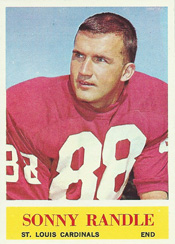
Among the most proficient teammate combinations in professional sports in St. Louis in the 1960s were Tim McCarver catching Bob Gibson with the baseball Cardinals, Lenny Wilkens passing to Bob Pettit with the NBA Hawks and Charley Johnson throwing to Sonny Randle with the NFL Cardinals.

Randle played for the St. Louis Cardinals from 1960-66 after entering the league with the 1959 Chicago Cardinals.
“When Randle came in as a rookie in 1959, all he could do was run straight _ and very fast,” Cardinals owner Bill Bidwill said to the St. Louis Post-Dispatch. “He taught himself how to become a receiver. He knew how to make moves and caught the ball well. He was tough.”

On Nov. 4, 1962, Randle had “one of the most exceptional pass-catching days” in the NFL, according to the Post-Dispatch.

Randle had 16 catches for 256 yards and a touchdown for the Cardinals against the New York Giants at Yankee Stadium.

The only NFL player at that time to have more catches in a game was Tom Fears of the Los Angeles Rams with 18 against the Green Bay Packers in 1950.

(Today, the NFL record is held by Brandon Marshall, who had 21 catches for the Denver Broncos against the Indianapolis Colts on Dec. 13, 2009.)

Randle’s 16 catches and 256 receiving yards remain the Cardinals’ single-game franchise records.

Johnson, in his fourth NFL start, completed 26 of 41 passes for 365 yards against the Giants. He broke the franchise single-game record of 320 passing yards achieved by Paul Christman of the 1947 Chicago Cardinals against the Detroit Lions. (Boomer Esiason later threw for 522 yards for the Arizona Cardinals against the Washington Redskins on Nov. 10, 1996.)

Position shift

Randle usually lined up at split end on the left side, but in his big game against the Giants he set up mostly from a flanker position on the right side, according to the Post-Dispatch. Randle was matched against Giants defensive back Dick Lynch, who the season before led the NFL in interceptions.

In the book “Giants in Their Own Words,” Lynch recalled how Randle tormented him that game: “He didn’t catch all 16 off me, but it was a rough day _ what I like to call an astigmatism day.”

Falling short

The record performances by Randle and Johnson couldn’t lift the Cardinals to victory. The Giants won, 31-28, taking advantage of five Cardinals turnovers.

With St. Louis ahead 14-10, the lead changed five times in the fourth quarter when the Giants outscored the Cardinals 21-14.

Giants quarterback Y.A. Tittle had touchdown throws of 33 yards to Frank Gifford and 20 yards to Alex Webster in the last quarter and Webster also ran three yards for a touchdown.

The Cardinals scored two touchdowns in the second quarter (an eight-yard pass from Johnson to tight end Taz Anderson and a four-yard run by John David Crow) and two more in the fourth quarter (a 55-yard pass from Johnson to Randle and a one-yard plunge by Johnson).

On their final drive, the Cardinals were nearing field goal range but Lynch intercepted a pass intended for Randle at the Giants 27-yard line. Game stats

In 97 games over eight seasons with the Chicago and St. Louis Cardinals, Randle had 60 touchdown catches among his 328 receptions. Video career highlights

Previously: How Sonny Randle helped Cardinals base runners

(Updated March 12, 2023)

Dan Driessen began the 1987 baseball season as a player without a team. By the end of that season, Driessen was playing for the Cardinals in the World Series.

Signed as an insurance policy, Driessen, like a good neighbor, was there for the Cardinals when they needed a first baseman to replace injured slugger Jack Clark in September 1987.
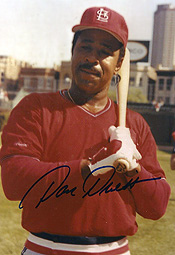
In June 1987, the Cardinals signed Driessen, 35, to a minor-league contract and assigned him to their Class AAA affiliate at Louisville.

“It’s nice to have him there in case we get a couple of guys hurt,” Lee Thomas, Cardinals director of player development, told the St. Louis Post-Dispatch. “He can still hit and play in the big leagues.”

Three months later, the Cardinals and manager Whitey Herzog were grateful to have Driessen available to help them down the stretch in their quest to hold off the Mets for the division title.

Member of Machine

Driessen, a left-handed batter, debuted in the big leagues with the 1973 Reds. He played for the Reds until 1984 and had his best seasons with them.

Able to play three positions (first base, outfield and third base), Driessen was a key role player for the 1975-76 World Series championship clubs known as the Big Red Machine. As the first National League designated hitter, Driessen batted .357 (5-for-14) in the Reds’ 1976 World Series sweep of the Yankees.

“Those were great teams,” Driessen said. “Guys like Tony (Perez), Davey (Concepcion) and Pete (Rose) loved to play the game. We had a good time when we came to the park.”

To make room for Driessen in their everyday lineup, the Reds traded Perez, their future Hall of Famer, to the Expos and named Driessen their first baseman for 1977. Driessen responded with a sensational season _ .300 batting average, 31 doubles, 91 RBI and 31 stolen bases _ for the 1977 Reds.

(In 1987, the Braves’ Gerald Perry, Driessen’s nephew, became the first 1st baseman to have 30 steals in a season since his uncle achieved the feat for the 1977 Reds.)

Seven years later, the Reds did to Driessen what they’d done to Perez: traded him to the Expos. Driessen played for the Expos (1984-85), Giants (1985-86) and Astros (1986) after leaving the Reds.

Comeback bid

In April 1987, the Astros released Driessen and it appeared his playing career was finished. He returned home to Cincinnati and worked out in local batting cages. The Reds showed interest, but made no offer. Then the Cardinals came through with their minor-league deal in June.

Driessen, with a wife and three daughters, opted to continue residing at home in Cincinnati. He would commute from Cincinnati to Louisville and back for home games. “It’s about 100 miles (one way),” Driessen told a Society for American Baseball Research biographer. “I’d make it in close to an hour and a half.”

In an interview with Dan O’Neill of the Post-Dispatch, Driessen said of his return to the minor leagues, “It’s tough, but that was the only way back. The only reason I did it was that I thought I had a little baseball left in me.”

Driessen batted .244 with 35 RBI in 58 games for Louisville _ unexceptional numbers _ but the Cardinals purchased his contract on Aug. 31, 1987, because by being on their roster before Sept. 1 he was eligible for the postseason.

Fitting in

Initially, Driessen was slotted for a pinch-hitting role. The Cardinals entered September 5.5 games ahead of the second-place Mets.

On Sept. 9, Clark, the Cardinals’ top run producer, injured his right ankle when he tried to avoid a tag by Expos first baseman Andres Galarraga. Clark’s spikes got stuck in the artificial turf at Montreal and his ankle rolled over.

“Jack has a history of not healing too quickly,” Cardinals manager Whitey Herzog said.

With Clark unable to play, Herzog’s options at first base were Driessen, Mike Laga and Jim Lindeman. Driessen had the most experience.

In his first 19-at bats for the Cardinals, Driessen had two hits, then five hits in the next two games.

Cardinals players accepted Driessen and helped him acclimate to a new team and new role. Catcher Tony Pena referred to him as “Papa.”

Cardinals second baseman Tommy Herr said, “He’s played well at first base. He’s real loose. When you’re in tough games, you like to have a guy who is composed.”

Said Driessen: “These guys are alive in this clubhouse.”

On Sept. 26, with the Cardinals 2.5 games ahead of the Mets, Driessen drilled a two-run home run off Rick Sutcliffe and sparked St. Louis to a key 5-3 victory over the Cubs. Boxscore

Five days later, Driessen had three RBI in the Cardinals’ division title clincher against the Expos. Boxscore

“Danny is a very good person and a good guy to have on the ballclub,” Herzog said. “I think he can still play, especially in a platoon situation (against right-handers).”

Big stage

Driessen batted .233 with 11 RBI in 24 games for the 1987 Cardinals.

With Clark still sidelined, Driessen was assured of getting prominent playing time in the postseason.

(Cardinals shortstop Ozzie Smith told Larry Harnly of The State Journal-Register of Springfield, Ill., that Clark should have attempted to play as a designated hitter in the World Series. “As a player, you have to grit it up,” Smith said. Smith also told Thomas Boswell of the Washington Post, “A lot of our players soured on Jack Clark when he didn’t try to come back … He should have taken a (painkilling) shot … Everybody would have at least known that he had tried.”)

In the seven-game National League Championship Series against the Giants, Driessen batted .250 (3-for-12) with two doubles and a RBI.

He batted .231 (3-for-13) _ again, with two doubles and a RBI _ in the World Series versus the Twins.

Afterward, the Cardinals released Driessen. He sat out the 1988 season and played one more year, 1989, with Yucatan of the Mexican League.

Previously: Why Jack Clark got chance to put Cards in World Series

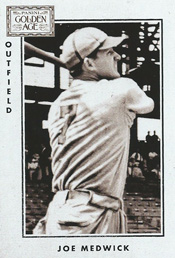
Joe Medwick was at home in suburban St. Louis on a Sunday morning when he got an unexpected phone call from Sam Breadon, Cardinals owner. Breadon wanted to know whether Medwick would be interested in playing again for the Cardinals.

When he recovered from his surprise, Medwick said yes.
Breadon told Medwick to get to Sportsman’s Park right away. The Cardinals wanted him available to play that afternoon.

On May 25, 1947, Medwick, who thought he was finished as a big-league player, rejoined the Cardinals, providing them with a much-needed run producer and giving him a chance to bring his career full circle.

Seven years earlier, the Cardinals had traded the moody slugger to the Dodgers.

Squire of Sappington

Medwick hit better than .300 in each of his first nine seasons (1932-40) with the Cardinals. Nicknamed “Ducky” because of how he swayed when he walked, Medwick also was known as “Muscles” because of his powerful and consistent hitting.

As the left fielder for the 1934 Gashouse Gang Cardinals, Medwick batted .319 with 40 doubles, 18 triples, 18 home runs and 106 RBI. He hit .379 (11-for-29) in the 1934 World Series, helping the Cardinals win four of seven against the Tigers.

Three years later, Medwick was named winner of the 1937 National League Most Valuable Player Award. Known for taking savage swings with a 35-ounce hickory bat, Medwick achieved baseball’s Triple Crown by leading the league that season in batting average (.374), home runs (31) and RBI (154). He remains the last NL player to earn a Triple Crown.

Medwick was traded to the Dodgers in June 1940 and played for them until July 1943. Over the next three years, Medwick was with the Giants and Braves and had a return stint with the Dodgers.

In December 1946, Medwick, released by the Dodgers, signed with the Yankees. He opened the 1947 season with the Yankees, but never appeared in a game for them. On April 29, when the Yankees arrived in St. Louis for a series with the Browns, they gave Medwick his release.

When no other team showed interest, Medwick went to his home in Sappington, Mo. “Medwick says he’s through with baseball,” the St. Louis Post-Dispatch reported.

Ready or not

After winning the 1946 World Series championship, the Cardinals had a poor start to the 1947 season. On the morning of Sunday, May 25, they were in last place at 11-19. Left-handed pitchers were being especially tough on Cardinals batters. Eddie Dyer, Cardinals manager, suggested to Breadon that Medwick would provide a reliable right-handed bat.

The Cardinals were scheduled to play a doubleheader at Sportsman’s Park that Sunday afternoon. Breadon phoned Medwick that morning and made his offer.

“It was mounting concern over Cardinals futility against left-handed pitching … that prompted Sam Breadon to summon Medwick from his country life of leisure and daily 18 holes of golf,” the St. Louis Star-Times reported.

Medwick, 35, rushed to the ballpark, met with Breadon and signed a contract. In the clubhouse, he was issued uniform No. 21 instead of the No. 7 he had worn during most of his first stint with the Cardinals.

“We needed somebody who can get us a fly ball or a hit once in a while in the pinch,” Dyer said.

Arriving too late to take batting practice, Medwick watched from the dugout as the Cardinals won the opener, 10-5.

In the second game, the Pirates started Fritz Ostermueller, 39, a left-hander, against Jim Hearn of the Cardinals.

In the fifth inning, with the Pirates ahead, 2-0, the Cardinals had a runner, Del Rice, on first base with Hearn due to bat. Dyer decided to send up a pinch-hitter for the pitcher.

Welcome back

“A husky Redbird, bearing the numeral 21 on his back, waddled to the plate, swinging a couple of bats,” The Sporting News reported. “The number was not listed on the scorecard, but to many in the crowd the newcomer’s distinctive gait stirred memories. Then, the announcement, ‘Medwick batting for Hearn,’ brought a tremendous cheer from the throng.”

Medwick, who hadn’t had a bat in his hand since he was cut by the Yankees four weeks earlier, dug into the batter’s box and awaited a pitch to his liking.

With a familiar snap of his wrists, Medwick swung at an Ostermueller offering and drilled it off the right-field wall for a run-scoring double, missing a home run by a foot.

“Spectator reaction was close to hysteria” as Medwick, replaced by pinch-runner Jeff Cross, “trotted head down to the dugout,” wrote the Post-Dispatch.

After the inning, Ostermueller walked by Dyer and said, “That’s the last run you’ll get off me today.”

Good to his word, Ostermueller pitched a three-hitter and the Pirates won, 2-1. Boxscore

Older and wiser

Still, the Cardinals had found the hitter they needed.

Utilized as a pinch-hitter and part-time outfielder, Medwick batted .307 in 75 games for the 1947 Cardinals. His on-base percentage was .373.

“There was a time when I went up to bat that I didn’t give a whoop in Glocamorra who was pitching,” Medwick said to The Sporting News. “Half the time, I didn’t bother to learn who was out there on the mound and I didn’t care what they were throwing. A fellow can’t be young forever, but he can be smart. I study ’em now, watch what they are throwing me and where they are throwing it.”

The Cardinals surged after June 1 and finished in second place at 89-65, five games behind the Dodgers.

Medwick “was credited with contributing considerably to the dash that brought the Birds from last place into a pennant contender,” The Sporting News wrote.

Medwick returned to the Cardinals in 1948, but the skills had eroded. He batted .211 in 20 games, all as a pinch-hitter, and made his last Cardinals appearance of a Hall of Fame career on July 25.

Medwick remains the Cardinals’ all-time single-season leader in doubles (64) and RBI (154).

Previously: How Joe Medwick got traded by Cardinals to Dodgers

Looking to improve their offense, the St. Louis baseball Cardinals sought the help of a wide receiver who excelled at scoring with the St. Louis football Cardinals.

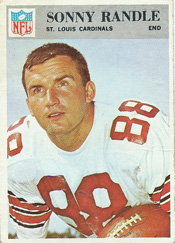
In 1961, the baseball Cardinals hired Sonny Randle to come to spring training and instruct major-league and minor-league players on how to run the bases better, with a special focus on teaching them to generate more speed from a standing start.

Four years later, in 1965, Randle was invited to come back and help the baseball Cardinals again.

Innovative idea

The 1960 Cardinals were sixth in the National League in runs scored, in part, because their base runners too often failed to take an extra base, or were unable to score on a hit.

The football Cardinals had moved from Chicago to St. Louis for the 1960 season and one of their top players was Randle. At the University of Virginia, Randle was a sprinter on the track team _ he ran the 100-yard dash in 9.6 seconds _ and was a wide receiver and kickoff returner on the football team.

Drafted by the football Cardinals, Randle debuted with them in 1959 and had a breakout season in 1960, with 62 catches, including 15 for touchdowns, in 12 games. His 15 touchdown receptions remain the single-season Cardinals franchise record.

Randle and Cardinals baseball general manager Bing Devine were at a banquet in 1960 and got into a conversation about how a wide receiver, or split end as Randle’s position was known, was able to generate speed. Devine got the idea to have Randle become a running instructor for the baseball club in spring training, according to St. Louis Post-Dispatch sports editor Bob Broeg.

After receiving permission from the football Cardinals, Devine arranged for Randle, 25, to join the coaching staff of the baseball Cardinals for an early training camp at Homestead, Fla.

New game

The early training camp, which started Feb. 12, 1961, had 24 players from the 40-man winter roster, including Curt Flood, Julian Javier, Tim McCarver and Bill White. Manager Solly Hemus was there, along with coaches Johnny Keane, Howie Pollet, Harry Walker and Darrell Johnson.

Randle, given the title of special running instructor, admitted he was unfamiliar with baseball. He hadn’t played the game since the seventh grade, when he got hit in the head by a pitch and “just laid down the bat and walked over to the track,” according to Broeg.

When Randle arrived at Homestead, Cardinals equipment manager Butch Yatkemen “had to show me how to put on a uniform,” Randle said.

The Feb. 16, 1961, edition of the Post-Dispatch had a photo showing Randle giving a tip to McCarver on how to get a fast start when running from a base.

“He really grows on you,” said Hemus. “The players were a lot more inclined to listen to an active football sprinter than to a veteran track coach, no matter how much more the old coach might know.”

When the early training ended and the 1961 Cardinals opened big-league camp on Feb. 28 at St. Petersburg, Fla., Randle was with them.

Earning his keep

Hemus, a month shy of his 38th birthday, challenged Randle to a 60-yard sprint across the outfield grass. Though Hemus was given a 25-yard head start, Randle won. “I know I never was fast, but you made me look like a sewing machine, running up and down in the same spot,” Hemus told Randle.

After the Cardinals played their 1961 exhibition opener against the Yankees on March 11, Randle went back to Homestead to instruct the minor-league players for two weeks.

“Sonny Randle impressed the baseball Cardinals … The feeling is the running technique of several players has been improved, notably (outfielder) Joe Cunningham and (catcher) Hal Smith,” Broeg reported.

Randle said he noticed many Cardinals didn’t use their upper bodies and arms properly when breaking away from a base.

“You’ve got to explode from a standing start and you don’t do it with arms hanging loosely at your side,” Randle said. “You’ve got to use the arms as well as the legs. You can’t run your best with the torso straight up like a prim old lady seated in a car with her nose pointed to the sky. You’ve got to lean forward _ explode.”

Asked by Broeg to compare Cardinals baseball and football training camps, Randle said, “I don’t think baseball players work nearly as hard or as long … They stand around more, too.”

After his stint with the baseball Cardinals, Randle returned to St. Louis to help coach track at John Burroughs School and prepare for the 1961 NFL season.

In the baseball Cardinals’ 1961 season opener against Warren Spahn and the Braves, Smith tripled for the first time in two years and credited Randle’s running tips with enabling him to reach third base on the hit. Boxscore

Return engagement

After the baseball Cardinals won the 1964 World Series championship, Randle was asked to be an instructor again during 1965 spring training.

New York Times columnist Arthur Daley visited Randle there and wrote, “He is an expert on quick starts and instant acceleration … His assignment is teaching Redbirds base runners how to get that extra little jump on the base paths.”

Said Randle: “The basic principles are identical for both sports _ the leg action and the arm action generate the same acceleration _ but where I drive straight ahead in football, base runners are facing sideways before they take off. Once they wheel around, though, they pick up speed the same way I do.”

Randle timed the Cardinals in 40-yard dashes. Lou Brock was the fastest at 4.3 seconds.

Years later, in his book “Stranger to the Game,” Cardinals pitcher Bob Gibson questioned why the club used Randle as a base running instructor “instead of asking Brock, who was already with the team and was the man who revolutionized baseball with his base running.”

In 97 games over eight seasons with the football Cardinals, Randle had 60 touchdown catches among his 328 receptions.

Previously: From Bill White to Isaac Bruce: September specials