Feeds:
Posts
Comments

A skilled administrator unafraid to make bold trades involving prominent players, Cardinals general manager Bob Howsam also was unpopular with many on the club and was second-guessed by bosses who restricted his authority and threatened his job security.

howsam_gibsonJumping at an offer for a higher salary, a multi-year contract and the opportunity to be fully in charge of baseball operations, Howsam left the Cardinals on Jan. 22, 1967, and joined the Reds as executive vice president and general manager.

The club Howsam left behind won the 1967 National League pennant and World Series title. Two players acquired by Howsam, first baseman Orlando Cepeda and right fielder Roger Maris, were important contributors to that Cardinals championship squad.

With Cincinnati, Howsam enjoyed his greatest success, building the Big Red Machine teams that won four pennants (1970, 1972, 1975 and 1976) and two World Series crowns (1975 and 1976).

Not welcome

A minor-league executive in Denver, Howsam replaced ousted Cardinals general manager Bing Devine in August 1964. Branch Rickey, a Cardinals consultant and former general manager, had recommended Howsam to club owner Gussie Busch.

Devine, who had acquired for the Cardinals key players such as outfielders Lou Brock and Curt Flood and infielders Bill White, Julian Javier and Dick Groat, was well-liked by club employees and media. After Devine departed, the Cardinals won 31 of 45 regular-season games, clinched the pennant and defeated the Yankees in the World Series.

Cardinals manager Johnny Keane and most players were upset Howsam, not Devine, was the general manager celebrating the championship. Howsam contributed only “three cheers” to the title run and his relationship with Keane was so sour their conversations consisted of two kinds: “little and none,” sports editor Bob Broeg of the St. Louis Post-Dispatch reported.

Howsam angered many when he attempted to take some credit for the 1964 success. According to the Post-Dispatch, Howsam said, “My personal feeling is Devine’s firing led us to the pennant and world championship. It fired up everybody _ the manager, the players and the entire Cardinals staff. They got to thinking about contracts for the next season and they simply produced.”

St. Louis shakeup

In 1965, Howsam’s first full season as general manager, the Cardinals finished in seventh place at 80-81. After the season, Howsam created an uproar when he traded three-fourths of the Cardinals’ infield: White, Groat and Ken Boyer. Most of the players St. Louis received in return were busts.

“He had nerve, if not judgment,” Broeg wrote.

Howsam worsened matters when he tried to defend the trade of White by claiming the first baseman was older than he was. In my 2011 interview with White, he said Howsam’s remarks upset him and he challenged the general manager.

The Post-Dispatch reported White “denounced Howsam and said he no longer could have any respect for him.”

Cardinals vice president Stan Musial had been “brought late into trade talks,” and “said he felt badly about the Bill White deal because he felt that he and others had been misled by Howsam’s approach to the deal,” the Post-Dispatch reported.

Hot seat

Howsam created ill will with players who “resented efforts to trim salaries in times of plenty,” Broeg reported, and were upset to receive notes from Howsam “telling them how to dress on the field, for instance, and how to sit in the bullpen.”

Howsam was successful in helping the Cardinals open a stadium in 1966 and with developing promotions to attract women and children to games.

However, when the Cardinals floundered early in the 1966 season _ they lost 14 of their first 22 games _ Howsam was “close to being fired,” Broeg reported.

What saved him was the trade he made on May 8, 1966, when the Cardinals got Cepeda from the Giants for pitcher Ray Sadecki. With Cepeda providing run production, the Cardinals improved, finishing with an 83-79 record, though in sixth place.

Ties that bind

Busch and the Cardinals’ hierarchy, including executive vice president Dick Meyer, lost confidence in Howsam and blocked two major trades he tried to make.

Before trading for Cepeda, Howsam tried to deal pitchers Steve Carlton and Nelson Briles, outfielder Mike Shannon and infielder Phil Gagliano to the Reds for shortstop Leo Cardenas, first baseman Gordy Coleman and pitcher Joey Jay, but the Cardinals’ “high command” vetoed the trade, The Sporting News reported.

After the 1966 season, Howsam wanted to trade Carlton, Briles and outfielders Bobby Tolan and Alex Johnson to the Cubs for outfielder Billy Williams, but again was stopped. “The price in promising young talent was too high, ownership concluded,” Broeg wrote.

The consolation prize was Maris, whom Howsam acquired from the Yankees for third baseman Charlie Smith.

Reds to rescue

For its Jan. 1, 1967, edition, the Post-Dispatch asked Howsam to respond to a story that listed him as the top candidate to become Reds general manager. “It’s news to me,” Howsam replied, adding he’d had no contact with the Reds.

Bill DeWitt Sr., a St. Louisan, had been owner of the Reds until selling the club to a syndicate led by Cincinnati Enquirer publisher Francis Dale in December 1966. DeWitt Sr. suggested the new owners pursue Howsam, calling him “one of the 10 best baseball men around.”

The Reds contacted Busch, who gave permission for them to approach Howsam. On Jan. 11, 1967, Howsam was interviewed by a Reds committee.

Soon after, the Reds offered Howsam a three-year contract at $50,000 per year. Howsam, working without a contract and receiving a $35,000 Cardinals salary, gave Busch a chance to match the offer, but he was uninterested.

“I wish him the best of luck except when his team plays ours,” Busch said.

A day after Howsam was hired by the Reds, Musial was named general manager of the Cardinals.
(Updated July 29, 2018)

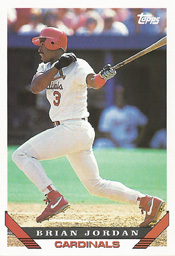
Brian Jordan produced his most important hit for the Cardinals against one of the all-time best relief pitchers.

brian_jordanFacing Trevor Hoffman in the ninth inning of Game 3 of the 1996 National League Division Series, Jordan hit a two-run home run, breaking a 5-5 tie and lifting the Cardinals to their first postseason series championship in nine years.
With 42 saves and nine wins, Hoffman had factored in 55 percent of the 92 regular-season victories achieved by the 1996 Padres.

In 2018, Hoffman was elected to the National Baseball Hall of Fame. His 601 saves rank second all-time behind the 652 by Mariano Rivera of the Yankees.

In a career filled with successes, one of Hoffman’s most glaring stumbles was in his first postseason against the Cardinals.

Key catch

After winning the first two games at St. Louis, the Cardinals were in position to clinch the best-of-five NL Division Series with a victory against the Padres at San Diego on Oct. 5, 1996.

The Padres led 4-1 after five innings, but the Cardinals rallied for three runs in the sixth and one in the seventh, taking a 5-4 lead.

In the eighth, Ken Caminiti hit a home run against Cardinals reliever Rick Honeycutt, tying the score. The Padres had a runner on second with two outs when Jody Reed hit a line drive to right-center. Jordan, the right fielder, dived and made an inning-ending catch. Video

“I think that was the most important play of the ballgame,” Jordan told the St. Louis Post-Dispatch. “If that ball gets by me, they’re going to score.”

Bruce Bochy, the Padres’ manager, brought in Hoffman to pitch the ninth. Hoffman got Ozzie Smith to line out to left before Ron Gant drew a walk. “I was high in the zone to Gant,” Hoffman told the San Diego Union-Tribune. “That wasn’t necessarily where I wanted to be.”

Up next was Jordan.

Delivering a dagger

Jordan led the 1996 Cardinals in RBI, with 104. He hit .367 with runners on base.

As a result of his diving catch the previous inning, Jordan’s neck and left shoulder stiffened when he got back to the dugout, but a quick massage from trainer Gene Gieselmann got Jordan ready to face Hoffman.

After working the count to 3-and-2, Jordan lined a pitch foul down the left-field line.

Jordan expected the next delivery to be a fastball, but Hoffman threw a slider.

Hoffman: “I hung it right over the middle.”

Jordan: “He threw me a slider up and I kept my hands back.”

Hoffman: “It wasn’t a high hanger. Brian had to go down and get it.”

Jordan: “If I miss that, I’m throwing my hat and my helmet down.”

Timing it right, Jordan swung and lofted the ball over the left-field wall. Boxscore

TV broadcaster Bob Costas described the home run as “a dagger through the heart” of the Padres. Video

Bernie Miklasz, Post-Dispatch columnist, rated Jordan’s jolt “the biggest St. Louis home run” since Jack Clark’s pennant-clinching shot against the Dodgers in the ninth inning of Game 6 of the 1985 NL Championship Series.

“I’ve always wanted to play in pressure situations,” Jordan said. “… To see that ball come down, over the fence, it was satisfying.”

Said Hoffman: “On 3-and-2, he’s looking to drive the ball and I gave him a pitch to do it … It was the right pitch in that situation. Unfortunately, the execution wasn’t quite there and I got bit in the butt.”

Previously: Cardinals dealt Trevor Hoffman first defeat

Previously: How Tony Gwynn tormented Dennis Eckersley

Previously: Why Jack Clark got chance to put Cards in World Series

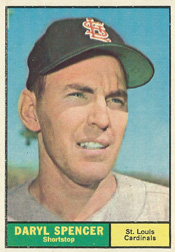
As a youth in Kansas, Daryl Spencer was a Cardinals fan. His favorite player was Marty Marion, the shortstop on four pennant-winning 1940s Cardinals teams.

daryl_spencerSpencer followed in the footsteps of his boyhood idol, becoming Cardinals shortstop in 1960. Unlike Marion, Spencer was a power hitter.
Though his tenure with the Cardinals was short _ he played all of the 1960 season and part of 1961 _ Spencer was a prominent member of a lineup that also had Stan Musial, Ken Boyer, Curt Flood and Bill White.

Joining Giants

Spencer hailed from Wichita, Kan. “I was a Cardinals fan growing up and we’d listen to them on the radio,” Spencer told the Society for American Baseball Research. “… My dad went to the World Series there in 1942 and had brought back some memorabilia for me that I really treasured.”

Inspired by Marion, who in 1944 became the first shortstop to win a National League Most Valuable Player Award, Spencer pursued a baseball career.

The Cardinals scouted Spencer, but it was the Giants who signed him after he’d had a successful season for the Pauls Valley Raiders, an independent team in the Class D Sooner State League in 1949.

Spencer made his big-league debut with the Giants in 1952 and hit 20 home runs for them in 1953. After two years (1954-55) in the military, Spencer was the Giants’ shortstop from 1956-58. He produced 17 home runs and 74 RBI for the 1958 Giants, but also committed the most errors (32) among NL shortstops.

In 1959, Spencer got shifted to second base, though he preferred shortstop.

Ready to deal

The 1959 Cardinals finished next-to-last in the NL at 71-83. They ranked seventh in runs scored (641) and sixth in home runs (118).

Determined to add power _ Boyer was the only 1959 Cardinals player to hit 20 home runs _ general manager Bing Devine offered second baseman Don Blasingame and pitcher Larry Jackson to the Giants for Spencer and pitcher Johnny Antonelli, according to multiple published reports.

Loaded with power hitters (Willie Mays, Orlando Cepeda, Willie McCovey and Willie Kirkland), the Giants were seeking defense and speed. Blasingame, who led the 1959 Cardinals in hits (178) and had 15 stolen bases, appealed to the Giants, but they were unwilling to trade Antonelli, who’d earned 19 wins in 1959.

Just when it appeared an agreement wouldn’t be reached _ “The deal somehow always moved away from us,” Giants owner Horace Stoneham said to The Sporting News _ Devine made a proposal that excluded Antonelli.

On Dec. 15, 1959, the Giants traded Spencer and outfielder Leon Wagner to the Cardinals for Blasingame.

Power source

“Blasingame will help the Giants at second base defensively and give them a leadoff man,” Cardinals manager Solly Hemus said to the St. Louis Post-Dispatch. “Spencer, bigger and stronger, will give us more punch.”

Hemus said he consulted with Musial and Boyer before the Cardinals made the trade. “They liked it,” Hemus said. “They felt we definitely were getting a plus. I respect their judgment.”

Hemus said Spencer would be the Cardinals’ starting shortstop in 1960 and Alex Grammas would shift from shortstop to second base.

Though Spencer, 31, was their primary target _ “Spencer is an aggressive guy whose desire to win won’t hurt,” Hemus said _ they were delighted to get Wagner.

Wagner, 25, hit 51 home runs for the minor-league Danville (Va.) Leafs in 1956 and combined for 30 home runs with Class AAA Phoenix (17) and the Giants (13) in 1958.

The Cardinals had attempted to acquire Wagner after the 1958 season, but he “was an untouchable,” Hemus told The Sporting News.

“We tried to get him instead of Bill White (whom the Cardinals acquired in March 1959 from the Giants),” Hemus said.

Key contributor

Spencer hit 16 home runs for the 1960 Cardinals. His on-base percentage (.365) ranked among the top 10 in the NL. He produced 131 hits and a team-high 81 walks in 148 games, but he also grounded into the most double plays (15) and committed 32 errors (31 at shortstop and one at second base).

The 1960 Cardinals finished in third place at 86-68, seven games ahead of the fifth-place Giants. The Cardinals _ even without much contribution from Wagner (four home runs) _ ranked third in the league in home runs (138), but scored two fewer runs (639) than they had in 1959.

Moving on

The next year, Spencer had a spectacular start to the season. In the Cardinals’ 1961 opener against the Braves at Milwaukee, Spencer hit a 10th-inning home run off starter Warren Spahn, carrying St. Louis to a 2-1 victory. Boxscore

The Cardinals, however, stumbled thereafter and looked to rebuild.

On May 30, 1961, with their record at 18-20, the Cardinals dealt Spencer to the Dodgers for infielder Bob Lillis and outfielder Carl Warwick.

Spencer generated 33 hits and 23 walks (a .366 on-base percentage) for the 1961 Cardinals, but his batting average with runners in scoring position was .214.

In 185 games with St. Louis, Spencer batted .257 with 20 home runs and 79 RBI. He had 164 hits, 104 walks and a .365 on-base percentage.

“I had a lot of friends on the Cardinals and I liked St. Louis, but L.A. is a good club to go to,” Spencer told the Post-Dispatch.

After stints with the Dodgers and Reds, Spencer continued his playing career in Japan. In seven seasons with the Hankyu Braves, Spencer batted .275 with 152 home runs and a .379 on-base percentage.

(Updated July 30, 2017)

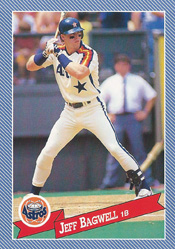
In a career filled with consistent hitting versus the Cardinals, Jeff Bagwell reached a personal pinnacle when he hit for the cycle against them.

jeff_bagwellBagwell, a first baseman, produced 449 home runs and 1,529 RBI in 15 years (1991-2005) with the Astros.
He was elected to the National Baseball Hall of Fame in balloting by the Baseball Writers Association of America on Jan. 18, 2017, and inducted on July 30, 2017.

Championship contenders

Many of Bagwell’s most meaningful games came against the Cardinals, who developed into the Astros’ most intense division rival.

In nine of the last 10 seasons of Bagwell’s career, 1996-2005, either the Astros or Cardinals finished in first place in the National League Central Division. In 2001, the Cardinals and Astros tied for first with 93-69 records. In 2004 and 2005, when the Cardinals won division titles, the Astros qualified for the postseason as a wild card and faced St. Louis in the NL Championship Series. The Cardinals prevailed in 2004; Houston won in 2005.

Bagwell, a right-handed batter, had more regular-season career hits (223) versus the Cardinals than he did against any other foe.

In 192 regular-season games facing St. Louis, Bagwell hit .319, with 38 home runs, 139 RBI and a .422 on-base percentage.

In 2000, when the Cardinals were division champions, Bagwell hit .463 (19-for-41) against them, with seven home runs and 18 RBI in 11 games.

His best single-game performance versus the Cardinals came the next year.

Liftoff in Houston

The Cardinals had won four in a row, holding opponents to three runs or fewer, heading into a series opener against the Astros on July 18, 2001, at Houston.

In the first inning, Bagwell hit a run-scoring single off starter Mike Matthews. He flied out to center in the third.

The Cardinals scored six times in the fifth and led, 8-6.

Sparked by Bagwell, the Astros rallied for eight runs in the bottom half of the inning.

Bagwell led off the fifth with a double against Luther Hackman. After the Astros scored five times, Bagwell capped the inning with a three-run home run off Gene Stechschulte.

Coming through

That meant Bagwell needed a triple to complete the cycle for the only time in his big-league career. He’d tripled just once (at Chicago) at that point in the season.

In the seventh, with Craig Biggio on third base and one out, Bagwell faced Andy Benes. “My only concern was getting that run home (from third),” Bagwell told the Houston Chronicle.

Bagwell lined a deep shot to right-center field.

“That’s probably the only place you can hit a triple in this park, for a right-hander,” Biggio said.

Bagwell rounded second _ “I was kind of laboring. I wasn’t going very fast,” he said _ and beat the throw to third.

“It worked out where I got a triple and got the cycle,” said Bagwell, “but a base hit up the middle would have been nice, too.” Boxscore

Bagwell became the fourth Houston player _ and the first since Andujar Cedeno on Aug. 25, 1992, versus the Cardinals Boxscore _ to hit for the cycle. The other Astros to do so were Cesar Cedeno and Bob Watson.

“I’m jealous,” Astros outfielder Moises Alou said to the Associated Press. “I’ve never even hit for the cycle when I played softball.’

Bagwell, who drew a walk while facing Dave Veres in the eighth, finished the game 4-for-5 with five RBI and four runs scored.

“It’s cool,” Bagwell said, “but it’s not something I put much stock in.”

Previously: Could Craig Biggio have made Hall of Fame as Cardinal?

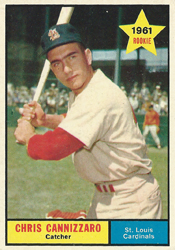
In 1960, the Cardinals had two prized prospects, Chris Cannizzaro and Tim McCarver, competing to become heir apparent to Hal Smith as starting catcher.

chris_cannizaroMcCarver got to the big leagues first _ for eight September games with St. Louis in 1959 _ but Cannizzaro gained an edge when he earned a spot on the Cardinals’ 1960 Opening Day roster and McCarver was sent to the minor leagues.
Though Cannizzaro was a strong thrower, he couldn’t hit as well as McCarver. By the end of the 1961 season, the Cardinals had made their decision: McCarver would stay and Cannizzaro would go.

McCarver became the Cardinals’ everyday catcher in 1963 and developed into a standout who played a key role in helping St. Louis win three National League pennants and two World Series titles in the 1960s.

Cannizzaro built a 13-year career in the big leagues and was best known as being a catcher for two NL expansion teams: 1962 Mets and 1969 Padres.

Good impression

Cannizzaro, son of a police officer, was a top athlete in San Leandro, Calif., near Oakland, and played youth baseball against future Cardinals teammates Curt Flood and Ernie Broglio.

Cannizzaro received baseball scholarship offers from schools such as Stanford and Arizona, but signed with St. Louis after graduating from high school in 1956 because “I felt I could advance fastest with the Cardinals,” Cannizzaro told the St. Louis Post-Dispatch.

In 1958, playing for manager Johnny Keane at Class AAA Omaha, Cannizzaro hit .272 in 110 games and established himself as a premier prospect.

At spring training in 1960, Cannizzaro, 21, and McCarver, 18, were on the big-league roster and competed for a backup job. Cannizzaro hit .419 (13-for-31) in exhibition games and “was outstanding on defense,” The Sporting News reported.

In what the magazine called “a surprise decision,” Cardinals manager Solly Hemus decided to open the 1960 season with four catchers: Smith, Cannizzarro, Carl Sawatski and Darrell Johnson.

“I can’t see how it will hurt Cannizzarro to stay with us,” Hemus said. “He’ll see how baseball is played in the majors. He’ll get plenty of work and we can use the hot bat.”

Plenty of fire

On April 17, 1960, Cannizzaro made his big-league debut for the Cardinals, replacing Sawatski in the seventh inning against the Dodgers at Los Angeles. In the eighth, Cannizzaro got his first at-bat. The pitcher: Sandy Koufax. Cannizzaro grounded out to second. Boxscore

Five nights later, on April 22, 1960, at St. Louis, Cannizzaro got his first Cardinals hit, a single to center off Dodgers rookie Ed Rakow. Boxscore

Cannizzaro was making a good early impression. “He has an excellent arm, a quick, searching mind and plenty of bounce and fire,” Cardinals general manager Bing Devine told the Post-Dispatch.

Umpire Frank Secory experienced Cannizzaro’s fire in a play at home plate on April 25, 1960, at St. Louis.

In the seventh, the Giants’ Willie McCovey hit a single to right off Bob Gibson. Willie Mays, racing from first base, was ruled safe at the plate by Secory. Cannizzaro, arguing that Mays never touched the plate, bumped into Secory three times, The Sporting News reported.

“I won’t take that from anybody,” Secory said.

Cannizzarro was ejected and the NL suspended him for two days, fining him $50.

Hemus called Secory’s ruling “a joke” and told the Post-Dispatch, “The umpire missed the play. He shouldn’t try to cover up his mistake by taking it out on a kid. Mays still hasn’t touched the plate.” Boxscore

Change in plans

With four catchers, the Cardinals couldn’t give Cannizzaro much playing time. He hit .222 (2-for-9) in seven games. The Cardinals decided Cannizzaro would benefit from playing regularly and sent him to the minors on May 10, 1960.

“At his age, he has made a fine impression to stay this long,” Devine said. “He is a very fine prospect who picked up considerable experience and confidence during his month with us.”

The following February, as spring training opened at St. Petersburg, Fla., the 1961 Cardinals were seeking a No. 3 catcher to back up Smith and Sawatski. “Hemus will pick between Tim McCarver and Chris Cannizzaro to bolster catching, with the latter favored,” The Sporting News reported.

However, neither Cannizzarro nor McCarver performed well enough. Gene Oliver, who also played first base and outfield, opened the 1961 season as the Cardinals’ No. 3 catcher.

Just before the Cardinals broke camp, Hemus informed Cannizzarro he was being sent to the minors. Cannizzaro, who had expected to make the roster, responded that his wife had left St. Petersburg that morning to drive to St. Louis. Leo Ward, Cardinals traveling secretary, called the local sheriff and “the highway patrol intercepted the Cannizzarro auto near Tallahassee,” advising Mrs. Cannizzarro to drive back to St. Petersburg, the Post-Dispatch reported.

Cannizzaro was called up to the Cardinals in July 1961 but got into just six games. He had one hit in two at-bats.

Casey’s catcher

Deciding McCarver had better potential, the Cardinals made Cannizzaro available in the NL expansion draft after the 1961 season and he was selected by the Mets, who had hired Hemus as a coach.

Casey Stengel, 72, the Mets’ manager, called his catcher Canzoneri. (He likely was thinking of Tony Canzoneri, a world champion boxer in the 1920s and 1930s.)

Nonetheless, Cannizzaro was a bright spot on a 1962 Mets team that finished in last place at 40-120. He threw out 55.6 percent of the runners attempting to steal against him.

“Cannizzaro is the only catcher the Mets own who can throw, run and make the plays,” The Sporting News opined in June 1962.

Said Stengel: “He can’t hit but … I want defense … A catcher like this kid, who can throw, will let my pitchers pay attention to the hitter instead of worrying about a runner on first base.”

In addition to the Cardinals and Mets, Cannizzaro played for the Pirates, Padres, Cubs and Dodgers. He was an all-star with the 1969 Padres, though he hit .220 in 134 games that season.

Previously: Cardinals have strong link to original Mets

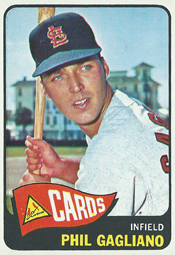
Phil Gagliano could have been involved in one of the most lopsided trades in favor of the Cardinals.

phil_gaglianoIn spring 1964, Cardinals general manager Bing Devine offered Gagliano, a second baseman, to the Cubs for outfielder Lou Brock. The Cubs were seeking a second baseman to replace Ken Hubbs, 22, who died in a plane crash in February 1964.

“The Cardinals tried to lure Brock away for Phil Gagliano,” The Sporting News reported.

Gagliano, 22, would have been a potential fit to replace Hubbs, who won the National League Rookie of the Year Award in 1962. Brock, meanwhile, had underachieved with the Cubs, but he appealed to the Cardinals, who were seeking to add speed to their lineup.

The Cubs turned down the Cardinals’ offer and instead acquired second baseman Joey Amalfitano, 30, from the Giants in a cash transaction in March 1964.

Three months later, in June 1964, the Cubs, needing pitching, agreed to deal Brock to the Cardinals for Ernie Broglio, an established starter.

The trade of Brock and pitchers Jack Spring and Paul Toth to the Cardinals for Broglio, reliever Bobby Shantz and outfielder Doug Clemens was considered a steal for the Cubs until Brock developed into a Hall of Fame player who sparked St. Louis to three National League pennants and two World Series titles.

Gagliano was a part of those Cardinals championship clubs as a utility player.

Gagliano played eight seasons (1963-70) with the Cardinals. Six years after offering Gagliano for Brock, Devine did deal him to the Cubs in May 1970.

Terrific tutors

Gagliano was a friend and teammate of Tim McCarver at Christian Brothers High School in Memphis. Scouted by former big-league player Buddy Lewis, Gagliano and McCarver signed with the Cardinals as amateur free agents in 1959.

McCarver made his big-league debut with St. Louis that year and established himself as the Cardinals’ catcher in 1963.

Gagliano debuted with the Cardinals in 1963. He could play all four infield positions and the corner outfield spots, but he fit best at second base and third base.

At the Cardinals’ Florida Instructional League camps in 1962 and 1963, Gagliano, a right-handed batter, caught the attention of instructors Joe Schultz, Eddie Stanky, Grover Resinger, Harry Walker and George Kissell.

“That’s where I learned to hit,” Gagliano told The Sporting News. “I learned to handle the bat in the Instructional League. I learned how to handle the outside pitch and I learned the strike zone there.”

Before the 1964 season, Gagliano was named by Cardinals writers as the hardest worker in spring training camp.

In May 1965, Cardinals scouting director George Silvey said, “Phil moved up faster than we expected because he always had so much poise.”

Red’s guy

Gagliano had his most productive season with the 1965 Cardinals. Filling in for starting second baseman Julian Javier, who broke his right hand in June when struck by a pitch from the Pirates’ Vern Law, Gagliano was batting .273 entering August before he tailed off. Overall, Gagliano batted .240 with eight home runs and 53 RBI in 122 games, including 48 starts at second base.

Red Schoendienst, the former second baseman who became Cardinals manager in 1965, liked Gagliano. “This kid is a tremendous player,” Schoendienst said.

Said Gagliano: “I like to hit the way Red Schoendienst wants me to. He says to go up and swing the bat _ don’t be a defensive hitter.”

New York calling

In spring 1967, Gagliano again almost was traded, and it was Devine who tried to acquire him.

The 1967 Mets were seeking a second baseman. Devine, who had been fired by the Cardinals in August 1964, was the Mets’ president. He contacted Cardinals general manager Stan Musial and inquired about Gagliano and infielder Jerry Buchek, according to The Sporting News.

“Gagliano is the man the Mets want,” The Sporting News reported. “The Cards, however, want to wait.”

On April 1, 1967, the Cardinals traded Buchek, pitcher Art Mahaffey and infielder Tony Martinez to the Mets for shortstop Eddie Bressoud, outfielder Danny Napoleon and cash.

Buchek became the Mets’ starting second baseman. Gagliano remained a valued backup to Javier at second base and to Mike Shannon at third.

Mentored by Schoendienst on fielding, Gagliano said, “I’ve been working mostly on the double play, getting my body in the proper position to throw. I had been throwing off balance too much. Red has worked hard with me and I feel I’ve improved a lot on the pivot.”

On April 11, in the Cardinals’ 1967 season opener against the Giants at St. Louis, Gagliano, replacing an ailing Shannon, hit a solo home run off Juan Marichal, supporting Bob Gibson’s shutout in a 6-0 triumph. Boxscore

Though Gagliano hit just 14 home runs _ all for St. Louis _ in 12 years in the majors, three of those came against future Hall of Famers: two off Marichal and one off Jim Bunning.

Devine intervention

Gagliano appeared in the 1967 and 1968 World Series for the Cardinals but was hitless in four at-bats.

On May 29, 1970, Devine, back for a second stint as Cardinals general manager, dealt Gagliano to the Cubs for Ted Abernathy, 37, a relief pitcher.

“It’s a shock … but I have no regrets,” Gagliano said to the St. Louis Post-Dispatch.

On May 30, 1970, Gagliano made his Cubs debut and got a two-run pinch-hit single off Dave Roberts, helping Chicago to an 8-7 victory over the Padres at Wrigley Field. Boxscore