Feeds:
Posts
Comments

Phil Gagliano could have been involved in one of the most lopsided trades in favor of the Cardinals.
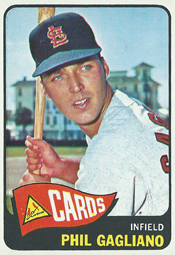
phil_gaglianoIn spring 1964, Cardinals general manager Bing Devine offered Gagliano, a second baseman, to the Cubs for outfielder Lou Brock. The Cubs were seeking a second baseman to replace Ken Hubbs, 22, who died in a plane crash in February 1964.

“The Cardinals tried to lure Brock away for Phil Gagliano,” The Sporting News reported.

Gagliano, 22, would have been a potential fit to replace Hubbs, who won the National League Rookie of the Year Award in 1962. Brock, meanwhile, had underachieved with the Cubs, but he appealed to the Cardinals, who were seeking to add speed to their lineup.

The Cubs turned down the Cardinals’ offer and instead acquired second baseman Joey Amalfitano, 30, from the Giants in a cash transaction in March 1964.

Three months later, in June 1964, the Cubs, needing pitching, agreed to deal Brock to the Cardinals for Ernie Broglio, an established starter.

The trade of Brock and pitchers Jack Spring and Paul Toth to the Cardinals for Broglio, reliever Bobby Shantz and outfielder Doug Clemens was considered a steal for the Cubs until Brock developed into a Hall of Fame player who sparked St. Louis to three National League pennants and two World Series titles.

Gagliano was a part of those Cardinals championship clubs as a utility player.

Gagliano played eight seasons (1963-70) with the Cardinals. Six years after offering Gagliano for Brock, Devine did deal him to the Cubs in May 1970.

Terrific tutors

Gagliano was a friend and teammate of Tim McCarver at Christian Brothers High School in Memphis. Scouted by former big-league player Buddy Lewis, Gagliano and McCarver signed with the Cardinals as amateur free agents in 1959.

McCarver made his big-league debut with St. Louis that year and established himself as the Cardinals’ catcher in 1963.

Gagliano debuted with the Cardinals in 1963. He could play all four infield positions and the corner outfield spots, but he fit best at second base and third base.

At the Cardinals’ Florida Instructional League camps in 1962 and 1963, Gagliano, a right-handed batter, caught the attention of instructors Joe Schultz, Eddie Stanky, Grover Resinger, Harry Walker and George Kissell.

“That’s where I learned to hit,” Gagliano told The Sporting News. “I learned to handle the bat in the Instructional League. I learned how to handle the outside pitch and I learned the strike zone there.”

Before the 1964 season, Gagliano was named by Cardinals writers as the hardest worker in spring training camp.

In May 1965, Cardinals scouting director George Silvey said, “Phil moved up faster than we expected because he always had so much poise.”

Red’s guy

Gagliano had his most productive season with the 1965 Cardinals. Filling in for starting second baseman Julian Javier, who broke his right hand in June when struck by a pitch from the Pirates’ Vern Law, Gagliano was batting .273 entering August before he tailed off. Overall, Gagliano batted .240 with eight home runs and 53 RBI in 122 games, including 48 starts at second base.

Red Schoendienst, the former second baseman who became Cardinals manager in 1965, liked Gagliano. “This kid is a tremendous player,” Schoendienst said.

Said Gagliano: “I like to hit the way Red Schoendienst wants me to. He says to go up and swing the bat _ don’t be a defensive hitter.”

New York calling

In spring 1967, Gagliano again almost was traded, and it was Devine who tried to acquire him.

The 1967 Mets were seeking a second baseman. Devine, who had been fired by the Cardinals in August 1964, was the Mets’ president. He contacted Cardinals general manager Stan Musial and inquired about Gagliano and infielder Jerry Buchek, according to The Sporting News.

“Gagliano is the man the Mets want,” The Sporting News reported. “The Cards, however, want to wait.”

On April 1, 1967, the Cardinals traded Buchek, pitcher Art Mahaffey and infielder Tony Martinez to the Mets for shortstop Eddie Bressoud, outfielder Danny Napoleon and cash.

Buchek became the Mets’ starting second baseman. Gagliano remained a valued backup to Javier at second base and to Mike Shannon at third.

Mentored by Schoendienst on fielding, Gagliano said, “I’ve been working mostly on the double play, getting my body in the proper position to throw. I had been throwing off balance too much. Red has worked hard with me and I feel I’ve improved a lot on the pivot.”

On April 11, in the Cardinals’ 1967 season opener against the Giants at St. Louis, Gagliano, replacing an ailing Shannon, hit a solo home run off Juan Marichal, supporting Bob Gibson’s shutout in a 6-0 triumph. Boxscore

Though Gagliano hit just 14 home runs _ all for St. Louis _ in 12 years in the majors, three of those came against future Hall of Famers: two off Marichal and one off Jim Bunning.

Devine intervention

Gagliano appeared in the 1967 and 1968 World Series for the Cardinals but was hitless in four at-bats.

On May 29, 1970, Devine, back for a second stint as Cardinals general manager, dealt Gagliano to the Cubs for Ted Abernathy, 37, a relief pitcher.

“It’s a shock … but I have no regrets,” Gagliano said to the St. Louis Post-Dispatch.

On May 30, 1970, Gagliano made his Cubs debut and got a two-run pinch-hit single off Dave Roberts, helping Chicago to an 8-7 victory over the Padres at Wrigley Field. Boxscore

(Updated Sept. 10, 2022)

In a move made as much for its public relations value as for on-field leadership, the Cardinals, in effect, hired two managers to replace Rogers Hornsby.

bob_ofarrellA week after Sam Breadon created an uproar when he traded Hornsby rather than agree to his contract demands, the Cardinals’ owner attempted to quell the controversy by naming one of the club’s most popular players as manager.

On Dec. 27, 1926, Bob O’Farrell, a Cardinals catcher and recipient of the 1926 National League Most Valuable Player Award, was chosen as Hornsby’s successor. At the same time, Bill McKechnie, former Pirates manager, was hired as Cardinals coach and assistant to O’Farrell.

O’Farrell, 30, had no experience managing. McKechnie, 40, had managed the Pirates for five seasons (1922-1926) and led them to a NL pennant and World Series championship in 1925. The Pirates produced winning records every year under McKechnie and finished no lower than third place. He was fired when the defending champion Pirates placed third, 4.5 games behind the first-place Cardinals, in 1926.

McKechnie had been considered a candidate to replace Hornsby, but Breadon opted instead for a manager who already was well-liked by fans and players.

Like latter-day Cardinals catchers such as Tim McCarver, Ted Simmons and Yadier Molina, O’Farrell was smart, talented and respected.

O’Farrell batted .293 with 30 doubles for the 1926 Cardinals, handled the pitching staff superbly and led NL catchers in putouts. In the 1926 World Series against the Yankees, O’Farrell hit .304 and threw out Babe Ruth attempting to steal, ending Game 7 and sealing the Cardinals’ championship.

Who’s the boss?

Few could have predicted the Cardinals would be seeking a manager in December 1926.

Hornsby, a second baseman who won the NL batting title in six consecutive seasons (1920-25) with the Cardinals, became their player-manager in 1925, replacing Branch Rickey.

After Hornsby, 30, led the Cardinals to their first pennant and World Series crown in 1926, he demanded a three-year contract. Breadon offered a one-year deal. When Hornsby persisted, Breadon traded him to the Giants on Dec. 20, 1926, incurring the wrath of Cardinals fans. The St. Louis Chamber of Commerce was so upset it asked Breadon to withdraw his membership in the group.

In the book “The Glory of Their Times,” O’Farrell said, “Hornsby was a great manager as far as I’m concerned. That (1926) year in St. Louis he was tops. He never bothered any of us. Just let you play your own game.”

Breadon offered O’Farrell a one-year contract to be player-manager. The catcher called Hornsby and sought his approval. Hornsby assured O’Farrell he wouldn’t be disloyal if he accepted the offer. Breadon was relieved when he did.

O’Farrell told author Lawrence Ritter, “I didn’t want to be the manager. I was in the prime of my (playing) career, and managing always takes something away from your playing.”

Likeable leader

In the St. Louis Star-Times, James Gould wrote, “The naming of O’Farrell undoubtedly will be as popular a choice as could be made under the circumstances … None is better liked by his teammates.”

The St. Louis Post-Dispatch called O’Farrell “the only man perhaps who was sure to be received pleasantly by the fans and the players.”

Breadon was “as jubilant as a 2-year-old” when he got both O’Farrell and McKechnie, the Star-Times reported.

“The offer I made to O’Farrell was positively the only one I made to anyone since Hornsby was traded,” Breadon said. “… He is absolutely the only man who could be chosen for the post. But the greatest joy of all was the signing of McKechnie.”

Breadon said McKechnie “ought to help O’Farrell guide the Cards to their second pennant.”

Unfair to O’Farrell

O’Farrell said “I never dreamed” of inheriting a World Series championship team. “I consider Hornsby the greatest manager I ever saw and just as he let the club play its own games I will let the fellows do their own thinking.” O’Farrell said. “You can’t think for 25 men.”

Hornsby, who also had no managing experience when he got the job, said O’Farrell was “a fine choice” and “he ought to make a good manager.”

Noting his proven skill in working with pitchers, The Sporting News suggested O’Farrell “probably knows more about the pitching part … in a day’s workout than Hornsby would learn second hand in a year.”

Set back by injuries and with his focus on managing, O’Farrell was limited to 61 games in 1927. Splitting the catching chores with Frank Snyder and Johnny Schulte, O’Farrell hit .264 with 10 doubles.

As manager, O’Farrell led the 1927 Cardinals to a 92-61 record _ better than the 89-65 mark of the 1926 championship club _ but St. Louis finished in second place, 1.5 games behind the Pirates.

Breadon replaced O’Farrell with McKechnie and gave O’Farrell a pay raise to remain on the team as a catcher in 1928. His tenure, though, was short-lived. In May 1928, O’Farrell was traded to the Giants. McKechnie led the Cardinals to the 1928 pennant.

(Updated July 30, 2017)

Tim Raines played like a Hall of Famer against the Cardinals.

In January 2017, Raines earned election to the National Baseball Hall of Fame in voting by the Baseball Writers Association of America. He was inducted into the Cooperstown, N.Y., shrine on July 30, 2017.

tim_rainesThe switch-hitting outfielder, who played 23 seasons in the big leagues, primarily with the Expos and White Sox, performed well against most teams, though he was especially good versus the Cardinals.
Raines had more career triples (12), walks (107) and RBI (70) against the Cardinals than he did versus any other team. Raines batted .324 against the Cardinals, with 187 hits, 105 runs scored, 68 stolen bases and a .424 on-base percentage.

Overall for his career, Raines batted .294 with 2,605 hits, 808 stolen bases and a .385 on-base percentage. Raines ranks fifth all-time in steals. Rickey Henderson (1,406), Lou Brock (938), 19th century player Billy Hamilton (914) and Ty Cobb (897) are ahead of him.

Deadly speed

Raines showed consistent excellence versus the Cardinals from 1982-85. During that stretch, his batting average against the Cardinals was .314 or better every year and his on-base percentage each season was .417 or higher. In 1982, when the Cardinals won the World Series championship, Raines batted .391 (27-for-69) against them, with an on-base percentage of .494.

One of Raines’ most significant games against the Cardinals occurred during a 7-4 Expos victory on Sept. 18, 1984, at St. Louis. Raines had four stolen bases, giving him 70 for the season. Raines became the first player to have 70 steals or more in four consecutive seasons.

“Coming from a small town (Sanford, Fla.) which nobody has ever heard of and then coming to the major leagues, it makes me proud to be able to do what I’ve done,” Raines said after the game to Rick Hummel of the St. Louis Post-Dispatch.

Raines would finish the 1984 season with 75 stolen bases, leading the National League for the fourth year in a row. He had 71 steals in strike-shortened 1981, 78 in 1982 and 90 in 1983.

(Though Raines also achieved 70 steals in both 1985 and 1986, the Cardinals’ Vince Coleman surpassed him as the NL stolen base leader in those seasons.)

In his book “You’re Missin’ a Great Game,” Whitey Herzog, who managed the Cardinals from 1980-90, called Raines “a great hitter with deadly speed.”

“If you don’t keep him off base, you’re going to get beat, especially when you can’t hold him on,” Herzog told Hummel.

Hard to stop

With Joaquin Andujar pitching and Darrell Porter catching, Raines swiped second base three times and third base once in his four-steals game against the Cardinals.

Raines “took advantage of Andujar’s slow release toward home plate,” Hummel reported.

“He’s got a quick move to first, but he’s got that high leg kick when he comes to the plate,” Raines said of Andujar. “He comes to the plate slow all the time. I’ve always felt that when he’s pitching, I can run.”

Said Andujar: “That guy just flies. It doesn’t matter whether you throw 100 times to first, he will still steal the base.”

After Andujar was relieved by Kevin Hagen, Raines attempted to steal his fifth base of the game but was caught by Porter.

Porter was one of just four catchers to throw out Raines attempting to steal up to that point in the season, according to the Post-Dispatch. The others: Steve Lake (Cubs), Mike Scioscia (Dodgers) and Ozzie Virgil (Phillies). Boxscore

Raines also had a standout season against the Cardinals in 1990, batting .373 (19-for-51) with 13 RBI and a .469 on-base percentage. On Oct. 1, 1990, Raines had five RBI, including a grand slam off Frank DiPino, in a 15-9 Expos triumph over the Cardinals at Montreal. Boxscore


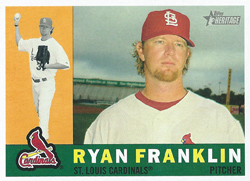
Acquired by the Cardinals to be a starting pitcher, Ryan Franklin appeared in 285 regular-season games for them and never made a start. Instead, Franklin established himself as a reliable setup reliever, then a closer and, when his playing career ended, a key member of the front-office staff.

ryan_franklin3In five seasons (2007-2011) as a Cardinal, Franklin had a 21-19 record with 84 saves and a 3.52 ERA. His best season was 2009 when, as the Cardinals closer, he was 4-3 with 38 saves and a 1.92 ERA in 62 appearances for the National League Central Division champions.
John Mozeliak, Cardinals general manager, saw in Franklin an ability to identify and assess talent, especially pitching. In 2012, Franklin became a special assistant to Mozeliak. Franklin has been in that role ever since.

Through the efforts of Daniel Shoptaw, founder of United Cardinal Bloggers, Mozeliak agreed after the 2016 season to answer questions from Cardinals bloggers.

In response to my question about the role Franklin performs, Mozeliak replied, “Franky has made a nice adjustment from his playing days to working in our baseball operations. He continues to grow as a professional both on the scouting and player development side. He obviously has expertise on pitching and we try to leverage that in the draft and in pro scouting decisions.”

Seeking a stopgap

When Franklin was signed as a free agent by the Cardinals in January 2007, no one could have envisioned he eventually would develop into a trusted advisor to the general manager. Franklin wasn’t even guaranteed a spot on the team.

The 2007 Cardinals, defending World Series champions, headed into spring training with a starting rotation of Chris Carpenter, Kip Wells, Anthony Reyes and Adam Wainwright.

The Cardinals were seeking someone to fill in as the fifth starter for Mark Mulder, who was recovering from shoulder surgery and was projected to return late in the 2007 season.

The Cardinals signed Franklin, 33, to a one-year, $1 million contract and planned to have him compete with Braden Looper and Brad Thompson for the No. 5 starter role.

Fitting role

Franklin had averaged 200 innings per season as a Mariners starter from 2003 to 2005. Though a workhorse, he wasn’t a winner. In 30 starts for the 2005 Mariners, Franklin had an 8-15 record and 5.16 ERA.

He split the 2006 season as a reliever for the Phillies (1-5, 4.58 ERA) and the Reds (5-2, 4.44 ERA).

The Cardinals hoped the right-hander would transform into an effective starter under the guidance of pitching coach Dave Duncan in much the way Jeff Weaver had in 2006.

Franklin “will be given the chance to win a starting job in spring,” Cardinals manager Tony La Russa told the St. Louis Post-Dispatch.

Said columnist Bernie Miklasz: “It’s possible … Franklin will hold Mulder’s spot and head to the bullpen when Mulder re-enters. That’s why Franklin’s low-budget addition makes so much sense.”

However, in spring training, Looper won a starting role and Franklin earned a spot in the bullpen.

Franklin pitched well throughout most of the 2007 season _ his ERA was 1.33 entering August _ and he finished with a 4-4 record and 3.04 ERA, convincing the Cardinals to keep him.

Previously: 2011 Cards came long way since Ryan Franklin in bullpen

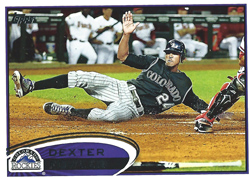
Of the eight career home runs Dexter Fowler has hit against the Cardinals, including one in the postseason, the most dramatic helped the Rockies to a second consecutive late-inning comeback.

dexter_fowlerOn July 7, 2010, Fowler crushed a three-run home run in the eighth inning off Cardinals reliever Jason Motte, tying the score at 7-7 and positioning the Rockies for a win in the ninth.
Six years later, on Dec. 9, 2016, Fowler, a free agent, got a five-year, $82.5 million contract from the Cardinals after helping the Cubs win their first World Series title in 108 years.

Clutch performer

Fowler was in his second full season with the Rockies in 2010 when the Cardinals came to Denver for a three-game series.

In the opener, on July 6, 2010, the Rockies erased a 9-3 Cardinals lead when they scored nine runs in the ninth and won, 12-9. Seth Smith broke a 9-9 tie with a three-run walkoff home run off Ryan Franklin. Fowler doubled and scored in that inning. Boxscore

The next night, the Cardinals led 7-4 in the eighth. The Rockies had runners on first and second, one out, when Cardinals manager Tony La Russa brought in Motte to relieve Trever Miller and face Fowler.

A switch hitter, Fowler batted from the left side against the hard-throwing Cardinals right-hander.

Fastball hitter

After missing the strike zone with his first two pitches, Motte delivered a 97 mph fastball. Fowler swung and missed.

The next pitch was a ball, running the count to 3-and-1.

Motte threw another 97 mph heater and Fowler fouled off the pitch.

“You’re just trying to get a hit and keep the train going,” Fowler said to the Associated Press.

Motte’s payoff pitch was a 98 mph fastball. “That’s his best pitch, so that’s what I was looking for,” Fowler told the Denver Post.

Fowler connected and the ball sailed over the wall for a three-run home run.

It was Fowler’s first home run since April 28.

“That one to Fowler was right down the middle … and he got the barrel on it,” Motte said to the St. Louis Post-Dispatch. “You fall behind (in the count) and you’ve got to throw strikes. You throw strikes, they hit the ball.”

Rocky Mountain high

Fowler’s home run set the stage for a Rockies walkoff win in the ninth.

With his bullpen depleted, La Russa chose Evan MacLane, making his major-league debut, to pitch the ninth.

MacLane, a left-hander, worked the count to 3-and-2 against the leadoff batter, Chris Iannetta. MacLane’s next pitch, a changeup, was drilled for a home run, giving the Rockies an 8-7 walkoff win. Boxscore

Previously: Jason Motte ran table on Cardinals saves in 2012

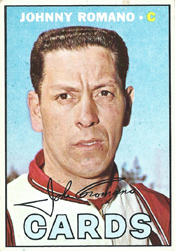
After leading American League catchers in home runs in 1966, Johnny Romano was a backup to Tim McCarver for the 1967 champion Cardinals.

johnny_romanoOn Dec. 14, 1966, the Cardinals traded pitcher Don Dennis and outfielder Walt Williams to the White Sox for Romano and pitcher Leland White.

Romano spent the entire 1967 season with the Cardinals, who won the National League pennant and World Series title, but he seldom played.

His most important contribution to the Cardinals occurred off the field: It was Romano who provided the tip that enabled Lou Brock, the Cardinals’ catalyst, to end a slump.

Catcher with clout

Romano debuted in the big leagues with the 1958 White Sox. He hit 15 or more home runs in six of seven seasons from 1960-66 with the Indians and White Sox. An American League all-star in 1961 and 1962, Romano achieved career highs in home runs (25) and RBI (81) with the 1962 Indians.

In 1966, Romano produced six home runs and 11 RBI during an eight-game White Sox winning streak from Aug. 3-12.

Asked by The Sporting News to explain his hot hitting, Romano said, “When you play every day, you feel more comfortable at the plate. Timing and confidence are the answers to batting success and you can’t have it if you don’t play.”

A right-handed batter, Romano, 32, finished the 1966 season with 15 home runs and a slugging percentage of .404. He also ranked third among American League catchers in fielding percentage at .993.

The White Sox made him available because they were grooming Duane Josephson, 24, to become their catcher. Romano also clashed with White Sox manager Eddie Stanky, who wanted him to hit behind the runner instead of swinging for the fences.

A proposed trade of Romano to the Red Sox was discussed, but the talks ended when the White Sox sought outfielder Carl Yastrzemski, The Sporting News reported.

New role

The Cardinals wanted a backup catcher who could reduce the workload of McCarver and generate offense against left-handed pitching.

McCarver, who caught in 148 games, had 19 doubles, 13 triples and 12 home runs for the 1966 Cardinals, but his batting average against left-handers (.238) was 50 points lower than against right-handers (.288). His backup, Pat Corrales, batted .181 overall and hit no home runs.

The Cardinals projected Romano as the answer to their need.

“Romano likes to hit against left-handers (.255 in 1966) and he will give McCarver a chance to rest once in a while,” Cardinals manager Red Schoendienst said.

Said Cardinals general manager Bob Howsam: “Romano should give us some right-handed power.”

Bob Broeg, in the St. Louis Post-Dispatch, concluded “the Cardinals appeared to help themselves … at no sacrifice” when they acquired Romano.

The Sporting News, however, noted Romano “understandably sounded upset when informed that he would be a No. 2 catcher.”

Tough task

At spring training in 1967, the combination of McCarver and Romano received praise.

Coach Joe Schultz said Cardinals catchers “could be the best in the league, offensively and defensively.”

Asked to rank the catching staffs in the National League, Astros manager Grady Hatton said, “I’d have to rate McCarver and Romano as No. 1.”

In its April 1, 1967, edition, The Sporting News again cautioned “Romano isn’t overly delighted with his second-fiddle rating,” but added, “It’s inconceivable that the sturdy right-handed swinger still doesn’t have some thunder left in his big bat.”

When the 1967 season got under way, Romano struggled to adapt to being a reserve. He produced two hits in his first 25 at-bats. “It’s tough when you don’t get to play often,” Romano said.

By June, Dave Ricketts took over as the primary backup catcher and Romano spent most of his time warming up pitchers in the bullpen.

Batting coach

In midseason, the Pirates offered to trade outfielder Manny Mota, catcher Jim Pagliaroni and pitcher Al McBean to the Cardinals for outfielder Curt Flood, pitcher Hal Woodeshick and Romano, but the Cardinals declined, The Sporting News reported.

In July, Brock, the Cardinals’ leadoff batter, went into a hitting funk. As the slump continued, Brock became more rigid at the plate and Romano detected the flaw. “I noticed Lou was locking his elbows before he swung and he was fouling off a lot of good pitches to left field,” Romano said. “I remind Lou every game about locking his elbows.”

Brock “applied Romano’s tip and went on a long-awaited surge,” The Sporting News reported. “Starting July 24, he went on a 24-for-56 binge, a .429 clip, and he hit safely in 13 straight games through Aug. 6.”

With Brock igniting the offense _ he generated 113 runs, 206 hits and 52 stolen bases _ the Cardinals cruised to a championship.

Romano, who batted .121 (7-for-58) with no home runs and two RBI for the 1967 Cardinals, was left off their World Series roster, but he was voted a full World Series share of $8,314.81, according to The Sporting News.

On Oct. 20, 1967, the Cardinals released Romano and he retired.