Feeds:
Posts
Comments

(Updated April 5, 2025)

On the day Ozzie Smith announced his plans to retire as a player, there was as much focus on his icy relationship with manager Tony La Russa as there was on his Hall of Fame career.

ozzie_smith9On June 19, 1996, Smith tearfully said he would retire after the Cardinals’ final game of the season. “I feel the time is here now,” Smith, 41, said to the Associated Press. “This is the best time. I’m ready for it.”

Impacting Smith’s decision, though, was his demotion to a reserve role at shortstop behind Royce Clayton, 26.

“I know that if I chose to do it I could play somewhere else,” Smith said to Rick Hummel of the St. Louis Post-Dispatch, “but my thinking was to finish my career as a St. Louis Cardinal.”

Smith used the attention created by his retirement announcement to express his unhappiness with La Russa.

Post-Dispatch columnist Bernie Miklasz wrote, “Unfortunately, Ozzie didn’t make it through (the day) without sniping at La Russa. Let’s hope the sourness will clear.”

Communication breakdown

Smith, who won 13 consecutive Gold Glove awards from 1980-92, went to spring training in 1996 determined to compete with Clayton for the starting shortstop job. La Russa, in his first year as Cardinals manager, said the player who performed best in spring training would be the shortstop during the season.

“I was told that the position would be earned in spring training,” Smith said at his retirement announcement. “I thought I did that.”

When La Russa declared Clayton the regular shortstop, Smith said he believed the manager hadn’t done what he said he would.

“This was the most disappointing thing in my career in St. Louis,” Smith told Hummel at the retirement announcement. “All I can go by is a person’s word. Going into spring training, I knew I had a job to do and I did that job.”

In response, La Russa said of Smith, “It’s fair to say he misunderstood how he compared to Royce in spring training. By what he was able to do defensively and on the bases, Royce deserved to play the majority of the games. Royce is capable of making more plays.”

Strain remains

Irked that Smith had brought up the controversy at the retirement announcement, La Russa complained to Hummel, “It doesn’t go away. It’s a constant irritation for him and for me _ his misunderstanding of that.”

Responding to a suggestion that the Cardinals owed a player of Smith’s caliber the chance to play regularly, La Russa said, “You can’t put a player ahead of any club … We don’t owe anybody. If Stan Musial comes back tomorrow and says, ‘I want to play’ _ that’s not what you do.”

Acknowledging that “there is a strain in the relationship” between he and Smith, La Russa added, “I’ll always feel like there’s a little edge in our relationship. I don’t think that ever will go away.”

Blame game

The next day, before the Cardinals faced the Expos at Montreal on June 20, 1996, Smith responded angrily to La Russa’s comments about Clayton performing the best in spring training.

“That’s cowardice as far as I’m concerned,” Smith told Hummel, “but should I expect anything different?”

Said La Russa of Smith: “All he’s got to do is look in the mirror and he can go out with honor and dignity rather than some kind of attempt at camouflage. I thought the purpose of his (retiring) was to be a positive influence on our ballclub. It doesn’t sound too positive to me.”

In a followup column, Miklasz reiterated that Smith is “a civic treasure” who “deserves a statue outside Busch Stadium,” but gave Smith an error for fueling the feud with La Russa.

“Ozzie is embarrassing himself … The only reputation that will be damaged is Ozzie’s,” Miklasz wrote.

In looking back on that 1996 tension with Smith, La Russa told Cardinals Yearbook in 2014, “Ozzie thought he played the best in spring training. It was obvious to us Royce would play better over 162 games. Both had a really important spot.”
 

(Updated April 11, 2026)

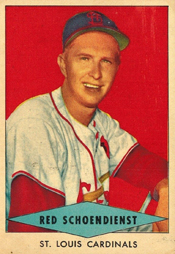
On June 14, 1956, soon after Red Schoendienst had driven off in his car, the phone rang at his house. Mary Schoendienst, Red’s wife, answered. The caller was a secretary for Cardinals general manager Frank Lane. She told Mary that Red had been traded to the Giants.

red_schoendienst10As Red was driving, he turned on his car radio. When the news came on, he learned of the deal.
In his 1998 book “Red: A Baseball Life,” Schoendienst said, “I didn’t appreciate getting the news that way.”

Said Mary: “I was shocked. The secretary called and said, ‘Mary, I have very sad news for you. Red has just been traded to New York.’ I just about fell over. I sat down on the couch in the living room. I couldn’t believe it. It was very hard.”

The Cardinals traded Schoendienst, outfielder Jackie Brandt, catcher Bill Sarni, pitcher Dick Littlefield and two players to be named (shortstop Bob Stephenson and pitcher Gordon Jones) to the Giants for shortstop Alvin Dark, catcher Ray Katt, pitcher Don Liddle, outfielder Whitey Lockman and cash.

“We let Schoendienst go with great reluctance, naturally, but to get a star like Dark you’ve got to give a star,” Lane told the St. Louis Post-Dispatch.

Sad day

Schoendienst, 33, a second baseman, was in his 12th season with the Cardinals. He had been named a National League all-star nine times with them.

Said Schoendienst of Lane: “(He) never understood how important baseball tradition was in St. Louis.”

Asked by the Associated Press to comment on the trade, Stan Musial, Schoendienst’s friend and road roommate, offered a rare “No comment.”

Said Schoendienst: “Stan says it was his saddest day in baseball.”

In his book “Stan Musial: The Man’s Own Story,” Musial said, “I was sick over the loss of my roommate and good friend.”

Many Cardinals fans shared Musial’s sentiments.

“Newspaper switchboards were swamped with calls after the deal was announced,” the Associated Press reported.

In the book “Redbirds Revisited,” Schoendienst said the trade “was a shock to me. That was the biggest disappointment I’ve ever had … I was established here in St. Louis. I wanted to finish my career here.”

Infield shift

The 1956 Cardinals were starting two infielders _ rookie shortstop Don Blasingame and first baseman Wally Moon _ out of position. “We couldn’t win with our infield,” Lane said.

Blasingame was better suited to play second base. That prompted Lane to trade for a shortstop. After the Cardinals got Dark, Blasingame was moved to second. Moon and Musial swapped spots, with Musial moving from right field to first base.

“We’re stronger now,” said Cardinals manager Fred Hutchinson.

Cardinals owner Gussie Busch told the St. Louis Globe-Democrat the trade had his approval. “It was the considered judgment of Lane and Hutchinson that this deal would work for the betterment of the ballclub,” Busch said, “and I am thoroughly in agreement with them.”

Top prospect

Though Schoendienst and Dark were central players in the deal, Brandt, a rookie, was a key. In 1955 with minor-league Rochester, Brandt batted .305 with 179 hits in 151 games and had 24 stolen bases. He hit .286 with a .362 on-base percentage in 27 games for the 1956 Cardinals.

“We’re very excited about getting Brandt,” Giants executive Chub Feeney told United Press. “We wouldn’t have made the deal without him. He can run, he can throw and he can hit … Frankly, we were surprised the Cards would let him go.”

Said Schoendienst: “I thought trading Brandt was a mistake.”

Musial said Brandt “had speed, defensive skill and some power. The Cardinals could have used him.”

Said Lane: “Brandt could come back to haunt us, but we’re thinking of ’56, not next year.”

Brandt became the left fielder for the 1956 Giants. To accommodate Schoendienst, the Giants moved Daryl Spencer from second base to shortstop. Schoendienst joined first baseman Bill White in forming the right side of the Giants’ infield.

Also-rans

Though Schoendienst, Brandt and Dark played well for their new teams, the deal didn’t make either club a winner.

The 1956 Giants finished in sixth place at 67-87. The 1956 Cardinals placed fourth at 76-78.

Schoendienst hit .296 in 92 games for the 1956 Giants. A year later, he was traded to the Braves.

Brandt batted .299 in 98 games for the 1956 Giants. He won a Gold Glove Award with them in 1959, but was dealt after that season to the Orioles.

In 100 games for the 1956 Cardinals, Dark hit .286. Two years later, he was traded to the Cubs.

Schoendienst and Dark eventually became successful big-league managers. Each won two pennants _ Schoendienst with the 1967 and 1968 Cardinals; Dark with the 1962 Giants and 1974 Athletics _ and a World Series title.


After getting a ringside view of Muhammad Ali bludgeoning an opponent, Bill White had seen enough boxing.

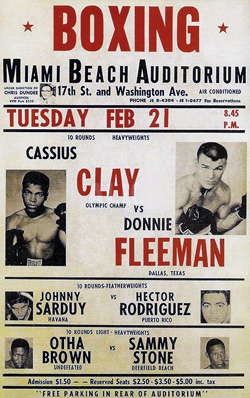
clay_fleemanWhite and Cardinals teammate Curt Flood met Ali, then known by his birth name of Cassius Clay, in Florida in February 1961. Ali, 19, was early in his professional boxing career after having won a gold medal at the 1960 Summer Olympics. White, 27, was the first baseman and Flood, 23, the center fielder for the Cardinals.
The Cardinals had opened an advance training camp in Homestead, Fla., near Miami, on Feb. 12, 1961, before they would move across state to their St. Petersburg base at the beginning of March. White and Flood were among the veterans who attended the early workouts at Homestead to get in extra hitting.

Ali was preparing for his fifth professional bout, a match with Donnie Fleeman, 29, an experienced heavyweight from Midlothian, Texas.

Meet in Miami

Seeking a break from small-town Homestead, which primarily was an agricultural community, White and Flood drove the 35 miles to Miami.

In his book “Uppity: My Life in Baseball,” White said he and Flood “went to the Sir John Hotel in the Overtown section, an area earlier known as Colored Town, where a lot of black celebrities stayed and performed.”

White said he and Flood were standing outside the hotel when an acquaintance approached and offered to introduce them to a friend of his.

“The friend was a tall, good-looking black kid named Cassius Clay _ later, of course, Muhammad Ali,” White said.

Bloody event

On Feb. 21, 1961, Ali fought Fleeman before 2,076 spectators at the Miami Beach Auditorium. White accepted Ali’s invitation to attend the fight and was given a ringside seat.

Ali, using what the Associated Press described as “a speedy jab and a rock-hard right cross,” earned a seventh-round technical knockout of Fleeman.

Ali twice opened a cut over Fleeman’s right eye and bloodied his nose, according to the Associated Press.

“At the end of the sixth,” wrote the Associated Press, “the bleeding Fleeman pointed to his midsection … and asked that doctors examine it. Dr. Alex Robbins said Fleeman had a rib injury and recommended that the scheduled eight-rounder be stopped.”

Said White: “In typical Ali fashion, he had boasted to me that Fleeman would never lay a glove on him _ and in typical Ali fashion, he was right … By the time he knocked Fleeman out in the seventh round, I had flecks of Fleeman’s blood all over my clothes. I never went to another professional fight.”

No thanks

Nine years later, in 1970, when White had retired as a player and gone into broadcasting, he was asked by Howard Cosell of ABC television to join him in working a fight in Italy.

“Howard persisted,” White said, “and while I was flattered by the offer, in the end I turned him down. Although I often watched boxing on TV, I hadn’t been to a fight since Ali spattered me with Donnie Fleeman’s blood in Miami in 1961. I just didn’t think that I was ready for such a high-profile assignment in a sport I had never covered.”

Message of hate

During their February 1961 introduction to Ali, White and Flood were invited to join the boxer at a Nation of Islam meeting at a Florida mosque.

In his book “The Way It Is,” Flood said Cardinals pitcher Bob Gibson attended the meeting, too.

Said White: “After being searched for weapons at the door, we went in and sat down and listened as a speaker talked about separating black people from the ‘white devils’ and how Black Muslims wanted to inflict mayhem on their enemies … After about 10 minutes, Curt looked at me and I looked at Curt and then we got up and left. Ali left with us.”

Said Flood: “Our wallets and watches were impounded at the door … The speeches _ or sermons _ were rampantly, savagely racist. The only discernible program seemed to be destruction of the hated ‘white devil’ and substitution of black rule.”

Rejecting racism

Said White: “I wanted to support anyone who was fighting against the oppression of black people, but the Nation’s philosophy really wasn’t my kind of thing.”

Said Flood: “I simply happen to doubt that black pride need be accomplished by racism … We ought to have learned enough about racism to avoid it in ourselves.”

Of Ali, Flood concluded, “Anyone who expects me to attack Muhammad Ali or the Black Muslims can forget it. I respect Ali. I would be surprised if he were a racist fanatic.”

Previously: Bill White interviewed about autobiography

Previously: Book details how Cardinals were segregated in Florida

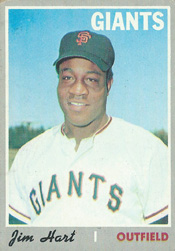
Jim Ray Hart had a prominent role in contributing to Bob Gibson’s worst start with the Cardinals, an outing so poor the pitcher was booed by the home crowd.

jim_hartHart, batting cleanup, had two key hits in the Giants’ 11-run first inning against the Cardinals on June 29, 1967, at St. Louis.
Nine of those runs, all earned, were charged to Gibson. Those are the most earned runs yielded in a game by Gibson in his Hall of Fame career.

The first eight batters Gibson faced reached base _ seven hits and a walk _ and the Giants led 7-0 before Gibson recorded an out. He was lifted before the Giants completed the inning.

In his book “Stranger to the Game,” Gibson called the outing “possibly the worst start of my life.”

In a Giants lineup that featured Willie Mays and Willie McCovey, no one did more damage that Thursday night than Hart, who drove in four runs in the opening inning with a single and a home run. Four years earlier, Hart suffered a fractured collarbone when hit by a Gibson fastball.

In 12 years (1963-74) with the Giants and Yankees, Hart, a third baseman and outfielder, batted .278 and produced 1,052 hits. He led the Giants in hits in each of three consecutive seasons (1965-67).

Stacking southpaws

The Giants began a four-game series with the first-place Cardinals on June 26, 1967, at St. Louis. The Cardinals won the opener, beating right-hander Gaylord Perry and dropping the fifth-place Giants 8.5 games behind the frontrunners.

The Giants, behind left-handed starters Mike McCormick and Ray Sadecki, won the second and third games. McCormick and Sadecki combined to limit the Cardinals to one run in 18 innings.

The series finale was scheduled to be a matchup of right-handed aces, Gibson for the Cardinals and Juan Marichal for the Giants. However, based on the performances of McCormick and Sadecki, Giants manager Herman Franks decided to start another left-hander against the Cardinals. Franks replaced Marichal with Joe Gibbon, a left-hander who had started and won against the Cardinals two weeks earlier, on June 17, at San Francisco. Gibbon had pitched in relief vs. the Cardinals on June 26 in the series opener at St. Louis.

All of the maneuverings were for naught. Gibson and Gibbon, similar in name, had similar results: Both were ineffective.

Opening salvo

The first two Giants batters, Jim Davenport and Tom Haller, each singled.

Willie Mays also singled, scoring Davenport and advancing Haller to second base.

Next up was Hart. He hit a line drive to left for a single, scoring Haller. Lou Brock, the left fielder, bobbled the ball, enabling Mays to score on the error and giving the Giants a 3-0 lead. Hart, credited with one RBI, reached second on the play.

With first base open, Gibson issued an intentional walk to Willie McCovey.

The next batter, Ollie Brown, singled, scoring Hart and putting the Giants ahead, 4-0. McCovey advanced to third.

Hal Lanier, the shortstop and son of former Cardinals pitcher Max Lanier, was up next. Lanier, batting .202, tripled, scoring McCovey and Brown and increasing the Giants’ lead to 6-0.

Unhappy fans

No. 8 batter Tito Fuentes singled, driving in Lanier and making the score 7-0.

Gibson struck out Gibbon and got Davenport to pop out to second.

When Gibson walked the next batter, Haller, Cardinals manager Red Schoendienst replaced him with Nelson Briles.

In the book “El Birdos,” author Doug Feldmann wrote that as Gibson departed “he was booed voraciously by the Busch Stadium crowd. Upon receiving the unfriendly goodbye from the home folks, Gibson tauntingly flung his cap in the air, which only increased the volume of the derision.”

Hammer from Hart

The first batter Briles faced was Mays, who singled, scoring Fuentes, advancing Haller to second and boosting the Giants’ lead to 8-0.

Hart, using a bat borrowed from Lanier, capped the outburst by hitting a three-run home run into the left-field bleachers, making the score 11-0.

The final line on Gibson: 0.2 innings, 9 runs, 7 hits, 2 walks.

Redbirds respond

Given a huge lead, Gibbon couldn’t taken advantage.

Brock led off the Cardinals’ half of the first with a triple. Julian Javier singled, scoring Brock. Curt Flood singled, moving Javier to third.

Orlando Cepeda delivered the Cardinals’ fourth consecutive hit, a single that scored Javier, moved Flood to third and made the score 11-2.

So much for using a left-hander.

Franks removed Gibbon, who failed to record an out, and replaced him with Bobby Bolin. The right-hander did the job. He got Mike Shannon to ground into a double play and Tim McCarver to fly out, ending the inning.

Bolin pitched nine innings of relief and got the win in a 12-4 Giants triumph. Boxscore

“So, a right-hander finally won one,” Giants pitching coach Larry Jansen said to the Oakland Tribune.

Beware of Bob

Gibson had entered the game with a 3.01 ERA and exited it with a 3.68 ERA.

“This, of course, put me in the mood to take it out on somebody and the opportunity quickly presented itself against the Reds,” Gibson said.

Facing the Reds in his next start, July 3, 1967, at St. Louis, Gibson struck out 12 in 7.2 innings, gave up three runs (two earned), took part in a brawl and got the win in a 7-3 Cardinals victory. Boxscore.


(Updated May 24, 2020)

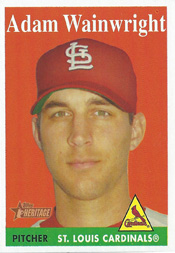
Adam Wainwright turned a special at-bat into a special feat.

On May 24, 2006, Wainwright swung at the first pitch in his first major-league plate appearance and hit a home run for the Cardinals against the Giants at San Francisco.

adam_wainwright9Leading off the fifth inning, with the Giants ahead, 4-2, Wainwright hit a Noah Lowry pitch over the left field wall.
Wainwright, 24, had appeared in three games for the 2005 Cardinals and 14 games for the 2006 Cardinals before getting his first plate appearance. He hadn’t taken any batting practice since spring training.

Asked by the St. Louis Post-Dispatch what he was thinking once he realized he had hit a home run, Wainwright said, “I wasn’t thinking anything until I hit third (base). I was wandering around the bases, making sure I was going the right way. I hit third (base) and I said, ‘Oh, my goodness. I just hit a home run in my first at-bat.’ It was crazy.”

A win and a blast

Chris Carpenter had been scheduled to start for the Cardinals, but he developed bursitis under his right shoulder and was scratched.

Brad Thompson got the start and pitched two innings. After Tyler Johnson pitched the third inning, Wainwright relieved.

With the score tied at 2-2, Wainwright yielded two runs in the fourth.

Before Wainwright went to bat in the fifth, Cardinals manager Tony La Russa approached him.

“Tony told me to have a good at-bat, so I made sure I swung at the first pitch,” Wainwright told the San Jose Mercury News.

Lowry, a left-hander, threw a fastball. “One of the few fastballs Noah threw for strike one,” Giants manager Felipe Alou said to the Alameda Times-Star. Video of home run

After Wainwright pitched a scoreless fifth, the Cardinals scored twice in the sixth, taking a 5-4 lead. Wainwright held the Giants scoreless again in the sixth.

For his three innings of relief, Wainwright earned the win in the Cardinals’ 10-4 triumph. Boxscore

Wainwright was one of three Cardinals pitchers to get an extra-base hit in the game. Jason Marquis tripled and Braden Looper doubled. “They almost hit for the cycle, the pitchers,” Alou said to the San Francisco Examiner. “They surprised everybody.”

Sweet swings

Wainwright is one of 10 Cardinals to hit a home run in his first plate appearance in the major leagues.

The list:

_ Eddie Morgan, pinch-hitter, April 14, 1936, vs. Cubs.

_ Wally Moon, center fielder, April 13, 1954, vs. Cubs.

_ Keith McDonald, pinch-hitter, July 4, 2000, vs. Reds.

_ Chris Richard, left fielder, July 17, 2000, vs. Twins.

_ Gene Stechschulte, pinch-hitter, April 17, 2001, vs. Diamondbacks.

_ Hector Luna, second baseman, April 8, 2004, vs. Brewers.

_ Adam Wainwright, pitcher, May 24, 2006, vs. Giants.

_ Mark Worrell, pitcher, June 5, 2008, vs. Nationals.

_ Paul DeJong, pinch-hitter, May 28, 2017, vs. Rockies.

_ Lane Thomas, pinch-hitter, April 19, 2019, vs. Mets.


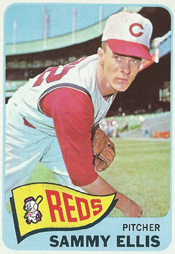
In 1964, Sammy Ellis almost derailed the Cardinals’ pennant run with his nearly flawless relief pitching for the Reds. A year later, the Cardinals briefly derailed Ellis, who was on his way to a standout season as one of the National League’s premier starters.

sammy_ellisEllis pitched in the major leagues during the 1960s for seven years: five with the Reds and one season each with the Angels and White Sox. He posted a career record of 63-58 with a 4.15 ERA.

The Reds put Ellis, 23, in their starting rotation in May 1964. He was 3-2 with a 4.62 ERA in five starts, including a loss to the Cardinals on May 30 at St. Louis. Boxscore

To Ellis’ disappointment, the Reds moved him to the bullpen, but it was the right choice. Ellis thrived, becoming the 1964 Reds’ best right-handed reliever.

Ellis had an 0.78 ERA in 11 August relief appearances, yielding two earned runs and striking out 22 in 23 innings.

In September, he was even better.

Scoreless relief

On Saturday, Sept. 19, 1964, the Cardinals opened a three-game series with the Reds at Cincinnati. The Cardinals began the day in second place, six games behind the Phillies and a game ahead of the Reds.

In the first game of a doubleheader, the Reds overcame a 5-4 Cardinals lead when Frank Robinson hit a three-run home run off Bob Gibson in the bottom of the ninth. Ellis got the win, pitching two innings of scoreless relief in the 7-5 Reds victory. Boxscore

The Cardinals recovered and won the second game, 2-0. Ellis pitched a scoreless inning in relief of Billy McCool. Boxscore

In the series finale on Sunday, Sept. 20, the Reds snapped a 6-6 tie with three unearned runs in the eighth off Cardinals closer Barney Schultz and prevailed, 9-6. Ellis, appearing in his fifth game in five days, got the win with two scoreless relief innings and improved his record to 10-3. Boxscore

“I was a bit tired today and I didn’t have as much on the ball as I wanted,” Ellis said to the Associated Press. “After all, I’ve had a pretty busy week, working in the last five games we’ve played.”

In the three games against the Cardinals, Ellis was 2-0 with six strikeouts in five scoreless innings.

By winning two of three in the series, the Reds were tied with the Cardinals for second place, 6.5 games behind the Phillies.

Cincinnati closer

Ellis made 13 relief appearances in September 1964, yielding no earned runs in 22.1 innings and striking out 26.

He kept the Reds in the pennant race until the season’s final day when the Cardinals clinched with a victory over the Mets.

Ellis completed the 1964 season with a 10-3 record and 2.57 ERA. He was 7-1 with a 1.62 ERA in 47 relief stints.

“I’m enjoying the relief pitching this year, but I hope the club doesn’t have the same plans for me next year,” Ellis said to The Sporting News.

Redbirds rally

Ellis, 24, joined the Reds’ starting rotation in 1965 and he was a success. He took a 15-7 record and 3.39 ERA into his Aug. 15, 1965, start against the Cardinals at St. Louis.

After retiring the first five batters, Ellis was rocked for four runs in the second inning. He gave up a solo home run to Bob Skinner and a three-run home run to Gibson. In chasing Gibson’s blast, Robinson crashed into the left field wall, suffered a badly bruised left hip and had to leave the game.

Though the Cardinals got hits off Ellis in each of the next five innings, they couldn’t score and the Reds led, 7-4, entering the bottom half of the eighth before St. Louis rallied.

Bill White led off the inning with a home run against Ellis. After Ken Boyer singled, Ellis was lifted by Reds manager Dick Sisler. The Cardinals roughed up relievers John Tsitouris and McCool, scoring eight in the eighth and earning a 12-7 victory. Boxscore

The final line for Ellis: 7 innings, 12 hits, 6 runs. The hits were the most Ellis yielded in a game in his major-league career.

Asked about taking out Ellis with a 7-5 lead, Sisler said, “What’s a guy going to do? You can’t expect a guy to go nine innings when it’s 98 degrees or more out there on the mound. When we needed help, I put in two guys whose past performances indicated they could do the job for me.”

Big winner

Ellis rebounded and finished the 1965 season with a 22-10 record and 3.79 ERA. Sandy Koufax (26), Tony Cloninger (24) and Don Drysdale (23) were the only NL pitchers with more wins than Ellis in 1965.

The next year, Ellis lost 19.

His career mark vs. the Cardinals: 6-5 with a 5.50 ERA in 21 appearances, including 10 starts.

Ellis spent 12 years in the big leagues as a coach with the Yankees, White Sox, Cubs, Mariners, Red Sox and Orioles.

Previously: Bob Gibson and his mighty home run seasons

Previously: Bob Gibson vs. Billy Williams: a classic duel