Feeds:
Posts
Comments

In 1964, Sammy Ellis almost derailed the Cardinals’ pennant run with his nearly flawless relief pitching for the Reds. A year later, the Cardinals briefly derailed Ellis, who was on his way to a standout season as one of the National League’s premier starters.
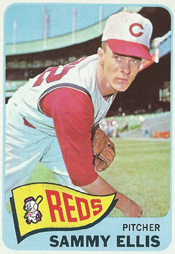
sammy_ellisEllis pitched in the major leagues during the 1960s for seven years: five with the Reds and one season each with the Angels and White Sox. He posted a career record of 63-58 with a 4.15 ERA.

The Reds put Ellis, 23, in their starting rotation in May 1964. He was 3-2 with a 4.62 ERA in five starts, including a loss to the Cardinals on May 30 at St. Louis. Boxscore

To Ellis’ disappointment, the Reds moved him to the bullpen, but it was the right choice. Ellis thrived, becoming the 1964 Reds’ best right-handed reliever.

Ellis had an 0.78 ERA in 11 August relief appearances, yielding two earned runs and striking out 22 in 23 innings.

In September, he was even better.

Scoreless relief

On Saturday, Sept. 19, 1964, the Cardinals opened a three-game series with the Reds at Cincinnati. The Cardinals began the day in second place, six games behind the Phillies and a game ahead of the Reds.

In the first game of a doubleheader, the Reds overcame a 5-4 Cardinals lead when Frank Robinson hit a three-run home run off Bob Gibson in the bottom of the ninth. Ellis got the win, pitching two innings of scoreless relief in the 7-5 Reds victory. Boxscore

The Cardinals recovered and won the second game, 2-0. Ellis pitched a scoreless inning in relief of Billy McCool. Boxscore

In the series finale on Sunday, Sept. 20, the Reds snapped a 6-6 tie with three unearned runs in the eighth off Cardinals closer Barney Schultz and prevailed, 9-6. Ellis, appearing in his fifth game in five days, got the win with two scoreless relief innings and improved his record to 10-3. Boxscore

“I was a bit tired today and I didn’t have as much on the ball as I wanted,” Ellis said to the Associated Press. “After all, I’ve had a pretty busy week, working in the last five games we’ve played.”

In the three games against the Cardinals, Ellis was 2-0 with six strikeouts in five scoreless innings.

By winning two of three in the series, the Reds were tied with the Cardinals for second place, 6.5 games behind the Phillies.

Cincinnati closer

Ellis made 13 relief appearances in September 1964, yielding no earned runs in 22.1 innings and striking out 26.

He kept the Reds in the pennant race until the season’s final day when the Cardinals clinched with a victory over the Mets.

Ellis completed the 1964 season with a 10-3 record and 2.57 ERA. He was 7-1 with a 1.62 ERA in 47 relief stints.

“I’m enjoying the relief pitching this year, but I hope the club doesn’t have the same plans for me next year,” Ellis said to The Sporting News.

Redbirds rally

Ellis, 24, joined the Reds’ starting rotation in 1965 and he was a success. He took a 15-7 record and 3.39 ERA into his Aug. 15, 1965, start against the Cardinals at St. Louis.

After retiring the first five batters, Ellis was rocked for four runs in the second inning. He gave up a solo home run to Bob Skinner and a three-run home run to Gibson. In chasing Gibson’s blast, Robinson crashed into the left field wall, suffered a badly bruised left hip and had to leave the game.

Though the Cardinals got hits off Ellis in each of the next five innings, they couldn’t score and the Reds led, 7-4, entering the bottom half of the eighth before St. Louis rallied.

Bill White led off the inning with a home run against Ellis. After Ken Boyer singled, Ellis was lifted by Reds manager Dick Sisler. The Cardinals roughed up relievers John Tsitouris and McCool, scoring eight in the eighth and earning a 12-7 victory. Boxscore

The final line for Ellis: 7 innings, 12 hits, 6 runs. The hits were the most Ellis yielded in a game in his major-league career.

Asked about taking out Ellis with a 7-5 lead, Sisler said, “What’s a guy going to do? You can’t expect a guy to go nine innings when it’s 98 degrees or more out there on the mound. When we needed help, I put in two guys whose past performances indicated they could do the job for me.”

Big winner

Ellis rebounded and finished the 1965 season with a 22-10 record and 3.79 ERA. Sandy Koufax (26), Tony Cloninger (24) and Don Drysdale (23) were the only NL pitchers with more wins than Ellis in 1965.

The next year, Ellis lost 19.

His career mark vs. the Cardinals: 6-5 with a 5.50 ERA in 21 appearances, including 10 starts.

Ellis spent 12 years in the big leagues as a coach with the Yankees, White Sox, Cubs, Mariners, Red Sox and Orioles.

Previously: Bob Gibson and his mighty home run seasons

Previously: Bob Gibson vs. Billy Williams: a classic duel
(Updated April 2, 2026)

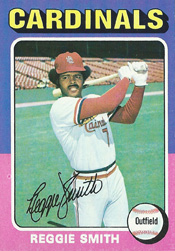
Mired in a slump, Reggie Smith got into the right frame of mind and snapped out of his funk, hitting three home runs, including the winning shot, for the Cardinals in a game against the Phillies.

reggie_smith3Following the lead of teammate Ted Simmons, Smith practiced transcendental meditation for inner peace before the Cardinals played on May 22, 1976, at Veterans Stadium in Philadelphia.
“I had good meditation today,” Smith told The Sporting News.

Both sides now

Hampered by an ailing left shoulder, Smith entered the Saturday night game with a .168 batting mark and three homers for the season.

He connected with home runs in each of his last three at-bats.

A switch-hitter, Smith hit two of the home runs right-handed and one left-handed. It was the sixth time Smith hit a home run from each side of the plate in a game.

It also was the only time in his 17 years in the big leagues that Smith hit three home runs in a game. All three occurred with two outs.

Smith, 31, became the first Cardinals batter to hit three home runs in a game since Stan Musial, 41, did so on July 8, 1962, vs. the Mets.

“I’m sorry it took me so long to start hitting,” Smith said to the Bucks County (Pa.) Courier Times. “I haven’t been doing much to help the club.”

Smith, who had been moved from right field to first base to third base during the season, was approached before the game by manager Red Schoendienst, who may have helped put him in a proper state of mind.

“I called Reggie into my office and asked him if he was relaxed enough when he was being shifted from position to position,” Schoendienst said. “He told me that, if I had enough confidence in him, he’d play anywhere anytime. I told Reggie that we needed his power in the lineup.”

Smith usually hit well at Veterans Stadium. “The background here has a lot to do with it,” he told the Philadelphia Inquirer. “Most backgrounds around the league are green and tend to create fuzziness. Here it’s black and you see better.”

Going deep

In the fifth inning, with the Phillies ahead, 2-1, Smith, batting right-handed, hit a Jim Kaat slider to left for a three-run home run, giving the Cardinals a 4-2 lead.

With the Phillies ahead, 6-5, in the seventh, Smith, batting left-handed, hit a Ron Reed changeup to right for a solo homer.

In the ninth, with the bases empty and the score tied at 6-6, Smith, batting from the right side, hit a Tug McGraw fastball to center for his third homer, putting the Cardinals ahead. Smith told the St. Louis Post-Dispatch that McGraw “tried to run (the fastball) away from me … to set me up for his screwball.”

The Phillies nearly rallied in the bottom of the ninth. Smith, moved from first base to third, helped thwart them, making a diving catch of a Larry Bowa liner. “In a way, I’m more proud of the catch,” he told the Inquirer.

Cardinals coach Fred Koenig said to the Post-Dispatch of Smith’s catch, “It’s almost inhuman for a man to get that close to a ball after going that far for it.”

Later in the inning, the Phillies had runners on first and second with two outs when Garry Maddox, facing Al Hrabosky, ripped a line drive that appeared headed for extra bases before shortstop Don Kessinger made a diving catch, ending the game and preserving the 7-6 Cardinals triumph. Boxscore

Four weeks later, on June 15, 1976, with his batting average at .218 and his home run total at eight, the Cardinals traded Smith to the Dodgers for catcher Joe Ferguson and minor-leaguers Bob Detherage and Freddie Tisdale.


In 1961, Bob Gibson, Curt Flood and Bill White would leave Al Lang Field in St. Petersburg, Fla., after a Cardinals home spring training game, walk across the street and get into an orange station wagon that would take them to another part of town where they stayed in a boarding house. The rest of their Cardinals teammates went nearby to their spring training accommodations at the swank Vinoy Hotel along the waterfront.

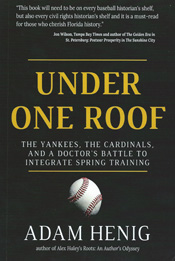
adam_henig_bookSt. Petersburg was a segregated city and the Vinoy didn’t allow any blacks to stay at the hotel.
In his new book “Under One Roof,” author Adam Henig tells the story of how Dr. Ralph Wimbish, a physician, NAACP leader and civil rights activist, led a successful effort to end segregated housing during spring training in St. Petersburg.

The book is available in paperback and on Kindle at this Amazon link. It would make a unique and important addition to a Cardinals fan’s library.

Henig effectively balances the stories of Wimbish and the baseball teams, Cardinals and Yankees, that trained in St. Petersburg.

Reading the book is like taking a journey in a time machine. Henig gives the reader a deep sense of what it was like to be in St. Petersburg in 1961 and how segregation was so strongly in force.

Two examples:

_ When author Alex Haley arrived in St. Petersburg from New York to do a magazine story on Wimbish, Haley was directed at the airport to a black cab driver because white drivers weren’t permitted to accept black passengers.

_ Wimbish’s daughter, Barbara, recalled that one of the few integrated restaurants in St. Petersburg was a Jewish deli.

Henig also does an admirable job of describing the pain and humiliation felt by black ballplayers.

The author is a first-rate researcher and his writing is vivid.

This book will help every reader appreciate the courage of Bill White, who joined Wimbish in taking a stand again racism and injustice, and helping to bring the Cardinals under one roof in segregated St. Petersburg.


(Updated March 7, 2022)

On a trip to Brooklyn, the Cardinals took a detour to Jersey City and played as if they were lost.

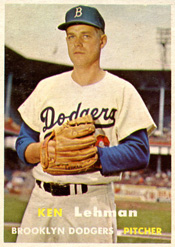
ken_lehmanOn May 16, 1956, the Cardinals faced the Dodgers in a regular-season game at Roosevelt Stadium in the Droyer’s Point section of Jersey City near Newark Bay.
Played on a Wednesday night with a raw wind howling at 25 mph and temperatures in the 40s, the game attracted 22,071 spectators to a stadium that officially seated 24,000.

A couple of gaffes by the Cardinals enabled the Dodgers to score five unearned runs and win, 5-3.

Strategic move

The Cardinals found themselves in Jersey City because of a business plan designed by Dodgers owner Walter O’Malley.

After the Dodgers won the World Series title in 1955, O’Malley stepped up efforts to get support for a new ballpark to replace Ebbets Field in Brooklyn. O’Malley said he would get private funding to build a ballpark but he wanted local government to provide land at the intersection of Flatbush and Atlantic avenues in Brooklyn.

In December 1955, the Dodgers signed a three-year deal to play some home games in Jersey City. Located across the Hudson River from Manhattan, Jersey City appealed to O’Malley for these reasons:

_ Playing games in New Jersey would show Brooklyn officials that O’Malley wasn’t bluffing about relocating the franchise if the Dodgers didn’t get the site he wanted for a new ballpark.

_ Roosevelt Stadium had parking for 7,000 cars (compared with parking for 700 cars at Ebbets Field). Increasingly, Dodgers fans in the suburbs preferred driving to a game. O’Malley would get the parking revenue and gate receipts from the games at Jersey City.

_ If a ballpark was under construction in Brooklyn, Jersey City would offer, in O’Malley’s view, a better alternative than decaying Ebbets Field as a place for the Dodgers to play until the new home was ready.

“I have previously stated it is our intention to occupy Ebbets Field only two more years; that is, 1956 and 1957,” O’Malley said to the Associated Press. “It is unlikely that the progress of constructing a new stadium would be sufficiently rapid for it to be available in 1958, in which event our arrangement with Jersey City would guarantee the continuance of the franchise at the nearest available point to Brooklyn.”

O’Malley’s decision to play games in Jersey City was widely unpopular with fans and media in Brooklyn.

On the road

Roosevelt Stadium was opened in 1937 on a site formerly used as an airport. The Dodgers arranged to play seven home games _ one against each of the other seven National League teams _ there in 1956 and pay Jersey City an annual rent of $10,000.

The first game was played April 19, 1956. The Dodgers beat the Phillies, 5-4, before 12,214. Video

The second game was against the Cardinals.

On May 12, 1956, the Cardinals began a two-week road trip that would take them to Chicago, Brooklyn, Jersey City, Philadelphia, New York City and Pittsburgh to play the Cubs, Dodgers, Phillies, Giants and Pirates.

In the first of a two-game set with the Dodgers, the Cardinals played at Ebbets Field on May 15, 1956, and were beaten, 7-5, before 15,788.

They traveled by bus from Brooklyn to Jersey City the next night.

Stars come out

The lineups for the Cardinals and Dodgers in Jersey City featured seven future Hall of Famers _ Stan Musial and Red Schoendienst for the Cardinals; Roy Campanella, Gil Hodges, Pee Wee Reese, Jackie Robinson and Duke Snider for the Dodgers.

Herm Wehmeier, acquired a week earlier from the Phillies, made his first start for the Cardinals and his opponent was Roger Craig.

Under a dateline of “Behind Enemy Lines, Jersey City,” Dick Young of the New York Daily News began his game story, “The Brooks journeyed across two rivers, to their house that is not a home, to be booed zestfully by the near-sellout crowd. From the very beginning, the boos poured down on the players of the home team, who were bewildered by it all at first, but now are finding it weirdly amusing. They cheered the Cardinals vigorously, these strange people who are being given a rare ration of big-league ball by the Brooklyn gypsies.”

In the third inning, Wally Moon broke a scoreless tie when he pulled a pitch down the right-field line for a three-run home run off Craig. “Moon’s drive wasn’t fair by more than 10 feet,” the St. Louis Globe-Democrat reported.

In the fourth, the Cardinals unraveled.

Dodgers capitalize

With one out, Snider and Campanella each grounded a single. The next batter, Hodges, hit a pop foul near the plate. Battling the wind, rookie catcher Hal Smith circled dizzily, got his mitt on the ball but dropped it for an error.

Given the second chance, Hodges singled, scoring Snider and cutting the St. Louis lead to 3-1.

After Wehmeier got Jackie Robinson to pop out to Schoendienst at second base, Sandy Amoros doubled, scoring Campanella, advancing Hodges to third and reducing the Cardinals’ lead to 3-2.

With first base open, Wehmeier issued an intentional walk to Carl Furillo, loading the bases for pitcher Ken Lehman, who had relieved Craig in the top half of the inning. Dodgers manager Walter Alston opted to let Lehman bat and he delivered, punching a two-run single up the middle and giving the Dodgers a 4-3 lead.

Zoning out

The Dodgers’ still weren’t done.

Lindy McDaniel relieved Wehmeier and walked Jim Gilliam, bringing Pee Wee Reese to the plate with the bases loaded. Reese hit a routine grounder to third baseman Ken Boyer. Instead of stepping on third for the forceout that would have ended the inning, Boyer tried to tag Lehman as the pitcher advanced from second to third. When Lehman avoided the tag, Boyer made an errant throw to first base. Reese was safe on the error and Furillo scored from third on the play, putting the Dodgers ahead 5-3. Boxscore

Lehman got the win, his first in the majors in four years.

“Whether it’s Flatbush or Jersey City, the result is the bitter same,” wrote Bob Broeg of the St. Louis Post-Dispatch. “The Cardinals play bush-league baseball on the home grounds of the Brooklyn Dodgers.”

After the game, the Cardinals went by bus to Philadelphia for their series against the Phillies.

Brief experiment

The average attendance for the seven Dodgers home games at Jersey City in 1956 was 21,196.

In 1957, the Dodgers played eight home games _ two against the Phillies and one each against the other six NL clubs _ at Jersey City. The Cardinals again had a May date. The Dodgers won, 6-0, on Don Newcombe’s five-hit shutout before 14,470 on May 3, 1957. Gilliam and Furillo each contributed two RBI. Tom Cheney, the Cardinals’ rookie starting pitcher, was lifted after facing four batters and retiring one. Boxscore

Lacking support for a new Brooklyn ballpark, O’Malley took the Dodgers to Los Angeles for the 1958 season. He paid Jersey City $15,000 as a settlement for breaking the agreement to play games there in 1958.


(Updated May 12, 2019)

In one of the most intriguing incidents in the long rivalry between the Cardinals and Dodgers, two of baseball’s most colorful characters, Leo Durocher and Casey Stengel, escalated a war of words into a post-game fight.

stengel_durocherThe animosity between the two was so strong Stengel brought a bat to the showdown.
Their tangle under the stands at Ebbets Field in Brooklyn occurred on May 12, 1936. Durocher was the Cardinals’ shortstop and Stengel was the Dodgers’ manager.

The Dodgers pummeled Dizzy Dean with 13 hits in eight innings and won, 5-2. Boxscore

Tempers flare

Throughout the game, Durocher, the Cardinals’ captain, and Stengel hollered at one another across the field.

“Stengel made the mistake of being personal,” the St. Louis Post-Dispatch reported. “He ought to have been in baseball long enough to think up something funny to say without casting reflections on a man’s ancestors.”

At some point during the bickering, Stengel told Durocher he’d see him after the game, The Sporting News reported.

According to the Post-Dispatch, the two had the following exchange on the field:

Durocher: “If you have nerve enough to say to my face what you’ve been saying under the protection of the ballgame, I’ll be surprised.”

Stengel: “I’ll be there _ and I’ll have a bat with me.”

Durocher: “You’ll probably need a bat.”

The Sporting News reported a different version. It said Durocher replied to Stengel, “You’d better have a bat with you.”

After the game, Durocher and Cardinals manager Frankie Frisch were in a runway that led from the dugout to the clubhouse under the stands when Stengel, holding a bat, confronted his nemesis.

In published accounts, Durocher and Stengel told different versions of what happened next.

Durocher’s version

According to the Post-Dispatch, Durocher went after Stengel and Stengel swung the bat. Durocher “took a glancing blow from the wooden weapon and then went to work on the disarmed Stengel,” the Post-Dispatch reported. “He landed a right to the mouth, cutting the Stengel lip and was swinging eagerly when dozens of pairs of arms seized him. He looked around and the runway was full of Dodgers players.”

The St. Louis Star-Times reported Durocher “took credit for landing a square right to Stengel’s mouth” and said Durocher admitted “Stengel struck him a glancing blow with the bat.”

“When we came out of the dugout under the stands, Stengel was waving the bat and shouting, ‘Don’t you come near me. I don’t want any trouble with you. I’ll hit you with this bat if you do,’ ” Durocher told the Star-Times. “I rushed in and in so doing got hit with the bat, right across the right ear, but I got in a few punches before what seemed like the entire Brooklyn ballclub landed on me.”

Frisch was knocked to the ground in the melee, the Star-Times reported.

Stengel’s version

According to the Brooklyn Daily Eagle, when Durocher made for Stengel in the runway, Stengel “dropped the bat and moved into close quarters, punching.”

Stengel said he hit Durocher with his fists.

“Stengel had his right hand behind Durocher’s head and was messing up the Durocher features with short, jolting left uppercuts,” according to the Daily Eagle.

“That fresh boob is lucky I didn’t knock out his few brains with that bat,” Stengel said, “but nothing like that was necessary. He can’t hit any harder with his fists than he can with a bat.”

Bruised egos

The Sporting News dubbed the incident, “Casey and His Bat.”

According to the Post-Dispatch, Durocher had a red mark “as big as a pencil” where the bat grazed the bridge of his nose. Stengel suffered a split lip.

The Daily Eagle reported Durocher “had bruised and slightly cut Casey’s mouth with a couple of long punches.”

National League president Ford Frick didn’t issue any fines because he said the fight occurred out of sight from the public, not on the field.

Hate to lose

After the season, the Dodgers fired Stengel. A year later, in October 1937, the Cardinals traded Durocher to the Dodgers. He became Dodgers manager in 1939.

Stengel eventually landed with the Yankees and won seven World Series titles and 10 American League pennants from 1949-60. Durocher won National League pennants with the Dodgers in 1941 and with the Giants in 1951 and 1954. His 1954 Giants brought him his lone World Series title as a manager. Cardinals owner Gussie Busch wanted to hire Durocher as manager in 1964 but changed his mind after the club won the World Series championship.

In 1951, in their only World Series matchup, Stengel’s Yankees won four of six games against Durocher’s Giants.

In his book “Nice Guys Finish Last,” Durocher said, “I would make the loser’s trip to the opposing dressing room to congratulate the other manager because that was the proper thing to do. But … I didn’t like it. You think I liked it when I had to go see Mr. Stengel and say, ‘Congratulations, Casey, you played great?’ I’d have liked to stick a knife in his chest and twist it inside him.”

Stengel and Durocher were elected to the National Baseball Hall of Fame for their achievements as managers.

Previously: Like Tony La Russa, ailing Casey Stengel left club


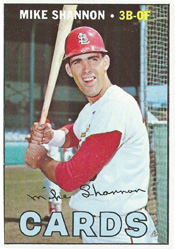
Mike Shannon and Jerry Buchek, the only St. Louis natives among the players on the 1966 Cardinals, had special roles in the first game played at Busch Memorial Stadium.

mike_shannon4On May 12, 1966, Shannon produced the first Cardinals hit and the first Cardinals RBI in the debut game at the $26 million circular stadium in downtown St. Louis. Buchek delivered a RBI-single that tied the score with two outs in the bottom of the ninth inning.

The Cardinals capped a successful evening when Lou Brock got a bases-loaded single in the 12th, giving the Cardinals a 4-3 victory over the Braves.

Sky high

A crowd of 46,048, a record for a sporting event in St. Louis at that time, turned out to see the Cardinals and their new home. Among those attending on that Thursday night were baseball commissioner William Eckert and National League president Warren Giles.

Each spectator was given a parchment “First Nighter” scroll as a souvenir. Many of the fans were dazzled by the scoreboard and its color graphics and animation. “No matter who hits a homer, the Anheuser-Busch eagle flaps its wings and a tiny, chirping redbird darts across one side of the board,” The Sporting News reported.

The seats were located farther from the field than those at the original Busch Stadium, formerly Sportsman’s Park, on North Grand Boulevard. The elevation of the upper deck was intimidating to some. “Fifteen more feet up and I’d be in heaven,” said former Cardinals manager Ray Blades.

Among the players, reviews of the stadium generally were favorable.

“This park is tailored to our type of club,” Cardinals outfielder Alex Johnson said to the Associated Press. “It’s a paradise for line drive hitters.”

Said Shannon: “There will be a lot of doubles and triples.”

Redbirds rally

Shannon had hoped his wife Judy and their four children would attend, but they couldn’t because they developed the mumps. “So Mike showed off his punch without Judy,” wrote Neal Russo of The Sporting News.

In the bottom of the first, Shannon singled against Braves starter Wade Blasingame for the first Cardinals hit. In the third, Shannon’s two-out triple off Blasingame scored Buchek from first with the first Cardinals run.

Braves leadoff batter Felipe Alou, playing on his 31st birthday, hit two solo home runs _ in the sixth off Ray Washburn and in the eighth against Tracy Stallard. The second home run gave the Braves a 3-2 lead.

In the bottom of the ninth, Alex Johnson was on third with two outs when Buchek batted against Billy O’Dell. With the count 2-and-2, Buchek swung at a pitch near his fists and looped a pop fly that fell into short right field for a single, scoring Johnson with the tying run.

As Buchek’s bloop fell safely between the Braves fielders, “a fast-retreating crowd set up a roar that would make the Metro-Goldwyn-Mayer lion sound like Mickey Mouse,” wrote St. Louis Post-Dispatch sports editor Bob Broeg.

Said Buchek: “It was a good pitch, in on me, and you’ve got to be lucky to hit the ball the way I did.”

Extra-inning drama

The Cardinals got a surprise in the 11th. Hal Woodeshick, a Cardinals relief pitcher, stroked a double off Phil Niekro. For Woodeshick, who had a career .092 batting average, it was his only extra-base hit in 11 big-league seasons. With two outs, Niekro issued an intentional walk to Julian Javier, then got Shannon to pop out to second, ending the inning.

In the 12th, the Braves threatened, putting runners on first and second, before Don Dennis escaped the jam by getting Alou to fly out to right.

The Cardinals took advantage of a Braves miscue in the bottom half of the 12th. Curt Flood led off and was hit by a Niekro pitch. Orlando Cepeda, the cleanup batter, bunted. Catcher Joe Torre fielded the ball and threw to second in a bid for a forceout. Instead, the ball sailed over the head of second baseman Frank Bolling. Flood advanced to third and Cepeda to second on the error.

After an intentional walk to Charlie Smith, filling the bases, Brock came to the plate against Niekro. With the infield drawn in for a play at the plate, Brock bounced a single up the middle, scoring Flood from third with the winning run. Boxscore

The next night, Shannon hit the first Cardinals home run at Busch Memorial Stadium. It was a solo shot off Braves starter Ken Johnson. Five days earlier, Shannon had hit the last Cardinals home run at the original Busch Stadium.

Previously: The story of the final game at original Busch Stadium

Previously: Here’s how Mike Shannon became a Cardinals catcher