Bobby Gene Smith twice opened seasons as the starting center fielder for the Cardinals. Both times, he was unable to hit consistently.
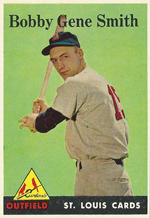 In 1957, Smith, a rookie, was the Cardinals’ starting center fielder from Opening Day through May 20. He was replaced by Ken Boyer, who moved from third base to center field.
In 1958, Boyer was back at third base and Smith again was manager Fred Hutchinson’s choice to be the Cardinals’ Opening Day starter in center field. He kept the job for a week, got sent to the minors and was replaced by rookie Curt Flood.
Top prospect
Smith signed as an amateur free agent with the Cardinals in 1952.
He had three consecutive impressive seasons in the Cardinals’ minor-league system:
_ In 1954, with Class C Fresno, Smith hit .305 with 22 triples and 107 RBI.
_ In 1955, still with Fresno, Smith batted .370 with 206 hits in 141 games.
_ In 1956, with Class AA Houston, Smith hit .299 with 21 home runs and 109 RBI.
Though he hadn’t played at the Class AAA level, Smith, 22, went to spring training in 1957 with the Cardinals and was tabbed by The Sporting News as a “standout candidate” for the starting center field job.
Rookie starter
Based primarily on his fielding in spring training, Smith was chosen by Hutchinson to supplant Bobby Del Greco as the starting center fielder.
In his major-league debut, Smith was 2-for-5, including a two-run home run off Art Fowler, in the Cardinals’ 13-4 Opening Day victory over the Reds on April 16, 1957, at Cincinnati. Boxscore
“That kid is going to be a real good one _ and for a long time,” Reds manager Birdie Tebbetts said.
However, the leap from Class AA to the big leagues proved too big of an adjustment for Smith. His batting average was .225 on May 21, 1957, when Hutchinson moved Boyer into center field and put rookie Eddie Kasko at third base.
Smith remained with the Cardinals as a reserve. On July 7, 1957, with Boyer nursing a stiff elbow, Smith got the start in center field and had his most productive game in the big leagues. Facing the Reds in the second game of a doubleheader at St. Louis, Smith was 3-for-4 with four RBI, including a three-run home run off Tom Acker. Boxscore
The highlights, though, were few for Smith. He hit .211 for the 1957 Cardinals, with 39 hits in 93 games. Smith made 41 starts in center and four starts in right.
On the move
In spring training 1958, Smith regained the center field job and was in the starting lineup when the Cardinals opened the season on April 15 at home against the Cubs.
Smith started in center in six of the first eight games for the 1958 Cardinals and batted .208. By the end of April, Flood was called up from the minor leagues, inserted as the starter in center and Smith was demoted to Class AAA Omaha, where he played for manager Johnny Keane.
In December 1959, the Cardinals traded Smith to the Phillies for catcher Carl Sawatski.
“We think he might be one of those players who develops as a hitter a little late,” Phillies general manager John Quinn said.
Three years later, on June 5, 1962, the Cardinals reacquired Smith, sending shortstop Alex Grammas and outfielder Don Landrum to the Cubs for him and infielder Daryl Robertson.
“We’re going to use Smith in the ballgames _ not as a pinch-hitter,” Keane, the Cardinals’ manager, told the St. Louis Post-Dispatch. ‘He’s going to be playing. We need right-handed hitters.”
Smith, sometimes platooning with Stan Musial in left field, hit .231 in 91 games for the 1962 Cardinals. In April 1963, the Cardinals sold Smith’s contract to the Red Sox, who assigned him to the minor leagues.
In four seasons (1957-59 and 1962) with the Cardinals, Smith hit .231 overall. In a seven-year big-league career with the Cardinals, Phillies, Mets, Cubs and Angels, Smith batted .243 with 13 home runs.
Two of those home runs were with the Phillies against the Cardinals: a two-run, pinch-hit home run off Bob Gibson on June 26, 1960, and a solo shot off Curt Simmons on Sept. 11, 1960.
Previously: Ken Boyer converted from infield to center
 On July 5, 2006, the Cardinals got Weaver from the Angels for minor-league outfielder Terry Evans. The Angels also paid $2.5 million of the remaining $4 million owed Weaver on his 2006 contract, the Los Angeles Times reported.
 In July 1966, Shannon entered the month with a .222 batting average for the season. He exited the month with a season batting mark of .304.
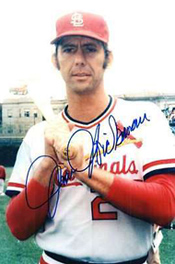 Hickman was an outfielder and first baseman for 13 years in the majors. Best known as a member of the original 1962 Mets and for an all-star season with the 1970 Cubs, Hickman grew up a Cardinals fan and was 18 when he signed with St. Louis in 1956.
 Eight different Cardinals pitchers accounted for those 12 consecutive road wins. Ten of those wins were achieved by starters, including eight complete-game efforts.
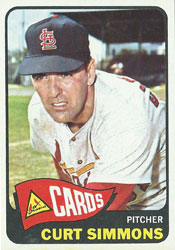 At least the Cardinals got a significant return, first baseman Orlando Cepeda, for Sadecki, 25, when they traded him to the Giants on May 8, 1966. All the Cardinals got for Simmons was cash.

