Feeds:
Posts
Comments

(Updated March 2, 2019)

Willie Crawford was acquired by the Cardinals from the Dodgers to strengthen the bench, but he exceeded expectations and became their starting right fielder, giving a good performance for a bad team.
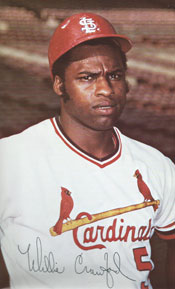
willie_crawfordOn March 2, 1976, the Cardinals traded second baseman Ted Sizemore for Crawford. The deal accommodated Sizemore, who was being displaced as the starting second baseman and wanted to play close to his home in California.

Crawford, who spent 12 seasons as a role player with the Dodgers, wanted to play regularly, but with Lou Brock in left, Bake McBride in center and Reggie Smith in right the 1976 Cardinals were set with starting outfielders.

Platoon player

In 1964, Crawford, a high school standout in Los Angeles, was signed by Dodgers scout Tommy Lasorda, the future Hall of Fame manager.

A left-handed batter, Crawford played in two World Series (1965 and 1974) for the Dodgers. He and Sizemore were teammates for two years. Sizemore won the National League Rookie of the Year Award in 1969, but was dealt to the Cardinals for slugger Dick Allen after the 1970 season.

No. 2 man

Sizemore was the Cardinals’ starting second baseman from 1971-75. Batting primarily in the No. 2 spot, he led the National League in sacrifice bunts (25) in 1973 and was second (with 21) in 1975.

In 1974, when Lou Brock had 118 stolen bases, he said, “You have to have the right man batting behind you. I do: Ted Sizemore.”

Sizemore said to the Los Angeles Times, “To bat behind a base stealer, you have to be patient, willing to take pitches and sacrifice your average, be able to make contact with two strikes, be adept in the subtle ways of hindering a catcher, and be satisfied that by helping to get that man to second base, you are doing what your team must do to win.”

By 1976, Sizemore was expendable because the Cardinals planned to shift Mike Tyson from shortstop to second base and play Don Kessinger at shortstop until Garry Templeton was ready to take over the position.

Anatomy of a deal

Sizemore told Cardinals general manager Bing Devine he intended to go to spring training in 1976 and beat out Tyson for the starting second base spot, but then changed his mind, “expressing his desire to be traded to Los Angeles if such a deal could be made,” Devine told United Press International.

Devine said he approached Dodgers executive Al Campanis and proposed a trade of Sizemore for Crawford. Because the Dodgers had Davey Lopes at second base and Bill Russell at shortstop, they projected Sizemore, 30, as a utility player.

The Cardinals and Dodgers also discussed a deal of Reggie Smith for Bill Russell, Campanis confirmed to the Los Angeles Times. The newspaper noted such a swap would give Crawford a chance to claim the Cardinals’ right field job and enable the Dodgers to move Davey Lopes to shortstop, opening up second base for Sizemore.

However, Campanis said the Cardinals opted “to stand pat (with Smith) until later in the spring,” the Los Angeles Times reported. “The Cardinals also expressed the opinion the Dodgers would have to part with more than Russell” for Smith.

(Three months later, in June 1976, the Cardinals sent Reggie Smith to the Dodgers for catcher Joe Ferguson and two minor-leaguers.)

Crawford, 29, told the Los Angeles Times he “never had the type of communications” with Dodgers manager Walter Alston “that I should have, but I don’t leave with ill feelings. I simply feel there was a need for a change of scenery. I was in a rut.”

Times columnist Jim Murray wrote, “Willie’s is a classic case of arrested athletic development. A big-muscled, powerful young man … Willie Crawford … has the body and configuration that must be used every day to stay at peak efficiency.”

Hot hitter

Crawford quickly fit in with the 1976 Cardinals. During spring training, The Sporting News reported, Crawford took over retired pitcher Bob Gibson’s role of “clubhouse and on-field needler.”

Over the first two weeks of the 1976 regular season, Crawford was used exclusively as a pinch-hitter by manager Red Schoendienst. On April 25, Schoendienst moved Reggie Smith to third base, replacing struggling rookie Hector Cruz, and put Crawford in right field. Crawford responded by batting .438 in April and .326 in May. After the Cardinals traded Smith to the Dodgers, Crawford got the most starts in right.

Strong season

Crawford completed the 1976 season with a .304 batting mark and .360 on-base percentage. His batting average against right-handers was .313.

Crawford hit nine home runs and produced 50 RBI, but consistent run production was a weakness. Crawford hit .225 with runners in scoring position, according to baseball-reference.com.

After the 1976 Cardinals finished 72-90, Schoendienst was fired and the club looked to make other changes.

Planning to move Cruz to right field in 1977, the Cardinals traded Crawford, pitcher John Curtis and utility player Vic Harris to the Giants for pitchers Mike Caldwell and John D’Acquisto and catcher Dave Rader in October 1976.
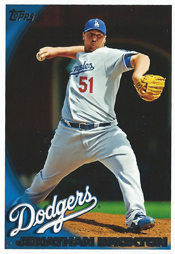
In his debut series as a major-league pitcher, Jonathan Broxton handled Albert Pujols just fine. It was John Rodriguez who gave the big rookie trouble.

jonathon_broxtonIn 2016, Broxton, 31, entered his 12th year in the big leagues and his second as a Cardinals reliever.

The right-hander, an imposing 6 feet 4 and 305 pounds, is seeking an encore to his Cardinals performance in 2015, when he posted a 2.66 ERA in 26 appearances and struck out 26 in 23.2 innings after being acquired from the Brewers on July 31.

Broxton has built a solid big-league resume (3.23 ERA, 118 saves) since making his debut against the Cardinals a month after turning 21.

Right stuff

A second-round selection of the Dodgers in the 2002 amateur draft, Broxton began the 2005 season with Class AA Jacksonsville. Under manager John Shoemaker, Broxton was converted from a starter to a reliever. The transformation led to an increase in the velocity of Broxton’s fastball. It was recorded as high as 101 mph on the speed gun.

Before a series against the Cardinals at Dodger Stadium on the last weekend of July 2005, Broxton got the call to come to Los Angeles.

Asked why the Dodgers would have Broxton skip Class AAA and jump directly to the big leagues, Dodgers general manager Paul DePodesta told MLB.com, “Because he throws 101. He has the perfect makeup for the bullpen. After his first game pitching relief, he came back to the dugout and said, ‘I could do this the rest of my career.’ He just took off in the role and made himself a major league-ready pitcher.”

Debut game

On July 29, 2005, Broxton’s first night in the big leagues, the Dodgers led the Cardinals, 5-4, after five innings when manager Jim Tracy opted to replace starter Brad Penny with Broxton.

The first batter Broxton faced, David Eckstein, singled to center. The next, Abraham Nunez, also singled to center, moving Eckstein to second base.

Pujols, the Cardinals’ best hitter, stepped to the plate.

Broxton struck out Pujols on a pitch described by Matthew Leach of MLB.com as “a biting slider.”

“It was my first time facing the guy and that’s always tough,” Pujols said.

Broxton still wasn’t out of trouble.

With Jim Edmonds at the plate, Broxton unleashed a wild pitch, enabling Eckstein to move to third and Nunez to second.

Tracy ordered an intentional walk to Edmonds, loading the bases for Rodriguez.

A left-handed batter, Rodriguez, 27, had made his big-league debut with the Cardinals 11 days earlier on July 18.

Rodriguez hit a sacrifice fly to right, scoring Eckstein with the tying run.

Broxton limited the damage by striking out Mark Grudzielanek, ending the inning.

Passing grade

In the seventh, Duaner Sanchez relieved Broxton, held the Cardinals scoreless and got the win when the Dodgers scored twice in the bottom half of the inning off starter Matt Morris. Boxscore

“Despite displaying a 96 mph fastball as advertised, Broxton admitted to feeling jittery and pitched that way,” wrote Ken Gurnick of MLB.com.

Asked why he had Broxton make his debut in a pressure situation, Tracy replied, “It was quite a test and he passed. What are you going to wait for? A seven- or eight-run lead? You can’t find out much then. In situations like this, you find out about ability, about character, about poise. He passed. He handled it extremely well.”

The game was attended by Broxton’s father, who coached his son from T-ball through middle school in Georgia.

“I’ve always dreamed of getting to this level and it was great having him there to share it,” Broxton said in the book “Major League Dads.”

Back-to-back

The next night, July 30, Tracy called on Broxton again.

This time, the situation was different, though the batters were the same.

With the Cardinals ahead, 8-4, Broxton, the Dodgers’ fourth pitcher of the game, entered to work the eighth.

Eckstein led off and flied out to center. Nunez walked.

Again, Broxton struck out Pujols. (Through 2015, Pujols had a career .143 batting average, 3-for-21, against Broxton.)

Edmonds walked and Nunez advanced to second.

With a runner in scoring position, Rodriguez delivered again, singling to right and scoring Nunez.

Like the previous night, the inning ended with Broxton striking out Grudzielanek. Boxscore

Broxton would finish the 2005 season with a 1-0 record, 5.93 ERA and 22 strikeouts in 13.2 innings for the Dodgers.

Through 2015, his career numbers versus the Cardinals: 2.47 ERA, six saves and 40 strikeouts in 40 innings pitched.

Previously: Dodgers rake Tom Poholsky for 14 singles, lose to Cardinals

In 2002, when the Cardinals signed their first Asian-born player, outfielder So Taguchi of Japan, the results weren’t immediately favorable. Taguchi experienced demotions and failure before he adjusted to American professional baseball. To his credit, Taguchi persevered and developed into a productive major leaguer who contributed to championship teams.

so_taguchi2An award-winning fielder, Taguchi was a 10-year veteran of the Japan Pacific League when he rejected two multi-year offers to remain in Japan, deciding instead he wanted to test his skills in the United States.
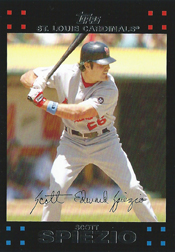
An agent, Alan Nero, arranged through an international scouting service for Taguchi to work out for big-league clubs in Arizona in November 2001. Two Cardinals scouts, Joe Sparks and Marty Keough, attended the workout and filed glowing reports, according to the St. Louis Post-Dispatch.

The Yankees, Rangers and Diamondbacks made offers to Taguchi, but the Cardinals’ proposal was the best: a $600,000 signing bonus and a three-year contract with a base salary of $1 million per year.

When the Cardinals announced the deal in January 2002, Taguchi, 33, became the third Japanese position player to sign with a big-league club in the United States, joining outfielders Ichiro Suzuki of the Mariners and Tsuyoshi Shinjo of the Giants.

Bill DeWitt, owner of the Cardinals, hailed the signing of their first Asian-born player as “a new day for the organization.”

Leap of faith

Entering spring training, the Cardinals had decided to move Albert Pujols from left field to third base. Taguchi was seen as a candidate for the open outfield spot.

Though neither general manager Walt Jocketty nor manager Tony La Russa had seen Taguchi play, La Russa said, “We trust our scouts.”

Jocketty said it was “very possible” Taguchi would be the left fielder for the 2002 Cardinals. A more cautious La Russa said, “We’ll see where he fits in the mix.”

Taguchi, who asked for uniform No. 6., the same he’d worn in Japan, settled on No. 99 after being told No. 6 had been retired in honor of Stan Musial.

Placido Polanco, Kerry Robinson, Al Martin, Eli Marrero and Eduardo Perez were Taguchi’s competition for the starting left field job.

“I absolutely feel at this stage of my career I can develop more and be an even better player,” Taguchi said.

He told Joe Strauss of the Post-Dispatch he accepted less money to play in the United States than he would have gotten to stay in Japan because “there are some things that matter more than money. I wanted to measure myself.”

Overmatched

After observing Taguchi in spring workouts and intrasquad games, La Russa said, “He’s a solid defensive player who knows how to run the bases. The question about him is how well he hits.”

Said Jocketty: “We’re not expecting him to hit home runs. We think So truly does the little things to help win a game.”

Once exhibition games began, Taguchi struggled. He went hitless in his first 14 exhibition game at-bats and never recovered.

Taguchi was batting .125 (4-for-32) in the exhibition season when Rick Hummel of the Post-Dispatch wrote, “The Taguchi experiment has been a huge mistake … He has seemed like a high schooler in being overmatched by ordinary pitchers.”

According to Strauss, Taguchi “never drove a pitch as far as the warning track in batting practice.”

Before an exhibition game with the Orioles, La Russa had a long conversation with Taguchi in the dugout and informed him the Cardinals wanted to send him to Class AAA Memphis. Taguchi had an escape clause in his contract that allowed him to become a free agent rather than accept an assignment to the minors. He impressed the Cardinals by agreeing to report to Memphis.

“I am going to stay to see this through,” said Taguchi, whose spring training batting average was .146 at the time of his reassignment. “I want to play in St. Louis. I want to play for this organization. I want to play for Tony La Russa.”

Said La Russa: “He believes he can play in this league and is prepared to show it.”

Champion Cardinal

After demoting Taguchi, the Cardinals decided to open the season with Pujols in left field and Polanco at third base.

In June 2002, Taguchi was called up to the Cardinals and made his big-league debut against the Mariners and his former Japan teammate, Suzuki, in Seattle. Taguchi appeared in four games before he was sent back to Memphis.

In August, Taguchi was dropped a level to Class AA New Haven.

Taguchi fought his way back, hitting .308 in 26 games with New Haven. He was called up to the Cardinals in September. In 19 games with the 2002 Cardinals, Taguchi hit .400 (6-for-15).

Showing steady improvement, Taguchi played six years with the Cardinals, batting .283. He helped the Cardinals win two National League pennants (2004 and 2006) and a World Series championship (2006).

In eight seasons in the majors (Cardinals, Phillies and Cubs), Taguchi hit .279. He had a .331 career batting average with runners in scoring position.

Scott Spiezio had the pedigree, the championship experience and the right amount of nonconformity to appeal to the Cardinals. What they didn’t know when they invited him to spring training was whether he still could produce.

scott_spiezioOn Feb. 17, 2006, the Cardinals signed Spiezio, a free agent, to a minor-league pact and brought him to camp at Jupiter, Fla., to compete for a utility role with the big-league club.
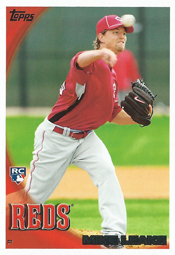
“There is a chance to give him some at-bats and see what he’s got,” Cardinals manager Tony La Russa said to the St. Louis Post-Dispatch.

The low-risk gamble yielded a big return for the Cardinals. Spiezio, 33, impressed in spring training, earned a spot on the Cardinals’ Opening Day roster and contributed to St. Louis winning its first World Series title in 24 years.

Based on what Spiezio had done the previous two seasons, it was hard to envision him having the success he did with the 2006 Cardinals.

Happy in a halo

In 2002, as first baseman for the Angels, Spiezio batted .285 with 82 RBI. In the postseason against the Yankees, Twins and Giants, he batted .327 with 19 RBI, helping the Angels to their lone World Series championship.

Spiezio drove in 83 runs for the 2003 Angels before becoming a free agent and signing with the Mariners. Limited by back problems, Spiezio’s career nosedived in Seattle. He hit .215 in 2004 and .064 in 2005.

The Mariners released him in August 2005 and no team showed interest until the Cardinals signed him six months later on the eve of spring training.

Open audition

St. Louis was seeking a replacement for John Mabry, who performed as a backup at first base, third base and in the outfield for the 2005 Cardinals before becoming a free agent and signing with the Cubs.

To replace Mabry, the Cardinals looked outside the organization. In December 2005, they signed Brian Daubach, 33, a free agent who had played in the big leagues with the Marlins, Red Sox, White Sox and Mets.

Daubach hit 20 or more homers in each of four consecutive seasons (1999-2002) with the Red Sox. He had spent most of the 2005 season with the Mets’ Class AAA club at Norfolk, hitting .325 with 16 home runs.

Spiezio was signed to provide competition for Daubach. A switch hitter, Spiezio could play first base, third base, second base and outfield. Daubach, a left-handed batter, primarily was a first baseman and outfielder.

All in the family

A Belleville, Ill., native, Daubach had been a Cardinals fan as a youth.

Spiezio, a native of Joliet, Ill., was the son of a Cardinals player. Ed Spiezio was a third baseman and outfielder who played five years (1964-68) with the Cardinals and appeared in two World Series (1967-68) for them.

When Scott Spiezio showed up at Cardinals training camp in 2006, he was assigned uniform number 26, the same his father had worn for St. Louis.

Good guy

Scott Spiezio also turned some heads at camp with his appearance. His left arm was covered with a tattoo displaying the full body image of his wife, Jennifer. A tuft of hair _ called a soul patch _ below his lip and above his chin was dyed red in tribute to the Cardinals.

“We’ve got some reports he can be a little bit off the wall,” Cardinals general manager Walt Jocketty said to Post-Dispatch writer Joe Strauss. “But he’s also a good guy. We don’t want to bring guys in here who are jerks. It’s something we research very heavily before we acquire a player.”

Cardinals shortstop David Eckstein, who was Spiezio’s teammate with the Angels, vouched for him, saying, “Scott is a hard-nosed guy who really understands and loves playing the game … He wants to win.”

Said Spiezio: “I just like to have fun. You’ve got to remember it’s just a game.”

Making the grade

Spiezio got five hits in his first six spring training game at-bats.

“We’re watching him really closely,” La Russa said. “He’s smart enough to know that he doesn’t have a real long leash. I’m impressed with the life in his body.”

Daubach hit well in Cardinals exhibition games, but Spiezio’s ability to play both corner infield positions gave him an edge. Daubach was sent to Class AAA Memphis and Spiezio earned a spot with the Cardinals as a backup to Albert Pujols at first and Scott Rolen at third.

Ed Spiezio and Scott Spiezio became the third father and son to play for the Cardinals. The others were outfielder Ed Olivares and his son, pitcher Omar Olivares, and pitchers Pedro Borbon and Pedro Borbon Jr.

Up, then down

In 2006, Spiezio hit .272 with 13 home runs and 52 RBI in 119 games for the Cardinals. He hit .318 versus left-handers, but produced all of his home runs against right-handers.

Spiezio played in 38 games at third base, 35 in left field, 13 at first base, eight at second base and five as designated hitter for the 2006 Cardinals.

In 2007, Spiezio underwent treatment for substance abuse and missed more than a month of the season. In December 2007, he was involved in a car crash in California. Two months later, aftr a warrant was issued for Spiezio and he was charged with drunken driving and assault, the Cardinals released him.

Regarding the club’s decision, La Russa told the Associated Press, “I think it’s a consistent message about what the team represents.”

(Updated Dec. 21, 2024)

Matched against a big-game pitcher in an atmosphere overloaded with emotion, Reds rookie Mike Leake unraveled versus the Cardinals.

mike_leakeOn Aug. 9, 2010, Reds manager Dusty Baker gave Leake the start in the opener of a showdown series against the Cardinals at Cincinnati. St. Louis manager Tony La Russa countered with an ace, Chris Carpenter.

After a scoreless duel for three innings, Leake cracked. He yielded seven runs in the fourth and became unnerved, losing track of the number of outs and heading toward the dugout before being sent back to the mound.

Emboldened, the Cardinals won the game, swept the series and overtook the Reds for first place in the National League Central Division.

Five years later, on Dec. 22, 2015, Leake, a free agent, signed with the Cardinals.

Queen City drama

In 2010, the Reds were seeking their first NL Central title in 15 years. On the morning of Aug. 9, they held a two-game lead over the second-place Cardinals entering a three-game series against them.

The tension between the division rivals, already high, was intensified that day by two developments:

_ Reds general manager Walt Jocketty acquired Jim Edmonds from the Brewers for outfielder Chris Dickerson.

Jocketty won two NL pennants and a World Series title as Cardinals general manager before he was fired after the 2007 season. Edmonds was the Cardinals’ center fielder on those championship clubs, but was traded after Jocketty left.

Edmonds joined four other former Cardinals _ third baseman Scott Rolen, infielder Miguel Cairo and pitchers Russ Springer and Mike Lincoln _ on the Reds.

_ In an interview with Hal McCoy of the Dayton Daily News, Reds second baseman Brandon Phillips lit into the Cardinals. McCoy posted the comments online before the game and the Cardinals read the remarks.

Said Phillips of the Cardinals, “All they do is bitch and moan about everything, all of them. They’re little bitches … I really hate the Cardinals. Compared to the Cardinals, I love the Chicago Cubs. Let me make this clear: I hate the Cardinals.”

Schumaker slam

Dusty Baker started a lineup that night with Phillips in the leadoff spot, Rolen at cleanup and Edmonds, in his Reds debut, batting fifth.

The Cardinals focused on trying to lay off Leake’s sinker and get him to deliver pitches up in the strike zone.

In the fourth, the Cardinals produced six hits and six runs on 12 pitches. Jon Jay doubled and Albert Pujols, Matt Holliday, Colby Rasmus and Yadier Molina each singled. The hits by Holliday and Rasmus each drove in a run. Molina’s single loaded the bases for Skip Schumaker, who was playing his first game since spraining his left wrist Aug. 3.

Schumaker swung at Leake’s first pitch and drove the ball 408 feet over the wall in left-center field for his first career grand slam, giving St. Louis a 6-0 lead.

Dazed and confused

“They got six in a span of 12 pitches,” Baker said to the Associated Press. “It happened so quickly that I didn’t have time to get anybody warmed up.”

After Schumaker’s slam, Leake fanned two batters, jogged off the mound and was at the foul line before he realized there were two outs, not three.

Leake returned, pitched to Felipe Lopez, who singled, and got yanked. Reliever Carlos Fisher walked Jay and yielded a single to Pujols, scoring Lopez. That run was charged to Leake, whose final line showed seven runs allowed in 3.2 innings.

Good plan

In the St. Louis Post-Dispatch, Joe Strauss wrote, “The Cards perfectly executed an early attack against Leake … They noticed a flattening of Leake’s assortment in his previous start and adopted a very aggressive tact.”

The Cardinals won, 7-3, and moved within a game of the Reds. Boxscore

Phillips was 0-for-5. Edmonds and Rolen also were hitless.

“I’m guessing Phillips really hated seeing Schumaker hit the grand slam, a massive hit that wasn’t very Cubs-like,” wrote columnist Bernie Miklasz.

Tempers flare

The next night, Aug. 10, Phillips sparked a brawl when, in the batter’s box, he used his bat to tap Molina’s shin guards. Molina responded angrily, both benches emptied and the fight carried to the backstop.

Reds pitcher Johnny Cueto kicked Cardinals catcher Jason LaRue in the head and he also kicked Carpenter in the back. Baker and La Russa were ejected.

The Cardinals won that game, 8-4, and moved into a tie with the Reds for first place. Boxscore

(Asked about the incident with Phillips, Molina said to Stan McNeal in an interview for the 2019 Cardinals Yearbook, “Moments like that are going to happen. We spent time together at the All-Star Game {the next year}, and we talked. I met his family. He met mine. We’re good.”)

On Aug. 11, the Cardinals completed the sweep with a 6-1 triumph. Rasmus hit a grand slam off Bronson Arroyo, Adam Wainwright pitched seven shutout innings and the Cardinals had first place to themselves.

The Reds, though, recovered and went on to win the division title, finishing five games ahead of the runner-up Cardinals.


(Updated Oct. 26, 2024)

Needing a closer, the 1996 Cardinals wanted Dennis Eckersley. What they didn’t want was the obligation to pay his entire salary.

dennis_eckersley3When the Athletics agreed to pay part of the sum and Eckersley agreed to defer much of the rest, the Cardinals agreed to a deal.

On Feb. 13, 1996, the Cardinals got Eckersley from the Athletics for reliever Steve Montgomery.

Eckerlsey, 41, was under contract to receive $2.2 million in 1996.

To make the trade, all sides agreed to this arrangement: The Athletics would pay him $700,000, the Cardinals would pay him $500,000 and Eckersley would defer $1 million to another year, the St. Louis Post-Dispatch reported.

Sticking together

Looking to rebuild after finishing in last place in 1995, the Athletics were eager to grant Eckersley’s request to be traded to St. Louis. Eckersley sought to be reunited with manager Tony La Russa and pitching coach Dave Duncan.

Eckersley was transformed from a starter to a closer by La Russa and Duncan after he was traded to the Athletics by the Cubs in April 1987. With Eckersley reliably sealing wins, the Athletics won three consecutive American League pennants and a World Series title from 1988-90.

Asked about La Russa by Chicago Tribune columnist Jerome Holtzman, Eckersley said, “I respect everything about him.”

Because he had pitched in the big leagues for at least 10 years, including the last five in a row with one club, Eckersley could veto a trade.

“If he goes elsewhere, it’ll be St. Louis,” Athletics general manager Sandy Alderson told The Sporting News. “It won’t be anywhere else.”

Experience wanted

La Russa, who left the Athletics after the 1995 season to become manager of the Cardinals, told Rick Hummel of the Post-Dispatch he was “hoping” Eckersley could be acquired by the time training camp opened at St. Petersburg, Fla. Acknowledging that negotiations were held up, La Russa added, “I don’t know if it can happen.”

Eckersley had one of his worst seasons in 1995. Though he earned 29 saves in 38 chances, Eckersley had a 4.83 ERA in 52 appearances. It was his third consecutive season with an ERA above 4.00. From 1988 through 1992, Eckersley posted ERAs below 3.00 each year.

“Eck has got plenty left physically,” La Russa said. “Mentally and emotionally, he’s still at the top of his game.”

Tom Henke, who had 36 saves and a 1.82 ERA for the 1995 Cardinals, had retired, leaving St. Louis without an established closer.

The Cardinals envisioned Eckersley as a fit for the role while a pair of potential successors, T.J. Mathews and John Frascatore, continued to develop.

Oakland connections

After the deal was made, La Russa said, “We’re getting a guy who will be anywhere from good to great as a closer this year.”

Said Eckersley: “To be an effective closer, you have to have a manager who knows how to use you.”

It also helped that Dave Duncan was there, too. Eckersley described Duncan to Stan McNeal of Cardinals Magazine this way: “He was analytics before analytics.”

“I had been in the big leagues a long time, but when Duncan said something, I listened,” Eckersley told McNeal. “He was a calming force. You know how it is when you trust somebody implicitly? That was me with Duncan.”

The Athletics reportedly wanted Mathews _ who would be dealt to Oakland a year later for slugger Mark McGwire _ but settled for Montgomery, 25, a prospect who earned 36 saves for manager Mike Ramsey at Class AA Arkansas in 1995.

“This was more to accommodate Dennis than acquire Steve,” Alderson told the San Francisco Chronicle. “… This is what Dennis wanted and, given where we are, this is probably best for us, too.”

Eckersley joined Rick Honeycutt, Mike Gallego and Todd Stottlemyre as former Athletics the Cardinals acquired since La Russa became their manager.

“I was 41 when I was traded to the Cardinals, but Tony and Duncan still trusted me,” Eckersley told Cardinals Magazine. “I can’t imagine having gone to another regime and trying to make my mark at that point in my career.”

Eckersley pitched two seasons for the Cardinals. He had 30 saves in 38 chances (0-6 record, 3.30 ERA) in 1996. He followed that with 36 saves in 44 chances (1-5 record, 3.91 ERA) in 1997.

In two years with the Athletics, Montgomery was a combined 1-1 with a 9.45 ERA. He also pitched for the 1999 Phillies and 2000 Padres.