Feeds:
Posts
Comments

If Jedd Gyorko hits as well for the Cardinals as he did against them, St. Louis will have added a productive batter to its lineup.
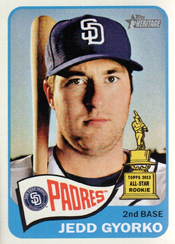
jedd_gyorkoAcquired by the Cardinals from the Padres in a trade for outfielder Jon Jay on Dec. 8, 2015, Gyorko entered the 2016 season as a versatile infielder who can perform at second base, shortstop and third base.

His career batting average versus the Cardinals is .342 (25-for-73), with five home runs and 16 RBI in 20 games.

Two of Gyorko’s best games came against the Cardinals in 2014.

Here is a look at those performances:

Sweet swing

Batting sixth and playing second base, Gyorko was 3-for-5 with four RBI and two runs scored against the Cardinals in a 12-1 Padres victory at San Diego on July 30, 2014.

He got a hit apiece off three pitchers.

Gyorko began his barrage with a solo home run in the fourth inning off starter Joe Kelly.

“Pitches were up that should have been down,” Kelly told the Associated Press.

In the sixth, Gyorko singled off Carlos Martinez. An inning later, with the bases loaded and one out, Gyorko hit a three-run double off Seth Maness, giving San Diego a 9-1 lead.

‘It was probably our ugliest loss of the year,” said Cardinals manager Mike Matheny.

Gyorko had been activated two days earlier after a 44-day stint on the disabled list because of foot problems.

“It obviously feels good to swing the bat the way I wanted to,” Gyorko said. “It feels a lot like how I was swinging it there at the end of the year last year. It’s something to build on, but I still have a long way to go.” Boxscore

Grand game

Two weeks later, on Aug. 16, 2014, at St. Louis, Gyorko hit a grand slam, lifting the Padres to a 9-5 victory over the Cardinals.

Batting fifth and playing second base, Gyorko was 2-for-3 with five RBI, two runs scored and two walks.

In the third, Gyorko’s two-out, RBI-single off Shelby Miller scored Abraham Almonte from third base, sparking a four-run Padres inning and tying the score at 4-4.

Said Miller: “Unacceptable. Obviously, it doesn’t sit well with me. I should have done a better job of making pitches.”

The Cardinals led, 5-4, entering the seventh. With one out and the bases loaded, Gyorko connected on a 94-mph fastball from reliever Kevin Siegrist, launching a grand slam over the left field wall and giving the Padres an 8-5 lead.

“It was a fastball down and in,” Gyorko said. “It probably wasn’t a bad pitch. I just put a good swing on it.”

The home run was the 31st of Gyorko’s big-league career, moving him past Mark Loretta as the Padres’ all-time home run leader as a second baseman.

“That’s a credit to the guys hitting in front of me,” Gyorko told the San Diego Union-Tribune. “Really, they are doing a great job of getting on base. I just have to capitalize more like tonight.”

The grand slam was the third of Gyorko’s big-league career and the only one yielded by Siegrist with the Cardinals. Boxscore

Afterward, Siegrist was demoted to the minor leagues and Martinez was recalled from Class AAA Memphis to replace him.

Said Matheny of Siegrist: “He feels physically strong, but there’s just something that’s a click off.”

Previously: Cards steals leader Jon Jay plays similar to Wally Moon

Previously: Jon Jay matched Curt Flood as flawless in center
(Updated Nov. 10, 2023)

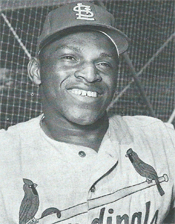
When Walt “No Neck” Williams played in the Cardinals’ system, he was hailed as the best hitter in the minor leagues and was said to have the potential to be the next Minnie Minoso.

walt_williamsThough he impressed the Cardinals, he never played for them at the major-league level.
The Cardinals were stocked with premier outfielders such as Lou Brock and Curt Flood, with prospects such as Bobby Tolan waiting in reserve. When the Cardinals acquired Roger Maris from the Yankees in December 1966, Williams was deemed expendable.

On Dec. 14, 1966, the Cardinals traded Williams and reliever Don Dennis to the White Sox for catcher Johnny Romano and minor-league pitcher Leland White.

Rushed to majors

At 19, Williams signed with the Houston Colt .45s, got sent to the Class A level of the minor leagues and batted .341 in 1963.

At spring training in 1964, Williams, 20, impressed the Colt .45s _ he nailed three runners at home with his outfield throws _ and opened the regular season in the major leagues.

Williams told The Sporting News it was during this time someone in the front office gave him the nickname of “No Neck.”

At 5 feet 6 and 190 pounds, Williams was described by one writer as “built along the lines of a fireplug,” creating a perception his head was touching his shoulders.

In his book “Five Seasons,” Roger Angell wrote that Williams had “the shoulders and chest of a heavyweight prizefighter. At the plate, he stands with his arms and shoulders raised high, peering at the pitcher over his left biceps, and waggles the bat fiercely.”

Williams, hitless in nine at-bats for the Colt .45s, was placed on waivers in May 1964 and claimed by the Cardinals, who assigned him to Class A Winnipeg.

Coached by Cardinals

Williams batted .318 at Winnipeg, went to the Florida Instructional League after the season, got guidance from manager George Kissell and hit .320 for the instructional league team.

In 1965, Williams was moved up a level to Class AA Tulsa and hit safely in his first 18 games. Williams finished the 1965 season with a .330 batting average, 36 stolen bases and 106 runs scored.

In 1966, Tulsa joined the Class AAA Pacific Coast League and Williams, playing left field, had another stellar season there. He led the league in batting average, hitting .330 for the second consecutive season, and produced 54 doubles and 25 steals with 107 runs scored.

Asked about the 1966 team in a 1981 interview with the Tulsa World, Williams said, “That year was one of the high moments of my career. The thing I remember about that 1966 team was that we had six or seven guys hitting over .300 but nobody was envious of the other. It was just a fun season.”

Change in plans

Cardinals general manager Bob Howsam and manager Red Schoendienst considered promoting Williams to St. Louis during the 1966 season, The Sporting News reported, but opted to have him stay at Tulsa, knowing he was unlikely to get at-bats on a club featuring outfielders Brock, Flood and Mike Shannon.

Based on his minor-league success, Williams was rated likely to win a spot with the 1967 Cardinals until the club acquired Maris on Dec. 8, 1966. The Cardinals planned to move Shannon to third base and start Maris in an outfield with Brock and Flood.

A week later, Williams was dealt to the White Sox.

“Williams should be a crowd pleaser,” Howsam said. “When you take a look at our outfield picture, you can see why we could afford to deal him.”

Hit man

The White Sox expected Williams to contend for the American League Rookie of the Year Award in 1967. “We picked up the best hitter in the minor leagues,” said White Sox general manager Ed Short.

Comparisons were made to Minoso, an all-star outfielder who six times batted better than .300 for the White Sox in a career that led to election to the Baseball Hall of Fame.

“White Sox officials believe they may just have another Minnie Minoso in No Neck Williams,” The Sporting News declared.

Les Moss, manager of the White Sox’s Class AAA Indianapolis team, had seen Williams play for Tulsa and said, “He’s the nearest thing to Minnie in his hustle, desire and aggressiveness that I’ve seen around anywhere. He’s no power hitter, but he can whack that ball. He’s an excellent leadoff man.”

Said Tulsa manager Charlie Metro: “The White Sox got themselves a fine-looking prospect. He not only was the best hitter in the league, but he’s a pretty fair outfielder … He overcomes mistakes with his speed.”

No fooling around

Williams hit .358 in spring training for the 1967 White Sox and was named Opening Day starting left fielder by White Sox manager Eddie Stanky.

“He’s really an aggressive hitter,” Stanky said. “He doesn’t fool around up there at the plate. He attacks the ball. He’s one of the few players who can tie into a high pitch and whack it for a line drive.”

Williams, 23, hit .240 as a White Sox rookie. He went on to play 10 years in the majors for the Colt .45s, White Sox, Indians and Yankees, batting .270 overall. His best season was in 1969 when he hit .304 for the White Sox and ranked third among American League right fielders in assists.

Looking back at his time in the majors, Williams told the Tulsa World, “I felt they never gave me a chance to relax to see me really play at my best.”

Neither of the players acquired by the Cardinals for Williams contributed much. Romano, a backup to catcher Tim McCarver, hit .121 in 24 games for the 1967 Cardinals and was released after the season. White, a left-hander, never appeared in a big-league game for St. Louis.

With Brock, Flood and Maris in the outfield and Shannon at third base, the 1967 Cardinals won the National League pennant and World Series championship.

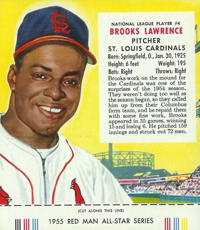
Brooks Lawrence, a 15-game winner as a Cardinals rookie pitcher in 1954, was their Opening Day starter in 1955, but he was weak from a bleeding ulcer, slumped and got demoted to the minor leagues.

brooks_lawrenceThe Cardinals decided Lawrence wouldn’t regain the effectiveness he had as a rookie.
On Jan. 31, 1956, the Cardinals traded Lawrence and pitcher Sonny Senerchia to the Reds for reliever Jackie Collum. It was the first deal general manager Frank Lane made since he joined the Cardinals in October 1955.

It turned out the Cardinals gave up on Lawrence too soon.

With his strength back and his ulcer under control, Lawrence pitched for the Reds in 1956 the way he had as a Cardinals rookie.

Long road to majors

In 1943, after graduating from high school in Springfield, Ohio, Lawrence joined the Army and served in the Pacific. He was awarded a Bronze Star for using a machine gun to fight off an enemy plane attacking U.S. soldiers. After military service, he attended Miami University in Ohio in 1947. Two years later, he began his professional pitching career in the Cleveland Indians’ farm system.

The Reds acquired Lawrence from the Indians in October 1953 on the recommendation of former Cardinals catcher Mickey Owen, who managed Lawrence in the winter league at Puerto Rico and taught him to throw a slider and a changeup. The Reds left Lawrence exposed in the 1953 minor-league draft and the Cardinals claimed him.

Lawrence opened the 1954 season with the Cardinals’ Class AAA club at Columbus, Ohio, and was promoted to St. Louis in June 1954.

Milestone performance

In his major-league debut against the Pirates at Pittsburgh, Lawrence, 29, started, pitched a four-hitter and became the first African-American pitcher to earn a win for the Cardinals. Boxscore

In 35 appearances for the 1954 Cardinals, Lawrence was 15-6 with a 3.74 ERA. He was adept at starting (9-2, 3.85 ERA) and relieving (6-4, 3.25 ERA).

Against the Cubs that season, Lawrence was 3-0 with a 1.82 ERA.

Medical emergency

Shortly after the 1954 season, Lawrence collapsed at his Springfield, Ohio, home. “I was coming out of the bathroom and passed out from loss of blood,” he told The Sporting News.

Diagnosed with a bleeding ulcer, Lawrence needed eight transfusions and spent 10 days in a hospital. “The doctor told me that if they had waited a half hour longer to bring me to the hospital it would have been too late,” Lawrence said.

According to The Sporting News, Lawrence was placed on a strict diet of milk, cream and baby food.

“I reported for spring training in 1955 weighing 217 pounds,” Lawrence said. “That’s about 12 pounds more than I usually weigh. I was healthy and looked it, but I wasn’t strong.”

Shaky season

Lawrence was the choice of manager Eddie Stanky to be the 1955 Cardinals’ Opening Day starter at Chicago against the Cubs, but he was shelled for five runs and lifted before he could complete the first inning. Boxscore

The poor start foreshadowed his season. In 46 games, including 10 starts, for the 1955 Cardinals, Lawrence was 3-8 with a 6.56 ERA.

He was equally bad as a starter (2-5, 6.58 ERA) and as a reliever (1-3, 6.55 ERA).

Against the Cubs that season, Lawrence was 0-3 with an 11.37 ERA.

After Lawrence was demoted to the minor leagues in August, Harry Walker, who had replaced Stanky as manager, said, “He’s a good man and I hope he proves again that he’s a good pitcher.”

Lawrence finished the season on an upswing, posting a 5-1 record and 2.37 ERA for Class AAA Oakland of the Pacific Coast League.

Change environment

After the 1955 season, Lane was tasked with rebuilding a club that finished 68-86.

Lane asked his Reds counterpart, Gabe Paul, about a pair of former Cardinals, Collum and third baseman Ray Jablonski. “When I heard what he wanted in return,” Lane said, “I told him he must have been the key man in the Brink’s holdup.”

Paul countered by saying Lane “was too much in love with St. Louis major- and minor-leaguers” to strike a deal.

Columnist Dick Young reported Paul contacted Lawrence “to ascertain that the pitcher’s ulcers have not been kicking up.”

Cardinals doctors declared Lawrence cured of ulcers, The Sporting News reported.

Said Lawrence: “There was nothing wrong with my arm last year. That ulcer was the trouble.”

Make a deal

The trade was made when Lane agreed to take only Collum in exchange for Lawrence and Senerchia.

“It’s not earth-shaking,” Lane said to United Press, “but it’s a start.”

Surprised, Lawrence said he thought the Cardinals “would have at least given me a good look” in spring training.

Lawrence worked for the water department in Springfield that winter and said, “I operated an air hammer. That takes the fat off you.”

Collum, who had pitched for the Cardinals from 1951-53 and was 9-8 for the 1955 Reds, “is not a great pitcher, but he’s a great competitor,” Lane said.

Used mostly in relief with the 1956 Cardinals, Collum was 6-2 with seven saves and a 4.20 ERA.

Lawrence won his first 13 decisions with the 1956 Reds and finished the season 19-10 with a 3.99 ERA.

Previously: The debut of Bill Greason, first black Cardinals pitcher

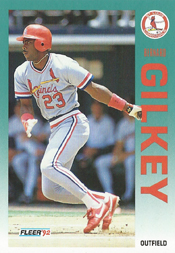
Deemed too expensive to be a reserve and not enough of a power hitter to remain the everyday left fielder, Bernard Gilkey no longer fit into the Cardinals’ plans.

bernard_gilkey3Looking to restock their farm system, the Cardinals were offered packages of prospects by the Mets, White Sox and Royals for Gilkey.
On Jan. 22, 1996, the Cardinals traded Gilkey, 29, to the Mets for three minor-league players: right-handed pitchers Eric Ludwick and Erik Hiljus and outfielder Yudith Ozorio.

In the short term, the deal had little impact on the Cardinals, even though Gilkey had a career year with the 1996 Mets. The Cardinals won the 1996 National League Central Division championship and qualified for the postseason for the first time since 1987.

In the long term, the trade hurt the Cardinals because they didn’t get the pitching help they needed. Neither Ludwick nor Hiljus could help a staff whose team ERA increased each year from 1997 through 1999, contributing to the Cardinals missing the playoffs in those seasons.

Hometown regular

Gilkey, a St. Louis native, debuted with the Cardinals in 1990, replaced Vince Coleman as the starting left fielder in 1991 and held the position through 1995.

For those six years, he batted .282 with 602 hits in 593 games. In 1993, his best Cardinals season, Gilkey batted .305 with 170 hits, including 40 doubles, 16 home runs, 15 stolen bases and a .370 on-base percentage.

However, Gilkey never hit more than 17 home runs or produced more than 70 RBI in a season with St. Louis.

In December 1995, the Cardinals signed free-agent Ron Gant, 30, to a contract for five years and $25 million. Gant had three times hit 32 or more home runs with the Braves and twice had topped 100 RBI. He had driven in at least 80 in five consecutive seasons.

Money ball

Gilkey was paid $1.6 million in 1995, when he led NL left fielders in fielding percentage (.986) and batted .298 with 17 home runs and 69 RBI.

Eligible for salary arbitration, Gilkey was seeking $3 million in 1996. The Cardinals offered $2.5 million. A settlement likely could be reached for $2.8 million, according to the St. Louis Post-Dispatch.

However, the Cardinals were looking to acquire a closer, either Dennis Eckersley of the Athletics or free-agent Gregg Olson, and trading Gilkey would help free up money to make such a deal.

“The only reason we’d have to move Gilkey is because of money,” Cardinals general manager Walt Jocketty said.

It’s business

Projecting a 1996 outfield of Gant in left, Ray Lankford in center and Brian Jordan in right, Cardinals manager Tony La Russa discussed the possibility of moving Gilkey to first base. “We were saying that, but I didn’t see that as an alternative,” Jocketty said. “That probably would have hurt us defensively.”

On the day he was traded, Gilkey said, “I’m not bitter. I understand business.”

He was, however, hurt by the rejection.

“Once they signed Ron Gant, I knew the opportunity for me playing in St. Louis was slim,” Gilkey said. “It’s kind of shocking to know that you’ve played with the St. Louis Cardinals through all the down times and you did whatever you could to help. All of a sudden, they turn into contenders and they send me on my way.”

Of the players acquired by the Cardinals, Ludwick, 24, projected to be the most promising. He had a 13-6 record and 3.31 ERA for Mets farm teams in 1995. “We have excellent reports on him,” Jocketty said.

Hiljus, 23, was 10-8 with a 3.94 ERA in the minors in 1995. Ozorio, 21, batted .217 with 40 stolen bases in Class A.

The aftermath

Joining a revamped Mets outfield that included another former Cardinal, Lance Johnson, in center, Gilkey had a sensational 1996 season. He batted .317 with 181 hits, including 44 doubles, 30 home runs, 117 RBI, 17 stolen bases and a .393 on-base percentage.

Gant hit .246 with 103 hits, including 14 doubles, 30 home runs, 82 RBI, 13 stolen bases and a .359 on-base percentage for the 1996 Cardinals.

Though Gilkey outperformed Gant in 1996, the Cardinals finished 88-74 and reached the NL Championship Series. The Mets finished 71-91.

Neither Hiljus nor Ozorio would play for St. Louis. Both were out of the Cardinals’ organization after the 1997 season.

Ludwick, older brother of outfielder Ryan Ludwick, pitched well at Class AAA Louisville _ 2.83 ERA in 1996 and 2.92 ERA in 1997 _ but flopped in two stints with the Cardinals. He was 0-1 with a 9.00 ERA in six games for the 1996 Cardinals and 0-1 with a 9.45 ERA in five appearances for the 1997 Cardinals.

On July 31, 1997, the Cardinals traded Ludwick and pitchers T.J. Mathews and Blake Stein to the Athletics for first baseman Mark McGwire.

Previously: How Bernard Gilkey foiled an opponent’s masterpiece

Previously: How Bernard Gilkey spoiled Frank Castillo’s big moment


Vern Rapp, rebel? Indeed. As a manger in the Cardinals’ system, Rapp challenged authority in a manner that would have made the hairs on Al Hrabosky’s Fu Manchu stand on end.

vern_rapp2Known as an unyielding disciplinarian for implementing a policy against facial hair while Cardinals manager in 1977, Rapp clashed with several Cardinals players, including Hrabosky, who grew a Fu Manchu moustache while developing a persona as “The Mad Hungarian.”
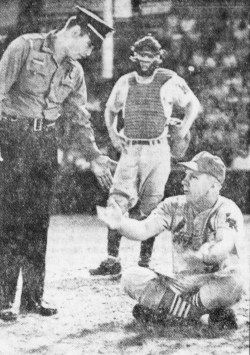
They may have been surprised to learn Rapp once caused such a fuss in an argument with an umpire that a police officer was called onto the field to intervene.

Sit down strike

Rapp, manager of the Cardinals’ Class AA Arkansas club, staged a protest by sitting on home plate after being ejected following a dispute with umpire Larry Barnett in a game at Albuquerque, N.M., on Aug. 13, 1966.

When Rapp refused to move, the umpire called police, who escorted Rapp from the field.

Photographs show police officer Fred Leyva standing over Rapp at home plate while Arkansas catcher Danny Breeden watches the drama unfold.

According to the Albuquerque Journal, “Rapp actually sat down on home plate and didn’t leave until a policeman talked him into leaving.” Rapp “had to be escorted off the field” by the officer, the newspaper reported.

Wrong word

The incident began when Rapp argued a close play at second base. Frank Godsoe, associate sports editor of the Amarillo Daily News, reported this exchange:

Barnett: “One more peep out of you and you’re out of the ballgame.”

Rapp: “Peep.”

That did it. Barnett ejected Rapp, who refused to leave because he felt the punishment didn’t fit the crime. Rapp said it was the first time he’d been ejected for saying the word “peep.”

“Before a ballgame, he is as friendly as a collie dog,” Godsoe wrote of Rapp. “Once in a game, he’ll use anything up to poison gas to try to beat you. He is a tough loser and in the heat of battle he can erupt like a volcano.”

Godsoe asked Texas League president Hugh Finnerty which manager in the league was toughest on umpires. “Vern Rapp,” Finnerty replied.

Rapp likely was fined $25 for the ejection, Godsoe reported.

No harm, no foul

The theatrics didn’t damage the careers of Rapp or Barnett

Barnett became a big-league umpire in 1969 and stayed on the job through 1999.

Rapp managed Arkansas to an 81-59 record in 1966 and was named Texas League manager of the year.

He managed Arkansas again in 1967 and 1968 before leaving the Cardinals’ organization to join the Reds as manager of their Class AAA Indianapolis team.

Rapp, a St. Louis native, managed Class AAA clubs through the 1976 season before getting his first big-league managing chance with the 1977 Cardinals, replacing Red Schoendienst.

Previously: The pitfalls of Cardinals rookie manager Vern Rapp

(Updated March 20, 2022)

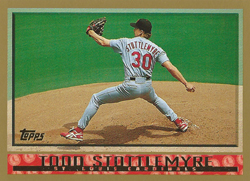
Valuing a mentor who could help him develop into a consistently productive starting pitcher, Todd Stottlemyre sought a trade from the Athletics to either the Yankees or the Cardinals.

todd_stottlemyre2His father, Mel, was pitching coach of the Yankees. Dave Duncan, who had served as somewhat of a surrogate father to Todd with the Athletics, was pitching coach of the Cardinals.

On Jan. 9, 1996, the Athletics honored his request, trading Stottlemyre to the Cardinals for outfielder Allen Battle and pitchers Carl Dale, Bret Wagner and Jay Witasick.

Stottlemyre, 30, joined free-agent acquisition Andy Benes as right-handers who bolstered a 1996 Cardinals rotation that included holdovers Donovan Osborne, Alan Benes and Mike Morgan.

Bernie Miklasz, columnist of the St. Louis Post-Dispatch, wrote, “The Cardinals have actually recruited starting pitchers who can throw fastballs by hitters.”

Stottlemyre certainly could do that. In 1995, he ranked first among American League right-handers in strikeouts. One reason he wanted to join the Cardinals was because Duncan was helping him learn to throw more than a fastball.

Bound for Blue Jays

Todd Stottlemyre, whose father started three games against the Cardinals’ Bob Gibson in the 1964 World Series, was drafted by St. Louis in 1985, but didn’t sign. He was chosen in a later draft by the Blue Jays and signed with them.

Stottlemyre debuted in the big leagues with the 1988 Blue Jays. He helped Toronto win consecutive World Series championships in 1992-93 and achieved double-digit win totals in four consecutive seasons (1990-93), but he had winning records in just two of seven years with the Blue Jays and overall was 69-70.

After the 1994 season, Stottlemyre became a free agent and signed with the Athletics, who had Tony La Russa as manager and Duncan as pitching coach. Stottlemyre posted a 14-7 record and 4.55 ERA for them. He struck out 205 in 209.2 innings. Among American League pitchers in 1995, only left-hander Randy Johnson of the Mariners struck out more batters.

Stottlemyre credited Duncan and La Russa with his development in Oakland. “I felt I took another step toward being able to pitch to my capability,” Stottlemyre said. “I felt I was more in control of myself throughout more ballgames … I’ve been able to get control of my curveball and changeup and off-speed pitches instead of just being a fastball, slideball pitcher.”

In an interview with Cardinals Magazine, Stottlemyre said, “Duncan has helped me to realize there’s more to pitching than rearing back and throwing the fastball as hard as you can. It’s been fun for me.”

Meet me in St. Louis

After the 1995 season, La Russa left the Athletics to become Cardinals manager and Duncan joined him as pitching coach. That’s when St. Louis became an attractive destination point for Stottlemyre.

“We feel his best years are ahead of him,” Duncan said. “Last year, he made tremendous progress as a pitcher. Consistency was the key with him.”

La Russa told Cardinals Magazine, “He’s a terrific competitor and that’s something you can never have enough of.”

The Athletics, looking to rebuild after finishing in last place in the American League West in 1995, were willing to trade Stottlemyre to restock their roster.

“He wanted to be elsewhere and it made sense for him to be elsewhere if we could get some value in return,” Athletics general manager Sandy Alderson told the San Francisco Chronicle.

Mike Jorgensen, Cardinals director of player development, said all three pitchers dealt to the Athletics were big-league prospects. “When you go shopping in the high-rent district, you know it’s going to be expensive,” Jorgensen said to the Post-Dispatch.

Consistent Cardinal

The trade benefitted the Cardinals more than it did the Athletics.

Stottlemyre was 14-11 with a 3.87 ERA in helping the 1996 Cardinals win the National League Central title. He led the 1996 Cardinals in strikeouts (194), complete games (five) and shutouts (two) and was second in wins.

Stottlemyre was 12-9 with a 3.88 ERA for the 1997 Cardinals and 9-9 with a 3.51 ERA for the 1998 Cardinals before he was traded with shortstop Royce Clayton to the Rangers for third baseman Fernando Tatis, pitcher Darren Oliver and outfielder Mark Little on July 31, 1998.

With St. Louis, Stottlemyre had three consecutive seasons with ERAs below 4.00 for the only time in his big-league career.

In his book, “Pride and Pinstripes,” Mel Stottlemyre said his son Todd took a while to realize his potential and believed it was because of the personal burden Todd carried after the death of his younger brother, Jason. Todd was the donor when Jason had a bone marrow transplant.

“After Jason died, it was almost like Todd wanted to lash out at the world, take out his anger on everybody else,” Mel Stottlemyre said. “He competed so hard that he was always at full throttle, and you can’t pitch that way all the time. He was fearless on the mound, which is important, but he was also pretty high-strung, always ready to fight, figuratively, if not literally.”

Of the four players traded by the Cardinals for Stottlemyre, only Witasick contributed much to the Athletics. In two stints with Oakland, Witasick was 5-5 with a 5.26 ERA. He pitched 12 years in the big leagues, appearing in the 2001 World Series with the Yankees and the 2002 World Series with the Giants.