Feeds:
Posts
Comments

Vern Rapp, rebel? Indeed. As a manger in the Cardinals’ system, Rapp challenged authority in a manner that would have made the hairs on Al Hrabosky’s Fu Manchu stand on end.

vern_rapp2Known as an unyielding disciplinarian for implementing a policy against facial hair while Cardinals manager in 1977, Rapp clashed with several Cardinals players, including Hrabosky, who grew a Fu Manchu moustache while developing a persona as “The Mad Hungarian.”

They may have been surprised to learn Rapp once caused such a fuss in an argument with an umpire that a police officer was called onto the field to intervene.

Sit down strike

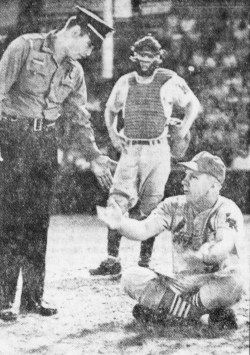
Rapp, manager of the Cardinals’ Class AA Arkansas club, staged a protest by sitting on home plate after being ejected following a dispute with umpire Larry Barnett in a game at Albuquerque, N.M., on Aug. 13, 1966.

When Rapp refused to move, the umpire called police, who escorted Rapp from the field.

Photographs show police officer Fred Leyva standing over Rapp at home plate while Arkansas catcher Danny Breeden watches the drama unfold.

According to the Albuquerque Journal, “Rapp actually sat down on home plate and didn’t leave until a policeman talked him into leaving.” Rapp “had to be escorted off the field” by the officer, the newspaper reported.

Wrong word

The incident began when Rapp argued a close play at second base. Frank Godsoe, associate sports editor of the Amarillo Daily News, reported this exchange:

Barnett: “One more peep out of you and you’re out of the ballgame.”

Rapp: “Peep.”

That did it. Barnett ejected Rapp, who refused to leave because he felt the punishment didn’t fit the crime. Rapp said it was the first time he’d been ejected for saying the word “peep.”

“Before a ballgame, he is as friendly as a collie dog,” Godsoe wrote of Rapp. “Once in a game, he’ll use anything up to poison gas to try to beat you. He is a tough loser and in the heat of battle he can erupt like a volcano.”

Godsoe asked Texas League president Hugh Finnerty which manager in the league was toughest on umpires. “Vern Rapp,” Finnerty replied.

Rapp likely was fined $25 for the ejection, Godsoe reported.

No harm, no foul

The theatrics didn’t damage the careers of Rapp or Barnett

Barnett became a big-league umpire in 1969 and stayed on the job through 1999.

Rapp managed Arkansas to an 81-59 record in 1966 and was named Texas League manager of the year.

He managed Arkansas again in 1967 and 1968 before leaving the Cardinals’ organization to join the Reds as manager of their Class AAA Indianapolis team.

Rapp, a St. Louis native, managed Class AAA clubs through the 1976 season before getting his first big-league managing chance with the 1977 Cardinals, replacing Red Schoendienst.

Previously: The pitfalls of Cardinals rookie manager Vern Rapp

(Updated March 20, 2022)

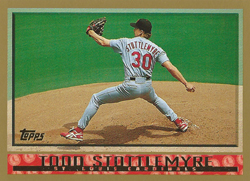
Valuing a mentor who could help him develop into a consistently productive starting pitcher, Todd Stottlemyre sought a trade from the Athletics to either the Yankees or the Cardinals.

todd_stottlemyre2His father, Mel, was pitching coach of the Yankees. Dave Duncan, who had served as somewhat of a surrogate father to Todd with the Athletics, was pitching coach of the Cardinals.

On Jan. 9, 1996, the Athletics honored his request, trading Stottlemyre to the Cardinals for outfielder Allen Battle and pitchers Carl Dale, Bret Wagner and Jay Witasick.

Stottlemyre, 30, joined free-agent acquisition Andy Benes as right-handers who bolstered a 1996 Cardinals rotation that included holdovers Donovan Osborne, Alan Benes and Mike Morgan.

Bernie Miklasz, columnist of the St. Louis Post-Dispatch, wrote, “The Cardinals have actually recruited starting pitchers who can throw fastballs by hitters.”

Stottlemyre certainly could do that. In 1995, he ranked first among American League right-handers in strikeouts. One reason he wanted to join the Cardinals was because Duncan was helping him learn to throw more than a fastball.

Bound for Blue Jays

Todd Stottlemyre, whose father started three games against the Cardinals’ Bob Gibson in the 1964 World Series, was drafted by St. Louis in 1985, but didn’t sign. He was chosen in a later draft by the Blue Jays and signed with them.

Stottlemyre debuted in the big leagues with the 1988 Blue Jays. He helped Toronto win consecutive World Series championships in 1992-93 and achieved double-digit win totals in four consecutive seasons (1990-93), but he had winning records in just two of seven years with the Blue Jays and overall was 69-70.

After the 1994 season, Stottlemyre became a free agent and signed with the Athletics, who had Tony La Russa as manager and Duncan as pitching coach. Stottlemyre posted a 14-7 record and 4.55 ERA for them. He struck out 205 in 209.2 innings. Among American League pitchers in 1995, only left-hander Randy Johnson of the Mariners struck out more batters.

Stottlemyre credited Duncan and La Russa with his development in Oakland. “I felt I took another step toward being able to pitch to my capability,” Stottlemyre said. “I felt I was more in control of myself throughout more ballgames … I’ve been able to get control of my curveball and changeup and off-speed pitches instead of just being a fastball, slideball pitcher.”

In an interview with Cardinals Magazine, Stottlemyre said, “Duncan has helped me to realize there’s more to pitching than rearing back and throwing the fastball as hard as you can. It’s been fun for me.”

Meet me in St. Louis

After the 1995 season, La Russa left the Athletics to become Cardinals manager and Duncan joined him as pitching coach. That’s when St. Louis became an attractive destination point for Stottlemyre.

“We feel his best years are ahead of him,” Duncan said. “Last year, he made tremendous progress as a pitcher. Consistency was the key with him.”

La Russa told Cardinals Magazine, “He’s a terrific competitor and that’s something you can never have enough of.”

The Athletics, looking to rebuild after finishing in last place in the American League West in 1995, were willing to trade Stottlemyre to restock their roster.

“He wanted to be elsewhere and it made sense for him to be elsewhere if we could get some value in return,” Athletics general manager Sandy Alderson told the San Francisco Chronicle.

Mike Jorgensen, Cardinals director of player development, said all three pitchers dealt to the Athletics were big-league prospects. “When you go shopping in the high-rent district, you know it’s going to be expensive,” Jorgensen said to the Post-Dispatch.

Consistent Cardinal

The trade benefitted the Cardinals more than it did the Athletics.

Stottlemyre was 14-11 with a 3.87 ERA in helping the 1996 Cardinals win the National League Central title. He led the 1996 Cardinals in strikeouts (194), complete games (five) and shutouts (two) and was second in wins.

Stottlemyre was 12-9 with a 3.88 ERA for the 1997 Cardinals and 9-9 with a 3.51 ERA for the 1998 Cardinals before he was traded with shortstop Royce Clayton to the Rangers for third baseman Fernando Tatis, pitcher Darren Oliver and outfielder Mark Little on July 31, 1998.

With St. Louis, Stottlemyre had three consecutive seasons with ERAs below 4.00 for the only time in his big-league career.

In his book, “Pride and Pinstripes,” Mel Stottlemyre said his son Todd took a while to realize his potential and believed it was because of the personal burden Todd carried after the death of his younger brother, Jason. Todd was the donor when Jason had a bone marrow transplant.

“After Jason died, it was almost like Todd wanted to lash out at the world, take out his anger on everybody else,” Mel Stottlemyre said. “He competed so hard that he was always at full throttle, and you can’t pitch that way all the time. He was fearless on the mound, which is important, but he was also pretty high-strung, always ready to fight, figuratively, if not literally.”

Of the four players traded by the Cardinals for Stottlemyre, only Witasick contributed much to the Athletics. In two stints with Oakland, Witasick was 5-5 with a 5.26 ERA. He pitched 12 years in the big leagues, appearing in the 2001 World Series with the Yankees and the 2002 World Series with the Giants.

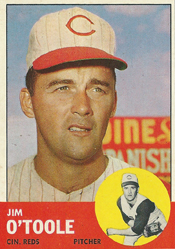
Of the many duels the Reds’ Jim O’Toole had with the Cardinals, the most bizarre was his performance in the first game of a 1963 doubleheader. Even without his nemesis, Ken Boyer, in the lineup, O’Toole was pummeled by the Cardinals, but still won.

jim_otooleA left-hander, O’Toole posted double-digit wins for the Reds in five consecutive seasons (1960-64) and was an All-Star Game starter in 1963. In nine years with Cincinnati, O’Toole was 10-14 with a 4.17 ERA in 38 appearances against the Cardinals.

His best game versus St. Louis was on May 6, 1960, when he pitched a four-hitter in a 1-0 Reds triumph. Boxscore

His worst game against St. Louis was on June 7, 1962, when he was rocked for six runs and 10 hits in 4.1 innings in an 8-2 Cardinals victory. Boxscore

Perhaps the most memorable was the escape act he performed on May 5, 1963, at Cincinnati.

Grim work

Though he yielded 12 hits, walked two, had two batters reach base on errors and threw a wild pitch before he was lifted with two on and none out in the seventh, O’Toole got his major league-leading sixth win of the season in a 5-4 Reds victory.

The Cardinals had two runners thrown out at home, two runners caught attempting to steal second, grounded into a double play and stranded nine.

In addition, “several Redbird smashes were kept in the ballpark by a treacherous wind,” The Sporting News reported.

“There’ll be games like that all season because the league is so well balanced,” said Cardinals general manager Bing Devine.

The Reds never trailed. Or, as the Associated Press noted, “The Reds scored three runs in the opening inning and held on grimly.”

O’Toole did the bulk of that grim work.

Unconventional script

Among the twists and turns:

_ O’Toole retired the first four batters he faced.

_ In the second inning, with the Reds ahead, 3-1, the Cardinals had Leo Burke on second and Gene Oliver on first with one out. Julian Javier grounded to shortstop Leo Cardenas, who booted the ball. Javier reached first safely on the error. Burke rounded third and headed for home. Cardenas recovered in time and threw to catcher Johnny Edwards, who tagged out Burke.

_ With two outs in the fourth and the Reds ahead, 4-2, the Cardinals had Javier on third and Ray Sadecki on first. O’Toole uncorked a wild pitch, enabling Sadecki to reach second. Dick Groat singled, scoring Javier but left fielder Frank Robinson’s throw to Edwards nailed Sadecki at the plate for the third out.

_ In the seventh, Curt Flood doubled and Groat followed with a RBI-single, knocking O’Toole from the game and cutting the Reds’ lead to 5-4. Al Worthington relieved and yielded a single to Bill White, moving Groat to third. The rally unraveled when George Altman struck out, White was caught attempting to steal and Charlie James flied out. Boxscore

Perhaps the outcome would have been different if Boyer had played.

O’Toole tormentor

Two nights earlier, in the series opener, Boyer was injured when Edwards spiked him while sliding into third. Boyer needed 13 stiches to close two wounds. He wouldn’t return to the lineup until after the Cardinals left Cincinnati.

Boyer had the most career hits (36) against O’Toole of any batter. He hit .468 (36-for-77) with five doubles, four home runs, 10 walks and 22 RBI versus O’Toole. Boyer’s career on-base percentage against him was .529.

In O’Toole’s first three full seasons with the Reds, Boyer haunted him, hitting .636 (7-for-11) in 1959, .462 (6-for-13) in 1960 and .750 (6-for-8) in 1961, according to Baseball-Reference.com.

O’Toole was the starting pitcher in the 1963 All-Star Game at Cleveland when the National League started an all-Cardinals infield of White at first, Javier at second, Groat at shortstop and Boyer at third.

In the second inning of that game, the American League had Leon Wagner on second, Zolio Versalles on first, two outs and pitcher Ken McBride at the plate.

McBride hit a grounder to Boyer’s left. He dived for the ball, but it deflected off his glove and into left field for a RBI-single, tying the score. Boxscore

Previously: 1963 NL all-stars started all-Cardinals infield

Previously: Why John Tsitouris forever will be linked to Cardinals

(Updated March 12, 2022)

When the Cardinals acquired Jamie Moyer, he was projected to pitch in their farm system. Moyer persevered and earned a spot in the Cardinals’ starting rotation, but instead of becoming a feel-good story, he went winless in seven starts. At 28, his big-league pitching career appeared near an end.

jamie_moyer3Who could have envisioned Moyer would recover to pitch in the majors until he was 49 and become one of the top 10 left-handers in career wins?

On Jan. 9, 1991, the Cardinals reached agreement with Moyer on a minor-league contract and invited him to their big-league spring training camp as a non-roster player.

“He’s young enough that we might want to take a look at him,” Cardinals general manager Dal Maxvill told the St. Louis Post-Dispatch.

Underwhelmed, Post-Dispatch columnist Bernie Miklasz reacted with two words and a punctuation mark: “Jamie Moyer?”

Moyer, who debuted with the Cubs in 1986, had a 2-6 record and 4.66 ERA in 33 appearances for the 1990 Rangers and was released after the season.

Two teams _ Cardinals and Expos _ made offers to Moyer.

“The people at Texas gave indication that he was throwing decently,” Maxvill said.

Moyer said he chose the Cardinals because “it seems like they have a lot of young arms who are not quite ready. I thought I could fit into the Cardinals’ plans before one of their younger guys comes up.”

“All I’m looking for is an opportunity … I’ve got to prove to people that I can pitch.” Moyer said.

Opportunity knocks

The 1991 Cardinals entered spring training with a projected rotation of Joe Magrane, Jose DeLeon, Bryn Smith, Bob Tewksbury and Ken Hill. However, on March 1, the Cardinals revealed Magrane had left elbow damage and would sit out the 1991 season.

Manager Joe Torre declared rookie Omar Olivares and Moyer as the top candidates to take Magrane’s spot in the rotation.

Moyer won the competition, producing a 1.63 ERA in spring training exhibition games compared with a 7.08 ERA for Olivares.

Torre said Moyer is “a changeup pitcher. He’s not going to impress you with his stuff. You have to go on the results.”

Not good enough

Moyer made his Cardinals debut on April 12, 1991, in a start against the Phillies and took the loss, giving up five runs and seven hits in two innings. Lenny Dykstra hit a two-run home run.

“I had no location at all … I pitched horribly,” said Moyer. “It’s a humbling game.” Boxscore

He earned a measure of redemption in each of his next two starts, pitching well enough to win but getting a loss and a no-decision instead.

Moyer held the Expos to one run in seven innings on April 17 and lost, 1-0. Boxscore He gave up two runs in six innings versus the Cubs on April 22 but reliever Juan Agosto got the win. Boxscore

Cardinals pitching coach Joe Coleman convinced Moyer to try a new approach by starting his delivery with his left foot on the third base side of the pitching rubber instead of the first base side, according to the Post-Dispatch.

After a loss to the Reds on May 14 _ “They didn’t hit a ball hard off him,” Torre said _ Moyer had an 0-4 record and 5.02 ERA. Boxscore

Moyer’s next start, on May 21 against the Pirates, would be the last game he’d pitch for the Cardinals. Barry Bonds hit two home runs off Moyer, who was lifted after yielding four runs in 2.2 innings. The Pirates won, 5-3, dropping Moyer’s record to 0-5 with a 5.74 ERA. Boxscore

“Moyer didn’t have it at all,” Torre said. “His location was bad.”

Two days later, the Cardinals sent Moyer to Class AAA Louisville and moved Olivares into the rotation.

“I’ve pitched well at times and I’ve pitched horribly at times,” Moyer said. “They gave me the opportunity in spring training and that’s all I could have asked for.”

Moyer spent the remainder of the 1991 season with Louisville, posting a 5-10 record and 3.80 ERA in 20 starts before the Cardinals released him in October.

Top 10 winner

After pitching for the Toledo Mud Hens in 1992, Moyer returned to the majors with the 1993 Orioles and established himself as a consistent and durable winner.

In 25 big-league seasons with eight teams _ Cubs, Rangers, Cardinals, Orioles, Red Sox, Mariners, Phillies and Rockies _ Moyer produced a 269-209 record. In April 2012, Moyer, six months shy of his 50th birthday, became the oldest pitcher to win a major-league game, going seven innings in a 5-3 Rockies victory over the Padres.

Moyer’s career record against the Cardinals: 5-1 with a 2.30 ERA in 13 appearances.

The top 10 left-handers in career big-league wins are:

_ Warren Spahn, 363

_ Steve Carlton, 329

_ Eddie Plank, 326

_ Tom Glavine, 305

_ Randy Johnson, 303

_ Lefty Grove, 300

_ Tommy John, 288

_ Jim Kaat, 283

_ Jamie Moyer, 269

_ Eppa Rixey, 266

All except John and Moyer have been elected to the National Baseball Hall of Fame.

Sunday night baseball, a standard feature on today’s major-league schedule, was a radical idea, born of necessity, when the Cardinals first experienced it in 1963.

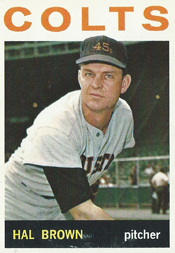
hal_brownAt that time, the Houston Colt .45s, in their second National League season, played their home games at an outdoor ballpark. In the summer, the oppressive Texas heat and humidity made day baseball uncomfortable, if not impractical, for fans and players.

“Rivals agreed that it’s too hot to play on Sunday afternoons,” United Press International reported.

The 1963 Colt .45s became the first big-league club to schedule Sunday night home games. The first was against the Giants on June 9. The second was played against the Cardinals on June 30. The winning pitcher in both was a 38-year-old knuckleball specialist, Hal Brown, a World War II combat veteran who had served as a gunner on U.S. Army Air Force bombers.

Need to be stingy

Brown, winding down his career with the weakest-hitting team in the National League, knew his best chance to win was to pitch a shutout for the Colt .45s.

The 1963 Colt .45s would rank last in the 10-team NL in runs (464), RBI (420) and home runs (62).

Brown earned five wins for the 1963 Colt .45s. He pitched complete-game shutouts _ two versus the Cardinals, including the Sunday night game, and one against the Phillies _ for three of those wins. In the other two, he pitched 6.1 innings of scoreless relief versus the Giants and held the Mets to three runs in a rain-shortened seven-inning start.

Thus, in his wins for the 1963 Colt .45s, Brown had an ERA of 0.66, yielding three runs in 49.1 innings.

Overall, Brown was 5-11 with a 3.31 ERA in 26 games, including 20 starts, for the 1963 Colt .45s. Brown yielded three runs or fewer in seven of his losses, with the Colt .45s scoring a total of five runs in those defeats.

Richards connection

Brown debuted in the major leagues with the 1951 White Sox. He also pitched for the Red Sox and Orioles before joining the Yankees in September 1962.

On April 21, 1963, the Yankees sent Brown to the Colt .45s for $25,000. Paul Richards, general manager of the Colt .45s, had been Brown’s manager with the White Sox and for most of his time with the Orioles. It was Richards who encouraged Brown to use the knuckleball.

“I don’t want a big knuckler,” Brown said to The Sporting News. “I want it to look just good enough to swing at. When you’re 38, you would rather get them out on one pitch than strike them out on three.”

Night moves

In the inaugural big-league Sunday night game, Brown relieved injured starter Turk Farrell with two outs in the third inning. Brown pitched the rest of the way, yielding one hit _ a Willie Mays single _ and retiring the last 17 Giants batters in a row for his first NL win in a 3-0 Colt .45s victory. Boxscore

Outside the ballpark, protesters opposed Sunday night baseball, according to the book “Colt .45s: A Six-Gun Salute.”

“It’s just plain wrong and ought not to be,” Baptist minister O.A. Taylor said of Sunday night games. “If they get by with this, they’ll start scheduling games on Sunday morning.”

Three weeks later, Brown got the start against the Cardinals in the second Sunday night game.

Brown pitched a complete-game seven hitter in a 1-0 Colt .45s victory. Houston scored in the fourth off starter Lew Burdette on John Bateman’s RBI-single.

Brown held the Cardinals to six singles and a triple, striking out six and walking one. He escaped several jams, including:

_ In the first inning, the Cardinals loaded the bases with two outs before Brown retired George Altman.

_ In the second, Curt Flood reached second with none out, but was caught attempting to steal third.

_ Altman tripled leading off the seventh. He was unable to advance on groundouts by Flood and Tim McCarver. Carl Sawatski flied out, ending the inning and stranding Altman at third.

_ In the eighth, the Cardinals had runners on first and third with one out. Brown retired Charlie James and Ken Boyer without allowing the runner from third to score.

“It was a weird but wonderful triumph,” wrote Mickey Herskowitz in The Sporting News.

Said Brown: “It’s a pretty good feeling to know you have to pitch a shutout to win and then to do it.” Boxscore

Brown shut out the Cardinals for the second time on Aug. 24, 1963, a Saturday night in Houston. He limited the Cardinals to four singles _ three by Flood and one by Altman _ in a 4-0 Colt .45s victory.

Stan Musial, making his final visit to Houston as a player and honored in ceremonies before the game, was 0-for-3 against Brown that night. Boxscore

Previously: From the start, Cardinals vs. Houston rivalry was special

Previously: Reds-Cardinals: Easter night to remember

Fed up with contract hassles and uneasy with the prospect of playing for manager Eddie Dyer, Walker Cooper, the best catcher in the National League, wanted out of St. Louis. Seeing a surplus of suitors causing Cooper’s market value to skyrocket, Cardinals owner Sam Breadon was willing to accommodate him.

walker_cooper2On Jan. 5, 1946, the Cardinals sent Cooper to the Giants for $175,000.

The cash amount was the third-largest paid by a club to acquire a player, according to media reports at that time.

(In 1934, the Red Sox sent $250,000 and shortstop Lyn Lary to the Senators for shortstop Joe Cronin. In 1938, the Cubs gave $185,000, plus pitchers Curt Davis and Clyde Shoun and outfielder Tuck Stainback, to the Cardinals for pitcher Dizzy Dean.)

“I decided Cooper wasn’t satisfied here and would do better elsewhere,” Breadon said. “But get me right: Walker was a great player here and I consider him the greatest catcher in the majors since Bill Dickey of the Yankees was a young man.”

In the short term, the trade didn’t hurt the Cardinals. Without Cooper, they won the 1946 World Series championship.

In the long run, losing Cooper was a factor in the erosion of the Cardinals, who went 18 years before winning another World Series crown.

3-time all-star

Along with his brother Mort, a starting pitcher, Walker Cooper was a key player on Cardinals clubs that won three consecutive NL pennants and two World Series titles from 1942-44.

He was named an all-star catcher in each of those three seasons. His numbers:

_ 1942: Batted .281 with 32 doubles and 65 RBI. Ranked second among NL catchers in assists (62) and runners caught attempting to steal (58 percent). Batted .286 in the World Series.

_ 1943: Batted .318 with 30 doubles and 81 RBI. Caught 48 percent of runners attempting to steal. Batted .294 in the World Series.

_ 1944: Batted .317 with 25 doubles and 72 RBI. Caught 43 percent of runners attempting to steal. Batted .318 in the World Series.

Cooper also was touted for game-calling skills. “He’s the best fellow handling young pitchers I have ever seen,” said Coaker Triplett, a Cardinals outfielder from 1941-43.

Feuding with front office

The relationship between Cooper and the Cardinals soured in 1945.

In spring training, Mort Cooper demanded a $15,000 contract. Breadon refused. In protest, Mort Cooper and Walker Cooper left camp and threatened to boycott the Cardinals’ opening series against the Cubs.

The brothers gave in and were with the club on Opening Day. Soon after, Walker Cooper was inducted into the Navy after playing four April games for the 1945 Cardinals. A month later, Mort Cooper was traded to the Braves.

While serving his Navy stint in 1945, Walker Cooper remained miffed at Cardinals management for the contract dispute and for dealing his brother.

Trade me

In October 1945, Walker Cooper called Breadon and requested a trade, the Cardinals owner told The Sporting News.

Cooper confirmed to the Associated Press he had asked to be traded.

A month later, Cardinals manager Billy Southworth resigned and joined the Braves. Breadon replaced Southworth with Dyer. Cooper again contacted the Cardinals and “said he would rather not play under Dyer,” Breadon said.

Cooper’s problem with Dyer occurred when both were with the Cardinals’ Houston farm club during spring training in 1939. Cooper apparently clashed with Dyer, who had replaced Ira Smith as manager. Cooper was shipped to the Cardinals’ Asheville, N.C., affiliate.

“(Dyer) said there had been differences with Cooper in Houston, but he believed they could be ironed out,” Breadon said. “He felt a player didn’t have to like him personally if he played good ball for his team.”

Said Dyer: “I have always been able to get along with any ballplayer and I could have gotten along with Cooper, whom I consider the best catcher in baseball.”

In his book “Stan Musial: The Man’s Own Story,” Musial said, “Breadon said Coop didn’t want to play for Dyer, but the boss gave (Dyer) no chance to talk to the catcher. The truth is, Mr. Breadon was annoyed at the Cooper boys for squabbling over salaries.”

Money talks

At the baseball winter meetings in December 1945, at least five clubs inquired about Cooper, with the Giants, Braves and Phillies making the most lucrative offers.

The Cardinals asked the Giants for $150,000 and three players. A few weeks later, the trade came together when the Giants offered to increase the cash amount to $175,000 if the Cardinals would drop their demand for players.

The transaction was announced three days before Cooper turned 31. It “kicked up more commotion among Polo Grounds customers than any deal since Frank Frisch was traded for Rogers Hornsby in 1926,” wrote The Sporting News.

Cooper was released from the Navy on April 2, 1946, and debuted with the Giants about two weeks later.

Looking back

His first season with New York was a dud. Cooper hit .268 with 46 RBI for a 1946 Giants team that finished in last place at 61-93. The 1946 Cardinals, using a platoon of Joe Garagiola and Del Rice at catcher, finished in first place at 98-58.

Cooper did better for the 1947 Giants, hitting .305 with 35 homers and 122 RBI.

After stints with the Reds, Braves, Pirates and Cubs, Cooper finished his career as a backup catcher for the 1956-57 Cardinals.

Neither Garagiola nor Rice performed at the level Cooper had for St. Louis.

In his book “Musial: From Stash to Stan the Man,” author James N. Giglio wrote, “Both Musial and (Enos) Slaughter rightly contended that the loss of Cooper cost the Redbirds several pennants.”

In choosing his all-time NL all-star team, Musial picked Dodgers catcher Roy Campanella “in a photo finish with Walker Cooper.”

Comparing the Cooper deal with the 1941 trade of St. Louis slugger Johnny Mize to the Giants, Musial said, “Big Coop’s sale by the Cardinals probably was even worse than the loss of Johnny Mize.”