Feeds:
Posts
Comments

If Tommy Lasorda had ordered Tom Niedenfuer to intentionally walk Jack Clark in the ninth inning of Game 6 in the National League Championship Series, Brian Harper likely would have been facing Jerry Reuss with the outcome on the line.
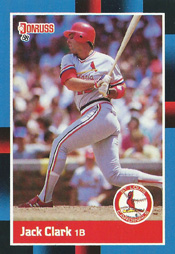
jack_clark5Instead, Lasorda, the Dodgers’ manager, made the fateful decision to allow Niedenfuer to pitch to Clark with Willie McGee on third, Ozzie Smith on second, first base open and two out.

On Oct. 16, 1985, Clark cracked a first-pitch fastball from Niedenfuer for a three-run home run, erasing a 5-4 Dodgers lead and carrying the Cardinals into the World Series with a 7-5 pennant-clinching victory at Los Angeles.

“After he hits the home run, even my wife knows I should have walked him,” Lasorda told the Daily Breeze of Torrance, Calif.

Match game

Jay Johnstone, a Dodgers reserve outfielder, wrote in his postseason column for the Daily News of Los Angeles that “Tommy, in fact, was going to walk him. Then he changed his mind.”

Andy Van Slyke, a left-handed batter, was on deck when Clark stepped to the plate against Niedenfuer.

“I was looking into the Dodgers dugout, waiting for Tommy to put up four fingers,” Van Slyke told reporters.

“If you were Tommy Lasorda, wouldn’t you rather pitch to me than to Jack Clark?”

Not, it turns out, if the pitcher is a right-hander, such as Niedenfuer.

If Clark had been walked intentionally, Lasorda intended to have a left-hander face Van Slyke. The left-hander the Dodgers had warming in the bullpen was Reuss, a former Cardinal.

In his book “White Rat: A Life in Baseball,” Cardinals manager Whitey Herzog said, “If Tommy walks Clark and brings in a lefty to pitch to Andy, I would have countered with Brian Harper, the only right-handed pinch-hitter I had left.”

Harper, a utility player, had batted .250 with no home runs in 43 games for the 1985 Cardinals.

In a rebuke of Lasorda, Herzog said, “I would rather let Brian Harper try to beat me than Jack Clark.”

Watching from the dugout, Harper was preparing for the chance to bat with the bases loaded. “Even when they pitched to Jack, I figured they would pitch around him,” Harper told the Daily Breeze.

Clark agreed, saying, “When they decided to pitch to me … I didn’t expect to get a pitch to hit.”

Cat and mouse

Niedenfuer was thinking the same. In the seventh inning, with the score tied 4-4 and Cardinals runners on first and third, Niedenfuer struck out Clark on sliders.

So, when Clark came to bat in the ninth, “I figured he wouldn’t be looking for a fastball,” Niedenfuer said.

Niedenfuer’s assumption had merit. In his book “You’re Missin’ a Great Game,” Herzog called Clark “the greatest fastball hitter of his era,” but said the slugger “took more heaters for strikes than any player I’ve ever seen.”

Said Herzog: “Jack Clark might have been the worst guesser I ever saw. He terrified people as a fastball hitter, but he took the wrong message from that. He believed nobody _ nobody _ would ever throw him a fastball. So he never sat on his best pitch. Jack would stand there waiting for the curve and … those pitchers would sneak heaters right by him.”

Knowing this, Niedenfuer said he intended to start Clark with a fastball on the outside part of the strike zone and try to get Clark to chase subsequent pitches outside the zone.

There were, however, two problems with this approach:

_ “I was looking for a fastball,” Clark said to the Daily News.

_ The fastball Niedenfuer delivered wasn’t on the outside corner. Instead, it was in the middle of the plate, about belt high.

Clark swung at the pitch and lifted a drive deep into the left-field bleachers.

“The only hope was that it would hit the Goodyear blimp and fall straight down,” Niedenfuer told Knight-Ridder Newspapers.

Said Clark: “It was the biggest, furthest, most important hit of my career.” Video

It also was the only home run Clark would hit in 47 career postseason at-bats. Boxscore

Previously: Trade for Jack Clark shook Cardinals from slumber

Ozzie Smith and Tom Niedenfuer, forever linked by a home run, were involved in a couple of other notable encounters before their infamous 1985 postseason showdown.

tom_niedenfuerOn Oct. 14, 1985, Smith sealed his spot in Cardinals lore by hitting a walkoff home run against Niedenfuer in the pivotal Game 5 of the National League Championship Series against the Dodgers at St. Louis. Boxscore

Though the home run was the most important swing of Smith’s Hall of Fame career, it wasn’t the first time he delivered a key hit against Niedenfuer.

One of those hits produced an unusual double play. Another helped cause a meltdown by the Dodgers bullpen, foreshadowing the drama that would unfold in the 1985 postseason.

Strange play

On Sept. 1, 1982, the Cardinals and Dodgers were in the 11th inning of a game at Los Angeles, with the score tied at 5-5. The Cardinals had Tommy Herr on second base and George Hendrick on first with one out when Smith stepped to the plate, facing Niedenfuer.

Smith looped a single to right field.

As Herr and Hendrick advanced, right fielder Pedro Guerrero made a strong throw to the plate. Herr, uncertain he could score, held at third. Hendrick, expecting Herr to head home, rounded second. When he saw Herr on third, Hendrick applied the brakes.

Guerrero’s throw to catcher Mike Scioscia was on target. Scioscia caught the ball and, seeing Hendrick take the wide turn around second, fired a throw to second baseman Steve Sax, who tagged out Hendrick as he tried getting back to the base.

When Herr saw Scioscia throw to second, he took off from third. Sax threw back to the catcher, who blocked the plate as Herr went into his slide. Scioscia caught the ball and tagged out Herr, ending the inning.

Instead of resulting in the go-ahead run, or at least loading the bases, Smith’s single off Niedenfuer resulted in a double play.

“Strange double play, all right,” Cardinals manager Whitey Herzog said to the Associated Press, shaking his head.

In the 13th, Smith delivered another single, against Ricky Wright, and it produced a run, scoring Kelly Paris from second and giving the Cardinals a 6-5 lead. Jim Kaat, 43, got the last two outs in the bottom half of the inning, stranding Steve Garvey at third and earning the last save of his career. Boxscore

“I’ve managed about 2,000 of these games and I have never seen one like this,” Herzog said to the Daily Breeze of Torrance, Calif.

Discouraged Dodgers

Two years later, on July 8, 1984, Smith contributed to a Cardinals rally against Niedenfuer at Los Angeles.

The Dodgers entered the ninth inning with a 6-2 lead. With one out, Willie McGee and Darrell Porter both singled against Dodgers reliever Ken Howell.

Niedenfuer relieved and the first batter he faced, Andy Van Slyke, hit a three-run home run, cutting the Dodgers lead to 6-5.

“Even after he hit it out, I still thought Tom would shut them down,” said Dodgers pitcher Orel Hershiser.

Instead, Smith followed with a single, knocking Niedenfuer from the game and keeping alive the Cardinals’ comeback hopes.

Hershiser relieved and struck out Mike Jorgensen for the second out of the inning, but Lonnie Smith singled, advancing Ozzie Smith to second, and Herr also singled, driving in the tying run.

In the 12th, the Cardinals scored twice off Pat Zachry and won, 8-6.

“We blew it and I’m very discouraged,” Dodgers manager Tommy Lasorda said to the Orange County Register. Boxscore

Wizardry from Oz

In 1985, Ozzie Smith was 0-for-4 for the year versus Niedenfuer before corking his Game 5-winning NL Championship Series home run _ his first batting from the left side. Video

In the decisive Game 6 of that series, Smith produced a RBI-triple and a walk versus Niedenfuer in two plate appearances. Boxscore

For his career, including regular season and postseason, Smith batted .353 (6-for-17) against Niedenfuer, with four singles, a triple, a home run, three walks, two RBI and no strikeouts.

In April 1990, Niedenfuer was released by the Mariners and signed with the Cardinals, becoming a teammate of Smith. “We’ve got to give him a job after all he’s done for us,” Herzog told the St. Louis Post-Dispatch.

When Niedenfuer entered the Cardinals’ clubhouse for the first time, first baseman Pedro Guerrero, his former Dodgers teammate, introduced him to Smith.

“I’d never really met him,” Ozzie said to columnist Bernie Miklasz. “I mean, what do you say _ thanks for that home run? But Niedenfuer took it well. I’m glad he’s here.”

In 52 games with the 1990 Cardinals, Niedenfuer was 0-6 with a 3.46 ERA.

Previously: Tom Niedenfuer revisits Cardinals’ historic home runs

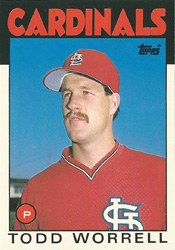
In the game that produced one of the most important Cardinals home runs, an exchange between Todd Worrell and his coach, Mike Roarke, played a critical role in setting the stage for the dramatic finish.

todd_worrell2On Oct. 14, 1985, Ozzie Smith hit a walkoff home run in the ninth inning against the Dodgers’ Tom Niedenfuer, lifting the Cardinals to a 3-2 victory in Game 5 of the National League Championship Series at St. Louis.

Smith’s blast became a beloved part of Cardinals lore, in part, because of broadcaster Jack Buck’s joyous, pitch-perfect call _ “Go crazy, folks! Go crazy!” _ and because of the shock value. Video

Smith, a switch hitter known more for his fielding than his hitting, had played eight seasons in the big leagues and hadn’t slugged a home run left-handed until doing so in the critical Game 5. The victorious shot gave the Cardinals their third win in a row after losing the first two games of the series and put them in position to clinch the pennant and a World Series berth in Game 6 at Los Angeles.

Circumstances might have been much different, though, if Roarke hadn’t connected with Worrell two innings earlier.

Rookie feels heat

In the seventh, with the score tied at 2-2, Ken Dayley was preparing to pitch his fourth inning in relief of Cardinals starter Bob Forsch. The first batter of the inning, Mike Scioscia, walked on four pitches. The next batter, Enos Cabell, hit the first pitch for a single, putting runners on second and first with none out.

Manager Whitey Herzog replaced Dayley with Worrell.

The hard-throwing rookie faced Steve Sax, who was instructed to bunt.

Worrell’s first two pitches were out of the strike zone and Sax took both for balls.

“The adrenaline was pumping and I was excited,” Worrell told Larry Harnly of The State Journal-Register of Springfield, Ill.

With the count 2-and-0, Sax got the take sign from third-base coach Joe Amalfitano.

Worrell threw another out of the strike zone, making the count 3-and-0.

Roarke to the rescue

From the top step of the dugout, Roarke, in his second season as pitching coach, shouted at Worrell and got his attention. Roarke had noticed Worrell’s pitches were being thrown from an angle that brought his arm up and over the top.

Roarke knew “Worrell’s accuracy improves when his delivery is from three-quarters rather than directly overhead,” the Daily News of Los Angeles reported.

Said Worrell: “Sometimes I try too hard and get myself mechanically screwed up.”

When Worrell threw from what appeared to the batter as an angle at 10 o’clock, he was effective. He lost command when his pitches were delivered from a 12 o’clock direction.

As Worrell peered into the dugout at his coach, Roarke held his arm at a 10 o’clock angle and moved it toward 12.

Worrell got the message.

Quick fix

Awaiting the 3-and-0 offering, Sax got another take sign. The pitch was a strike.

“After I got the first strike in there to Sax, I knew I would be all right,” Worrell said.

With the count 3-and-1, Sax got a third straight take sign. The pitch, another fastball, was a strike, making the count 3-and-2.

Said Worrell of Sax: “He’s aggressive _ he had doubled off me in another game _ so I knew if I got a fastball close, he would be hacking.”

Worrell threw a pitch that tailed away from the batter. Sax swung and missed, striking out.

Asked about being given three take signs, Sax told the Daily Breeze of Torrance, Calif., “I just have to do what I’m told.”

Said Dodgers manager Tommy Lasorda: “We were looking for a walk to Sax to load the bases.”

Out of danger

The next batter, pitcher Fernando Valenzuela, hit a groundball up the middle. Worrell knocked down the ball, recovered it behind the mound and made an accurate toss to first, retiring Valenzuela as the runners advanced to second and third.

“I let Fernando hit because I was happy with the way he was throwing the ball,” Lasorda said when asked why he didn’t use a pinch-hitter.

Mariano Duncan, the Dodgers’ slumping leadoff batter, followed by swinging at the first pitch and popping out to catcher Darrell Porter, ending the threat.

“First and second, nobody out and a 3-and-0 count,” said Dodgers outfielder Mike Marshall, lamenting the lost scoring opportunity. “You either have to say we blew it, or give them credit.”

The score remained tied until, with one out in the ninth, Smith worked his magic. Boxscore

Previously: How speedsters rattled Bob Welch in 1985 NLCS

Seeking a general manager who could turn the Cardinals from flops into champions, team owner Gussie Busch sought the advice of the leader of the publication considered the authority on baseball.

frank_laneAs the 1955 season neared its end, Busch asked J.G. Taylor Spink, publisher of The Sporting News, to recommend the best general manager to hire. Spink suggested Frank Lane of the White Sox.

In September 1955, Lane resigned from the White Sox and sent a telegram to Busch. The wire read: “Have tux, will travel.”

On Oct. 6, 1955, Busch hired Lane to be general manager of the Cardinals.

In a column for The Sporting News, Spink wrote of Lane’s hire, “Probably the most exciting chapter in the history of St. Louis baseball is about to be enacted … The Cardinals will have a team that will win more games _ or the players who lose won’t be around long.”

Taking a trader

Busch bought the Cardinals in 1953 and appointed one of his Anheuser-Busch executives, Dick Meyer, as general manager. Meyer was better suited to run the business side of the franchise rather than the baseball operations side.

As the Cardinals headed to a 68-86 record and next-to-last finish in the National League in 1955, Busch wanted a general manager with a proven record of producing a winner.

Lane, a longtime baseball executive, became general manager of the White Sox after they finished the 1948 season in last place at 51-101. He improved the White Sox through trades and they posted 89 wins in 1953, 94 in 1954 and 91 in 1955.

In seven seasons (1949-55) with the White Sox, Lane made 241 trades involving 353 players, earning the nickname “Trader.”

Rich resources

Busch sent Meyer to New York to begin negotiations with Lane during the 1955 World Series between the Dodgers and Yankees. That led to a follow-up meeting involving Busch, Lane and Meyer in St. Louis.

The Cardinals signed Lane, 59, to a three-year contract. Meyer was promoted to executive vice president. Bill Walsingham Jr., a Cardinals vice president for nine years, resigned, acknowledging the club didn’t need two vice presidents.

Busch gave Lane “full authority” to make all baseball decisions.

“I had three offers but only considered one of them _ the job with the St. Louis club,” Lane said. “Why? Because the Cardinals have the potential for a great club and I know the management has the wherewithal to get what it needs if it doesn’t have what it takes to win.

“I don’t think I’m going too far when I say we should be a first division club and quite possibly a contender if we made the deals needed to augment an already fine nucleus of talent.”

Asked if any Cardinals players were untouchables for trading, Lane replied, “Yes. We’ll start with Stan Musial, then add Red Schoendienst, Bill Virdon, Wally Moon, Ken Boyer, Harvey Haddix and a few others.”

Lane identified the Cardinals’ top needs as a first baseman, catcher and pitching.

His first major move was to replace manager Harry Walker with Fred Hutchinson, the former Tigers manager.

Bad deals

According to Bob Broeg in the book, “Redbirds: A Century of Cardinals Baseball,” Lane would watch Cardinals home games from the roof outside the Busch Stadium press box, “squinting like a sun worshipper who didn’t see well and listening to the radio.”

“Lane lived for baseball, traveling always with a radio at his ear and a stack of newspaper sports sections under his arm,” Broeg observed.

Expecting magic, the Cardinals instead saw blunders in the trades Lane made in 1956. Among his worst deals that season:

_ Pitchers Harvey Haddix and Stu Miller to the Phillies for pitchers Murry Dickson and Herm Wehmeier.

_ Center fielder Bill Virdon to the Pirates for outfielder Bobby Del Greco and pitcher Dick Littlefield.

_ Second baseman Red Schoendienst and others to the Giants for shortstop Alvin Dark and others.

When Busch got wind of Lane’s plans to trade Musial to the Phillies for pitcher Robin Roberts, he blocked the deal, then told Lane that any future trade proposals would have to be approved by Busch and Meyer before being enacted.

The 1956 Cardinals finished in fourth place at 76-78.

Win or else

Before the 1957 season, Busch told a Knights of Columbus banquet audience, “If the Cardinals don’t win this year or next, Frank Lane will be out on his ass.”

Lane was miffed. Wanting assurances he had the owner’s support, Lane asked Busch to extend his contract beyond 1958. Busch refused.

Lane did make a couple of good trades before the 1957 season, acquiring pitcher Sam Jones from the Cubs and slugging outfielder Del Ennis from the Phillies. The Cardinals placed second in the NL in 1957 at 87-67.

Still upset by Busch’s win-or-else ultimatum before the season and offended that he had to get approval before making deals, Lane resigned in November 1957, with a year remaining on his Cardinals contract, and became general manager of the Indians.

Busch replaced Lane with Bing Devine.

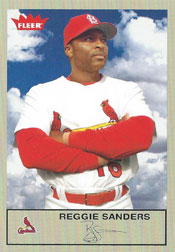
In a lineup of heralded run producers, including Albert Pujols, Jim Edmonds and Larry Walker, Reggie Sanders stole the spotlight with a standout RBI performance for the Cardinals in the 2005 National League Division Series.

reggie_sanders2Sanders had 10 RBI in three games for the Cardinals in their series sweep of the Padres.

Sanders, 37, established a NL Division Series record for most total RBI. Doing it in the minimum three games added to the awesomeness of the achievement.

To put the feat into perspective, consider that when Pujols and David Freese each had nine RBI for the Cardinals in the 2011 NL Championship Series against the Brewers, each did so in six games. When Pujols had nine RBI for St. Louis in the 2004 NL Championship Series versus the Astros, he played seven games.

Sanders had missed 54 games during the 2005 regular season after fracturing his right leg.

In five previous NL Division Series, Sanders had produced five total RBI, including one in 14 at-bats for the Cardinals against the Dodgers in four games in 2004.

Here is a breakdown of his 10-RBI effort against the Padres in the 2005 NL Division Series:

Game 1

Sanders was 2-for-4 with six RBI and a run scored in an 8-5 Cardinals victory on Oct. 4 at St. Louis.

In the third inning, the Cardinals led, 2-0. With the bases loaded and one out, Sanders, facing starter Jake Peavy, singled off the glove of first baseman Mark Sweeney, scoring Edmonds and Pujols.

Two innings later, Sanders again faced Peavy with the bases loaded and one out. With the count 3-and-0, Sanders got the green light to swing and ripped a high pitch for a grand slam over the left field wall, increasing the Cardinals’ lead to 8-0 and knocking Peavy from the game. Video

“You pretty much got to challenge him there and we lost the challenge,” said Padres manager Bruce Bochy to the St. Louis Post-Dispatch. Boxscore

The grand slam was the third by a Cardinals batter in a postseason game. The others: Ken Boyer in the 1964 World Series against the Yankees and Gary Gaetti in the 1996 NL Championship Series versus the Braves.

“Everything is all about results right now,” Sanders said. “It’s all about getting your ballclub where it needs to be and to continue to go as long as you can.”

Game 2

Sanders was 1-for-4 with two RBI in the Cardinals’ 6-2 victory on Oct. 6 at St. Louis.

In the seventh, with the Cardinals ahead, 4-1, Sanders hit a double against reliever Rudy Seanez, scoring Edmonds and Pujols. Boxscore

“For us, it’s all about timing,” Sanders said. “Manufacture runs when you have to manufacture. Really try to put pressure on the pitcher and the defense, no matter what the circumstances are.”

Game 3

The Cardinals completed the sweep with a 7-4 victory at San Diego. Sanders was 1-for-4 with two RBI.

With the Cardinals ahead, 3-0, in the second, Sanders batted with the bases loaded against starter Woody Williams, who had been his St. Louis teammate the year before. Sanders drilled a two-run double, knocking Williams out of the game. Boxscore

For the series, Sanders batted .333 (4-for-12) with two doubles, a home run, a single, a walk and a run scored.

Previously: Cards convinced Larry Walker to join pennant push


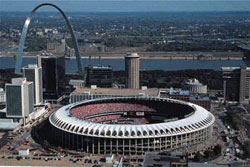
On a day designed for lingering, honoring and enjoying, the Cardinals and their fans bid farewell to their downtown St. Louis home.

busch_stadium2On Oct. 2, 2005, the Cardinals played a regular-season game at Busch Memorial Stadium for the last time.

Six months before they would begin play in a new downtown ballpark, the Cardinals rallied to beat the Reds, 7-5, in a game that took 3 hours and 11 minutes to complete before a crowd of 50,434.

After the game, the Cardinals conducted a two-hour ceremony that honored the players and personnel who had been a special part of Cardinals baseball at Busch Memorial Stadium from 1966 to 2005.

Though the Cardinals would play five 2005 postseason games at Busch Memorial Stadium  _ two against the Padres in the National League Division Series and three versus the Astros in the NL Championship Series _ the regular-season finale provided the opportunity for the Cardinals and their fans to have what St. Louis Post-Dispatch columnist Bernie Miklasz described as the “world’s largest group hug.”

Hard win

Early on, it appeared the Reds might put a damper on the day. In the third inning, Felipe Lopez, Adam Dunn and Austin Kearns hit consecutive home runs off starter Matt Morris and the Reds had a 5-1 lead.

“It wasn’t the start I would have pictured, the storybook ending type of deal,” Morris said.

The Cardinals rallied against starter Brandon Claussen, scoring three in the fourth and two in the fifth for a 6-5 lead.

Several players contributed to the comeback win. Mark Grudzielanek had three hits, a RBI and scored a run. Reggie Sanders, Yadier Molina and Abraham Nunez each had two hits, a RBI and a run scored.

Cardinals manager Tony La Russa used nine pitchers. Brad Thompson earned the win with an inning of shutout relief. Jason Isringhausen pitched a scoreless ninth for the save, giving the Cardinals their 100th win of the season. Video

The Cardinals left 12 runners on base; the Reds stranded 11.

“This was a really hard, hard game,” said La Russa. “Nothing was easy.” Boxscore

Redbird reunion

In the ceremony that followed, former players, coaches and managers were introduced by decade, starting with the 1960s.

Among those appearing on the field were present and future Hall of Famers Lou Brock, Steve Carlton, Bob Gibson, Whitey Herzog, Red Schoendienst, Ozzie Smith and Bruce Sutter.

Stan Musial sent word he wasn’t feeling well and was unable to attend.

Others receiving big ovations when introduced included Jack Clark, Vince Coleman, Keith Hernandez, Tommy Herr, George Kissell, Willie McGee, Mark McGwire, Mike Shannon and Ted Simmons.

“This is the place that gave birth to me and the chance to be the player I was,” Coleman said to MLB.com.

Said McGee: “This is home for a lot of us.”

Tributes were made to the deceased who had played prominent roles at Busch Memorial Stadium. They included Ken Boyer, Nelson Briles, Jack Buck, Curt Flood, Joe Hoerner, Darryl Kile, Roger Maris and Darrell Porter.

The stadium remained filled with spectators as afternoon turned into early evening.

“To have all of those people stay here the entire time, it was amazing,” La Russa said. “That’s the No. 1 memory I’ll have from this day, the way everyone stayed and applauded and appreciated every moment.”