Feeds:
Posts
Comments

(Updated Nov. 19, 2024)

Concerned he would become forgotten in their vast minor-league system, Ted Williams rejected an offer to begin his professional career with the Cardinals.

ted_williamsIf he would have signed with the Cardinals, Williams likely would have been in their organization at the same time as Stan Musial, making it possible the 1940s Cardinals could have had two of the game’s best left-handed hitters, Musial and Williams, in the same lineup.

Instead, Williams played two years with his hometown minor-league San Diego Padres of the Pacific Coast League before signing with the Red Sox. In his only World Series, Williams opposed Musial and the Cardinals in 1946.

Meet me in St. Louis

In the book “Voices From Cooperstown,” Williams told author Anthony J. Connor that as a youth his favorite player was Giants first baseman Bill Terry. Williams said, “I’d be playing, or just swinging a bat, and I’d say to myself, ‘Bill Terry’s up, last of the ninth, bases loaded, 3-and-2 count.’ You know how kids announce their own games.”

In 1935, Williams was in his junior year at Herbert Hoover High School in San Diego. Playing mostly outfield and first base, he hit .588 in 15 games and also pitched, posting a 4-2 record.

Herb Benninghoven, a scout for the Cardinals in San Diego, took notice of Williams, began attending his games and befriended him.

In his book “My Turn at Bat,” Williams recalled Benninghoven would sit “way out in the outfield, looking at me with field glasses.”

Often, after games, Benninghoven “might drive Ted home, and they’d talk baseball, or he’d invite the boy over to his house. His wife was always cooking and baking something good,” wrote Ben Bradlee Jr. in his book “The Kid: The Immortal Life of Ted Williams.”

On Aug. 6, 1935, the San Diego Evening Tribune reported Williams had been invited to try out for the Cardinals in St. Louis. It was the first public indication Williams was considered a professional baseball prospect.

“Ted Williams, slim Herbert Hoover High pitcher, with whom local diamond fans are well acquainted, has received an offer to try out with the St. Louis Cardinals of the National League,” the Evening Tribune wrote. “Herb Benninghoven … tendered the offer and informed Williams his expenses would be taken care of should he care to make the trip east for the trial.”

The newspaper added, “Doubt was expressed that Ted would accept, however, since he still has one more year of high school and should he go into organized baseball he would be declared ineligible for further high school competition.”

Williams still was 16 _ he would turn 17 a few weeks later on Aug. 30, 1935 _ and speculation was his parents didn’t want him to leave home yet.

He didn’t attend the Cardinals tryout and instead returned to high school for his senior year.

In hot pursuit

Meanwhile, the Yankees joined the Cardinals in pursuing Williams. The Yankees offered Williams a chance to play for their Oakland affiliate in the Pacific Coast League and, according to the Bradlee book, Williams and his family agreed in principle that he would sign with New York after he graduated from high school.

Still, the suitors kept arriving, most notably the Tigers and Pacific Coast League Los Angeles Angels. Benninghoven and the Cardinals hadn’t given up either.

In January 1936, in the middle of Williams’ senior year, San Diego was granted a franchise in the Pacific Coast League and the team was named the Padres. Soon after, Benninghoven, looking to sign Williams before he graduated, invited him to attend a Cardinals tryout camp in Fullerton, Calif. This time, Williams accepted.

Cardinals general manager Branch Rickey, originator of their farm system, was overseeing the tryout camp. The night before, Williams was hit by a pitch in the thigh during a game. At the tryout camp, his sore thigh hampered his mobility and Rickey was unimpressed by Williams, according to the Bradlee book.

“That sore leg made me look like I was anchored,” Williams said in his autobiography. “I was discouraged, I didn’t hit particularly well, and they hardly gave me a look.”

Still, because of a strong endorsement from Benninghoven, the Cardinals offered Williams a contract, but he spurned the offer.

In “My Turn at Bat,” Williams said of the Cardinals, “They would have probably sent me to Oshkosh or Peoria or someplace, because they had a huge farm system and you could get lost.”

Bound for Boston

Money also may have been a factor in Williams’ decision to reject the Cardinals.

When Benninghoven died in January 1970, an obituary by the Associated Press reported, “He once said he missed signing Ted Williams out of high school when the St. Louis Cardinals refused an extra $1,000 which Williams demanded.”

Williams also turned his back on the Yankees and instead, with his parents urging him to stay home, signed with the Pacific Coast League Padres.

After two seasons with the Padres, Williams, 19, signed with the Red Sox in December 1937. He played one year for their Minneapolis farm team, joined the Red Sox in 1939 and embarked on a Hall of Fame career in which he would hit .344 with 521 home runs and 1,839 RBI with Boston. In 1941, Williams hit .406, becoming the last big-league player to achieve a .400 batting average.

In 104 American League games at Sportsman’s Park in St. Louis against the Browns, Williams hit .399 and had an on-base percentage of .531.

Two years after Williams first appeared with the Red Sox, Musial, who had converted from pitcher to outfielder, debuted with the 1941 Cardinals and launched his own Hall of Fame career in which he would hit .331 with 475 home runs and 1,951 RBI in 22 years with St. Louis.

In his book “Stan Musial: The Man’s Own Story,” Musial said of Williams: “Ted was a once-in-a-generation hitter, the best in our time. He knew his art and he knew his (opposing) pitchers. He had a keen appreciation of the strike zone, a great eye, quick hands and power.”
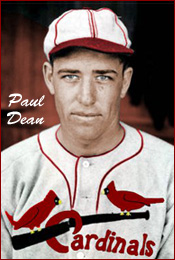
When Cardinals rookie Paul Dean learned to mix his pitches, hit the corners of the strike zone and quit trying to emulate his larger-than-life older brother, he became an effective starter for St. Louis.

paul_deanIn 1934, Paul Dean, 21, debuted with the Cardinals, won his first eight decisions and went into the All-Star Game break with a 10-4 record.

Paul Dean’s brother, Dizzy Dean, 24, was the ace of the 1934 Cardinals staff. Paul entered the Cardinals’ 1934 spring training camp as a candidate to join his brother in the starting rotation after posting a 22-7 record in 1933 for minor-league Columbus.

During that 1934 spring training, Dizzy brashly predicted he and Paul would combine for 45 wins for the Cardinals that season. Though well-intentioned, the remark put added pressure on Paul.

Some Cardinals veterans already thought Paul wasn’t ready for the big leagues and was being given preferable treatment in spring training because he was Dizzy’s brother.

Paul didn’t help matters with his combative nature. He feuded with first baseman Rip Collins and coach Mike Gonzalez and later got into a fight with outfielder Joe Medwick.

Needing a makeover

Paul made the Opening Day roster for the 1934 Cardinals. He yielded eight earned runs in six innings over his first three appearances and had an ERA of 12.00.

According to the book “Diz” by Robert Gregory, Cardinals manager Frankie Frisch told Paul, “You’ve got the speed, but it won’t matter how hard you throw. If it’s down the middle, these fellows are going to hit it.”

Said Cardinals pitcher Tex Carleton of Paul: “He doesn’t have a curve. No pitching finesse.”

Frisch and his coaches, Gonzalez and Buzzy Wares, worked with Paul to develop an off-speed pitch. Dizzy thought the instruction was a hindrance rather than a help. “There ain’t nothing wrong with Paul,” Dizzy said. “… He’ll be all right if them coaches don’t ruin him by trying to make him over. I want them to lay off that kid.”

In his next start, May 3 against the Phillies, Paul got his first big-league win, but he wasn’t sharp, yielding five runs in five innings in an 8-7 Cardinals victory.

“I was worried because he was obviously overawed by his big brother,” Frisch recalled years later. “Paul was imitating Dizzy’s style on the mound, but lacked his colossal self-confidence.”

Turning point

Paul’s next start was scheduled for May 11 against the defending World Series champion Giants and their ace, Carl Hubbell. Speculation was Paul would be sent to the minor leagues if he didn’t pitch well in that game.

“In many respects, Paul was pitching for his job,” The Sporting News reported. “He had done nothing prior to this outing and there were grave doubts about his ability to put a curve in there with his fast one that would keep the wolves away from the plate.”

A few days before the showdown, Frisch invited Paul to join him for dinner. Over porterhouse steaks, Frisch, who began his career with the Giants, explained to Paul how to pitch to each Giants batter. Frisch also told Paul to be himself, trust his talent and use the off-speed pitch he’d been learning.

Before a Ladies Day crowd at Sportsman’s Park in St. Louis, Paul mixed a changeup with his fastball and delivered some pitches from a sidearm delivery that helped hide the ball from batters. He held the Giants to two runs and got the complete-game win when the Cardinals snapped a 2-2 tie with a run off Hubbell in the 10th. Boxscore

“I think Paul Dean is in a fair position to become a great pitcher,” said Frisch. “His only trouble has been control and as long as he can pitch to spots he will be OK. We have worked hard on him and he has shown us that he knows how to pitch and can grab information and make the best of it. I like him.”

Dean demands

Paul became a consistent winner. Through May 31, Paul was 5-0, Dizzy was 6-2 and the Cardinals were in first place.

On June 1, Dizzy was scheduled to start against the Pirates. Instead, he staged a strike, refusing to pitch until the Cardinals gave his brother a $2,000 pay raise. Paul’s salary was $3,000. Dizzy’s salary was $7,500.

Dizzy ended his walkout the next day.

Paul won his next three decisions, boosting his record to 8-0 with a shutout against the Phillies on June 17.

Wrote The Sporting News: “He has passed the experimental stage and today unquestionably rates as the greatest young right-hander to come into the majors since Wes Ferrell and Lon Warneke.”

Deans deliver

After beating the Giants on June 26, Paul was 10-1 with a 3.92 ERA. He lost his next three decisions before the July 10 All-Star Game.

The Dean brothers continued to win in the second half of the season, especially in the September pennant stretch. Paul was 5-3 with a 1.93 ERA in September; Dizzy was 7-1 with a 1.54 ERA that month.

The Cardinals won the pennant with a 95-58 record, finishing two games ahead of the Giants.

Dizzy was 30-7 and led the NL in strikeouts for the third consecutive season. Paul was 19-11 with 16 complete games and five shutouts. With a combined 49 wins, the brothers had exceeded Dizzy’s prediction.

In the World Series, Dizzy and Paul each won twice, leading the Cardinals to the championship over the Tigers. In Paul’s two starts, he pitched complete games, yielding two earned runs in 18 innings.

Previously: How Dizzy Dean got the best of his matchup with Babe Ruth

Previously: Pennant clincher: How Dizzy Dean got 2 shutouts in 3 days

Previously: Cardinal cool: How Dizzy Dean survived armed robbery

(Updated July 13, 2020)

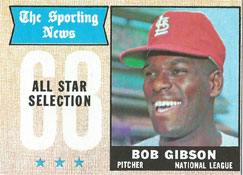
In a display of strength and versatility, Bob Gibson in 1965 pitched 13 innings in a start vs. the Giants on July 7, pitched four innings of relief against the Cubs on July 11 and earned a save with two innings of relief in the July 13 All-Star Game.

bob_gibson15Well aware of Gibson’s workload, the Phillies’ Gene Mauch, National League manager, left it up to the Cardinals’ ace to choose whether to pitch in the All-Star Game at Minnesota.

“He told me before the game that his arm didn’t feel good,” Mauch told the Minneapolis Star-Tribune. “I made it clear that it was his decision whether to pitch or not. During the game, Gibson sent word that he was OK.”

Mauch called on Gibson to protect a 6-5 lead over the final two innings.

“Gibson thinks he can get anybody in the world _ and I do, too,” Mauch told the Associated Press.

Grateful for Gibson’s save, the Dodgers’ Sandy Koufax, who got the All-Star Game win, good-naturedly said to Gibson, “Why don’t you quit starting? There’s a heck of a future in relieving for you.”

NL fireballers

The National League unleashed an array of hard throwers on the American League. Juan Marichal of the Giants started and was followed by the Reds’ Jim Maloney, Dodgers teammates Don Drysdale and Koufax and the Astros’ Turk Farrell before Gibson entered in the eighth. The American League scored all of its runs off Maloney.

Gibson, the Cardinals’ lone all-star representative, retired the first two batters he faced, striking out the Tigers’ Willie Horton and getting the Yankees’ Bobby Richardson on a groundout. After he walked the Twins’ Zoilo Versalles, Bill Freehan of the Tigers followed with a single to center. When the throw from Willie Mays went to third, Freehan took second, putting two runners in scoring position for the next batter, the Twins’ Jimmie Hall.

A left-handed batter, Hall hit a shot to center. Mays started for the ball, slipped and barely recovered in time to make a leaping, backhanded catch, ending the inning.

In the bottom of the ninth, the Twins’ Tony Oliva led off with a double. Attempting a bunt, the Indians’ Max Alvis offered at Gibson’s first pitch and popped out for the first out.

Gibby vs. Killer

Twins slugger Harmon Killebrew was up next. The crowd at Metropolitan Stadium was abuzz at the prospect of their prodigious home run hitter driving in his Twins teammate Oliva from second with the tying run.

Instead, Killebrew struck out.

“He threw me sliders until the last pitch,” Killebrew told the Star-Tribune. “That was a good, hard fastball.”

To the St. Louis Post-Dispatch, Killebrew said, “For a guy who was supposed to be tired, Gibson threw pretty darn good. The ball just seemed to drop under my bat.”

American League manager Al Lopez sent a left-handed pinch-hitter, the Yankees’ Joe Pepitone, to bat next.

Gibson struck him out, sealing the win. Boxscore and video of Gibson at 13:40 mark

Throwing heat

In describing how he pitched Pepitone, Gibson said, “The first two sliders were up and in. They aren’t going to do a darn thing with it if it goes in there. If it doesn’t get in there, that’s a different story. The last pitch was a fastball. That was in there.”

Asked to describe the strikeout pitch, Pepitone said, “Whoosh. I saw it good, too. He was just a little too quick.”

Nine months earlier, Pepitone went 0-for-4 versus Gibson in Game 7 of the 1964 World Series. After fanning Pepitone in the All-Star Game, Gibson said to the Star-Tribune, “The World Series is a lot more thrilling to pitch in than the All-Star Game because there’s money involved.”

In the clubhouse, National League catcher Joe Torre of the Braves soaked his left hand in warm water to ease the soreness from having so many fastballs slam into his mitt.

“I had some real hummers coming out of the bullpen,” Torre told The Sporting News. “The hand really hurts.”

Said Gibson: “I got to admit he was catching some sizzlers.”

Previously: As all-stars, only two hit Bob Gibson more than once


In an exhibition established to assist the United States’ war effort and help compensate for the cancelation of the All-Star Game, the Cardinals were part of a baseball experiment.

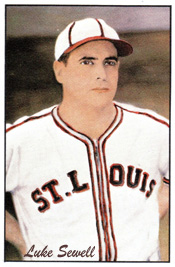
luke_sewellOn July 10, 1945, Browns manager Luke Sewell used nine pitchers in an exhibition against the Cardinals at Sportsman’s Park. Sewell wanted to see what would happen if he utilized a different pitcher in each of nine innings.

He increased the intrigue factor by alternating a right-hander and a left-hander each inning.

The result: The Browns shut out the Cardinals on two hits and won, 3-0.

Asked whether he’d consider using a different pitcher an inning in a regular-season game, Sewell told the Associated Press, “I wouldn’t think of it … I don’t think this will ever be more than just a novelty.”

Non-essential game

The All-Star Game was canceled in 1945 under orders from Col. J. Monroe Johnson, chief of the Office of Defense Transportation. With the nation needing resources in World War II, the Office of Defense Transportation had the authority to enforce travel restrictions. It viewed the All-Star Game scheduled for July 10, 1945, at Boston’s Fenway Park to be an unnecessary luxury that would sap travel resources needed for the war effort.

To replace the All-Star Game, Major League Baseball proposed eight interleague exhibition games _ four on July 9 and four on July 10. Proceeds from the exhibitions would be donated to the War Service Relief Fund.

The Office of Defense Transportation approved seven of the exhibitions and rejected a proposed game between the Tigers and Pirates at Pittsburgh because of the distance the Tigers would need to travel from Detroit.

The approved games:

_ New York Yankees vs. New York Giants at the Polo Grounds in New York.

_ Chicago Cubs vs. Chicago White Sox at Comiskey Park in Chicago.

_ Cincinnati Reds vs. Cleveland Indians at Municipal Stadium in Cleveland.

_ Brooklyn Dodgers vs. Washington Senators at Griffith Stadium in Washington.

_ Philadelphia Phillies vs. Philadelphia Athletics at Shibe Park in Philadelphia.

_ Boston Braves vs. Boston Red Sox at Fenway Park in Boston.

_ St. Louis Cardinals vs. St. Louis Browns at Sportsman’s Park in St. Louis.

World Series rematch

The Cardinals-Browns game matched the defending league champions. The Cardinals had defeated the Browns in six games in the 1944 World Series.

A crowd of 24,113 turned out at Sportsman’s Park for the exhibition, producing $36,000 for the War Service Relief Fund.

In order, the nine pitchers who appeared for the Browns:

_ First inning, right-hander Tex Shirley.

_ Second inning, left-hander Sam Zoldak.

_ Third inning, right-hander Pete Appleton.

_ Fourth inning, left-hander Earl Jones.

_ Fifth inning, right-hander George Caster.

_ Sixth inning, left-hander Lefty West.

_ Seventh inning, right-hander Sig Jakucki.

_ Eighth inning, left-hander Al Hollingsworth.

_ Ninth inning, right-hander Bob Muncrief.

The Cardinals’ hits were a double Red Schoendienst against Shirley in the first inning and a single by Ray Sanders versus Zoldak in the second.

Browns outfielder Milt Byrnes hit a solo home run against Cardinals starter Red Barrett in the first.

In the fourth, a triple by Pete Gray, a one-armed outfielder, sparked a two-run inning for the Browns against Al Jurisich.

The seven interleague exhibitions attracted a total attendance of 169,880 and raised $244,778 for the War Service Relief Fund.

Except for the high number of outstanding players on the field, the first All-Star Game at St. Louis was a lot like any other Tuesday afternoon game at Sportsman’s Park in 1940.

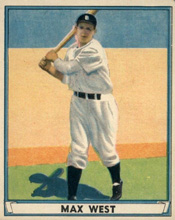
max_westMore an exhibition game than a spectacle celebrating baseball’s best, the drab event played on July 9, 1940, lacked the feel of being a special occasion.

Dan Daniel, columnist for The Sporting News, called the Sportsman’s Park setting “a cold stage” and “depressing,” noting that bunting wasn’t even draped around the ballpark.

“Advance publicity was almost nil,” Daniel wrote. “Hoopla by both leagues was missing woefully before and on the day of battle.”

A band hired to entertain showed up only an hour before game time.

Unmoved, baseball commissioner Kenesaw Mountain Landis said, “These people came out to see a ball game, not a parade.”

Cardinals are hosts

The 1940 All-Star Game was the eighth overall since the concept of a summer classic began in 1933. Because it was the National League’s turn to be the 1940 home team, the Cardinals, not the American League Browns, were the host at Sportsman’s Park.

A crowd of 32,373 attended. Cardinals owner Sam Breadon estimated 60 percent of the spectators came from outside St. Louis. They included celebrities such as Hollywood entertainers Bob Hope and Joe E. Brown and actor George Raft.

Among the American League starters were left fielder Ted Williams, center fielder Joe DiMaggio, first baseman Jimmie Foxx and catcher Bill Dickey.

The NL starters included a pair of Cardinals, first baseman Johnny Mize and center fielder Terry Moore, and a longtime former Cardinal, left fielder Joe Medwick. Traded by the Cardinals to the Dodgers a month earlier, Medwick was booed when he was announced as the left fielder.

Playing a hunch

National League manager Bill McKechnie of the Reds initially had Mel Ott of the Giants starting in right field. An hour before game time, he changed his mind and started Max West of the Braves instead.

McKechnie told the Associated Press he made the change because he wanted Ott available to play the later innings when the sun presented a challenge to fielders in right. McKechnie said Ott had more experience than West in handling a St. Louis sun field.

“It was my hunch that Ott … would be a bit steadier in the sun and that is the only reason for the change,” McKechnie said.

The Sporting News reported a different reason for the switch. Braves manager Casey Stengel, first-base coach for the NL, suggested to McKechnie that West “has a home run in him,” columnist Dick Farrington reported.

McKechnie inserted West into the No. 3 spot in the batting order.

After Paul Derringer of the Reds held the AL scoreless in the first (Williams walked and DiMaggio grounded out), Arky Vaughan and Billy Herman opened the NL half of the inning with back-to-back singles off Red Ruffing of the Yankees.

West, 23, a Dexter, Mo., native, stepped to the plate for his first (and only) at-bat as an all-star. He swung and missed at the first pitch from Ruffing, then launched the second into the seats in right-center for a three-run home run.

Hard fall

A half-inning later, Luke Appling of the White Sox tried to ignite an AL rally with a drive to right. West attempted a leaping catch, fell hard against the wall and crumpled to the ground as Appling reached second with a double.

Stengel was among the first to rush to West’s aid. The right fielder was able to get to his feet and limp back to the dugout with what was reported to be a bruised hip. Bill Nicholson of the Cubs replaced West in right field. (Ott subbed for Nicholson in the sixth.)

NL pitching dominated the remainder of the game. Derringer, Bucky Walters, Whit Wyatt, Larry French and Carl Hubbell held the AL scoreless and the NL won, 4-0, in the first All-Star Game shutout.

Moore was the only NL player to play the entire game. He was 0-for-3 with a walk. Mize and Medwick each was 0-for-2.

The AL managed only three hits _ two by Appling and one by pitcher Bobo Newsom of the Tigers. Boxscore

West never again appeared in an All-Star Game. In a seven-year career with the Braves, Reds and Pirates, West hit .254 with 77 home runs.

St. Louis has been the All-Star Game site five times: 1940, 1948, 1957, 1966 and 2009. Only New York (nine) and Chicago (seven) have hosted the All-Star Game more often.

Previously: Joaquin Andujar skipped All-Star Game to barbecue quail

Previously: How Joe Medwick got traded by Cardinals to Dodgers

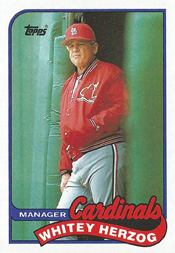
Unhappy with management’s indifference to re-signing any of the team’s core free agents and unwilling to ask those players to make the kinds of selfless sacrifices that were essential to the success of his Cardinals clubs, manager Whitey Herzog found himself trapped in the middle of an uncomfortable situation.

whitey_herzog5On July 6, 1990, Herzog, 58, resigned when he concluded he couldn’t be effective with a team uninterested in playing his style of baseball.

“I was totally embarrassed by the way our team played,” Herzog said to the Associated Press. “I just feel very badly for the ball club, the organization and the fans.”

Adios

Herzog said he decided to quit on July 3 while the 1990 Cardinals were in San Francisco. He discussed the decision with his wife on July 4, informed Cardinals management on July 5 and made the announcement on July 6 at a news conference at the team hotel in San Diego.

Three weeks earlier, Herzog had offered to resign, but club president Fred Kuhlmann and general manager Dal Maxvill talked him out of it. “He told us then it could get a lot uglier,” Maxvill said.

When Herzog stepped down, the Cardinals had a 33-47 record and were in last place in the National League East. In 11 years with the Cardinals, Herzog was 822-728, with three NL pennants and a World Series championship. He replaced Ken Boyer as manager in 1980 with the club in the cellar.

“I came here in last place and I leave here in last place,” Herzog told Rick Hummel of the St. Louis Post-Dispatch.

Red Schoendienst, the Cardinals coach and former manager, was named interim manager. “I had dinner with Whitey (July 5) and we stayed up late discussing the team,” Schoendienst told Hummel. “He never gave me a hint (about resigning).”

Herzog blamed himself rather than the players for the team’s performance. “I don’t think that I have done a good job as a manager this year,” Herzog said. “I just can’t get the guys to play and I think anybody could do a better job than me.”

Invested in self

Outfielders Willie McGee and Vince Coleman, third baseman Terry Pendleton and reliever Ken Dayley were among the ten 1990 Cardinals eligible for free agency after the season. By July, it became apparent management wasn’t interested in re-signing any of those core players.

“I watched Whitey suffer through this year and his hands are almost tied,” Cardinals broadcaster Mike Shannon said after Herzog resigned. “He can’t get things done right because we don’t really have a Cardinals baseball team here. What we have, in my estimation, is we’ve got so many people … just playing for themselves. They’re just playing for their free agency. Whitey Herzog is not going to be responsible for having a club that’s not a team.”

Herzog told Ross Newhan of the Los Angeles Times, “I felt I couldn’t look them in the eye and ask them to do the little things we always had to do because it might cost them 10 points off their batting averages and that might cost them $3 million as free agents. We had a half season to go and I felt powerless.”

Before the season ended, the Cardinals traded McGee to the Athletics. Coleman, Pendleton and Dayley became free agents after the season and signed with other teams.

In his book “You’re Missin’ a Great Game,” Herzog said, “Fred Kuhlmann decided not even to negotiate with our free-agent players. He wouldn’t even talk to their agents. I said, ‘Man, at least talk to them; let ’em think they might be coming back. That way they have something to play for.’ But they wouldn’t do it.

“Why is that important? For our type of ball club, it was death … If we were going to win, we had to hit to the right side, play team ball and sacrifice personal stats … But if you were up for free agency, and if you knew the club didn’t want you, would you shoot the ball to right?”

Brain drain

The impending free agents weren’t the only players falling short of executing to Herzog’s standards. “I feel kind of responsible,” said first baseman Pedro Guerrero. “I know that I haven’t done the job that I did last year at this point.”

Said Herzog of his players: “The effort is there, but sometimes I don’t know if the minds are there.”

After his news conference, Herzog departed for St. Louis on an Anheuser-Busch corporate jet without saying goodbye to his team.

“We didn’t deserve for him to talk to us,” catcher Tom Pagnozzi told Bernie Miklasz of the Post-Dispatch. “We embarrassed him. We all but spit on him with the way we played. He didn’t have to say anything to us. We know why he’s leaving. We drove him out of here.”

Said Pendleton: “It wasn’t his fault that we stunk.”

Faces of hate

Miklasz, a sharp-eyed, pull-no-punches observer, had this chilling opening to his column from the Cardinals clubhouse in San Diego after Herzog departed:

“This was a clubhouse divided, with all the ugly cliques finally exposed,” Miklasz wrote. “Cardinals were squared away in opposite corners, eyeballing each other with looks that could kill. White players, mostly pitchers, on one side. Black players, most notably Ozzie Smith, on the other. Bad vibrations everywhere.

“It’s no wonder Whitey Herzog wanted out of here and escaped on the first corporate jet he could find. Whitey didn’t resign; he evacuated, leaving behind a team so ripped apart and split open that the players didn’t try to conceal the wounds. No one bothered to put on a mask. Nothing could hide these faces of hate.”

Previously: Ted Simmons helped put pal Joe Torre on path to Hall