Feeds:
Posts
Comments

(Updated July 5, 2019)

During a game at Cincinnati, the managers of the Cardinals and Reds threw punches at one another and wrestled on the ground near home plate. One of them may have taken a bite out of the other.
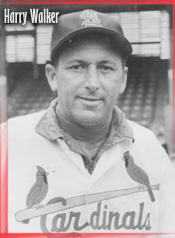
harry_walkerOn July 5, 1955, a fight between managers Harry Walker of the Cardinals and Birdie Tebbetts of the Reds prompted players to rush onto the field and join in the fisticuffs.

Watching from his seat in the Crosley Field stands was National League president Warren Giles. “I never before heard of two major-league managers starting a fight between their teams by being the first to exchange blows,” Giles said to The Sporting News. “To the best of my knowledge, their fight was unprecedented.”

Action inning

The drama began in the ninth.

With the Reds ahead 3-2, Bill Virdon led off the ninth for the Cardinals and hit a home run against former St. Louis pitcher Gerry Staley, tying the score. After a single and a walk, Bob Stephenson gave the Cardinals a 4-3 lead with a one-out RBI-single off Joe Black.

In the Reds’ half of the inning, another former Cardinals player, Ray Jablonski, delivered a RBI-single against reliever Paul La Palme, tying the score at 4-4.

After Walker made a pair of defensive changes, sending Ken Boyer to replace Solly Hemus at third base and Pete Whisenant to replace Joe Frazier in right field, Cardinals catcher Bill Sarni went to the mound to visit with La Palme. Tebbetts suspected Sarni was trying to buy time for Boyer and Whisenant to loosen their arms.

Tebbetts protested to plate umpire Jocko Conlan, claiming the rules called for the game to resume as soon as the new fielders took their positions.

The argument ended without a resolution.

Sam Mele, batting with one out and runners on first and second, flied out to Whisenant.

Johnny Temple was the next batter, but before he could take a stance, Sarni again visited the mound. As he did, Whisenant threw more practice tosses.

Temper tantrums

Tebbetts came out to the plate to complain to Conlan. Walker rushed over to defend his team. The managers began yelling at one another, with Conlan between them.

“We called each other names,” Tebbetts said. “We both seemed to get the idea at once that the only way to settle our argument was with our fists. So we started swinging.”

In The Sporting News, Bob Broeg wrote, “Tebbetts suddenly swung _ and missed _ prompting a return blow that landed.”

Tebbetts, 42, and Walker, 38, grabbed one another, wrestled to the ground and rolled around in the dirt.

Players from both benches emptied onto the field, with several piling onto Walker and Tebbetts. Some squared off in individual battles. Pitchers Art Fowler of the Reds and Larry Jackson of the Cardinals tangled. So did Frazier and Reds outfielder Wally Post.

“Fights were going on all over an area of 50 feet to the right of the plate,” according to the Cincinnati Enquirer, which called it “one of the wildest rhubarbs witnessed at Crosley Field in years.”

Others, such as Stan Musial and Red Schoendienst of the Cardinals and Ted Kluszewski of the Reds, played peacemakers.

Bruised and battered

Walker suffered a bruised forehead and said Tebbetts bit him on the left ear.

“A lot of players must have hit me or kicked me,” said Walker. “At one time, while we were down, I yelled at Birdie, ‘You’re trying to bite me.’ ”

Said Tebbetts: “Someone stomped on my back and someone else kicked me in an ear. I saw another foot coming at me and ducked my head against Harry’s face so close he thought I was trying to bite him. I was just trying to protect my own head.”

Tebbetts suffered a nosebleed and cuts on his lip and neck. “I feel like I have been run over by a steam roller,” Tebbetts said.

Reds rally

Conlan ejected Tebbetts, Walker and Sarni.

As the managers left the field, Walker picked up Tebbetts’ cap from the ground and wore it into the Cardinals’ clubhouse, the St. Louis Post-Dispatch reported.

When played resumed, Temple singled, scoring Chuck Harmon with the run that gave the Reds a 5-4 victory. Boxscore

Giles fined Tebbetts and Walker $100 each.

“Managers have an obligation to preserve or restore order and not, by their actions, to incite disorder,” Giles said.

Said Tebbetts: “I’ve got nothing against Walker. He was just doing his job even if I didn’t agree as to the manner in which he was trying to do it.”

Previously: The story of why Cardinals fired manager Eddie Stanky

Previously: No backing down: Tony La Russa vs. Lloyd McClendon

Previously: Wrangle at Wrigley: Tony La Russa vs. Dusty Baker

Previously: 1980s macho match: Whitey Herzog vs. Roger Craig
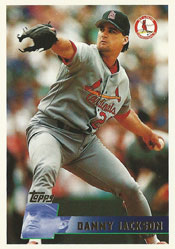
In a season fraught with futility, the pitcher who epitomized the plight of the 1995 Cardinals was Danny Jackson. Expected to provide wins and hope, Jackson instead represented losses and despair.

danny_jacksonOn July 2, 1995, Jackson was the losing pitcher for St. Louis against the Cubs at Chicago, dropping his season record to 0-9.

Jackson became the first Cardinals pitcher to start a season 0-9 since Art Fromme in 1907 and the first Cardinals pitcher to lose nine in a row since Bob Forsch did so from July 5 through Aug. 19 in 1978.

Tough guy

A left-hander, Jackson was signed by the Cardinals as a free agent in December 1994 after posting a 14-6 record and 3.26 ERA for the 1994 Phillies.

Jackson had pitched in three World Series for three different franchises (1985 Royals, 1990 Reds and 1993 Phillies) and had been a 23-game winner with the 1988 Reds.

Cardinals general manager Walt Jocketty gave Jackson a three-year contract for a guaranteed $10.8 million.

“Danny Jackson gives us the toughness we’ve lacked in our pitching staff,” Cardinals manager Joe Torre told the St. Louis Post-Dispatch.

Troubled pitcher

Jackson, 33, who underwent thyroid surgery during the off-season, started poorly with the 1995 Cardinals, yielding four runs or more in each of his first four appearances. Jackson had complications with his medications. He also was hampered by an unsteady defense and erratic offense.

Still, Jackson’s ineffectiveness was his own doing. His pitching mechanics were out of synch.

His ERA after his ninth loss was 7.83. Jackson gave up three or more runs in an inning 11 times in his first 11 starts for the Cardinals. He was unable to last longer than five innings in eight of those starts.

“I don’t know what the hell is going on, but I know one thing: I’m sick and tired of losing,” Jackson said after his record fell to 0-9. “It doesn’t seem to make any difference what I do. It’s always the same.”

Said Mike Jorgensen, who had replaced Torre as manager: “We’re going to keep sending him out there until we get him smoothed out.” Boxscore

Goodbye gorilla

Five days after his loss to the Cubs, Jackson ended the streak in spectacular fashion, shutting out the Marlins on a four-hitter on July 7, 1995, at St. Louis.

“I feel like I got King Kong off my back,” Jackson said.

Said catcher Tom Pagnozzi: “That was the best he had looked as far as not muscling the ball and throwing fluidly.” Boxscore

Jackson won his next start, beating the Phillies, and then lost three decisions in a row.

Bad numbers

In his last start of the season, Aug. 11 against the Padres, Jackson injured an ankle, was lifted in the second inning and didn’t pitch again in 1995.

His season record: 2-12 with a 5.90 ERA.

In 19 starts, Jackson yielded 120 hits in 100.2 innings and had almost as many walks (48) as strikeouts (52). Batters hit .303 against him.

His failures were a key factor in the Cardinals having a 62-81 record.

Jackson never recovered. In three seasons with the Cardinals, he was 4-15 with a 5.78 ERA.

On June 13, 1997, the Cardinals dealt Jackson, pitcher Rich Batchelor and outfielder Mark Sweeney to the Padres for pitcher Fernando Valenzuela, outfielder Phil Plantier and third baseman Scott Livingstone.

Previously: The day Cardinals fired Joe Torre, traded Todd Zeile

(Updated June 29, 2020)

Taking advantage of an unmotivated, jet-lagged team, Fernando Valenzuela pitched a no-hitter against the Cardinals. It was the second no-hitter pitched in the major leagues that night and the first versus the Cardinals in 12 years.

fernando_valenzuelaOn June 29, 1990, at Los Angeles, Valenzuela pitched the only no-hitter of his career in a 6-0 Dodgers victory over the Cardinals.

Earlier that night, Dave Stewart, Valenzuela’s former Dodgers teammate, pitched a no-hitter for manager Tony La Russa’s Athletics against the Blue Jays. It was the first time no-hitters had been pitched in both the American League and National League on the same day.

Valenzuela, 29, struck out seven and walked three. The Cardinals also had a runner reach on an error.

The left-hander pitched the first no-hitter against the Cardinals since Tom Seaver of the Reds on June 16, 1978.

Control, confidence

After beating the Pirates in a night game at St. Louis on June 28, the Cardinals stayed overnight at home and left the morning of June 29 for that night’s game against the Dodgers. The Cardinals arrived in Los Angeles about 12:30 in the afternoon Pacific Coast time.

The Dodgers watched on the clubhouse TV as Stewart completed his no-hitter at Toronto. Boxscore

Valenzuela turned to his teammates and said, “You’ve seen one on TV. Now come watch one live,” Rick Hummel of the St. Louis Post-Dispatch reported.

Valenzuela’s previous big-league best had been a two-hitter.

From the first pitch, Valenzuela was in command. “Throughout the game, I had excellent control,” he told the Orange County Register. “I had a lot of confidence.”

Timely tip

In the ninth, Vince Coleman led off for the Cardinals. The speedster was carrying a 10-game hitting streak and was the batter Valenzuela feared most in the St. Louis lineup. “Coleman makes a lot of contact and he can bunt,” Valenzuela said.

On a 2-and-1 pitch, Coleman hit a shot down the third-base line, but it was foul. With the count at 2-and-2, Coleman showed bunt, took a pitch outside and was called out on strikes by umpire Jerry Layne.

Referring to Layne’s strike zone, Cardinals manager Whitey Herzog told the Los Angeles Times, “I don’t want to take anything away from Fernando, but he had the right guy behind the plate.”

Willie McGee was up next and he walked on four pitches.

That brought to the plate Pedro Guerrero, who had been Valenzuela’s Dodgers teammate from 1980-88. Guerrero was playing on his 34th birthday.

“When Willie got on,” Guerrero told Hummel, “I said, ‘I’m going to be the one that’s going to do it.’ ”

With the count 0-and-2, Guerrero hit a grounder up the middle. As Valenzuela reached for the ball, it tipped his glove and was deflected to second baseman Juan Samuel, who stepped on second for the force on McGee and threw to first for the game-ending double play.

Jubilant Dodgers broadcaster Vin Scully told listeners, “If you have a sombrero, throw it to the sky.” Video of ninth inning

“Do you think if I don’t touch that ball, it goes through for a single? I think it does,” said Valenzuela. “I think if I don’t touch it, I’m in trouble.”

Said Guerrero: “I hit it pretty good. If he doesn’t get a glove on it, I think it’s through there.” Boxscore

Cardinals crusher

The loss was the fifth in six games for the Cardinals (30-44).

“We’re pathetic,” said Herzog.

Said Guerrero: “We didn’t look too good out there, but I think flying on game day had something to do with it.”

Stewart called the Dodgers clubhouse after the game to congratulate Valenzuela.

The no-hitter evened Valenzuela’s season record at 6-6 and lowered his ERA from 4.09 to 3.73.

Valenzuela was the fourth Dodgers pitcher to achieve a no-hitter since 1958 when the franchise moved from Brooklyn to Los Angeles. The others were Sandy Koufax, Bill Singer and Jerry Reuss.


(Updated June 27, 2020)

In his final career win as a starter, Bob Gibson achieved a milestone.

bob_gibson19On June 27, 1975, Gibson earned his 250th career win, pitching six innings in a 6-4 Cardinals victory over the Expos in Game 1 of a doubleheader at Montreal.

Gibson became the first and only Cardinals pitcher to achieve 250 wins. No one else has come close. The pitcher with the next-best career wins total as a Cardinal is Jesse Haines (210).

The win also was the first for Gibson since May 5, 1975.

“Number 250 doesn’t mean any more than 249,” Gibson said to the Associated Press. “It feels good to be able to win a game and help the ball club. I want to be part of a winning ball club. I haven’t lost that.”

Gibson told the St. Louis Post-Dispatch, “I’m not out there for anything more than pride.”

Breaking stuff

Gibson, 39, shut out the Expos through six innings.

“I was getting my breaking ball over,” Gibson said. “If you don’t have the breaking stuff. you just have the fastball. It’s tough to pitch with just the fastball.”

Gibson also contributed a RBI-single in the fifth off Expos starter Steve Rogers and scored on a Ted Sizemore two-run double.

“If his arm isn’t that good any more, he still has the heart,” Expos manager Gene Mauch said to the Montreal Gazette. “It looks like the heart is as big as ever.”

In the seventh, with the Cardinals ahead, 4-0, the first two Expos batters reached base and Gibson was lifted by manager Red Schoendienst. Ron Bryant relieved and yielded a RBI-double to Barry Foote. Rookie Greg Terlecky replaced Bryant and gave up a two-run single to Bob Bailey. Two of the runs were charged to Gibson.

Gibson’s line for the game: 6 innings, 5 hits, 2 runs, 6 walks, 1 strikeout. Boxscore

“His hard slider may not be able to chip the corner off a brick any more and his right arm feels like a toothache when he has finished pitching a game,” the Post-Dispatch observed.

Said Gibson: “I ache every time I take a step.”

One more win

Gibson made two more starts, the last of his career, against the Phillies and Giants, and lost both, dropping his season record to 2-8.

His 251st and final win of his career came in relief on July 27, 1975, against the Phillies at St. Louis.

Relieving rookie starter John Denny in the fourth, Gibson pitched four shutout innings in a 9-6 Cardinals triumph. Gibson struck out Larry Bowa and Mike Schmidt to end the sixth and struck out Greg Luzinski to start the seventh.

Gibson’s line for the game: 4 innings, 3 hits, 0 runs, 1 walk, 4 strikeouts. Boxscore

It was Gibson’s first win in relief since beating the Mets on the final day of the 1964 season, clinching the National League pennant for St. Louis.

Gibson made six more relief stints for the 1975 Cardinals and lost two, finishing his final season at 3-10 with a 5.04 ERA.

In 17 seasons (1959-75) with St. Louis, Gibson was 251-174 with a 2.91 ERA. Among his accomplishments: two NL Cy Young awards, two World Series Most Valuable Player awards, a NL MVP Award and nine Gold Glove awards. He was elected to the National Baseball Hall of Fame in 1981.

Previously: How Ron Reed replaced Bob Gibson in Cardinals rotation


(Updated June 23, 2020)

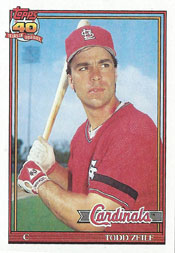
In June 1995, the Cardinals were a franchise in disarray. The depth of their dysfunction was revealed on one dismal day, June 16, when they fired their manager, Joe Torre, and traded their cleanup hitter, Todd Zeile.

todd_zeileRather than signal an inspiring beginning, the moves had the feel of surrender.

The termination of Torre largely was viewed as a lame effort to deflect attention from management’s shortcomings.

The trading of Zeile largely was viewed as spiteful.

A bad team

After being named Cardinals manager in August 1990, Torre led the Cardinals to winning seasons each year from 1991 through 1993. His best record was 87-75 in 1993. When the Cardinals fell to 53-61 in strike-shortened 1994, Torre’s friend, general manager Dal Maxvill, was fired and replaced by Walt Jocketty.

By then, the Anheuser-Busch ownership of the Cardinals seemed more interested in minimizing expense to enhance profitability than it did in investing in the team.

After splitting their first 18 games, the 1995 Cardinals lost 10 of their next 13 and fell to 12-19.

“This is a bad team and someone must pay the price,” columnist Bob Nightengale wrote in The Sporting News. “They don’t have a marquee power hitter. They’re awful defensively. They have no speed.”

Published reports indicated Cardinals president Mark Lamping was pressuring a reluctant Jocketty to appease a restless fan base by changing managers.

Cheap PR move

On the morning of June 16, with the Cardinals’ record at 20-27, Jocketty went to Torre’s home and informed him he was fired.

“It didn’t surprise me,” Torre told Rick Hummel of the St. Louis Post-Dispatch.

His overall record as Cardinals manager: 351-354. “We worked hard and we did a lot of things,” Torre said. “We just didn’t win enough.”

Said Jocketty: “We will not stand pat and let things keep going as they were.”

Unimpressed, Post-Dispatch columnist Bernie Miklasz concluded the Cardinals “dumped a classy guy, Torre, to feed the wolfpack.”

“All I see is a cheap PR move.” Miklasz wrote. “All I see is a twitch reflex from a panic attack.”

Change the dynamics

After considering Cardinals coaches Chris Chambliss and Gaylen Pitts as candidates to replace Torre, Jocketty chose director of player development Mike Jorgensen. “He is an intense guy … He’ll bring a little fire to the clubhouse as well as to the field,” Cardinals pitcher Tom Urbani said of Jorgensen. Said Jocketty: “I wanted to bring in someone who could change the dynamics a little.”

Jocketty, though, wasn’t done for the day. Next, he dealt Zeile.

Deal or no deal

Zeile was batting .291 with five home runs and 22 RBI as the first baseman and cleanup hitter for the 1995 Cardinals. In June that year, he revealed the Cardinals had reneged on a three-year, $12 million handshake agreement he said they made in April.

Lamping was furious and said, “There never was a deal with Todd Zeile.”

The Cardinals were paying Zeile a 1995 salary at a rate of $3.2 million, the Chicago Tribune reported. Zeile opted to seek a 1995 salary of $4.2 million in an arbitration hearing scheduled for June 16, according to the Tribune.

On the night of June 15, the Cardinals offered Zeile a $4 million contract for 1995, the Tribune reported, but he rejected it. “It wasn’t the brightest business decision, but based on principle, I would not accept that offer,” Zeile said.

Rather than go to arbitration, the Cardinals traded Zeile, 29, to the Cubs for pitcher Mike Morgan, 35, and a pair of minor-league players, first baseman Paul Torres and catcher Francisco Morales.

“Todd Zeile was not happy,” Jocketty told the Tribune. “He had asked that we trade him and I have been spending the last couple of weeks trying to accommodate him.”

According to the Post-Dispatch, Jocketty had offered Zeile to the Padres for pitcher Andy Benes, but the proposal was rejected.

“We’re not happy with the chemistry and the focus of this team,” Jocketty said. “If you saw Todd Zeile play, you could see he’s not a real aggressive person in his approach to the game. He was kind of at one gait.”

In seven seasons with St. Louis, Zeile started at three positions _ catcher, third base and first base _ and batted .267 with 75 home runs.

Zeile told Hummel he would depart “with a lot more fond memories than negative,” but added, “Unfortunately, this situation turned kind of ugly at the end. I think it will be better in the long run to go somewhere where I’ll be embraced.”

In comments to the Tribune, Zeile said, “The organization hasn’t made a commitment to the players to win. They should be able to produce winners.”

Miklasz blasted Lamping and Jocketty, saying the Cardinals executives “smeared Zeile, suggesting he was responsible for poor team chemistry. Zeile wasn’t any more at fault than any of the other veterans on the team. Why single him out as the villain?”

Noting the decisions by Jocketty to acquire underperforming third baseman Scott Cooper and pitcher Danny Jackson, Miklasz wrote: “Jocketty traded for Cooper and he’s a nervous wreck. Jocketty signed Jackson and he’s a physical wreck.”

The aftermath

Getting fired by the Cardinals turned out to be a blessing for Torre. He was hired to manage the Yankees and led them to four World Series titles and six American League pennants. Torre was inducted into the Baseball Hall of Fame in 2014.

Jorgensen managed the Cardinals to a 42-54 record and returned to the front office after the season. He was replaced as manager by Tony La Russa, who would lead St. Louis to two World Series championships and three National League pennants and would be inducted into the Hall of Fame with Torre.

Rookie John Mabry replaced Zeile as the Cardinals’ first baseman.

The Cubs signed Zeile for $3.7 million for one year, but he was a bust with them in 1995, hitting .227. He became a free agent after the season and signed with the Phillies.

Zeile played for 11 teams: Cardinals, Cubs, Phillies, Orioles, Dodgers, Marlins, Rangers, Mets, Rockies, Yankees and Expos. He had 2,004 hits and 1,110 RBI in 16 seasons in the majors, and also played in 29 postseason games with the Orioles, Rangers and Mets.

Morgan made 17 starts for the 1995 Cardinals and was 5-6 with a 3.88 ERA. The next year, he was 4-8 with a 5.24 ERA for St. Louis before he was released.

The two minor-league players acquired with Morgan from the Cubs never reached the big leagues.


Determined to reconstruct their bullpen, the 1965 Cardinals acquired the closer they needed, but gave up an ace to get him.

mike_cuellarOn June 15, 1965, the defending World Series champions traded pitchers Mike Cuellar and Ron Taylor to the Astros for pitchers Hal Woodeshick and Chuck Taylor.

Woodeshick became the closer for the 1965 Cardinals and pitched effectively.

Cuellar developed into an all-star for the Astros, mastering the screwball and curve and paving his way to becoming a Cy Young Award winner with the Orioles.

Seeking a stopper

Barney Schultz and Ron Taylor were the top relievers for the 1964 Cardinals. Schultz had a team-high 14 saves and a win, all after his call-up from the minors in August 1964. Taylor had eight saves and eight relief wins.

Cuellar also was a useful reliever for the 1964 Cardinals. Overall, his record that season was 5-5 with a 4.50 ERA. As a reliever, though, Cuellar was 3-0 with four saves and a 2.53 ERA in 25 appearances.

Red Schoendienst, who replaced Johnny Keane as Cardinals manager, went into the 1965 season with Schultz and Taylor as his top two relievers. Cuellar was sent to Class AAA Jacksonville and placed in the starting rotation.

Schultz and Taylor struggled early with the 1965 Cardinals. Schultz gave up runs in five of his first six outings. Taylor yielded runs in three of his first four appearances. The Cardinals lost five of their first six games.

On June 14, 1965, the Cardinals were in seventh place at 28-30. The bullpen had accounted for five saves: two apiece by Schultz and Bob Purkey; one by Taylor.

Saves leader

The experienced left-handed relievers sought by Cardinals general manager Bob Howsam were Ron Perranoski of the Dodgers and Woodeshick. Perranoski led the NL in appearances in 1962 and 1963 and posted 14 saves or more each season from 1962-64. Woodeshick led the NL in saves in 1964, with 23.

Promoting Cuellar from the minors was an option the Cardinals rejected, even though the left-hander had compiled a 9-1 record and 2.41 ERA in 15 games.

Instead, Howsam offered Cuellar in trade talks. The Astros wanted him, but insisted on Taylor, too.

“Ron Taylor was in demand,” Schoendienst told The Sporting News. “Houston wouldn’t make the trade without him.”

After acquiring Woodeshick, the Cardinals called up right-hander Don Dennis from Jacksonville. Woodeshick and Dennis replaced Schultz and Taylor as the top Cardinals relievers. Schultz remained on the team, but in a low-profile role.

“This deal makes our staff well-balanced,” Howsam said.

Good start

Initially, the trade appeared to favor the Cardinals.

hal_woodeshickWoodeshick was as good as expected. He had seven saves and a win in July when the Cardinals had a NL-best 17-10 record. Overall, Woodeshick was 3-2 with 15 saves and a 1.81 ERA for the 1965 Cardinals. Left-handed batters hit .154 against him, with no home runs.

Dennis helped, too: six saves and a 2.29 ERA.

For the 1965 Astros, Cuellar was 1-4 and Taylor was 1-5.

By 1967, the trade looked a lot different.

Orioles, Mets benefit

Woodeshick was 2-1 with two saves and a 5.18 ERA for the 1967 NL champion Cardinals. He pitched a scoreless inning in the 1967 World Series and was released after the Cardinals won the championship. In three seasons with St. Louis, Woodeshick was 7-4 with 21 saves and a 2.67 ERA.

Cuellar was 16-11 for the 1967 Astros. He pitched two scoreless innings for the NL in the All-Star Game. After the 1968 season, Cuellar was traded to the Orioles. He earned the 1969 American League Cy Young Award, with 23 wins, a 2.38 ERA and five shutouts. He helped the Orioles win three consecutive pennants (1969-71) and a World Series title (1970) and four times won 20 or more in a season.

Ron Taylor was traded to the Mets before the 1967 season and revived his career, with eight saves and a 2.34 ERA that year. Like in 1964 for the Cardinals, Taylor was a stellar reliever for the 1969 Mets, helping them win their first World Series championship versus Cuellar and the Orioles.

Chuck Taylor made his big-league debut with the 1969 Cardinals. In three seasons with St. Louis (1969-71), he was 16-13 with 11 saves and a 2.99 ERA.