Feeds:
Posts
Comments

(Updated Feb. 8, 2016)

As a rookie, Carlos Villanueva almost kept the 2006 Cardinals from qualifying for the postseason and winning their first World Series title in 24 years.
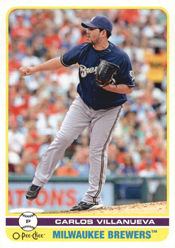
carlos_villanuevaNine years later, Villanueva was competing for the 2015 Cardinals as an effective member of their relief staff.

On Oct. 1, 2006, the Cardinals entered the final day of the regular season needing a win over the Brewers at St. Louis or an Astros loss to the Braves in Atlanta to clinch outright the National League Central Division title. If the Cardinals lost and the Astros won, the Cardinals would need to win a regular-season makeup game against the Giants to clinch the division title and avoid a one-game playoff with the Astros to advance to the National League Division Series against the Padres.

Rookie starters

Cardinals manager Tony La Russa gambled and started rookie Anthony Reyes against the Brewers on three days of rest, choosing to hold back Chris Carpenter in the hope St. Louis would clinch the division crown versus Milwaukee and have their ace available for Game 1 of the NL Division Series.

Brewers manager Ned Yost chose Villanueva as his starter. Villanueva had faced the Cardinals for the first time on Sept. 20 at Milwaukee and pitched seven scoreless innings in a 1-0 Brewers victory. Boxscore

Reyes flopped.

The Brewers scored four in the first on a two-run home run by Prince Fielder, a solo home run by Geoff Jenkins and a RBI-single by David Bell. Reyes was lifted before he could complete the opening inning.

Keep me in, coach

Given a 4-0 lead, Villanueva faced Cardinals leadoff batter Aaron Miles. who “smacked a sharp one-hopper off Villanueva’s pitching hand,” the Milwaukee Journal Sentinel reported.

“It felt bad,” Villanueva said.

Yost went to the mound and asked his right-hander, “How are you doing?”

“Of course, I said, ‘I’m doing great,’ ” Villanueva said.

In truth, the hand throbbed.

Said Yost: “I came close to taking him out. He couldn’t even swing a bat. I kept an eye on him and if I noticed a drop-off in effectiveness I would have taken him out. But I didn’t see it.”

Villanueva baffled the Cardinals. With each inning, their hopes of beating the Brewers dimmed.

Bailout by Braves

Then, in the fifth, a roar erupted from the Busch Stadium crowd as the final from Atlanta was posted: Braves 3, Astros 1. The Braves had prevailed behind six shutout innings from starter John Smoltz and a home run by Jeff Francoeur. Boxscore

The loss by the Astros meant the Cardinals had clinched the division title, regardless of the outcome of their game with the Brewers.

As fans cheered in appreciation, Villanueva stepped off the mound. Derryl Cousins, the home plate umpire, motioned for the game to resume, but Villanueva lingered, letting “the celebration last a few more seconds,” the St. Louis Post-Dispatch reported.

“I wanted to give them their moment,” Villanueva said. “I knew what was going on.”

Drama in ninth

Villanueva shut out the Cardinals through eight innings, extending his scoreless streak against them to 15 innings over two starts.

In the bottom of the ninth, with the Brewers ahead, 5-0, Villanueva got Miles to fly out to right. Then, the Cardinals thundered to life. Chris Duncan launched a 414-foot home run. Albert Pujols followed with a 424-foot shot.

Francisco Cordero relieved and struck out Preston Wilson, but Scott Spiezio followed with a home run, cutting the deficit to two. Cordero then ended the drama _ and the regular season _ by striking out Juan Encarnacion, preserving a 5-3 victory for Villanueva and the Brewers. Boxscore

Unfazed, the Cardinals regrouped and beat the Padres in the NL Division Series, the Mets in the NL Championship Series and the Tigers in the World Series.

Previously: 2006 was critical to Tony La Russa earning Hall of Fame status

(Updated April 5, 2026)

As an infielder who struggled to hit, Dal Maxvill overcame the odds and started in 21 World Series games for the Cardinals. As a coach with no experience as a baseball executive, Maxvill again overcame the odds and became general manager of the Cardinals.

dal_maxvill3On Feb. 25, 1985, Maxvill was the surprise choice of the Cardinals to replace Joe McDonald as general manager. Maxvill was a coach with the Atlanta Braves when the Cardinals approached him about becoming their top baseball executive.

As Rick Hummel noted in a report for The Sporting News, “It seemed a rather sizeable leap to go from third-base coach to general manager.”

In his book “White Rat: A Life in Baseball,” Cardinals manager Whitey Herzog said, “I had my doubts about him when he was hired … He’d never made a trade, never negotiated a contract and I wondered what the hell was going through their minds when they hired him.”

Baseball and business

Maxvill, 46, said he hadn’t applied for the job and was approached by club officials. Team owner Gussie Busch said he was seeking a candidate who knew both baseball and the Cardinals organization and also had business experience.

To Busch, Maxvill met the criteria.

Maxvill played for the Cardinals from 1962-72. Replacing the injured Julian Javier, he started seven games at second base in the 1964 World Series. He started seven games at shortstop in the 1967 World Series and again in the 1968 World Series. Maxvill won a Gold Glove Award in 1968. He hit .220 as a Cardinal.

Maxvill was a Cardinals coach from 1979-80 and an instructor in 1981. He and former Cardinals reliever Joe Hoerner were co-owners of a St. Louis travel agency. Maxvill earned a degree in electrical engineering from Washington University in St. Louis and worked for a St. Louis engineering company during his off-seasons as a Cardinals player in the 1960s.

The Cardinals offered Maxvill a one-year contract.

“Of all the people we considered, myself and the other members of the executive committee unanimously agreed that Dal Maxvill has the qualifications we were looking for in a general manager,” Busch told the Associated Press.

Fred Kuhlmann, chief operating officer of the Cardinals, said Tal Smith, a consultant hired to lead the search for a general manager, gave Maxvill “as enthusiastic a recommendation as there could be.”

“We were looking for someone with a sense of business ability to go along with his baseball experience, the innate ability to cope with the business aspects of being general manager,” Kuhlmann said to the St. Louis Post-Dispatch.

Cardinals connections

Two other ex-Cardinals players _ Tim McCarver and Joe Torre _ were considered before Maxvill was offered the position, The Sporting News reported.

“I’ve been a Cardinals fan since I was 3,” said Maxvill. “My mother and father took me to see Enos Slaughter, Terry Moore and Red Schoendienst.”

Schoendienst, a Cardinals coach in 1985, was Maxvill’s manager from 1965-72. “Once, I was his boss,” Schoendienst said. “Now, he’s mine.”

Asked his opinion of the Cardinals hiring Maxvill, former general manager Bing Devine told Bob Broeg of the Post-Dispatch, “Why shouldn’t he be a good general manager? He always has done everything better than any of us expected. I think the selection was excellent.”

Good deal

On April 2, 1985, Maxvill made his first trade, acquiring infielder Jose Oquendo from the Mets for infielder Angel Salazar and minor-league pitcher John Young.

The Cardinals won two pennants, 1985 and 1987, with Maxvill as general manager. “He turned out to be a hell of a baseball executive,” Herzog said. “… Maxie is smart and he caught on fast.”

Maxvill was Cardinals general manager from 1985-94 until he was fired by team president Mark Lamping and replaced by Walt Jocketty.

In the 2005 book “Cardinals Where Have You Gone?” Maxvill said to writer Rob Rains, “Probably my biggest disappointment was that I couldn’t convince the powers that be that we needed more of an investment into the ballclub other than just the farm system. We needed to replace the free agents who were leaving us. I could never convince (Anheuser-Busch) that the ballclub needed to dip into their savings account so we could sign a major free agent.”

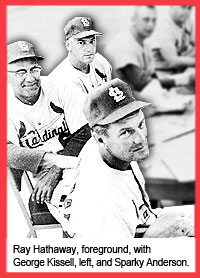
ray_hathawayAs a minor-league manager and pitching instructor for the Cardinals, Ray Hathaway worked closely with fellow teacher and Branch Rickey protégé George Kissell in helping prospects learn the fundamentals.

However, unlike Kissell, who devoted his career to the Cardinals, Hathaway left the organization amid a swirl of controversy.

Discovered by Dodgers

Hathaway, a right-handed pitcher, began his professional playing career in the Dodgers’ organization in 1939. His big-league career consisted of four appearances for the 1945 Dodgers. “My greatest thrill was walking into (Brooklyn’s) Ebbets Field for the first time,” Hathaway told the Asheville Citizen-Times.

Rickey, the Dodgers’ top baseball executive, was impressed by Hathaway, who earned a Bronze Star with the Navy in World War II’s Battle of Guadalcanal.

With the Cardinals, Rickey built a minor-league system that emphasized instruction based on an organizational philosophy. Rickey brought the same approach to the Dodgers. He saw Hathaway as someone who understood the system and could teach it.

In 1947, Rickey named Hathaway manager of the Dodgers’ farm club in Santa Barbara, Calif. It was the first of Hathaway’s 25 seasons as a minor-league manager.

“If I were starting a major-league franchise, I would have Ray Hathaway as my manager,” Bob Terrell, longtime sports editor of the Asheville Citizen-Times, said, according to the Web site MiLB.com. “He had the unique ability to get the most out of his players and was a master of baseball strategy.”

Joining the Cardinals

Hathaway was managing in the Pirates’ system when the Cardinals made him an offer after the 1964 season. He accepted and was named manager of the Cardinals’ Class A affiliate at Raleigh, N.C., in 1965.

Among those Hathaway mentored at Raleigh were future Cardinals pitchers Mike Torrez, Wayne Granger and Sal Campisi. Hathaway, 48, also pitched in a game for Raleigh, giving him 20 seasons as a minor-league player.

In 1966, Hathaway was the Cardinals’ minor-league pitching instructor. Among those also teaching Cardinals prospects then were Kissell, Sparky Anderson, Charlie Metro, Vern Rapp and Ron Plaza. Anderson, Metro and Rapp would manage in the majors.

Kissell, like Hathaway, devoted his career to teaching. Kissell joined the Cardinals’ organization under Rickey as a minor-league prospect in 1940 and worked for the Cardinals until his death at 88 in 2008.

Rookie welcome

After managing the Cardinals’ Class A Lewiston (Idaho) club in 1967, Hathaway replaced Kissell as manager of the Gulf Coast Cardinals rookie league team in 1968, enabling Kissell to become a roving instructor in the minor-league system.

Among the players on the 1968 Gulf Coast Cardinals was third baseman Bob Forsch. In his book, “Tales from the Cardinals Dugout,” Forsch, who would become a Cardinals pitcher, recalled his first encounter with Hathaway on the day he joined the team in Florida after traveling from his home in California.

“I hadn’t slept in almost two days, coming in from Sacramento, so I went up to my room and I overslept,” said Forsch. “I woke up at a quarter to five and I just jumped in a cab. I got to the complex … and ran to the bus. It was leaving right at five for the ballpark where we played the big night games.

“And Ray Hathaway, the manager, came up to me when I was getting on the bus. And the only thing he said to me was, ‘Don’t ever be late.’ That was it.”

Thank you, teacher

In 1969, the Cardinals named Hathaway manager of the Class AA Arkansas Travelers. Among the prospects on that team were future Cardinals outfielders Jose Cruz and Luis Melendez and pitchers Al Hrabosky and Reggie Cleveland.

According to his biography at SABR.org, Cleveland credited Hathaway and Cardinals coach Billy Muffett with teaching him how to pitch at the professional level. Cleveland had pitched for Hathaway at Lewiston and posted a 2.90 ERA with 11 complete games. He was the ace of Hathaway’s Arkansas club, compiling a 15-6 record with 13 complete games and a 3.39 ERA.

Trouble at Arkansas

The 1969 Arkansas team was 66-69 under Hathaway, finishing second to Memphis in the Eastern Division of the Texas League. After the season, Hathaway resigned and stunned the Cardinals by publicly criticizing the Arkansas front office headed by team president Max Moses and general manager Carl Sawatski.

“Ray Hathaway has tossed in the towel as manager of the Arkansas Travelers, firing an angry salvo at the front office as he departed,” The Sporting News reported. “It appears from a statement by Hathaway that in resigning he might have beaten management to the punch.”

Said Hathaway: “The Little Rock club has expressed its desire of not rehiring me as your manager for 1970. This request was made two days before I had planned on making the identical request to (Cardinals farm director) George Silvey. My decision is the result of a great number of problems our players have endured. They are too numerous and insulting to mention …

“Mr. Silvey and the entire (Cardinals) organization exerted themselves to help us succeed in producing a contending club, which we definitely were. This has been done without appreciation from anyone connected with the Little Rock club.”

Arkansas officials referred all comment to Silvey, who said, “It’s unfortunate Ray made a public statement of his grievances. We’re sorry this happened. He’s forthright and outspoken. That’s obvious. I had no idea he was planning anything like this.”

Ken Boyer replaced Hathaway as Arkansas manager. Hathaway spent the next three seasons managing teams in the Cleveland Indians organization. His final season as a manager was 1973 with Wilson, N.C., an independent team in the Carolina League.

Previously: Ron Plaza was mentor to Steve Carlton, Jose Cruz

Previously: Cardinals boosted managing career of Sparky Anderson

Four months after reaching the pinnacle of his managerial career with the Cardinals, Billy Southworth was dealt a devastating setback by the tragic death of his son.

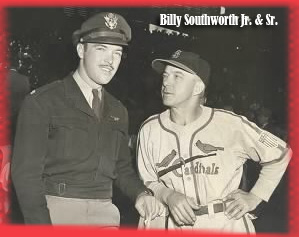
southworthOn Feb. 15, 1945, Major Billy Southworth Jr., son of the Cardinals manager, was killed when the B-29 Superfortress plane he was piloting crashed into Flushing Bay in New York.

The death of Billy Jr., 27, occurred four months after his father managed the Cardinals to their third consecutive National League pennant and second World Series championship in three years.

Baseball to bombers

Like his father, who was an outfielder for five big-league teams, including the Cardinals, Billy Jr. played professional baseball. He was a minor-league outfielder for five seasons, including three in the Cardinals’ system.

In September 1940, while with the Phillies’ Toronto affiliate, Billy Jr., 23, enlisted as a flying cadet in the U.S. Army Air Corps. He went overseas in October 1942. His first B-17 was nicknamed “Bad Check” because, he told the Sporting News, it always bounced back.

Billy Jr. piloted his B-17 on raids of U-boats and other enemy targets over occupied France and Germany. During his 25 combat missions, he wore a Cardinals cap given to him as a gift by his father.

Billy Sr. recalled his son completed those missions in Europe “without ever getting a scratch,” International News Service reported.

“I was just another Joe, occupying a lucky seat with a fine crew,” Billy Jr. said. “I tried to manage ’em like Dad manages his Cardinals.”

Billy Sr. managed the Cardinals to 105 wins or more each season from 1942-44. The Cardinals won the 1942 World Series title versus the Yankees and the 1944 World Series title versus the Browns.

Home front

After serving his full quota of missions in Europe and earning the Distinguished Flying Cross and Air Medal, Billy Jr. returned to the United States and was assigned to training. He met a Hollywood movie producer, Hunt Stromberg, who signed the major to a contract and urged him to pursue a film career after his military service was completed.

In November 1944, Billy Jr. visited his father and stepmother, Mabel, at their home in Sunbury, Ohio.

It would be the last time they’d see their son.

Final mission

Three months later, Billy Jr., with eight crew members and one civilian onboard, took off from Mitchel Field in Long Island on a routine training flight of a B-29 to Miami.

The warplane was near La Guardia Field in New York when Major W.L. Anken, an observer aboard the B-29, noticed heavy smoke from one of the engines. He informed Billy Jr. over the intercom. The pilot replied, “Keep an eye on it.”

Billy Jr. radioed to the La Guardia Field control tower that he would try an emergency landing.

“Witnesses said the bomber’s left outboard motor had stopped when the landing was attempted,” the Associated Press reported. “The pilot nosed the Superfortress up to circle the field.”

The runway was short for such a huge aircraft.

“He was unable to bank on one side because of the disabled engine and the location of the airport tower prevented him from turning the other way,” wrote The Sporting News.

The plane overshot the runway and headed straight toward the icy waters of Flushing Bay.

“The left wing clipped and struck the water,” the Associated Press reported. “The plane somersaulted and crashed” into the bay, then exploded.

The front section of the plane broke off and sunk into 30 feet of water. Billy Jr. and four crew members were killed. Their bodies could not be found.

There were five survivors: four crew members (including Major Anken) and the civilian, a technical expert for the Bendix Corporation of South Bend, Ind. All were seated in the back of the plane and saved by rescuers who fought through fire to reach them.

On the scene

At his home, Billy Sr., 51, received news of the tragedy. He and Mabel immediately prepared to head to New York.

In the book “Billy Southworth: A Biography of the Hall of Fame Manager,” author John C. Skipper wrote, “When they arrived at Flushing Bay, Billy, speaking in a cracked voice, asked someone to point out where the plane had gone down. He gazed at the site, said nothing, and became overcome with emotion.”

Billy Sr. and his wife joined daily search parties on barges in Flushing Bay. Billy Sr. still was in New York when the Cardinals opened spring training. He eventually joined the defending champions in training camp and was managing the club when the 1945 season began.

Closure

On Aug. 4, 1945, after the Cardinals defeated the Pirates in Pittsburgh, Billy Sr. got a call to come to New York. The body of his son had been recovered off Silver Beach in the Bronx on Aug. 3 by a New York Police Department launch.

“As grim as the situation is, my days, weeks and months of waiting have not been in vain,” Billy Sr. told The Sporting News.

From New York, Billy Sr. accompanied his son’s body to Ohio. Billy Jr. was buried with military honors at Green Lawn Cemetery in Columbus on Aug. 7, 1945. Among those attending the service was Casey Stengel, a friend and former teammate of Billy Sr.

Billy Sr. rejoined the Cardinals in New York on Aug. 9, 1945. He managed the Cardinals to 95 wins and a second-place finish. After the season, he accepted a more lucrative offer to manage the Braves.

Wrote Skipper: “For Billy Sr. there was a gaping wound to his soul that would never completely heal. He had lost his son, his pal, his best friend on earth. He would struggle with those thoughts for most of the rest of his life.”

Previously: How a B-17 nearly clipped Cardinals in World Series

(Updated Dec. 14, 2015)

Imagine Pete Rose in a Cardinals lineup with Ted Simmons, Keith Hernandez, George Hendrick and Garry Templeton. The Cardinals tried to make it happen.

brock_roseThe catch: Rose likely would have been brought in to replace Lou Brock, relegating the popular Cardinals standout to a reserve role.

In November 1978, Rose left the Reds, his hometown team and the only one for whom he had played since entering the majors in 1963, and became a free agent. Five clubs _ Cardinals, Phillies, Braves, Pirates and Royals _ were finalists in bidding to sign him.

The Cardinals, determined to become contenders after finishing 24 games under .500 in 1978, wanted Rose, 37, to bring his hitting, hustle and hubris to St. Louis.

Rose chose the Phillies, even though the Cardinals and the others made more lucrative offers.

Sorely needed

Before the December 1978 baseball winter meetings began in Orlando, Rose met with Cardinals owner Gussie Busch, general manager John Claiborne and manager Ken Boyer in St. Louis “with the hope the Cardinals might be able to land a man who certainly would fit the type of offensive player so sorely needed by the Redbirds,” The Sporting News reported.

Rose, who started at third base for the 1978 Reds, likely would have played left field for the 1979 Cardinals, joining an outfield of Hendrick in right and Tony Scott in center. Simmons was the St. Louis catcher. The infield for the 1979 Cardinals was Hernandez at first, Ken Oberkfell at second, Templeton at shortstop and Ken Reitz at third.

Brock, the stolen base champion and future Hall of Famer who had sparked the Cardinals to three National League pennants and two World Series titles, had experienced a miserable 1978 season, batting .221 with no home runs and 12 RBI. He would turn 40 in 1979 and there were doubts whether he could be an effective everyday player.

In a 2014 interview with the Web site of Boston radio station WEEI, Rose recalled, “I went to St. Louis to talk with Gussie Busch, who offered me a Budweiser distributorship. I liked that, but he wanted me to replace Lou Brock and I didn’t want to get in that situation.”

(Brock remained the Cardinals’ regular left fielder in 1979 and rebounded strongly, hitting .304 in his final big-league season.)

In the book “The Lords of the Realm,” author John Helyar wrote that Busch talked with Rose about being a Budweiser spokesman and also discussed a distributorship. The meeting occurred at a St. Louis hospital, where Busch was preparing for hernia surgery.

“I probably would have had a hernia, too, if I had to carry all the money he was offering me,” Rose said.

In the Jan. 13, 1979, edition of The Sporting News, Claiborne denied Rose was offered a distributorship from Anheuser-Busch, though he confirmed the Cardinals “had made a very strong pitch for Rose.”

Treated like son

Indeed, Rose said the Phillies’ offer was lower than the bids of the Cardinals, Braves, Pirates and Royals.

“There were five bids and I took the lowest one,” Rose said. “Being conservative, I could have gotten at least another million and a half.

“I wish I could have played a year for each of the other four owners. They treated me like a son. But I had to analyze where I’d be the happiest. And the Phillies’ revised offer was enough that I didn’t have to worry about the money.”

The Phillies initially offered Rose a three-year, $2.1 million contract _ an average of $700,000 per year. When they sweetened the deal to $3.2 million for four years _ an average of $800,000 per year _ Rose accepted. He said his friendship with Phillies players Larry Bowa, Greg Luzinski and Mike Schmidt also persuaded him.

(The book “Pete Rose: A Biography” reports the breakdown of the Phillies deal as $905,000 the first year, $805,000 the second, $705,000 the third and $565,000 the fourth, with a $245,000 bonus if Rose played in 125 games.)

Chasing The Man

Royals owner Ewing Kauffman had made an aggressive bid, “but Rose has insisted all along he is a National Leaguer and what he lusts after most is Stan Musial’s record for hits in that league,” The Sporting News reported.

(Rose would surpass Musial’s NL record of 3,630 hits and then move ahead of Ty Cobb for the all-time mark. Cobb had 4,189 hits. Rose finished with 4,256.)

If Rose had selected the 1979 Royals, he would have played that season for manager Whitey Herzog.

The Braves thought Rose would pick them. Team owner Ted Turner offered Rose $1 million per year for “three years, four years, five years, whatever you want,” Sports Illustrated reported.

“A major network and a wire service columnist reported Rose was headed for the Braves,” wrote The Sporting News. “Team officials in Orlando for the winter meetings had Rose’s statistics printed upon the club’s letterhead and another member of the front office staff flew from Atlanta to Orlando with a Braves jersey and cap for Rose to wear at the signing.”

The contract Rose got from the Phillies made him baseball’s highest-paid player. “$3.2 million for a leadoff man, ye gods!” wrote Atlanta columnist Furman Bisher.

Phillies vs. Cardinals

Rose made his Phillies debut on Opening Day, April 6, 1979, against the Cardinals at St. Louis. Playing first base and batting leadoff a week before his 38th birthday, Rose was 1-for-3 with a walk against John Denny, who pitched a five-hitter in an 8-1 Cardinals triumph. Boxscore

The Cardinals would finish ahead of the Phillies in the NL East in 1979. The Cardinals were third at 86-76 and the Phillies were fourth at 84-78.

Rose had a spectacular 1979 season, collecting 208 hits and batting .331. He finished second to Hernandez (.344) for the NL batting title. Rose led the league in on-base percentage (.418), edging Hernandez (.417).

On Dec. 14, 2015, baseball commissioner Rob Manfred denied a request to reinstate Rose, who was banned from baseball in 1989 for misconduct related to gambling. In 2004, Rose admitted to betting on games during his tenure as Reds manager.


Since 1931, three pitchers have achieved 30 wins in a season: Denny McLain (31 with 1968 Tigers), Dizzy Dean (30 with 1934 Cardinals) and Lefty Grove (31 with 1931 Athletics).

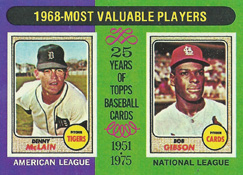
gibson_mclainI met McLain on Jan. 31, 2015, at a sports card show at the American Legion Hall in Sebastian, Fla. Richard Stone, who produces the show, was kind in introducing me to McLain and arranging the interview.

McLain was friendly, talkative, outspoken.

The pitcher, who used to drink a case of Pepsi a day, said he had dropped 180 pounds, crediting a procedure called bariatric surgery, which removed a portion of his stomach.

In 1968, when he won both the American League Most Valuable Player and Cy Young awards, McLain had a 31-6 record, 1.96 ERA and 28 complete games. He won a second Cy Young Award in 1969, with a 24-9 record, 2.80 ERA and 23 complete games.

McLain was suspended by baseball commissioner Bowie Kuhn for part of the 1970 season because of his association with bookmakers. After his playing career, he twice went to prison: the first time on a conviction for racketeering and the second time on a conviction for embezzlement.

Here are excerpts from my tape-recorded interview with Denny McLain:

Q.: You are the last pitcher with 30 wins in a season. Do you think the achievement gets the credit it deserves?

Denny McLain: “As time goes by, the stories about it become greater, but the appreciation becomes a little less. Will anyone win 30 again? Obviously not. The game has changed. No else is going to do it.”

Q.: Do you think today’s major leaguers appreciate the feat?

Denny McLain: “A lot of players today don’t know historically what happened 30, 40 years ago. There are some, but they are the exceptions. Very few know or actually care. It’s about the paycheck. Despite how the current guys treat them, the former players still respect the players today. That’s the difference.

“Of course, we’re all a little jealous of the money. The guys today don’t understand what we did to get them to the place where they are today. We walked out (on strike) when we were making $20,000, $30,000 a year. I wonder if they were making $20,000, $30,000 a year today how many guys would walk out. Guys today win 15 games and make $30 million a year.”

Q.: Insane?

Denny McLain: “Insane is a kind word. They should be committed.”

Q.: You and Dizzy Dean are the last two pitchers to win 30 in a season. You both are considered to be free spirits. Do you see similarities to him?

Denny McLain: “Dizzy and I both had the same personalities. We got along super well because he was as nuts as I was.”

Q.: You got to meet him?

Denny McLain: “I met both Dizzy Dean and Lefty Grove.”

Q.: What was Dizzy Dean like?

Denny McLain: “He wanted to have a good time all the time. He was a big-time gambler. On the night before I won my 30th in 1968, Dizzy says to me, ‘How you feeling? Anything bothering you? Think you’re going to win tomorrow?’ At the time, I didn’t know he was a big-time gambler. Dizzy was soliciting information.”

Q.: What was Lefty Grove like?

Denny McLain: “Lefty Grove was the nicest man I ever met in my life. He was a class act. He was articulate. He knew the game.”

Q.: In 1966, at age 22, you were the starting pitcher for the American League in the All-Star Game at St. Louis and retired all 9 batters you faced …

Denny McLain: “Six of them are in the Hall of Fame.”

Q.: They would be Willie Mays, Roberto Clemente, Hank Aaron, Willie McCovey, Ron Santo and Joe Torre. Mays led off and struck out …

Denny McLain: “I had him 3-and-2. Bill Freehan, my catcher, called for a curve. In an All-Star Game, to call a curve on 3-and-2 is pretty drastic. I was so pumped up. I threw a curve that was one of the greatest I’ve ever thrown in my life. They call it a 6 o’clocker.” Boxscore

Q.: Then Clemente flied out and Aaron struck out …

Denny McLain: “In winter ball in 1964 in Puerto Rico, I played against Santurce. That team had Clemente and (Orlando) Cepeda. First time I pitched against them, I struck them out each four times. That’s when Clemente came up to me and said, ‘Why aren’t you in the big leagues?’ I said, ‘I am.’ ”

Q.: The story is that before the 1968 World Series you said you wanted not only for the Tigers to beat the Cardinals, you wanted to humiliate them. True?

Denny McLain: “I wanted us to beat them in four. I got tired of hearing about Bob Gibson’s (1.12) ERA. I kept saying, ‘If he’s that good, why didn’t he win some more games?’ I know one of the quotes I said was, ‘He won 22 games. I won 21 by the end of July.’ That really got everybody ticked off.”

Q.: Then in Game 1 of the World Series, Gibson strikes out 17, pitches a shutout and you get lifted after five innings …

Denny McLain: “There’s nothing you could do. We got beat 4-0. One of us was going to win and one of us was going to lose. I lost.” Boxscore

Q.: You and Gibson were matched again in Game 4. Again, he won …

Denny McLain: “We shouldn’t have played the game. It was played in a downpour. I was never a mudder.” Boxscore

Q.: In Game 6, you start against Ray Washburn, pitch a complete game and win …

Denny McLain: “That was my day. If we lose that game …”

Q.: The World Series is over …

Denny McLain: “It would have killed me.”

Q.: You received a cortisone shot for your right shoulder before that game. How much did that help?

Denny McLain: “I got the injection about an hour before the game. I got another touch to it about 20 minutes before I went to warm up. Took some kind of pill. I didn’t have any pain until the fifth or sixth inning.” Boxscore

Q.: You struck out seven, walked none, the Tigers win, 13-1 …

Denny McLain: “The thing that made me mad about that ballgame is there were two outs in the ninth and I had a shutout. Julian Javier got a base hit with a man on second. Boy, was I mad. It was just a lousy ground ball that went through the hole.”

Q.: Did you feel the win was redemption after two losses to Gibson?

Denny McLain: “They only had one pitcher. That was Gibson. The rest of them weren’t very good. We were surprised at how bad their pitching was. But what St. Louis did is much like what we did: Play fundamentally sound baseball. If you play the game soundly, you will win.”

Previously: Should Curt Flood have caught Jim Northrup’s drive?