Feeds:
Posts
Comments

Tom Lasorda, in his big-league debut, helped Stan Musial achieve a personal best.

tom_lasorda2On Aug. 5, 1954, Musial had seven RBI in a game for the first time in his Cardinals career.

Facing the Dodgers at Ebbets Field in Brooklyn, Musial hit a pair of three-run home runs _ one each off Preacher Roe and Erv Palica _ in consecutive innings. His seventh RBI came on a sacrifice fly against Lasorda.

Musial, 33, was in the prime of a Hall of Fame playing career. Lasorda, 27, was a big-league rookie who had spent eight seasons in the minor leagues. The left-hander would appear in just 26 games in the majors _ eight with the Dodgers and 18 with the Athletics _ but would be elected to the Hall of Fame as a Dodgers manager.

Dodgers nemesis

After grounding out in the first inning, Musial hit the first of his three-run homers in the third against Roe, a left-hander who had debuted with the 1938 Cardinals.

It was Roe who, when asked his approach to pitching to Musial, replied, “I throw him four wide ones, then try to pick him off first base.”

Musial hit .377 with 12 homers and 28 RBI against Roe in his career.

In his autobiography, Musial said of Roe, “At Brooklyn, he became an outstanding pitcher, changing speeds and mixing up a well-controlled curve, screwball and, as the man admitted himself later, a spitter. Because I didn’t want him to load up one of those quick-dipping spitters on me, I always tried to keep him from getting two strikes on me.”

An inning after his home run off Roe, Musial crushed the second of his three-run homers, this time against Palica. Musial hit .429 in his career versus Palica.

Rookie reliever

Lasorda relieved Palica in the fifth. The first big-league batter to face him was Red Schoendienst, who singled. The next batter, Bill Sarni, also singled. Lasorda then struck out Joe Cunningham and got Alex Grammas to ground into a double play.

In the sixth, Lasorda walked the leadoff batter, pitcher Brooks Lawrence. After Rip Repulski flied out, Wally Moon doubled, putting runners on second and third.

Musial then hit a fly ball to left. Sandy Amoros caught it, Lawrence tagged and scored, giving Musial his seventh RBI, and the Cardinals led, 10-2.

With those RBI, Musial became the first player in the majors to reach 100 in 1954. It was his seventh season of 100 RBI. His two home runs were Musial’s 29th and 30th of the season.

Paul Waner, the Hall of Fame outfielder, told The Sporting News, “No telling how many homers Stan could make if he weren’t unselfish.”

The Cardinals won, 13-4. Before then, the Dodgers had won 18 of the last 19 against the Cardinals at Ebbets Field. Boxscore

Lasorda pitched three innings in his debut and yielded three runs. Musial would face Lasorda a total of three times in his career. After the sacrifice fly, his other two plate appearances versus Lasorda resulted in a walk and a strikeout.

In his 22 seasons with the Cardinals, Musial had just one other seven-RBI game. That occurred on June 23, 1961, in a 10-5 Cardinals victory over the Giants at St. Louis. In that game, Musial had a three-run home run off starter Billy O’Dell and a grand slam off Bobby Bolin. Boxscore


(Updated July 5, 2018)

The catcher who displaced A.J. Pierzynski as the Giants’ starter before the 2005 season became his manager in 2014.

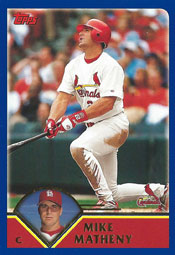
aj_pierzynskiPierzynski, signed by the Cardinals on July 26, 2014, to help compensate for the loss of injured all-star Yadier Molina, was the Giants’ starting catcher in 2004. The Giants were interested in having him return for 2005. Instead, given a chance for a defensive upgrade that better fit their budget, the Giants signed free-agent Mike Matheny in December 2004 and dumped Pierzynski.

A decade later, Matheny, 43, was the Cardinals’ manager and Pierzynski, 37, joined Tony Cruz as the St. Louis catchers.

The Giants paid a hefty price for Pierzynski when they acquired him from the Twins in November 2003 for pitchers Joe Nathan, Francisco Liriano and Boof Bonser.

Pierzynski produced a career-best 77 RBI with 28 doubles, 11 home runs and a .272 batting average for the 2004 Giants, but he was criticized by teammates and booed by fans. He caught only 23 percent of runners attempting to steal (15 of 66) and was charged with nine passed balls.

Let’s make a deal

After the season, Pierzynski was eligible for arbitration. Because of his hitting, he appeared poised to be awarded a judgment of more than $5 million for 2005. The Giants, unwilling to pay that much for one season, wanted Pierzynski to consider instead a multiyear contract in the $9 million to $10 million range.

When Pierzynski suggested a larger amount, the Giants turned to Matheny, a free agent who earned three Gold Glove awards as the Cardinals’ starting catcher from 2000-2004. The Cardinals hoped Matheny would return to continue to mentor Molina in 2005, but were unwilling to offer Matheny more than $4 million for two years, according to the San Francisco Chronicle and the St. Louis Post-Dispatch.

When the Giants offered a three-year, $10 million deal, Matheny accepted. Pierzynski requested his release, enabling him to become a free agent.

Run saver

Giants general manager Brian Sabean thanked Pierzynski for his contributions, but added, “We’re in a better position in a lot of ways going with Matheny.”

Matheny established the major league record for consecutive errorless games by a catcher (252 games from August 2002 until August 2004). He caught 30 percent (16 of 54) of runners attempting to steal in 2004 nd had just two passed balls.

”There’s no telling how many runs he’s going to save,” Sabean said to the San Jose Mercury News.

Said Matheny: ”As soon as the Giants hit the scene, we realized it could be a really special opportunity. There are a couple teams you want to play for and you’re not sure it will work out. In my case, it did.”

Chirpy personality

Several media reports cited Pierzynski’s personality as a factor in his departure.

_ Henry Schulman of the San Francisco Chronicle: “Pierzynski was a defensive liability and rubbed many in the organization the wrong way, even as pitchers grew to respect his game-calling ability.”

_ Jorge L. Ortiz of the Chronicle: “Pierzynski quickly fell into disfavor because of his chirpy personality and defensive deficiencies.”

_ John Shea of the Chronicle: “Pierzynski never seemed to fit in as a Giant … He slumped early and late and was criticized by multiple anonymous Giants pitchers in an Oakland Tribune report.”

_ Chris Haft of the Mercury News: “Though Giants management had publicly expressed interest in retaining Pierzynski … his difficulty in meshing with teammates did not endear him to the club.”

_ Laurence Miedema of the Mercury News: “Pierzynski was criticized by several unnamed (Giants) pitchers in April and was booed regularly at home.”

_ Bud Geracie of the Mercury News: ‘Sabean’s one-year rental of A.J. Pierzynski … ranks as his worst deal. A.J., we hardly knew ye. And we didn’t like ye.”

Matheny won his fourth Gold Glove Award with the 2005 Giants. Pierzynski signed with the 2005 White Sox and helped them to their first World Series championship in 88 years.

Previously: Why Mike Matheny ended his playing career as a Giant

Previously: The play that defined Mike Matheny as Cardinals Gold Glove

Tony La Russa and Joe Torre bring to 10 the number of managers in the National Baseball Hall of Fame who either played for or managed the Cardinals. Three of those 10 did both.

miller_hugginsLa Russa and Torre were inducted into the Cooperstown, N.Y., shrine on July 27, 2014.

The 10 Hall of Fame managers who either played for or managed the Cardinals are, in alphabetical order: Walter Alston, Leo Durocher, Whitey Herzog, Miller Huggins, Tony La Russa, John McGraw, Bill McKechnie, Wilbert Robinson, Billy Southworth and Joe Torre.

Huggins, Southworth and Torre are the three Hall of Fame managers who both played for and managed the Cardinals.

Several other Hall of Famers _ such as Roger Bresnahan, Frankie Frisch, Rogers Hornsby and Red Schoendienst, to name a few _ managed the Cardinals, but were inducted at Cooperstown because of their stellar playing careers, not for managing.

Another Hall of Fame manager, Sparky Anderson, managed Cardinals farm teams, but didn’t manage the Cardinals and didn’t play for them.

Here is a look at the 10 Hall of Fame managers who either played for or managed the Cardinals:

Walter Alston

If general manager Branch Rickey hadn’t left St. Louis to join the Dodgers after the 1942 season, Alston eventually may have become Cardinals manager.

Instead, Rickey lured Alston from the Cardinals to the Dodgers. In 23 years as Dodgers manager, Alston had 2,040 wins, four World Series titles and seven National League pennants from 1954-76.

Signed to a Cardinals contract by Frank Rickey, Branch’s brother, after he was graduated from Miami (Ohio) University, Alston played in the Cardinals’ farm system from 1935-44. He was a Cardinals minor-league player and manager at Class C Portsmouth (Ohio) in 1940 and at Class C Springfield (Ohio) in 1941 and 1942.

In the only major-league game in which he played, for the Cardinals against the Cubs in the season finale on Sept. 27, 1936, at St. Louis, Alston struck out against Lon Warneke in his lone at-bat and made an error in two fielding chances as a replacement for Johnny Mize at first base. Boxscore

In a 1965 interview with the Associated Press, Alston said of Branch Rickey, “I always will be grateful for the second chance he gave me (to become a manager).”

Leo Durocher

After firing general manager Bing Devine in August 1964, the Cardinals planned to hire Durocher as their manager after the season. Instead, the Cardinals rallied to win the pennant and the World Series crown. When manager Johnny Keane resigned to join the Yankees, the Cardinals, looking for a popular replacement, changed course and hired Schoendienst rather than Durocher.

Durocher was the Cardinals’ shortstop from 1933-37. He started for the World Series champions in 1934. He was an all-star in 1936. He led National League shortstops in fielding percentage in 1933 and 1936.

In 24 years as a manager with the Dodgers, Giants, Cubs and Astros, Durocher had 2,008 wins, three pennants and a World Series championship.

Whitey Herzog

As Cardinals manager, Herzog won a World Series title and three pennants, reviving a franchise that had gone without a postseason appearance throughout the 1970s. Herzog had a record of 822-728 in 11 years with the Cardinals. He had 1,281 wins overall in 18 years as manager with the Rangers, Angels, Royals and Cardinals.

Miller Huggins

Like Torre, Huggins played for and managed the Cardinals, but earned his Hall of Fame credentials for his work with the Yankees.

Huggins was a Cardinals second baseman from 1910-16 and was their manager from 1913-17. He had a .402 on-base percentage and .270 batting average as a Cardinals player. He led the National League in on-base percentage at .432 in 1913.

His best season as Cardinals manager was 1917 when St. Louis finished in third place at 82-70. In five seasons as Cardinals manager, he was 346-415.

Huggins was the Yankees manager when Babe Ruth joined the team. He won three World Series crowns and six pennants with the Yankees. He was their manager when the Cardinals beat them in the 1926 World Series and when they beat the Cardinals in the 1928 World Series.

In 17 seasons as a big-league manager, Huggins had 1,413 wins, 1,067 with the Yankees.

Tony La Russa

His 1,408 wins with the Cardinals are the most by any manager in the franchise’s history. In 16 seasons with the Cardinals, La Russa earned two World Series titles, three pennants and nine postseason berths.

La Russa ranks third all-time in wins (2,728) among big-league managers. In 33 years managing the White Sox, Athletics and Cardinals, La Russa won three World Series crowns and six pennants.

John McGraw

In 33 years managing the Orioles and Giants, McGraw had 2,763 wins. Only Connie Mack had more. McGraw won three World Series championships and 10 pennants with the Giants.

He played in 99 games as a third baseman for the 1900 Cardinals and led the National League that season in on-base percentage at .505. He also batted .344.

Bill McKechnie

In 1928, his first season as Cardinals manager, McKechnie won a pennant. He managed the Cardinals for part of the 1929 season before resigning and joining the Braves. In 25 years as manager with the Pirates, Cardinals, Braves and Reds, McKechnie had 1,896 wins, two World Series titles (with the 1925 Pirates and 1940 Reds) and four pennants.

Wilbert Robinson

Robinson won two pennants with the Dodgers, also known then as the Robins, and had 1,399 wins in 19 years as manager of the Orioles and Dodgers.

He was a backup catcher for the 1900 Cardinals, batting .248 in 60 games.

Billy Southworth

Like La Russa, Southworth won two World Series championships and three pennants as Cardinals manager. Southworth achieved the feat in three consecutive years (1942-44). He also won a pennant with the Braves. In 13 years as a manager with the Cardinals and Braves, Southworth had 1,044 wins.

In an interview for the 2008 Hall of Fame yearbook, Whitey Herzog said he was a boyhood fan of Southworth. “He was kind of my idol in high school,” Herzog said.

He was a Cardinals outfielder in 1926, 1927 and 1929, compiling a .305 batting average. Southworth hit a three-run home run off Yankees starter Urban Shocker, helping the Cardinals to a Game 2 victory in the 1926 World Series. Boxscore

Joe Torre

A case could be made that Torre qualifies for the Hall of Fame as a player. In 18 seasons with the Braves, Cardinals and Mets, Torre hit .297 with 2,342 hits and 1,185 RBI.

He played third base, first base and catcher for the Cardinals from 1969-74 and batted a collective .308 with 1,062 hits. He earned the 1971 National League Most Valuable Player Award when he led the league in batting average (.363), hits (239) and RBI (137).

In 29 years as a manager with the Mets, Braves, Cardinals, Yankees and Dodgers, Torre had 2,326 wins (fifth all-time) and won four World Series titles and six pennants (all with the Yankees). He was 351-354 in six seasons as Cardinals manager.

Previously: Great debate: When Tony La Russa first batted the pitcher eighth

Previously: Cardinals boosted managing career of Sparky Anderson

Previously: 1956 Cardinals groomed nine managers

Previously: Mike Matheny, Eddie Dyer share rare rookie achievement

Performing in an era when two, not five, teams qualified for the postseason from the National League, the best Cardinals club produced by manager Joe Torre wasn’t a September contender, even though its record was similar to, or better than, future St. Louis champions.

joe_torre4On July 27, 2014, Torre and Tony La Russa, who had the most wins of any Cardinals manager, were inducted into the National Baseball Hall of Fame. Torre primarily was elected for managing the Yankees to four World Series crowns and six American League pennants.

Torre was 351-354 as Cardinals manager from August 1990 until June 1995. His best St. Louis team, the 1993 Cardinals, had an 87-75 record but finished third in the National League East Division, 10 games behind the champion Phillies and seven behind the second-place Expos.

Since 2012, the National League qualifies three division champions and two wild-card teams for the postseason. In 1993, only the champions of the East and West divisions advanced.

The 1993 Cardinals had the fifth-best record in the National League. Their 87 wins were one fewer than those posted by the 1996 Cardinals (who were Central Division champions) and the 2012 Cardinals (who qualified for the postseason as a wild-card with the fifth-best record in the league). The 1993 Cardinals had four more wins than the 2006 Cardinals, who were Central Division champions and proceeded to win the World Series title.

Jefferies delivers

First baseman Gregg Jefferies led a 1993 Cardinals lineup that ranked fourth in the National League in runs scored (758) and batted a collective .272, eight percentage points better than the league average. Jefferies batted .342 with 16 home runs, 83 RBI, 46 stolen bases and a .408 on-base percentage.

Joining Jefferies among the top producers were third baseman Todd Zeile (17 home runs, 103 RBI), right fielder Mark Whiten (25 home runs, 99 RBI), left fielder Bernard Gilkey (40 doubles, 16 home runs) and shortstop Ozzie Smith (.288 batting average, 21 stolen bases).

The pitching staff featured closer Lee Smith (43 saves despite a 4.50 ERA) and three starters with winning records and double-figure wins: Bob Tewksbury (17 wins), Rene Arocha (11) and Donovan Osborne (10). But the staff was neither deep nor dominant and it produced a team ERA of 4.09, five percentage points above the league average.

A 20-7 June record put the Cardinals at 45-31 overall. After beating the Braves on July 19, the Cardinals were a season-high 18 wins over .500 at 55-37 and in second place, three games behind the Phillies and 6.5 ahead of the third-place Expos.

One month later, on Aug. 19, the Cardinals were holding steady, 17 wins above .500 at 69-52 and still in second place, but had lost ground to the Phillies, who were eight games ahead of them in the East.

Good group

As late as Sept. 19, the Cardinals were 15 wins above .500 at 82-67, but the Expos had moved past them and into second place. The Cardinals trailed the Expos by four games and the Phillies by eight.

“We have a good group,” Torre told the St. Louis Post-Dispatch on Sept. 19. “There’s a lot more offense out there than we’ve had for a while. We thought our pitching would carry us, and it did for a while, but we’re a much better team offensively than we thought at the beginning of the season.”

St. Louis lost eight of its next 11, dashing any hopes of a postseason berth.

The Phillies won the division title at 97-65. The second-place Expos were 94-68.

“You’re happy it’s over because finishing third, when you thought you had a chance for more, it’s frustrating,” Torre said after the season finale.

Said Ozzie Smith: “We competed for a long time, but then we just sort of fell out. That’s the disappointing part.”

Energy drain

In an analysis of the Cardinals’ 1993 season, Rick Hummel of the Post-Dispatch wrote, “The season must be classified as a disappointment to everyone concerned. A team that should have contended didn’t contend long enough. And a team that most certainly should have finished second didn’t seem to care about that.”

Hummel gave Torre a grade of C-plus for his managing in 1993. “Torre thought he had a team that would be in it until the last few days, at the least … Try as he might, Torre couldn’t infuse enough energy into this team late in the season,” Hummel wrote.

In his three full seasons as Cardinals manager (1991-93), Torre’s teams had winning records. The 1991 Cardinals finished second in the East Division, but 14 games behind the Pirates. Here is a breakdown of Torre’s year-by-year records with the Cardinals:

_ 1990: 24-34. (Hired in August by general manager Dal Maxvill).

_ 1991: 84-78.

_ 1992: 83-79.

_ 1993: 87-75.

_ 1994: 53-61. (Players’ strike halted season in August).

_ 1995: 20-27. (Fired in June by general manager Walt Jocketty).

Previously: Ted Simmons helped put pal Joe Torre on path to Hall

Previously: George Kissell, Cardinals inspired Joe Torre to be manager

Previously: Cardinals, Hall of Fame link Tony La Russa, Joe Torre

Dennis Eckersley and Jason Isringhausen, the closers who contributed the most to helping Tony La Russa earn election to the National Baseball Hall of Fame, also played prominent roles in his first win as Cardinals manager.

dennis_eckersley2The Cardinals beat the Mets, 5-3, in New York on April 3, 1996, in La Russa’s second game as Cardinals manager. Eckersley earned a tension-filled four-out save. Isringhausen was the opposing starter, facing the Cardinals for the first time in his career.

The win was the first of a franchise-record 1,408 for La Russa in 16 years as Cardinals manager.

After successful stints managing the White Sox and Athletics, La Russa secured his Hall of Fame status with his Cardinals career. He joined another Hall of Famer, Billy Southworth, as the only managers to win two World Series titles with the Cardinals. On July 27, 2014, La Russa and another former Cardinals manager, Joe Torre, were inducted into the Hall of Fame at Cooperstown, N.Y.

Converted starters

At Oakland, La Russa and pitching coach Dave Duncan converted a reluctant Eckersley from a starter into a closer. The move transformed Eckersley into a Hall of Fame pitcher. He earned 386 of his 390 saves with La Russa as manager _ 320 in nine years with the Athletics and 66 in two years with the Cardinals.

Isringhausen, who also successfully converted from starter to closer, joined the Cardinals in 2002. Pitching for La Russa and Duncan, Isringhausen compiled a franchise-record 217 saves in seven seasons with the Cardinals and finished his big-league career with 300 saves.

After La Russa left the Athletics to become manager of the 1996 Cardinals, Eckersley was acquired in a trade for pitcher Steve Montgomery and, at 41, became the St. Louis closer.

On April 1, 1996, in La Russa’s debut as Cardinals manager, the Mets overcame a four-run deficit and won, 7-6. Eckersley didn’t appear in that game. Boxscore

Seeking a win

Isringhausen, 23, got the start for the Mets in the season’s second game. He was 9-2 as a Mets rookie in 1995. A native of Brighton, Ill., near St. Louis, Isringhausen acknowledged that facing the Cardinals was special. “I had more butterflies (than usual),” Isringhausen said to the St. Louis Post-Dispatch.

Isringhausen pitched six innings, yielding three runs to the Cardinals. He was lifted for a pinch-hitter, with the Cardinals leading, 3-0. Bernard Gilkey, a former Cardinal, clubbed a three-run home run off starter Todd Stottlemyre in the bottom of the sixth, tying the score at 3-3.

The Cardinals scored a run in the seventh off Robert Person and another run in the eighth against Jerry DiPoto, taking a 5-3 lead. In the bottom of the eighth, the Mets had runners on first and second with two outs when La Russa replaced Stottlemyre with Eckersley.

“No matter how much experience you have, you’re a little uptight when you come into the game,” Eckersley said to the Post-Dispatch. “I felt very uncomfortable, like I’d never been in a game before.”

Solid swing

The first batter Eckersley faced in his Cardinals debut was Butch Huskey, the Mets’ cleanup batter.

With the count 1-and-2, Eckersley threw a fastball. Huskey swung and launched a drive toward center field. He knew he had made solid contact. “I thought it had a chance to go (over the wall),” Huskey said to the New York Daily News.

Center fielder Ray Lankford raced toward the wall while tracking the path of the ball. “I thought I could tell by the look on (Lankford’s) face that he was going to catch it,” Eckersley said.

The ball carried farther than Eckersley thought. As Lankford neared the 396-foot sign, he leaped, extended his glove and caught the ball, ending the inning and preserving the lead.

“Most definitely, I was robbed,” Huskey told the Post-Dispatch. “The ball jumped off my bat. I thought it was going out.”

In the bottom of the ninth, with the Cardinals still ahead by two, Eckersley retired the first two batters before Jose Vizcaino and Kevin Roberson each singled. Edgardo Alfonzo was up next, representing the potential winning run. Eckersley struck him out, earning his first National League save and preserving La Russa’s first National League win.

“In this league, it’s hard to get a hit or a save or a win,” La Russa said. “I don’t think there are any ugly ones.” Boxscore


(Updated July 17, 2019)

Insisting the crime didn’t fit the punishment, Cardinals pitcher Joaquin Andujar threatened to return home to the Dominican Republic rather than pay a fine for an altercation with Giants counterpart Mike Krukow.

joaquin_andujar6Though Andujar didn’t leave the Cardinals _ he completed a season in which he led the National League in wins (20) and innings pitched (261.1) _ the incident and his reaction to it contributed to the legend of the talented, emotional starter.

On July 17, 1984, in a game between the Giants and Cardinals at St. Louis, Manny Trillo was hit by a pitch from Andujar in the first inning. Andujar led the National League in most batters hit by pitches in both 1984 and 1985.

Two innings later, when Andujar batted for the first time in the game, Krukow brushed him back with two pitches. On the second brushback pitch, Andujar “had to jump rope or the ball would have hit him” in the leg, the St. Louis Post-Dispatch reported.

Plate umpire Billy Williams went to the mound to warn Krukow to stop throwing at Andujar. “I thought the first time the ball got away from him,” Williams said. “The second one didn’t.”

As Giants manager Frank Robinson joined the conversation on the mound, Krukow began yelling at Andujar.

“I said, ‘Don’t throw at my hitters,’ ” Krukow told the San Francisco Examiner. “He said something back. He wasn’t speaking Spanish.”

Krukow tossed down his glove and charged at Andujar.

Andujar tossed down his helmet and threw a punch at Krukow, the Post-Dispatch reported. Krukow and Andujar grappled on the ground for a while.

Both benches emptied but there was no serious fighting and neither pitcher was ejected because Williams said he didn’t see either throw a punch. When the at-bat continued, Krukow struck out Andujar.

Krukow said his teammates expected him to answer Andujar’s plunking of Trillo. “I have to dress next to these guys,” Krukow said. “I couldn’t look them in the eye if I didn’t protect them.”

Trillo said Andujar probably didn’t intend to hit him with the pitch, but added, “I think Krukow was right to do what he did.”

When Andujar went back to the mound to pitch the fourth, he was an emotional wreck. The Giants broke a scoreless tie, reaching Andujar for four runs on three singles, a double and a walk. They swiped two bases in the inning and Andujar uncorked a wild pitch. The Giants went on to a 7-2 victory. “He always comes unglued when that happens,” Cardinals manager Whitey Herzog said. Boxscore

A week later, the National League fined Andujar $200 for his role in the incident.

Incredulous, Andujar said, “I’m not going to pay that. They’re going to suspend me if I don’t pay. I should go to the Dominican Republic right now. I have enough money. I could live on that. This is lousy.”

“I’m a black Dominican and that’s why they fine me,” Andujar said to reporter Rick Hummel. “What else am I supposed to think?”

In explaining his on-field actions to The Sporting News, Andujar said, “He charged me. What am I supposed to do, run?”

A month later, amid speculation he would ask to be traded when his contract expired after the 1984 season, Andujar attempted to squelch such talk. “I like Whitey Herzog,” Andujar said. “I want to be here. I don’t want to get traded. I want to die here. I want St. Louis fans to know that. Maybe they will feel better if they know you want to die here.”

Andujar accepted a three-year, $4.5 million deal from the Cardinals after the season. In his book “White Rat: A Life in Baseball,” Herzog said, “If it hadn’t been for Andujar and (Bruce) Sutter, we might have finished in last place (in 1984).”

The next year, Andujar posted 21 wins for the 1985 Cardinals, but he imploded during Game 7 of the World Series, confronting umpire Don Denkinger, and was traded to the Athletics two months later.

Previously: How Joaquin Andujar made like Babe Ruth for Cardinals

Previously: Joaquin Andujar skipped All-Star Game to barbecue quail