Feeds:
Posts
Comments

(Updated June 6, 2020)

When news of the D-Day invasion of France by Allied Forces reached the United States that morning, most of Organized Baseball honored the solemn event by canceling the games scheduled for June 6, 1944, but the Cardinals chose to play an exhibition game.
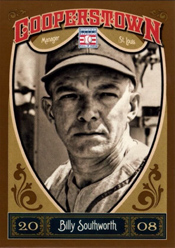
billy_southworth3On D-Day, the United States and its allies crossed the English Channel and launched an offensive that significantly helped lead to the defeat of Nazi Germany in World War II. More than 9,000 Allied soldiers died or were wounded in the effort.

Two National League games _ Phillies vs. Dodgers at Brooklyn and Reds vs. Pirates at Pittsburgh _ were scheduled for Tuesday, June 6, 1944. Both were called off in deference to the D-Day invasion. No American League games had been scheduled for that date.

In addition, four minor-league groups _ Appalachian League, American Association, Eastern League and International League _ called off all games on the June 6 schedule.

Because of the time difference between Europe and the United States, news of the invasion reached America in time for the ballgames that day to be canceled.

The Cardinals decided to honor their commitment to play an exhibition that night in Wilmington, Del., against the Wilmington Blue Rocks, a Phillies affiliate in the Inter-State League.

Long, winding road

It was part of a long, winding road trip for the two-time defending National League champions.

On May 26, 1944, the Cardinals embarked on a 17-game road swing that began in Brooklyn and took them to New York, Boston and Philadelphia before ending at Cincinnati on June 11.

After playing the Phillies at Philadelphia on June 4, the Cardinals weren’t scheduled to play their next regular-season game until June 8 at Cincinnati.

Rather than enjoy off-days, the Cardinals were scheduled to play an exhibition with their minor-league affiliate at Allentown, Pa., on June 5 before going to Wilmington for the June 6 exhibition versus the Blue Rocks.

In the June 5 exhibition at Allentown, the Cardinals put on a power display for the crowd of 3,091. Stan Musial and Danny Litwhiler each hit two home runs and Walker Cooper had one home run in the Cardinals’ 22-4 victory. Cardinals manager Billy Southworth started Freddy Schmidt, who pitched for Allentown in 1942, as a gesture to the local fans, The Sporting News reported. A total of 17 Cardinals played and the others rotated as base coaches so the fans could see all the big-league players.

Musial’s big night was extra special for the Allentown manager, Ollie Vanek, who as a scout had recommended the Cardinals sign Musial.

Down on the farm

The next day, while the nation was gripped by the news of the D-Day invasion, the Cardinals were in Delaware. The Blue Rocks selected a 6-foot-7 left-hander, George Michotte, 20, as their starting pitcher.

“Before the game, the members of both squads lined up on the foul lines and stood in silent prayer in respect of D-Day,” the Wilmington Morning News reported. “The players remained there during the playing of the National Anthem.”

Before a crowd of 3,668, the Cardinals did most of their damage in the seventh. With the score tied at 1-1, Marty Marion opened with a single and George Fallon, a second baseman who hit .199 that season, followed with a two-run home run to left off Michotte. After Johnny Hopp, batting for pitcher Ted Wilks, walked, Augie Bergamo tripled, scoring pitcher Harry Brecheen, who was running for Hopp.

After the Phillies farmhands batted in their half of the seventh, the game was halted by rain.

The 4-1 victory came at a cost to the Cardinals. Third baseman Whitey Kurowski injured his leg and missed the next two regular-season games.

The Cardinals were supposed to leave Philadelphia by train for Cincinnati on June 7, but Leo Ward, Cardinals traveling secretary, could get accommodations for only 14. Southworth and the Cardinals starting players, including pitcher Max Lanier, who was scheduled to start the June 8 game at Cincinnati, boarded the train. The rest of the team waited for another train, which departed Philadelphia at 1:08 a.m. on June 8, and arrived in Cincinnati less than three hours before game time, The Sporting News reported.

The weary Cardinals lost that June 8 game against the Reds by a 2-1 score, but won the remaining three games of the series, including an 18-0 shellacking in a game that featured the big-league debut of 15-year-old Reds pitcher Joe Nuxhall. Boxscore

The Cardinals won 11 of the 17 regular-season games on the trip and went home with a 32-16 record. Having survived their odyssey, they went on to clinch their third consecutive National League pennant.

Previously: How a B-17 nearly clipped Cardinals in World Series
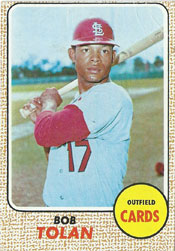
As a teen-ager, Bobby Tolan was a premier prospect for the Cardinals and was given a chance to displace Mike Shannon as the right fielder.

bob_tolanTolan was 19 when he debuted in right field for the Cardinals on Sept. 3, 1965. Batting leadoff, Tolan was 1-for-4 against the Mets. He singled to center in his first at-bat, but was picked off by pitcher Dick Selma and tagged out in a rundown. Boxscore

Sprinter speed

A left-handed batter, Tolan, 17, was signed by the Pirates in 1963 as an amateur free agent out of Fremont High School in Los Angeles. His cousin, Eddie Tolan, had been called the world’s fastest human after winning gold medals in the 100-meter and 200-meter sprints for the United States in the 1932 Olympic Games at Los Angeles.

After a season in the Pirates’ system, Tolan was left off the big-league roster and selected by the Cardinals in the December 1963 minor-league draft.

Converted from first baseman to outfielder by the Cardinals, Tolan made an immediate impact, hitting .297 with 34 stolen bases for Class AA Tulsa and being named to the Texas League all-star team.

In 1965, Tolan continued to impress. He hit .290 with 45 stolen bases for Class AAA Jacksonville.

A 1965 profile of Tolan in The Sporting News was headlined, “Teen-ager Tolan A Blur On Bases, Whiz With Stick.”

After Jacksonville beat the Dodgers in an exhibition game that year, Dodgers shortstop Maury Wills said, “He could challenge my base-stealing record.”

Said Dodgers catcher John Roseboro: “The kid looks too good to be true.”

Grover Resinger, who managed Tolan in consecutive seasons at Tulsa and Jacksonville, filed glowing reports to the Cardinals.

Another Billy Williams

“He’s improving all the time,” Resinger said. “… He’s going to be one of the better hitters in the game. He’s a line-drive hitter, with good power to all fields. Bobby is a Billy Williams type of hitter. He’s going to get stronger and I think he has a good chance to become a 25- to 30-homer hitter.”

Late in the 1965 season, Bob Howsam, Cardinals general manager, decided to give Tolan a chance to be St. Louis’ everyday right fielder for the final month of the season.

Shannon, who had become the Cardinals’ regular right fielder in the second half of 1964, struggled in 1965. He hit .221 and had almost as many strikeouts (46) as hits (54). The Cardinals’  backup right fielders _ Tito Francona (.259) and Phil Gagliano (.240) _ weren’t long-term solutions.

Howsam also was thinking ahead to 1966 when the Cardinals would move into their spacious new home, Busch Stadium II. He envisioned Tolan joining Lou Brock and Curt Flood in an outfield of speedsters who could chase down fly balls in the big stadium. Howsam also liked the thought of Tolan running the bases.

“His base-stealing ability is unlimited,” Resinger said of Tolan. “I think he’ll eventualy steal 50 bases in the big leagues. He’s not as fast as Brock, but he is above average.”

Too much, too soon

Tolan made 17 September starts in right field for the 1965 Cardinals, but he was overmatched at the plate. He hit .188 (13 hits in 17 games).

That performance prompted Howsam to alter his plans. After the 1965 season, the Cardinals acquired outfielder Alex Johnson from the Phillies. The Cardinals opened the 1966 season with Johnson in left, Flood in center and Brock shifting from left to right.

Johnson started poorly, though, and by mid-May was sent to the minors. The Cardinals moved Brock back to left and reinserted Shannon in right.

Tolan hit .172 in 43 games for the 1966 Cardinals. He was a backup to Roger Maris in right for the 1967-68 Cardinals clubs that won consecutive National League pennants and a World Series title.

After the 1968 season, the Cardinals traded Tolan to the Reds for right fielder Vada Pinson. Tolan was reunited with Howsam, who had become the Reds’ general manager.

Given a starting outfield spot, Tolan thrived with Cincinnati. He fulfilled Resinger’s prediction, producing a league-high 57 steals for the 1970 Reds. In four seasons with Cincinnati, Tolan hit .282 with 140 steals and helped the Reds win pennants in 1970 and 1972.

In a 13-year major league career with the Cardinals, Reds, Padres, Phillies and Pirates, Tolan hit .265 with 193 steals.

Previously: Here’s how Mike Shannon became a Cardinals catcher

(Updated Dec. 25, 2018)

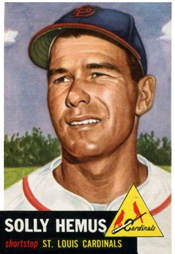
Solly Hemus had a knack for getting on base atop a Cardinals lineup stacked with Hall of Fame hitters.

solly_hemusIn 1953, Hemus established a Cardinals record when he reached base safely in the first 33 home games of the season.

A left-handed batter who primarily played shortstop, Hemus was listed at 5 feet 9, 165 pounds. In 11 big-league seasons, Hemus had an on-base percentage of .390.

Mighty Mouse

Eddie Stanky, manager of the 1953 Cardnals, described Hemus to The Sporting News as a batter who “worried pitchers” and “annoyed catchers.” St. Louis baseball writer Bob Broeg tabbed Hemus as “Mighty Mouse.”

Usually batting first or second in a 1953 Cardinals lineup with eventual Hall of Fame inductees Stan Musial, Red Schoendienst and Enos Slaughter, Hemus ranked sixth in the National League that year in most times on base (261).

Hemus didn’t bat for a high average, so he depended on working walks and getting hit by pitches to boost his on-base percentage.

In his first 55 games overall in 1953, Hemus reached base 108 times _ 62 hits, 43 walks and three hit by pitches, including one that knocked him cold, The Sporting News reported.

Hemus led the National League in most times hit by pitches (12) in 1953, one of three times he led the league in that category.

Explaining why Hemus often was struck by pitches, Oscar Ruhl of The Sporting News wrote, “Hemus stands with his feet almost even with the plate and leans his arms far over it.”

Shortcomings at short

After reaching base safely _ by base hit, walk or hit by pitch _ in the first 33 Cardinals home games of 1953, Hemus had the streak snapped in the second game of a doubleheader versus the Phillies on June 27 at St. Louis. Hemus was 0-for-4 against Phillies pitchers Bob Miller and Andy Hansen. Though Hemus reached on an error by first baseman Earl Torgeson, that didn’t count toward the streak because it occurred as a result of a miscue. Boxscore

Hemus finished the 1953 season with 163 hits in 154 games and 86 walks. He scored 110 runs and achieved double figures in doubles (32), triples (11) and home runs (14).

Though a favorite of Stanky, Hemus’ assets on offense couldn’t overcome his liabilities on defense.

“Hemus is handicapped by limited range and, though he has adhesive hands, his throwing arm isn’t top-grade either,” Broeg reported in The Sporting News.

Though better suited for second base than shortstop, Hemus couldn’t supplant Schoendienst at second. Alex Grammas became the Cardinals’ starting shortstop in 1954 and Hemus became a utility player.

Previously: Why Bing Devine was forced to fire Fred Hutchinson

(Updated April 5, 2026)

Determined to find a shortstop with the potential to quickly reach the majors as a starter, the Cardinals got it right when they chose Garry Templeton.

garry_templeton2Two years after he was drafted and taught how to switch-hit, Templeton made his Cardinals debut and became a fixture at shortstop for six seasons in St. Louis.

Prep phenom

In 1974, the Cardinals wanted a shortstop to succeed Mike Tyson, who was better suited to play second base.

Templeton, 18, a senior at Santa Ana Valley High School in California, was the prospect who most excited the Cardinals. A right-handed batter, Templeton hit .437 as a senior and .402 for his high school career.

On June 4, the night before the 1974 draft, Cardinals scout Bob Harrison called Templeton’s high school coach, Hersh Musick, and said, “We’re going to take Garry on the first round if he isn’t grabbed up before we get a chance,” the Santa Ana Register reported.

The Cardinals had reason to be concerned about Templeton’s availability by the time they got to select with the 13th pick in the first round. Shortstops were in high demand. Three of the 12 teams selecting ahead of the Cardinals took shortstops. None, it turned out, developed into as good a player as Templeton.

Shortstops chosen ahead of Templeton: Bill Almon (No. 1 pick), Padres; Mike Miley (No. 10 pick), Angels; and Dennis Sherrill (No. 12 pick), Yankees.

Asked his reaction to being selected, Templeton told the Santa Ana newspaper, “It is what I have been working for since I was 8 years old. It didn’t make any difference to me what club took me, just as long as I get a chance … I just hope I can make it into Busch Stadium quickly.”

Said Musick: “Garry is a fantastic hitter, has tremendous speed, possesses a strong arm, can field with the best and is dedicated. What more could any ballclub ask for?”

Lot to learn

The Cardinals signed Templeton for about $40,000, The Sporting News reported.

Templeton was assigned to the Cardinals’ Gulf Coast League rookie club in Florida. One of his teammates was another Cardinals infield prospect, Scott Boras, who would become a high-profile agent for professional athletes.

In a May 2014 interview with Washingtonian magazine, Boras said one reason he became an agent was because of the Cardinals’ handling of the Templeton signing. “The thing that really got me into this was the unfairness of the draft,” Boras said. “I thought it was wrong for the game. I go back to Garry Templeton. He’s an African-American kid _ no representation _ he walks in and they have all the techniques to sign you. It’s a one-way situation. He did not get his value.”

Because of his speed, the Cardinals worked on teaching Templeton how to hit from both sides of the plate.

“I watched Templeton learn to switch-hit in three weeks,” said Boras. “Three weeks! He was a remarkable athlete.”

Templeton hit .268 for the Gulf Coast League Cardinals and advanced to Class A St. Petersburg, where he struggled, batting .211.

Stick with it

Templeton, 19, opened the 1975 season at St. Petersburg and continued to perform below expectations. Discouraged by his lack of progress, Templeton approached manager Jack Krol. According to Ron Martz, columnist for the St. Petersburg Tmes, the ensuing conversation went like this:

Templeton: “I want to hit just right-handed.”

Krol: “Stick with it (switch-hitting). It’s not like you’re 24 or 25 years old. You’ve got plenty of time to learn.”

“The Redbirds are thirsting for a shortstop who can switch-hit, run well and dazzle in the field,” The Sporting News reported. “That’s why they had Garry Templeton try switch-hitting shortly after landing him out of high school.”

With Krol’s patient prodding, Templeton got his batting average to .264 and was sent to Class AA Arkansas, where he hit .401 in 42 games.

Templeton began the 1976 season at Class AAA Tulsa and produced 142 hits in 106 games, earning a promotion to the Cardinals.

The 20-year-old made his big-league debut on Aug. 9, 1976.

Templeton had 911 hits in 713 games over six seasons for the Cardinals, batting .305 with 138 steals. He twice was named an all-star as a Cardinal and led the National League in triples for three consecutive seasons: 1977 (18), 1978 (13) and 1979 (19). In 1979, Templeton produced a National League-best 211 hits and became the first major-league player to get 100 hits from each side of the plate in one season.

(In the 2005 book “Cardinals Where Have You Gone?” Templeton said he regretted becoming a switch-hitter. “I should never have let them talk me into becoming a switch-hitter,” Templeton told Rob Rains. “I should have been a right-handed hitter my entire career. I think I could have achieved more.”)

He also committed the most errors among NL shortstops for three seasons in a row: 1978 (40), 1979 (34) and 1980 (29).

After a run-in with manager Whitey Herzog for failing to hustle and for making obscene gestures to Cardinals fans who booed him, Templeton was traded to the Padres after the 1981 season. The deal brought shortstop Ozzie Smith to St. Louis, launching him onto a Hall of Fame career.


Managers Tony La Russa of the Cardinals and Lloyd McClendon of the Pirates engaged in a nose-to-nose public showdown, creating hard feelings that lasted deep into the following season.

tony_larussa13La Russa and McClendon were suspended for their actions.

On June 3, 2004, the Cardinals and Pirates were playing the last of a four-game series at Pittsburgh. The Cardinals won the first three and were leading, 4-2, in the ninth inning of the finale.

Tensions had run high since the series’ second game when the Cardinals’ Scott Rolen was hit in the head by a pitch from Ryan Vogelsong. Cardinals starter Jeff Suppan retaliated by plunking Daryle Ward in the at-bat after Ward had slugged a home run.

In the finale (in which catcher Yadier Molina got the start in his major-league debut), the Cardinals’ Albert Pujols was struck in the leg by an Oliver Perez delivery in the sixth inning. Jason Kendall, the Pirates’ first batter in the bottom half of the inning, got nailed by a Woody Williams pitch.

Bring it on

With two outs and none on in the ninth, Cardinals batter Tony Womack barely avoided a high, tight pitch from Mike Gonzalez.

From the dugout, La Russa yelled at Gonzalez.

Kendall, the catcher, yelled back at La Russa.

La Russa barked at Kendall, telling him to keep the pitches down.

Angered, McClendon charged onto the field and headed directly toward the Cardinals dugout.

Umpires Brian Gorman and Dale Scott tried to restrain McClendon, who called out La Russa.

Accepting the challenge, La Russa entered the field.

As both benches emptied, La Russa and McClendon stood toe to toe and exchanged heated words along the first-base line.

“As angry as the two were,” wrote Pittsburgh Post-Gazette columnist Ron Cook, “it’s surprising no punches were thrown.”

Gorman ejected both managers.

Crime and punishment

“I did what I feel I had to do,” McClendon said to the Post-Gazette. “He (La Russa) crossed the line by yelling at my players. If I don’t do anything there, I lose respect. I lose my team.”

Said La Russa to the St. Louis Post-Dispatch: “I can’t read anybody’s mind, but the way (Gonzalez) was looking and prancing, I was very suspicious (of his intent). That just doesn’t belong. If you’re going to pitch inside, get the ball below the shoulder.”

When the game resumed, Jason Isringhausen closed out the Pirates in the ninth and the Cardinals completed the sweep. Boxscore

The next day, Bob Watson, vice president of on-field operations for Major League Baseball, suspended each manager for two games and imposed fines.

La Russa and McClendon agreed the matter should be settled on the field.

“I think it’s really bad business,” La Russa said to the Associated Press. “But I also think Major League Baseball is not really attacking the problem _ of pitches up and in _ in the best way that they should.”

Said McClendon: “I guess what you’re supposed to do now … is when the opposing manager berates your players you should just sit there and not say a thing and allow your team to lose respect for you and for them to know that you’re not going to fight for them and stand up for them.”

Plot thickens

The story didn’t end there.

Two months later, in August 2004, McClendon asked umpires to check the cap of Cardinals pitcher Julian Tavarez for a foreign substance. The umpires found something suspicious and ejected Tavarez, who was suspended for 10 games.

In an interview with the Post-Dispatch, La Russa accused McClendon of “gamesmanship.”

Tavarez said McClendon “was trying to get back at Tony more than doing anything to me.”

Said McClendon to MLB.com: “Why would I hate the Cardinals? I don’t hate Tony … I respect them.”

A year later, however, in August 2005, McClendon and Pirates hitting coach Gerald Perry, a former Cardinals player, got into an altercation with Cardinals pitching coach Dave Duncan during batting practice. Perry may have struck Duncan in the jaw, according to published reports. Afterward, in discussing the incident with the media, Duncan labeled McClendon “an idiot.”

One month after that, the Pirates fired McClendon.

Previously: Wrangle at Wrigley: Tony La Russa vs. Dusty Baker

Previously: 1980s macho match: Whitey Herzog vs. Roger Craig

In the span of five months, Mike Shannon transformed from Cardinals reject to World Series standout.

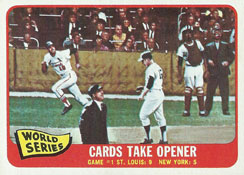
1964_game1Demoted to the minor leagues in May 1964 and shunted by Cardinals consultant Branch Rickey, Shannon recovered and sparked St. Louis to a Game 1 victory over the Yankees in the World Series.

“Show you can hit”

After short stints with the 1962 and 1963 Cardinals, Shannon, 24, began the 1964 season as a reserve outfielder with St. Louis. He got three at-bats and struck out each time.

In early May, general manager Bing Devine informed Shannon he was being sent to Class AAA Jacksonville. According to the Associated Press, Shannon and Devine had this exchange:

Shannon: “What do you want of me?”

Devine: “We’d like to see you hit more. If you show us you can hit, we’ll bring you back.”

Shannon produced 80 hits in 70 games for a Jacksonville club managed by Harry Walker. Good to his word, Devine brought back Shannon to the Cardinals on July 7. Manager Johnny Keane gave him the chance to be the everyday right fielder.

In mid-August, with the Cardinals in fifth place and apparently out of contention, team owner Gussie Busch, acting on the advice of Rickey, fired Devine with six weeks left in the season.

Bob Broeg, longtime St. Louis sports journalist, uncovered an Aug. 10 memo written by Rickey that urged the Cardinals to dump Shannon.

“I would let Shannon go back to Jacksonville for the balance of the (1964) season.” Rickey wrote in the memo, which was published in The Sporting News. “I would even let Shannon go to the draft of Triple-A if major league waivers could be secured. I don’t believe we can win the pennant in 1965 with Shannon as a regular player on the Cardinals club, or (Carl) Warwick or (Charlie) James or (Bob) Uecker or (Jerry) Buchek.”

Shannon, however, remained with the 1964 Cardinals. Keane continued to play him and Shannon produced. He delivered nine home runs and 43 RBI after his promotion from Jacksonville, helping the Cardinals surge and win the National League pennant on the last day of the season.

Denting the scoreboard

In Game 1 of the World Series, Shannon started in right field and batted sixth, between left-handed batters Bill White and Tim McCarver. In his first World Series at-bat, Shannon singled off Whitey Ford and scored.

The Yankees led, 4-2, when Shannon batted with one on and one out in the sixth. A south wind was blowing about 15 mph toward left field. When Ford delivered a high slider, Shannon connected and sent a towering shot toward left. Helped by the wind, the ball cleared the wall and kept rising until it crashed between the letters “B” and “U” in the Budweiser sign atop the 75-foot-high scoreboard at Busch Stadium.

Witnesses estimated the home run traveled more than 450 feet and likely as far as 475 to 500 feet.

“That was about the longest ball I’ve ever seen hit out here,” Keane said.

Said Shannon: “That homer gave me the biggest thrill of my life.”

The two-run home run, described by the Associated Press as a “Ruthian wallop,” tied the score at 4-4 and, according to The Sporting News, “seemed to ignite a spark among the Redbirds.” Video

The Cardinals scored twice more in the inning, taking a 6-4 lead, and won, 9-5. Shannon was 2-for-4 with three runs scored and two RBI. Boxscore

“If I picked the turning point of the game _ the one that got us the chance we needed and inspired the players _ it would have to be Shannon’s home run,” Keane said.

In his book “Whitey and Mickey,” Ford revealed that during the Cardinals’ four-run sixth, “My left hand went numb. It just went dead. No blood was getting down from the shoulder. The artery was blocked.”

Hit or miss

Shannon started in right field in all seven games of the 1964 World Series. He led the Cardinals in runs scored (six) and in strikeouts (nine) and batted .214 with no walks. Spanning two games, Shannon struck out in five consecutive at-bats: twice against Pete Mikkelsen in Game 5 and three times against Jim Bouton in Game 6.

He became the fifth player in World Series history to strike out in five consecutive at-bats. The others: Josh Devore, 1911 Giants; George Mogridge, 1924 Senators; George Pipgras, 1932 Yankees; and Mickey Mantle, 1953 Yankees.

Shannon was the first Cardinals batter to strike out nine times in a World Series since Jim Bottomley did so in 1930. Since then, Vince Coleman struck out 10 times with the Cardinals in the 1987 World Series. Two other Cardinals _ Jack Clark in 1985 and Willie McGee in 1987 _ each struck out nine times in a World Series.

For overcoming his doubters and contributing significantly to the Cardinals’ championship, Shannon was awarded a full World Series winners share: $8,622.19.