Feeds:
Posts
Comments

In his major-league debut, Cardinals reliever John Costello escaped an inherited bases-loaded jam, struck out the side in the next inning and earned the win.

john_costelloTwenty-six years later, on June 16, 2014, Nick Greenwood became the first Cardinals reliever to earn a win in his major-league debut since Costello did so on June 2, 1988, at Philadelphia.

Costello and Greenwood achieved their feats under very different circumstances.

Greenwood, 26, a left-hander, relieved starter Carlos Martinez to begin the fifth inning with the Cardinals leading the Mets, 2-1, at St. Louis. Greenwood held the Mets to a run in 3.1 innings and the Cardinals won, 6-2. Greenwood got the win because Martinez didn’t pitch the necessary five innings for a starter to qualify for a win. Boxscore

Costello, 27, a right-hander, was brought in by manager Whitey Herzog to replace reliever Steve Peters with the score tied at 2-2 in the 13th inning at Philadelphia. The Phillies had the bases loaded and one out.

“I didn’t have much alternative,” Herzog told the St. Louis Post-Dispatch.

Tough spot

The Cardinals had used six pitchers in the game after also using six the night before in a 13-inning victory against the Astros at Houston.

Said Herzog: “That was a hell of a place to put him in.”

After Herzog handed the ball to Costello and left the mound, catcher Tony Pena began a conversation with the newcomer. According to the Post-Dispatch, the talk went like this:

Pena: “What you got?”

Costello: “I’ve got three pitches _ fastball, slider, changeup.”

Then Costello told Pena to forget about the latter two and just call for the fastball.

“When he started laughing,” Costello told United Press International, “that broke the nervousness.”

Costello had another reason to focus on fastballs. He was experiencing stiffness in his right shoulder. “But the adrenaline took over and took the pain away,” Costello told the Post-Dispatch.

The first batter he faced, Chris James, hit a short fly out to right and the runners held. The next batter, Mike Young, flied out to left, ending the threat.

Pressure no problem

In the 14th, Cardinals cleanup hitter Tom Brunansky walked, stole second and scored on a two-out infield single by Pena.

Costello, throwing fastballs only, struck out all three Phillies he faced in the bottom half of the inning (Bill Almon, Danny Clay, Juan Samuel), earning the win in the Cardinals’ 3-2 triumph. Boxscore

“If I can handle that pressure right there, I guess I can handle some more along the line,” Costello said to the Post-Dispatch.

Said Herzog: “He was sneaky (fast), the way they were swinging. We’ll put him back out there.”

Costello, chosen by St. Louis in the 24th round of the 1983 amateur draft, went on to have a spectacular rookie season for the 1988 Cardinals. He was 5-2 with a save and a 1.81 earned run average in 36 games.

In 1989, Costello followed up with a 5-4 record, 3 saves and a 3.32 ERA in 48 games.

On April 23, 1990, the Cardinals traded Costello to the Expos for utility player Rex Hudler. Costello finished his big-league career with the 1991 Padres. In four major-league seasons, Costello was 11-6 with 4 saves and a 2.97 ERA in 119 games.

Previously: How Jose Oquendo became a Cardinals catcher

Ozzie Smith and Matt Adams, opposites in size, shared at least one common trait: Both were able to drive in key runs for the Cardinals over a stretch of games.

ozzie_smith8Adams in 2014 became the first Cardinals player to deliver game-winning RBI in four consecutive games since Smith did so in 1988, according to the Elias Sports Bureau.

A 6-foot-3, 260-pound first baseman, Adams primarily utilized power to produce his game winners in a stretch from June 13-16, 2014.

In three consecutive Cardinals wins over the Nationals at St. Louis from June 13-15, Adams hit a home run for the winning RBI in each game. The home runs were hit off Jordan Zimmerman, Stephen Strasburg and Doug Fister. The Cardinals won, 1-0, on June 13 Boxscore; 4-1 on June 14 Boxscore; and 5-2 on June 15. Boxscore

Adams snapped a 1-1 tie with a RBI-single off Jacob deGrom for the game-winning hit on June 16 in a 6-2 Cardinals victory over the Mets at St. Louis. Boxscore

Twenty-six years earlier, Smith used a very different combination of productive at-bats for his four consecutive game-winning RBI. A 5-foot-11, 150-pound shortstop, Smith had a bunt, but no home runs, among his game winners in a stretch from Sept. 8-11, 1988. Here’s what he did:

Cardinals 1, Phillies 0, at St. Louis, Sept. 8, 1988

The Cardinals had the bases loaded with two outs in the fifth inning when Smith came to bat against Phillies starter Kevin Gross. With the count at 3-and-2, Smith checked his swing and walked, forcing in Tony Pena from third base with the run. The Phillies appealed, saying Smith had swung and missed at strike three, but third-base umpire Steve Rippley upheld the call of home-plate umpire Fred Brocklander.

Phillies manager Lee Elia said Rippley blew the call.

Cardinals manager Whitey Herzog conceded to the St. Louis Post-Dispatch, “A lot of guys would have punched (Smith) out.” Boxscore

Cardinals 6, Cubs 2, at St. Louis, Sept. 9, 1988

With the Cubs ahead, 1-0, the Cardinals loaded the bases with one out in the sixth. Facing starter Calvin Schiraldi, Smith said he was trying for a sacrifice fly. Instead, he doubled off the right-field wall, driving in Jose Oquendo and Greg Mathews and giving the Cardinals a 2-1 lead.

Deflecting attention away from himself, Smith credited Pedro Guerrero, whom the Cardinals acquired from the Dodgers on Aug. 16, with boosting the offense. Guerrero had three RBI in the game.

“We’re a different team now,” Smith said. “We’re doing a lot more things with our pitching and a lot more with our offense. The addition of one person (Guerrero) has stabilized our offense.” Boxscore

Cardinals 9, Cubs 3, at St. Louis, Sept. 10, 1988

With the score tied at 2-2, Tom Pagnozzi at second and two outs, Smith doubled to center off starter Rick Sutcliffe, giving the Cardinals a 3-2 lead.

“What you’re seeing now is something that didn’t happen in spring training,” Smith said. “We never jelled offensively. We’re settling in now.” Boxscore

Cardinals 3, Cubs 2, at St. Louis, Sept. 11, 1988

In the seventh inning, with the score tied at 2-2, Curt Ford was on third with one out. With Smith at the plate, Herzog called for the squeeze play. Smith executed, dropping a bunt to the right side of the infield. Ford dashed home with the go-ahead run. The only play for pitcher Mike Harkey, who fielded the ball, was to toss to second baseman Ryne Sandberg, covering first, to retire Smith.

“You just hope you get a decent pitch and you can put it in play,” Smith said of the bunt.

Asked about the four consecutive game-winning RBI, Smith told the Post-Dispatch, “It’s good to be in a position to say you got the record game-winning RBI, but the important thing is we won the game.” Boxscore

Smith finished the 1988 season with 51 RBI and was tied with Pena for third on the team, behind Tom Brunansky (79) and Terry Pendleton (53). The Cardinals ranked 11th in the 12-team National League in both RBI (536) and runs (578).

Previously: Intimidation: Ozzie Smith, Will Clark and the Battle at Busch

His name, perfect for a young, hard thrower, seemed the kind a novelist or screenwriter would conjure, but Billy McCool was real, a left-hander who broke into the majors with the Reds as a teenager and for two years was among the top relievers in the National League.

bill_mccoolThe Cardinals found McCool nearly untouchable in 1966, when he was a National League all-star.

McCool battled the Cardinals for six seasons, 1964-69. He pitched more innings and had more strikeouts versus the Cardinals than he did against any other big-league opponent.

In 1970, the Cardinals acquired McCool, 26, from the Padres, but his career had peaked. In 18 appearances for the 1970 Cardinals, he was 0-3 with a 6.23 ERA and a save.

Reds rookie

A standout athlete at Lawrenceburg, Ind., McCool was signed by the Reds as an amateur free agent in 1963. McCool, 19, made his big-league debut with the 1964 Reds and was a prominent pitcher for a club in the thick of a pennant race with the Cardinals and Phillies through the final day of the season.

McCool posted six wins and seven saves with a 2.42 ERA for the 1964 Reds. The Sporting News named him its National League Rookie Pitcher of the Year.

Against the Cardinals that season, McCool was 0-2 with a save in six appearances. On Sept. 19, the Reds beat Bob Gibson and the Cardinals in the first game of a doubleheader at Cincinnati. McCool got his first big-league start in the second game. Matched against Ray Sadecki, McCool was good, yielding two runs, striking out seven and issuing no walks in eight innings. Sadecki was better. He pitched eight scoreless innings and combined with Barney Schultz for the shutout in a 2-0 triumph for the Cardinals. Boxscore

After the season, McCool and his brother-in-law, a pharmacist, bought a drugstore in Lawrenceburg. Wrote The Sporting News: “Billy McCool not only throws aspirin tablets, he sells them.”

Billy the Kid

McCool sought a pay raise from the Reds for 1965. According to The Sporting News, contract talks between McCool and assistant general manager Phil Seghi included this exchange:

Seghi: “Billy, you’re just a kid yet. You’re asking for too much money.”

McCool: “If I’m only a kid, why do they give me a man’s job to do?”

Appearing in 62 games, including two starts, in 1965, McCool compiled nine wins and 21 saves for the Reds. He ranked second in the league in saves, behind the Cubs’ Ted Abernathy. McCool was 1-1 with four saves versus the Cardinals that season.

Used exclusively in relief in 1966, McCool had eight wins, 18 saves and a 2.48 ERA. He again ranked second in the league in saves, behind the Dodgers’ Phil Regan. In seven games against the 1966 Cardinals, McCool was 2-1 with three saves and a 1.04 ERA. He struck out 23 Cardinals in 17.1 innings and yielded two earned runs.

In the July 2, 1966, edition of The Sporting News, Mets second baseman Chuck Hiller said of McCool’s fastball, “It looks about the size of a Ping-Pong ball when it comes up to the plate.”

Said Mets third baseman and former Cardinals standout Ken Boyer: “That slider he’s throwing now is the best I’ve ever seen a left-hander have.”

McCool made 11 starts in 31 appearances in 1967 and four starts in 30 appearances in 1968.

Battles with Brock

He had two significant games against the 1968 Cardinals.

On April 23, 1968, the Reds led the Cardinals, 2-0, through eight innings at St. Louis. In the ninth, the Cardinals scored twice off starter George Culver, tying the score. In the 10th, Lou Brock hit a two-run walkoff home run against McCool, giving the Cardinals a 4-2 victory. Boxscore

Two months later, on June 14, McCool got a start at St. Louis. He held the Cardinals scoreless in six innings and limited them to two hits _ singles by Julian Javier and Tim McCarver _ and got the win in a 7-0 Reds triumph. Boxscore It was McCool’s last major-league win as a starter.

Brock hit .147, 5-for-34, with 12 strikeouts against McCool in his career. Another Cardinals hitter who struggled versus McCool was Mike Shannon. He hit .100, 2-for-20, with seven strikeouts. The Cardinals who hit McCool best: Javier at .400, 8-for-20, and Curt Flood at .292, 7-for-24.

The Reds made McCool, 24, available in the expansion draft after the 1968 season and he was selected by the Padres. In four appearances for the Padres against the 1969 Cardinals, McCool was 2-1 with a 4.15 ERA.

On Aug. 6, 1969, at San Diego, McCool relieved Clay Kirby in the ninth with the score tied at 2-2 and retired the Cardinals in order. When ex-Cardinal Ed Spiezio opened the Padres’ ninth with a home run off Steve Carlton, lifting San Diego to a 3-2 victory, McCool got the win, his last in the big leagues. Boxscore

Save for St. Louis

In April 1970, the Cardinals acquired McCool from the Padres for infielder Steve Huntz. After a stint at Class AAA Tulsa, McCool was promoted to the Cardinals in May.

In his third appearance, May 15, 1970, McCool earned a save with two scoreless innings in relief of Mike Torrez in a 1-0 victory over the Cubs at St. Louis. McCool retired Don Kessinger, Glenn Beckert and Billy Williams on ground balls in the eighth. In the ninth, after getting groundouts from Jim Hickman and Johnny Callison, McCool walked Ron Santo before retiring Cleo James on a fly ball. Boxscore

That was McCool’s highlight as a Cardinal. In July, he was demoted to Tulsa. After the season, the Cardinals traded him to the Red Sox for pitcher Bill Landis. McCool never returned to the major leagues.

In seven big-league seasons, he posted a 32-42 record with 58 saves and a 3.59 ERA. In 33 games against the Cardinals, McCool was 6-6 with eight saves, a 3.26 ERA and 68 strikeouts in 66.1 innings.

Previously: Cardinals vs. Reds: rich tradition of July 4 showdowns

After losing the first two games of the 1985 National League Championship Series, the Cardinals could have been fazed by the prospect of facing Dodgers pitcher Bob Welch in Game 3. Welch had produced two complete-game wins against St. Louis in the regular season. A loss to him in the third game of the postseason series would push the Cardinals to the brink of elimination.

bob_welchInstead, it was Welch who was shaky.

Speedsters Vince Coleman and Willie McGee distracted a jumpy Welch and the Cardinals beat him, sparking a streak of four consecutive wins that propelled them into the World Series.

Welch was a premier pitcher for 17 years in the big leagues with the Dodgers and Athletics. He posted a career record of 211-146. In 1990, he was 27-6 with a 2.95 ERA and earned the American League Cy Young Award while pitching for the pennant-winning Athletics team of manager Tony La Russa and coach Dave Duncan.

In 1985, Welch was 14-4 with a 2.31 ERA in 23 starts for the Dodgers. He averaged less than two walks per nine innings.

The Cardinals, though, jolted Welch out of his comfort zone in the National League Championship Series.

Give the ump a mitt

In the first inning, Coleman lined a single over the head of third baseman Bill Madlock. With the count 1-and-0 on the next batter, McGee, the Dodgers pitched out, but Coleman swiped second anyway. Distracted by Coleman dancing off second, Welch walked McGee.

Tommy Herr came up next and worked the count full. Welch then whirled and attempted a pickoff of Coleman. The throw came closer to hitting umpire Paul Runge than it did to reaching the glove of shortstop Dave Anderson, covering second, and the ball sailed into center field. Coleman scored and McGee raced to third.

“I’m supposed to be able to make this play,” Welch said to the Daily Breeze of Torrance, Calif. “But for some reason I threw the ball to Runge. Too bad he didn’t have a mitt. He could have made the tag.”

Said Coleman to the Springfield (Ill.) State Journal-Register: “I was surprised he threw. The count was 3-and-2 and I wasn’t going to run until he threw to the plate.”

After walks to Herr and Andy Van Slyke, McGee scored on Terry Pendleton’s grounder to second, giving the Cardinals a 2-0 lead.

Sitting on the fastball

In the second inning, the Cardinals continued to apply pressure on Welch. With one out, Coleman singled. Catcher Mike Scioscia tried to pick off Coleman, but the throw eluded first baseman Greg Brock. Coleman advanced to third and scored on McGee’s single. After McGee was nailed attempting to swipe second, Herr smacked a Welch fastball over the right-field wall for a home run, putting the Cardinals ahead, 4-0.

“Welch kept throwing me fastballs,” Herr said to the Daily Breeze. “I fouled three of them off and I was sitting on the fastball when he threw the home run pitch.”

Said Welch: “I never got in a situation where I could use my curve ball. I never got in a situation where I was pitching, period. I just threw it up there.”

(Including the postseason, Herr batted .300 against Welch in his career, with 12 hits in 40 at-bats. Eleven of those hits were singles.)

Herr told the San Diego Union that the reason Welch beat the Cardinals twice during the 1985 regular season was because “he kept Coleman and McGee off base and was able to throw his breaking ball a lot. Today, he had to throw more fastballs with Vince and Willie on base.”

Welch was lifted after 2.2 innings. His line: 6 walks, 5 hits, 4 runs, 2 earned. Harried by the Cardinals, he’d made 20 pickoff throws.

“We weren’t trying to screw Welch up, even though that’s what happened,” said McGee.

Given the 4-0 lead, Cardinals starter Danny Cox and relievers Ricky Horton, Todd Worrell and Ken Dayley held the Dodgers to two runs. St. Louis won, 4-2. Boxscore

The Dodgers never recovered, losing the next three games, including Game 5 on the Ozzie Smith “Go crazy, folks” walkoff home run and Game 6 on Jack Clark’s ninth-inning three-run homer.

Welch finished his career with a 7-8 record and 3.99 ERA against the Cardinals in 18 regular-season appearances, including 15 starts.

Previously: How Bing Devine tried coaxing Kirk Gibson to Cardinals

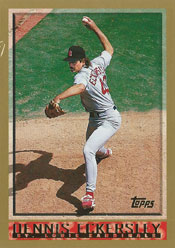
In a showdown of future Hall of Famers, the Padres’ Tony Gwynn prevailed against the Cardinals’ Dennis Eckersley.

tony_gwynnOn June 10, 1997, at San Diego’s Qualcomm Stadium, Gwynn hit doubles in the first and third innings off Cardinals starter Todd Stottlemyre, helping the Padres to a 3-1 lead and extending his hitting streak to 20 games.

In the ninth, the Cardinals scored four runs off closer Trevor Hoffman for a 5-3 lead.

Eckersley was brought in by Cardinals manager Tony La Russa to try for the save. Eckersley and Hoffman ranked among the best closers all-time. What were the odds of both blowing leads in the same inning?

The first batter Eckersley faced, Chris Gomez, singled. With one out, Greg Vaughn also singled. After Eckersley retired Rickey Henderson on a fly out, Gwynn stepped to the plate.

La Russa positioned his outfielders to play deep, near the warning track, willing to concede a single rather than a score-tying extra-base hit.

From the batter’s box, Gwynn searched for holes in the defense. “He was looking out there (to left-center),” Eckersley told the St. Louis Post-Dispatch.

Gwynn sliced a line drive between left fielder Willie McGee and center fielder Ray Lankford. Gomez and Vaughn raced home, tying the score at 5-5.

Gwynn reached second with his career-best third double of the game.

San Diego scored in the 12th and won, 6-5.

“I’m sure Eck would want that pitch back to Gwynn,” La Russa said. “He didn’t get it where he was trying to get it. With a single, we’ve still got a chance, but he hit right where he was trying to hit it. That’s what a Hall of Famer does.”

Said Eckersley: “I just couldn’t get the ball down. Even if it was down, he would have hit a bullet anyway.”

Including the postseason, Gwynn hit .474 (9-for-19) against Eckersley in his career.

“I think people tick (Gwynn) off when they say he can’t drive in runs,” Lankford said. “I think he can do just about anything he wants to do.” Boxscore

Gwynn, 37, enjoyed his most productive season in 1997. He hit .372, earning the last of his eight National League batting titles, and had single-season career highs in hits (220), doubles (49), home runs (17) and RBI (119).

Two years earlier, Ted Williams, the last big-leaguer to hit .400 in a season, advised Gwynn to turn on the inside pitch and drive it, according to the book “Bob Chandler’s Tales from the Padres Dugout.”

Initially reluctant to alter his approach, Gwynn tried Williams’ suggestion in 1997.

“In late June, I hit three home runs over a four-game span by turning on the inside pitch and driving it over the wall,” Gwynn said. “From that time on, I noticed pitchers stopped throwing inside to me and I was able to hit the ball all over. Finally, I understood what Ted meant.”

Three other big performances by Gwynn versus the Cardinals:

_ July 15, 1988: Gwynn had three hits and four RBI, including a two-run single off reliever Ken Dayley in the ninth, lifting the Padres to a 7-3 victory at St. Louis. Boxscore

_ April 18, 1993: In producing five hits in five at-bats in the Padres’ 10-6 triumph at San Diego, Gwynn had three singles off starter Donovan Osborne, a single off Mike Perez and a two-run home run off Omar Olivares. Boxscore

_ Aug. 4, 1999: Gwynn, 39, hit a grand slam off starter Kent Mercker, but the Cardinals won, 7-6, at St. Louis. The grand slam was the third and last of Gwynn’s big-league career. Boxscore


(Updated April 2, 2021)

Eddie Morgan of the Cardinals hit a home run on the first pitch he saw in the majors.

eddie_morganHe did it on Opening Day, April 14, 1936, against the Cubs at Sportsman’s Park in St. Louis.

Even before Morgan began his big-league career with a home run, Dodgers manager Casey Stengel had interest in acquiring the rookie after seeing him in spring training games.

Good outfield group

The 1936 Cardinals opened the season with a stellar starting outfield of Joe Medwick in left, Terry Moore in center and Pepper Martin in right. They also had three rookie outfielders _ Lynn King, Lou Scoffic and Morgan _ on the Opening Day roster.

“One thing I don’t have to worry about is my outfield,” Cardinals manager Frankie Frisch said to The Sporting News. “I’ve really got three fine-looking kids in Lou Scoffic, Lynn King and Ed Morgan. The only difficult thing about the outfield situation will be to decide which one of the three we’ll send back to the minors. That’s how good they all are.”

Cardinals ace Dizzy Dean got raked for nine runs in six innings in the season opener against the defending National League champion Cubs at Sportsman’s Park in St. Louis. With the Cubs ahead, 12-3, in the seventh, Frisch tabbed Morgan, 21, to make his big-league debut as a pinch-hitter for reliever Bill McGee.

A left-handed batter, Morgan swung at the first pitch he saw from starter Lon Warneke and hit a drive into the pavilion in right-center for a two-run home run. Boxscore

Soon after, Stengel and the Dodgers approached Cardinals general manager Branch Rickey about a proposed trade. The Cardinals wanted third baseman Joe Stripp. When Stengel asked for Morgan, Rickey declined and the talks ended without a deal.

Morgan, 5 feet 10, 160 pounds, appeared in eight games for the Cardinals, hitting .278 (5-for-18, with four singles and the home run). Unlikely to get much playing time with St. Louis, Morgan was sent to Class AA Columbus (Ohio) on May 9.

In his first at-bat for Columbus on May 10, Morgan hit a home run off Milwaukee’s Joe Heving.

Let’s make a deal

By July, the Cardinals were seeking pitching. The Dodgers still wanted Morgan. When the Dodgers offered George Earnshaw, 36, a right-hander in his last season in the majors, the Cardinals accepted, with both clubs agreeing that Morgan would report to the Dodgers after the conclusion of the Columbus season.

In reporting the trade, The Sporting News called Morgan a “hard-hitting farmhand” and “a left-handed pull hitter of the type the Dodgers need to caress that short right-field wall at Ebbets Field.”

Throughout the summer, Stengel spoke enthusiastically about his plans to play Morgan in September games with the Dodgers, who were out of contention and heading for a seventh-place finish.

Morgan hit .299 in 118 games for Columbus, but, just before the minor-league season ended, he fractured a bone in his lower leg, preventing him from joining the Dodgers in September.

After the 1936 season, Stengel was replaced as manager by Burleigh Grimes, the former Cardinals spitball pitcher. Grimes managed Morgan with the 1935 Bloomington (Ill.) Bloomers. Morgan hit .347 in 112 games for that Cardinals Class B minor-league club.

Expectations were for Morgan to compete for a starting outfield job with the 1937 Dodgers, but he hit .188 in 39 games for them and was returned to the minors in July. He never played in the big leagues again. His lone major-league home run was the one he hit in his first at-bat.

Morgan played in the minor leagues until 1950. In 17 minor-league seasons, he had a .313 batting average and hit 172 home runs.