Feeds:
Posts
Comments

(Updated Sept. 20, 2022)

Embarrassed by their inability to stop the Dodgers from stealing bases and convinced they needed to find a solution in order to win a pennant, the 1964 Cardinals turned to an unlikely source for help: Bob Uecker.
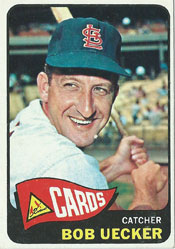
bob_uecker2The second-string catcher couldn’t slow Dodgers speedsters, but he did provide a defensive upgrade to a 1964 Cardinals club that won its first pennant and World Series title in 18 years.

On April 9, 1964, St. Louis sent Gary Kolb and Jim Coker to the Braves for Uecker.

Even then, at age 29, well before he became known as a broadcaster and for his comedy roles on television and in the movies, Uecker had a reputation throughout baseball as a funnyman.

Wrote The Sporting News: “Those who know him regard new Cardinals catcher Bob Uecker as a good-humor man.”

“Yes, I guess you can call me a stand-up type of comic,” Uecker said to St. Louis reporter Jack Herman.

The Cardinals, though, were serious about finding a way to overtake the Dodgers.

Armed for defense

In 1963, the Cardinals finished in second place at 93-69, six games behind the National League champion Dodgers. The Cardinals were 6-12 against the Dodgers and stolen bases were a significant reason for that. The Dodgers were successful on 27 of 33 stolen base attempts (82 percent) against the 1963 Cardinals. For the second season in a row, Dodgers speedster Maury Wills had 11 steals in 12 attempts versus the Cardinals.

“If we have a catcher who can throw well, they might think twice about running,” Cardinals manager Johnny Keane said.

Tim McCarver became the starting catcher for the Cardinals after Gene Oliver was traded to the Braves in June 1963 and his primary backup was Carl Sawatski.

McCarver nailed 38 percent of runners (28 of 73) attempting to steal in 1963 and Sawatski nabbed 30 percent (7 of 23). When Sawatski retired after the 1963 season, the Cardinals went looking for a backup for McCarver.

Uecker spent seven seasons in the Braves’ minor-league system. The Braves had groomed Joe Torre to replace veteran Del Crandall as their starting catcher.

In stints with the 1962 and 1963 Braves, Uecker impressed with his arm. He caught 5 of 7 runners attempting to steal in 1962 and 1 of 2 in 1963.

Office politics

Cardinals general manager Bing Devine was ready to make the trade for Uecker, but club consultant Branch Rickey opposed it, in part, because he didn’t want Gary Kolb to be dealt. Rickey had the support of Cardinals owner Gussie Busch and that gave him a voice in any proposed trade.

In his book “October 1964,” author David Halberstam wrote, “As both Keane and Devine pushed hard for the trade, Rickey resisted with a vehemence out of all proportion to the importance of the players at stake.”

As spring training neared its end, Keane asked Devine to make another attempt for Uecker.

“I’m sorry, Johnny, but I can’t go back there anymore,” Devine replied. “I’ve gone as far as i can go on that one.”

According to Halberstam, Devine suggested that Keane could approach Busch and appeal to him to approve the deal. Keane did and Busch granted his permission.

“We got Uecker to help Timmy and make our catching solid,” Keane said. “We’re certainly not vulnerable behind the plate anymore.”

In Uecker’s 1982 book “Catcher in the Wry,” McCarver said, “Uke really did have some talent. The first thing you looked at was his defensive ability _ his throwing arm and glove. I envied his arm (and) his relaxed, quick hands.”

On his first day with the Cardinals, Uecker was introduced to Rickey. According to Halberstam, Uecker extended his hand and said, “Mr. Rickey, I’m Bob Uecker, and I’ve just joined your club.”

“Yes, I know,” Rickey replied, “and I didn’t want you. I wouldn’t trade 100 Bob Ueckers for one Gary Kolb.”

Then Rickey turned and walked away.

Tough test

The 1964 Cardinals opened the season against the Dodgers at Los Angeles. With left-hander Sandy Koufax starting, Keane put Uecker, a right-handed batter, in the Opening Day lineup. (Uecker, the prankster, posed in a left-handed batting stance for his 1965 Topps baseball card.)

Uecker went 0-for-2 at the plate and 0-for-3 in attempting to prevent stolen bases that night. Willie Davis, Maury Wills and Jim Gilliam swiped bases against Uecker and starting pitcher Ernie Broglio.

“Uecker’s arm was not at fault,” The Sporting News reported. “The Dodgers speedsters just got too much of a jump on Ernie Broglio and the catcher’s strong throws were a little too late.” Boxscore

For the season, the 1964 Dodgers had 11 steals in 14 attempts (78 percent) against the Cardinals, but on July 16, 1964, Wills twice was caught attempting to steal against the Cardinals at St. Louis. McCarver was the catcher. Ray Sadecki was pitching the first time Wills was caught; Mike Cuellar was on the mound the second time. Boxscore

Overall, Uecker threw out 38 percent (8 of 21) of all attempted base stealers in 1964. He was 0-for-5 against the Dodgers; 8-for-16 against the rest of the National League. He hit .198, but his defense and his clubhouse popularity enabled him to stick with the Cardinals throughout the season.

The Phillies and Reds turned out to be the Cardinals’ main competition for the crown. Each finished a game behind St. Louis. The Dodgers were 80-82, in sixth place, 13 games behind the Cardinals.
(Updated Jan. 19, 2026)

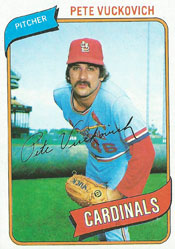
Facing the defending World Series champion Pirates, Cardinals starter Pete Vuckovich performed a high-wire act in the 1980 season opener.

pete_vukovichVuckovich pitched a three-hit shutout in the Cardinals’ 1-0 victory on April 10, 1980, at St. Louis. It was the first of only two times the Cardinals won a season opener by a score of 1-0. The second occurred March 31, 2014, against the Reds at Cincinnati.

In the 2014 game, the Cardinals escaped an eighth-inning jam in which the Reds had runners on first and third with none out. Boxscore

In the 1980 game, Vuckovich performed a Houdini act by striking out the side with two runners on base in the ninth.

Strikeout pitch

Using a variety of off-speed pitches called by catcher Ted Simmons, Vuckovich retired 14 Pirates in a row between the first and sixth innings.

The Cardinals got a run against Bert Blyleven in the second when Bobby Bonds, in his Cardinals debut after being acquired from the Indians, walked and scored on a George Hendrick double.

Vuckovich held the Pirates to two hits through eight innings, but in the ninth it began to unravel.

Pinch-hitter Lee Lacy led off with a single and Omar Moreno followed with a walk, putting runners on second and first with none out.

“We couldn’t ask to be in a better situation,” Pirates manager Chuck Tanner told United Press International.

Tim Foli, who the year before was the toughest National League batter to strike out, stepped to the plate.

Vuckovich struck him out swinging.

Next up, Dave Parker, who was nicknamed “The Cobra” for his ability to uncoil quickly and lash line drives.

Vuckovich struck him out swinging.

“The pitches were looking good and then the ball would break away,” Parker told the St. Louis Post-Dispatch.

Willie Stargell, destined for the Hall of Fame, followed. With the count 0-and-1, Stargell swung and missed at a low pitch that glanced off the wrist of Simmons and rolled into the Pirates’ dugout, enabling Lacy to advance to third and Moreno to second.

Simmons told the Post-Dispatch, “I went to sleep … The ball hit the dirt, but I could have blocked it.”

Stargell watched the next three pitches sail outside the strike zone, making the count 3-and-2.

“You can’t do anything but respect these guys,” Vuckovich said. “There’s no room for getting scared or nervous because they can sense that, too. If they get that feeling, they can get you.”

The payoff pitch from Vuckovich was a wicked breaking ball. “The ball dropped eight inches,” Vuckovich told the Pittsburgh Post-Gazette. Stargell swung and missed with such intensity his bat flew out of his hands and into the stands. The strikeout of Stargell set off a celebration among the 42,867 spectators at Busch Stadium. Boxscore

Praise from Stan

“I was lucky,” Vuckovich said. “It could just as easily have gone the other way.”

Vuckovich delivered 111 pitches, striking out nine and walking two.

“Today was an emotional drain,” Vuckovich said to the Associated Press.

The performance earned Vuckovich the admiration of everyone who witnessed it.

“Amazing,” Stan Musial, the Cardinals’ all-time greatest player, said to The Sporting News. “He throws the best right-handed breaking pitches I ever saw.”

Cardinals pitching coach Claude Osteen said to Bob Fallstrom of the Decatur (Ill.) Herald and Review, “He has total command. Nobody in our league has as many kinds of pitches and such command. There are guys who throw harder. Vuckovich has so many speeds. He has a changeup, an off-speed slider, an off-speed curve. He has great motion on the off-speed pitches. He knows how to pitch.”

Pirates second baseman Phil Garner said, “Vuckovich gets my vote for Cy Young Award already.”

Vuckovich finished 12-9 with three shutouts and a 3.40 ERA for the 1980 Cardinals. After the season, Vuckovich, Simmons and reliever Rollie Fingers were traded to the Brewers. Vuckovich led the American League in winning percentage in each of his first two years with the Brewers and won the 1982 Cy Young Award.


(Updated April 26, 2020)

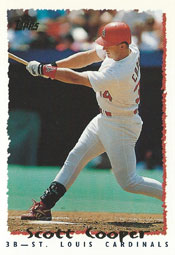
Scott Cooper enjoyed a storybook start to his Cardinals career.

scott_cooperCooper, a St. Louis native and lifelong resident, got a walkoff RBI in his Cardinals debut.

On April 26, 1995, two weeks after he was dealt to St. Louis by the Red Sox, Cooper lifted the Cardinals to a 7-6 Opening Day victory over the Phillies at Busch Memorial Stadium in St. Louis. The season began later than usual because of the players’ strike that carried over from the 1994 season.

Playing third base and batting fourth, Cooper was 3-for-5 with four RBI.

In his first plate appearance for the Cardinals, Cooper struck out against Curt Schilling. “My first at-bat I was more nervous than any at-bat in my life,” Cooper said to the Springfield (Ill.) State Journal-Register. “I have played in front of 50 million fans in the All-Star Game, but in that first at-bat I had problems getting down to the basics.”

In the ninth inning, with the Phillies ahead, 6-5, the Cardinals loaded the bases with none out against Norm Charlton, who was making his first regular-season appearance since undergoing ligament transplant surgery in his left elbow in 1993. Bernard Gilkey sparked the rally with a single. Ozzie Smith and Ray Lankford each followed with a four-pitch walk.

Cooper, acquired along with reliever Cory Bailey in a April 9, 1995, trade for pitcher Rheal Cormier and outfielder Mark Whiten, stepped to the plate with the chance to be a hometown hero. He had supplied 40 tickets to the game for friends and family, including his mother, father, sister and two brothers.

The first two pitches Charlton delivered to Cooper nearly hit him. He fouled off a pitch, then grounded the next past diving first baseman Dave Hollins for a single into right field, scoring Gilkey and Smith. Boxscore and Video

Cardinals fans chanted “Coop” in tribute.

“I’ve probably dreamed up 50,000 different scenarios for how this game would go,” Cooper said to the Associated Press, “but I probably couldn’t have written it any better.”

Said Cardinals manager Joe Torre: “He knows he’s up there to knock in runs. He was up there swinging. That’s very aggressive and I like that.”

Charlton told the Philadelphia Daily News, “We played a great game and I screwed it up.”

After a fast start to his Cardinals career _ he was batting .325 on May 17 _ Cooper tailed off. A .284 hitter in five years with the Red Sox, Cooper batted .230 in 118 games for the Cardinals. He had almost as many strikeouts (85) as hits (86).

Granted free agency after the season, Cooper played in Japan in 1996. He returned to the big leagues with the 1997 Royals in his final season as a player.

Their given names were John and George.

Their baseball names were Sonny and Sparky.

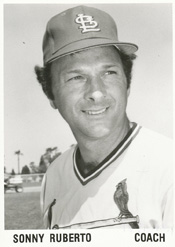
sonny_rubertoTogether, they contributed to a standard of teaching that became a hallmark of the Cardinals.
Sonny Ruberto, mentored by Sparky Anderson in the Cardinals’ system, influenced St. Louis players and prospects from 1977-81 as a big-league coach and minor-league manager.

Two of his pupils in the Cardinals system, Jim Riggleman and John Stuper, carried on with reputations as first-rate instructors. Riggleman managed five big-league teams. Stuper, who started and won Game 6 of the 1982 World Series for the Cardinals, coached the Yale University baseball team.

George “Sparky” Anderson, who built a Hall of Fame career as manager of the Reds and Tigers, was 30 when he began his managerial career with Class AAA Toronto in 1964. A year later, he became a manager in the Cardinals system.

John “Sonny” Ruberto was 24 when he began his managerial career with the Padres’ Class A Lodi club in 1970. At 31, he became the youngest coach in the major leagues when he joined the staff of first-year Cardinals manager Vern Rapp in 1977.

Cardinals prospect

A standout catcher at Curtis High School in Staten Island, N.Y., where he played with other future major leaguers such as Terry Crowley and Frank Fernandez, Ruberto signed with the Cardinals as an amateur free agent in 1964. Two years later, he was on a Class A St. Petersburg team managed by Anderson.

In a 1966 game that began on June 14 and ended at 2:30 a.m. on June 15, the visiting Miami Marlins beat St. Petersburg, 4-3, in 29 innings. “It was the darndest thing I’ve ever seen,” Anderson told The Sporting News.

Ruberto played all 29 innings _ the first nine as catcher and the last 20 at shortstop. He had two hits in 10 at-bats and scored a run.

Ruberto hit .283 in 88 games for St. Petersburg. The next year, he played for the Cardinals’ Class A Modesto club, managed by Anderson.

On May 22, 1969, the Cardinals traded Ruberto and second baseman John Sipin to the Padres for infielder Jerry DaVanon and first baseman Bill Davis. Ruberto made his big-league debut as a player with the Padres that month.

Big Red Machine

After a season managing Lodi, Ruberto in 1971 joined the Reds organization, where he was reunited with two key figures from his Cardinals days: Anderson (the Reds’ manager) and Bob Howsam, the former Cardinals general manager who took over the same role with Cincinnati.

Ruberto resumed his playing career and was sent to Class AAA Indianapolis. His manager there for the next five years, 1971 through 1975, was Rapp. As catcher, Ruberto was credited with helping the progress of several Reds pitching prospects, including Joaquin Andujar, Ross Grimsley, Tom Hume, Milt Wilcox and Pat Zachry.

“I feel I had something to do with their development,” Ruberto told The Sporting News.

When Rapp was named Cardinals manager, replacing Red Schoendienst, for the 1977 season, he selected Ruberto to be the first-base coach.

Wrote The Sporting News: “Like Rapp, Ruberto had been a career Triple-A catcher highly regarded for his ability to handle pitchers. Ruberto even has some ideas on helping Ted Simmons improve his backstopping duties.”

Rapp was brought to the Cardinals to instill discipline. At spring training in 1977, The Sporting News reported, “Rapp sized up his charges to make sure that the regulation baseball uniforms were worn properly. He had coach Sonny Ruberto demonstrate how he wanted the uniforms worn.”

At the helm

Rapp was fired in April 1978 and replaced by Ken Boyer. After the season, two of the coaches Boyer had inherited, Ruberto and Mo Mazzali, were replaced by Schoendienst and Dal Maxvill.

The Cardinals, though, kept Ruberto in the organization, naming him manager of the 1979 St. Petersburg club, succeeding Hal Lanier, who was promoted to Class AAA Springfield.

“What kind of manager will I be?” Ruberto said in response to a question from the St. Petersburg Times. “Well, a little of Vern Rapp, a little of Sparky Anderson, a little of Billy Martin and a lot of Sonny Ruberto.”

St. Petersburg finished 64-71, but the Cardinals were pleased with how their prospects, such as Stuper and fellow starting pitcher Andy Rincon, developed under Ruberto.

In 1980, Ruberto managed the Cardinals’ Class AA Arkansas team to an 81-55 record and a Texas League championship. Stuper had a 7-2 record for Arkansas. Riggleman, a third baseman, hit .295 with 21 home runs and 90 RBI in 127 games.

Ruberto managed the Cardinals’ Class A Erie team to a 44-30 record in 1981.

He operated a photography business in St. Louis and resided there with his family for 26 years.

(Updated April 5, 2022)

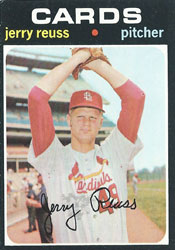
St. Louis native Jerry Reuss was 21 when he started a Cardinals home opener.

jerry_reussReuss faced the Giants on April 10, 1971, in the Cardinals’ first home game of the season, but he got derailed that Saturday afternoon by a baseball legend nearly twice his age.

Willie Mays, less than a month shy of his 40th birthday, hit a two-run home run off Reuss, sparking the Giants to a 6-4 victory. It was Mays’ fourth home run in as many games and boosted his career total to 632, 82 behind the all-time leader at that time, Babe Ruth.

Reuss, a left-hander, had debuted with the Cardinals in September 1969. He made 20 starts for St. Louis in 1970, producing a 7-8 record, two shutouts, five complete games and a 4.10 ERA.

After the 1971 Cardinals opened at Chicago by splitting a pair of games against the Cubs _ Bob Gibson and Steve Carlton were the St. Louis starters _ they played their home opener on the day before Easter in front of 26,841 at Busch Memorial Stadium. Reuss was paired against Frank Reberger, 26, a right-hander who had started his big-league career as a reliever.

According to the St. Louis Post-Dispatch, it was the first time Reuss had started an opener of any kind, home or away, since he was in high school.

The first time through the Giants batting order went well for Reuss. He struck out Mays looking to end the first. He struck out Willie McCovey to begin the second.

In the third, the game was scoreless when Chris Speier walked with two outs, bringing up Mays. Reuss got ahead on the count, 0-and-2. His third pitch was a fastball. Mays turned on it and sent the ball soaring into the left field bleachers.

“I’m just happy to play,” Mays said to Pat Frizzell of the Oakland Tribune. “Not many guys my age can go out there every day. I hit the pitch hard.”

Reuss told the Post-Dispatch, “He’s hit home runs off better pitchers than I am.”

Cardinals catcher Ted Simmons said Mays struck out on an inside fastball in the first inning. When Mays batted in the third, “Reuss put the fastball on the inside corner of the plate, but it came in chin high,” Simmons said to the Post-Dispatch.

In the fourth, Ken Henderson singled and Dick Dietz belted a two-run home run, increasing the San Francisco lead to 4-0.

“It was a real fastball,” Dietz said of the pitch he hammered off Reuss. “He supplied the power.”

After the next batter, Al Gallagher, singled, manager Red Schoendienst lifted Reuss for right-hander Chuck Taylor.

Reuss’ line: 3 innings, 5 hits, 4 runs, 3 walks, 3 strikeouts. Boxscore

The Giants went on to win the National League West championship that season. The Cardinals finished as runner-up to the Pirates in the East. Reuss made 35 starts for the 1971 Cardinals. He was 14-14 with seven complete games, two shutouts and a 4.78 ERA. He issued a team-high 109 walks in 211 innings.

In April 1972, two months after the Cardinals traded Carlton to the Phillies, Reuss was dealt to the Astros for pitchers Scipio Spinks and Lance Clemons.

Cardinals general manager Bing Devine said team owner Gussie Busch ordered the trade.

In the book “The Spirit of St. Louis,” Devine told author Peter Golenbock, “This was a deal I had to make because Mr. Busch said, ‘Jerry Reuss is growing facial hair,’ and he didn’t like facial hair on ballplayers, or executives either.”

Reuss told me in a 2014 interview, “When you look back about how that was the thinking in baseball in the early 1970s and then just two or three years later baseball began to change with the times. Guys were coming in with long hair and beards. And you just wonder: What was the stink all about?”

Also, Reuss had been offered a $3,000 raise to $20,000, but hadn’t signed. He asked for $25,000, The Sporting News reported.

“Reuss didn’t appear to be happy with us, couldn’t come to terms and we were still far apart,” Devine told The Sporting News.

Said Reuss: “I think Mr. Busch is putting his principle ahead of the whole ballclub.”

In a 22-year major-league career, primarily with the Dodgers and Pirates, Reuss compiled a record of 220-191. He was 14-18 versus the Cardinals.

(Updated June 9, 2024)

Ken Oberkfell got called up to the Cardinals in the second half of 1978, didn’t hit, began pressing and never did achieve his potential in his brief trial that year. The next season, Oberkfell, relaxed but aggressive, became the Cardinals’ starting second baseman and enjoyed a successful rookie year.

ken_oberkfell2Oberkfell, a left-handed batter, hit .120 for the season after being promoted to the Cardinals in July 1978.

He was one of the Cardinals’ top hitters in 1979 spring training games, hitting better than .300. Still, Oberkfell didn’t have the starting second base job when the 1979 season opened. That belonged to veteran Mike Tyson.

Oberkfell impressed manager Ken Boyer by going 4-for-4 (three singles and a triple) in an April 22, 1979, game against the Reds. Boxscore

“I had one four-hit day in the minors, but it wasn’t nearly as big a thrill as this,” Oberkfell said to The Sporting News.

In May 1979, Boyer began platooning Oberkfell with Tyson, a right-handed batter. Fighting to remain a starter, Tyson tried switch-hitting in June, but Boyer allowed Tyson to hit left-handed only when the Cardinals were ahead, or when the score was tied, in games Tyson started as a right-handed batter. Oberkfell got the starts versus right-handed pitching. “I don’t think (Tyson) is as good a hitter left-handed as Oberkfell yet,” Boyer said.

Oberkfell “has fielded almost flawlessly,” wrote Rick Hummel in The Sporting News. When Tyson stretched ligaments in his left knee, Oberkfell was the fulltime starter for the last third of the season.

“I’ve always had the attitude that I’d be the Cardinals second baseman some day,” Oberkfell told Hummel. “It’s a great feeling playing for the Cardinals … The key to me this year (1979) is being more aggressive and more relaxed.”

Oberkfell led National League second basemen in fielding percentage (.985) in 1979. He made eight errors in 875.1 innings at second base and turned 65 double plays. Hummel cited Oberkfell for “standing in strongly on the double play.”

Oberkfell also batted .301 in 135 games in 1979. His .396 on-base percentage was the best of his 16 years in the majors. He hit .305 against right-handers and .287 versus left-handers.

Tyson was traded to the Cubs for reliever Donnie Moore after the 1979 season and Oberkfell remained the Cardinals’ everyday second baseman in 1980.

In 1981, the Cardinals made Tommy Herr the starter at second base and moved Oberkfell to third base, where he replaced Ken Reitz, who was traded to the Cubs in the deal that brought closer Bruce Sutter to St. Louis.

“Oberkfell could play third base,” manager Whitey Herzog told Cardinals Magazine. “He never made a bad throw to first in his life. If he could get to something, he could get it over to first perfect.”

Oberkfell led National League third basemen in fielding percentage in 1982 (.972) and 1983 (.960). He and Herr and Sutter were key players in the Cardinals’ 1982 World Series championship season.

Previously: From Les Bell to David Freese: Cardinals 3rd base champions