Feeds:
Posts
Comments

(Updated Jan. 9, 2019)

When Rick Ankiel confirmed on March 5, 2014, he had retired as a player at 34, it was his second retirement announcement.
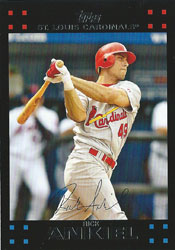
rick_ankiel4Nine years earlier, in March 2005, Ankiel, 25, announced at the Cardinals’ spring training site in Jupiter, Fla., he was retiring as a pitcher and would seek to transform himself into an outfielder.

At the time, the idea seemed to be preposterous _ almost as preposterous as if someone would have suggested in 2000 that the rookie phenom of the Cardinals suddenly would lose his ability to throw strikes during the postseason, igniting his downfall as a pitcher.

After all, the last players to make their big-league debuts as pitchers before earning significant play in the majors as position players were Bobby Darwin (1962-77) and Willie Smith (1963-71), according to the Elias Sports Bureau.

Ankiel persevered, hit 32 home runs in the minor leagues in 2007, got promoted to the Cardinals in August that year and belted a three-run homer in his first game back in the big leagues as a position player. Boxscore

Feel-good story

In his first 23 games after being promoted to the 2007 Cardinals, Ankiel hit .358 with nine home runs and 29 RBI.

The Pittsburgh Post-Gazette called Ankiel “the sport’s feel-good story of 2007.”

Within 24 hours, following an all-too-familiar-pattern, Ankiel went from being marvel to mystery.

On Thursday afternoon, Sept. 6, 2007, Ankiel capped his comeback with a remarkable performance against the Pirates at St. Louis. Batting second in the order, Ankiel was 3-for-4 with two home runs, a career-high seven RBI, four runs scored and a walk in a 16-4 Cardinals victory.

“Even his foul balls down the left-field line are deep,” Pirates pitcher Matt Morris, Ankiel’s friend and former Cardinals teammate, said to the St. Louis Post-Dispatch. “There’s nothing lazy about his swing.”

Ankiel grounded into a double play in the first inning, though the Post-Gazette reported Ankiel hit the ball so hard he “would have had another hit but for a spectacular stop by second baseman Freddy Sanchez.”

In the second, Ankiel launched a three-run home run off Bryan Bullington, making his first big-league start. After drawing a walk and scoring in the fourth, Ankiel smoked a two-run homer off John Grabow in the fifth. He received curtain calls from the appreciative fans after both home runs.

Ankiel added a two-run double in the sixth against Dave Davidson, making his big-league debut. With St. Louis ahead 16-3, manager Tony La Russa removed Ankiel. Boxscore

In the seven-game homestand, Ankiel batted .440 with five home runs and 19 RBI.

“He’s been relentless every at-bat,” La Russa said.

Said Cardinals shortstop Brendan Ryan: “He’s been putting up Nintendo numbers.”

Right or wrong

Imagine the emotional swing the following morning, Friday, Sept. 7, 2007, when the New York Daily News reported Ankiel in 2004 had received eight shipments of human growth hormone from an Orlando-based pharmacy through a Palm Beach Gardens, Fla., clinic.

Ankiel was attempting to recover from an arm injury in 2004. Major League Baseball didn’t ban the use of human growth hormone by players until 2005. Said Cardinals general manager Walt Jocketty: “There was no violation of Major League Baseball rules. There was no violation of any laws.”

The report, though, led some to question whether performance-enhancing drugs were aiding Ankiel in his storybook success with the 2007 Cardinals. “I’m a little surprised at the unfairness of some people who are rushing to conclusions before getting all the information,” La Russa said. “I don’t think he did anything wrong.”

In his 2017 book “The Phenom, Ankiel admitted he used human growth hormone from January 2004 to December 2004 to help him recover from elbow surgery.

“I took human growth hormone because it was, by Major League Baseball standards, legal,” Ankiel said in his book. “I told no one. In 2005, when Major League Baseball banned human growth hormone, I stopped using.

“I felt I’d done nothing illegal … The fact that I was not in trouble legally or, ultimately, with the league seemed lost on everyone.”

In his first at-bat after news of the human growth hormone shipments, Ankiel singled. He went hitless in his next 19 at-bats. He hit just two home runs in his final 24 games of 2007, then returned in 2008 to hit 25.


(Updated May 4, 2020)

In 17 years with the Cardinals, Bob Gibson hit 102 batters with pitches. In 1,489 plate appearances, Gibson was hit by a pitch just eight times.

gene_mauchThree of those times, Gibson was hit by Phillies pitchers playing for manager Gene Mauch. Two of those incidents involved Dennis Bennett. The last one led to Gibson being ejected and Bennett calling the Cardinals ace a “chicken” and a “coward.”

Mauch and Gibson were intense competitors. In a June 1962 game, Gibson was hit by a pitch from Bennett, a Phillies rookie. Three months later, the Phillies’ Art Mahaffey plunked Gibson with a pitch. Mauch, in his third season as Phillies manager, was trying to instill toughness in a team that lost 107 of 154 games in 1961. Gibson, in his second full season in the Cardinals’ rotation in 1962, was establishing himself as a consistent winner.

By 1964, both the Cardinals and Phillies were contenders. On May 4, 1964, the Phillies went into St. Louis tied with the Giants for first place in the National League. The Cardinals were 2.5 games behind.

Bennett was matched against Gibson in the series opener. In the second inning, Curt Flood led off with a home run. “After Flood hit the homer, I made up my mind somebody was going down,” Bennett told the Philadelphia Daily News.

Bennett delivered a knockdown pitch to the next batter, Julian Javier.

“They were digging in on me and I had to protect myself,” Bennett said to The Sporting News. “… I missed Javier by just a couple of inches or they might have had to carry him out.”

Dispensing medicine

First up for the Phillies in the third was Bennett. Gibson’s first pitch to him was high and tight. Bennett didn’t move but glared at Gibson, according to United Press International. Gibson’s second delivery, another high fastball, backed Bennett away from the plate. Bennett moved toward the mound before he was intercepted by plate umpire Doug Harvey, who issued a warning to Gibson.

Bennett told the Philadelphia Daily News, “When Gibson threw those pitches five feet over my head, I yelled out at him, ‘If you can’t come any closer than that, come in and get me.’ If he was going to put me down, he should have put me down.”

“Sure, I dusted him off,” Gibson told the Associated Press, “but he threw right at Javier’s head. Bennett doesn’t have that bad control. I just wanted to let Bennett know I had to protect our batters.”

Gibson also told United Press International that Mauch “is always telling his pitchers to throw at the hitters. They deserve to get some of their own medicine once in a while.”

In the bottom half of the third, Ken Boyer hit a two-run triple off Bennett. Jack Baldschun relieved and yielded a RBI-single to Flood, increasing the Cardinals’ lead to 5-1.

An inning later, Gibson batted with one out and the bases empty. Baldschun’s first pitch nearly clipped Gibson’s ankle.

In his book “Stranger to the Game,” Gibson said Mauch “knew that I was at the boiling point. He had been agitating me all night from the bench, trying his best to get me angrier and angrier.”

Flipping out

Aiming higher, Baldschun hit Gibson in the thigh with the next pitch. Gibson flipped the bat underhanded toward the pitcher. Baldschun caught it with his glove hand. Harvey immediately ejected Gibson.

Said Harvey: “He had a lethal weapon out there. I’m happy to say Gibson did not throw the bat violently, but he did throw it to the mound.”

“I wasn’t trying to hit him with the bat, but I was mad, hurt and just plain disgusted with the whole business,” Gibson said. “I tossed the bat just the way hitters do when they’re disgusted after striking out.”

In his book, Gibson said, “Without thinking, I flung my bat in Baldschun’s direction … Naturally, I was ejected, which is exactly what Mauch was counting on.”

Said Mauch to the Philadelphia Daily News: “He lost his composure.”

Bennett told United Press International, “Gibson’s nothing but a chicken … If he wants to fight, he ought to put up his fists instead of throwing the bat … That’s a coward’s way out if I ever saw one.”

Said Baldschun of his pitch to Gibson: “I figure he had one brush coming.”

Mauch told The Sporting News, “I’ve been popping off all over the country about how great a competitor Gibson is, but he didn’t show me much this time.”

The Cardinals responded quickly and effectively.

On the first pitch Baldschun threw after Gibson was ejected, Carl Warwick homered, scoring Jerry Buchek, who ran for Gibson, and extending the St. Louis lead to 7-1.

Last laugh

The Cardinals cruised to a 9-2 victory. Roger Craig got the win, pitching five innings in relief of Gibson. The ejection was costly to Gibson _ and not for the $100 he was fined. He finished the regular season with 19 wins. If he hadn’t flipped the bat, he would have remained in the game and qualified for the win with another inning pitched. Adding that win would have given him his first 20-win season. Boxscore

“Six pitchers reached for their gloves in the dugout when Gibson was thrown out with that lead,” Cardinals pitcher Curt Simmons said.

Cardinals manager Johnny Keane was upset with Mauch. “Why throw at anybody?” Keane said to the Philadelphia Daily News. “He wouldn’t want to be up there with Gibson throwing at him. Gibson could kill somebody. They’d be sorry to see a man lying dead at home plate.”

Gibson and the Cardinals got their revenge against Mauch and the Phillies. In first place on Sept. 20, 1964, and leading the Cardinals and Reds by 6.5 games with 12 to play, the Phillies went into a 10-game losing streak. St. Louis clinched the pennant by beating the Mets on the last day of the season, with Gibson getting the win in relief. Gibson went on to win Games 5 and 7 of the 1964 World Series against the Yankees and was named winner of the World Series Most Valuable Player Award.

Mauch managed for 26 seasons in the big leagues, never winning a pennant.

(Updated Jan. 5, 2021)

During spring training in 2014, Orioles manager Buck Showalter told a Baltimore prospect to write a report on the career of Frank Robinson after the minor-league player admitted he was clueless about the Hall of Fame slugger who became baseball’s first black manager.

frank_robinsonThat got me thinking: How many fans know about Robinson’s achievements versus the Cardinals?

In tribute to Frank Robinson, here’s my written report on the feats you should know he achieved while playing against the Cardinals:

Turning anger into runs

Robinson produced 586 home runs, 1,812 RBI and 2,943 hits in a 21-year major-league playing career from 1956-76. He spent 11 seasons _ 10 with the Reds; one with the Dodgers _ in the National League. In 203 games against the Cardinals, Robinson had 220 hits, including 46 home runs and 41 doubles, and drove in 127 runs. His career batting average versus St. Louis was .290.

Against the Cardinals, Robinson made his major-league debut, had his greatest single-game home run performance, delivered several game-winning shots and won a couple of dramatic duels with Bob Gibson.

In the book “Sixty Feet, Six Inches,” Gibson said, “Frank Robinson might have been the best I ever saw at turning his anger into runs. He challenged you physically as soon as he stepped into the batter’s box, with half his body hanging over the plate.

“His fearlessness played a tremendous part in making him the hitter he was. He practically dared you to clip him or knock him down and, when you did, he’d use it as intensity. He seemed to gain strength from it. If you couldn’t drive him off the plate _ and you couldn’t _ then you couldn’t take away his outside corner.

“As a rule, I’m reluctant to express admiration for hitters, but I make an exception for Frank Robinson.”

In the book “Pure Baseball,” first baseman Keith Hernandez said Robinson would wear out a pitching staff if they threw at him. According to Hernandez, Cardinals manager Red Schoendienst “called a meeting and told his pitchers he’d fine them $100 for hitting Frank Robinson. Leave him alone. We want to win these games.”

Vinegar Bend Mizell

In his first big-league game, April 17, 1956, at Cincinnati, Robinson, batting seventh and playing left field, was 2-for-3 with a walk versus Cardinals starter Vinegar Bend Mizell. In his first at-bat in his debut game, Robinson doubled. “Second pitch,” Robinson said to the Washington Post, “line drive off the center field fence. Missed being a home run by a couple of feet.” Boxscore

Three years later, Robinson hit three home runs in a major-league game for the only time. It happened against the Cardinals on Aug. 22, 1959, at Cincinnati. All three homers were hit with two outs.

The first of the three came against Mizell. It was a three-run shot in the fifth inning that broke a 1-1 tie. It was one of eight homers Robinson hit against Mizell in his career. Robinson followed that with a two-run homer off Dean Stone in the sixth and a solo blast against Bob Duliba in the eighth. Boxscore

Larry Jackson

Robinson hit 10 home runs in his career against Larry Jackson. Seven occurred while Jackson was with the Cardinals. The most damaging was struck on Sept. 2, 1957, at Cincinnati.

In the second game of a doubleheader with the Cardinals, the Reds batted in the 10th inning with the score 1-1. Jackson, the starter, walked the leadoff batter, Bob Thurman, and Robinson followed with a walkoff, two-run home run, lifting the Reds to a 3-1 victory. Boxscore

Two-homer games

On April 30, 1958, at Cincinnati, Robinson hit a fifth-inning solo home run off Lindy McDaniel, giving the Reds a 4-2 lead. After the Cardinals rallied with two runs in the ninth to tie the score at 4-4, Robinson led off the 10th against Morrie Martin, who had held the Reds scoreless for three innings, and hit a walkoff home run, giving the Reds a 5-4 victory. Boxscore

Robinson also had a pair of other two-homer games against the Cardinals:

_ He hit a solo home run in the second inning off Ernie Broglio and the winning shot in the 11th, also off Broglio, in a 4-3 Reds victory on Sept. 10, 1962, at St. Louis. Boxscore

_ He hit a pair of home runs off Tracy Stallard in a 6-3 Reds victory on April 24, 1965, at Cincinnati. Boxscore

Bob Gibson

In showdowns between Hall of Famers Gibson and Robinson, the Cardinals pitcher usually had the upper hand, but Robinson also enjoyed spectacular successes against Gibson.

Robinson hit .229 (19-for-83) versus Gibson and struck out 12 times. He also hit four home runs.

In his book ‘Stranger to the Game,” Gibson said, “I brought the ball in close to Frank Robinson … although I believe most pitchers tried him outside. The way he crowded the plate, they figured he was waiting to pounce on the inside pitch, but it seemed to me that he beat a hell of a lot of guys who pitched him away.”

In an interview with former baseball commissioner Fay Vincent for the book, “We Would Have Played For Nothing,” Robinson said, “Bob threw what we called a heavy ball. He had a hard slider. He was just mean enough, you know, he was up under your chin and that type of thing. So he was tougher to hit against than Sandy Koufax, but Koufax was tougher to get hits off of.”

Here is a look at the four home runs Robinson hit off Gibson:

_ Gibson blew leads in the ninth and 10th innings of a game at Cincinnati on Sept. 7, 1962.

The Cardinals led, 4-3, entering the bottom of the ninth before the Reds scored a run off Gibson to tie.

In the 10th, St. Louis regained the lead, 5-4, giving Gibson another chance to seal the win, but Robinson hit a solo home run against him in the bottom of the 10th.

The Reds won, 6-5, on a RBI-double by Vada Pinson off Curt Simmons in the 11th. Boxscore

_ Gibson was matched against fellow power pitcher Jim Maloney on May 4, 1963, at Cincinnati.

In the third inning of a scoreless game, Pete Rose walked, Pinson singled and Robinson followed with a three-run home run off Gibson. Maloney shut out the Cardinals on four hits and the Reds won, 6-0. Boxscore

_ In the opener of a doubleheader on Sept. 19, 1964, at Cincinnati, Gibson took a 5-4 lead into the ninth. With two outs and pinch-runner Tommy Harper on third, Gibson walked Pinson, bringing Robinson to the plate.

Robinson crushed a three-run, walkoff home run, lifting the Reds to a 7-5 triumph. Boxscore

_ In the first game of a doubleheader at Cincinnati on June 22, 1965, Robinson hit a solo home run off Gibson in the sixth inning, helping the Reds to a 5-4 victory. Boxscore


Three prominent Cardinals from the Whitey Herzog era _ Willie McGee, Tom Pagnozzi and, yes, Ozzie Smith _ thrived under Tony La Russa in his first season as St. Louis manager.

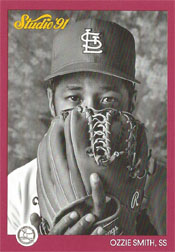
ozzie_smith7Though Smith got upset with La Russa because the manager reduced his playing time in 1996, relegating him to a reserve role behind shortstop Royce Clayton, what gets overlooked is Smith produced a quality final season under La Russa’s management.

After Joe Torre was fired in 1995, La Russa was hired to manage the Cardinals in 1996.

Pagnozzi and Smith were holdovers from the 1995 Cardinals. McGee returned to the Cardinals as a free agent after spending the 1995 season with the Red Sox.

After spring training in 1996, Smith was slowed by a hamstring problem and Clayton established himself as the starting shortstop. The decision to put Smith in a secondary role created a rift between La Russa and Smith.

Unlike Smith, McGee and Pagnozzi built respectful relationships with La Russa in 1996.

Like Smith, McGee and Pagnozzi performed well under La Russa’s management that year.

McGee: Team player

_ McGee batted .307 for the 1996 Cardinals. It was his highest batting average in five years. McGee also led the 1996 Cardinals in pinch-hitting batting average (.350, 14-for-40).

In October 1996, just before the Cardinals opened the National League postseason, Jeff Gordon of the St. Louis Post-Dispatch wrote, “McGee brought a lot more than heritage or aesthetics to the table. He filled in admirably for (Brian) Jordan and (Ron) Gant and proved dangerous as a part-timer coming off the bench.”

McGee said of La Russa, “Whatever he asks me to do, I do. Pinch-hit, play, whatever … I’m sure he’ll try to put the best team he can out there.”

Pagnozzi: Rises to challenge

_ Pagnozzi produced single-season career highs in home runs (13), slugging percentage (.423) and runs scored (48) for the 1996 Cardinals while elevating his skill as a pitch caller. Pagnozzi batted .270 in 1996 and especially was effective (.311, 56-for-180) with runners on base.

Describing the celebration after the Cardinals clinched the division title on Sept. 24, 1996, at Pittsburgh, Rick Hummel wrote, “One of the more poignant clubhouse scenes was a tearful Tom Pagnozzi, the Cardinals catcher, hugging manager Tony La Russa, who didn’t seem all that impressed with Pagnozzi early in the season.”

Said Pagnozzi: “We went through a lot. I just thanked him for staying with me and keeping me here. We respect each other and I think I’ve risen to his challenge. To me, this was a great feeling because I was able to go up and look him in the eye and he knows I’m a player.”

Smith: Blinded by pride

_ Smith, who was 41 during the 1996 season, hit .282 that year. He started 50 games at shortstop and otherwise was used primarily as a pinch hitter. He hit .351 (40-for-114) at home under La Russa’s management.

Wrote Gordon: “La Russa’s unsentimental handling of Smith set the tone for this season. He was here to win, not to massage egos. Those who played had to bust their tails and those who sat were supposed to stay ready.”

“The key is, this is a team sport,” La Russa said. “They’ve got to handle their emotions so that they’re contributing something positive to the club. If the guy on the bench is in the corner and not getting ready to put a piece in later on, I have a problem with that. I’m checking that all the time. My job is not making guys happy. It’s to do what’s best for the team.”

Previously: How Ron Gant, Jeff Brantley burned bridges with Cardinals

(Updated July 1, 2024)

Desperate for pitching, the 1954 Cardinals settled on a simple solution: Raid the Yankees, winners of five consecutive World Series titles.

vic_raschiThe strategy backfired, but the Cardinals at least succeeded in electrifying the fan base and creating buzz throughout the major leagues.

On Feb. 23, 1954, the Cardinals made bids to pry two right-handed aces, Vic Raschi and Allie Reynolds, from the Yankees. They got Raschi but failed to land Reynolds.

The acquisition of Raschi, one of the top pitchers in the American League, was considered a bold move by the Cardinals. Though some were skeptical about why the Yankees were willing to part with Raschi, many believed the deal vaulted the Cardinals from also-rans to National League pennant contenders.

Raschi, 35, had a regular-season record of 120-50 in eight years with the Yankees. He was 5-3 with a 2.24 ERA in six World Series (1947 and 1949-53) for New York. Reynolds, 37, was 118-56 from 1947-53 with the Yankees. He was 7-2 with a 2.79 ERA in six World Series for them.

Big spenders

In 1954, the Cardinals and Yankees both trained in St. Petersburg, Fla. While there, Cardinals owner Gussie Busch saw Dan Topping, a co-owner of the Yankees, and asked whether the Yankees could spare “any kind of right-hander with a fair chance,” The Sporting News reported.

Busch had deep pockets and a desire to spend. Meanwhile, several Yankees were feuding with general manager George Weiss over contract offers for the 1954 season. The Yankees were willing to dump some of their aging, high-priced talent.

According to The Sporting News, Busch “was astonished” when he found the Yankees willing to deal. Busch offered $85,000 for Raschi and $100,000 for Reynolds, according to John Carmichael of the Chicago Tribune.

First, both pitchers needed to clear waivers through the American League in order for the transactions to be completed with the Cardinals. Raschi went unclaimed; Reynolds didn’t. When the Indians claimed him, the Yankees pulled Reynolds off the waiver list and kept him for the 1954 season.

Surprise shake-up

Raschi was at the beach when Bill Greene, a photographer for the New York World-Telegram and Sun, found him and informed him of the trade.

Greene: “You’ve been sold to the Cardinals.”

Raschi: “No, you’re kidding.”

Raschi, who was 13-6 for the 1953 Yankees, wanted a salary for the 1954 season of $40,000, the same amount he was paid in 1951 (when he won 21 for the third season in a row) and in 1952 (when he won 16). Weiss offered $34,000.

“This club is complacent … Raschi’s attitude was like so many other attitudes on this club,” Weiss said.

Almost no one saw the deal coming. Wrote The Sporting News: “Imagine the amazement of the writers when (it was) announced the New York club had sold Raschi to the Cardinals.”

Frank Lane, general manager of the White Sox, thought Raschi was in decline. “As short as the Yankees are on pitchers, don’t you think they would have kept him if he possibly could have helped them? Guys the Yankees get rid of usually are through,” Lane said.

Most, though, thought the Cardinals helped themselves. The 1953 Cardinals had finished at 83-71 _ 22 games behind the National League champion Dodgers.

_ Steve O’Neill, Phillies manager: “Before this deal, we figured we had only Brooklyn and Milwaukee to beat. But now we have the Cards as well.”

_ Leo Durocher, Giants manager: “This tightens up our race some more. I know Raschi is a great competitor.”

_ Casey Stengel, Yankees manager: “(Raschi) certainly wasn’t sold for anything he did on the field. They must have been awfully sore at him in the front office.”

_ Bob Broeg, St. Louis writer: “The acquisition of Vic Raschi was hailed from ballpark front office to tavern backroom … Raschi considerably strengthened the club’s pennant chances.”

_ The Sporting News: “If Raschi wins for the Cards, and the Bombers fail, there will be a storm over the Bronx which will rock (Yankee) Stadium to its very foundations.”

In his autobiography, “The Mick,” Yankees slugger Mickey Mantle said, “They called Raschi the Springfield Rifle. He was a battler, always pushing himself to the limit of his abilities and probably beyond, playing the bulk of his career on damaged knees.”

Ace folds

Raschi heightened expectations, saying, “I expect to have three or four more seasons of top-flight pitching … I’ll be disappointed if I don’t win 20 games.”

Cardinals manager Eddie Stanky said he’d be pleased if Raschi matched the 13 wins he had in 1953. “I’m sure he can do that, at least,” Stanky said.

Raschi won his first five decisions for the 1954 Cardinals, including a shutout of the Giants on May 19 at New York. Raschi held the Giants to five singles, two by Willie Mays, in a 3-0 Cardinals triumph. Boxscore The win gave Raschi a career mark of 125-50, a .714 winning percentage.

When Raschi shut out the Giants again, on a three-hitter on July 29 Boxscore, his record was 8-5, but an assortment of ailments, including back pain, plagued Raschi in the final two months. He lost his last four decisions and finished the 1954 season at 8-9 with a 4.73 ERA in 30 games.

Raschi ranked second on the 1954 Cardinals in starts (29), innings pitched (179) and strikeouts (73). He was 3-0 with 1.85 ERA against the Giants, who won the pennant that season, but Raschi didn’t deliver at the level he and the Cardinals expected. St. Louis led the league in batting (.281) but was seventh in pitching (4.50 ERA). The Cardinals slumped to 72-82 _ 25 games behind the Giants.

At Cardinals spring training in 1955, Raschi was limited to five innings pitched. He made one start in the regular season, got shelled by the Reds and was released the next day.

“I always admired Vic as a great competitor,” Stanky told The Sporting News, “and he proved himself a man, a real man, the way he took this unfortunate news, but we’ve got to stake our chances on younger pitchers who have shown promise.”

In 35 years as a major-league manager, Tony La Russa was fired once. The White Sox replaced him with Jim Fregosi.

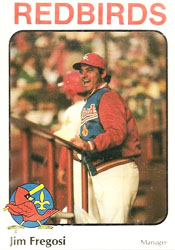
jim_fregosiFregosi managed the Cardinals’ Class AAA club at Louisville from 1983 until he replaced La Russa as White Sox manager in June 1986. Among the prospects managed by Fregosi at Louisville were Vince Coleman, Danny Cox, Ken Dayley, Ricky Horton, Tito Landrum, Greg Mathews, Jose Oquendo, Terry Pendleton, Andy Van Slyke and Todd Worrell. Seventeen of the players on the 1985 National League championship Cardinals club played for Fregosi at Louisville.

Path to the majors

An all-star shortstop for the Angels in the 1960s, Fregosi managed the Angels from 1978-81, leading them to their first division title in 1979, before he was fired and replaced by Gene Mauch. After sitting out the 1982 season while running a food brokerage business, Fregosi became Louisville manager in 1983. Lee Thomas, the Cardinals’ director of player development, had been an Angels teammate of Fregosi and was instrumental in bringing him into the St. Louis organization.

Louisville won back-to-back American Association championships (1984-85) under Fregosi, but with Whitey Herzog entrenched as Cardinals manager Fregosi’s best hope of managing again in the major leagues was with another organization. The Mariners contacted him, but Fregosi wanted an opportunity with a franchise prepared to win.

In June 1986, White Sox general manager Ken “Hawk” Harrelson fired La Russa and pitching coach Dave Duncan. The White Sox were 26-38 and Harrelson had been clashing with La Russa and Duncan. “The record is not indicative of the talent involved,” Harrelson told the Chicago Sun-Times.

Fregosi was Harrelson’s first choice. Harrelson had sent scouts to Louisville and their reports on Fregosi were glowing, the Sun-Times reported.

Tireless teacher

Here is what others said about Fregosi’s work in the Cardinals system:

_ Rick Bozich, columnist, Louisville Courier-Journal: “When you roll the highlights films of what Fregosi has accomplished in Louisville, the two American Association championships won’t even make the top 10. No, the lingering images will be of the consistently long hours he worked developing the young players who carried the St. Louis Cardinals to the 1985 National League pennant and the wonderfully tranquil clubhouses he presided over. There was never a reason to check Fregosi’s time card. He reported to Cardinal Stadium at 2 every afternoon. One day he’d be in the cage convincing Vince Coleman he could make millions chopping down on the ball; the next day you could find him in the bullpen tinkering with Todd Worrell’s fastball grip.”

_ Mo Mozzali, Cardinals scout: “As fantastic as Jimmy has been for baseball in Louisville, he’s done even more for the players in the Cardinals organization. I’ve never seen anybody better working with young players.”

_ Dyar Miller, Louisville pitching coach: “Jim is a great teacher. He works on the field for three or four hours before every game, on theories of hitting, turning the double play, getting ready to pitch in the bullpen, whatever.”

_ Tony La Russa to the Sun-Times after learning Fregosi had replaced him: “When Jim Fregosi was in this league (as Angels manager), I thought he did an outstanding job. He’s been ready to manage in the big leagues for several years.”

Tales from Tony

White Sox owner Jerry Reinsdorf said La Russa told him, “If you have to fire me, hire Jim (Fregosi) or Jim Leyland … Fregosi is a good manager. I like him.”

La Russa went to the Athletics and won three American League pennants and a World Series title before joining the Cardinals. La Russa won two World Series titles and three National League pennants with the Cardinals and was elected to the National Baseball Hall of Fame.

Fregosi managed the White Sox from 1986-88 before stints as manager of the Phillies (1991-96) and Blue Jays (1999-2000). He won a National League pennant with the 1993 Phillies.

In 1996, La Russa’s first season as Cardinals manager, he was asked by the St. Louis Post-Dispatch about Fregosi during a series with the Phillies. La Russa replied, “The old line had me asking, ‘What does Fregosi have that I don’t have?’ The answer was, ‘Your job.’ “