Feeds:
Posts
Comments

(Updated March 30, 2026)

In a 27-year Hall of Fame pitching career in the majors, Nolan Ryan held opponents to a .204 batting average and a .307 on-base percentage. So what Lonnie Smith did against him is amazing.

lonnie_smith4A right-handed batter, Smith has the best career batting average and best career on-base percentage of any hitter with at least 30 plate appearances against Ryan.

Smith hit . 500 (12-for-24) with five walks versus Ryan. He also twice was hit by Ryan pitches. Smith’s on-base percentage against Ryan is .613.

Cardinals catalyst

In four seasons (1982-85) with the Cardinals, Smith hit .556 (10-for-18) against Ryan, who was with the Astros then. (Ryan spent more seasons with the Astros, nine, than he did with the Mets, Angels and Rangers.)

Smith had eight singles, a double, a home run, four walks and twice was hit by pitches in seven games with the Cardinals against Ryan. Smith is part of the reason Ryan posted a losing career record (10-13) versus the Cardinals.

The first and last games Smith played as a Cardinal versus Ryan may have been the most significant.

In his first regular-season game with the Cardinals, April 6, 1982, at Houston, Smith was hit by a Ryan pitch to lead off the game. He triggered a five-run inning against the Astros’ ace. Smith also had two singles before Ryan was lifted after three innings. The Cardinals opened with a 14-3 victory, foreshadowing a season that would yield their first World Series title in 15 years. Boxscore

“This is what you call getting your butt pounded,” Ryan told the Houston Post. “I guess that’s the worst game I ever pitched for the Astros.”

Houston manager Bill Virdon said to the Houston Chronicle, “Nolan didn’t have control of his curveball. He didn’t have command of his fastball either.”

Smith stunner

Two years later, Aug. 31, 1984, in his final appearance as a Cardinal against Ryan, Smith, batting fifth instead of his customary leadoff spot, hit a grand slam in the first inning, launching the Cardinals to a 7-5 victory over the Astros at St. Louis. Boxscore

“I got behind on the count to Lonnie Smith and had to throw a strike,” Ryan told the Houston Chronicle, “and I just threw him a fastball down the middle.”

The grand slam was Smith’s first home run in two months (since June 28 off Mark Thurmond of the Padres) and his first with a runner on base in two years (since Aug. 14, 1982, off John Candelaria of the Pirates).

It also was the second of three grand slams Smith would hit in his major-league career. (Smith’s first grand slam was against Rick Rhoden of the 1982 Pirates and his last was off Roger Mason of the 1992 Pirates.)

Ryan hadn’t given up a grand slam in seven years (to Pat Kelly of the 1977 Orioles) until Smith delivered his stunning shot.

“You’ve got to give them credit,” Astros manager Bob Lillis said to the Associated Press. “They hit with men on base and that’s what it takes.”

Previously: Steve Carlton vs. Nolan Ryan: fateful 1971 finale of aces

Previously: How Lonnie Smith came clean with the Cardinals
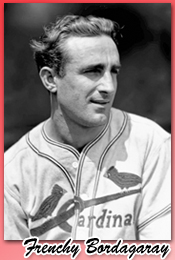
Frenchy Bordagaray was a deluxe pinch-hitter for the Cardinals.

frenchy_bordagarayBordagaray, 5 feet 7, 175 pounds, led the major leagues in pinch-hitting batting average in 1938.

Using a short right-handed swing, Bordagaray, 28, hit a club-record .467 (21-for-45) as a Cardinals pinch-hitter in 1938.

Proud to be Basque

Stanley George Bordagaray was born Jan. 3, 1910, in the California town of Coalinga, near Fresno. His mother nicknamed him Frenchy, according to the New York Times. (Bordagaray told an interviewer, “I had five brothers and we were all called Frenchy. But I’m not a Frenchman. I’m a Basque. Nobody ever got that right.”) His father, a sheepherder who immigrated to the United States from the Basque region between Spain and France at 15, wanted Stanley to become a violinist, but the youth preferred sports.

An outfielder and third baseman, Frenchy Bordagaray made his big-league debut in 1934 with the White Sox and was traded to the Dodgers at the end of the year. After the 1935 season, Bordagaray got a bit part in the John Ford film “The Prisoner of Shark Island.” When Frenchy showed up at Dodgers spring training camp in 1936 still sporting the moustache and goatee he had grown for the movie role, manager Casey Stengel ordered him to shave, saying, “If anyone is going to be a clown on this club, it’s going to be me.”

After the 1936 season, the Dodgers dealt Bordagaray, pitcher Dutch Leonard and infielder Jimmy Jordan to the Cardinals for outfielder Tom Winsett.

Boys in the band

Bordagaray hit .293 as a utility player for the 1937 Cardinals, but he became best known as a member of teammate Pepper Martin’s Mudcats band. The one-time violinist played washboard and fiddle.

Showing no signs of what was to come in 1938, Bordagaray was abysmal as a pinch-hitter in 1937, getting one hit in 16 at-bats for an .063 average.

In 1938, he had three doubles, nine RBI and scored 13 runs in his 21-for-45 performance as a pinch-hitter. Overall, he hit .282 for the 1938 Cardinals.

The Cardinals traded Bordagaray to the Reds for outfielder Dusty Cooke in December 1938. Bordagaray played for the Yankees and returned to the Dodgers before ending his 11-year big-league playing career in 1945.

Bordagaray appeared in the 1939 World Series for the Reds and in the 1941 World Series for the Yankees, but never had a World Series at-bat. His two appearances in the 1939 World Series were as a pinch-runner for Ernie Lombardi. His lone appearance in the 1941 World Series was as a pinch-runner for Bill Dickey.

In two seasons with the Cardinals, Bordagaray batted .289 (132-for-456).

His big-league career batting average as a pinch-hitter was .318 (62-for-195).

(Updated May 12, 2018)

Since 2000, when he broke into the big leagues with the Pirates, until 2017, when he finished his pitching career with the Reds, Bronson Arroyo was a frequent foe of the Cardinals.

bronson_arroyoArroyo, who flipped breaking pitches like Frisbees in an ocean breeze, has a regular-season career record of 8-18 with a 4.94 ERA in 42 appearances against the Cardinals. Most of those appearances occurred while he pitched for the Reds.

A look at some of Arroyo’s best and worst performances against the Cardinals:

Good for Arroyo

_ May 1, 2006: Arroyo pitched a complete-game four-hitter in a 6-1 Reds victory at Cincinnati. Juan Encarnacion’s home run prevented a shutout.

“He doesn’t have overpowering stuff, but he’s smart,” Cardinals outfielder John Rodriguez said to the St. Louis Post-Dispatch. “He knows where his pitches are going.”

Said Cardinals manager Tony La Russa: “He got a lot of outs in a lot of different parts of the (strike) zone. That’s good pitching.” Boxscore

_ June 12, 2008: Arroyo pitched six shutout innings and hit a home run against Joel Pineiro in a 6-2 Reds victory at Cincinnati. Arroyo departed after experiencing cramps in his right forearm.

“He didn’t leave pitches over the middle,” Cardinals outfielder Skip Schumaker said. “He was effective pitching to the small part of the plate.” Boxscore

_ May 16, 2010: Arroyo tossed a complete-game seven-hitter and knocked in two runs in a 7-2 Reds victory at Cincinnati. Cardinals outfielder Colby Rasmus described Arroyo’s assortment of pitches as “doo-doo” and “slop.”

Said Arroyo: “I could care less what adjective you put next to my pitch selection. The name of the game is to put a zero on the board as many times as I can.” Boxscore

Good for Cardinals

_ Aug. 10, 2006: Arroyo braided his hair into cornrows in an effort to change his luck, but the Cardinals weren’t impressed. Arroyo yielded home runs to Jim Edmonds, Chris Duncan and Scott Spiezio in the Cardinals’ 6-1 victory at Cincinnati.

“I’m at the end of my rope with superstitions,” Arroyo told the Dayton Daily News. “Either I’m going to bring a live chicken in here, or just go out and pitch.” Boxscore

_ June 6, 2007: In the seventh inning, with the Reds ahead, 4-3, Ryan Ludwick tied the score with a pinch-hit home run off Arroyo. With two outs, Albert Pujols followed with a two-run home run, lifting the Cardinals to a 6-4 triumph at St. Louis.

“All the runs they scored were on mistakes,” Arroyo said. “With Pujols, I tried to freeze him with a heater in, but it wandered over the middle of the plate.” Boxscore

_ Sept. 26, 2008: Arroyo gave up a career-high 13 hits in seven innings but escaped with a no-decision in the Cardinals’ 7-6 victory at St. Louis. Arroyo reached 200 innings pitched for the fourth consecutive season. Boxscore

_ July 5, 2009: The Cardinals pounded Arroyo for 11 hits and eight runs in five innings and won, 10-1, at Cincinnati. Said Reds manager Dusty Baker: “Bronson got kicked around pretty good. He was a sacrificial lamb because my bullpen was in bad shape.” Boxscore

Previously: Cardinals, Reds stage star-studded brawl in 1967

(Updated Nov. 21, 2024)

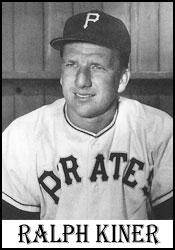
Ralph Kiner, the Hall of Fame left fielder who hit 369 home runs in a 10-year major league career, slugged three home runs in a game for the Pirates against the Cardinals.

ralph_kinerThroughout his career, Kiner was a Cardinals nemesis, hitting .309 with 50 home runs and 142 RBI against them.

A .279 career hitter with the Pirates, Cubs and Indians, Kiner’s batting mark against the Cardinals was his highest versus any National League team.

Kiner blooms at Greenberg Gardens

In 1947, Kiner, 24, was in his second big-league season with Pittsburgh. The Pirates had acquired Hank Greenberg, 36, the longtime Tigers slugger, to play first base and mentor Kiner.

(In the book “Voices from Cooperstown,” Kiner told author Anthony J. Connor that as a boy he rooted for Greenberg and the 1934 Tigers. “I can still rattle off the whole lineup,” Kiner said. “The funny thing is I never saw them play. I was in southern California then and there was no TV. It just goes to show what an 11-year-old boy can do with a newspaper box score and a good imagination.”)

To capitalize on the right-handed power of Kiner and Greenberg, the Pirates extended the bullpen fence about 30 feet in front of the left field wall at Forbes Field, shortening the distance for a home run from about 360 feet to about 330 feet, and dubbed the area Greenberg Gardens.

Though the 1947 Pirates were an awful team _ they would finish in last place at 62-92 _ they topped one million in home attendance for the first time in franchise history because of the slugging of Kiner (51 home runs) and Greenberg (25).

On Aug. 16, 1947, Kiner had three home runs, five RBI, four runs scored and two walks in the Pirates’ 12-7 victory over the Cardinals at Forbes Field.

The Pirates and Cardinals combined to hit 10 home runs in the game. The Pirates accounted for seven _ three by Kiner and two each by Greenberg and Billy Cox. Whitey Kurowski hit two homers for the Cardinals and Terry Moore hit one. All 10 home runs were hit by right-handed batters.

Kiner’s first home run came with the bases empty in the third off starter Ken Burkhart and landed against the light tower in the bullpen. He hit a three-run shot over the scoreboard in left off Ted Wilks in the fourth before capping his day with another solo homer off Johnny Grodzicki in the eighth. The third home run was the longest and “seemed headed for Carnegie Museum in nearby Shenley Park,” according to the St. Louis Post-Dispatch. Boxscore

Thanks, Hank

Kiner struggled early in the 1947 season and Pirates manager Billy Herman wanted to send him to the minors but Greenberg convinced the front office to keep Kiner on the club, according to the book “Voices From Cooperstown.”

According to author Anthony J. Connor, when Kiner reached a low point, going hitless in five at-bats against the Cubs, Greenberg said to Kiner, “Stay with it. The fundamentals are there and it is going to work.”

Kiner credited Greenberg with making him into a consistent power hitter. “Right from the start of spring training down in Florida, Hank was at my side constantly,” Kiner told The Sporting News. “He got me to move up a little closer at the plate to protect the outside (corner) and to spread my feet a bit, too.

“Hank gave me confidence and he taught me how to relax. Last year, I was usually tense at the plate. When a pitcher had two strikes on me, I was always afraid I’d be called out on strikes and I’d go after that bad one … I bet I’ve hit most of my home runs this year with two strikes on me.”

Said Greenberg: “Ralph had what it takes all the time. I merely gave him a bit of advice here and there when he asked me … Kiner and Ted Williams are probably the best wrist hitters in the game today.”

In his book “Stan Musial: The Man’s Own Story,” the seven-time batting champion of the Cardinals said Kiner “was the most consistent home run hitter in the National League. Hank Greenberg helped him and so did Greenberg Gardens at Pittsburgh, but Ralph worked at his game and improved himself as a hitter. He had a good eye and good power, plus a type of swing that sent the ball high with good backspin so that it kept sailing.”


Desperate for revenue and suspicious of new technology, the Cardinals joined the Browns in banning radio broadcasts of their games.

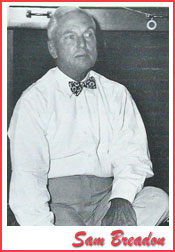
sam_breadon2On Feb. 3, 1934, the National League Cardinals and American League Browns declared that radio broadcasts were having a negative impact on attendance at their games at Sportsman’s Park in St. Louis.

In 1933, with America reeling from the Great Depression, the Cardinals drew 256,171 in 77 home games, even though they had a winning record (82-71) and were just two years removed from a World Series championship. It was their lowest home attendance since moving to Sportsman’s Park from Robison Field in 1920.

The 1933 Browns, a last-place finisher at 55-96, attracted 88,113 in 77 home games.

Radio broadcasts of Cardinals and Browns games had been carried since 1926, five years after the first broadcast of a major-league game, the Phillies vs. the Pirates, on Pittsburgh station KDKA in 1921.

Under the headline “St. Louis Clubs Sign Off on Radio,” The Sporting News reported in its Feb. 8, 1934, edition that “this decision was reached with dramatic suddenness by Sam Breadon, president of the Cardinals, and Louis B. von Weise, who holds a similar title with the Browns.”

“There, no doubt, was a time when the microphones did us some good,” Breadon said. “That was in the high times. But now we are at a point where we are willing to experiment a season without the mikes.”

Strong reactions

St. Louis radio executives were stunned and disappointed.

“We feel that it was a service the public appreciated and that radiocasting of the games helps more than it damages attendance,” said Jack Van Valkenburg, president of KMOX.

Added Thomas Patrick Convey of St. Louis station KWK: “Nobody has worked harder than myself to try to get people out to the ballpark.”

In an editorial, The Sporting News supported the right of the St. Louis clubs to choose whether to permit radio broadcasts of games. “Like other sports, baseball long has been in doubt as to the value of broadcasts,” The Sporting News wrote. “… The opinion has been growing stronger within the past two years that, whatever good the radio may have done the game in the past, conditions now have changed and its tendency to cause the fan to sit in front of the loudspeaker instead of in the stands is beginning to outweigh all its advantages.”

Most of the mail Breadon received in reaction to the decision opposed the radio ban.

Business and marketing

Breadon, a native New Yorker, may have been influenced by the decisions of all three New York clubs _ the American League Yankees and the National League Dodgers and Giants _ to ban radio broadcasts of their games.

Teams in Boston, Chicago, Cincinnati and Detroit were continuing game broadcasts. Walgreens paid Chicago radio station WGN $45,000 to sponsor game broadcasts for the 1934 season, The Sporting News reported.

Radio magnate Powel Crosley had purchased the Reds, with the notion of using radio to promote his team and using the broadcasts as an advertising revenue generator for his stations.

Without the broadcasts, home attendance of the Cardinals and Browns increased in 1934. The Cardinals, who won the National League pennant and World Series championship that year, drew 325,056 in 77 home games, an increase of almost 70,000. The Browns, who placed sixth at 67-85 in 1934, attracted 115,305, a spike of 27,000.

In 1935, the broadcasts of Cardinals and Browns games were restored. The business models in Chicago and Cincinnati may have convinced the St. Louis clubs to end the ban.

Capitalizing on their status as reigning World Series champions, Cardinals home attendance jumped to 506,084 in 1935. The Browns, who fell back to seventh place in 1935, drew 80,922 to 76 home games that year, including 300 to a Friday afternoon game on May 10 against the Athletics. Boxscore

(Updated Sept. 10, 2025)

On Feb. 28, 1989, the day the veterans committee was to announce its selections to the National Baseball Hall of Fame, coach Red Schoendienst was at Cardinals spring training camp in St. Petersburg, Fla., with his wife, Mary.

red_schoendienst7“When is the announcement?” Mary asked.

“3 o’clock,” replied Red.

“I’m not going shopping,” Mary said.

In relaying the conversation to the Associated Press, Schoendienst said, “Anytime you can stop a gal from going shopping, that’s pretty big news.”

Schoendienst, the longtime Cardinals second baseman, got the call from Ed Stack, Hall of Fame president, informing him he’d been elected to the Cooperstown shrine, ending a wait of 20 years.

Two days after the veterans committee announcement, Bob Broeg, the St. Louis journalist who covered Schoendienst since his debut with the Cardinals in 1945, wrote, “I don’t think the Cardinals are going to get Schoendienst out of uniform anytime soon, even though he’s 66. He still likes a hot ballgame and a cold beer.”

Schoendienst and umpire Al Barlick each got the necessary 14 votes from a committee of 18 which included Red’s friend and former teammate, Stan Musial.

Joining them in the 1989 Hall of Fame induction class were Johnny Bench and Carl Yastrzemski, each of whom was elected by the Baseball Writers Association of America. Harry Caray, the former Cardinals broadcaster, also was headed to Cooperstown as 1989 winner of the Ford C. Frick Award for broadcast excellence.

“A great player and a winner,” Caray said of Schoendienst to Rick Hummel of the St. Louis Post-Dispatch.

Schoendienst had been on the Baseball Writers Association of America ballot for 15 years (1969-83) but failed to receive the necessary 75 percent of the votes for election. His best showing was 42.6 percent in 1980.

When he got the call he’d been elected by the veterans committee (ahead of candidates such as Richie Ashburn and Phil Rizzuto), Schoendienst told Hummel, “I was standing up. Then I had to sit down.”

In 19 seasons (1945-63) with the Cardinals, Giants and Braves, Schoendienst was named an all-star 10 times and collected 2,449 hits. He six times led National League second basemen in fielding percentage, prompting Musial to declare Schoendienst had “the greatest pair of hands I’ve ever seen in baseball.”

In the book “Few and Chosen,” catcher Tim McCarver said, “There’s a saying in baseball that you can tell the guys who were good fielders by the way they shake hands. When you shake Red’s hand, it’s as soft as a pillow, and that’s the way he was as a fielder. Soft, pliable, flexible hands. An infielder is taught to field a ground ball below the hop, to absorb the hop, and Red was a master at that … Another thing about Red, he had a quick bat. Howard Pollet, the fine left-hander, said you couldn’t throw a fastball past Red.”

Schoendienst played 15 seasons for the Cardinals. He managed them for 14 years, achieving 1,041 wins, two league pennants and a World Series title.

Informed by Hummel of his former teammate’s election by the veterans committee, Enos Slaughter, a Hall of Fame outfielder for the Cardinals, said, “It’s long overdue … Red would have to rank with any second baseman, bar none, that I played with.”