Feeds:
Posts
Comments

(Updated Dec. 1, 2023)

On Jan. 31, 1994, the Cardinals signed free agent Rick Sutcliffe to a minor-league contract and invited the right-hander to spring training with the hope he could earn a spot on their roster and in their starting rotation.

Sutcliffe won the 1979 National League Rookie of the Year Award with the Dodgers and the 1984 Cy Young Award with the Cubs but the Cardinals were getting a pitcher on the back side of his career.
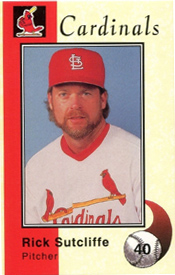
rick_sutcliffeSutcliffe had injured a knee in 1993 and posted a 5.75 ERA in 29 appearances for the Orioles, but the Cardinals saw him as an inexpensive solution to replace starting pitcher Donovan Osborne, who was sidelined for the 1994 season after having shoulder surgery.

“I have no doubt I can still pitch,” Sutcliffe, 37, told the St. Louis Post-Dispatch.

Cardinals general manager Dal Maxvill said to the St. Louis newspaper, “The reports we have are his arm is in good shape and he was throwing the ball well at the end of the (1993) season. I know one thing: He’s won 26 games the last two seasons (16 in 1992 and 10 in 1993). We only have one guy on our staff (Bob Tewksbury) who has more.”

Post-Dispatch columnist Bernie Miklasz called the signing of Sutcliffe “a good pickup” and added, “He’s a leader revered by young pitchers. If Sutcliffe can help settle down the young staff and win a few games, great.”

Sutcliffe called the Cardinals when he couldn’t reach a deal to stay with the Orioles, the Post-Dispatch reported.

According to the Baltimore Sun, “He entered January (1994) still thinking that he would return for one more season in Baltimore, but chose St. Louis after turning down an Orioles offer that he thought was made only out of a sense of obligation.”

Sutcliffe’s contract with the Cardinals called for him to be paid $250,000 if he made the team, and he could get another $250,000 in appearance incentives.

For the birds

Naturally, Sutcliffe’s first spring training start for the Cardinals came against the Orioles. He gave up three runs in the first inning, but none in the next two. “It took him a while to get comfortable with the idea of pitching against a team that he fully expected to play for this season,” the Baltimore Sun reported.

Sutcliffe told the Baltimore newspaper, “When you want to come inside (with a pitch), it’s tough to have your friends standing there.”

According to the Sun, Orioles manager Johnny Oates had “pushed hard” for the return of Sutcliffe. So had their shortstop, Cal Ripken. Before Sutcliffe signed with St. Louis, Ripken had told The Sporting News, “It is very important that Suttcliffe come back. He’s an experienced pitcher who matches up with some of the top pitchers in the league. He takes the pressure off the rest of the guys. He’s a great teacher and a great leader.”

Sutcliffe had helped with the development of the Orioles’ “young starting rotation and his leadership had contributed to the development of a winning attitude in the clubhouse,” the Sun reported.

At Cardinals spring training, Sutcliffe took on the role of mentor to pitchers such as Rheal Cormier, Tom Urbani and Allen Watson.

“Cormier keeps a thick notebook on his pitching appearances, with many of the entries influenced by Sutcliffe,” the Louisville Courier-Journal reported.

Watson told the Louisville newspaper, “Last year, I had nobody to talk to. After I met Rick in spring training, he gave me a lot of insight on how to go through the bad times.”

Sutcliffe’s work with the pitchers had the approval of Cardinals manager Joe Torre and pitching coach Joe Coleman.

“I had that role toward the end of my career _ an experienced player that other players could come to,” Torre said to the Post-Dispatch. “They feel funny about going to the manager all the time. It’s like going up to the teacher all the time, like you’re trying to kiss up.”

Coleman told the Courier-Journal, “We knew that Rick had this type of leadership.”

Ups and downs

Though he posted a 5.57 ERA in spring training games, the Cardinals opened the 1994 season with Sutcliffe on their roster.

Sutcliffe won his first start for them, beating the Dodgers at St. Louis. Boxscore

Following that, he got shelled at Atlanta. The Braves got back-to-back-to-back home runs from Ryan Klesko, Fred McGriff and David Justice in the first inning and won, 7-1. Boxscore

In 11 career appearances at Atlanta-Fulton County Stadium, Sutcliffe was 0-5 with a 6.70 ERA.

Soon after, Sutcliffe suffered a severe hamstring injury. After three starts during an injury rehabilitation assignment in the minors, he came back to the Cardinals in late May.

Sutcliffe had a couple of other terrible starts for them _ seven runs in two innings versus the Marlins on June 15 Boxscore and eight runs against the Rockies in 5.1 innings on July 17 Boxscore. He also produced quality wins, with 7.2 scoreless innings versus the Dodgers again on May 31 Boxscore and a stifling of the Cubs (one run in six innings) on June 26. Boxscore

Sutcliffe earned wins in three of his last four decisions.

His last appearance was a win against the Braves on July 22, 1994, but he left in the sixth inning after he threw a wild pitch and felt pain in his arm. Boxscore

An exam revealed he had a torn labrum as well as a major tear in his rotator cuff and problems with his biceps. In looking back at the last pitch he threw, Sutcliffe told the Post-Dispatch, “I guess I’m lucky my arm didn’t go with it. There wasn’t anything else holding it on.”

In 16 appearances (14 starts) during the strike-shortened 1994 season, Sutcliffe gave up 93 hits in 67.2 innings, posting a 6-4 record despite a 6.52 ERA. In his 14 starts, his ERA was 6.78. He walked more batters (32) than he struck out (26).

Sutcliffe’s problems were a reflection of a troubled pitching staff. The pitching standouts for the 1994 Cardinals were relievers Rob Murphy (3.79 ERA) and John Habyan (3.23). The primary starters were Bob Tewksbury (5.32 ERA), Vicente Palacios (4.44), Allen Watson (5.52), Sutcliffe (6.52), Omar Olivares (5.74) and Tom Urbani (5.15).

Overall, the 1994 Cardinals’ staff ERA was 5.15, tied with the Rockies for worst in the National League.

Granted free agency after the 1994 season, Sutcliffe attracted little interest and retired in April 1995. His career record in the majors is 171-139. He went into broadcasting. In March 2008, Sutcliffe was diagnosed with colon cancer. After receiving treatment, he resumed his broadcasting career.

 

(Updated April 4, 2025)

A tip of the cap to Sparky Anderson.

He did what Tony La Russa could not: choose a team logo to display on the cap for his plaque in the National Baseball Hall of Fame.

sparky_andersonAs managers, Anderson and La Russa won World Series titles with teams from both the National League and American League. Anderson was a role model for La Russa and mentored him.

La Russa differed from Anderson on the controversial cap choice.

La Russa, elected to the National Baseball Hall of Fame in December 2013, said he chose not to have a team logo on the cap for his plaque because he didn’t want to disrespect any of the three teams _ White Sox, Athletics and Cardinals _ he managed.

“They offered one logo or no logo,” La Russa recalled to Cardinals Yearbook in 2014. “I said no logo. That was an easy call for me.”

Because he won two of his three World Series titles with the Cardinals, became the all-time leader in wins (1,408) among Cardinals managers and spent 16 years as a manager with St. Louis, La Russa disappointed many Cardinals loyalists, including club owner Bill DeWitt Jr., with his decision.

“I understood how some people could be upset because the last 16 years (with St. Louis) were special,” La Russa told Cardinals Yearbook, “but I can’t forget the first 16 (with the White Sox and Athletics). ”

Contrast La Russa’s choice with that of Anderson’s:

Anderson, elected to the National Baseball Hall of Fame in 2000, chose to have a Reds logo on the cap for his plaque _ even though he was fired in Cincinnati and spent nearly twice as many years managing the Tigers as he did the Reds.

Cardinals connection

Anderson’s decision had roots from his three years as a minor-league manager in the Cardinals’ system.

Anderson said he chose the Reds cap for his plaque as a tribute to Bob Howsam.

As Reds general manager, Howsam hired Anderson to manage Cincinnati, launching him onto his Hall of Fame career.

As Cardinals general manager, Howsam saved Anderson’s career by hiring him to manage in the St. Louis system.

Anderson was unemployed after being fired as manager of Class AAA Toronto in 1964. In March 1965, Fred Koenig resigned as manager of the Cardinals’ Class A Rock Hill team. With the start of the season near, Howsam was scrambling to find a replacement.

Howsam took a chance on Anderson.

Anderson managed Rock Hill to a 59-63 record.

In 1966, the Cardinals named Anderson manager of Class A St. Petersburg. He led St. Petersburg to a 91-45 record and strengthened his reputation within the Cardinals organization as a first-rate instructor.

Howsam left St. Louis to become general manager of the Reds in January 1967. The Cardinals named Anderson manager of Class A Modesto. He led Modesto to a 79-61 mark and the league championship.

In the fall of 1967, Howsam wooed Anderson into the Reds organization as a minor-league manager at Class AA Asheville. Two years later, Oct. 9, 1969, Howsam introduced Anderson as manager of the Reds.

“He hired a 35-year-old nobody knew and he had the courage and fortitude to do that,” Anderson told the Associated Press in February 2000, explaining why Howsam inspired him to select a Reds cap for the plaque. “Had he not done that, I doubt very much, in all honesty, that I would have managed in the major leagues. And I owe that to him.”

Anderson won two World Series titles and four pennants with the Reds and posted an 863-586 record. Howsam retired after the 1977 season and was replaced by Dick Wagner, who, after one year on the job, fired Anderson in 1978.

The next year, the Tigers hired Anderson. He led them to the 1984 World Series title and earned 1,331 wins with Detroit from 1979-95.

Sparky: Tony isn’t a bozo

When La Russa became a big-league manager in 1979, with the White Sox, he sought advice from many, including Anderson.

“I never saw anyone catch on as fast as he did,” Anderson said of La Russa in the book “Tony La Russa: Man on a Mission” (2009, Triumph). “When you talk to him, you realize he is very intelligent. You’re not talking to a bozo. He learned so fast, you were never going to trick him. He knew what was going on. I always played him straight up, but I never let him play any tricks on me either.”

Roland Hemond, general manager of the 1979 White Sox, said, “Tony was smart enough to pick up the wisdom those guys were willing to pass along. I don’t think Sparky would have spent so much time with him if he thought he was talking to a guy who would not be around very long.”

After the 1995 season, when La Russa was trying to decide whether to leave the Athletics for the Cardinals, Anderson was an influencer in his decision.

“Going to the National League wasn’t something I considered initially,” La Russa said in his book “One Last Strike” (Morrow, 2012). “Several people, including Sparky Anderson, told me that I’d love it, and when the name St. Louis came up, I started to think seriously about it.”

His success with St. Louis sealed La Russa’s election to the Hall of Fame _ even if his cap won’t reflect that.


(Updated Nov. 10, 2019)

Imagine a gathering of 1960s icons that included Stan Musial, Sandy Koufax, Willie Mays, Frank Sinatra and Dean Martin.

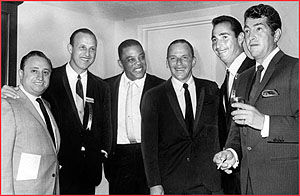
musial_friarsThose athletes and entertainers were together at a 1964 Friars Club roast.

A black-and-white photo from the event, reproduced here, shows (from left to right) Dodgers publicist Danny Goodman, Musial, Mays, Sinatra, Koufax and Martin (the latter in a classic pose, with cigarette in one hand and a drink in the other).

They were at the Friars Club in Beverly Hills on Nov. 10, 1964, for a testimonial dinner in honor of Musial, the Cardinals standout who had retired as a player a year earlier. Less than a month before the gala, the Cardinals, with Musial in the front office as an executive, clinched the 1964 World Series championship against the Yankees.

The Friars Club, founded in 1904 in New York City, primarily attracted comedians and entertainers as its members and became best known for its bawdy celebrity roasts. A Beverly Hills branch of the club opened in 1947.

The dinner for Musial attracted a stellar group from the baseball and entertainment worlds.

Among the baseball celebrities joining Koufax and Mays in honoring Musial were Don Drysdale, Leo Durocher, Bob Feller, Hank Greenberg, Vin Scully and Duke Snider.

Sinatra and Martin were joined by personalities such as Gene Autry, Milton Berle, Gene Barry, Arthur Godfrey and master of ceremonies George Jessel.

Following the standard Friars Club format, several of the entertainers took turns on the dais poking fun at the honored guest.

An example of the cutting humor was this line from Godfrey about Musial’s restaurant in St. Louis: “After eating there, I can understand why Stan came all the way to Los Angeles for a meal.”

Comedian Corbett Monica quipped, “He’s such a nice guy. I might even say he’s holy. He reminds me in fact of Saint Joseph, a dull little town in nothern Missouri.”

In rare serious moments, Autry spoke of how his friendship with Musial began when Stan was a Cardinals rookie, and Mays told the audience Musial and Joe DiMaggio were his idols when he began his baseball career, the Los Angeles Times reported.

“Stan is the kind of man you want your kids to remember for a long time,” Mays said.

The highlight of the evening came when Sinatra and Martin “ran through a half-dozen song parodies filled with jabs at Musial,” The Sporting News reported. The Rat Pack duo’s special lyrics to popular tunes were so risqué that none “is in danger of ever being published,” wrote Sporting News correspondent Bob Hunter.

Sinatra and Martin ended on a high note with a duet to the tune of the song “The Lady is a Tramp.” Changing the lyrics to salute Stan the Man, Sinatra and Martin made the signature line, “Mr. Musial, you’re a champ.”

The Sporting News observed, “Musial received several standing ovations, the final one lasting for a lengthy period after he had responded to the barbs and roasts with a witty, humble speech of thanks.”

In opening his remarks, Musial said to the celebrity club members, “It’s been a great evening and it’s great to be with such famous and good friends _ even if they don’t know a darn thing about baseball.”

Previously: How Bing Devine helped Stan Musial plan retirement

(Updated Nov. 10, 2019)

The Cardinals’ all-time leader in regular-season plate appearances for a year isn’t a noted leadoff batter such as Lou Brock or Vince Coleman. It’s Taylor Douthit.

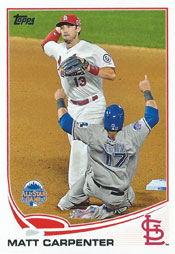
matt_carpenter3The Cardinals’ top 10 in regular-season plate appearances in a year, according to Baseball-reference.com:

1. Taylor Douthit, 752 in 1928.

2. Taylor Douthit, 748 in 1930.

3. Curt Flood, 739 in 1964.

4. Lou Brock, 729 in 1970.

5. Don Blasingame, 728 in 1957.

6. Lou Brock, 727 in 1973.

7. Bill White, 726 in 1963.

8. Lou Brock, 724 in 1967.

9. Stan Musial, 722 in 1949.

10. Lou Brock, 721 in 1971.

The most recent Cardinals player who came closest to cracking the top 10 was Matt Carpenter, who had 717 regular-season plate appearances in 2013.

A player is credited with a plate appearance each time he completes a turn batting. Unlike an at-bat, a plate appearance may result in a walk, a hit by pitch, a sacrifice bunt or a sacrifice fly.

The all-time major-league leader in regular-season plate appearances in a year is Jimmy Rollins of the 2007 Phillies at 778.

Musial is the Cardinals’ career leader in regular-season plate appearances at 12,717.

Cardinals catalyst

Among Cardinals, no one was better at getting to the plate in a season than Douthit.

A right-handed batter, Douthit, 27, was the center fielder and leadoff batter for the 1928 National League champion Cardinals. He hit .295 with 191 hits and 84 walks in 752 plate appearances in 1928. In the only game he wasn’t in the leadoff spot that season, he batted fifth in four plate appearances.

He also was a high-quality center fielder.

Despite his success, Douthit was the subject of trade speculation after the 1928 season.

In its Oct. 25, 1928, edition, The Sporting News reported Douthit “is one of the mysteries of baseball. He has been a great fielder for years, perhaps the best fly chaser in the game today … This year, he started out like a champion batter. He was the first hitter to collect 100 safeties. His fielding, as always, was brilliant. Then, in midseason, he slumped as a batter and stayed in the slump right through the World Series.”

At the end of July, Douthit had a season batting average of .347, but he hit .218 in August and .179 in September. In the 1928 World Series against the Yankees, Douthit was 1-for-11 (.091).

“If Douthit is traded,” The Sporting News reported, “he’ll make the Cards weep frequently … It will be difficult to remember his early-season hitting after the long late summer and fall when he was looked upon as the man who officially opened every game by making the first out.”

The Cardinals kept Douthit and it was a good decision. He helped them win another National League pennant in 1930. Douthit hit .303 that season with 201 hits and 60 walks in 748 plate appearances. In the 11 games he wasn’t in the leadoff spot, he batted third in 54 plate appearances.

Again, though, he had a miserable World Series, hitting .083 (2-for-24) against the Athletics.

In 1931, Douthit was challenged for the center field job by rookie Pepper Martin. On March 26, 1931, The Sporting News reported, “There was much winter conversation about (Pepper) Martin … But that doesn’t make Douthit anybody’s snail. Taylor always has been a good hitter and a brilliant fielder and, unless he breaks a leg or an arm, he’ll play 154 games for the Redbirds in center field.”

That prediction didn’t pan out. The Cardinals wanted Martin in center field. Though Douthit was hitting .331, he was traded to the Reds on June 15, 1931, for outfielder Wally Roettger.

In nine seasons (1923-31) with the Cardinals, Douthit hit .300 and produced 1,006 hits. His on-base percentage with St. Louis was a sparkling .373.

Lou Brock was expected to have a breakout year in 1964 _ with the Cubs, not the Cardinals.

lou_brock8From October 1963 until the start of the 1964 season, Brock was heralded as an emerging superstar who, along with Billy Williams and Ron Santo, gave the Cubs legitimate hope of building a contender.

Instead, the Cubs deviated from their plan to construct a team with Brock as a cornerstone. Desperate for experienced pitching, the Cubs traded Brock and pitchers Jack Spring and Paul Toth to the Cardinals on June 15, 1964, in a deal that brought them pitchers Ernie Broglio and Bobby Shantz along with outfielder Doug Clemens.

Brock propelled the Cardinals to the 1964 National League pennant with his hitting (.348 batting average in 103 games) and speed (33 steals) after being acquired from the Cubs.

Many had predicted he would produce those kinds of numbers for Chicago.

After hitting .258 with 24 steals for the Cubs in 1963, his second full season in the major leagues, Brock, 24, finished runner-up to Cardinals catcher Tim McCarver in balloting by the Associated Press for the honor of National League sophomore of the year.

“Brock is going to be one of the great players in the game within a few years,” Cubs executive Bob Whitlow told The Sporting News in October 1963.

A month later, The Sporting News reported, “In order to acquire (an) extra starting hurler, the Cubs will not break up their infield nor will they deal either Billy Williams or Lou Brock of the outfield.”

Said Santo: “As for Brock, he’s just going to keep getting better.”

Brock led the Cubs in hitting at .380 during the 1964 spring training season.

In a poll of National League writers conducted by The Sporting News before the start of the 1964 regular season, Brock was selected the Cubs player “likeliest to improve.”

Brock started the season well, hitting .306 in April, but batted .221 in May. He entered June in a 4-for-29 slump. On the day he was traded to the Cardinals, his batting average was .251.

Cubs beat writer Edgar Munzel sensed the Cubs were erring in dumping Brock. Calling Brock “a great young prospect,” Munzel wrote, “Even though he was hitting only .251, the youngster combines power with tremendous speed. He was a constant base-running threat.”

Brock, acquired by the Cardinals three days before his 25th birthday, went on to enjoy a spectacular 19-year big-league career, with 3,023 hits, 938 stolen bases and election to the National Baseball Hall of Fame in 1985.

Previously: Bill White: We thought Brock deal was nuts

(Updated Aug. 2, 2020)

In considering a career path for 1972, Mike Shannon could have attempted a comeback as a Cardinals player or accepted a position on manager Red Schoendienst’s coaching staff. He also could have become a minor-league manager. Instead, he became a Cardinals broadcaster.

mike_shannon3Shannon, who helped the Cardinals win three National League pennants and two World Series titles in the 1960s as a right fielder and third baseman, had his playing career cut short in 1970 because of a kidney disease. He spent the 1971 season as the Cardinals’ assistant director of promotions and sales.

In May 1971, Shannon told the Los Angeles Times-Washington Post News Service, “Ever since I’ve been working, since I was 19 years old, I’ve been in the St. Louis organization. On and off the field, I’m a Cardinal all the way. The difference now is I’m trying to sell the Cardinals off the field.”

After one season in promotions and sales, Shannon went looking for another role. According to the St. Louis Post-Dispatch, Shannon had bought a 350-acre cattle ranch in central Missouri and was prepared to spend his time doing that if he couldn’t get another position with the Cardinals.

In The Sporting News, columnist Dick Young reported Stan Musial told him Shannon “will try to make a comeback with the Cardinals” as a player in 1972.

A month later, The Sporting News reported “Shannon had been in the picture as a coach” for Schoendienst’s 1972 staff. Years later, Shannon told Dan Caesar of the Post-Dispatch that when he declined the coaching opportunity, “I felt really bad because jobs were really tough to get in baseball, but it just wasn’t the kind of money I needed to get by on with five kids to raise and send to college.”

According to the Post-Dispatch, Cardinals general manager Bing Devine offered Shannon the chance to become manager of the Cardinals’ 1972 Class AAA Tulsa club, replacing Warren Spahn. Shannon later confirmed he rejected the offer.

Instead, Shannon was selected in November 1971 to join Jack Buck and replace Jim Woods on the Cardinals broadcast team for 1972.

Opportunity knocks

In the book “Jack Buck: That’s a Winner,” Buck recalled the position opened for Shannon when Woods, unwilling to make promotional appearances on behalf of the Cardinals and team owner Anheuser-Busch, departed for a job with the Oakland Athletics.

“Woods became ill with a gallbladder attack shortly after he was hired (by the Cardinals), and later didn’t do the things he was expected to do by our bosses,” Buck said. “He thought Anheuser-Busch demanded too much of the broadcasters and (he) didn’t show at appearances they wanted him to make in the community, and didn’t attend luncheons and banquets.

“Woods didn’t like someone telling him he had to be here or there at a certain time, although he knew that was part of the job. He left as soon as he could.”

Swing and miss

Years later, Shannon told Mike Eisenbath of the Post-Dispatch that when he accepted the broadcasting job, “I don’t think I was looking at doing it past one year. I just figured, ‘I think I’ll try this.’ ”

Unpolished, Shannon struggled to adapt to broadcasting.

“Shannon’s delivery at first was about as jagged as a broken beer bottle,” the Post-Dispatch’s Dan Caesar wrote.

Broadcaster Jay Randolph said to the Post-Dispatch, “Shannon was raw, raw, raw. Man, he was chopped meat.” Said broadcaster Ron Jacober: “There were a lot of dissatisfied listeners. I myself wondered how in the world could they have hired this guy. He was just awful.”

Shannon knew it. In 1972, he told the Post-Dispatch, “I have a poor radio voice … I’m not the guy with the golden lungs … I’ll probably be moving out of this business into raising cattle eventually.”

Years later, reflecting on his 1972 broadcast debut, Shannon told the Evansville Courier & Press: “It was like buying a new house. I didn’t know where the bathroom was or where the garage was. I knew nothing about the mechanics.”

Shannon told the Post-Dispatch, “I didn’t become frustrated, but a lot of the listeners may have been.”

That’s a winner

Shannon credited Jack Buck with teaching him on the job.

“My real ace in the hole I had was Jack,” Shannon told the Post-Dispatch. “Good Lord of mercy, I don’t know what I would have done without him. That man helped me so much. I didn’t have to go to broadcasting school. Working with Jack was like having a private tutor on the job training.”

Buck opened his home to Shannon for training sessions.

“We’d have a tape recorder and a stopwatch, and I’d try to coach him on how to do a scoreboard show,” Buck said to the Post-Dispatch.

Shannon became a success and remained a Cardinals broadcaster for parts of six decades. His conversion to broadcasting “turned out to be pure inspiration,” the Post-Dispatch observed. “Shannon has given Cardinals fans years of expertise, laughter, malaprops, insight and frequent doses of uncommon common sense.”

He never tried to be perfect. “Perfection was hung on a cross a long time ago,” Shannon said.