Feeds:
Posts
Comments

Playing a position primarily reserved for run producers, first baseman Tino Martinez failed too often to deliver for the Cardinals.

tino_martinez2That was the primary reason the Cardinals traded Martinez to the Rays.

On Nov. 21, 2003, the Cardinals dealt Martinez, a Tampa native, to the Rays for minor-league pitcher Evan Rust and a player to be named. A month later, the Rays sent minor-league first baseman John-Paul Davis to the Cardinals, completing the trade.

To sweeten the deal, the Cardinals agreed to pay most of Martinez’s $7.5 million salary for 2004, MLB.com reported.

By moving Martinez, the Cardinals were able to switch a more reliable run producer, Albert Pujols, from left field to first base in 2004.

Power outage

The 2003 Cardinals, the only St. Louis team from 2000 through 2006 to miss qualifying for the National League playoffs, stranded 1,217 runners, three fewer than the Phillies, the league leader in that category.

Martinez shouldered a good deal of the blame for those missed opportunities. He batted .210 (29-for-138) with runners in scoring position in 2003. That was far below his career average of .278 with runners in scoring position.

Martinez, who turned 36 three weeks after the trade, also produced a paltry .429 slugging percentage in 2003. Only Sean Casey (.408) of the Reds and Robert Fick (.418) of the Braves had lower slugging percentages in 2003 among National League first basemen with at least 400 at-bats.

“I wasn’t happy with the way I played in St. Louis,” Martinez said to MLB.com. “I didn’t play up to my capability.”

Said Cardinals manager Tony La Russa to the St. Louis Post-Dispatch: “I thought he competed, but he wasn’t as productive as he’s been.”

Martinez, who topped 100 RBI in a season five times with the Yankees, had become a free agent and signed with the Cardinals in December 2001 as the replacement at first base for Mark McGwire, who retired.

In 2002, Martinez produced 25 doubles, 21 home runs and 75 RBI in 150 games for St. Louis, but he batted .246 (33-for-134) with runners in scoring position.

The next season, his home run and RBI totals dropped to 15 and 69 while his .210 batting average with runners in scoring position was far less than utility players such as Bo Hart (.274) and Kerry Robinson (.292).

In his two seasons with St. Louis, Martinez batted .267 with 36 home runs and 144 RBI. His .434 slugging percentage as a Cardinal was disappointing when compared with his career mark of .471.

Rocky road

“I don’t think we view Tino’s time here as a disaster or a mistake,” Cardinals general manager Walt Jocketty told the Post-Dispatch. “… For some reason, he got a bad rap from people.”

La Russa touted Martinez as one of the team leaders, along with catcher Mike Matheny and pitcher Woody Williams, who held the players together in 2002 after the sudden death of teammate Darryl Kile. “It bothers me to see a stain on this guy,” La Russa said to Joe Strauss of the Post-Dispatch.

There were reports Martinez had become a disgruntled clubhouse presence in 2003 as his performance waned and the pressure increased.

Wrote Strauss: “Initially projected as protection for Pujols, Martinez became frustrated over his varied place in the batting order and decreased playing time against left-handed pitching.”

The Cardinals entered September 2003 in first place in the National League Central Division. They stumbled and finished in third. It didn’t go unnoticed that Martinez batted .217 (13-for-60) in September.

After the trade, Post-Dispatch columnist Bryan Burwell described Martinez’s attitude in the clubhouse as being like an “annoying pebble.”

Wrote Burwell: “And now that Martinez is gone, you have to wonder if he is the only pebble that was lodged in the Cardinals’ shoes. Does the absence of his negative presence mean that the clubhouse troubles are gone with him? Or does it mean that there are still a few more folks who need to go?”

With second baseman Fernando Vina departed for free agency, the Cardinals reportedly were looking to sign veterans Kenny Lofton to replace Pujols in left field and Roberto Alomar to replace Vina.

“One of the things we are trying to do is improve our table-setters at the top of the lineup,” La Russa said to MLB.com.

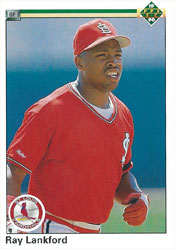
Instead, the Cardinals reacquired Ray Lankford to play left field and, late in spring training, signed Red Sox reject Tony Womack to play second base.

Those moves helped the Cardinals to a pennant-winning season in 2004.

Previously: Tino Martinez, Mike Matheny and the Cards’ Easter brawl

In 1998, the Cardinals were so eager to unload outfielder Ron Gant and reliever Jeff Brantley that they paid the Phillies $6 million to take the underperforming malcontents off their hands.

ron_gantGant and Brantley responded with a series of toxic salvos. Brantley ripped pitching coach Dave Duncan and Cardinals fans. Gant accused manager Tony La Russa of being unethical, immoral and a racist.

The attacks proved baseless. The accusers looked classless.

What both players were attempting to camouflage was their skills had eroded from the days when they were all-stars.

Seeking a transformation after failing to qualify for the postseason in 1997 and 1998, the Cardinals made a flurry of transactions on Nov. 19, 1998. They signed two free agents _ outfielder Eric Davis and reliever Scott Radinsky _ and traded Gant, Brantley and pitcher Cliff Politte to the Phillies for pitchers Ricky Bottalico and Garrett Stephenson.

To seal the deal, the Cardinals agreed to pay $5 million of the $11 million Gant was due on the last two years of his contract and $1 million of Brantley’s $2.8 million contract for 1999.

True grit

Though they hit 223 home runs, the 1998 Cardinals finished in third place in the National League Central Division, 19 games behind the champion Astros. Gant hit 26 home runs in 121 games, but struck out 92 times in 383 at-bats and hit .240. Brantley, expected to be the closer, produced 14 saves, but also had eight blown save chances, gave up 12 home runs in 50.2 innings and posted an 0-5 record and 4.44 ERA.

On the eve of the trade, Cardinals general manager Walt Jocketty told St. Louis Post-Dispatch columnist Bernie Miklasz, “We want more guys who are gritty and hard-nosed.”

Eric Davis had survived colon cancer surgery and Scott Radinsky had fought Hodgkin’s disease. “They’re very strong-willed and competitive and they’re battlers,” Jocketty said to Post-Dispatch reporter Rick Hummel. “That’s the type of people you want to bring to this club.”

After the trade, Brantley told Hummel that when he reported to spring training with the 1998 Cardinals “my arm still hurt.” Brantley had shoulder surgery in 1997 while with the Reds.

Boos for Brantley

Brantley said he was mishandled by Duncan and mistreated by the fans.

“My relationship with Duncan was absolutely terrible,” Brantley said to Hummel. “Whether it was my fault or his fault, I don’t know.”

Said Duncan: “All I can say is that it was not an ideal working relationship. It wasn’t because I didn’t try to make it work.”

Regarding the booing he received, Brantley said, “It’s kind of sorry to take a guy coming off major arm surgery and make him a scapegoat for your ballclub. … I’m not very happy the way I was treated. I was treated grossly unfairly in that ballpark.”

In a parting shot, Brantley said of Gant: “He’ll be glad to get a new place without all the head games and mind games.”

Big whiff

Gant, however, was uncomplaining when interviewed by Hummel about the trade. “There were times I didn’t do my job because of my injuries,” said Gant, slowed by a right hamstring injury in 1998. “… I would have liked to have been with the Cardinals. I had a great time here.”

Said La Russa of Gant: “He would have flashes where you saw what he could do and he could dominate a game and then he would swing and miss a lot where it was tough for him to help.”

A month after the trade, Gant sparked controversy when he told Philadelphia media that Mark McGwire, who hit 70 home runs that year, hampered others in the Cardinals lineup by batting third in the order.

Responding on a St. Louis radio show, La Russa said of Gant, “It was whiff, whiff, whiff. I really hope he goes to Philly and whiffs for them like he whiffed for us. And we’ll see what excuses he makes.”

La Russa also commented on Brantley’s earlier criticism of Duncan. Said La Russa: “Duncan went to bat for him a hundred times.”

“What really ticks me off is that these are the two guys that we, as an organization, worked harder for than anyone else,” La Russa said.

Getting personal

Gant waited to respond until he reported to Phillies spring training camp in February. He told the Philadelphia Inquirer that La Russa has “no morals or values. That’s just the type of person (La Russa) is. Anybody who treats (shortstop) Ozzie Smith like he’s a kid coming up from the minors has no ethics or morals to him.”

In an interview with Hummel, La Russa responded: “You can say I’m a stupid manager. But unethical? Immoral? That’s very strong stuff. That’s like lying, cheating and stealing. Did I do all those things to Ozzie Smith?”

Gant continued his attack in subsequent interviews. “I have nothing against St. Louis,” Gant told reporters. “It’s just the person I was playing under. He didn’t get along with Rickey Henderson. Royce Clayton didn’t like him. Ozzie Smith, he treated like he was the worst person on earth.”

Asked whether there was significance in that Gant and the players he mentioned are black, Gant replied. “Yeah, there is.”

A stunned La Russa responded: “He’s getting lower than cheap.”

Several black players, including former Cardinals outfielder Brian Jordan, defended La Russa and angrily discounted Gant’s accusations. Dave Stewart, a black pitcher who played for La Russa, said, “To call Tony a racist is off base.”

Wrote Miklasz: “Gant continues to embarrass himself by blaming someone else for his failure to earn the $15 million paid to him by the Cardinals over the past three seasons … In my 20 years as a sportswriter, I have never seen a baseball manager protect a player the way Tony La Russa covered for Gant.”

Fade away

Soon after that, Gant issued a half-hearted apology: “All I can say is I apologize to my fans and the families involved. … I apologize to anybody who might have been hurt.”

In May, just before the Phillies played the Cardinals for the first time in 1999, Gant, asked about the controversy, told the Post-Dispatch: “I’ve been told not to comment on that anymore. That whole situation is over. We both said things that we regret.”

By then, though, Gant was being booed regularly by Phillies fans. He entered that series against the Cardinals with a .223 batting average. In July 2000, the Phillies traded Gant to the Angels. He bounced from there to the Rockies, Athletics and Padres before playing his final season in 2003.

Brantley pitched in 10 games for the 1999 Phillies, posting a 1-2 record and 5.19 ERA. He had a 5.86 ERA for the 2000 Phillies and a 5.14 ERA for the 2001 Rangers before retiring as a player.

(Updated May 25, 2020)

In 1974, when the Cardinals’ 5-foot-9 shortstop, Mike Tyson, arrived at spring training at about 185 pounds, teammates called him “Hoggie” because he was “considerably overweight,” The Sporting News reported.

His year went downhill from there.

mike_tysonDuring the Cardinals’ first regular-season road trip in 1974, Tyson was assaulted and robbed in his hotel room.

On April 17, 1974, with the Cardinals in Philadelphia to play the Phillies, Tyson was in his room at the Bellevue-Stratford Hotel when he received a call from someone who identified himself as a maintenance man, asking whether the air-conditioning was working.

“I said, ‘No,’ ” Tyson told The Sporting News. “They said they’d be right over. About 10 minutes later, there was a knock at the door and when I opened it I was facing a shotgun and a handgun.”

Two men tied Tyson’s hands and taped his mouth, according to The Sporting News.

In a 2020 interview with Stan McNeal of Cardinals Gameday Magazine, Tyson recalled, “It was going through my mind that they were going to kill me right there.”

Tyson said he felt better when one of the men asked him if he could breathe all right with the tape on his mouth. “I figured, ‘OK, they’re not going to try to do anything terrible.’ ” Tyson recalled.

The robbers ransacked the room and fled with Tyson’s wallet, containing $80 in cash and two credit cards.

Tyson managed to free himself and call police. Soon after, a suspect was arrested after trying to use one of the credit cards to buy clothes.

Five months later, two men pleaded guilty to robbery charges. According to The Sporting News, the gun used was a toy pistol.

Meanwhile, Tyson struggled on the field. He hit .200 in May. By June, the Cardinals, “concerned about shortstop,” according to The Sporting News, made trade offers for Don Kessinger of the Cubs and Bud Harrelson of the Mets, but both proposals were rejected. The Cardinals reportedly offered Tyson and pitchers Alan Foster and Mike Garman to the Cubs for Kessinger.

Desperate, the Cardinals had coaches Vern Benson and George Kissell “hit ground balls by the bushel” to outfielder Luis Melendez each day in the hope of converting him into a shortstop, but that experiment was scratched.

Instead, the Cardinals stayed with Tyson as their shortstop. He hit .180 in July.

Tyson was especially inept against the 1974 Reds, hitting .065 (2-for-31) overall against them and going hitless (0-for-15) at Cincinnati’s Riverfront Stadium. He also batted . 111 (4-for-36) versus the Braves.

Tyson did hit .360 against the Astros and .344 versus the Padres.

For the season, he batted .223 and made 30 errors at shortstop.

After the season, the Cardinals acquired Ed Brinkman to be their shortstop for 1975, but he flopped and Tyson ended up playing more games at shortstop for the 1975 Cardinals than any other infielder.

In four seasons with the Cardinals, Jake Westbrook pitched for two National League pennant winners and a World Series champion.

jake_westbook3Westbrook, acquired from the Indians on July 31, 2010, in a deal involving outfielder Ryan Ludwick, was 36-32 with a 4.27 ERA in regular-season games for the Cardinals.

A look at his top 5 games as a Cardinal:

1. Big win in big game

The Cardinals’ hitting heroics in Game 6 of the 2011 World Series might have gone for naught if it weren’t for the scoreless inning pitched by Westbrook.

After St. Louis scored twice in the 10th to tie the score at 9-9, Westbrook relieved closer Jason Motte and pitched a scoreless 11th against the Rangers. He got Nelson Cruz to fly out before Mike Napoli singled. Westbrook then retired David Murphy on a flyball and Esteban German on a groundout.

When David Freese followed with a game-winning home run leading off the bottom of the 11th, giving St. Louis a 10-9 victory, Westbrook got a World Series win. Boxscore

2. Rough on Reds

In the Cardinals’ 10-0 victory over the Reds on April 10, 2013, Westbrook pitched his only shutout as a Cardinal and his first since 2006 with the Indians.

Westbrook got 17 outs on ground balls and he held the Reds hitless in six at-bats with runners in scoring position. Boxscore

“The ball was in the zone and really moving a lot,” Westbrook said to the Associated Press.

3. Surprise slugger

A career .130 hitter, Westbrook hit his only big-league home run, a grand slam off Randy Wolf, and earned the win in the Cardinals’ 8-3 victory over the Brewers on Aug. 31, 2011. Boxscore

“It’s pretty special … I’m still not that great of a hitter,” Westbrook said to the Associated Press.

4. Tiger tamer

In his first complete game for St. Louis, Westbrook held sluggers Miguel Cabrera and Prince Fielder hitless and finished with a five-hitter in the Cardinals’ 3-1 triumph over the Tigers on June 20, 2012. Westbrook induced 15 ground ball outs with his sinker. Boxscore

5. Helping the cause

In September 2011, the Cardinals’ only realistic chance to qualify for postseason play was to overcome the Braves and secure the lone wild-card spot in the National League.

Westbrook enabled the Cardinals to complete a critical three-game sweep of the Braves by outdueling Tim Hudson and getting the win in a 6-3 St. Louis victory on Sept. 11, 2011.

Entering the game with a 4.65 ERA, Westbrook held the Braves scoreless for five innings and retired the first seven batters before yielding a hit. Boxscore

Inspired by the sweep, the Cardinals went on to catch the Braves, earn the wild-card spot and begin their postseason push to a World Series title.

Previously: Cardinals pitchers enjoy grand slam streak

(Updated May 30, 2020)

In his first game for the Cardinals, George Altman singled four times against Mets pitcher Roger Craig, who experienced the first of 22 losses in 1963. Boxscore

roger_craigSeven months later, Altman was traded for Craig, a deal that helped transform the Cardinals into World Series champions in 1964.

On Nov. 4, 1963, the Cardinals sent Altman and pitcher Bill Wakefield to the Mets for Craig.

Craig was 5-22 for the 1963 Mets and he lost 18 consecutive decisions between May 4 and Aug. 4, but the Mets were shut out in nine of Craig’s losses and he lost five times by 1-0 scores.

Devine intervention

The Cardinals acquired him because he could start and relieve, general manager Bing Devine said, and his 3.78 ERA in 1963 indicated Craig was a better pitcher than his won-loss record showed.

“Craig gives us stability and maneuverability in our pitching,” Devine told United Press International.

Cardinals manager Johnny Keane told New York columnist Red Smith, “We think Craig is a lot of pitcher.”

Said Craig to the Associated Press: “I knew I’d be traded. I was praying it wouldn’t be to another second-division club. I felt I suffered enough … I want to thank the Mets for dealing me to a good club. The Cardinals have the best-hitting team in the league and should be a contender for many years.

“I feel I’ve never pitched better than (1963) despite my record. I had better control, better stuff and my arm didn’t bother me despite all the work … My stay in New York made me a better pitcher because it taught me to bear down harder. There was plenty of opportunity.”

In an uncannily prescient prediction to The Sporting News in December 1963, Mets broadcaster Ralph Kiner said of the Cardinals’ acquisition of Craig, “It could mean the pennant for them. It gives the Cards a great middle relief man or maybe even another starter. Ask any manager what that means. Craig is a great competitor.”

Craig’s versatility for the 1964 Cardinals was reflected in these statistics: He was third on the club in games pitched (39), third in saves (five), fourth in starts (19) and fourth in innings pitched (166).

His best work for the 1964 Cardinals was out of the bullpen. Overall, he was 7-9 with a 3.25 ERA. In relief, he was 2-1 with a 2.20 ERA in 20 games.

Relieving Ray Sadecki, Craig won Game 4 of the 1964 World Series against the Yankees. Boxscore

Big bopper bust

George Altman, the right fielder for the 1963 Cardinals, had been expected to provide power and run production after being acquired from the Cubs, but he was a streaky hitter who failed to produce consistent power. He hit .274 with 18 doubles, nine home runs and 47 RBI in 135 games for the Cardinals.

Altman’s inconsistency was reflected in these statistics: He hit .370 for St. Louis in April, .184 in May, .305 in June and .226 in July.

“Altman wasn’t that bad a player for us,” Devine told the St. Louis Post-Dispatch. “It’s just that we looked for so much from him … We made the trade (for Craig) to strengthen our pitching as well as to open the way for our young outfielders. We’ve wanted Craig for some time.”

Altman hit .230 for the 1964 Mets and duplicated the home run and RBI totals (nine and 47) he had for St. Louis in 1963.

After returning to Chicago and playing for the Cubs from 1965-67, Altman revived his career in Japan.

In search of a late-night drink at a venerable St. Louis hotel, longtime Cardinals broadcaster Harry Caray nearly was killed when struck by a car.

harry_carayOn Saturday afternoon, Nov. 2, 1968, less than a month after he’d called the World Series between the Cardinals and Tigers, Caray did the broadcast of the Oklahoma State vs. Missouri football game at Columbia, Mo.

Afterward, he drove to St. Louis and, on a whim, decided to stop by and watch the NHL game between the Blues and North Stars. During the hockey game, Caray, who was estranged from his second wife at the time, called a friend and arranged to meet for dinner.

After dinner, unwilling to call it a night, Caray headed to the Chase Park Plaza Hotel, a landmark in St. Louis since the 1920s and a venue for music and shows. It was about 1:15 a.m., Sunday morning, Nov. 3, 1968, when Caray drove up to the hotel in the rain.

A regular at the Chase Park Plaza, Caray, 54, usually left his car with a parking attendant at the entrance, but, because of the rain, there was a backup of vehicles in the hotel driveway.

Impatient, Caray noticed an empty parking spot along the curb on the other side of the street, directly across from the hotel. He parked, exited the car and started to cross the busy street, Kingshighway.

Sent flying

Midway across, Caray told The Sporting News, “I turned to see if anything was coming from my left. The last thing I remember was, ‘Am I OK out here?’ ”

A car driven by Michael Poliquin, 21, a Vietnam War veteran from Overland, Mo., struck Caray. “He was knocked 40 feet in the air,” The Sporting News reported. “His shoes were found 25 feet south of the hotel and he landed 40 feet north.”

Poliquin, who hours earlier had been engaged to be married, told police he saw a pedestrian step into the street in midblock and wasn’t able to stop on the slickened pavement, the Associated Press reported. Poliquin said Caray saw the car at the last moment and jumped in the direction the vehicle was skidding.

In his book “Holy Cow!,” Caray said, “I was lying in the street … in the pouring rain. People started to gather around. Many recognized me; all were afraid to touch me.

“A Goodwill truck came down Kingshighway. The driver saw a body in the street and … stopped his truck. When he saw I was just lying unattended to in the rain, he pulled a few burlap bags from the back of the truck and covered me with them _ keeping me warm and dry _ then just drove away. I think he saved my life.”

Taken to a hospital, Caray was treated for compound fractures of both legs, a broken right shoulder, a broken nose and facial cuts, the Associated Press reported. “I had almost died on the street when the rainwater and blood nearly congested my lungs … I was extremely fortunate they didn’t have to amputate my left leg during surgery,” Caray said.

Police cited the driver of the car for failure to display a license and Caray was cited for crossing a street while not at an intersection, the Associated Press reported.

Party room

Initially, the only visitors permitted in Caray’s hospital room were family members and Robert Hyland, general manager of Cardinals flagship radio station KMOX, according to United Press International. “We can’t keep Harry from talking,” Hyland said. “He’s full of spirit and already tired of being in the hospital. He’s been pestering the doctors to let him go back to work.”

The doctors informed Caray he would need to remain in the hospital until just before Christmas. Caray convinced hospital staff his recovery would progress if he could have lots of visitors.

“My room became headquarters for off-duty nurses, for kids who wanted to talk baseball, for all my friends,” Caray said. “At night they would send martinis down from the restaurant on the top floor, as well as specially prepared meals, so I didn’t have to eat the awful hospital food. After a while, it was like a nightclub in there. It got so I hated to leave.”

Upon Caray’s release, Cardinals owner Gussie Busch offered the broadcaster the use of Busch’s beach house near St. Petersburg, Fla. Caray recuperated there _ under the care of a male nurse, he said _ and was back in the Cardinals’ broadcast booth for the start of the 1969 season.