Feeds:
Posts
Comments

(Updated Sept. 27, 2019)

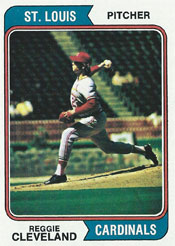
Reggie Cleveland may have been an unlikely candidate to nearly pitch the Cardinals’ first perfect game. Ken Rudolph may have been one of the unlikeliest batters to keep him from achieving perfection.

reggie_cleveland3On Sept. 27, 1973, Cleveland faced the minimum 27 batters in pitching a one-hitter against the Cubs at St. Louis.

Rudolph, a catcher batting eighth, was the only Cubs player to reach base. He singled in the sixth, then was erased on a double play.

Cleveland, 25, hadn’t won since Aug. 22, losing four consecutive decisions, but the right-hander threw just 78 pitches in subduing the Cubs.

“I had an unbelievable fastball,” Cleveland said to The Sporting News. “I put it where I wanted almost every time and the ball kept jumping.”

Said Cardinals catcher Ted Simmons: “That’s as good a one-hit perfecto as you’ll ever see. Reggie didn’t make a really bad pitch all night.”

Cleveland retired the first 16 Cubs batters. With one out in the sixth, Rudolph, who entered the game with a .196 batting average, singled sharply to left.

“Rudolph hit a good pitch, a slider low and away,” Simmons said.

The next batter, Burt Hooton, bunted. Cleveland fielded the ball and threw to shortstop Mike Tyson for the force on Rudolph at second. Tyson fired the relay to second baseman Ted Sizemore, covering first, to complete the double play.

In the bottom of the inning, Lou Brock lined a two-run home run into the seats in right against Hooton, producing the game’s only scoring.

“That was the first changeup I’ve hit out of the park in five years,” Brock said to the Chicago Tribune.

Cleveland set down the Cubs in order in the seventh, eighth and ninth innings, finishing the gem in 1 hour, 40 minutes.

He told the St. Louis Post-Dispatch, “The fastball was the best I’ve ever had.”

The ninth inning was relatively drama-free. Glenn Beckert flied out, Pete LaCock struck out and Adrian Garrett grounded out. Boxscore

The final out by Garrett provided a twist.

Four years earlier, May 27, 1969, Cleveland’s wife gave birth to their first child, a daughter. That night, Cleveland, pitching for the Cardinals’ minor-league Arkansas affiliate, pitched a one-hitter versus Shreveport, facing the minimum 27 batters. The lone hit was a second-inning single by Adrian Garrett.

The one-hitter versus the Cubs was the last game Cleveland pitched for the Cardinals. He was traded to the Red Sox after the season. A year later, October 1974, the Cardinals acquired Rudolph to be Simmons’ backup.

In a game filled with excellent catchers, the one who stood out was the unlikeliest of all.

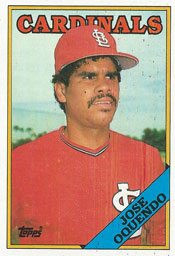
jose_oquendo4In 1988, Jose Oquendo caught an inning for the Cardinals in a game against the Mets at St. Louis.

In doing so, Oquendo became the first National League player in 70 years to play all nine positions in one season.

Before Oquendo, the last to accomplish the feat in the National League was Gene Paulette, primarily a first baseman for the 1918 Cardinals. Cesar Tovar of the American League Twins played all nine positions in 1968.

On Sept. 24, 1988, the Mets jumped to a 6-0 lead in the second inning against the Cardinals. Oquendo, 25, started the game at his primary position at second base and moved to shortstop in the sixth inning, replacing Ozzie Smith.

With the Mets ahead, 10-1, Cardinals manager Whitey Herzog, looking to give the home crowd something to cheer, decided the time was right to play Oquendo at catcher.

Move over, Tony

In the seventh, Oquendo moved from shortstop to catcher, replacing starter Tony Pena, the National League leader among catchers in fielding percentage in 1988.

First up for New York with Oquendo behind the plate was Gary Carter, the Mets’ 1988 all-star catcher.

“I told (Carter), ‘Don’t foul it off. I don’t want to get hit,’ ” Oquendo said to the St. Louis Post-Dispatch.

Facing reliever Steve Peters, Carter obliged, flying out.

Tim Teufel was the next batter. With the count 3-and-1, Peters shook off Oquendo’s sign. Before he could offer another, Peters went into his wind.

“I told Teufel, ‘Get ready. I don’t know what’s coming,’ ” Oquendo said. “He was laughing. That’s why he fouled the pitch off.”

On the next pitch, a 3-and-2 curve called by Oquendo, Teufel swung and missed, striking out.

Easy as 1,2,3

Kevin Elster then lined out to third. It was the only one of the nine innings the Mets were retired in order.

His goal accomplished, Herzog lifted Oquendo and replaced him with catcher Tom Pagnozzi in the eighth.

“It was fun,” Oquendo said. “I felt pretty good. I didn’t feel nervous at all.”

Said Peters to the Associated Press: “He called a good game … He’s got a nice, low target.” Boxscore

In 1988, Oquendo appeared in 69 games at second base, 47 at third base, 17 at shortstop, 16 at first base, nine in right field, four in center field, two in left field, one at catcher and one as a pitcher.

On May 14, 1988, Oquendo pitched four innings of relief against the Braves at St. Louis. Oquendo held Atlanta scoreless for three innings before the Braves scored twice in the 19th inning for a 7-5 victory. Boxscore

Oquendo took the loss, becoming the first non-pitcher to get a decision in a major-league game since the Yankees’ Rocky Colavito in 1968. Boxscore

Previously: Whiteyball: Willie McGee at shortstop; Ricky Horton in right

Like a scene from the movie “The Natural,” Stan Musial achieved one of baseball’s rarest hitting feats with flair.

stan_musial28Shedding the bandages from his ailing wrists, Musial took just five swings in the Cardinals’ game against the Braves at Boston on Sept. 22, 1948.

Each swing produced a hit.

It was Musial’s fourth five-hit game of the season. No major-league player had done that in 26 years. Only two have done it since.

Joining Musial as the only big-league players with four five-hit games in a season: Willie Keeler (1897 Orioles), Ty Cobb (1922 Tigers), Tony Gwynn (1993 Padres) and Ichiro Suzuki (2004 Mariners).

Musial had jammed his left wrist making a diving catch at Brooklyn on Sept. 17, 1948. The next day, he was hit on the right hand, near the wrist, by a pitch.

With his wrists taped, Musial remained in the lineup as the Cardinals pursued the National League-leading Braves.

A win over the Cardinals on Sept. 22 would clinch for the Braves their first pennant in 34 years. The Braves started their ace, left-hander Warren Spahn.

Going for broke

When Musial arrived at the Boston ballpark that day, he noticed the wind was blowing out toward right field, favoring a left-handed batter.

St. Louis writer Bob Broeg approached Musial at the batting cage and said, “A great day for the hitters.”

“Yeah, but I can’t hit like this,” Musial responded.

In his book “Stan Musial: The Man’s Own Story,” Musial said, “I held up the wrists with the flesh-colored tape. Angrily, I ripped it off.”

Without the tape to restrict him, Musial wanted to be able to snap his wrists, no matter how painful, and try to take advantage of the favoring wind and the short carry (319 feet) to the right-field bleachers.

Musial’s first two hits that day came against Spahn.

In the first inning, Musial singled to left. He said he punched the ball in that direction “to minimize wrist strain.”

In the third, Musial lined the ball over the head of left fielder Mike McCormick for a double.

Musial batted in the fourth against right-hander Red Barrett, who had been a teammate on the 1946 Cardinals.

Said Musial: “He tried to fool me with a 2-and-0 changeup, but I saw it coming and said to myself, ‘To hell with the wrists.’ ”

Musial pulled the pitch over the right-field wall for a two-run home run, his 38th of the season.

Swing away

In the sixth, Musial singled off left-hander Clyde Shoun. Musial said he was “entirely aware” Cobb had been the last player to achieve four five-hit games in a season.

“I wanted that fifth hit,” he said.

In the eighth. Musial got his chance against Al Lyons.

The first two pitches from the right-hander missed the strike zone. Musial didn’t want a walk.

“I made up my mind, with the Cardinals far ahead (8-2), that I’d swing at anything close to the plate _ wrists be hanged,” Musial said.

“The next pitch was a bit outside, but I jerked it around … It bounced in the hole between first and second and got through. Saving the sore wrists as much as possible, I had hit safely five times by taking the absolute minimum number of swings _ just five.” Boxscore

All four of Musial’s five-hit games in 1948 came away from home.

“If I could have played the 1948 season on the road, I might have hit .400 and ripped the record book apart,” Musial said.

Instead, Musial batted .376 overall _ .415 on the road and .334 at home.

Here is a look at his other five-hit games in 1948:

_ April 30, 1948, at Cincinnati: Musial hit a home run, two doubles and two singles off four right-handers in the Cardinals’ 13-7 victory over the Reds. The homer, a two-run shot, was off starter Howie Fox. Musial batted .447 (21-for-47) at Crosley Field in 1948. Boxscore

_ May 19, 1948, at Brooklyn: Musial singled twice off right-hander Rex Barney, tripled against right-hander Erv Palica and had a single and double off left-hander Preacher Roe in the Cardinals’ 14-7 victory over the Dodgers. Musial batted .522 (24-for-46) at Ebbets Field in 1948. Boxscore

_ June 22, 1948, at Boston: Musial had five singles, four off right-handed starter Bill Voiselle and another against Shoun that snapped a 2-2 tie in the ninth inning, in the Cardinals’ 5-2 triumph over the Braves. Musial hit .467 (21-for-45) at Braves Field in 1948. Boxscore

In his 22-year big-league career with the Cardinals, Musial had eight five-hit games. In addition to the four in 1948, the others were:

_  July 21, 1943, versus the Giants, at St. Louis. It was his only five-hit game at home.

_ Sept. 19, 1946, at Boston. Former Cardinals ace Mort Cooper started for the Braves.

_ Sept. 3, 1947, at Wrigley Field in Chicago.

_ Sept. 27, 1962, two months before his 42nd birthday, at Candlestick Park in San Francisco. The fifth hit was a single off former teammate Stu Miller.

Previously: How Stan Musial turned in a great comeback year at 41

(Updated Feb. 27, 2022)

On weekdays, Ted Simmons was just another University of Michigan student. On weekends, he was a member of the National League champions.
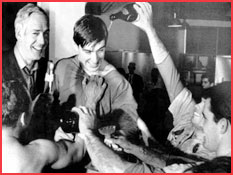
ted_simmons17Simmons, the switch-hitting catcher, made his major-league debut with the Cardinals in September 1968.

After an outstanding season at Class A Modesto of the California League, Simmons was promoted to the Cardinals on Sept. 6, 1968.

A year earlier, the Cardinals selected Simmons in the first round of the amateur draft. Simmons signed for $50,000, played 53 games in the low minors and enrolled at the University of Michigan as a physical education and speech major, beginning classes in the fall of 1967.

In 1968, Simmons was assigned to Modesto, whose manager was Joe Cunningham, a former Cardinals first baseman. In 136 games for Modesto, Simmons had 163 hits, including 30 doubles and 28 home runs, and batted .331 with 117 RBI.

In his Hall of Fame induction speech, Simmons said, “Joe Cunningham, my manager at the A level, was the first major-league hitter to tell me that I would become one myself. I believed him because he had been one himself.”

Simmons was named winner of both the California League’s Most Valuable Player and Rookie of the Year awards.

Exceeding expectations

In the book “The Ted Simmons Story,” author Jim Brosnan, the former Cardinals pitcher, wrote, “Ted had set some goals for that (1968) season … He had outlined those goals to his girlfriend, an art major.”

Simmons’ goals were to hit 20 home runs with 80 RBI and bat .300 for Modesto.

“Simmons’ girl drew up a fancy chart to remind him of what he was trying to achieve and how well he was doing game by game,” Brosnan wrote. “Simmons hung the chart on the wall of his Modesto apartment, kept it up to date each night and eventually exceeded even his best expectation.”

When Simmons was called up to St. Louis, the Cardinals announced he would be with the club only on weekends because he was attending classes at the University of Michigan during the week.

Nine days after his promotion to the big leagues, Simmons, 19, was in the Cardinals’ clubhouse, participating in a wild pennant-clinching celebration at Houston on Sunday, Sept. 15. Simmons, who still hadn’t appeared in a game, and broadcasters Harry Caray and Jack Buck were among those who had their shirts ripped open in the rowdy fun, The Sporting News reported.

“Mike Shannon was telling me how great it was going to be to have a day off in San Francisco so the team could (continue to) celebrate,” Simmons recalled to Cardinals Magazine. “I told him I wasn’t going because I had class the next day. He said, ‘You’re crazy.’ I said, ‘That may be, but that’s what I’m going to do.’ ”

Back to school

When the party ended, Simmons returned to Ann Arbor, Mich., arriving at midnight, and the Cardinals continued their road trip to San Francisco.

In a 1978 interview with Sport magazine, Simmons recalled the atmosphere on the University of Michigan campus, with calls for social change and an end to the war in Vietnam.

“My first reaction was, ‘Don’t bother me with that stuff. I just want to play ball.’ But quickly I looked around and realized what was going on,” Simmons said. “All of a sudden, a new world opened up to me. It was then that I started to develop as a human being and as someone who tried to function in this world rather than someone who just tried to hit the slider.”

Simmons told Cardinals Magazine, “Walking across campus, you would see every kind of protest there was. Civil rights were just going crazy, and you were seeing this everywhere. It forced you to open your eyes and start thinking about what’s happening around you.”

Simmons rejoined the Cardinals in time for their Saturday, Sept. 21, game at Dodger Stadium. Cardinals manager Red Schoendienst put the rookie in the lineup that day as the starting catcher, batting seventh.

In his first big-league at-bat, facing left-hander Claude Osteen, Simmons struck out in the second inning.

He singled to right in the fifth for his first hit. The Dodgers’ first baseman was Ken Boyer, the former Cardinals third baseman. Simmons told Stan McNeal of Cardinals Gameday Magazine, “When I got to first, he turned to me and asked, ‘That your first hit, rookie?’ I said, ‘Yeah.’ He said, ‘I hope it’s the first of 2,500.’ ”

(Simmons would achieve 2,472 hits in his major-league career.)

In his final plate appearance of his debut game, Simmons walked in the eighth.

Catching Larry Jaster and Wayne Granger, Simmons had three putouts and an assist. The Dodgers, who had 11 hits and two walks in a 3-0 victory, didn’t attempt a steal. Boxscore

Simmons played in one more game for the 1968 Cardinals. In their season finale, on Sunday, Sept. 29, at St. Louis, Simmons replaced Tim McCarver in the eighth inning of a rout of the Astros. He grounded out to third in his only at-bat.

After the season, when the Cardinals players met to determine how to dispense with their bonus money for reaching the World Series, Simmons was awarded a share: $250.

Twenty-eight years later, in 1996, Simmons earned his degree from the University of Michigan. He said he wears his graduation ring to honor the achievement and to honor his late mother, Bonnie.

“I was the only one of four children to get a college education because we couldn’t afford for the others to go,” Simmons told Cardinals Gameday Magazine. “It was big for me, but bigger than life for my mom.”
 

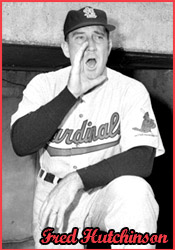
Ignoring the recommendation of general manager Bing Devine, Cardinals owner Gussie Busch ordered the firing of manager Fred Hutchinson.

fred_hutchinsonAt the press conference on Sept. 17, 1958, a distraught Devine spoke so glowingly about Hutchinson that the reporters there said it seemed like the manager was being hired, not fired.

Hutchinson had managed the 1957 Cardinals to an 87-67 record and second-place finish in the National League. Based on that performance, Busch was expecting the Cardinals to contend for a pennant in 1958.

However, the 1958 Cardinals lost 14 of their first 17 games. Lacking both power and run production, the Cardinals entered September in the second division of the eight-team league.

Busch wanted a change. Devine, in his first season as St. Louis general manager, wanted to keep Hutchinson and shake up the coaching staff instead.

Dick Meyer, an aide to Busch, called Devine and instructed him to prepare a report on his recommendations for the team. Devine was given a date and time to meet with Busch and Meyer and present the report.

Done deal

In his book “The Memoirs of Bing Devine,” Devine told writer Tom Wheatley, “So I wrote my report and I spent a lot of time on it … When we had our meeting, I handed the report to Mr. Busch. It featured rehiring Fred Hutchinson.

“Mr. Busch took the report and put it on his desk. He didn’t read it. He didn’t even open it.”

Instead, Busch told Devine, “We’re going to get rid of Fred Hutchinson. And you don’t need to think about replacing him because I already have the manager: Solly Hemus.”

Said Devine: “I was kind of hurt by the whole process of firing Hutchinson and hiring Hemus … I had made what I thought was a thorough report and the determination was made for me without my views being considered.”

On Sept. 13, Devine informed Hutchinson he would be fired during the last week of the season. When word leaked and reports appeared in the press, the Cardinals moved up the date of the dismissal, calling the press conference for Sept. 17.

Hearts and flowers

The Associated Press described Devine as “grim-faced” as he announced Hutchinson and his coaching staff were fired. (Coach Stan Hack agreed to remain as interim manager for the final 10 games.) Hutchinson, who attended the press conference, “appeared in good spirits,” the Associated Press reported.

Devine told The Sporting News, “We have no direct criticism and this is most difficult when it’s a man like Hutch, who gave us full effort, was most cooperative and 100 percent in giving young players a chance.”

According to United Press International, “It appeared clear Hutch was the victim of baseball’s strange logic: If the bus breaks down, fire the driver.”

The Cardinals, who were 69-75 when Hutchinson was fired, finished 72-82 and tied for fifth. They were last in the National League in runs (619), RBI (570) and home runs (111) and committed 151 errors, second-most in the league.

“It’s apparent the club has to score more than it did this year,” Hutchinson said. “It’s a good 50 runs behind the second-poorest offensive club in the league. Both the pitching and defense have to be steadier, too.”

Hutchinson was 232-220 in three years (1956-58) as Cardinals manager. Three years after his firing, he managed the Reds to the 1961 pennant. Hemus, a former Cardinals infielder, went 190-192 as St. Louis manager before he was fired in July 1961 and replaced by one of his coaches, Johnny Keane.

Utilizing a wicked curveball that Willie Mays admired but couldn’t hit, Ray Washburn capped a sensational summer of 1968 by pitching the Cardinals’ first no-hitter in 27 years.

ray_washburn2The gem was achieved less than 24 hours after the Cardinals had been held hitless by the Giants’ Gaylord Perry.

Perry and Washburn became the first big-league pitchers to toss no-hitters in consecutive games.

Perry walked two and struck out nine, including ex-teammate Orlando Cepeda twice, in outdueling Bob Gibson in the Giants’ 1-0 victory over the Cardinals before 9.546 on Tuesday night, Sept. 17, 1968, at Candlestick Park in San Francisco. Boxscore

On Wednesday afternoon, Sept. 18, 1968, Washburn walked five and struck out eight, including Mays twice, in the Cardinals’ 2-0 victory before 4,703 at Candlestick. Boxscore

“I never saw a guy throw a curve much better,” Mays said to United Press International. “It floated up there, but you couldn’t hit it.”

Washburn threw 138 pitches: 89 fastballs, 42 curves and seven sliders, The Sporting News reported.

“His curve was the big thing for him,” said Cardinals pitching coach Billy Muffett to the Associated Press. “It kept the hitters off balance.”

Said Cardinals catcher Johnny Edwards: “The curve turned him into a great pitcher. He got away from depending too much on his hard slider.”

Giants grounded

The Associated Press described Washburn’s curve as “deadly” to a lineup of sluggers that included Mays, Willie McCovey, Bobby Bonds and Jim Ray Hart. Washburn was effectively wild with a sinking fastball that set up his curve.

“I had control of my breaking pitches when I was behind the batters,” Washburn said. “My slow curve was working. If you have good motion and can keep it away from the hitters, it’s a very effective pitch.

“The curve helps me keep the batters off stride and has them hitting the ball off the end of the bat and into the ground.”

The Giants hit two balls out of the infield.

The no-hitter was Washburn’s first as a professional. He said he had pitched one in high school. It was the first no-hitter by a Cardinals pitcher since Lon Warneke did it against the Reds in 1941. Boxscore

“I’ve been with the Cards 23 years and never saw a no-hitter before,” said St. Louis manager Red Schoendienst.

Back from the brink

Perry went into the Cardinals’ clubhouse to congratulate Washburn. Until Perry and Washburn, only one no-hitter had been pitched in San Francisco since the Giants moved there from New York after the 1957 season. That was tossed by the Giants’ Juan Marichal against the Colt .45s in 1963. Boxscore

Before his no-hitter, Washburn had lost his previous two starts, including a 5-1 decision versus Perry and the Giants on Sept. 7 at St. Louis. Washburn won seven consecutive decisions from June 16 to July 29.

In 1963, Washburn tore a muscle in his right shoulder. Some thought he never could recover to pitch like he did for St. Louis five years later.

“He was almost finished,” Schoendienst said.

Cardinals trainer Bob Bauman called the injury “one of the worst muscle tears ever. The way it looked, we thought he’d never come around.”

Said Washburn: “They never gave up on me and I never gave up on myself.”

Washburn finished the 1968 season with a 14-8 record and 2.26 ERA.