Feeds:
Posts
Comments

(Updated on Sept. 12, 2018)

Helped by three newcomers, dubbed the Polish Falcons, the 1953 Cardinals led the major leagues in doubles with 281.

Eight members of the 1953 Cardinals each produced 20 or more doubles: Stan Musial (53), Red Schoendienst (35), Enos Slaughter (34), Solly Hemus (32), Rip Repulski (25), Steve Bilko (23), Ray Jablonski (23) and Del Rice (22).
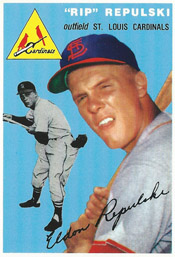
rip_repulski2Bilko, Jablonski and Repulski, all everyday starters for the first time in the big leagues, were called the Polish Falcons because of their Polish-American heritage. (Musial, in the majors since 1941, also was Polish-American.)

Eddie Stanky, manager of the 1953 Cardinals, played the trio in nearly every spring training game and they earned his trust. All three opened the season as starters _ Bilko at first base, Jablonski at third and Repulski in center.

(Stanky also was of Polish descent. He was born Edward Raymond Stankiewicz in Philadelphia.)

Bilko, 24, had appeared in 57 games for St. Louis from 1949-52, but never put in a full season with the Cardinals. Jablonski, 26, and Repulski, 24, both were making their big-league debuts with the 1953 Cardinals. All three had played together in 1952 for Rochester, a Cardinals farm team.

“During the training season, The Brat (Stanky) concentrated on the three Poles from Rochester, playing them daily, and they convinced him the Cardinals would field their strongest right-handed power since, first, Walker Cooper, and then George Kurowski left the Redbird batting order, seven and five years ago, respectively,” The Sporting News reported.

Said Stanky: “A lot of those left-handers who throw lollipops are going to find us an altogether different ballclub.”

In May, The Sporting News followed up with a glowing report on the Cardinals’ hitting: “The pickup in power had been a result largely of the presence of the three Polish Falcons, the newcomers from Rochester … They were hitting just about as had been hoped for.”

Polish power

Bilko, 6 feet 1 and at least 230 pounds, struck out a league-high 125 times in 1953, but he also punished pitchers with his power. On May 28, Bilko struck out five times in a game against the Reds. Boxscore The next day, against the Braves, Bilko doubled twice in the same inning _ one each against Vern Bickford and Ernie Johnson. Boxscore

In July, The Sporting News reported, “Although Repulski had been rested eight days after a slump and though Jablonski could look horrible in the field now and then and Bilko helpless against an occasional pitcher, the Falcons passed the first third of the season in fine style.”

The Falcons, all married with children, were friends as well as teammates. “On the road, they take in movies together (and) eat as a unit,” The Sporting News noted.

As the season wound down, the debut of the Polish Falcons was declared a success. “They’re better hitters than I thought they were and they’ll be even better next year with this season’s experience,” Musial said.

In a Sporting News story headlined “Cards Hit Jackpot with Polish Falcon trio,” Stanky said, “They have not only done as well as expected, but better.”

The final 1953 hitting statistics for the Falcons:

_ Bilko: 21 home runs, 84 RBI, .251 batting average.

_ Jablonski: 21 home runs, 112 RBI, .268 batting average.

_ Repulski: 15 home runs, 66 RBI, .275 batting average.

In voting for the National League Rookie of the Year Award, Jablonski placed third and Repulski tied with Braves outfielder Bill Bruton for fourth. The winner was Dodgers infielder Jim Gilliam, with Cardinals pitcher Harvey Haddix the runner-up.
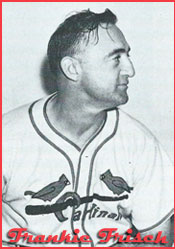
In September 1938, the relationship between Cardinals manager Frankie Frisch and executive Branch Rickey had become irreparable.

frankie_frisch2Cardinals owner Sam Breadon liked and respected Frisch, but he determined he couldn’t afford to lose Rickey.

On Sept. 11, 1938, Breadon reluctantly fired Frisch.

Frisch had been a Hall of Fame-caliber second baseman for the Cardinals and was Breadon’s favorite player. In 1933, Frisch became the Cardinals’ player-manager, replacing Gabby Street, and led them to a World Series championship the following year. The Cardinals contended in 1935 and 1936, finishing second in the National League both years.

Aggressive and feisty, Frisch managed the Cardinals’ rough-and-tumble Gashouse Gang clubs that featured colorful characters such as Dizzy Dean, Pepper Martin, Joe Medwick, Rip Collins and Leo Durocher.

Frisch was Breadon’s guy more than he was Rickey’s and he and Rickey clashed. Rickey, for instance, wanted Frisch to move center fielder Terry Moore to third base.

At a Chamber of Commerce luncheon at St. Louis in April 1938, Rickey put the heat on Frisch, telling the audience, “Except for pitching, this is the greatest ballclub the Cardinals ever had.”

Instead, the Cardinals were in sixth place in September 1938 and speculation grew Frisch wouldn’t be brought back in 1939.

Don Gutteridge, third baseman for the 1938 Cardinals, told author Peter Golenbock for the book “The Spirit of St. Louis” that “during the latter part of the season all of us were thinking Frankie might get fired …My guess is that Frisch wanted to play certain players and Rickey wanted him to play somebody else.”

Showdown with Breadon

After Labor Day, Frisch went to Breadon, seeking to learn whether he had the owner’s support. “I have the greatest admiration for the old man (Breadon),” Frisch told The Sporting News. “He’s been swell to me right along and we never had a cross word, but I had heard reports a new manager was to be brought in for 1939 and on Sept. 9 I decided to find out where I stood.

“I told the old man that if he was planning a change I would like to be free now so that I could get lined up with some other club. Breadon said he would give me his answer Sunday (Sept. 11). You know the rest.”

According to multiple published reports, Breadon told Frisch he would have to accept a pay cut if he wanted to return in 1939. When Frisch and Breadon were unable to agree on salary terms, Breadon told Frisch before the Pirates-Cardinals game at Sportsman’s Park on Sept. 11 that the manager would be replaced.

In a Page 1 article headlined “Sam Breadon Fires Frisch to Keep Peace With Rickey,” The Sporting News reported that Clarence “Pants” Rowland, a representative of Cubs owner P.K. Wrigley, had met three times with Rickey. Rowland, acting on instructions from Wrigley, offered Rickey either the job of president or general manager of the Cubs, The Sporting News surmised.

Breadon figured it was easier to replace a manager than it was to find a substitute for Rickey, but he didn’t like making the move.

As Frisch prepared to leave the ballpark after his termination, Breadon “put his arms around Frankie, bade him goodbye and there was mist in his eyes when he turned quickly and hustled out of the room,” The Sporting News reported.

“A good manager”

“I do not blame (Frisch) for the position of the club this year,” Breadon told The Sporting News. “He has not done anything we can find fault with and he has been a good manager.”

(In six seasons as Cardinals manager, Frisch had a record of 458-354, a .564 winning percentage.)

Rickey remained in the background and didn’t talk with reporters about Frisch’s departure. Frisch declined to discuss his strained relationship with Rickey.

“I leave St. Louis with the best of feeling toward the club officials, players and fans,” Frisch said. “… You know how it is _ a manager’s welcome often wears out with the front office.”

Wrote Jack Cuddy of The Pittsburgh Press: “When (Frisch) received his walking papers from president Sam Breadon and marched into the dressing room during Sunday’s game at St. Louis, the Gashouse Gang died a sudden death. His dismissal meant the final triumph of Branch Rickey in a long-standing feud. Rickey … always has been opposed to the hell-for-leather philosophies of the Gas House Gang on or off the field.”

Mike Gonzalez, the Cardinals’ Cuban-born coach, took over as manager for the rest of the 1938 season. Rickey selected Ray Blades, manager of the Cardinals’ Rochester farm club, to manage St. Louis in 1939.

Frisch was part of the Braves’ radio broadcast team in 1939 and became manager of the Pirates in 1940.

Previously: Why Cardinals dealt Dizzy Dean to Cubs 75 years ago

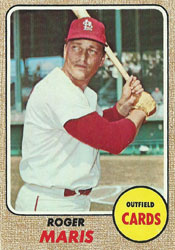
In 1968, seven years after he broke Babe Ruth’s single-season home run record, Roger Maris hit the last homer of his career. He did it as a Cardinal on the afternoon St. Louis clinched its second consecutive National League pennant.

roger_maris2By then, Maris no longer was the slugger who had hit 61 home runs for the 1961 Yankees. Injury-plagued, he was tired of baseball and instead was looking forward to running an Anheuser-Busch distributorship in Florida.

Maris, 34, also was hampered by a right hand weakened by playing most of the 1965 season with a broken hamate bone. Without hand strength, Maris lacked a consistent power stroke, especially on fastballs. His home run production steadily decreased, dropping from 13 in 1966 to nine in 1967.

When Maris homered off a Don Wilson off-speed pitch on Sept. 15, 1968, at the Astrodome, it brought his season total to five. It was Maris’ first home run since July and the last of 275 over 12 big-league seasons. Boxscore

All five of the right fielder’s 1968 home runs were hit on the road. Three came against the Niekro brothers, Joe of the Cubs and Phil of the Braves.

Last hurrah

After Maris hit a two-run, third-inning homer off Phil Niekro on June 10, 1968, he removed himself from the game because of a bruised heel. After the all-star break, Maris improved and hit .359 (14-for-39) in July. On Aug. 5, Maris announced he would retire after the season.

A month later, when the Cardinals played the Mets for the last time that season in New York, where Maris had spent seven tumultuous years with the Yankees, the Shea Stadium scoreboard flashed this message in the third inning:

“To Roger Maris, making his last New York appearance as an active player today, we express our appreciation of an outstanding career and wish you and yours the best.”

Maris, who sat out that game, took quiet delight in hitting a double and two singles the previous night against the Mets in his New York finale. Boxscore

In the first two games of the Cardinals-Astros series at Houston Sept. 13-15, Maris went hitless in nine at-bats. After he popped out to the catcher in the Sept. 14 game, Maris “banged his bat hard against the roof of the dugout,” The Sporting News reported.

In his first at-bat against Wilson on Sept. 15, Maris struck out, extending his hitless skid to 10 in the series.

When he came up against Wilson in the third, with Curt Flood on first and one out, Maris launched a two-run home run, lifting the Cardinals to a 3-2 lead and sparking them to a 7-4 pennant-clinching victory. His last home run also was the only one he hit at the Astrodome.

Comfortable as Cardinal

On Sept. 29, the Cardinals honored Maris in ceremonies before the final game of the regular season at St. Louis’ Busch Stadium II.

After receiving a standing ovation from the crowd of 23,792, Maris said, “I want to thank the Cardinals for two of my most enjoyable years in baseball and I want to thank all the fans for accepting me the way they did.”

Maris, acquired by the Cardinals in a December 1966 trade with the Yankees, hit 14 home runs in his two seasons with St. Louis. Here is a look at those:

1967

1. May 9, solo HR vs. Woodie Fryman, at Pittsburgh.

2. May 21, solo HR vs. Don Cardwell, at New York.

3. June 10, 3-run HR vs. Dodgers’ Bob Miller, at St. Louis.

4. June 11, solo HR vs. Dodgers’ Ron Perranoski, at St. Louis.

5. June 23, solo HR vs. Phillies’ Rick Wise, at St. Louis.

6. July 16, solo HR vs. Mets’ Dick Selma, at St. Louis.

7. July 18, solo HR vs. Jim Maloney, at Cincinnati.

8. July 29, solo HR vs. Cecil Upshaw, at Atlanta.

9. Sept. 7, 2-run HR vs. Cal Koonce, at New York.

NOTE: Maris hit a solo homer off Jim Lonborg of the Red Sox in Game 5 of the 1967 World Series.

1968

1. April 14, 3-run HR vs. Joe Niekro, at Chicago.

2. April 14, solo HR vs. Joe Niekro, at Chicago.

3. June 10, 2-run HR vs. Phil Niekro, at Atlanta.

4. July 26, 2-run HR vs. Steve Blass, at Pittsburgh.

5. Sept. 15, 2-run HR vs. Don Wilson, at Houston.

Previously: Slider was key to 15 wins in a row for Bob Gibson in 1968

(Updated Sept. 13, 2025)

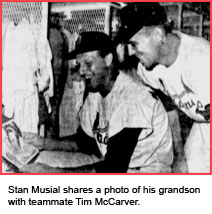
On the first swing of his first at-bat as a grandfather, Stan Musial had fans and teammates shouting, “Oh, baby!”

A few hours after his first grandchild was born, Musial, 42, hit the first pitch he saw from Cubs starter Glen Hobbie for a two-run home run atop the pavilion roof in right field at Busch Stadium in St. Louis.

stan_musial_mccarverSharon Musial, wife of Stan’s son, Dick, gave birth to a son, Jeffrey, on Sept. 10, 1963, at Fort Riley Kan., where Dick, 23, was stationed as an Army lieutenant.

Musial and his wife, Lil, had waited until 1:30 a.m. on Sept. 10 before heading to bed. In his book “Stan Musial: The Man’s Own Story,” Musial said, “Lil and I awakened with a start at exactly the same time _ 4:40 a.m. _ and got up, troubled. As she brewed coffee, I paced the floor. Suddenly, the phone rang. Son Dick was calling from Fort Riley, Kan. Sharon had given birth to a boy. When? Just two minutes after Lil and I woke up.”

In a story headlined “Grandpa Musial Shuffles to Plate _ Celebrates by Swatting Homer,” The Sporting News reported, “The Man took a nap later in the morning so he could be better rested for the night game coming up.”

When he arrived at the ballpark, Musial said, he handed out cigars in the clubhouse. The Cardinals were honoring former St. Louis-area major leaguers that night and the old-timers gave Musial a ribbing.

“Hey, Gramp, you belong with us,” retired outfielders Joe Medwick and Terry Moore said to Musial.

With a laugh, Musial replied, “Next year.”

Musial, batting third and playing left field, came up in the first inning with Dick Groat on first and one out. He hit Hobbie’s first pitch for his 11th home run of the season and 474th of his 22-year big-league career. The homer came fewer than 16 hours after the grandchild was born.

“The remarkable Stan Musial set another major league record: Most home runs by a new grandfather, 1,” the Associated Press reported.

Said Musial: “That one was for Jeffrey Stanton Musial.”

In the book “Few and Chosen,” Cardinals catcher Tim McCarver said Musial “probably was the greatest low-ball hitter ever. Even in his 40s, there was no more devastating a low-ball hitter than Stan. Throw him a pitch down in the strike zone, even below the zone, and he would leave his feet.”

Musial’s home run overshadowed the performance that night of Bob Gibson, who hit a three-run homer off Hobbie and pitched a shutout in the Cardinals’ 8-0 victory, their 13th win in 14 games. Boxscore

Gibson and Musial were two of six future Hall of Fame members who played in the game. The Cubs started the other four: right fielder Lou Brock, left fielder Billy Williams, third baseman Ron Santo and first baseman Ernie Banks.


Tony La Russa brought out the evil twin in Dusty Baker.

dusty_baker2On Sept. 3, 2003, the Cardinals and Cubs played the fourth game of an intense five-game series at Chicago’s Wrigley Field. La Russa, the Cardinals’ manager, and Baker, the Cubs’ manager, engaged in a shouting match that added a memorable but ugly chapter to the rivalry between the franchises.

In the second inning, Cubs starter Matt Clement hit Cardinals pitcher Dan Haren with a pitch. An inning later, Haren hit Clement. That prompted the theatrics from the managers.

Baker rushed onto the field, confronted the umpires, then pointed angrily at the visitors’ dugout, where La Russa stood, glaring.

“Even back in the dugout, Baker kept pointing and yelling as La Russa smirked,” wrote Chicago Sun-Times columnist Jay Mariotti.

“Baker hollered, ‘I’ll (mess) you up,’ at La Russa,” wrote St. Louis Post-Dispatch columnist Bernie Miklasz.

“TV cameras caught Baker telling La Russa he’d gladly take him on any time and La Russa telling him to bring it on,” reported Mike Kiley of the Sun-Times.

“The two managers yelled at each other from across the field,” wrote Joe Strauss of the Post-Dispatch. “Baker at one point flipped an obscene gesture at La Russa.”

Wrote Miklasz: “A rumpus with an opposing manager makes La Russa’s blood surge and raises his competitiveness to maximum-testosterone level.” Video

Cardinals fold after feud

The teams hardly needed motivation. The day before, they split a gritty doubleheader. The Cubs won the opener in 15 innings. The Cardinals won the second game, 2-0, behind Matt Morris. Cubs pitcher Kerry Wood twice knocked down Morris with pitches and dusted him with a third, prompting La Russa to say Wood “likes to scare people. I’ve heard he likes to hit people.”

Baker and Wood objected to La Russa’s remarks.

After the La Russa-Baker macho match that followed Haren and Clement being hit by pitches, the intensity was raised to a fever pitch.

The Cardinals, who entered the Sept, 3 game in first place in the National League Central, a half-game ahead of the Astros and 1.5 games ahead of the Cubs, led, 6-0, in the sixth, but the Cubs scored three in the sixth, three in the seventh and two in the eighth and won, 8-7. Boxscore

Wrote Miklasz: “La Russa was nearly inconsolable.”

Said La Russa: “As far as bad losses go, it’s tied for first with any that I can remember. There’s been some savage losses, but this is right there with the worst of them.”

A defiant Baker told the Post-Dispatch: “Nobody intimidates me but my dad and Bob Gibson and a bully I had in elementary school. And I grew bigger than him, so he couldn’t bully me.”

Mariotti suggested the Cubs change their logo because “a cuddly little cub doesn’t fit the image any more when Dusty Baker is threatening to kick Tony La Russa’s butt.”

Beware the Gemini

The next day, La Russa and Baker met on the field before the game and had what was described by Strauss as “a decidedly serious conversation” for about five minutes.

Said La Russa to the Post-Dispatch: “I explained to him that the Cardinals and my players come first with me and I recognized that the Cubs and his players come first with him. If we both have that understanding, I think it’s easy for us to maintain a respect and friendship with each other.”

Baker, in comments to both the Sun-Times and Post-Dispatch, revealed there is a bad Dusty that tries to overtake the good one.

“I’m not proud of myself when I display that kind of action because I don’t really like that person when he comes out,” Baker said. “And he rarely comes out unless he’s provoked to come out.

“I’m a Gemini and I’ve definitely got an evil twin. I don’t like that twin. That’s the mean side. He’s got to run his course, then go back in there for a while. Everybody has a side they don’t like. I can get even hotter.”

Previously: Dusty Baker ended playing career with Tony La Russa at helm

Bob Forsch might have spent his entire playing career with the Cardinals if management had given him the opportunity. Instead, informed he wasn’t wanted, Forsch took the chance to extend his career with the Astros.

bob_forsch6On Aug. 31, 1988, the Cardinals traded Forsch to the Astros for utility player Denny Walling.

Forsch was 9-4 with a 3.73 ERA for the 1988 Cardinals. A fan favorite, he ranked second among all Cardinals pitchers in career games started (401) and third in career wins (163).

In his book “Tales from the Cardinals Dugout,” Forsch said general manager Dal Maxvill called him while the team was in Atlanta and said he planned to trade him to the Astros.

Under baseball rules, Forsch, 38, could have blocked a trade because he was a player with five years of service with one team and 10 years in the majors.

The second-place Astros, chasing the Dodgers in the National League West, were pressing for a decision before midnight on Aug. 31, the last date a player could be acquired and still be eligible for the postseason.

Encouraging him to accept the trade, Maxvill told Forsch he wasn’t in the Cardinals’ plans for 1989. Forsch said he wasn’t ready to quit. When the Astros sweetened the deal by guaranteeing Forsch a contract for 1989, he agreed to the trade.

Maxvill played hardball

“It was better than what I was offered here,” Forsch said to Rick Hummel of the St. Louis Post-Dispatch. “Maxvill made it pretty clear that I wouldn’t have a job here.

“I would have liked to have pitched here some more, but it didn’t look like it was going to work out … Maybe the decision would be easier if I felt they wanted me here.”

In his book, Forsch said manager Whitey Herzog told him he would have a chance to earn a spot with the Cardinals in 1989.

“(But) Dal told me, ‘Well, if you stay here (and reject the trade) you’re not going to pitch again,’ ” Forsch said. “When I heard that, I was a little shocked, to say the least.”

Maxvill said Forsch would be offered a job in the Cardinals organization if he didn’t pitch in 1989.

“Forschie has been great for the Cardinals for a lot of years,” Maxvill said. “He was a great teacher and a great person. We’re sorry to lose him, but I was happy to accommodate him and hopefully he’ll pitch next year.”

Tributes from teammates

A consistent winner and classy competitor, Forsch pitched two no-hitters and appeared in three World Series for the Cardinals. The right-hander produced 10 double-digit win seasons and was 163-127 in 15 years (1974-88) with the Cardinals.

Kevin Horrigan, sports editor of the Post-Dispatch, suggested the Cardinals should retire Forsch’s uniform number 31, but they didn’t. Shortstop Ozzie Smith called Forsch “the consummate professional.” Center fielder Willie McGee said Forsch is “a great person, a great leader and one of the best competitors I have ever played with in any place and at any level.”

Forsch said having former Cardinals coach Hal Lanier as Astros manager “made a lot of difference” in his decision to accept the trade. “I knew Hal real well and really liked him,” Forsch said.

Also, Ken Forsch, Bob’s older brother, pitched for the Astros from 1970-80.

Two days after Bob was dealt to the Astros, the Cardinals were in Houston to begin a three-game series.

When Cardinals broadcaster Jack Buck entered the Astros clubhouse, Forsch asked, “How do I look in blue?”

Replied Buck: “Like your brother.”

Previously: Forsch vs. Forsch: Bob had edge in brotherly matchup