Feeds:
Posts
Comments

Only one teenager has struck out 10 or more Cardinals in a game. Gary Nolan, a Reds rookie, was 19 when he struck out 12 Cardinals in seven innings on July 19, 1967, at Cincinnati.

gary_nolan“Every major-league club probably has a kid in the minors with as much ability as Nolan has, but what the other kids don’t have is Nolan’s makeup _ heart _ or whatever you want to call it,” Phillies manager Gene Mauch told The Sporting News.

Nolan had an 8-2 record and 2.29 ERA entering his start against the Cardinals.

Through seven innings, Nolan held the Cardinals scoreless and limited them to four singles, walking none.

His 12 strikeouts came in the first six innings. Five Cardinals _ Roger Maris, Tim McCarver, Mike Shannon, Dal Maxvill and Larry Jaster _ each struck out twice. Lou Brock and Orlando Cepeda struck out once apiece.

The Reds led, 2-0, as Maxvill opened the Cardinals’ eighth against Nolan. Maxvill, who entered the game with a .210 batting average, doubled to right. According to the Associated Press, Nolan told Reds manager Dave Bristol the bicep in his right arm had tightened.

“The pitch Maxvill hit was up and you could tell Gary didn’t have much on it,” Bristol said.

Bristol lifted Nolan, citing the arm problem, and the umpires allowed reliever Ted Abernathy to take as many warmup pitches as he needed. (Cardinals manager Red Schoendienst told the Associated Press he wasn’t convinced Nolan’s arm had tightened and implied the Reds had used the injury as an excuse to give Abernathy extra time to loosen.)

“I just didn’t want to take any chances,” Bristol said. “It was a muscle in his arm and he was tired.”

Said Nolan: “I wasn’t tired, but my arm tightened up.”

Nolan’s departure benefitted the Cardinals. Alex Johnson, the first batter Abernathy faced, doubled to center, scoring Maxvill. Two outs later, Maris singled, driving in the tying run.

The Cardinals won, 3-2, in 12 innings when Gerry Arrigo walked Bobby Tolan with the bases loaded. Boxscore

The victory sparked a run of 10 wins in 13 games for the Cardinals and vaulted them 4.5 games ahead of the second-place Cubs.

Six days after facing the Cardinals, Nolan made his next start against the Braves and held them to a run in eight innings. Nolan finished the 1967 season with a 14-8 record and 2.58 ERA, striking out 206 in 226.2 innings.

Previously: Cardinals vs. Reds: rich tradition of July 4 showdowns

In 1993, when the Cardinals made their first regular-season visit to Miami, several fans of the expansion Marlins switched their allegiance to St. Louis for one game.

rene_arocha2Cardinals pitcher Rene Arocha, a Cuban defector who settled in Miami, had the support of the South Florida Cuban community when he started against the Marlins on June 23, 1993.

Arocha was a Cardinals rookie in 1993. Two years earlier, on July 10, 1991, while with the Cuban national baseball team, Arocha defected to the United States. He walked out of Miami International Airport and into a waiting car, becoming the first member of Cuban president Fidel Castro’s baseball team to defect, the Sun-Sentinel of Fort Lauderdale reported.

Miami became Arocha’s adopted hometown. The Cardinals won a lottery among major-league teams for the right to sign the Havana native.

A right-hander, Arocha was 5-2 with a 3.05 ERA as he prepared to face the Marlins. He had been on the 15-day disabled list in April after breaking a finger on his glove hand. “If he doesn’t get hurt (again), he’ll win 15,” Cardinals broadcaster Mike Shannon told the Sun-Sentinel. “If he’s lucky, he’ll win 20.”

Rick Hummel of the St. Louis Post-Dispatch wrote that Arocha’s start at Miami was “one of the major happenings of the expansion Florida Marlins’ first season.”

Said Cardinals infielder Jose Oquendo: “The Cubans think that Miami is Cuba.”

Arocha partnered with a Miami radio station and Nike to buy 500 general admission tickets, the New York Times reported. “The Cubans here want to see me pitch,” Arocha told Hummel. “They would be disappointed if I didn’t … The fans, and probably myself, want to win here more than someplace else.”

As anticipation built toward game time at Joe Robbie Stadium, so did Arocha’s anxiety and adrenalin. Cardinals manager Joe Torre and pitching coach Joe Coleman tried to calm him.

“They just told me to concentrate on the job I had to do in the game,” Arocha said. “When I got to the mound, I felt very emotional. I was trying to throw the ball harder than normal.”

Arocha yielded singles to three of the first four batters he faced. “He was pumped up,” Torre said. “He did get a little out of whack trying to throw the ball too hard a few times.”

The Marlins led, 1-0, after an inning. Arocha changed the momentum in the second in a most unexpected way. After the Cardinals scored a run to tie, they had the bases loaded with one out and Arocha at the plate. Arocha, hitless in his first 19 major-league at-bats, drilled a two-run single to center off starter Ryan Bowen, giving St. Louis a 3-1 lead.

“I couldn’t believe it when the ball went into the outfield,” Arocha said of his first big-league hit. “This means more than my first major-league win. I knew what it felt like to win, but I didn’t know what it would feel like to have a base hit.”

Arocha pitched 5.1 innings, yielding six hits and three runs, walking two and striking out two. As he departed, he received a standing ovation from the crowd of 37,936.

“That was a very warm feeling,” Arocha said. “I got a great response from the people that I know were behind me.”

Said Cardinals catcher Erik Pappas: “I was surprised how loud the crowd was. It sounded like they were more for him than they were for the Marlins.”

The Cardinals received 3.2 innings of scoreless relief from Paul Kilgus, Rob Murphy, Mike Perez and Lee Smith, winning, 4-3, and boosting Arocha’s record to 6-2. Boxscore He would finish the season 11-8.

Marlins first baseman and Cuba native Orestes Destrade said of Arocha: “He’s surprised a few of his critics who said he couldn’t pitch at the major-league level.”

Previously: First Rockies lineup had prominent Cardinals connection

(Updated June 11, 2024)

Keith Hernandez was a World Series hero, the best-fielding first baseman in the sport, the most consistent hitter in the Cardinals’ lineup, winner of a league Most Valuable Player Award and a fan favorite.

keith_hernandez2To Whitey Herzog, none of that made up for what the Cardinals manager considered an unforgivable sin _ lack of maximum effort.

In a trade that remains one of the Cardinals’ most unpopular and contentious, Hernandez was dealt to the Mets on June 15, 1983, for pitchers Neil Allen and Rick Ownbey.

The deal, which Mets catcher John Stearns called “the biggest heist since the Thomas Crown Affair,” was made, in part, because of the Cardinals’ need for pitching. Their top two starters, Joaquin Andujar and Bob Forsch, were having subpar seasons and the Cardinals also lacked a reliable replacement for departed No. 5 starter Steve Mura. “Good arms are hard to come by,” Cardinals general manager Joe McDonald said to United Press International. “If Allen was not having a bad year, there’s no way we could have gotten him.”

Herzog told the St. Louis Post-Dispatch, “We had to decide if we were going to have enough hitting if we did this. Or did we have enough pitching if we didn’t do it? We need pitching.”

The primary reason for the deal, though, was the deteriorating relationship between Herzog and Hernandez.

Do the hustle

In his book “White Rat: A Life in Baseball,” Herzog was unsparing in his criticism of Hernandez, saying:

Keith Hernandez was dogging it … He’s the best defensive first baseman I’ve ever seen. But on offense, he was loafing. He loafed down the line on ground balls and he wasn’t aggressive on the bases.

“What I couldn’t live with was his attitude. I’ve got two basic rules _ be on time and hustle _ and he was having trouble with both of them … His practice habits were atrocious. He’d come out for batting practice, then head back to the clubhouse to smoke cigarettes and do crossword puzzles … It was getting to the point where I was fed up with him.”

Herzog began clashing with Hernandez soon after taking over as Cardinals manager in June 1980. In a game at Atlanta during Herzog’s first series as manager, Hernandez didn’t run hard on a fly ball that was dropped. “Hernandez has the ability to be among the best players in the major leagues,” Herzog told The Sporting News, “but one little thing like that can make him a bad guy for a long time. When you’re out there, run hard.”

According to the Post-Dispatch, the Cardinals first offered Hernandez to the Mets after the 1980 season in exchange for Allen, second baseman Doug Flynn and pitcher Tim Leary, but the Mets declined.

Time to go

Early in the 1983 season, Hernandez came close to being dealt to the Astros. According to the Post-Dispatch, the Astros offered to swap first baseman Ray Knight and pitcher Vern Ruhle for Hernandez.

In an interview for the book “Whitey’s Boys,” Hernandez said, “I could tell a trade was coming (in 1983) because I knew I wasn’t in Whitey’s good graces.”

On June 15, 1983, Hernandez was taking batting practice at Busch Stadium when he was called into Herzog’s office. As he approached the office, Hernandez told the Post-Dispatch, “I knew I was gone.”

Herzog informed Hernandez of the trade to the Mets 20 minutes before it was announced. “It wasn’t an easy thing for him to tell me,” Hernandez said.

Hernandez called his agent to find out whether he could block the trade. “I wasn’t shocked I was traded,” Hernandez said. “I was shocked it was to the Mets.”

“I’m disappointed,” Hernandez told the Post-Dispatch. “I loved it here and the fans were great to me.”

When the deal was announced on the Busch Stadium scoreboard, fans booed.

Eight months earlier, Hernandez had produced seven hits and eight RBI in the last three games of the 1982 World Series. He sparked a Cardinals comeback in the decisive Game 7, driving in the tying run with a two-run single. He hit .299 in 10 years with St. Louis, won the 1979 National League batting title, shared the Most Valuable Player Award that year (with the Pirates’ Willie Stargell) and won five consecutive Gold Glove awards from 1978-82.

In a column about the trade, Kevin Horrigan of the Post-Dispatch wrote, “The Mets are getting a great hitter and a great first baseman, but they’re also getting a good guy, a man who has grown up a lot in the last three years.”

In exchange for Hernandez, the Cardinals got Allen (2-7, 4.50 ERA) and Ownbey (1-3, 4.67). Allen had told the Mets he thought he had an alcohol problem. Instead, he was diagnosed as suffering from stress.

“So the Cards had to enter the pitching market, which is so badly inflated it looks like it’s being run by an Argentinian junta,” Horrigan wrote in the Post-Dispatch. “Inflation touches us all. Ten grand for a Chevrolet? Outrageous. A buck for a hamburger? Absurd. Buck and a quarter for a gallon of gas? Ridiculous. A Keith Hernandez for Neil Allen and Rick Ownbey? Outrageous, absurd and ridiculous.”

Said Herzog: “If Allen falls on his butt, then we got jobbed, but everybody in the organization … were in agreement this had to be done.”

Hernandez told Cardinals Magazine, “Whitey was the best manager I ever played for. That’s not a criticism of the others. Whitey made me a better player … He just basically taught us how to win.”

Mets make out

Mets general manager Frank Cashen called the acquisition of Hernandez “the biggest deal” he had made since joining the club, the New York Daily News reported. Cashen said the Cardinals initiated the trade. “Joe McDonald told me right off we could have Hernandez if we were willing to give up Allen,” Cashen told the Daily News.

The Associated Press declared the trade “a total surprise.”

Second baseman Tommy Herr told the Post-Dispatch, “I really don’t understand why they had to trade Keith. It’s difficult taking his bat out of the lineup.”

In remarks to the Daily News, Mets pitcher Tom Seaver said, “This may be the best deal the Mets have ever made because of the overall reaction Keith’s presence will create … The one thing we have not had is a consistent third-place hitter. There are not many more consistent players in baseball than Keith.”

Herzog said to Cardinals Magazine, “He might have been the best hit-and-run man I ever managed. I thought George Brett was good when I managed him and he was very good, but Keith Hernandez never, ever swung and missed a (hit-and-run) ball. He loved to hit-and-run, and we used it an awful lot with him.”

John Stearns spoke for many when he told Frank Dolson of Knight-Ridder Newspapers, “Were they (the Cardinals) drunk when they made that deal? I just couldn’t believe it. I thought, ‘Do they know something about Hernandez that we don’t? Is there a problem somewhere?’ ”

Turns out there was more of a problem than most knew.

Drug deal

In testimony two years later in a federal court case, Hernandez said he had used “massive” amounts of cocaine, starting in 1980 after he was introduced to the drug by Cardinals teammate Bernie Carbo, and had developed an “insatiable desire for more.”

Hernandez testified he broke his cocaine habit on his own just before the trade to the Mets. Hernandez said what motivated him to stop using was seeing teammate Lonnie Smith have a “bad experience” with the drug after a game at Philadelphia.

Herzog said he didn’t know Hernandez had been using drugs, but that he had become suspicious.

Meet the Mets

Hernandez would thrive with the Mets. At the time of the trade, the Mets had the worst record in the major leagues. Hernandez helped transform them into contenders by 1984 and World Series champions in 1986.

In his book “Mookie,” Mets center fielder Mookie Wilson said of Hernandez, “One thing I didn’t envision was what kind of clubhouse presence he would bring. Even before we saw what he could do on the playing field every day, it was his mannerisms and professionalism that made him stand out. He didn’t come in with the rah-rah stuff or any glitter. Instead, it was clear that he was a student of the game and learned a lot about leadership from guys like Lou Brock and some of the other great Cardinals veterans he played with.”

Allen was 20-16 with five saves in three seasons with St. Louis. Ownbey was 1-6 in two Cardinals seasons.

Said Herzog: “People always say it’s the worst deal I’ve ever made, but I don’t believe that … Getting rid of Hernandez was addition by subtraction. I really feel that, if we had kept him, his attitude and his bull would have ruined our ball club. I know he never would have been as good for us as he has been with the Mets.”

On the surface, Lonnie Smith in 1983 was having a strong follow-up to his successful first season with the Cardinals. What most, including his manager and many of his teammates, apparently couldn’t see was that an addiction to cocaine had Smith on the verge of a breakdown.

lonnie_smith3In June 1983, Smith approached Whitey Herzog, informed the Cardinals manager he was abusing drugs and needed help. Two days later, with Herzog’s support, Smith left the Cardinals and entered a drug rehabilitation facility, the Hyland Center in St. Louis.

Smith spent a month in the treatment center, returned to the Cardinals’ lineup on July 8 and performed well the remainder of the season, nearly winning the National League batting title. Smith hit .321, two percentage points behind 1983 batting champion Bill Madlock (.323) of the Pirates.

In 1982, Smith had sparked the Cardinals to the World Series championship. The left fielder hit .307, scored 120 runs and had 68 stolen bases. Three years later, Smith testified in court that he had bought cocaine three weeks before the World Series and had used the drug with teammates Keith Hernandez and Joaquin Andujar.

Smith was hitting better than .300 in early June 1983, but his drug use was intensifying.

“I did cocaine and pot mostly and I was even starting to drink,” Smith told the Associated Press in March 1984. “That was a bad sign because my father was an alcoholic and still is. I saw what it did to him and I had stayed away from that. But avoiding alcohol left me wide open to drugs.

“I started in high school in Los Angeles … It progressively got worse. The more you do, the worse it gets.”

On June 8, 1983, Smith went 0-for-2 with a pair of walks at Philadelphia. Boxscore Years later, in an interview with Kent Babb of The State newspaper in Columbia, S.C., Smith said he bought drugs after that game.

Wrote Babb: “(Smith) holed up in his hotel room, plowed through the drugs and began a night that would chill him to the bone. Smith says he did not sleep that night; he sat on the floor, shaking and sweating as the sun rose, and was terrified he was on the edge of a fatal overdose. He did not play in the Cardinals’ game the next day, feeling nauseated in the dugout and stuffing clumps of toilet tissue into his nostrils to stop a chronic nosebleed.”

It was that day, June 9, that Smith told Herzog of his drug problem and asked for help. Babb later reported that “Smith learned he had consumed so much cocaine that he developed a large ulcer in one of his nostrils, a sign he was burning away the flesh of his nose.”

“I felt so terribly drained,” Smith said in the 1984 interview with Hal Bock of the Associated Press. “I was losing interest in everything in life.”

The Cardinals left Philadelphia that night and went to Chicago for a day game with the Cubs on June 10. While arrangements were being made to admit Smith to the rehabilitation center, Herzog put Smith in the lineup that day. Smith produced two singles against Ferguson Jenkins, who shut out the Cardinals, 7-0. Boxscore

The next day, June 11, 20 minutes before the Cardinals-Cubs game, Herzog informed reporters that Smith had left the team and begun “in-patient therapy for a drug problem.”

Herzog said he wasn’t aware of any drug problems with Smith before the player approached him in Philadelphia.

In his book “White Rat: A Life in Baseball” (1987, Harper and Row), Herzog recalled, “(Smith) came to me and asked for help. He said he’d tried, but he couldn’t stop taking coke. He had a bad, bad problem. It later developed at that (1985) drug trial in Pittsburgh that Lonnie was using coke with Hernandez and Andujar. He didn’t tell me that at the time. He only asked for help, and we got it for him. I admired him, and still do, for having the guts to ask for help.”

Dane Iorg, who platooned with David Green as the replacements for Smith, told The Sporting News that Smith’s drug use was “really shocking.” Pitcher Dave LaPoint said, “I had no idea … None of us expected it.” Catcher Darrell Porter, who underwent treatment in 1980 for drug and alcohol addiction, said, “(Smith) never came to me. I didn’t know anything about it.”

Smith’s wife, Pearl, told St. Louis Post-Dispatch reporter Rick Hummel she also was surprised. “This is the first I’d heard of it,” she said. “I’d never seen it at home.”

Said Lonnie Smith to the Associated Press: “At first you deny it. That’s the first step in realizing you’re in trouble. Addicts are the biggest con men in the world.”

In an interview for the book “Whitey’s Boys” (2002, Triumph), Smith said, “After 1982 I started getting (drugs) in the mail through the winter, and in 1983 I was involved pretty bad. I couldn’t function as a husband, a father or a player. I was rushing back to my room, locking the door and doing it. I was constantly doing it until I ran out _ and then I wanted to go out and do more.”

In his first game after rehabilitation, Smith went 2-for-4 at San Diego. Boxscore He later told the Associated Press that the first week in the treatment center was difficult.

“I was undergoing addiction withdrawal,” Smith said. “I felt terrible.

“I still get the craving for drugs. You never get over that.”

Previously: Cardinals beat Pascual Perez on way to 1982 pennant

(Updated June 9, 2020)

Tim McCarver and Terry Pendleton each hit an inside-the-park grand slam for the Cardinals against the Mets on the same date, 22 years apart.

tim_mccarver3Each occurred on June 9 in New York in the second game of a Sunday doubleheader.

McCarver hit an inside-the-park grand slam June 9, 1963, in the Cardinals’ 10-4 win over the Mets in Game 2 of a doubleheader at the Polo Grounds.

Pendleton hit an inside-the-park grand slam June 9, 1985, in the Cardinals’ 8-2 win over the Mets in Game 2 of a doubleheader at Shea Stadium.

Both occurred because of outfield misplays.

Slipping and sliding

The Cardinals led, 6-1, in the eighth inning when McCarver batted with the bases loaded, one out, against Mets rookie reliever Larry Bearnarth and laced a line drive to center.

“I was just figuring on a sacrifice fly,” McCarver told The Sporting News.

Center fielder Rod Kanehl got to the ball and, just as he appeared ready to make the catch, slipped and fell. The ball darted past him and rolled to the wall, 475 feet from home plate. McCarver raced home with his second big-league home run. It was the first grand slam he’d hit at any level of competition.

Cardinals center fielder Curt Flood empathized with Kanehl, informing the St. Louis Post-Dispatch, “The turf is loose and the grass is slippery out there. I slipped three or four times running when the ball wasn’t even hit to me.” Boxscore

Communication breakdown

Like McCarver, Pendleton was looking to extend a Cardinals lead when he came up against Mets reliever Joe Sambito with the bases loaded and one out in the fifth inning. St. Louis led, 4-0.

Pendleton hit Sambito’s first pitch to right-center. Right fielder Danny Heep and center fielder Terry Blocker gave chase.

“At first I thought, ‘Good, we’ll get a run on a sacrifice fly,’ ” Pendleton told the New York Times. “Then I looked in the outfield and saw them flying at each other, not slowing down.”

As Blocker was reaching for the ball, he and Heep collided, and the ball caromed off Blocker’s glove. “We both called for it, but I didn’t hear him until the last second,” Heep said to the New York Daily News.

“I could see it coming,” Cardinals manager Whitey Herzog said to the Associated Press. “Neither one of them knew if they could catch the ball.”

Blocker lay motionless. Heep recovered, retrieved the ball and got it to first baseman Keith Hernandez, whose relay throw was too late to nab Pendleton. Boxscore

“I thought one of them would be able to get up in time,” said Pendleton. “I thought I had a shot at a triple.”

Becker injured both knees and was carried from the field on a stretcher.

“It’s a hell of a way to get a grand slam, isn’t it?” Herzog asked.


In 1968, the Cardinals, and all major league teams, were faced with a decision of whether to play games on the day of slain Sen. Robert F. Kennedy’s burial and on the national day of mourning declared in his honor.

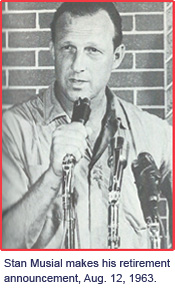
stan_rfkCardinals players said publicly they didn’t want to play on either day, but, facing the prospect of forfeiting if the Reds didn’t join them in sitting out, the Cardinals played three games in less than 24 hours over both days.

Other teams and players acted more defiantly, displaying the leadership and clarity baseball commissioner William Eckert lacked.

Kennedy, the New York senator and candidate for the 1968 Democratic presidential nomination, was shot in the predawn morning of June 5, hours after he won the California primary. He died on June 6 at age 42.

The funeral for Kennedy was scheduled for Saturday, June 8, at St. Patrick’s Cathedral in New York. Burial was planned for about 5 p.m. at Arlington National Cemetery near Washington. A train would transport Kennedy’s body from New York to Washington.

President Lyndon Johnson declared Sunday, June 9, a national day of mourning in tribute to Kennedy.

Eckert ordered no big-league game on June 8 would start until after the burial.

The Yankees, Senators and Cubs called off their afternoon home games scheduled for June 8. The Astros called off one of their doubleheader games against the Pirates and said the other game would be held after the burial.

At San Francisco, Mets players refused to play the Giants that Saturday. Mets management supported the players’ decision. The Giants front office, expecting a large crowd at Candlestick Park, was miffed, but agreed to call off the game when Mets officials refused to change their stance.

Other afternoon games, including Cardinals at Reds, were moved to night starts. The Cardinals-Reds game was rescheduled for 7 p.m.

However, when the train carrying Kennedy’s body was delayed by large crowds along the route from New York to Washington, the burial was pushed back several hours.

Cardinals and Reds players held separate pre-game meetings, took the field for warmups, and returned to the clubhouses again when they learned the burial wouldn’t be held before the 7 p.m. game time, the Associated Press reported.

Cardinals players wanted to call off the game, The Sporting News reported, but because they were the visitors they left the decision to the Reds.

Reds manager Dave Bristol urged his team to play. Pitcher Milt Pappas, the Reds’ player representative, disagreed. Pappas told Bristol most Reds players preferred not to play the game, the Associated Press reported. Bristol responded that if he could find nine players to take the field the Reds would play.

“If we go out (on the field to play), we all go out,” Pappas replied. “If we do go out, find yourself a new player representative.”

Pappas took a vote of Reds players on whether to play. The outcome was 12-12, with one abstaining, The Sporting News reported. A second vote was held and the result was 13-12 in favor of playing.

“Pappas lost a power struggle within the club when several players heeded the urgings of manager Dave Bristol to play the game,” The Sporting News reported.

Pappas, telling the Associated Press his “days with the club are numbered,” resigned as player representative.

The June 8 game began at 7:45 p.m. and the Cardinals won, 7-2, before 13,368. Boxscore

“Our position was that we had scheduled this game in good faith at a time about an hour and a half after the burial was scheduled,” Reds general manager Bob Howsam said. “We would have waited if the delay had been a short one.”

Pappas and catcher Tim McCarver, the Cardinals’ player representative, said both clubs voted not to play the doubleheader scheduled for Sunday, June 9, the national day of mourning for Kennedy.

Eckert declared that management of each home club would decide whether to play games that Sunday.

(Two months earlier, Eckert had called off all big-league spring training exhibition games on April 7, the national day of mourning for slain civil rights leader Dr. Martin Luther King Jr. Also, in respect for King’s funeral on April 9, all of the major-league regular-season openers scheduled for April 8 and April 9 were moved to April 10.)

The Orioles called off their June 9 doubleheader with the Athletics and the Red Sox called off their game with the White Sox. All other home teams, including the Reds, decided to play that Sunday.

The Reds scheduled a memorial service for Kennedy before the first game of the doubleheader. The Cardinals won the opener, 10-8, on Lou Brock’s three-run home run. Boxscore The Reds won the second game, 7-6, on shortstop Leo Cardenas’ RBI-double in the 12th off reliever Steve Carlton, the Game 1 starter. Boxscore Attendance was 28,141.

Pappas pitched in relief in both games, yielding a run in eight total innings, and was booed by fans. (Two days later, Pappas was traded to the Braves.)

At Houston that Sunday, Astros third baseman Bob Aspromonte and first baseman Rusty Staub, and Pirates third baseman Maury Wills, refused to play, protesting the decision to hold the game on the national day of mourning. All were fined by their teams.

Pirates outfielder Roberto Clemente decided to join Wills in sitting out the game, but changed his mind after a meeting with manager Larry Shepard, The Sporting News reported. “I preferred not to play,” Clemente said. “The disturbing thing to me was the indifferent attitudes of some of our players.”

Frank Mankiewicz, press secretary for Robert Kennedy, sent telegrams to Pappas, Aspromonte, Staub, Wills and Mets manager Gil Hodges (on behalf of the entire team), thanking them for the stances they took. “Please accept my personal admiration for your actions,” Mankiewicz wrote in the telegrams.

He said Kennedy’s widow, Ethel, would write personal letters to those who received telegrams, the Associated Press reported.

Wrote Bob August of the Cleveland Press, “Baseball’s observance of Senator Kennedy’s death was disorganized, illogical and thoroughly shabby.”

Under the headline, “The Aftermath _ Baseball Takes A Beating,” The Sporting News reported, “Baseball wallowed in a morass of confusion and acrimony in trying to decide what to do about paying respect to Sen. Robert F. Kennedy … For the most part, there was no concrete plan on how mourning for (Kennedy) would be handled.”

Previously: Bob Gibson put aside grief to pitch while mourning MLK