Feeds:
Posts
Comments

(Updated April 16, 2020)

Dizzy Dean was a weakened pitcher who was feuding with his manager, but when the Cardinals traded him to the Cubs on the eve of a season opener it was a surprise to nearly everyone.

dizzy_dean4On April 16, 1938, Dean was dealt to the Cubs for $185,000 and three players, pitchers Curt Davis and Clyde Shoun and outfielder Tuck Stainback.

“The deal hit like a lightning bolt from the blue, for there had not been even the slightest indication the famous and eccentric pitcher had been on the block,” the St. Louis Globe-Democrat reported.

Dean, 28, had a 134-75 record in seven Cardinals seasons, including 30-7 in 1934 when he carried them to a World Series title. Dean won twice in the 1934 World Series against the Tigers, including a six-hit shutout in the decisive Game 7.

Reasons to deal

From 1935-37, the Cardinals finished second, second and fourth. When the Cubs approached Cardinals owner Sam Breadon and executive Branch Rickey about a deal for Dean during spring training in 1938, there was interest because:

_ Damaged arm. During the 1937 All-Star Game, a ball hit by Earl Averill of the Indians struck Dean on the left foot and broke his toe. Dean pitched again too soon after the injury. Compensating for the damaged toe, he altered his pitching motion and weakened his right arm, essentially losing his devastating fastball.

In the book “Ol’ Diz: A biography of Dizzy Dean,” author Vince Staten wrote, “Rickey was convinced Diz’s career was over and he was upfront with the Cubs about Diz … The Cubs knew they were getting damaged goods.”

When informed of the trade, Giants manager Bill Terry told the Chicago Tribune, “I do not believe Branch Rickey would get rid of the pitcher Dean was two years ago. If he were still a man who could win 20 to 30 games, I think he would have stayed with the Cardinals. Rickey must know he is through as a great pitcher and has got what he can for him.”

_ Feuds with Frisch. Dean and Cardinals manager Frankie Frisch feuded often. After they had a couple of run-ins during spring training in 1938, the Cardinals decided to act.

“The pitcher and his manager … were embroiled in more than the usual amount of bickering during the training season, with the result that the Cardinals believed that Dizzy’s value to them was dubious, at best,” International News Service reported. “The situation finally reached a point where either Dean or Frisch had to go.”

Wrote The Sporting News: “Renewed trouble with manager Frankie Frisch … finally moved Sam Breadon and Branch Rickey to sell their star of stars.”

On the day of the trade, the Associated Press reported Dean saying to Frisch, “Frankie, I want you to know I’ve enjoyed playing for you.”

Replied Frisch, “Diz, I’m sorry to see you go.”

A Cardinals player, witnessing the exchange, said loud enough for others to hear, “Bunk.”

_ Bigger than team. Rickey and Breadon decided Dean was taking too much credit for team successes and focusing too much attention on self.

“Even when he’s good, one pitcher doesn’t make a club,” Rickey said.

Said Breadon: “I think the team will be a 23-player club now and not a Dizzy Dean club.”

Cubs come calling

When the Cubs first approached the Cardinals about Dean, they offered two players and $150,000, The Sporting News reported. The Cardinals countered with a demand of two players and $200,000. A compromise was reached when the Cubs added Stainback to the deal, giving the Cardinals three players, plus $185,000.

The deal was completed in a phone call between Rickey and Cubs owner P.K. Wrigley while the Cardinals were defeating the Browns, 10-7, in an exhibition game at St. Louis on April 16. The trade was announced immediately after the game, stunning Cardinals players.

“There goes our pennant and World Series money,” Pepper Martin said.

Said fellow outfielder Terry Moore: “Yeah, we’d have been a cinch with Diz.”

Dean told his teammates, “I hate to leave you guys, but I bet that fellow Wrigley will give me more money than I was getting here.”

Replied Martin: “Yeah, maybe Wrigley will buy you a yacht, too, so you can float around on Lake Michigan.”

Informed the Cardinals got a lot of money from the Cubs in the deal, Martin told the St. Louis Globe-Democrat, “You can’t play cash on the baseball field.”

Cubs manager Charlie Grimm told the Chicago Tribune the trade was “a dandy” and said, “We now have a stop pitcher and that’s something we lacked.”

Dean told the Associated Press, “The deal came as a surprise and I haven’t quite got over it yet, but I’m tickled to be playing under Grimm.”

Money ball

In his book, Staten wrote, “The trade would help both clubs in other ways. The $185,000 covered the Cards’ entire season payroll. And Diz helped the Cubs fill the seats at Wrigley Field.”

Also, Rickey had a personal incentive to trade top players for cash because his contract called for him to get a percentage of the sale as remuneration in addition to his salary.

According to the St. Louis Star-Times and St. Louis Globe-Democrat, Rickey tried to acquire fireball pitcher Van Lingle Mungo from the Dodgers after dealing Dean, but it didn’t work out. Rickey also contacted the Phillies about pitchers Claude Passeau and Bucky Walters, but came up empty there, too, the Star-Times reported.

Though sidelined for most of May, June and July, Dean was effective when he pitched in 1938. He was 7-1 with a 1.81 ERA in 13 games for the 1938 Cubs, who won the National League pennant.

The Cardinals stumbled to a sixth-place finish and Frisch was fired in September before the season ended.

Dean, however, never regained the form that made him a sensation with St. Louis. He was 9-7 over the next three seasons with Chicago.

From the very first game, Mark McGwire signaled that 1998 would be a special season for him.

mark_mcgwire3McGwire hit home runs in each of the Cardinals’ first four games of 1998, joining Willie Mays of the 1971 Giants as the only major-league players to begin a season in that manner. Since then, two others have done it: Nelson Cruz of the 2011 Rangers and Chris Davis of the 2013 Orioles, according to the Elias Sports Bureau.

The season-opening streak sparked McGwire to a record 70 home runs that year. Though tainted by subsequent revelations that McGwire used performance-enhancing drugs, the slugging feats remain official in the big-league record books.

McGwire’s home runs in the first four games of 1998 accounted for 12 RBI and lifted the Cardinals to three victories. Here is how it happened:

_ Cardinals 6, Dodgers 0, March 31, 1998, at St. Louis: Playing a regular-season game in March for the first time, the Cardinals’ opener was scoreless in the fifth inning when McGwire launched a grand slam off a floating change-up from Dodgers starter Ramon Martinez. Boxscore

The high drive carried 364 feet into the left-center stands at Busch Stadium II.

“You’re not going to see too many people hit a ball that high and have it leave the ballpark,” Dodgers left fielder Todd Hollandsworth said to the St. Louis Post-Dispatch.

Said McGwire to writer Rick Hummel: “It sort of surprised me the way it carried. I knew I hit it high enough. It was just a matter of far enough.

“I was juiced up. I don’t know my own strength. I hope I don’t hurt anybody.”

Speculation already was rampant that McGwire might challenge the single-season homer record of 61 by the Yankees’ Roger Maris. Under a headline of “McGwire’s Slam Drives Cards _ Countdown to 61 Begins,” Mike Eisenbath of the Post-Dispatch wrote in the lead paragraph of his game story, “Mark McGwire took what might be a first step toward immortality.”

_ Cardinals 8, Dodgers 5, April 2, 1998, at St. Louis: With two out in the 12th, McGwire hit a three-run walkoff home run off a curve from rookie reliever Frank Lankford. Boxscore

“You know anything is possible with him _ is that amazing?” said Cardinals manager Tony La Russa.

_ Padres 13, Cardinals 5, April 3, 1998, at St. Louis: McGwire’s two-run homer off Padres starter Mark Langston in the fifth was the highlight for St. Louis. Boxscore

_ Cardinals 8, Padres 6, April 4, 1998, at St. Louis: With the Cardinals clinging to a 3-2 lead in the sixth, McGwire provided a cushion with a three-run homer off reliever Don Wengert.

Counting the home runs he hit for St. Louis in the last two games of 1997, McGwire extended his long ball streak to six consecutive games over two seasons. Boxscore

“It’s unbelievable,” said Cardinals catcher Tom Lampkin. “(McGwire) has a chance to hit the ball out of the ballpark every time he walks up to the plate.”

McGwire’s streak ended on April 5, 1998, when he was limited to a single and a walk in five plate appearances against Padres starter Kevin Brown and reliever Trevor Hoffman. Boxscore

The Cardinals blew a 7-3 ninth-inning lead in that game and lost, 8-7. Wrote columnist Bernie Miklasz: “We have finally discovered Mark McGwire’s weakness: he can’t pitch.”

Previously: Willie McCovey and his legendary St. Louis home run

(Updated April 7, 2016)

In 1963, Cardinals starters opened the season by pitching shutouts in the team’s first three games.

curt_simmons2The 1963 Cardinals and 2016 Dodgers are the only major-league teams to start a season with three consecutive shutouts, according to the Elias Sports Bureau.

The Cardinals opened with wins of 7-0 and 4-0 over the Mets and 7-0 against the Phillies. Surprisingly, Bob Gibson didn’t pitch any of those games.

The Cardinals’ consecutive trio of shutouts were pitched by Ernie Broglio, Ray Washburn and Curt Simmons. Gibson, the Cardinals’ ace, had fractured his ankle in September 1962 and was being given extra time by manager Johnny Keane before making his first 1963 start. (Gibson’s 1963 debut came in the Cardinals’ sixth game.)

In previewing the 1963 season, The Sporting News had predicted success for the Cardinals’ rotation:

Keane does seem to have a fine front line of pitchers. (Ernie) Broglio, Bob Gibson and Ray Washburn are good enough to be named now among the National League hurlers likely to win 20 games in 1963. All have pitched brilliantly in exhibition games. Broglio is throwing with the smoothness that marked his work in 1960 and Gibson has given no indication that the fractured ankle will bother him at all. Washburn profited greatly by his two months in the winter instructional league.

Here’s how the 1963 Cardinals opened their season:

_ Cardinals 7, Mets 0, April 9, 1963, at New York: Broglio limited the Mets to two hits, both by second baseman and leadoff batter Larry Burright. Broglio retired 20 in a row from the second inning to the ninth. He walked two and struck out eight.

Burright led off the first with a single and Broglio held the Mets hitless until Burright led off the ninth with a double.

Broglio preserved the shutout by striking out catcher Choo Choo Coleman and retiring outfielders Ed Kranepool and Duke Snider on groundouts after Burright’s double. Boxscore

“We had trouble hitting, which is going to be a big problem all year,” Mets manager Casey Stengel said to the Associated Press after the game.

_ Cardinals 4, Mets 0, April 10, 1963, at New York: Washburn held the Mets to four singles (two by Kranepool and one each by Coleman and first baseman Tim Harkness) and retired 17 in a row from the second inning to the eighth. He walked one and struck out five. Boxscore

Wrote The Sporting News: Washburn’s route-going performance was especially eye-popping because he went all the way in only two of his 25 starts in his rookie campaign a year ago.

“I had good stuff and kept it all the way,” Washburn said. “I made some real good pitches on (slugger) Frank Thomas. He used to bother me quite a bit.”

Cardinals catcher Gene Oliver said Washburn’s successful outing was “mostly a matter of confidence and experience, knowing that he can throw any kind of pitch in a given situation instead of coming in with a fastball or slider most of the time.”

_ Cardinals 7, Phillies 0, April 13, 1963, at St. Louis: After a two-day break, the Cardinals won their home debut. Simmons pitched a five-hitter, walked two and struck out four. No Phillies baserunner reached third base. Boxscore

It was Simmons’ 10th win in 11 decisions against the Phillies since he signed with the Cardinals after his release by Philadelphia in May 1960.

Simmons set the tone in the first inning when Don Hoak, the Phillies’ third baseman and No. 2 batter, dropped to the ground to avoid being struck by a high and tight pitch. Hoak subsequently struck out.

“He (Simmons) has been doing that to me for years and I’ve taken all I’m going to,” Hoak said to The Sporting News. “The next time, I’m going after him.”

Unfazed, Simmons responded, “He’s not a good enough hitter to bother throwing at.”

Previously: Kyle Lohse effort is similar to Ernie Broglio classic in 1963

(Updated Jan. 13, 2025)

Lacking an “h” in his first name was one of many differences between Cris Carpenter and the successful Cardinals ace of the similar name, Chris Carpenter. Still, there was a time when Cris Carpenter was regarded as a top talent in the St. Louis system.

cris_carpenterChris Carpenter, signed as a free agent by the Cardinals in December 2002, posted a 95-44 regular-season record in nine years with St. Louis (2004-2012)

Cris Carpenter, from the University of Georgia, was a first-round pick of the Cardinals in the 1987 amateur draft. He was the 14th overall selection, ahead of No. 1 picks such as the Astros’ Craig Biggio (22nd overall), the Orioles’ Pete Harnisch (27th) and the Tigers’ Travis Fryman (30th).

“No way I thought he would last until 14th, but he did,” Cardinals scouting director Fred McAlister told Cardinals Yearbook in 1988. “He might be the best pitcher in that draft.”

Afterward, Cris Carpenter spent the summer of 1987 pitching for Team USA in the Pan American Games. He was 6-1 with five saves and a 1.37 ERA. He signed with the Cardinals in September 1987.

Cris Carpenter began his first professional season as a starter for Class AAA Louisville in 1988. After seven appearances, he was called up to the Cardinals and started against the Braves in his major-league debut on May 14, 1988. The Braves were the boyhood favorite of Cris Carpenter, who grew up in Gainesville, Ga.

“It’s hard to believe I’ll be pitching against the Braves,” Cris Carpenter said to the St. Louis Post-Dispatch. “I watched Dale Murphy on television for so many years, but to see him in person and pitch against him … It’s going to be fun.”

Cris Carpenter’s debut game turned out to be one of the most memorable in Cardinals lore. The Braves won, 7-5, in 19 innings. Infielder Jose Oquendo pitched the final four innings for St. Louis and took the loss. Carpenter yielded five runs in six innings. Murphy was 0-for-2 with a walk against Carpenter. Boxscore

In five years (1988-92) with St. Louis, Cris Carpenter was 21-15 with a 3.66 ERA, primarily as a reliever. Under manager Joe Torre, Carpenter was 10-4 with a 4.23 ERA in 59 relief appearances in 1991 and 5-4 with a 2.97 ERA in 73 relief appearances in 1992.

The Cardinals made Cris Carpenter available in the National League expansion draft in November 1992 and he was selected by the Marlins. “He lost his confidence and tried to guide the ball,” Torre said. “When he gets into that mode of trying to guide the ball, he gets burned.”


(Updated Jan. 22, 2022)

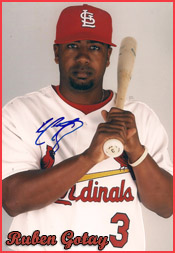
During spring training in 2010, Ruben Gotay was considered a candidate to earn an Opening Day roster spot with the Cardinals as a utility player. Instead, he spent the season in the minors.

ruben_gotayThree years later, Gotay was back in Cardinals spring training camp as a surprise fill-in at the minor-league level.

On March 27, 2013, during the last week of spring training camp at Jupiter, Fla., Gotay signed with the Cardinals and reported to Springfield to become the starting third baseman for the Class AA Texas League club.

The signing was a stunner because Gotay, 30, hadn’t received interest from any major-league organization after spending the 2012 season in the minor-league systems of the Blue Jays and Braves.

Five years removed from his last big-league appearance with the 2008 Braves, Gotay was home in Puerto Rico, trying to land a spot with an independent league team, when the Cardinals called.

According to Kary Booher of the Springfield News-Leader, Gotay became Springfield’s oldest player since infielder Aaron Miles, 34, was on the club in May 2010.

The Cardinals were in need of a Class AA third baseman because the projected starter, Matt Cerda, 22, left camp, saying he may pursue a different career. The Cardinals weren’t ready to put a top third base prospect, such as Patrick Wisdom, at Class AA, so they went looking for a veteran.

“I’ve been blessed,” Gotay said to the Springfield News-Leader. “It feels pretty good to be back in the field.”

Three years earlier, after signing a free-agent contract with the Cardinals, Gotay was considered a versatile talent who could fill a utility role for them.

He had played four seasons in the big leagues with the Royals (2004-05), Mets (2007) and Braves (2008) before spending 2009 in the minor leagues.

Gotay was one of four non-roster infielders at the 2010 Cardinals’ major-league spring training camp. The others: Daniel Descalso, Pete Kozma and Donovan Solano.

In 2010, Gotay was the best-known player in that group. As the starting second baseman for the Royals in 2005, Gotay had a 3-for-3 game against the Cardinals’ Matt Morris on May 21 Boxscore and followed that the next day with a home run off the Cardinals’ Jeff Suppan. Boxscore

His uncle, Julio Gotay, had been the Cardinals’ starting shortstop in 1962.

In January 2010, Joe Strauss of the St. Louis Post-Dispatch wrote, “Gotay is given the best chance among non-roster infielders to break camp with the club.”

That same month, Post-Dispatch columnist Bernie Miklasz wrote, “Gotay is intriguing. Could he surprise and do for the 2010 Cardinals what Abraham Nunez did for the 2005 team?”

In an exhibition game against the Mets at Jupiter, Gotay hit a walkoff home run for a 6-5 Cardinals victory. Noting that Gotay had fouled off several fastballs before hitting the full-count homer, Derrick Goold of the Post-Dispatch reported it was “the kind of ninth-inning at-bat that gets attention.”

Gotay’s chance of earning a spot with the 2010 Cardinals was set back when they signed free-agent infielder Felipe Lopez during spring training. With two weeks left in camp, the Cardinals reassigned Gotay to Class AAA Memphis.

Five months later, August 2010, Cardinals third baseman David Freese suffered a season-ending ankle injury. Gotay was batting .271 with a .400 on-base percentage at Memphis, but the Cardinals traded for fading veteran Pedro Feliz of the Astros rather than call up Gotay.

Strauss of the Post-Dispatch wrote that Gotay “fit a statistical profile” but was “judged unsuitable for promotion.”

“Gotay’s defensive shortcomings became obvious to the major-league staff before spring training ended,” Strauss wrote. “He never received consideration as an emergency option.”

Gotay finished the 2010 season with 135 hits in 139 games for Memphis. He had 30 doubles, 13 home runs, 70 RBI, 95 walks, a .285 batting average and a .410 on-base percentage. He made 17 errors at third base. Gotay was granted free agency after the season and signed with the Marlins organization.

With the Cardinals’ Springfield club, managed by Mike Shildt, in 2013, Gotay played third base, batted .279 in 133 games and led the team in hits (139) and RBI (89).

One of the most glorious seasons in Cardinals history was the most painful in the 13-year big-league career of Gus Triandos.

gus_triandosTriandos was a catcher with the 1964 Phillies, whose late-season collapse enabled the Cardinals to surge to the National League pennant and a World Series title.

A right-handed batter who three times slugged more than 20 home runs in a season for the Orioles, Triandos, 34, was nearing the end of his playing days when he platooned with Clay Dalrymple on the 1964 Phillies.

Though he broke into the majors with the Yankees in August 1953, Triandos never had appeared in a World Series. He spent most of his career with the Orioles before he was traded with outfielder Whitey Herzog to the Tigers in November 1962.

After a season with Detroit, he was dealt with pitcher Jim Bunning to the Phillies in December 1963.

The Phillies had finished last in the National League each season from 1958 through 1961. They hadn’t won a pennant since 1950. But amazing things began to happen for Triandos and the 1964 Phillies.

Triandos dubbed 1964 “the season of the blue snow,” an apparent reference to the Paul Bunyan and blue ox folklore.

What that meant, Triandos told the Chicago Tribune in a 2005 interview, was “so many odd things happened that year” he wouldn’t have been surprised if snow turned blue.

On June 21, 1964, Triandos caught Bunning’s perfect game against the Mets at Shea Stadium. Triandos also drove in two runs and scored a run. Boxscore

Triandos told The Sporting News that Bunning was so relaxed “he was jabbering like a magpie.”

“On the bench before the ninth,” Triandos related, “(Bunning) said, ‘I’d like to borrow (Sandy) Koufax’s hummer for that last inning.’ Then he’s out there with two hitters to go and he calls me out and says I should tell him a joke or something, just to give him a breather.”

The Phillies finished that day in first place. They entered September with a 5.5-game lead over the second-place Reds and were seven ahead of the fourth-place Cardinals.

Holding a 6.5-game lead over the Cardinals and Reds with 12 to play, a pennant seemed a near certainty for the Phillies.

Then they lost 10 in a row.

In that stretch was a three-game sweep by the Cardinals over the Phillies at St. Louis.

The middle game of the set was on Sept. 29, 1964. The Phillies had lost eight straight and had fallen into third place. Behind Ray Sadecki, seeking his 20th win, the Cardinals took a 3-0 lead.

In the fourth, the Phillies made a desperate bid to regain momentum and salvage their season. They loaded the bases on three walks. With two outs and Dalrymple due up, manager Gene Mauch called on Triandos to pinch hit. He singled to center, scoring two and pulling the Phillies within one.

But the Cardinals held on, winning, 4-2, and moved into a first-place tie with the Reds.

The next night, Sept. 30, the Cardinals prevailed, 8-5, over Bunning and the Phillies, while the Pirates beat the Reds, 1-0, in 16 innings. The Cardinals gained sole possession of first place.

Four days later, on the final day of the season, St. Louis clinched the pennant. The Cardinals had won 10 of their final 13, including a stretch of eight in a row.

“Everybody looked at each other and was like, ‘What happened?’ ” Triandos said to the Chicago Tribune in 2005.

The Phillies ended their season with Bunning’s shutout in a 10-0 victory over the Reds. Both the Phillies and the Reds finished a game behind the Cardinals.

In the locker room after the game, Triandos told the Associated Press, “I guess I was more disappointed than anyone. Anybody my age feels that way. There might not be another chance.

“It’s not snowing blue.”

Previously: 1964 Cardinals were menace to Dennis Bennett