Feeds:
Posts
Comments

(Updated Jan. 22, 2019)

Skip Schumaker’s most important hit during eight seasons with the Cardinals occurred during one of the greatest at-bats in one of the classic games in franchise history.
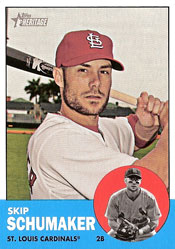
skip_schumakerChris Carpenter pitched a gem against the Phillies in the decisive Game 5 of the 2011 National League Division Series, but the effort could have been wasted if Schumaker hadn’t driven in the run that led to a 1-0 Cardinals victory.

Schumaker’s first-inning RBI-double off Phillies ace Roy Halladay was the defining achievement of his Cardinals career.

Rally Squirrel

In 2011, Schumaker was the Cardinals’ second baseman. In Game 4 of the National League Division Series at St. Louis, Schumaker singled in each of his first two at-bats. In his third at-bat, in the fifth inning, a squirrel ran across the plate, distracting pitcher Roy Oswalt as he unleashed a pitch. Oswalt asked umpire Angel Hernandez to nullify the pitch, ruled a ball, but Hernandez denied the request. “I was wondering what size of animal it needed to be for it not to be a pitch,” Oswalt said. (The Cardinals went on to win, 5-3, preventing the Phillies from clinching the series that night. Thus was born the Rally Squirrel, which became a part of Cardinals lore. Said Phillies manager Charlie Manuel: “Being from the South and being a squirrel hunter, if I had a gun there, might have did something. I’m a pretty good shot.”) Boxscore and MLB video

Schumaker subsequently flied out to center in that squirrelly at-bat. He was lifted before the start of the next inning with what the Cardinals described as a hamstring cramp caused by dehydration.

Before Game 5 at Philadelphia, doctors cleared Schumaker to play. Manager Tony La Russa opted to start Nick Punto at second base and Schumaker in center field in place of the slumping Jon Jay. Schumaker hadn’t started in center in eight weeks, but he had a career .364 batting mark versus Halladay and La Russa wanted Schumaker second in the order, behind Rafael Furcal.

The decision paid immediate dividends.

Epic at-bat

Furcal led off the game with a triple and Schumaker followed with an at-bat the St. Louis Post-Dispatch described as “epic.” With the count 0-and-2, Schumaker fouled off five two-strike pitches. On the 10th pitch of the at-bat, Schumaker pulled a curveball into the right-field corner for a run-producing double. MLB video

“That was a good at-bat,” Halladay said. “I threw him two or three pitches that were good pitches and he just kept fouling them off.”

Said Schumaker to ESPN.com: “I was happy just to put the barrel of the bat on the ball.” Asked whether he was fortunate to foul off a couple of Halladay’s toughest pitches, Schumaker said, “Yeah, probably seven of the 10.” MLB video

Halladay stopped the Cardinals the remainder of the game, but Carpenter was better. He shut out the Phillies on three hits. The Cardinals advanced to the National League Championship Series against the Brewers. Boxscore

Schumaker wouldn’t play in the Milwaukee series. In his second at-bat against Halladay, Schumaker strained a muscle in his side and left the game after he flied out. Schumaker returned for the World Series against the Rangers, started three games in center and appeared in three others. He had two hits in 11 at-bats.

Skip six

Schumaker’s most memorable regular-season performance occurred on July 26, 2008, when he had six singles in seven at-bats in the Cardinals’ 10-8 victory in 14 innings against the Mets at New York. He keyed the winning rally with a one-out single off Aaron Heilman. One out later, Albert Pujols launched a two-run home run. Boxscore

Batting in the leadoff spot and playing left field, Schumaker became the first Cardinal in 73 years to produce six hits in a game. Until then, the feat was last achieved by rookie Terry Moore on Sept. 5, 1935, against the Braves at St. Louis. Batting leadoff and playing center field, Moore was 6-for-6, with five singles and a double. Boxscore

Schumaker and Pujols (who was 5-for-8) became the first Cardinals pair since 1930 to each have five hits in a game. Charlie Gelbert and Taylor Douthit each had five hits against the Cubs on May 16, 1930, at St. Louis. Boxscore

Schumaker had two other feats of note for the Cardinals.

On the last day of the 2007 season, Schumaker was 5-for-5 (four singles and a double) against the Pirates at Pittsburgh. Boxscore

Three years later, on Aug. 9, 2010, during a heated series against the Reds at Cincinnati, Schumaker hit a grand slam, the only one of his career, against Mike Leake in a 7-3 Cardinals victory. Boxscore
(Updated Jan. 6, 2016)

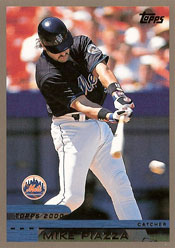
The performance of catcher Mike Piazza against the Cardinals in the 2000 postseason led to his only World Series appearance in a 16-year major-league playing career. It also may have helped his case in getting elected to the National Baseball Hall of Fame.

mike_piazzaPiazza was elected to the Hall of Fame on Jan. 6, 2016. He enhanced his credentials with a standout National League Championship Series for the Mets against the Cardinals. By hitting .412 (7-for-17) with two home runs, three doubles, five walks, four RBI and seven runs scored in the five-game series versus St. Louis, Piazza carried the Mets to their first pennant in 14 years.
[Piazza deserves election to the Hall of Fame, but so does former Cardinals catcher Ted Simmons. Simmons has more hits (2,472) and more RBI (1,389) than Piazza (2,127 hits; 1,335 RBI). Although Simmons had 1,769 more at-bats than Piazza, the point is Simmons is in the same class as Piazza as an overall hitter among catchers. Plus, Piazza wasn’t as good as Simmons on defense. For example, Piazza allowed the most stolen bases of any National League catcher in a season 10 times during his career.]

Tough on Cardinals

Piazza, who played for the Dodgers, Marlins, Mets, Padres and Athletics, hit .331 (112-for-338) with 24 home runs and 65 RBI in 97 regular-season games against the Cardinals in his career.

Cardinals pitching was just the tonic he needed entering the 2000 National League Championship Series. Although he had hit well overall during the 2000 regular season (.324 batting average, 38 home runs, 113 RBI), Piazza had slumped throughout September. His regular-season batting average was .218 after Aug. 27. In the National League Division Series against the Giants, he hit .214.

[Piazza hit .348 (8-for-23) against the Cardinals during the 2000 regular season. On May 27, 2000, in a 12-8 Mets victory at St. Louis, Piazza reached bases in all six of his plate appearances on a home run, single and four walks. Boxscore]

Pacing the Mets

In the first inning of the first game of the National League Championship Series, Piazza established the tone for the Mets. He laced a double down the third-base line off a Darryl Kile curve, driving in the first run and moving Edgardo Alfonzo to third. Alfonzo then scored on a Robin Ventura sacrifice fly, giving the Mets a 2-0 lead on their way to a 6-2 victory at St. Louis.

A headline in the St. Louis Post-Dispatch the next morning read, “Piazza’s MVP Effort Gets Mets Off To Fast Start.”

“We’re a pretty good team,” said Mets manager Bobby Valentine. “And when Mike’s hitting we’re a real good team.”

Said Piazza: “We were able to take the crowd out of the game early, which is big. They’ve got an electric crowd.” Boxscore

In Game 2, a 6-5 Mets victory, Piazza homered off reliever Britt Reames (after nearly being called out on a too-close-to-take 0-and-2 pitch), walked three times and scored twice. Boxscore

Piazza was a central figure in the Cardinals’ lone win of the series, an 8-2 victory in Game 3 at New York. After St. Louis scored twice in the top of the first, Cardinals starter Andy Benes yielded singles to the first two Mets batters in the bottom half of the inning, bringing Piazza to the plate with runners on first and third and no out.

To the Cardinals’ great relief, Piazza hit a weak grounder that third baseman Fernando Tatis scooped on a short hop and turned into a double play. Though a run scored, the Cardinals had gained the momentum by surviving the threat.

“That was key for all of us,” Cardinals catcher Carlos Hernandez said to the Post-Dispatch. “Everybody knows Piazza. He’s a real good hitter. When he got that groundball, I thought it was over. Everybody, when Piazza gets to bat, expects him to hit the ball out of the park.”

Said Piazza: “It was a tough, two-strike pitch, tough to lay off of it.” Boxscore

Sweet dreams

Piazza battered the Cardinals in Game 4 (home run, double, two RBI, three runs and a walk) and in Game 5 (two runs, double and a walk). In the locker room, celebrating the only pennant clinching he’d experience, Piazza told the Post-Dispatch, “It’s like a dream. I hope nobody pinches me. I don’t want to wake up from this.”

Six years later, the Cardinals gained a measure of revenge against both Piazza and the Mets. In 2006, Piazza was with the Padres, who were overwhelming favorites against the Cardinals in the National League Division Series. This time, Piazza hit .100 (1-for-10) in four games against the Cardinals. (Batting against St. Louis for the final time in his career, Piazza, pinch-hitting for Russell Branyan in the eighth inning of Game 4, grounded into a double play against reliever Josh Kinney. Boxscore)

After eliminating the Padres, the Cardinals beat the Mets in a seven-game National League Championship Series before winning the World Series title against the Tigers.

Previously: 2011 Cardinals are first to have top 3 in hitting into double plays

(Updated Jan. 23, 2019)

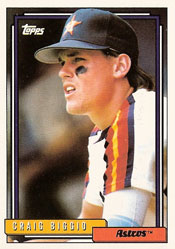
Craig Biggio, a Hall of Famer who spent his career with the Astros, rejected a chance to become a Cardinal in his prime.

craig_biggioBiggio was recruited aggressively by the Cardinals when he became a free agent after the 1995 season. At age 30, he had a chance to be their second baseman at the start of the Tony La Russa era and become part of a franchise that would reach the postseason nine times in La Russa’s 16 seasons as Cardinals manager.
Instead, Biggio remained with the Astros and continued to torment Cardinals pitching.

Biggio had regular-season career bests of 280 hits and 131 RBI against the Cardinals in 20 years (1988-2007) with the Astros. Versus St. Louis in the regular season, he batted .298 with a .378 on-base percentage, 22 home runs, 58 doubles and 31 stolen bases. In the postseason (the National League Championship Series of 2004 and 2005), Biggio hit .250 against the Cardinals.

After the 1995 season, Biggio weighed offers from the Cardinals, Rockies, Padres and Astros. La Russa, who had just been named Cardinals manager, and general manager Walt Jocketty met with Biggio, his wife and agent Barry Axelrod in California in an effort to convince the player to become a Cardinal.

“We were received well,” Jocketty told the St. Louis Post-Dispatch for a story published Dec. 5, 1995. “He likes Tony a lot and would enjoy playing for him. It’s important for him to go to a place where the team is going to be competitive. I think he would enjoy playing here. He’s a guy who would be very important to our program.”

Four days later, Post-Dispatch columnist Bernie Miklasz wrote “Craig Biggio would own this town” if he signed with St. Louis.

The Cardinals offered Biggio a five-year, $25 million contract, the Associated Press reported, but Biggio took the Astros’ four-year, $22 million deal. “I consider myself a loyal person,” Biggio said. “… I want to win in an Astros uniform.”

Twelve years later, when Biggio was finishing his playing career in 2007 with 3,060 hits, La Russa told MLB.com, “Walt and I put a full-court press on Craig (in 1995). I thought we put together a charge that had a chance, but I know … his teammates were also talking to him. He made a smart decision to stay there.”

Biggio told St. Louis writer Rick Hummel in 2007 that a few years earlier La Russa had told him, “I’m still ticked at you for not signing with us.”

“Tony said it in a good way,” Biggio said, “but I was their guy. But I never wanted to leave Houston.”

Biggio, who played most of his career as a second baseman, faced the Cardinals for the first time on Aug. 17, 1988, when he entered the game at Busch Stadium II in the ninth inning as a catcher. Boxscore

In 108 regular-season games at Busch Stadium II (which was the Cardinals’ home through 2005), Biggio batted .314 with 30 doubles, 11 home runs and 60 RBI.

Biggio faced the Cardinals for the final time during a September 2007 weekend series at Busch Stadium III. Before the middle game of the series on Sept. 22, 2007, Jocketty presented Biggio with a check for $3,053 (his hits total at the time) during an on-field ceremony. (Biggio donated the money to a charity.) Cardinals fans gave Biggio an ovation during and after the presentation, MLB.com reported.

“I’ve always said the Cardinals fans are the classiest fans in the game because they appreciate a good play,” Biggio said to the Post-Dispatch.

In remarks to reporters, La Russa called Biggio “the perfect pro.”

“He’s tied for first among guys you respect for all the years I’ve been here,” said La Russa.

Alyson Footer of MLB.com wrote, “Craig Biggio always appreciated the city of St. Louis, the Cardinals organization and Cardinals fans, and during an on-field pregame presentation on Saturday the admiration was reciprocated.”

Biggio appeared in the game that night as a pinch-hitter in the ninth inning and singled against Tyler Johnson. Boxscore

The next day, Sept. 23, 2007, Biggio, playing second base, went 1-for-4 in his final game against the Cardinals. The hit was a seventh-inning single off Russ Springer. When Biggio batted again in the eighth, he received a standing ovation that he acknowledged with a tip of his batting helmet. After flying out to right field, he was removed from the game. Boxscore

In a 2011 interview with the New York Times, Biggio said he “absolutely” could have played another two or three years longer than he did, but he wanted more time with his wife and three children. “I couldn’t look my family in the eyes anymore and justify (playing),” Biggio said. “It was time to go.”

Previously: Lance Berkman and his greatest games as a Cardinal

(Updated on Oct. 26, 2024)

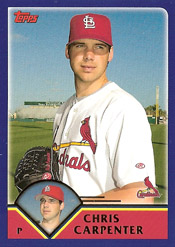
Mike Matheny helped recruit Chris Carpenter to the Cardinals.

chris_carpenter8After becoming a free agent, Carpenter, 27, left the Blue Jays for a one-year incentive-laden contract with St. Louis on Dec. 13, 2002.
Carpenter had undergone shoulder surgery in September 2002 and the Cardinals were gambling he would recover and be able to pitch for them in the second half of the 2003 season as “a potential swing man,” the St. Louis Post-Dispatch reported.

Matheny, the Cardinals’ starting catcher from 2000-2004, had been Carpenter’s teammate with the Blue Jays in 1999. Before signing with the Cardinals, Carpenter went to St. Louis at the club’s request to have a magnetic resonance imaging test on his shoulder. While in the city, he met with Matheny, who urged him to accept the Cardinals’ deal, the Post-Dispatch reported.

Carpenter also spoke with two other former Blue Jays teammates, pitchers Woody Williams (a Cardinal from 2001-2004) and Pat Hentgen (a Cardinal in 2000). Like Matheny, they endorsed the Cardinals as the right fit for Carpenter.

“They all said it was the best city, the best fans, the best organization,” Carpenter told Joe Strauss of the Post-Dispatch in December 2002. “It wasn’t a financial decision at all. It was because it was the best situation.”

The Cardinals were interested in acquiring Carpenter in July 2002 before they traded for Chuck Finley of the Indians. Soon after that, Carpenter was sidelined for the season because of the shoulder problems.

The Sporting News quoted a big-league scout as saying Carpenter was “a steal” for the Cardinals.

Carpenter didn’t return to form as quickly as the Cardinals expected. He didn’t pitch for them in 2003 _  he made eight minor-league starts totaling 18.2 innings that year _ but the move paid off in the long term.

As a Cardinal, Carpenter had a 95-44 regular-season record and a 10-4 postseason mark, including 3-0 in World Series games. He won the National League Cy Young Award in 2005 and had the best ERA in the league in 2009.

Regarding his win against the Rangers in Game 7 of the 2011 World Series, Carpenter told Stan McNeal of Cardinals Magazine, “Without pitching coach Dave Duncan, I’m not sure how we win Game 7.”

Starting against the Rangers for the third time in 10 days, Carpenter gave up two runs in the first inning and still was struggling in the second before Duncan came to the mound for a visit.

“He told me to establish my breaking ball because they were all over my hard stuff,” Carpenter recalled to McNeal. “I started throwing breaking balls, they stopped sitting on my other stuff, and I ended up pitching into the seventh. We took the lead and ended up winning our second ring in six seasons.” Boxscore

(Updated Aug. 3, 2022)

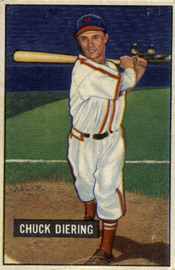
On the brink of being sent to the minor leagues for the third time in four seasons, Chuck Diering delivered on a make-or-break opportunity and soon found himself playing regularly in a Cardinals outfield with Stan Musial and Enos Slaughter.

chuck_diering

A St. Louis native, Diering played five seasons for the Cardinals.

In 1949, Diering began the season with the Cardinals but seldom was used, going hitless with a walk in three plate appearances. The Cardinals were planning to send him back to Class AAA Rochester by May 20. Diering had played there in 1946 and most of 1948 after breaking into the majors with the Cardinals in 1947.

Diering’s fortunes changed on May 8, 1949, as the Cardinals prepared to face left-hander Joe Hatten of the Dodgers at Brooklyn. Cardinals manager Eddie Dyer had opened the season with Stan Musial as his center fielder. But, wrote Bob Broeg in The Sporting News, “Dyer didn’t like the idea of subjecting Musial to the daily wear and tear of center field, and the valuable slugger made it plain he would prefer not playing there game after game.”

So Dyer was looking for a right-handed batter to play center against left-handed pitching, with the thought he could move Musial to right and keep Slaughter in left. Dyer decided to give Diering a chance against Hatten and the Dodgers.

Batting leadoff and playing center field, Diering responded with a 2-for-4 performance, with two RBI and a walk that Sunday at Brooklyn. Boxscore

Impressed, the Cardinals opted to keep Diering. By June, Diering regularly was starting in center field. On June 16, his seventh-inning single off Hatten snapped a 2-2 tie and propelled the Cardinals to a 6-2 victory over the Dodgers at St. Louis. Boxscore Three days later, against the Phillies, Diering’s fifth-inning single off Ken Heintzelman tied the score 2-2 and his two-out single off Robin Roberts in the ninth drove in the winning run in the Cardinals’ 6-5 victory at St. Louis. Boxscore

“Six weeks have brought a happy change in the career of Chuck Diering, who expected to eat Rochester restaurant food again this summer and instead has been enjoying home cooking as much as St. Louis fans have liked his clutch hitting and sensational center fielding,” Broeg wrote.

Diering continued his stellar play throughout the summer. On Aug. 19, his batting average was .281. He also impressed with his ability to chase down drives to the gaps. A headline in The Sporting News referred to him as “Deerfoot Diering.” Broeg reported that Diering “almost has made the fans forget Terry Moore with his brilliant center field play.”

Moore, a four-time all-star and starting center fielder for the Cardinals’ World Series championship clubs of 1942 and 1946, was a coach for the 1949 Cardinals. Diering credited Dyer and his coaching staff for his transformation into a Cardinals starter in 1949.

“I’ve had a lot of help,” Diering told The Sporting News. “Dyer persuaded me to choke my grip at bat. Tony Kaufmann made me lay off high pitches. Buzzy Wares encouraged me to try a preliminary swing or two to loosen my tense shoulder muscles and Terry Moore goes over the pitchers with me every day, showing how each is different and how they’ll try to pitch to me.”

Said Dyer: “We want to handle him just right because the kid really has done a job of helping solve a big problem. He has become a valuable man in this club’s success.”

The 1949 National League pennant race went down to the last day of the season, with the Dodgers (97-57) winning the title by a game over the Cardinals (96-58).

Diering finished the year with a .263 batting average, 21 doubles and eight triples in 131 games. His fielding percentage of .987 led all National League center fielders. He also ranked in the top five among NL center fielders in putouts (295) and assists (seven).

At spring training in 1950, Diering impressed Yankees center fielder Joe DiMaggio, who told the St. Louis Post-Dispatch, “Pretty good kid they got out there in center field.”

Yankees manager Casey Stengel said Diering “gets a fast jump on a ball, all right.”

Diering split playing time in center with Bill Howerton and Harry Walker in 1950. He primarily was a bench player for the Cardinals in 1951.

On Dec. 11, 1951, the Cardinals traded Diering and pitcher Max Lanier to the Giants for Eddie Stanky, who became player-manager.

Diering completed his big-league career with the Orioles in 1956. The Cardinals signed him to play for their minor-league club at Omaha, managed by Johnny Keane, in 1957.

After the season, he returned to St. Louis and purchased an automobile dealership in nearby Alton, Ill.

Diering batted .252 in five seasons with the Cardinals and .249 overall in a nine-year major-league career.

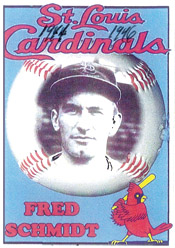
The National League Rookie of the Year Award didn’t exist in 1944. If it had, Cardinals pitcher Freddy Schmidt would have been a good candidate.

Schmidt contributed seven wins and five saves to the 1944 World Series championship club.

freddy_schmidtThe 1944 Cardinals dominated the National League with a 105-49 record, finishing 14.5 games ahead of the runner-up Pirates.

Discovered by the Cardinals when he attended one of their tryout camps in his hometown of Hartford, Conn., Schmidt joined the organization with Class D Shelby of the North Carolina State League in 1937.

It was the first of seven consecutive seasons in the Cardinals’ minor-league system for Schmidt. He was a 19-game winner for Class B Allentown in 1942 and was 13-10 for Class AA Rochester in 1943.

At 28, Schmidt made the Cardinals’ Opening Day roster in 1944. Initially used in relief, Schmidt earned the confidence of manager Billy Southworth and was given occasional starts.

His first big-league start was an eye-opener to the degree of difficulty in the major leagues. Starting for the Cardinals in the second game of a doubleheader on June 4, 1944, at Philadelphia, Schmidt held the Phillies to an unearned run and four hits in seven innings, but was the losing pitcher. His counterpart, Bill Lee, shut out the Cardinals on two hits and the Phillies won, 1-0. Boxscore

Schmidt earned his first big-league win in his next appearance, a relief stint on June 14, 1944, against the Cubs at St. Louis, when the Cardinals scored three in the bottom of the eighth and won, 10-9. Boxscore

In August, Southworth used Schmidt as a starter more frequently _ and the rookie responded, pitching a pair of shutouts in an 11-day stretch.

On Aug. 16, 1944, at St. Louis, Schmidt pitched a five-hitter in the Cardinals’ 5-0 victory over the Giants. The win was the Cardinals’ fifth in a row and enabled them to achieve their 80th victory on the earliest date in National League history. Boxscore

Schmidt used his arm and his bat to lead the Cardinals to a 4-0 victory over the Pirates in a cold drizzle on Aug. 25, 1944, at St. Louis. Schmidt pitched a six-hitter and struck out nine. He also produced two singles and two RBI. Pirates manager Frankie Frisch twice ordered intentional walks to the Cardinals’ No. 8 batter, Marty Marion, and Schmidt foiled the strategy each time with a RBI-single, the Associated Press reported. Boxscore

Schmidt finished the regular season with a 7-3 record, five saves and a 3.15 ERA in 37 games, including nine starts.

In his lone appearance in the 1944 World Series, Schmidt pitched 3.1 innings of scoreless, one-hit relief in Game 3, a 6-2 victory for the Browns. Boxscore

Two months later, Dec. 8, 1944, Schmidt was drafted into the Army.

Schmidt rejoined the Cardinals in 1946 and was 1-0 with a 3.29 ERA in 16 relief appearances, helping St. Louis to its fourth pennant of the decade.

After appearing in two games for St. Louis in 1947, Schmidt and outfielder Harry Walker were traded to the Phillies for outfielder Ron Northey on May 3. In September, after he posted a 5-8 record for Philadelphia, the Phillies placed him on waivers and Schmidt was claimed by the Cubs. He pitched in one game for Chicago _ and never appeared in the big leagues again.

Schmidt had a career major-league record of 13-11, 8-3 as a Cardinal.

Previously: Danny Litwhiler: perfect fit for champion Cardinals