Feeds:
Posts
Comments

Mort Cooper, usually outstanding for the 1942 Cardinals, uncharacteristically experienced double disappointments in two of his most high-profile starts that year.
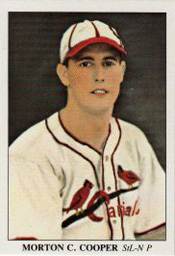
Cooper earned 22 wins and pitched 10 shutouts for the Cardinals in 1942, but he also started and lost both the All-Star Game and Game 1 of the World Series.

Cooper, 29, a right-hander, was 22-7 with a 1.78 ERA and 22 complete games for the 1942 Cardinals. During one stretch, he won nine consecutive decisions, including five by shutouts. Dodgers manager Leo Durocher chose Cooper to start the All-Star Game for the National League on July 6, 1942, at the Polo Grounds in New York.

Cooper and his brother, Cardinals catcher Walker Cooper, formed the first brother battery to start an All-Star Game.

The game was scheduled to start at 6:30 p.m. but was delayed more than 30 minutes because of storms. Mort Cooper, who had completed his warmups, told the United Press wire service the delay hurt him and he didn’t find his command until the third inning.

Lou Boudreau, the Indians shortstop and American League leadoff batter, drove Cooper’s second pitch of the game 260 feet into the upper deck in left for a home run. Boudreau said the home run provided “one of the biggest thrills I ever had in baseball.”

The next batter, Yankees right fielder Tommy Henrich, lined a 3-and-2 pitch. The ball landed in a pool of water in the outfield, enabling Henrich to stretch a single into a double.

After Cooper retired the American League’s two marquee players, left fielder Ted Williams of the Red Sox and center fielder Joe DiMaggio of the Yankees, Tigers first baseman Rudy York delivered a key blow. A right-handed batter, York swung late at a high fastball and “the result,” The Sporting News reported, “was something like a slice in golf.”

The ball carried toward the short right-field stands and stayed in fair territory as it landed over the fence for a two-run home run and a 3-0 American League lead. “On most any other big-league field,” The Sporting News reported, “the homer would have sliced foul.”

York swung so late at the 1-and-1 pitch “I thought I already had that one in my glove,” Walker Cooper said.

“I walloped it,” York said. “I thought at first it was going foul, but what a kick I got out of it when I saw the ball plump into the lower-right stands, well inside the foul line.”

Cooper pitched three innings, yielding four hits and three runs. The American League won, 3-1. Boxscore

Behind the pitching of Cooper and rookie Johnny Beazley (a 21-game winner), the 1942 Cardinals won 106 games and finished two ahead of the second-place Dodgers. Cooper was selected by manager Billy Southworth to start Game 1 of the World Series against the Yankees on Sept. 30 at St. Louis.

Cooper gave up five runs, 10 hits and three walks in 7.2 innings and took the loss in a 7-4 Yankees victory.

Batting fourth, DiMaggio singled and scored in the fourth, drove in a run in the fifth and singled and scored in the eighth, igniting a three-run inning versus Cooper. Boxscore

“I hadn’t pitched in a week and my control was off,” Cooper said to the Associated Press. “Pitched too high. They didn’t hit my fastball at all. It was my curve.”

Cooper started Game 4 at Yankee Stadium and surrendered five runs in 5.1 innings. Max Lanier got the win in relief in a 9-6 Cardinals triumph. Boxscore

Sporting News columnist Dan Daniel called Cooper an “emphatic flop,” who was “too tired to show at his best.”

It ended well, though, for Cooper and the Cardinals. St. Louis won the championship in five games. Cooper won the 1942 National League Most Valuable Player Award winner and he again topped 20 wins in both 1943 and 1944, helping the Cardinals to two more pennants.

Previously: How Mort Cooper pitched two straight 1-hitters for Cardinals
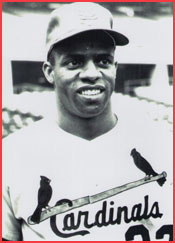
Before the 1967 season, Ted Savage competed with Mike Shannon for the role of starting third baseman of the Cardinals. Neither could have imagined then that both would have long careers with the Cardinals after their playing days.

Shannon, who would win the third base job, played until 1970. After a year as the franchise’s assistant director of promotions and sales, Shannon became a Cardinals broadcaster in 1972 and remained in the job through the 2021 season.

Savage spent three (1965-67) of his nine years in the majors as a Cardinals reserve. He joined their front office in September 1987 as assistant director of community relations and minor-league instructor. The 2012 season was his 25th and last in the Cardinals’ front office. At 75, he retired as director of target marketing in the Cardinals Care and community relations department.

A native of the St. Louis-area town of Venice, Ill., Savage signed with the Phillies as an amateur free agent in 1960 and quickly made a favorable impression. In 1961, Savage was named most valuable player of the Class AAA International League after hitting .325 with 24 home runs, 31 stolen bases and 111 runs scored for Buffalo.

Savage became the Phillies’ left fielder as a rookie in 1962 and hit .266 with 16 stolen bases. He was traded to the Pirates after the season, beginning a journey that would land Savage with eight big-league teams between 1962 and 1971.

In December 1964, the Pirates traded Savage and pitcher Earl Francis to the Cardinals for second baseman Jack Damaska and outfielder Ron Cox.

A substitute school teacher in St. Louis during the off-season (he was graduated from Lincoln University, with a bachelor’s degree in education), Savage reported to spring training in 1965 with the Cardinals’ minor-league players. He began the regular season with Class AAA Jacksonville, stole 34 bases in 87 games and was called up to St. Louis on July 23 after reserve outfielder Carl Warwick was dealt to the Orioles.

Savage didn’t get a hit until his 19th at-bat as a Cardinal. The slump-busting double on Aug. 2 sparked a winning rally against the Dodgers. Boxscore

Two weeks later, Savage hit his first and only Cardinals home run, a two-run shot off Joe Nuxhall of the Reds. Boxscore

The highlights were too few. Savage hit .159 (10-for-63) in 30 games for the 1965 Cardinals. He opened the 1966 season with Class AAA Tulsa.

“Ted is really something,” Tulsa manager Charlie Metro told The Sporting News. “He can do everything _ and well. I consider him a better center fielder than eight of those now up in the big leagues.”

Savage, hitting .317 with 34 doubles, 18 homers and 43 steals for Tulsa, was called up to the Cardinals in August 1966. He was instrumental in helping St. Louis to a 5-1 victory over the Pirates on Aug. 27. Savage doubled and scored against starter Steve Blass and rapped a two-run double off reliever Pete Mikkelsen. Boxscore

Just as in 1965, though, Savage mostly struggled, batting .172 (5-for-29) in 16 games for the 1966 Cardinals.

After the season, Savage was sent by the Cardinals to the Florida Instructional League with the intent of being converted to a third baseman. He also received instruction on playing second base. Savage responded well to the challenges.

Wrote The Sporting News: “Besides playing a slick hot corner, Savage also won three straight games for the Cards. In one, he stole home with the winning run. In another, he drove in the deciding run with a single. And, in the third, he hit a game-winning 415-foot homer.”

Meanwhile, Shannon also was working toward a conversion from outfield to third base. In December 1966, the Cardinals traded their starting third baseman, Charlie Smith, to the Yankees for right fielder Roger Maris.

Though Shannon was regarded the frontrunner to replace Smith, Savage was considered a good bet to win a spot with the 1967 Cardinals. St. Louis ace Bob Gibson told The Sporting News, “Ted’s really improved. He’s got lots of guts and he could help some team right now.”

His confidence bolstered, Savage had a spectacular spring training, hitting .364 in exhibition games. Cardinals hitting instructor Joe Medwick said, “Savage became a good hitter again by going with the pitch.”

Savage made the 1967 Opening Day roster as a reserve infielder-outfielder. (Shannon was the starting third baseman and Lou Brock, Curt Flood and Maris were the outfielders).

However, Savage hardly played _ and when he did, he wasn’t effective. With his batting average at .125 (1-for-8), Savage was in the visitors’ clubhouse at Forbes Field in Pittsburgh when manager Red Schoendienst informed him he was being optioned to Tulsa. Angered, Savage grabbed a ukelele he had purchased and smashed it against his locker, The Sporting News reported.

The Cardinals switched gears. They sent Savage to the Cubs rather than return him to the minor-league system. Savage made an immediate impression in Chicago. He twice scored on steals of home. On June 2, his first time facing the Cardinals since his departure, Savage hit a home run against Steve Carlton, one of two he would hit against the St. Louis left-hander that season. Boxscore

Savage told The Sporting News he was sorry he had smashed the ukelele and explained, “I figured I had done everything they (the Cardinals) had asked me to. I just wasn’t going to go back to the minors.”

Savage also would play for the Dodgers, Reds, Brewers and Royals. His best season was 1970 when he hit .279 with 12 homers and 50 RBI for the Brewers.

After his playing career, Dr. Ted Savage earned a Ph.D. degree in urban studies from St. Louis University and spent nine years as athletic director at Harris-Stowe State University in St. Louis before joining the Cardinals’ front office.

In 1946, his first season as Cardinals manager, Eddie Dyer guided them to a World Series title.

Dyer had been a manager in the Cardinals’ farm system for 13 years (1928-36 and 1939-42) when he was chosen to replace Billy Southworth, who left after the 1945 season to manage the Braves. Dyer led the 1946 Cardinals to their ninth National League pennant and sixth World Series title.
Southworth was one of the most successful Cardinals managers. He led them to three NL pennants and two World Series championships. After the 1945 season, when the Cardinals placed second behind the Cubs, Southworth was approached by the Braves and offered a financial deal “that comes to a baseball manager only once in his career,” he told United Press.

Southworth, 52, was under contract to the Cardinals through the 1946 season. After hearing from the Braves, Southworth asked Cardinals owner Sam Breadon whether he would consider releasing him from the remaining year of his contract.

Breadon agreed, telling the Associated Press he “couldn’t stand in Southworth’s way.”

Southworth, who was earning $20,000 a year from the Cardinals according to multiple published reports, signed a three-year deal with the Braves. United Press reported the total value of the contract at $75,000 to $100,000. The Associated Press stated Southworth would earn $30,000 a year from the Braves. The Sporting News reported the contract was for $35,000 a year.

“The Braves offer was one which comes to a baseball man only once in a lifetime,” Southworth said to The Sporting News, “and I wish to state publicly how much I appreciate Mr. Breadon’s magnanimity in not putting any obstacle in my way to better myself. I have never had a harsh word with Mr. Breadon during all the years I worked for him in St. Louis.”

One reason Breadon was willing to allow Southworth to leave was he had Dyer available to replace him.

Dyer, 46, worked for the Cardinals as a player, minor-league manager and administrator, but he left in 1944 to tend to his various business interests in Houston. He was pleased to be asked to return to the Cardinals as manager.

“It was a big surprise to me,” Dyer said to the Associated Press when asked his reaction about being selected to replace Southworth, “although I always wanted to manage a big-league club.

“Since Billy Southworth had a contract with another year to run, I was surprised at his leaving the Cardinals. I made certain he hadn’t taken the step because of any disagreement with the club before I accepted the managership. I wouldn’t have taken the job under such a circumstance.”

United Press noted, “Since his entry into the St. Louis organization in 1922, Dyer has been one of the chain’s hardest and most unpublicized workers. Last year (1944), when Eddie left the Cards to go into the oil business in Houston, an attempt was made to alter his decision. He was told that he was next in line for the managerial job. Thinking Billy Southworth was a fixture for as long as he chose, Dyer declined.”

A graduate of Rice with a bachelor of arts degree, Dyer was signed to the Cardinals by Branch Rickey. A left-hander, Dyer pitched six seasons (1922-27) for the Cardinals, posting a 15-15 career record and 4.75 ERA before a sore arm ended his playing days.

Dyer became a Cardinals minor-league manager in 1928. He stayed in that role through 1936, then spent two years as a Cardinals minor-league executive before he returned to managing St. Louis minor-league teams from 1939-42.

Under Dyer, the Cardinals’ Houston farm club won Texas League championships in three consecutive seasons (1939-41).

Among the future Cardinals standouts groomed by Dyer in the minor leagues were outfielders Joe Medwick and Enos Slaughter, first baseman Johnny Mize and pitchers Howie Pollet and Harry Brecheen.

In 1943, after Rickey had departed the Cardinals for the Dodgers, Dyer became director of the Cardinals’ minor-league system. He was in that role until July 1944, when he accepted an opportunity to join his brother in an oil business.

With an influx of players preparing to return to the 1946 Cardinals after military service during World War II, Breadon saw Dyer as the ideal talent evaluator to sort through the roster options.

“I consider him the best judge of young ballplayers in the country, which makes him priceless at a time like this” Breadon said to The Sporting News.

Said Dyer: “All I ask of a ballplayer is that he stay in shape to play winning baseball. My theme song for years to my players has been, ‘Be mentally and physically fit to do your best and we won’t worry about the results.’ ”

Dyer led the 1946 Cardinals to a 98-58 record and the franchise’s fourth NL pennant in five years. (The Cardinals and Dodgers ended the regular season tied for first. St. Louis won a best-of-three playoff and advanced to the World Series, defeating the Red Sox in seven games.) Under Southworth, the 1946 Braves finished fourth at 81-71, their first winning season since 1938.

Dyer managed the Cardinals for five years and never had a losing season. In 1949, the Cardinals nearly won another pennant under Dyer but placed second, a game behind the Dodgers.

In 1948, his third season with the Braves, Southworth managed them to the NL pennant, their first since 1914.

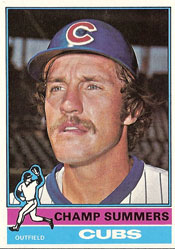
In 11 big-league seasons, Champ Summers hit only one home run against the Cardinals. Like many of the events involving Champ Summers, it was bigger than life.

The last home run of Summers’ major-league career was a pinch-hit grand slam off the Cardinals’ Bob Forsch, lifting the Padres to a 7-3 victory on April 10, 1984, at San Diego.
It was fitting that Summers’ final home run was struck as a pinch-hitter with the bases loaded. His first big-league homer _ hit for the Cubs against the Astros’ Jim York on Aug. 23, 1975, at Chicago _ also was a pinch-hit grand slam. Boxscore

From his colorful nickname to his unusual path to the major leagues, Summers was one of the game’s endearing characters.

In 1984, Summers, 38, was in his last big-league season, primarily employed as a left-handed pinch-hitter for San Diego. In their sixth game of a three-city West Coast trip to open the season, the Cardinals were leading the Padres, 3-1, in the fifth inning when Summers batted for pitcher Andy Hawkins with the bases loaded. He lined Forsch’s second pitch into the right-field seats. Boxscore

Summers rounded the bases so slowly his home run trot “made a wedding march look like a 40-yard dash,” wrote Bud Shaw of the San Diego Evening Tribune.

“I did take some time to watch that one,” Summers said with a smile. “I felt like I won the lottery.”

Summers told Phil Collier of the San Diego Union, “Hitting is like dancing. If you can’t hear the music, you can’t dance. I feel like I could dance all night.”

Under the headline “Performance of Padres’ Champ Worth an Oscar,” Shaw wrote, “For just one day, it would be nice to live the charmed life of Champ Summers. Preferably on a day when the rent is overdue, the unemployment check is lost in transit and your mother-in-law isn’t.”

Asked about his at-bat against Forsch, Summers said, “I don’t know what the pitch was and I don’t know where it was. I never know.”

John Junior Summers was born June 15, 1946, in Bremerton, Wash. He was nicknamed “Champ” at birth.

“My father was a prizefighter in the Navy,” Summers told the Belleville (Ill.) newspaper. “He said when I was born I looked like I went 10 rounds with Joe Louis. It’s a sad story, but true.”

Champ Summers moved with his family to the St. Louis metropolitan area. He was a natural athlete. At 17, while attending Madison (Ill.) High School, Summers was challenged to a tennis match by a local 13-year-old looking to test himself against worthy competition. The phenom was Jimmy Connors.

Summers entered the Army, became a paratrooper and served in Vietnam. When he came back to the U.S., he enrolled at Southern Illinois University Edwardsville and played basketball and baseball. He was playing in a men’s softball league when a scout for the Oakland Athletics discovered him and signed him to a free-agent contract in 1971.

When Summers reached the major leagues with Oakland in 1974, the year he turned 28, he was known as John Summers, the name he had used throughout his minor-league career as well.

One day, Summers said, as he was signing autographs before a game at Oakland during his rookie season, teammate Reggie Jackson watched him slowly sign “John J. Summers Jr.” on each item handed him. Reggie asked Summers whether he had a nickname. When Summers replied “Champ,” Jackson told him he’d be a fool not to use it.

When Summers was traded to the Cubs in 1975, he introduced himself as Champ Summers _ and it remained his big-league moniker.

Summers played in the majors, primarily as an outfielder, for six teams (Athletics, Cubs, Reds, Tigers, Giants and Padres) from 1974 through 1984.

A career .255 hitter, he batted .271 against the Cardinals. He was tough versus St. Louis with the Cubs in 1975 (.313) and with the Giants in 1982 (.364).

In 2001, Summers returned to the St. Louis region as the first manager of the Gateway Grizzlies of the Frontier League in Sauget, Ill.

Previously: Rick Horton: Bob Forsch was heart, soul of Cardinals’ staff

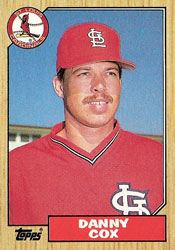
Mike Aldrete threatened to derail the Cardinals’ pennant push with a knockout smash off the foot of Danny Cox.

Cox was a starting pitcher for the 1987 Cardinals and Aldrete was a lethal hitter for the 1987 Giants.
Aldrete hit .438 (14-for-32) against the Cardinals during the 1987 regular season. His most damaging swing, however, produced a groundout that broke a bone in Cox’s right foot and sidelined him for a month.

Cox got even in the 1987 National League Championship Series. In a Game 7 pennant-clinching triumph, Cox held Aldrete hitless and shut out the Giants.

Riding a seven-game winning streak, the first-place Cardinals opened a series against the Giants at St. Louis on July 9, 1987.

In the seventh inning, Aldrete smacked a low liner and it struck Cox in the right foot. The ball caromed back to catcher Tony Pena, who threw out Aldrete at first base.

Cox remained in the game and completed eight innings before being relieved by Todd Worrell with the score tied 3-3. The Cardinals won, 7-6, scoring four in the 10th after the Giants had scored three in the top of the inning. Boxscore

The next day, it was discovered during an examination by team physician Dr. Stan London that Aldrete’s shot broke a bone in Cox’s foot. Cox, who had an 8-3 record, went on the disabled list and his foot was placed in a cast.

“I was throwing the ball real well and the team was playing real well,” Cox said to the Associated Press. “If anything good came out of it, at least we got (Aldrete) out.”

Aldrete, a Carmel, Calif., native and former standout for Stanford University, was enjoying a productive year for the Giants. He replaced injured right fielder Candy Maldonado in late June and put together an 11-game hitting streak before the all-star break. In his first 21 outfield starts after replacing Maldonado, Aldrete hit .341 with 15 RBI.

“I’ve tried to be a patient, disciplined hitter,” Aldrete said to The Sporting News. “You swing at strikes and let the balls go _ that’s the key to hitting.”

Nick Peters, a Bay Area baseball reporter, wrote of Aldrete, “He has a classic swing and the ability to foul off pitches until he finds something he likes. When he does, it usually becomes a rope.”

Cox returned to the Cardinals’ rotation Aug. 8, 1987. He finished the regular season with 31 starts, 199.1 innings pitched, an 11-9 record and a 3.88 ERA.

Aldrete posted a .325 batting average and a .396 on-base percentage in 126 regular-season games. He hit .419 with runners in scoring position.

As division champions, the Cardinals and Giants advanced to the National League Championship Series. They split six games, setting up a deciding Game 7 at St. Louis.

For the winner-take-all finale, Cox was named the Cardinals’ starting pitcher by manager Whitey Herzog. Aldrete was placed first in the Giants’ batting order by manager Roger Craig.

Cox set the tone early, retiring Aldrete on a groundout to second to begin the game.

In the third, with the Cardinals ahead 4-0, the first two Giants batters of the inning singled, bringing Aldrete to the plate. Cox got him to ground into a double play.

From there, Cox and the Cardinals were in control. Aldrete flied out to left, leading off the sixth, and he ended the eighth with a groundout to third. Cox pitched a shutout and the Cardinals won, 6-0. Boxscore

“He’s a good pitcher, no matter what the score is,” Aldrete said of Cox. “When he gets a lead, it makes him that much tougher.”

Previously: On 25th anniversary, top 10 facts about 1987 Cardinals

(Updated Sept.30, 2017)

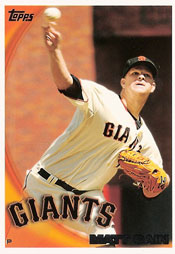
As a 20-year-old rookie, Matt Cain was put in the care of a 35-year-old veteran catcher, Mike Matheny.

With Matheny catching six of the right-hander’s seven starts for the 2005 Giants, Cain enjoyed a successful beginning to his major-league career.

Promoted to the Giants after posting a 10-5 record for Class AAA Fresno, Cain made his big-league debut on Aug. 29, 2005, against the Rockies at San Francisco.

With Matheny behind the plate, Cain, the youngest pitcher to start a game for the Giants since 20-year-old Mark Grant in 1984, limited the Rockies to two runs in five innings, but took the loss in a 2-1 Colorado victory. Matt Holliday, the Rockies’ cleanup batter, got two of the three Colorado hits against Cain _ a solo home run and a single. Boxscore

After the game, reporters approached Matheny for his assessment of the rookie.

“He has electric stuff, the kind of stuff you don’t see very often as far as velocity and late life,” Matheny said to the San Jose Mercury News. “His fluid motion makes him very deceptive.”

Matheny told the San Francisco Chronicle: “It’s just a shame we have such trouble scoring runs for these guys, especially after a first start like that, and he has to walk away with a loss. It’s a shame we couldn’t pull out a win for him.”

Working well with Matheny, Cain quickly achieved two milestones. He earned his first big-league win in his second start and recorded his first big-league complete game in his third start.

Cain held the Diamondbacks to a run on three hits through seven innings and got the win in the Giants’ 3-2 victory at Phoenix on Sept. 4. Boxscore

Five days later, Cain went the distance in earning the win in the Giants’ 2-1 victory over the Cubs at San Francisco. He gave up two hits and struck out eight. Boxscore

Cain earned 104 regular-season wins in 13 years (2005-17) with the Giants.

Against the Cardinals in his career, Cain was 2-7 with a 6.42 ERA in the regular season and 1-1 with a 2.19 ERA in the postseason. Both postseason appearances against the Cardinals occurred in 2012 when Matheny was in his first year as St. Louis manager.

Cain made his final big-league appearance on Sept. 30, 2017.

Previously: Pitcher for 1964 Cardinals was mentor to Mike Matheny