Feeds:
Posts
Comments

In 1987, as the baseball Cardinals headed toward the National League championship, the football Cardinals opened their last season in St. Louis.
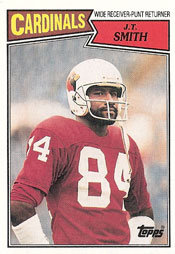
Both franchises received spectacular years from players named Smith.

Ozzie Smith batted a team-high .303 with 40 doubles and 43 stolen bases, leading the baseball Cardinals to the 1987 pennant, their third in six years. Smith also led NL shortstops in fielding percentage (.987) and won a Gold Glove Award.

Wide receiver J.T. Smith led the NFL in receptions (91) and receiving yards (1,117) and was third in touchdown catches (eight), helping the football Cardinals showcase one of the most potent attacks during the 1987 season.

Coached by Gene Stallings, the 1987 football Cardinals averaged 24.1 points per game, allowed an average of 24.5 points per game and finished 7-8 (tied with the Cowboys and Eagles for second place in the NFC East) before moving to Arizona the following year.

J.T. Smith, quarterback Neil Lomax and running back Stump Mitchell made the 1987 football Cardinals an entertaining, if not a championship-caliber, club. Lomax led the NFL in passing yards (3,387) and completions (275) and was third in touchdown passes (24). Mitchell rushed for 781 yards and made 45 receptions.

On Sept. 13, 1987, while David Cone and the Mets were beating the baseball Cardinals, 4-2, at Shea Stadium to move within 2.5 games of first-place St. Louis in the NL East, the football Cardinals opened the regular season with a 24-13 victory over the Cowboys at Busch Stadium.

Lomax threw a pair of touchdown tosses to wide receiver Roy Green, and a defense led by ends Freddie Joe Nunn and Curtis Greer held to one touchdown a fearsome Dallas offense that featured quarterback Danny White and running backs Herschel Walker and Tony Dorsett. It was the first time Lomax and Green had combined for more than one touchdown pass since 1984, The Sporting News reported. Boxscore

The football Cardinals split their first four games, then lost three in a row. They spent the rest of the season trying to get back to the .500 mark while reports circulated that team owner Bill Bidwill was looking to shift the franchise to Phoenix, Baltimore or Jacksonville.

On Dec. 13, 1987, two months after the baseball Cardinals defeated the San Francisco Giants in Game 7 of the NL Championship Series, the football Cardinals defeated the New York Giants, 27-24, in their home finale before 29,623.

Vai Sikahema returned a punt 76 yards for a touchdown, sparking the Cardinals to a 27-10 lead against a Giants team coached by Bill Parcells and defensive coordinator Bill Belichick and featuring quarterback Phil Simms.

Mitchell rushed for 111 yards, the first time since 1985 a running back (Eric Dickerson) had gained 100 yards against the Giants. “Our offensive line just knocked them around,” Lomax said. Boxscore

Bidwill was unhappy with the 54,000-seat capacity of Busch Memorial Stadium and, according to The Sporting News, was “investigating the possibility of moving while local businessmen were preparing a final proposal aimed at convincing him to stay.”

Two weeks later, on Dec. 27, 1987, the St. Louis football Cardinals played their last game. The Cowboys beat them, 21-16, at Dallas behind two touchdown runs by Walker. Boxscore

In mid-January, Bidwill said he was moving the franchise to Phoenix, ending the football Cardinals’ 28-year stay in St. Louis.


Joe Frazier was a bit of a late bloomer who developed into a productive left-handed pinch-hitter as a Cardinals rookie.

Frazier had 15 pinch-hit RBI as a Cardinals rookie in 1954.
In 1947, Frazier made his big-league debut, hitting .071 (1-for-14) in nine games for the Indians.

Frazier didn’t return to the major leagues until seven years later when he made the Opening Day roster of the 1954 Cardinals as a 31-year-old rookie outfielder.

Frazier had caught the attention of the Cardinals while tearing up the Class AA Texas League for Oklahoma City in 1953. Frazier earned the Texas League batting title with a .332 average, slugged 55 doubles and 22 home runs and had 113 RBI.

In October 1953, the Cardinals sent catcher Les Fusselman and cash to Oklahoma City to acquire Frazier. In assessing Frazier, Cardinals scout Joe Mathes told St. Louis journalist Bob Broeg, “Of this I’m certain _ he’s a major-league hitter.”

During spring training in 1954, Cardinals manager Eddie Stanky became impressed by rookie outfielders Frazier, Wally Moon and Tom Burgess. Stanky told reporters Frazier might beat out the venerable Enos Slaughter, soon to turn 38, for the starting right field job.

After the Cardinals left their Florida spring training camp and barnstormed their way back to St. Louis, Broeg filed this report on Frazier for The Sporting News:

Frazier … does not have the speed or outfielding skill of a Slaughter or Wally Moon. But the sturdy slugger has tremendous power that was reflected in long outs in spacious Florida parks before he began to find the range en route home in stadiums of major-league dimensions, hitting two homers April 1 at Birmingham against the White Sox and another two days later at Houston.

“I consider him a left-handed (Ray) Jablonski, a hitter of courage who thrives on men-on-base situations,” said Stanky.

Opting to begin the season with all three rookie outfielders on the roster, along with starters Stan Musial and Rip Repulski, the Cardinals traded Slaughter to the Yankees in April. “It’s the greatest shock I ever had in my life,” Slaughter said to The Sporting News.

The Cardinals’ outfield was Musial in left, Moon in center and Repulski in right, with Frazier and Burgess in reserve.

Frazier excelled as a pinch-hitter and was used primarily in that role. He ripped a two-run pinch-hit homer off the Phillies’ Robin Roberts on May 5. From July 5 through July 24, Frazier had six hits and a walk in eight pinch-hit appearances.

One of Frazier’s hits in that stretch was a two-run walkoff homer in the ninth off the Cubs’ Bob Rush, lifting St. Louis to a 2-1 victory on July 10. Frazier’s blast struck the screen on the pole above the pavilion roof at Busch Stadium. Boxscore

On Aug. 17, Frazier delivered a three-run pinch-hit homer in the seventh off Jim Wilson, leading the Cardinals to a 4-1 victory over the Braves at Milwaukee. The 385-foot shot into the right-field bleachers sealed Wilson’s first loss after eight consecutive wins and snapped the Braves’ nine-game winning streak. Boxscore

Frazier finished the 1954 season with 20 hits as a pinch-hitter _ two shy of tying the big-league mark of 22 established by Sam Leslie of the 1932 Giants. Frazier’s batting average as a pinch-hitter that season was .323, with 15 RBI. Overall, Frazier batted .295 (26-for-88) for the 1954 Cardinals.

Frazier played for the Cardinals in 1955, but hit .200 in 58 games. In May 1956, St. Louis traded Frazier and shortstop Alex Grammas to the Reds for outfielder Chuck Harmon. Frazier finished his big-league playing career that year with the Orioles.

After a stint as a minor-league manager, Frazier was named manager of the Mets in 1976. He led New York to an 86-76 record that year, but when the 1977 Mets stumbled to a 15-30 start, Frazier was replaced by another ex-Cardinal, Joe Torre.

Previously: 1956 Cardinals groomed nine big-league managers

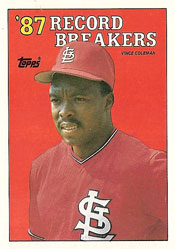
In 1987, Vince Coleman established a major-league stolen base record. He also achieved a personal goal with one powerful swing of the bat.

On Aug. 26, 1987, Coleman hit a home run over an outfield wall for the first time in three seasons with the Cardinals. He had logged 1,721 at-bats without hitting a ball out of the park, according to The Sporting News.
(Coleman had hit an inside-the-park home run on May 21, 1985, his rookie year, against the Braves’ Len Barker at St. Louis. Boxscore and video.)

Facing Astros left-hander Jim Deshaies, Coleman drove an opposite-field home run over the right field gate at St. Louis’ Busch Memorial Stadium. The fifth-inning solo shot was estimated to carry 386 feet.

“It’s a lot of fun to do it,” Coleman said to the Associated Press. “I had confidence in my ability that I’d hit at least one. I feel awfully proud.”

It was Coleman’s speed, though, that won that game for St. Louis.

With the score tied 4-4, Coleman doubled against reliever Juan Agosto leading off the seventh and moved to third on Ozzie Smith’s sacrifice bunt.

The next batter, Tommy Herr, grounded to shortstop Dale Berra, who looked toward Coleman, then threw to first to retire Herr. When Berra unleashed his throw, Coleman dashed for home. He slid across the plate with the winning run, beating the peg from startled first baseman Glenn Davis. Boxscore

“That last piece of baserunning was a beauty,” Cardinals manager Whitey Herzog said. “Really, it turned out bigger than the home run.”

Said Berra: “I went to fake him back to third and then I threw. That’s the first time that’s ever happened to me.”

Coleman finished the 1987 regular season with three home runs. He hit 28, three against Deshaies, in a 13-year major-league career. His single-season high was six for the 1990 Cardinals.

Most impressively, Coleman totaled 109 stolen bases during the 1987 regular season, becoming the first major-league player to swipe 100 or more in three consecutive years. He had 110 in 1985 and 107 in 1986.

“I think 100 stolen bases is a hell of an accomplishment,” Coleman said. “MVP honors are presented to the big home run hitters. I just get my personal satisfaction out of stealing bases and hope that I get compensated for it.”

For a player who spent all 18 of his big-league seasons in the American League, outfielder Johnny Damon had his share of memorable performances against the Cardinals, including a home run to lead off Game 4 in the historic sweep of the 2004 World Series by the Red Sox.

Yet it was an incident that occurred in 1997, in Damon’s first regular-season series against St. Louis, that may be what many Cardinals fans will most remember about him.
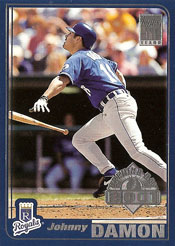
Damon, 38, was released in August 2012 by the Indians, two months after his two-run home run off reliever Maikel Cleto helped Cleveland to a 6-2 victory at St. Louis on June 8, 2012. A left-handed batter with more than 2,700 big-league hits, Damon may be facing the end of his major-league playing career.

He excelled against the Cardinals, batting .330 (31-for-94) with 18 runs in 23 regular-season games. Damon also hit .286 (6-for-21) against them in the 2004 World Series.

From the start, he was a fiery combatant when facing St. Louis. In August 1997, the Cardinals played the Royals in the regular season for the first time. The Cardinals won the opener of the three-game weekend series at Kansas City.

The next night, a Saturday, Aug. 30, the Royals pounded starter Manny Aybar and reliever Mark Petkovsek. When right fielder Jermaine Dye hit a grand slam off Petkovsek in the fourth inning, it increased the Royals’ lead to 14-1.

The next batter was Damon. Petkovsek’s first pitch to him hit Damon in the ankle. Damon charged the mound. He grabbed Petkovsek in a headlock and they tumbled to the ground.

Both benches and both bullpens emptied. During the next five minutes, the Associated Press reported, “play was halted as players wrestled and jostled, screamed and postured.”

Cardinals pitcher Andy Benes went after Tim Belcher and tore the front of the Royals starter’s jersey. Royals bench coach Jamie Quirk and Cardinals pitching coach Dave Duncan wrestled one another to the ground, the Associated Press reported.

Damon and Petkovsek were ejected. Two innings later, Belcher hit St. Louis right fielder Phil Plantier in the hip with a pitch.

There were no serious injuries, but there was plenty of huffing and puffing in the clubhouse after the Royals’ 16-5 victory. Boxscore

“The guys in red versus the guys in blue. Or was it the Bloods versus the Crips?” Chili Davis, the Royals’ designated hitter, said to the Lawrence Journal-World.

Said Damon: “I kind of thought he’d throw at me. I did what I had to do.”

An incredulous Cardinals manager Tony La Russa told the Lawrence newspaper, “Hitting the guy on the ankle? With a sinker? Are you kidding?”

Said Petkovsek: “I was just trying to throw a fastball inside. I was surprised he came out there.”

Asked whether hitting Plantier with a pitch was retaliation, Belcher said, “I was pitching him in all night.”

The Kansas City Star and St. Louis Post-Dispatch gave heavyweight treatment to the melee.

_ La Velle Neal of the Star: Basebrawl broke out at Kauffman Stadium Saturday night.

_ Dick Kaegel of the Star: Now it’s absolutely official. This Royals-Cardinals thing is a rivalry. The boys got down and dirty Saturday night.

_ Rick Hummel of the Post-Dispatch: Emotions already were running reasonably high for this first interleague meeting between the Cardinals and Kansas City Royals. But, in a tumultuous fourth inning Saturday, they reached fever pitch.

Not all bought into the notion the series had created bad blood between Missouri’s major-league teams. Said Royals catcher Mike Macfarlane to the Lawrence Journal-World: “How can there be bad blood? We’ve only played them twice.”

Damon was in the lineup, batting leadoff, the next afternoon, Aug. 31. He struck out three times, including in the ninth inning when he batted with two on and one out against closer Dennis Eckersley. Cardinals pitchers hit two batters and St. Louis won, 5-4.

Previously: Cardinals were Royals’ first opponent in Kansas City

(Updated Jan. 30, 2023)

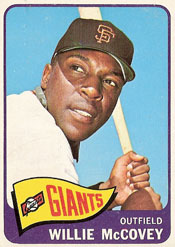
Before Mark McGwire, who played for the Cardinals from 1997-2001, another Big Mac, Willie McCovey of the Giants, hit the longest home run seen in St. Louis.

Cardinals broadcaster Mike Shannon has said the longest home run he has witnessed was hit by McCovey on Sept. 4, 1966, at St. Louis.
Leading off the third inning against Cardinals starter Al Jackson, McCovey hit a changeup that landed in the upper deck above the scoreboard in right-center field at Busch Memorial Stadium. The ballpark opened four months earlier, in May 1966.

Shannon was playing right field for the Cardinals that day and “had a good look” at McCovey’s home run. Shannon said he later asked McCovey (who had 521 career home runs in the major leagues) whether it was the longest ball he’d hit. “I don’t know if it was the longest,” Shannon said McCovey replied, “but it was the hardest.” Boxscore

Cardinals catcher Tim McCarver told writer Roger Angell of The New Yorker magazine, “There’s no doubt in my mind about this. It was as if McCovey had hit it off a tee. It caromed off the upper part of the scoreboard and bounced back onto the field.”

The book “Baseball’s Ultimate Power: Ranking the All-Time Greatest Distance Home Run” had this description of McCovey’s St. Louis home run: “The ball was struck on a line drive trajectory that resulted in a 515-foot journey.”

The Cardinals’ 2005 Busch Stadium commemorative yearbook said many who witnessed McCovey’s blast will continue to regard it as the longest home run in that stadium’s history. “That may be the farthest hit anywhere,” Shannon said. “I’ll never forget it as long as I live.”

In the first inning, with the Cardinals using an infield shift against the left-handed slugger, McCovey bunted for a single. Asked by Jack Hanley of The San Mateo Times whether he got more pleasure from the bunt or from the mammoth home run, McCovey replied, “The more I think about it, the more I’m becoming convinced I get a bigger kick out of the bunt. It’s because, when you do the unexpected, the other fellow is completely surprised and it’s a trifle upsetting. The bunt can win a ballgame as much as a homer.”

(On Sept. 16, 1966, 12 days after his shot in St. Louis, McCovey hit a 505-foot home run off Mets starter Jack Fisher at San Francisco’s Candlestick Park. It’s the longest home run hit at that stadium, according to the San Francisco Examiner. Boxscore)

Until McGwire arrived, Pirates first baseman Willie Stargell came closest to challenging McCovey’s home run for longest hit at Busch Memorial Stadium. On July 4, 1979, Stargell hit a slider from reliever Darold Knowles 510 feet, above and to the right of the scoreboard. Boxscore

“That’s the longest home run I’ve ever seen hit in this ballpark by a left-hander,” Cardinals first baseman Keith Hernandez said to the Associated Press.

Said Stargell: “When I saw it go out, I saw (Knowles) flinging something like his cap. He was disgusted. It was a ball that Darold, I’m sure, got in an area he didn’t want. It was a nice, easy swing. I had no idea it was going that far.”

Nineteen years after Stargell’s shot, McGwire hit what officially is called the longest home run at Busch Memorial Stadium. The 545-foot home run on May 16, 1998, against the Marlins’ Livan Hernandez hit the St. Louis Post-Dispatch sign in center field. For the remainder of the season, a giant Band-Aid marked the spot where the ball dented the sign. Boxscore

“It’s the best ball I’ve ever hit,” McGwire said. “I don’t think I can hit one better than that.”

In 2012, the Cardinals shut out the Cubs in consecutive games at St. Louis.

Those were the Cardinals’ first back-to-back shutouts of the Cubs in 23 years.

Spurred by an explosion of power hitting, the 2012 Cardinals beat the Cubs, 12-0, on July 21 and won again, 7-0, on July 22.

Jake Westbrook pitched seven scoreless innings July 21 and relievers Barret Browning, Victor Marte and Trevor Rosenthal completed the shutout. Lance Lynn pitched six scoreless innings July 22 and combined with relievers Fernando Salas and Marc Rzepczynski for the second consecutive shutout.

In 1989, the Cardinals’ back-to-back shutouts of the Cubs occurred in Chicago.

On June 9, 1989, a 15-mph wind came out of the northwest at Wrigley Field, meaning it was blowing toward the batters. Facing Scott Sanderson, the Cardinals scored in the first inning on back-to-back two-out doubles by Ozzie Smith and Pedro Guerrero.

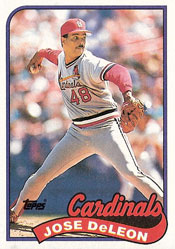
Cardinals starter Jose DeLeon made the run hold up. He limited the Cubs to three hits and struck out 10 in eight innings. In the ninth, Ken Dayley relieved, recorded an out and yielded a single to Damon Berryhill. Todd Worrell came in and retired the next two batters for the save in the Cardinals’ 1-0 victory. Boxscore

“It makes a big difference when the wind is blowing in,” DeLeon said to the Associated Press. “My breaking ball is a lot better when the wind is blowing in.”

Cubs manager Don Zimmer said DeLeon “was outstanding. Over the last two years, he’s the most improved pitcher I’ve seen in the big leagues.”

The next day, June 10, Joe Magrane pitched a complete-game shutout, Tony Pena drove in three runs and St. Louis won, 6-0. Magrane struck out nine, including Ryne Sandberg twice. Boxscore

“I wouldn’t trade (Magrane) for any pitcher in the league, except maybe (Doc) Gooden,” Cardinals manager Whitey Herzog told The Sporting News.

DeLeon (16-12, 3.05 ERA, three shutouts) and Magrane (18-9, 2.91 ERA, three shutouts) had successful seasons for the 1989 Cardinals, but the Cubs won the division title, finishing seven games ahead of St. Louis.

Previously: Cardinals have strong link to Mets’ 50-year anniversary